Maths in Primary School
Including Results of an INTO Survey
Irish National Teachers’ Organisation 35 Parnell Square Dublin 1 Telephone: 01 8047700 Fax: 01 872 2462 Email: [email protected] Web: http://www.into.ie General Secretary: John Carr
Cumann Múinteoirí Éireann 35 Cearnóg Pharnell Baile Atha Cliath 1 Guthán: 01 8047700 Fax: 01 872 2462 Ríomhphost: [email protected] Gréasán: http://www.into.ie Árd Rúnaí: John Carr
Foreword 1
CHAPTER 1
Mathematics in the Primary School
DISCUSSION DOCUMENT FOR THE INTO CONSULTATIVE
CONFERENCE ON EDUCATION, KILKENNY 2004 3
CHAPTER 2
Results of INTO Survey on Mathematics, 2004 21
CHAPTER 3
Report from the Maths Discussion Groups at
INTO Education Conference 2004 39
Bibliography 47
Appendix 1
I
t is generally accepted that mathematics education is an important dimension of a general education. It is perceived as a core area of learning in probably most educa-tion systems throughout the world. However, we may well queseduca-tion how well mathe-matics are taught in the primary school. Ireland has participated in a number of national and international assessments in the area of mathematics, the main findings of which are summarised in this report. Though Ireland performs reasonably well in overall terms, there is no doubt that there is room for improvement, particularly in some aspects of the mathematics programme. The most recent international research, conducted by the OECD among fifteen year old pupils, indicates Ireland’s performance in mathematics to be in the average range. Mathematical questions in real-world contexts were set to assess not only mathematical skills and knowledge but also problem-solving strategies. The evidence from OECD countries shows that the greater the social inclusion in schools the better the pupil performance in mathemat-ics overall. Ireland’s performance in the OECD PISA study (Programme for International Student Assessment) raises issues which warrant further discussion in relation to the approach to teaching mathematics and the content of the curriculum at both primary and second level.The primary maths curriculum of1999 has incorporated a number of concerns
that were identified by the INTO in its previous research on mathematics, and which were raised at the consultative conference on education in1990. It is heartening to
know that many of the recommendations the Education Committee made in1990,
particularly in relation to problem solving, overloading of content, estimation, mental and oral maths and use of mathematical games, have been incorporated into the revised curriculum. Initial responses from teachers to the revised curriculum are included in this report.
Both the Department of Education and Science and the National Council for Curriculum and Assessment carried out evaluations and reviews of the
implementa-tion of the mathematics curriculum in primary schools during the school year
2003-2004. The quality of the mathematics curriculum was found to be good in the
majority of schools. However, a number of issues were identified which require addressing if the teaching of mathematics is to improve further. The INTO calls for additional materials and resources and enhanced opportunities for professional devel-opment for teachers as key elements in supporting mathematics teaching in primary schools.
I would like to acknowledge the work of the INTO Education Committee in preparing this report. It is a further contribution to education research carried out by teachers. The Committee carried out quantitative research, by issuing questionnaires to members seeking their views on the revised Maths curriculum and I would like to thank all the members who completed the questionnaire, which informs this report. I would also like to take this opportunity to thank members of the Head Office team who prepared the report for publication, under the general direction of Deirbhile Nic Craith, Senior Official.
John Carr, MA (Ed) General Secretary
1
Mathematics in the Primary School
Discussion Document circulated for the INTO
Consultative Conference on Education, Kilkenny, 2004.
INTRODUCTION
There is a general acceptance of the importance of mathematics education. It is perceived as a core area of learning in probably most educational systems throughout the world. Indeed many international studies have sought to compare achievement in mathematics between various countries. Its inclusion as a curricular area in schools reflects its value in providing pupils with knowledge, skills and procedures which are necessary tools in understanding the physical environment and in exploring patterns and relationships. Mathematics, though enjoyable and valid in its own right, is also relevant to learning in many other curricular areas.
The INTO, in its report onMathematics in the Primary School(1990) highlighted a number of areas where changes were required in the primary curriculum. Many of the Education Committee’s recommendations, particularly in relation to problem solving, overloading of content, estimation, mental and oral maths and the use of mathematical games have been incorporated into the revised mathematics
programme in the Primary Curriculum (1999). The proposal to develop a
continu-ous curriculum for the compulsory school years, as is common in most European countries, has not materialised, as primary and post-primary curricula tend to be developed separately, an issue which merits addressing by the National Council for Curriculum and Assessment (NCCA). The INTO argued strongly that the needs of pupils in compulsory schooling should not be subordinated by assessment. It was also
argued that the mathematics curriculum should not be designed for pupils who would need applied mathematics for future careers in engineering, accountancy or the sciences, but should instead focus on pupils’ needs in preparation for life as adults capa-ble of dealing with practical mathematics in real-life situations (INTO,1990, p.64). In addition to its economic utility and intrinsic social value, mathematics education is an intellectual pursuit in its own right, a source of fascination, challenge and enjoy-ment, (DES,1999, p.3) and this is reflected in the current mathematics curriculum in primary schools.
It is too early to assess fully the impact of the revised mathematics curriculum.
Teachers were given an opportunity during the school year2003-2004, to review
their implementation of the mathematics curriculum, in addition to the English and Visual Arts curriculum. The NCCA, in order to assist schools with this process, designed review templates. A number of schools were invited to return their templates to the NCCA for inclusion in a general review and evaluation of the curricu-lum. The NCCA has compiled a report arising from the curriculum review process. The Inspectorate, as part of their ongoing work on school evaluation, also considered
the implementation of the mathematics curriculum1. The INTO carried out a survey
of members to ascertain their views in relation to the current mathematics programme, and these findings are included in this report.
Mathematics is recognised as one of the sciences and is used in everyday life. Achievement in mathematics is regularly monitored by both teachers in classrooms as an integral part of the teaching learning process and by the Department of Education and Science (DES), who on behalf of the State, gathers information on the general performance of the educational system. Ireland, therefore, has participated in many international assessments of mathematics learning, in addition to national assess-ments. A brief overview of Ireland’s achievements are included in this report, high-lighting the areas in which Irish pupils achieve well and the areas where Irish pupils achieve poorly by international comparison. Information from such assessments is useful in guiding future curriculum development in mathematics education and in informing the needs of teacher education, both initial teacher education and ongoing professional development.
MATHEMATICS IN THE PRIMARY CURRICULUM
The Primary School Curriculum (1999) contains a number of revisions to the
math-ematics curriculum of 1971. The implementation process for the revised Primary
School Mathematics Curriculum began in September2002 following an inservice
1 The Department’s report ‘An Evaluation of Curriculum Implementation in Primary Schools’ was published in May 2005
programme provided by the Primary Curriculum Support Programme (PCSP). The aims of this curriculum are as follows:
l To develop a positive attitude towards mathematics and an appreciation of both
its practical and its aesthetic aspects.
l To develop problem-solving abilities and a facility for the application of
mathe-matics to everyday life.
l To enable the child to use mathematical language effectively and accurately.
l To enable the child to acquire an understanding of mathematical concepts and
processes to his/her appropriate level of development and ability.
l To enable the child to acquire proficiency in fundamental mathematical skills and
in recalling basic number facts.
(Primary School Curriculum,1999, p.12)
Mathematics should be portrayed to children as being practical and relevant in their everyday lives. It should be integrated with other areas of the curriculum, such as social, environmental and scientific education (SESE), music and physical education. Whenever possible it should be linked to the children’s environment and their own experiences. Through the mathematics curriculum, children are being prepared to deal effectively with the varied transactions of everyday life and to make sense of the mass of information and data available through the media. It is essential, therefore, that children see mathematics as relevant to their own lives. As stated in the teacher guidelines for mathematics, the curriculum will be a key factor in preparing children to meet the demands of the21st century (p.2). Children should enjoy mathematics and be catered for according to their ability. They should look forward to the chal-lenges of mathematics learning and be fully equipped to face them with confidence and enthusiasm in order to experience the satisfaction of a job well done.
There is a great emphasis on children being the instruments of their own learning. The constructivist approach is central to the mathematics programme, where chil-dren must construct their own internal structures. They are encouraged to develop their own mathematical strategies for solving problems by using their knowledge of one area to explore another and enhance their growth of reasoning. Access to concrete materials is considered necessary for pupils at all class levels from infants through to sixth class. Language also plays an important role. Children need to develop the ability to listen, question and discuss as well as to read and record. Discussion can be in pairs, groups or among the class as a whole. The teacher supplies mathematical language when necessary to enable children to build up an appropriate mathematical vocabulary. Concepts need to be adequately developed orally before children record them in writing, using symbols and mathematical expressions.
STRUCTURE OF THE CURRICULUM The curriculum comprises five strands:
l Number.
l Algebra.
l Shape and space.
l Measures.
l Data.
The strands form a network of related and interdependent units which are further developed as strand units. An overview of the strands, and the main differences
intro-duced to the curriculum in1999are outlined below.
Number
A ceiling has been placed on number work to allow for more extensive treatment of the mathematics programme as a whole and to allow more time for concept develop-ment. It places less emphasis than heretofore on long, complex pen-and-paper calcula-tions and a greater emphasis on mental calculacalcula-tions, estimation and problem-solving skills. Recording can be concrete, oral, pictorial or diagrammatic, or can include model-making. Work on fractions and decimals, in general, will place more emphasis on understanding the relationships between them.
Algebra
Algebra has always been part of the curriculum. It includes patterns, sequences and statements such as2+ _ =5. It is, now, formally recognised at all levels. Positive and negative numbers are introduced in senior classes. It is expected that numbers used will be kept small so that the children can understand the concepts presented.
Shape and space
This strand explores spatial awareness and its application to real-life situations. It is particularly suited to integration.
Measures
This strand has six strand units – length, area, weight, capacity, time and money. Problems should be mainly practical with the totals easily verified by measuring. As with the previous curriculum children should be taught from an early age to estimate. Children will need to handle materials, investigate them and then to discuss and
compare their findings. The reasons for using standard measuring instruments should be explored in a practical way.
Data
Graphical representation and interpretation has always been part of the curriculum, but data handling is, now, a separate strand. Interpreting and understanding visual representation is essential, as the child needs to be enabled to interpret data in an increasingly technological world. It is hoped that, where available, information tech-nology will be used by children in data-handling exercises. Children must understand how important it is to enter relevant data and ask clear questions if the information to be extracted from the database is to be of any use. The concept of chance is of great importance. It represents real-life mathematics and promotes thinking and discussion. Topics can be introduced through problems, practical experiments and simulations that help to develop intuitive foundations for future work and are fun for the child.
Linkage
Strands can be taught in parallel rather than one after the other. Children will use their knowledge of one area to explore another. This facilitates the use of number through-out the mathematics curriculum.
Calculators
Calculators have been introduced to schools for the first time from fourth to sixth classes. They help the development of problem-solving skills by allowing the child to focus on the structure of a problem and possible means of solution. They can be used to check estimates, to perform long and complex computations and to provide exact results to difficult problems. However, the calculator cannot be a substitute for practi-cal activity with materials.
Assessment
Assessment should provide information that will enable the teacher to cater for indi-vidual differences in ability, to assess previous learning, to address learning styles, and to resist pressure to push the child to premature mechanical mastery of computational facts and procedures.
ALTERNATIVE APPROACHES TO TEACHING MATHEMATICS In addition to traditional approaches to the teaching of mathematics, a variety of alternative approaches are used by teachers to support the teaching and learning of mathematics – a selection of which are outlined below.
The Mathematics Recovery Programme
The Mathematics Recovery Programme draws on research into the learning and teaching of early mathematics undertaken by Professor Leslie Steffe and his colleagues at the University of Georgia in the US and by Professor Bob Wright who worked with him as a doctoral student. Research has shown that there are already vast differences in the mathematical knowledge of students when they begin school
initially (Aubrey,1993; Young-Loveridge,1989; Wright,1991,1994). This gap
tends to remain and increase throughout their schooling. Strong negative attitudes to mathematics can develop along the way. The Mathematics Recovery Programme is directed towards early intervention.
ASSESSMENT
Children are assessed by way of an ‘Interview Schedule’. This is an oral assessment seeking to find out what the child knows, what strategies, if any, s/he is using and getting to the core of the concept problem. The assessment is concerned, primarily, with number, addressing the following topics
l facility with number words and number word sequences;
l ability to recognise, identify and write numerals;
l emerging strategies for adding and subtraction;
l knowledge of the tens and units aspect of the numeration system;
l emerging methods of notating in arithmetic; and
l ability to ascribe number to spatial and temporal patterns.
FOCUS AND KEY FEATURES OF PROGRAMME
The focus of the programme is to identify low-attaining students at an early stage and, subsequently, to provide a programme of intensive, individualised teaching. The aim of the programme is to raise the student to a level where s/he can return and learn successfully in the mainstream class. Instruction takes place on a one-to-one basis and in conjunction with the class teacher.
The ‘Interview Schedule’ (ie, the assessment that is done) is used to develop an indi-vidual teaching framework for each student involved in the Mathematics Recovery Programme. The programme deals with early number - counting on/back, counting in 2s, 3s and so on, counting in tens for place value, visualising and manipulating number. The instruction is problem-based and from a constructivist perspective. It is mainly oral – extending the child’s current thinking. It should be challenging but with a good possibility of success, thus, increasing self-esteem. Children are encouraged to reflect on their own mathematical thinking.
The programme involves teaching cycles of 10-15weeks duration. Students are
taught for30minutes daily, four or five days a week. In Ireland, at present, learning support and special needs resource teachers are using the programme. Those partici-pating in the programme are finding it very successful. There is great demand for the limited number of in-service places available. Pilot projects, supported by the Department of Education and Science, are planned for a number of schools in Limerick.
Regrouping for Mathematics
Regrouping is a form of grouping where children remain in their normal teaching unit for most of the day and are assigned to groups, according to ability, for certain subjects eg, mathematics. Assignment to groups is made on the basis of actual performance in the subject and there is mobility between levels so that students can move from one to another according to their achievements. Instruction is adapted to the specific needs of the students.
There are many advantages to grouping children according to ability. For example, there is a greater challenge to brighter students as they can progress faster and children with difficulties in learning mathematics will gain more confidence and perform better if the class work is aimed at their level. In addition, teachers may find it easier and more productive working with groups of children of similar ability. There are various forms of grouping – mixed-ability grouping where children of different abili-ties are placed in the one class and streaming, where children are placed in classes according to ability. With regrouping children spend most of the day in a mixed-abil-ity setting and are regrouped for certain subjects such as mathematics. Therefore, the original class remains the primary reference group.
Lyons (1999) in her research on regrouping sought “to ascertain whether a
regrouping system for mathematics at fifth and sixth class level contributed to the development of a more positive attitude towards mathematics and an increased level of confidence in approaching study of the subject”. For the purpose of her research she chose an all-girls, largely middle-class, convent school situated in an expanding urban area. There were three classes of each level from second class upwards. The
system of regrouping pupils of both fifth and sixth classes for mathematics had been in operation in the school for the previous five years. Teachers of the fifth and sixth classes moved from one maths group to another each term. Pupils were not told the ability level to which they were assigned although it became clear in the course of the study that they succeeded in working that out for themselves. The three mixed-ability classes in both fifth and sixth were regrouped according to ability – TOP MIDDLE WEAK – for the teaching of mathematics. For the purpose of the investigation pupils were chosen at random from each level and both pupils and their parents were inter-viewed.
RESULTS OF INVESTIGATION
Almost all pupils were happy with their placement and understood the importance of ability as a criterion for the formation of the groups, and that they were being regrouped in an effort to assist them. The majority of the students understood that it was possible to change groups. A minority in the weak-ability group did not seem to be aware of this, possibly, because flexibility only existed in this particular study between high-ability and medium-ability groups. According to Lyons, it is very important that those in the weak ability group are aware of the possibility of upward mobility.
The majority of pupils and parents from sixth class were quite happy changing teachers for instruction during the year, whereas, on the whole, they were unhappy with this arrangement in fifth class.
There were more children in sixth class than in fifth class who rated mathematics among their favourite subjects, leading to the conclusion that the overall attitude towards the subject was becoming more positive since regrouping. Half of fifth class compared to87.5% of sixth considered the work easier than the previous year. Most of sixth class pupils commented that learning mathematics was more enjoyable and over half of fifth class reported an improved attitude. These comments were generally supported by the parents of both classes.
Pupils and parents, alike, from both fifth and sixth classes were agreed on the posi-tive effects of regrouping on the nightly ritual of homework. This was most evident in the weaker ability pupils. It was thought that “the relatively new feelings of success for weaker ability students would, hopefully, help to break the cycle of repeated failure and lead to an increase in confidence and improved attitude towards maths”. The majority of pupils and parents from both fifth and sixth classes considered that their confidence in approaching mathematics had increased and no child reported a reduc-tion in confidence levels.
Pupils in the middle and weaker groups were more sensitive to comments made about placements. Those in fifth class were more affected than those in sixth class. It was perceived by the author that by the time pupils reached sixth class, having been in the system for a year, they generally tended to accept the process as the norm and,
therefore, major discussion concerning it ceased. The majority of the parents and pupils of both fifth and sixth expressed a preference for continuing with the practice of regrouping.
A regrouping system in any school would need to be continuously monitored and evaluated. The focus of the system is on the development of confidence and the growth of a more positive attitude towards the subject. The correct assignment of pupils to the different groups is essential, and such assignments must be flexible. There is a need also to outline the philosophy underlying the system to both pupils and their parents when introduced initially. According to Lyons “a regrouping programme may offer pupils the support to develop mathematical skills at their own pace, to experience success where they had previously known only failure and to work at an appropriate individual level”.
Parental Involvement in Maths in Primary School
(A) SHARED MATHS / MATHS FOR FUN
Shared Maths/Maths for Fun is a teaching strategy where parents are involved in the classroom. The children in the class are divided into groups. One parent works with each group for a period of40minutes. The equipment is stored in crates, baskets or boxes. The groups move from one game/activity to another. A timer is set to buzz
after10minutes signalling the end. Children tidy up before moving on to the next
game/activity. To encourage ease of movement and a low noise level Merit Stickers may be given to groups who leave everything in its place and move quietly from table to table. The group with the highest number of stickers (every group!) receive a Maths Bookmark at the end of the session, which lasts six weeks. Suggested games and activ-ities include: Tangrams; Relational Attribute Blocks; Pattern Blocks; Pentominoes; BINGO; Bank Balance; Snakes And Ladders; Dienes Blocks; My Computer and Time Games. See Appendix 1 for a description.
(B) PAIRED MATHS
Paired Maths is where parents are involved in playing mathematically-based games with their children at home. The parents of the children involved attend a school-based meeting. They are given instruction on how the system works. Each child in the class will be given a game to take home for a period of one week. The whole process lasts six weeks.
ASSESSMENTS OF MATHEMATICAL ACHIEVEMENT
Irish primary schools have participated in a small number of national and interna-tional assessments of mathematics achievement since the introduction of Curaclam na Bunscoile (DES1971). Ireland has also participated in international assessments at second-level. This section of the report highlights the main findings of both national and international assessment in relation to mathematics, in addition to giving an overview of the main findings of a recent study on mathematics teaching and learning at junior cycle at second level. The latter study raises some issues of relevance regard-ing the approach to mathematics teachregard-ing at primary level.
National Assessments
The Department of Education tested a national sample of second and fourth classes in
1977 and sixth classes in 1979. Sixth classes were retested in 1984 and reports
were issued by the DES in1977,1980and1985.
The tests for second and fourth classes included items in seven content areas: Operations with Whole Numbers, Whole Number Structure, Measurement,
Fractions and Decimals, Geometry, Graphs and Problems. At second class level,85%
achieved mastery in Operations with Whole Numbers and55% to 65% achieved
mastery over six content areas. Items which caused most problems at second class related to subtraction and the commutative and distributive properties of addition. Girls slightly outperformed boys in all areas with a marked difference on a few items. At fourth class, mastery levels were lower across the board with75% mastery at
Operations with Whole Numbers and a40% -60% range in the other areas. Items of
Unitary method, adding and subtracting decimals, interpreting graphs and timetables, problems, relating fractions and decimals, symmetry, perimeter and long division all achieved less than50% mastery. Again girls outperformed boys in most areas of the tests.
The achievement tests for sixth classes covered10content areas in mathematics: Operations with Whole Numbers, Whole Number Structures, Fractional Number Structure, Operations with Fractions, Decimals and Percentages, Metric Measure, Algebra, Geometry, Charts and Graphs and Problems. Geometry, Measurement, Problem Solving, Whole Number Structure and Algebra were the areas of lowest mastery and boys, on average, outperformed girls.
In 1999, the Educational Research Centre (ERC) tested national mathematical
achievement in 4th classes in 5 areas: Number, Algebra, Shape and Space, Measures and Data. These correspond to the strand units in the Revised Primary School
Curriculum (NCCA1999). Pupils performed best on Data (69% correct), Number
(46%). No significant gender differences arose but a much higher proportion of boys scored at or below the 10th percentile.
International Assessments
Ireland took part in a number of international surveys of mathematical achievement
since the introduction of the 1971 Primary School Curriculum. The Second
International Mathematics Study (SIMS) in1980-82 targeted13year olds, some in
sixth class and some in first year, at post-primary level. The International Assessment
of Educational Progress (IAEP) conducted studies of13year olds in1988and both
nine year olds and13year olds in1991. The Third International Maths and Science
Study (TIMSS) took place in1995 and targeted third and fourth classes in primary
schools and first and second year pupils in post-primary schools.
IAEP I (1988)
IAEP I (1988) carried out tests in five countries: Ireland, UK, USA, Korea, Spain and seven Canadian Provinces, in six content areas: Number and Operations; Algebra; Relation and Functions; Geometry; Measurement; Data Organisation and Interpretation and Logic and Problem Solving. Ireland, UK, Spain and French Canadians performed at the mean level of all participants. English Canadians performed above the mean, while Korea achieved well above the mean. The USA performed below the mean. Ireland scored particularly badly in Data Organisation and Interpretation and relatively badly in Geometry and Measurement. The remain-ing three areas showed a much stronger performance. No significant gender differ-ences were reported. However, a correlation between a greater amount of time spent watching television and a lower maths achievement score was noted.
IAEP II (1991)
IAEP II (1991) tested20countries for13year olds and14countries for nine year olds. The international average for13year olds was58% and Ireland scored61%. At
nine year old level, the average score was63% and Ireland’s mean score was60%.
IAEP II covered five content areas: Number and Operations; Measurement; Geometry; Data Analysis; Statistics and Probability; and Algebra and Functions. Ireland scored significantly below the mean in both geometry and measurement and at about the mean in the other areas. Girls scored higher than boys in third and fourth
classes but not
significantly higher.
TIMSS (1995)
13year olds. The average score for the older age group was484for first year students and513for second year students. The Irish pupils scored500for first year students
and527for second year students. In third class the international average was470
and Irish pupils scored476. In fourth class Ireland scored550over a mean score of
529.
The TIMSS (1995) tested six content areas: Whole Numbers; Fractions and
Proportionality, Measure, Estimation and Number Sense, Data Representation, Analysis and Probability, Geometry and Patterns, Relationships and Functions. Pupils in 4th class scored at the mean in two areas: Measure, Estimation and Number Sense and Geometry. They scored significantly above the mean in the other four areas.
No significant differences showed up between boys and girls. Fourth class pupils
reporting more than 100 books at home scored significantly higher than those
reporting less than25books and fourth class pupils reporting a positive attitude to maths scored significantly higher than those who did not. Irish pupils in smaller classes scored higher than those in larger classes but not significant so.
PISA 2000
The OECD Programme for International Student Assessment (PISA) assesses the knowledge and skills achieved by students near the end of compulsory schooling (ie,
15year olds). In PISA2000 Ireland scored just above the country average of 500
(502.9). Boys scored significantly higher than girls at this age which correlated with that of most other countries tested. The number of books in the home was noted as an
indicator of success in maths achievement.
PISA 2003
PISA 2003 focused on mathematics and two reports were published – Learning for
Tomorrow’s WorldandProblem Solving for Tomorrow’s World.
Mathematics was assessed in four domains, Shape and Space, Change and Relationships, Quantity and Uncertainty. Mathematical questions in real-world contexts were set to assess not only mathematical skills and knowledge but also prob-lem-solving strategies. Ireland finished within the OECD average range and17th out of the29 countries taking part. In the domains assessed, Ireland was significantly above the average in both Uncertainty and Change and Relationships; was on the aver-age for Quantity, and below averaver-age for Shape and Space.
Males outscored females in all four domains of mathematics assessed but the over-all difference was not large except inShape andSpacewhich was significant. These results seem at variance with Junior Certificate results in Ireland where females consis-tently outperform male students. The types of real-world problems posed in the PISA
amongst Irish students showed a more positive attitude to mathematics as a factor for improving education and life skills than the OECD average.
In relation to variation between both students and schools, PISA found that Ireland had one of the lowest ranges of student performance variation amongst OECD coun-tries. Low achievers in Ireland performed stronger than many OECD countries but conversely high achievers did not perform as well as their counterparts. PISA also reported that Ireland is one of the few countries with little performance differences between schools. This prompted the remark that “parents can be confident of high and consistent performance standards across schools in the entire education system.” The variation of performance between schools and between students, although small, was best explained by socio-economic factors.
The initial recommendations of the PISA2003 Report relate to the education
system and schools rather than pupils. The evidence from OECD countries shows that the greater the social inclusion in schools the better the pupil performance in mathe-matics overall. The first recommendation, therefore, is to develop social inclusion in schools across the education system. Since there is little variation in pupil performance between schools, the second recommendation is that policies aimed at improving the performance of low achievers are likely to be the most effective.
PISA2003also included a section on cross-curricular problem solving which again placed Ireland within the OECD average similar to that achieved in general maths
performance. A small portion of PISA 2003 was also given over to reading and
science. First indicators were that Ireland was well above the OECD average in read-ing with only three countries scorread-ing higher than Ireland. In science, Ireland was again well above the OECD average but still some way behind the highest rated countries. PISA2006will be a major assessment of science in the OECD. The full data for PISA
2003 remains to be completely interpreted and further reports will be produced in
due course.
Summary
Ireland has consistently scored at about or just above the mean in the international studies in which it has participated. Items relating to number and data have been the most successful, while those relating to geometry, measurement and algebra have been less so. Little or no difference between the performance of boys and girls was detected except at15year old level (PISA2000). Pupils’ attitude to mathematics and socio-economic backgrounds seems to have some significance relating to mathemati-cal achievement.
JUNIOR CYCLE MATHEMATICS IN POST PRIMARY SCHOOLS
The Gender Equality Committee of the Department of Education and Science initi-ated and funded a study reliniti-ated to Junior Certificate Maths. The study is based on
Exam Results (1992-1996) and case studies of ten different second-level schools
around the country. With the co-operation of teachers and students an intensive video study of twenty mathematics lessons and six English lessons involving second year students was undertaken. The video studies were complemented by interviews with students, teachers and parents in order to examine the relationship between teaching practices and attitudes to learning.
The study was designed to explore co-educational and single-sex schools across different types of school background to gain understanding about pedagogical styles and priorities and their impact on the teaching and learning of mathematics. The impact of gender and social class on outcomes was a related objective.
The study outlined two epistemological approaches to mathematics teaching. These contrasting perspectives are the absolutist and the relativist. The former is objective, consistent and knowledge based and favours a didactic approach to trans-mission. The latter is based on interaction between individuals, society and knowledge and is culturally situated. This lends itself more to problem based and constructivist learning.
Second-level teachers, who are preparing students for public examinations, are inclined to favour didactic teaching where it is known to be rewarded with good exam-ination results. In preparation for the main video study, an analysis of Junior
Certificate Mathematics examination results for1992 — 1996 was carried out.
Students have a choice between three levels: Foundation, Ordinary and Higher. The uptake of each level is approximately in the ratio1:3:2respectively. Mathematics has a low take-up at the Higher level (36%) in comparison to Irish (40%) and English (61%). It is conjectured that this may relate to a static syllabus that is perceived to be difficult.
Gender differences vary widely with regard to type of school and social back-ground. Girls in general tend to reject maths or under perform in maths more and this is more pronounced in disadvantaged schools. However, it is shown that this cannot be explained by teaching or school-specific variables alone. The wider socio-cultural context where gender identities are created and reinforced is the prevailing basis for gender differences in both participation and performance. However, the number of girls taking Higher level papers has risen significantly over the last fifteen years.
Where major differences exist in performance they are, increasingly, linked to social class background rather than gender. It would appear that differences in take-up rates of different levels of mathematics between co-educational and single-sex schools is
not so much related to their coeducational status as it is to the social class composition of their school population and the tradition of the school. The schools with the most disadvantaged students are the ones in which there is the highest take-up of Foundation and Ordinary levels. The most socially selective schools, fee-paying secondary, have the highest take-up rates at Higher level. The analysis also suggests that teacher expecta-tions and perspectives on students were influenced by the students’ social class and background. The track, set, stream or band into which a student is placed influences his/her experience of learning mathematics. Top tracks experience a more intense, work-focused and competitive learning environment than the lower tracks.
Review of Case Studies
There was a high level of uniformity in how the lessons were organised and presented. The didactic approach, teacher demonstration and student practice, was the preferred choice of teachers. Learning was most often equated with the memorisation of formulae and procedures. There was little time devoted to problem-solving, to the practical application of mathematics in the physical world or to alternative methods of solving problems. Teachers were more likely to use lower-level and drill questioning with the emphasis on giving the ‘right’ answer. It was clear from the video that students were not encouraged to ask questions. Interaction was for the most part
teacher-initiated with only 4% student-initiated. In general, boys received more
teacher attention than girls did. The classes that were most gender-balanced were those in which the teachers were gender aware. There was a tendency for a small number of boys to dominate classes in both coeducational and in single-sex boys’ schools. Praise was limited, although girls in all types of classes received somewhat more praise than boys did.
Teachers’ Perspectives
Teachers, generally, attributed students’ improvements to having an innate ability and to being encouraged and supported by the teacher. They did not hold themselves responsible for any observed deterioration in students’ performance. Students’ own attitudes, behaviour or lack of ability were deemed to be the main reasons. All of the teachers adhered to the essentialist view about mathematical ability ie, that some students have a natural talent for the subject while others do not. Six of the ten teach-ers claimed that students from “poor” backgrounds were disadvantaged in learning mathematics by their parents’ lack of knowledge of, and especially interest in, educa-tion. Most of the teachers assigned homework in each lesson and corrected it in the next. A number of teachers observed that certain students entered second level schools educationally disadvantaged in mathematics, raising questions as to why this
was the case, and why the problems had not been addressed at primary level.
Student Perspectives
For pupils, mathematics, as a subject, seemed to be defined and interpreted in terms of the person who taught it. They rejected the essentialist view of mathematics (innate ability). Pupils were more likely to state that what was required for success in school mathematics was having a good teacher and studying at home. They also thought that good memorisation was important but not necessarily “learning the text book by heart”. They were quite positive about the value and importance of mathematics required for everyday life, for employment and for further education purposes. They recognised it as an important subject that had both a short and long term value. However, the study also highlighted that students were reluctant, even fearful, to ask for help in mathematics class. In discussing their experience of learning mathematics throughout their primary and post-primary education, students said they, generally, preferred to ask their parents and/or other siblings for help at home or, alternatively, to ask one of their friends or classmates. Students spoke about finding it “unnerving” when questioned in class and feeling under pressure to “get it right”. For students, teacher attitudes appear to have a big bearing on outcomes. Students related their atti-tudes to mathematics in terms of their teacher. If the teacher was perceived as positive and supportive, they were labelled “good”. Teachers were criticised for being negative or “going too fast”.
Parent Perspectives
Parents from all types of social backgrounds held the essentialist view on children’s “innate ability” for successful learning in mathematics. While very few parents actively avoided co-educational schools there were those who actively chose single-sex schools as these were reported to be strong academically and/or were prestigious because of their socially selective intake. Parental expectations were a significant influ-ence on student/teacher attitudes and performance.
Possible Implications for Primary School Maths Teaching
As evidenced from the above study, didactic teaching is the norm at second level. However, while constructivist teaching is the basis of the revised primary curriculum (1999) and was also implicit in the1971 curriculum, there is still a lot of didactic teaching at primary level. If primary teaching in the future evolves to a constructivist approach as is envisaged, the students should be transferring to second level with greater knowledge and more positive attitudes to mathematics. However, they may
well be less suitably equipped to cope with a didactic approach, if such practices remain at second level.
Students are often streamed at entry to second-level. Students who leave primary with low attainment levels, irrespective of ability, will be unable to enter the higher streams at second level. This raises the question of the quality of mathematics educa-tion at primary level. Disadvantaged schools and disadvantaged students are being discriminated against both socially and educationally. In second level schools where streaming takes place, there is no real mechanism for the disadvantaged pupil to change streams. This places a burden on primary level to bring children to a suffi-ciently high level to give them the option to enter the highest stream on entry to second level.
Gender differences are small in comparison to social differences. Parental values and student and teacher attitudes have a major effect on mathematics achievements. Attitudes to mathematics and resulting teaching styles and practices at primary level need to be tailored to develop support and positiveness towards mathematics and to reduce pupil anxiety. Parents also need to be informed about how the system works as well as encouraged to develop positive attitudes to mathematics and education in general.
Student attitudes appear to be very dependent on their concept of what a ‘good’ teacher is, in that teaching styles that incorporate positive reinforcement, supportive and steady progress through topics and an emphasis on ‘anxiety-free’ environments need to be encouraged for maximum effect. Teachers also need to be aware of gender differences between boys and girls and also between dominant and non-dominant boys in making classes more inclusive for all students.
2
Results of INTO Survey on
Mathematics (2004)
INTRODUCTION
The Education Committee of INTO conducted a national survey on the teaching of
mathematics in the primary school in March2004. A total of505(51%)
question-naires were returned and processed. Where responses were made by all or most partic-ipants, results are given in percentages. Questions that required opinions or a variety of responses are reported by giving the actual number of teacher replies. It was decided to include some opinions that were expressed by relatively few respondents since they provide additional information and illustrate practice in some instances.
School Details
Surveys were returned from505teachers of whom20% taught infant classes,15%
taught junior classes,20% were in middle classes and24% were in senior classes. The
remaining20% taught in multiclasses. Respondents reported that23% were in one
to four teacher schools,44% were in five to16 teacher schools and33% were in
larger schools. Describing their location, 32% of teachers said they were in rural schools, while 35% were in small towns and29% were in city schools. Three-quarters of teachers replying taught in co-educational schools,13% taught in boys’ schools
and 10% taught in girls’ schools. One-quarter of respondents were working in
schools designated disadvantaged and 6% were teaching through the medium of
Irish. Teachers reported a variety of class sizes. One-tenth of teachers had classes of up
to15pupils, one-fifth had16-20pupils, one-quarter had21-25pupils, one-third
had26-30pupils and one-eighth taught classes of over30pupils.
Learning Support
reported that their schools provided LSM, while39% teachers reported that they did not. However, relatively little time out of total learning support time is allocated to maths by most of those schools providing LSM. In total 184 (36%) teachers reported children in their classes receiving LSM, as follows:
Table 1: Numbers of Pupils per Class receiving LSM/Number of Teachers with Pupils receiving LSM
When respondents were asked how many should be receiving LSM, they reported as follows:48% felt up to 4 pupils needed LSM, 31% reported five to eight pupils in need and6% felt even more pupils required assistance. A total of 218(43%) teach-ers reported that children received support in maths from the special needs resource teacher. Eighty six teachers reported one such pupil,63teachers had two pupils,31
had three pupils,20had four pupils and17had more than four pupils receiving such help.
Details of Respondents
Four-fifths of respondents were female and one-fifth of respondents were male, which corresponds with the general representation of male and female teachers in the
profes-sion. Only 16% of respondents had mathematics as a degree subject while 82%
reported that they had not. Regarding the number of years spent teaching,31% had
less than10years teaching experience,23% had11-20years experience,29% had
21-30years experience and18% had more than30years experience as a teacher.
Professional Development /Inservice
Apart from PCSP inservice seminars in Mathematics Teaching,30% had attended
Number of Pupils in Class Number of teachers who reported
receiving Learning Support pupils in their class receiving
in Maths learning support in Maths
1 pupil 34 teachers 2 pupils 42 teachers 3 pupils 35 teachers 4 pupils 29 teachers 5 pupils 21 teachers 6 pupils 13 teachers
INTO Maths courses and22% had attended Education Centre Maths courses. A small
number had attended other Maths courses, while25% reported not having attended
any other inservice courses. Three-fifths of teachers reported that their school had availed of the cuiditheoireacht service for Mathematics, while one-third had not.
TEACHING AND LEARNING MATHEMATICS
Mathematical Activities
Teachers were asked how often they used six different mathematical activities. The
results are outlined in Table2 below. There was liberal use of estimation, mental
maths, memorisation and problem solving, especially in the older classes. However, less than one-fifth made much use of alternative algorithms or computerised proce-dures, and this was mostly in the senior classes.
Table 2: How often teach-ers used six differ-ent math- emati-cal activities Teaching Methodologies
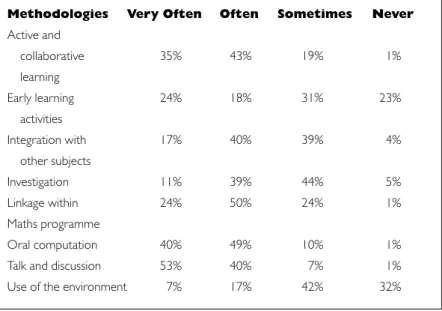
Teachers indicated how often they used eight particular teaching methodologies in
mathematics. The results are outlined in Table3below. The environment was
regu-larly used by less than one-fifth of respondents but its most frequent use was in infant classes. Active and collaborative learning, talk and discussion, oral computation and linkage within the maths programme were very frequently used by teachers. Integration and investigation were also used frequently. Integration was practised twice as often in infant classes as in more senior classes. As expected, early learning activities
Methodologies Very Often Often Sometimes Never
Alternative 4% 16% 27.6% 33.0% algorithms Computerised 4% 12% 41.8% 38.8% procedures Estimation 25% 48% 21.0% 0.8% Memorisation of 33% 37% 20.0% 7.0% facts/formulae Mental maths 48% 40% 10.6% 1.4% Problem solving 35% 51% 12.2% 1.4%
are reported mostly in infant classes with some continuity into first and second classes.
Activity learning was also reported as slightly more frequent in infant classes.
Table 3: How often teachers used eight teaching methodologies in mathematics
Teaching Resources
Teachers reported their use of teaching resources. Table 4 below outlines their
responses. Textbooks, resource books and concrete materials were the most used resources. Maths games were also used quite often. ICT games and programmes and calculators were the least used resources.
Methodologies Very Often Often Sometimes Never
Active and collaborative 35% 43% 19% 1% learning Early learning 24% 18% 31% 23% activities Integration with 17% 40% 39% 4% other subjects Investigation 11% 39% 44% 5% Linkage within 24% 50% 24% 1% Maths programme Oral computation 40% 49% 10% 1%
Talk and discussion 53% 40% 7% 1%
Use of the environment 7% 17% 42% 32%
Resources Very Often Often Sometimes Never
Calculators 6% 18% 21% 53% Concrete materials 41% 38% 20% 1% ICT games 5% 13% 29% 52% ICT programmes 8% 17% 45% 30% Maths games 12% 30% 51% 8% Resource books 30% 42% 24% 5% Textbooks 74% 21% 3% 2%
Table 4: How often respondents report using teaching resources
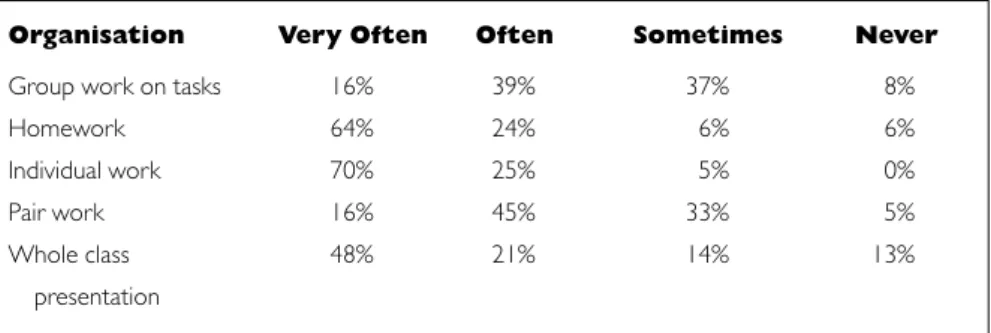
Organisation Very Often Often Sometimes Never
Group work on tasks 16% 39% 37% 8%
Homework 64% 24% 6% 6%
Individual work 70% 25% 5% 0%
Pair work 16% 45% 33% 5%
Whole class 48% 21% 14% 13%
Organisational Structures in Mathematics
Teachers were asked how often they used five organisational structures in the maths classroom. Their responses are outlined in Table 5 below. Group work and paired work were used quite often, but homework, individual work and whole class presen-tation were the most frequently used.
Table 5: How often teachers used five organisational structures in mathematics
Textbooks
Two-thirds of teachers reported that schools were using one particular textbook series throughout the school. Ten different texts were in use. Among reasons given by the one-third not using one textbook were – series not complete yet, undecided which series to choose, preference for a variety of texts or unavailability of Irish texts. Almost half of the respondents use workbooks and more than a quarter use additional text-books to provide supplementary mathematics material.
ICT and
Calculators
A small number of respondents use ICT for specific areas of mathematics. Some71
teachers use computers for tables drills and practice,21teachers use ICT for graphs
and logo activities, while27use ICT for problem solving. However, as many as315
(62%) teachers use a variety of commercial games packages that cover wider aspects of the curriculum.
Reporting on the success of the introduction of calculators in teaching and learning
mathematics,9% of teachers said that the use of calculators was very successful,
30% said it was successful, 29% reported moderate success and6% said the
intro-Materials Percentage of teachers citing
availability of materials
Unifix cubes 51%
Sorting materials 62%
Counting equipment 45%
Place value materials 43%
Fraction/decimal/ 27% percentage materials Measure (length) 64% Measure (weight) 35% Measure (capacity) 22% Measure (time) 38%
duction of the use of calculators was not successful. A total of92teachers said that
they use calculators for number operations,86use them for estimation and45use
them for money, percentages and place value. Some32respondents reported using
calculators for checking answers, while another38use them for maths games. Only
15respondents use calculators for exploring patterns and sequences, while six make use of them for problem solving and three teachers use calculators for supporting weaker pupils. Most of the take-up on the use of calculators was reported in fifth and sixth class. However, even in these classes, only50% of respondents use calculators often or very often.
Materials and Equipment
Respondents reported that Shape and Space was the strand of the curriculum best
supported by concrete materials. The majority (79%) of teachers had some form of
suitable materials available, although only15% had access to large geometric equip-ment. Early Mathematical Activities and Number were also fairly well supported by available concrete materials. A variety of equipment was cited by teachers as outlined in the following table:
Table 6: Materials used by teachers
Algebra and Data were poorly represented in the survey with little or no equipment cited to support these strands.
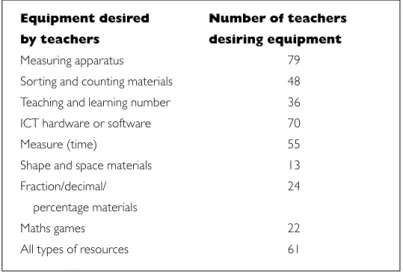
Teachers were asked what types of maths materials they would like in their class-rooms. Additional equipment desired by teachers is outlined in the following table.
Equipment desired Number of teachers
by teachers desiring equipment
Measuring apparatus 79
Sorting and counting materials 48
Teaching and learning number 36
ICT hardware or software 70
Measure (time) 55
Shape and space materials 13
Fraction/decimal/ 24
percentage materials
Maths games 22
Types of Questioning Very Often Often Sometimes Never Discussion/ Higher order 37% 47% 15% 1% Drills/Fast paced review 26% 44% 24% 6% Recitation/Activity 25% 46% 25% 4%
Seeking Assistance Very Often Often Sometimes Never
From peers 15% 44% 37% 2%
From teachers 63% 35% 3% 0%
Table 7: Equipment desired by teachers The chal-lenges faced by teachers in using maths materi-als in the class-room were predom-inantly
organi-sational. A total of 176teachers reported problems with storage, maintenance and
retention of materials;152 stated that large classes, supervision, explanation, suit-ability and divergence of abilities were problematic in using equipment and58 teach-ers cited lack of resources and lack of space as detrimental to the use of materials.
Classroom Interaction
Regarding the percentage of classroom interaction that is pupil led,45% reported
that less than25% of classroom interaction was pupil led,36% said that such
inter-action ranged between26% -50% and only15% stated that pupil led interaction
was greater than50%. Almost identical results were recorded for the percentage of questioning initiated by pupils –54% reported that less than25% of questioning was
pupil led,32% reported that between26% and50% of questioning was pupil led,
and only 11% stated that pupil questioning was greater than 50%. Only 2% of
respondents stated that
children were not encouraged to ask questions related to maths topics, while98%
stated that they were. Regarding frequency,41% were encouraged to ask questions
very often,42% were often encouraged and15% were sometimes encouraged.
Respondents were asked about the frequency of three types of teacher questioning in the classroom. Their responses are outlined in Table8below. It is clear from the table that teachers are slightly more likely to use discussion and higher order ques-tions.
Indicators for Success Indicators of Limited Progress
Intelligence innate ability
Innate ability intelligence
Pupil effort pupil attitude
Pupil attitude pupil effort
Teaching methodologies pupil self-esteem
Pupil self-esteem teaching methodologies
Pupil behaviour pupil behaviour
Resources parental attitude
Parental attitude parental involvement
Parental involvement resources
Social class social class
Table 8: The frequency of types of teacher questioning in the classroom
Assistance
Respondents were asked from where did their pupils seek assistance in mathematics. It is evident from the table below that pupils were most likely to seek assistance from their teacher.
Table 9: Teacher opinion as to where pupils seek assistance in mathematics
Indicators for Successful Learning in Mathematics
Teachers were asked to rank twelve indicators for successful learning in mathematics. Respondents then placed the same indicators in order of significance in relation to
making limited progress in mathematics. The results are outlined in Table10next
page. It should be noted that the rankings reflect similar opinions between indicators for success or failure. However, while their opinions show a clear pattern, there was relatively little difference overall in teachers’ preferences between the highest and lowest ranked indicators. A handful of opinions separate each indicator in the ranking tables, although there was a clearer gap between the top and bottom of each table.
Challenges Posed Number of Respondents
Measures 47 Algebra 41 Decimals 22 Time 17 Number 9 Fractions 7
Shape and Space 7
Place Value 6 Estimation 5 Patterns 5 Probability 4 Subtraction 4 Problem Solving 3 Tables 3 Language 1
Table 10: Indicators for successful learning and for limited progress in Maths
Teachers’ opinions on reasons for constant failure at maths by some children were elicited. Two fifths (40%) of respondents blamed failure on lack of interest, lack of attention and lack of effort;18% felt it was due to lack of ability and poor intelligence.
Another14% of teachers considered poor early learning experiences due to lack of
concrete materials and too little oral work had failed to lay a good foundation. A small
minority (4%) put it down to curriculum overload or to lack of parental support
(37%). Only3% of teachers blamed a lack of self-esteem for constant failure, while large classes and lack of individual attention were blamed by4% of respondents.
Relating to the ability of children, two-thirds of teachers expressed the view that catering to the average was most important in teaching mathematics. Almost one-quarter felt that devoting time to low ability children was most pressing, while only one in twenty considered providing for high ability children as paramount. Responses to the query on which of these three groups consume most time during maths lessons, elicited almost identical results.
Problem Solving
A large majority of teachers (83%) reported that they present many methods to
children for the solving of problems. Only14% of teachers concentrate on using only
one method for problem solving. A resounding 93% of teachers responded that
children are encouraged to develop their own methods of problem solving and92%
reported that they encourage pupils to think creatively and that children were encour-aged to provide reasons for their conclusions. The largest majority (96%) encourage the children to use mathematics in everyday life.
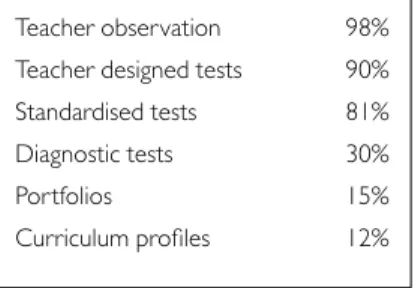
Teacher observation 98%
Teacher designed tests 90%
Standardised tests 81%
Diagnostic tests 30%
Portfolios 15%
Curriculum profiles 12%
Junior/Senior Infants 1st/2nd class 3rd/4th class 5th/6th class Multiclass
CURRICULUM AND ASSESSMENT
Curricular Changes
Teachers were asked what aspects of the new strands of the mathematics curriculum posed particular challenges for them. A small number reported the following prob-lems as outlined in Table11below.
Table 11:The challenges posed to teachers by the revised curriculum.
However,56teachers stated that it was too early to assess the impact of the revised
curriculum in the classroom to date. Three fifths (61%) of the teachers who
responded were happy with content changes in the mathematics curriculum. They welcomed the emphasis on problem solving and relevance to everyday life, as well as the opportunity to revitalise their approaches and methodologies. Though,17% felt there was little if any real change in content, a significant minority of respondents,
9%, expressed the view that changes were detrimental to the curriculum, citing poor texts in maths and a possible lowering of standards.
Assessment
Teachers were asked what forms of assessment they used in mathematics. Their responses are outlined in Table12below.
Table 12: The forms of assessment used by teachers in mathematics
When analysed by class level, it emerges that over90% of teachers use standard-ised tests in senior classes, as evident in Table13below.
Table 13: Use of Standardised Tests
Two thirds of teachers expressed satisfaction with the assessment resources and materials available to them. The other third were not satisfied. When asked what influence assessment had on their teaching of mathematics,45% of teachers replied that it helped them to plan for their pupils’ progress through the maths curriculum. Another17% of teachers found that it is a useful diagnostic tool and9% felt it gave an indicator for reinforcement and revision. A small percentage (4%) of teachers have responded to assessment by teaching pupils how to tackle tests. In relation to stan-dardised tests,16% of respondents find them useful diagnostically,21% find them useful in comparing results with their own assessments and with a national average. Only10% do not find them helpful and16% of respondents are critical of the word-ing and out of date nature of standardised tests.
Planning
Over a quarter (28%) of respondents reported that their schools had completed their planning in mathematics. Two thirds (68%) stated that planning was ongoing, while
only 2% had not yet begun. Seventy-eight teachers would welcome the sharing of
ideas and innovations and11cited the need for more collaborative planning. Thirty-four respondents wanted more PCSP support, while 31 felt they would benefit from inservice courses. Thirty teachers would particularly appreciate increased access to learning support.
More than two-fifths of respondents (43%) reported a significant build up of
resources to implement the mathematics curriculum, more than half (55%) said that the build up was in progress, and only2% had not begun the process.56teachers felt that increased access to mathematical resources and concrete materials would be the greatest support in developing their teaching of mathematics.
Teachers expressed many concerns in relation to teaching mathematics. Seventy-two respondents were concerned with the progress of children of both low and high ability through the maths curriculum and the provision of adequate learning support for those in need. Sixty-three respondents felt worried that children would not learn concepts or be able to develop abstractions of their previous work with concrete materials. Sixty-nine teachers felt constrained by a lack of concrete materials and other resources. Sixty-two respondents were concerned that pupils would have positive attitudes and develop confidence in their mathematical ability. Forty-six teachers expressed a concern that numeracy would not be neglected in the face of new emphases. Seventeen respondents had a difficulty with textbooks, especially the lack of texts in Irish. A smaller number expressed concerns with the following areas: mathematical language (8), continuity between schools or classes (10), discipline (8), class size (12), lack of time (9) and curriculum overload (9).
Curriculum Continuity
Continuity of curriculum between primary and post-primary school was an issue for 40 of the responding teachers. Thirty-eight felt that communication or the lack of it was a problem, while 36 felt primary assessments were ignored. Forty-three saw the awareness by second level teachers of the primary curriculum as being paramount. Eighteen teachers worried about levels of learning support at second level and 13 worried about the lack of concrete materials for low ability pupils. Fifty-eight teachers saw problem solving skills as the single most important ability that needed to be acquired before transfer to post-primary.
Referring to issues concerned with pupil transfer within the primary school, teach-ers cited progress reports (50), curriculum continuity (37), good school planning (39) and the need to develop similar methodologies (69) as being the major prereq-uisites to success. In addition,138placed great emphasis on revision, while 16 high-lighted the importance of individual needs.
DISCUSSION
Introduction
Responses to the present survey reflect the opinions of a broad cross-section of the teaching cohort across all class groups, single and multi-class, advantaged and disad-vantaged, urban and rural. The vast majority of teachers are embracing the philoso-phy of the revised curriculum, although it is a little early to assess implementation. There were some reservations expressed and these are highlighted below. In general,
teachers seem happy with the way mathematics is progressing but give pointers as to how the situation could be improved.
Learning Support
The only disturbing factor uncovered in the first section of the survey relates to the level of learning support provided for mathematics. Less than 60% of those polled have access to mathematical learning support in their schools, yet almost half felt they had up to four pupils in need of support and almost a third felt they had up to eight such needy pupils. The amount of time allocated to mathematics for those children receiving learning support is very little compared to language support. Access to learn-ing support in mathematics for all those children who require it must be made a prior-ity in any programme for special needs provision.
Teaching and Learning Mathematics
The survey has ascertained that estimation and problem solving are regularly used by three-quarters of teachers and that mental arithmetic and memorisation of facts is used by even more. This appears to show that teachers are embracing the new order without the abandonment of the old! Both discussion and oral computation are highly used in classrooms, as well as active and co-operative learning. This indicates a commitment to constructivism as envisaged in the revised curriculum. However, the poor use of the environment is a cause for concern. Reasons for only one quarter of teachers using the environment are unclear from the survey, although informal discussion has indicated that safety issues may be a major contributory factor. In organising the maths classroom, teachers make much use of individual work and whole class presentation. Teachers also use pair work and group work but less often. A great emphasis is placed on homework
There is still a large dependence on texts and workbooks, with most schools using one text series throughout the school. About half of the respondents use workbooks and many also use additional texts.
There has not been a huge take up in the use of calculators and computers, although most teachers use ICT on a limited basis. It is perhaps too early to expect the introduction of calculators to have made an impact in schools. However, it is a little disappointing to see computers so little used for specific areas of the mathematics curriculum.
While some schools have made a good start in the collection of mathematical rials, it is obvious that teachers are not yet satisfied with the amount of resource mate-rials available to them. There is a large wish list of equipment desired by teachers to implement the revised curriculum. It is acknowledged, however, that equipment