An Analysis of Convolutional Neural Networks
for detecting DGA
Carlos Catania1, Sebastian Garcia2, and Pablo Torres1 1 Facultad de Ingenieria. UNCuyo. Mendoza. Argentina 2 CTU - Czech Technical University. Prague. Czech Republic
Abstract. A Domain Generation Algorithm (DGA) is an algorithm to generate domain names in a deterministic but seemly random way. Mal-ware use DGAs to generate the next domain to access the Command Control (C&C) communication channel. Given the simplicity and veloc-ity associated to the domain generation process, machine learning detec-tion methods emerged as suitable detecdetec-tion soludetec-tion. However, since the periodical retraining becomes mandatory, a fast and accurate detection method is needed. Convolutional neural network (CNN) are well known for performing real-time detection in fields like image and video recogni-tion. Therefore, they seem suitable for DGA detecrecogni-tion. The present work is a preliminary analysis of the detection performance of CNN for DGA detection. A CNN with a minimal architecture complexity was evaluated on a dataset with 51 DGA malware families as well as normal domains. Despite its simple architecture, the resulting CNN model correctly de-tected more than 97% of total DGA domains with a false positive rate close to 0.7%.
Keywords: Neural Networks, Network Security, DGA Detection
1
Introduction
A domain generation algorithm (DGA) is used to dynamically generate a large number of pseudo random domain names and then selecting a small subset of these domains for the Command Control (C&C) communication channel. The idea behind the dynamic nature of DGA was to avoid the inclusion of hard-coded domain names inside malware binaries, complicating the extraction of this infor-mation by reverse engineering [7]. The first DGA detection attempts depended on published lists of domains already detected as DGA. However, given the simplicity and velocity associated to the domain generation process, detection approaches that relied on static domain blacklists were rapidly rendered ineffec-tive [5]. Nowadays, DGA detection methods can be classified in two main groups: (A) Context-based or (B) Lexicographical-based . The so-called context-based approaches mostly rely on the use of context information such as the responses from the DNS servers. A typical example would the fact that DGA domains are not usually registered and therefore the DNS response is usuallyNXDomain. On the other hand, lexicographical approaches classify the domains by studying the statistical properties of the characters conforming the domain name.
Regarding Lexicographical approaches, Natural Language Processing (NLP emerged as one of the most useful techniques for detecting DGA, specially in the analysis of the n-gram frequency distribution of domain names. An n-gram is defined as a contiguous sequence ofnitems from a given sequence of text. It is possible to use greater values fornthan 1. In the simpler form, whenn= 1, the single character frequency distribution is generated. The assumption is that DGA domains will have a different n-gram distribution than normal domain names. An example of n-gram based DGA detection are [12, 9] that compares uni-grams and bi-grams distribution using the Kullback-Leibler (K-L) divergence.
Several other DGA detection approaches extended the idea of using the infor-mation provided by domain names properties (including n-gram distributions) to train a machine learning classifier such as Random Forest[1] or Linear Re-gression[12]. Recently, to avoid the need of designing the right set of features for training machine learning classifiers, some authors explored the application of Deep Learning (DL) techniques. In particular the application of Long-Short-Term-Memory (LSTM) networks [2]. When applied to the text analysis prob-lem, the internal design of LSTM cell is capable to capture combinations of characters that are important to discriminating DGA domains from non-DGA domains. This flexible architecture generalizes manual feature extraction like n-grams, but instead learns dependencies of one or multiple characters, whether in succession or with arbitrary separation.
Despite the good results reported, LSTM networks have proved to be diffi-cult to train under some particular cases [6]. The aforementioned issue together with the considerable time required during training could be the major obsta-cle for the massive adoption of LSTM networks in DGA detection. The fact is that DGA techniques change over the time and the periodical retraining of the network becomes mandatory. However, if the presence of long-term dependency patterns in DGA domain names is ignored, it is possible to apply another well-known Deep Learning technique: Convolutional Neural Networks (CNN). CNN are simply neural networks that use convolution in place of general matrix mul-tiplication in at least one of their layers. CNN have been successfully applied in a many practical applications mainly related to image and video recognition. When applied to text analysis the convolution is applied over one dimension and denoted as 1D-CNN. The main advantage of 1D-CNN are they can be trained much faster than LSTM (up to 9X times faster than LSTM) and similarly to LSTM, 1D-CNN are capable of learning representations for groups of characters without being explicitly told about the existence of such groups. However, they can’t deal with patterns with arbitrary separation.
In the present work we focus on analyzing the DGA detection performance of a 1D-CNN. Similarly to [11], we are interested in evaluating the performance of a network with a minimal architecture complexity. Hence, the considered network architecture consists of just a minimal extra layers in addition to the Convolu-tional Layer. Evaluation is conducted on a dataset containing 51 different DGA families as well as normal domain names from the Alexa corpus and the Bam-benek feeds. Two different DGA schemes, including the recent word-based, are
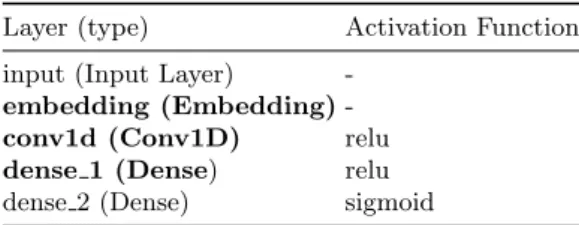
Table 1.The complete network architecture including the corresponding output di-mensions and activation function used in each layer
Layer (type) Activation Function input (Input Layer)
-embedding (Embedding) -conv1d (Conv1D) relu dense 1 (Dense) relu dense 2 (Dense) sigmoid
included in the dataset. Word-based DGA consists of concatenating a sequence of words from one or more wordlists, resulting in less randomly appealing domain name and thus more difficult to detect [7].
The hypothesis presented in this work is that despite the 1D-CNN limita-tions, they can learn the common properties from the different DGA generation schemes and the resulting detection performance is within the range required for real-world scenarios.
The main contributions of the present article are:
– An analysis of the advantages and limitations of a simple 1D-CNN learning model for detecting DGA.
– The detailed evaluation of 1D-CNN on a extended dataset that includes domain names from 51 different real malware DGA following different gen-eration schemed as well as normal domains from two different sources. The rest of this paper is organized as follows: Section 2 describes the network architecture, Section 3 details the experiments design and results while Section 4 discusses the importance of the results, and finally in Section 5, we presents the conclusions.
2
The Neural Network Architecture
The Neural Network Architecture model is a 1D Convolutional Neural Network (CNN). This CNN is composed of three main layers. The first one is an Em-bedding layer, then there is aConv1D layer, and finaly a Dense fully connected layer. The first two layers are the most relevant components of the architecture regarding the problem of detecting DGA domains. Both layers are responsible for learning the feature representation in order to feed the third Dense and fully con-nected layer. Beside the three layers previously described, the complete Neural Network Architecture includes some other layers for dealing with the dimensions output of theConv1D layer as well as layers for representing the input domain and the output probability. A detail of the complete architecture together with the used activation functions is shown in Table 1, whereas the three main layers are described in the following subsections.
2.1 Embedding Layer
A character embedding consists in projectingl-length sequences of input char-acters into a sequence of vectors Rlxd, where l has to be determined from the
information provided by the sequences in the training set anddis a free parame-ter indicating the dimension of the resulting matrix [11]. By using anEmbedding
layer in the architecture, the neural network learns in an efficient manner the optimal set of features that represent the input data.
2.2 1D Convolutional Layer
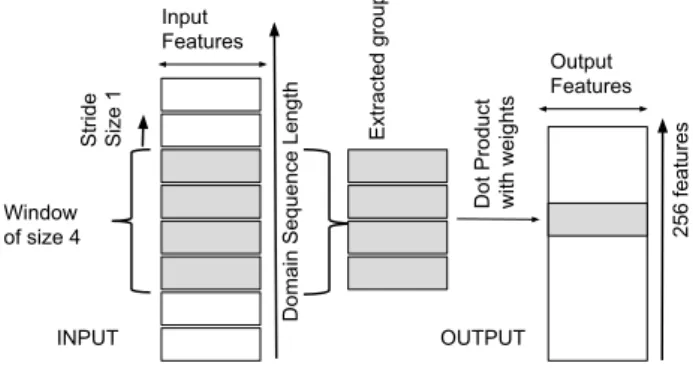
TheConv1Dlayer refers to a convolutional network layer over one dimension. For the DGA detection problem, such dimension consists of the length of the domain name sequence. The convolutional layer is composed of a set of convolutional filters that are applied to different portions of the domain name. A visual example of the feature extraction process for a 1D Conv layer is shown in Fig. 1. The figure depicts a 1D convolutional layer constructing 256 filters (features) (nf= 256), with a window (kernel) size of 4 (ks= 4) and a stride length value of 1 (sl= 1). The layer selects from groups (also referred as patches) of 4 characters to apply the convolutional filters, and continues shifting one character at a time (stride value) applying the same convolutions filter over the rest of the sequence. Consequently, the neural network generates 4-grams features. These features represent the discriminative power of these group of letters in the domain names.
Domain Sequence Length
INPUT OUTPUT Input Features Output Features Extracted group Window of size 4
Dot Product with weights
256 features
Stride Size 1
Fig. 1.Feature extraction process of the 1D convolutional layer
By applying the same filter all over the sequence the required computation time is considerable reduced when compared with traditional Multilayer Percep-tron layers. Additionally, since a convolutional kernel independently operates on each 4-gram it is possible to go over the entire input layer concurrently. This paralellization and its consequent low computing time is one of the major ben-efits of using convolutional networks instead of other deep learning approaches usually used for text processing such as Long Short Term Memory (LSTM) [3, 10, 11].
2.3 Dense Layers
The features extracted by both previous layers are be used by traditional Mul-tilayer Perceptron Network (MLP) to output the probability of a given domain belongs to DGA or Normal class. MLP is composed of two layers: A first fully connected layer of size hn (Dense layer ) connected to a second Dense layer of size 1 used for actually giving the probability output about the considered domain.
3
Experimental Design
The analysis focused on the detection performance considering the DGA and normal domains, as well as the detection performance on the different malware families included in the dataset. Several standard performance metrics for net-work detection evaluation were used. These metrics correspond to True Positive Rate (TPR) and False Positive Rate (FPR). TPR is computed as the ratio between the number of correctly detected DGA domains and the total number of DGA domains. Whereas FPR is computed as the ratio between the number of normal domains that are incorrectly classified as DGA and the total number of normal domains.
The evaluation of the 1D-CNN DGA detection method was carried out fol-lowing the usual machine learning methodology. A dataset containing both DGA and normal domains was split in a 70:30 ratio. To guarantee the independence of the results, the 70% of the datasetset was used for tuning the 1D-CNN hyper-parameters (training set). Whereas the remaining 30% (testing set) was used for testing the performance of the 1D-CNN DGA detection model on unseen domains.
3.1 Dataset Description
The 1D-CNN detection method was evaluated on a dataset containing both DGA and normal domain names. The normal domain names were taken from the Alexa top one million domains. An additional 3,161 normal domains were included in the dataset, provided by the Bambenek Consulting feed. The later group is particularly interesting since it consists of suspicious domain names that were not generated by DGA. Therefore, the total amount of domains normal in the dataset is 1,003,161 . DGA domains were obtained from the repositories of DGA domains of Andrey Abakumov3 and John Bambenek 4. The total amount of
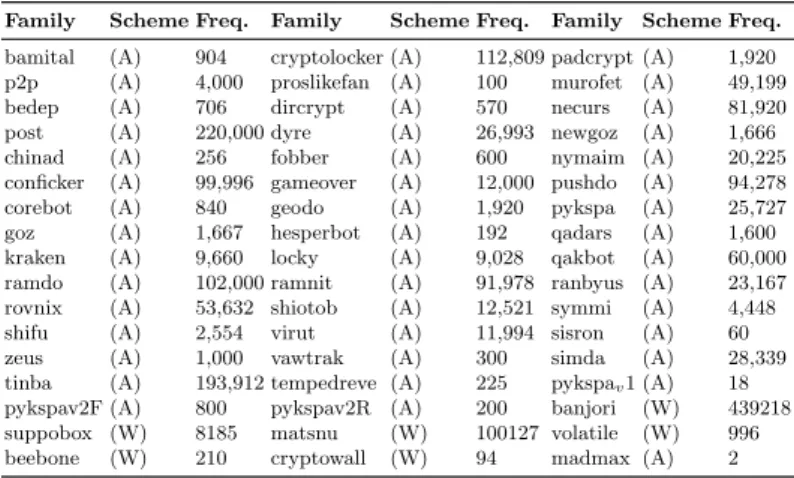
DGA domains is 1,915,335, and they correspond to 51 different malware families. The list of malware families and the amount of domains selected can be seen in Table 2.
The DGA generation scheme followed by the malware families includes the simple arithmetical (A) and the recent word based (W) schemes. Under the arithmetic scheme, the algorithm usually calculates a sequence of values that
3https://github.com/andrewaeva/DGA 4http://osint.bambenekconsulting.com/feeds/
Table 2.Episode frequency and generation scheme for the DGA Malware Families in the dataset used for training and testing the 1D-CNN for DGA detection method. (A) stands for Arithmetic generation scheme while (W) for word-based
Family Scheme Freq. Family Scheme Freq. Family Scheme Freq. bamital (A) 904 cryptolocker (A) 112,809 padcrypt (A) 1,920 p2p (A) 4,000 proslikefan (A) 100 murofet (A) 49,199
bedep (A) 706 dircrypt (A) 570 necurs (A) 81,920
post (A) 220,000 dyre (A) 26,993 newgoz (A) 1,666
chinad (A) 256 fobber (A) 600 nymaim (A) 20,225
conficker (A) 99,996 gameover (A) 12,000 pushdo (A) 94,278
corebot (A) 840 geodo (A) 1,920 pykspa (A) 25,727
goz (A) 1,667 hesperbot (A) 192 qadars (A) 1,600
kraken (A) 9,660 locky (A) 9,028 qakbot (A) 60,000
ramdo (A) 102,000 ramnit (A) 91,978 ranbyus (A) 23,167 rovnix (A) 53,632 shiotob (A) 12,521 symmi (A) 4,448
shifu (A) 2,554 virut (A) 11,994 sisron (A) 60
zeus (A) 1,000 vawtrak (A) 300 simda (A) 28,339
tinba (A) 193,912 tempedreve (A) 225 pykspav1 (A) 18
pykspav2F (A) 800 pykspav2R (A) 200 banjori (W) 439218 suppobox (W) 8185 matsnu (W) 100127 volatile (W) 996
beebone (W) 210 cryptowall (W) 94 madmax (A) 2
have a direct ASCII representation usable for a domain name. On the other hand, word-based consists of concatenating a sequence of words from one or more wordlists.
3.2 Hyper Parameters Tuning
Adjusting the network hyper-parameters is perhaps the most difficult task in the application of neural networks. For the proposed 1D-CNN architecture sev-eral hyper parameters needed to be adjusted. Among all the possible hyper-parameters, we particularly focused on finding the optimal values related to the
Embedding,Conv1D andDense layers. A traditional grid search was conducted through a specified subset on the training set. For a robust estimation, the evaluation of each parameter combination was carried out using a k-fold cross validation withk= 10 folds. The The 1D-CNN was trained using the back prop-agation algorithm [8] considering theAdaptive Moment Estimation optimizer [4]. The 1D-CNN training was carried out during 10 epochs.
Table 3 shows the parameter combinations with the better performance de-tection in terms of the F1-Score.
Table 3. Best Hyper-parameters subset. For space reason only the first parameter combination is shown. The parameters combination with the higher average F1-Score was chosen for all the remaining experiments.
avg. F1 sd nf ks sl d l hn parameters 0.9797 0.0050 256 4 1 100 45 512 5,612,705
3.3 Evaluation on Unseen Domains
The present section details the results after evaluating the 1D-CNN with the hyper-parameters selected from previous section. In this case, complete training set was used for training the 1D-CNN and then tested on the remaining 30% of the dataset. The metrics described in subsection 3 were calculated on testing set with a decision boundary threshold set to 0.90. In terms of the two considered classes (i.e Normal or DGA), the resulting TPR value was around 97% of total DGA present in the dataset while the FPR was 0.7% of total normal domains.
Regarding the FPR discriminated by normal domains types, the 1D-CNN DGA detection algorithm has correctly detected as normal almost the 100% of total Alexa domains. However, for the case of the Bambenek domains, the false positive rate increased to 16%.
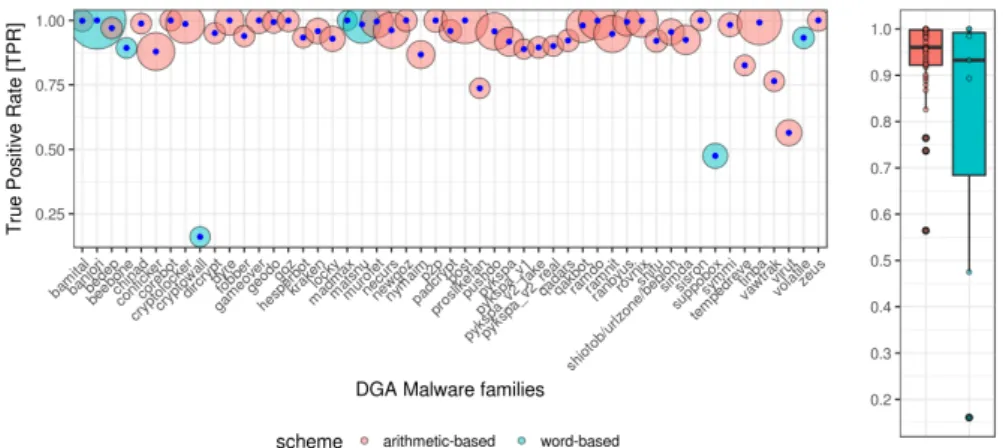
In Fig. 2 we show the TPR per DGA malware family and its DGA generation scheme (red for arithmetic and blue for word based). The diameter of the circle around each point provides a visual idea about the absolute frequency of DNS requests that belong to that malware family in the training set. In general, most of the DGA were detected with TPR values close to 0.75 no matter the DGA generation scheme used. The only three exceptions wereCryptowallwith TPR value of 0.16,Virutwith 0.56 and Suppoboxmalware with 0.47.
Fig. 2.True Positive Rate per DGA malware family
4
Discussion
It seems that the 1D-CNN detection method was capable of extracting common patterns present in arithmetic-based DGA generation algorithms of the different malware families. The previous claim could be an explanation of the good results observed in malware families with very low episode frequency. That is the case of families such as chinad and bamital, which with less than 1000 examples showed a TPR greater than 90%.
0% 2% 4% 6% 8% a b c d e f g h i j k l m n o p q r s t u v w x y z P ercent
Virut False Negative Character Distribution
0% 3% 6% 9% a b c d e f g h i j k l m n o p q r s t u v w x y z Domain Characters P ercent
Character Frequency Distribution for Normal domains
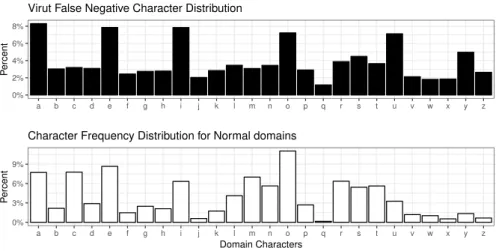
Fig. 3.Character Frequency Distribution for not detected DGA malware
The situation was different for the word-based DGA schemes. As can be seen in the boxplot located at the right of Fig. 2, the 75% of TPR for arithmetic-based DGA were concentrated between 1 and 0.92. On the other hand, in the case of word-based, the 75% of TPR values were between 1 and 0.58. It seems clear that TPR for malware families using the arithmetic-based generation scheme were significantly better than word-based. Since the word-based generation scheme aim at imitating the look of the normal domains, such poor results are expected. There was, however, some unexpected results that deserved a deeper analysis. In particular, results showed for theMatsnumalware family, a word-based DGA with a 0.92 TPR and the case ofVirut, an arithmetic-based DGA with a 0.57 TPR.
In the case of Virut, the poor performance can be explained by the the Frequency Character Distribution (FCD) of the generated DGA domains. The Fig. 3 shows the FCD for theVirutDGA malware (in black) and compare them with FCD for normal domains (in white). Notice that for ease of comparison only characters present in DGA domains were included in the normal FCD.
Despite not being a word-based DGA, Virut vowels frequency is consider-able higher when compared with the rest of the characters. Moreover, such vowel frequency in DGA domains shows similarities with the normal FCD. The simi-larities with normal FCD could difficult the discrimination process carried out by the 1D-CNN detection method. Such process is even more complicated since Viruta small number of episodes included in the dataset.
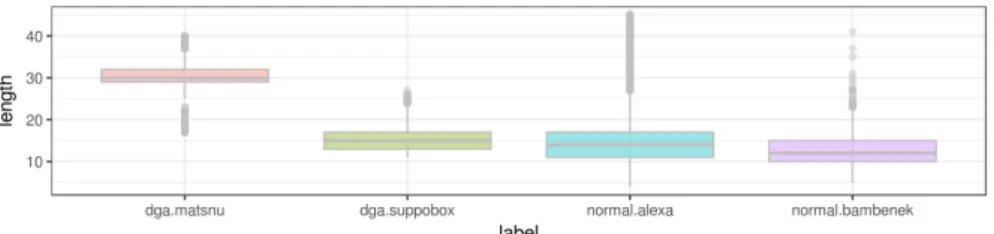
In the case of Matsnu, the high TPR could not be explained by the FCD, since, as expected, Matsnu FCD shared similarities with normal FCD. After inspecting several aspects of the DGA, we found that domain name length was the discriminative feature between normal andMatsnudomain names. Domains names generated byMatsnuwere considerable larger than normal domains. In
Fig. 4 we compare the Character Length Distribution (CLD) of Matsnu and normal domains. As can be seen, theMatsnudomains are significant larger than normal domains. On the other hand, thesuppoboxmalware (shown also in Fig. 4) has a CLD close to normal domains. Since not only CLD but also FCD are similar to normal domains,suppoboxdomains become very difficult to detect.
Fig. 4.character length distribution ofMatsnu,Suppobox and normal domains names
5
Concluding Remarks
In the present work, we explored the viability of 1D-CNN for lexicographical DGA detection. A network with a minimal architecture complexity was evalu-ated on a dataset containing domains names generevalu-ated by 51 different malware families as well as normal domains. Malware families included two different DGA generation scheme: (1) the most common arithmetic-based and (2) the recent and more difficult to detect Word-based. The dataset was properly split in train-ing and testtrain-ing sets. A hyper-parameters grid search was conducted on traintrain-ing set and the best resulting model was then evaluated on the testing set.
Despite its simple architecture, the resulting 1D-CNN model correctly de-tected more than 97% of total DGA domains with a FPR around 0.7%. Such results make it suitable for real-life networks. Inspecting the malware family results, we observed that the 75% arithmetic-based DGA showed TPR values between 1 and 0.92. Such values were observed even in malware families with low frequency episode, confirming the hypothesis that a 1D-CNN can learn the common properties from the different DGA generation families, at least under the arithmetic-based generation scheme. On the other hand, in the case of word-based, the 75% of TPR values were between 1 and 0.58. Such high variability in the TPR results responds to the high TPR for malware such asMatsnuand the low TPR for malware such assuppoboxandcryptowall. By analyzing the FCD and CLD we detected than even tough both shared the FCD with normal domains,Matsnushowed a significant increment in the length of the domains, a situation that makes it easily detectable. Different was the case of malware such assuppobox, that shared both FCD and LCD with normal domains, and consequently was very difficult to detect.
To sum up, despite the good results shown by 1D-CNN, we observed that it could be very difficult to detect word-based DGA that share the CLD and FCD with normal domains. Therefore, as the word-based generation scheme become more precise in imitating normal domains the detection could be extremely hard.
Moreover, it is possible that such particular cases be outside the capabilities of detection methods following a lexicographical approach. Consequently, an alternative strategy could be necessary.
Acknowledgments
The authors would like to thank the financial support received by CVUT and UNCuyo during this work. In particular the founding provided by the Czech TACR project no. TH02010990 and the PICT 1435 granted by ANPCyT.
References
1. Ahluwalia, A., Traore, I., Ganame, K., Agarwal, N.: Detecting broad length al-gorithmically generated domains. In: Traore, I., Woungang, I., Awad, A. (eds.) Intelligent, Secure, and Dependable Systems in Distributed and Cloud Environ-ments. pp. 19–34. Springer International Publishing, Cham (2017)
2. Goodfellow, I., Bengio, Y., Courville, A.: Deep Learning. MIT Press (2016), http://www.deeplearningbook.org
3. Hochreiter, S., Schmidhuber, J.: Long short-term memory. Neural Comput. 9(8), 1735–1780 (Nov 1997)
4. Kingma, D.P., Ba, J.: Adam: A method for stochastic optimization. CoRR abs/1412.6980 (2014)
5. K¨uhrer, M., Rossow, C., Holz, T.: Paint it black: Evaluating the effectiveness of malware blacklists. In: Stavrou, A., Bos, H., Portokalidis, G. (eds.) Research in Attacks, Intrusions and Defenses. Springer International Publishing (2014) 6. Pascanu, R., Mikolov, T., Bengio, Y.: Understanding the exploding gradient
prob-lem. CoRR abs/1211.5063 (2012), http://arxiv.org/abs/1211.5063
7. Plohmann, D., Yakdan, K., Klatt, M., Bader, J., Gerhards-Padilla, E.: A com-prehensive measurement study of domain generating malware. In: 25th USENIX Security Symposium (USENIX Security 16). pp. 263–278. USENIX Association, Austin, TX (2016)
8. Rumelhart, D.E., Hinton, G.E., Williams, R.J.: Neurocomputing: Foundations of research. chap. Learning Representations by Back-propagating Errors, pp. 696–699. MIT Press (1988)
9. Schiavoni, S., Maggi, F., Cavallaro, L., Zanero, S.: vol. 8550, pp. 192–211. Springer (7 2014)
10. Torres, P., Catania, C., Garcia, S., Garino, C.G.: An analysis of recurrent neu-ral networks for botnet detection behavior. In: 2016 IEEE Biennial Congress of Argentina (ARGENCON). pp. 1–6 (June 2016)
11. Woodbridge, J., Anderson, H.S., Ahuja, A., Grant, D.: Predicting Domain Generation Algorithms with Long Short-Term Memory Networks (2016), http://arxiv.org/abs/1611.00791
12. Yadav, S., Reddy, A.K.K., Narasimha Reddy, A.L., Ranjan, S.: Detecting algo-rithmically generated domain-flux attacks with DNS traffic analysis. IEEE/ACM Transactions on Networking 20(5), 1663–1677 (2012)