11 Page 11-19 © MAT Journals 2018. All Rights Reserved
Improved Multiple Fusion Techniques Based Single Image
Dehazing
1
Ms. Ajeeta singh bhadoria, 2Dr Vandana vikas thakre
1
Student,2Professor
Department of electronics and communication engineering Madhav institute of technology and sciences,
Madhya Pradesh, Gwalior, India
Email:[email protected], [email protected]
DOI:https://doi.org/10.5281/zenodo.1477789
Abstract
In view of the unfavorable climate circumstances like the presence fog or overwhelming rain, computerized pictures are simply put through to a broad variety of assortment during acquisition, which may diminishes visual effect & affects post-processing of the picture. Pictures debased by mist adversely influence the class of vision-based physical security system. This prompts to accidents in air, on sea & on the road. In any case, for enhancing the picture appearance to a human viewer, or to change a picture to a format more suitable to machine processing, improving techniques ought to be utilized. After improvement is again re-established the improved picture via restoration techniques. Here, we enhance our image by applying propose method provide us better results when contrasted with base techniques. The output image is clearer in compare of base paper image and hollow effect is also reduced. In our propose algo in view of another, non-local prior. The algorithm depends on the suspicion that shades of a fog-free picture are well approximated via a pair of hundred particular colors that frame tight groups in RGB space. In this algorithm we use low pass filter & band pass filter for smoothing the image. Calculate the PSNR and Time.
Index Terms:image Defogging; DCP; single image dehazing; Multiple fusion technique; IDCP; CLAHE.
INTRODUCTION
Image processing (IP) systems increment the estimation of a picture from the defiled picture. Outdoor scene images captured in the bad climate are often offended inlight of the entity of the haze, fog, mist, or other media. Because of bad climate environment for example haze, fog ,snow and rain is the major reason of image degradation. During Fog, The rays gets spread out before getting the camera, when we take a image utilizing a camera due to a little impurity in the environment. [1] picture Fusion is a method to enchance the nature of data from an arrangement of picture. through the system of picture combination the good information from each of the given pictures is integrate
together to shape a resultant photo whose quality is higher in that of the input photos. This is accomplished by apply a succession of operator on the pictures that would make the great info in every of the picture prominent. The resulting image is shapedviajoining such amplified info from the input images into a solitary image. Image Fusion discovers it application in hugescope of zones. It is utilized for medical diagnostics & treatment. A patient‟s images in variousinformation formats can be intertwined. These structures can incorporate magnetic resonance image (MRI), computed tomography (CT), For example, CT images are used more often to ascertain differences in tissue density while MRI images are normallyutilized to analyse brain tumours.
12 Page 11-19 © MAT Journals 2018. All Rights Reserved Image fusion is additionallyutilized in the
region of remote sensing wherein multivariate images like thermal images, IR Images, UV Images.[2]
Restoration of images taken in these specific conditions has caught increasing attention in the final years. This assignment is significant in some outdoor applicationfor example remote sensing, intelligent vehicles, object recognition & surveillance. In remote detectingframework, the recorded groups of reflected light are handled in order to re-establish the outputs. Multi-image techniques [3] resolve the image dehazing issue through processing a few input pix that have been taken in diverse environmental situations. any other choice is to expect that an approximated 3-d geometrical version of the scene is given.In this paper of Treibitz and Schechnerdiverse edges of polarized filters are utilized to guess the haze impacts. A more difficultissue is when only a solitary degraded image is accessible. Solutions for those cases have been presentedjust recently.
Challenging issues like these require efficient fusion methods to mix infoacquired from different-input imaging sources into visually pleasent images. Image fusion is a notable idea that looks to optimize info drawn from various images taken of a similar sensor or diverse sensors. The objective of the combination strategy is that the intertwined results yield an unrivaled delineation of the first scene, than any of the first source pictures.
The particles absorb & scatter light as it travels through the source to the observer, resulting in an undistinct image. While this impactmight be attractive in an imaginative setting, it is sometimes important to fix this deprivation. For instance, few laptop vision algos have confidence the thought that the input image is firmly the scene radiance,
i.e., there‟s no aggravation from mist. At that point, this supposition is damaged, algorithmic blunders can occur. Among current fogextractioninvestigation, fog estimation methods is partitioned into two wide classes of either hoping on additional info or employing past assumption. Techniques that depend on extra information like: taking numerous images of the similar scene utilizingdiverse degrees of polarization, various images taken amidvariousclimate conditions, &techniques that require client provided depth information or a 3D display. While these can achieve greatoutcomes, the additionaldata required is often not available, and so a more flexible approach is preferable. Importantdevelopment in solitary image mistextraction has been as of late. The principle target of the project are reduce the hazed portion of image, Remove the impulse noise, To enhance the nature of hazed image, To center on dehazing caused of ecological sources like haze, fog and dust etc[4]
Fig: 1. Original Image and Fog Removal Image
VARIOUSDEFOGGING
TECHNIQUES
Dark Channel Prior (DCP)
The DCP is rely upon the succeeding searching over on out of doors fog loose images: In vast part of the nonsky patches, least one color channel has few pixels whose depth could be very low & close to 0. Comparably, the least depth in the sort of patch is close to 0.This system is extremelyhelpful for defogging of single image. The figure of the haze free image is measured. Imagine that some of the color
13 Page 11-19 © MAT Journals 2018. All Rights Reserved channel, extremely minimal intensity of
few pixels. Those pixels are defined as dark pixels [5]. These dull pixels are used to figure the exchange delineate. Transmission outline to take out some blocky effect. Single image is utilizing of foggy image restoration (IR) so that Transmission map is expected precisely basically, the least intensity in such a bit need to have extremely lowest value. Dark channel is designed by,
Dark(x) = min {min {Jc(y}}, y ∈ Ω(x) c∈{r, g, b}
Where J' is a color channel of J and Q(x) is a local
ATM Light
The atmospherically light-weight vector, air that describes the ambient light within the scene. Existing strategies either believe user input or follow error-prone assumptions like the gray-world assumption. In various situation of terrible climate, especially in sunshine where, the sky is normally overcast, we can disregarded the presence of the sunlight & assume that the atmospheric light is universal constant.
Radiance
Radiant flux or radiant power is the brilliant vitality radiated, reflected, transmitted or got, per unit time and unearthly motion or ghostly power is the brilliant motion per unit recurrence or wavelength, contingent upon whether the range is taken as an element of recurrence or of wavelength.
LITERATURESURVEY
Yin Gao, Yijing Su, Qiming Li, Jun Li*, “The conventional prior methods are not adequate to address this challenging issue to deal with the halo artifacts & brightness distortion issue. In this paper, we propose a multi-scale fusion technique for single fog image restoration. To appropriatelyupgrade the transmission, our strategy is composed in new Kirsch administrators with versatile
boundary constraint. With another multi-scale image fusion technique, we can efficiently remove & fuse the haze from these images. The proposed techniquelessons the halo artifacts via adaptively restricting the limit of an arbitrary haze image. Another multi-scale image fusion technique for single image dehazing has additionally been proposed to create a more nature visual recovery impact. [6]
Zhigang Ling et al. [2017] in this paper, our intend to build up a novel image defogging calculation by specifically anticipating the haze thickness of recovered images as opposed to receiving earlier assumptions or requirements. So as to accomplish this objective, two particular advances are presented. To start with, we embrace three fog significant measurable highlights got from foggy images, and further build up a basic fog density evaluator (SFDE) by making a linear
merge of these
mist-significantcharacteristics. This proposed surveyor can proficiently see the mistthickness of a solitary image without reference to a relating fog-free image & has a low computational load compared with an accessiblestrategy. Second, a material science based numerical association among the transmission & the mist thickness score of the recuperated picture is shaped by methods for SFDE; hence picture defogging can be act like a minimization issue on the mist thickness score of the recouped picture. [7].
Changli Lii et al. [2017]this article mostly focuseson the image restoration. Firstly, it studies the He's defogging algodepend on DCP & make some improvement based on this theory. Aiming at solving the defects of imprecise estimation of full of atmosphere light and long time running of He's algorithm, the improvement of estimation of climatic light and transmittance are introduce in this paper.
14 Page 11-19 © MAT Journals 2018. All Rights Reserved To improve the transmittance of estimation
by introducing a gain coefficient instead of soft matting algorithm for long time. At the similar time four binary tree subdivision methods is in the habit of estimate the atmospheric light, which is able to shorten the operation time, avoid the halo phenomenon and get an improved defogging outcome [8].
Md. Imtiyaz Anwar et al. [2017] in this paper, it's far deliberate for visibility enhancement via fog extraction utilizing a single grey or a shade picture, by way of an effective post-processing approach. This algorithm is rely on DCP idea accompanied by using a post-processing approach primarily based visibility enhancement scheme for foggy pics.Subjective and quantitative investigation is linked for assessment of defogged images procured from the proposed methodology and is in like manner differentiate and other certainly understood techniques to found its efficiency. The proposed algorithm preserves sharp details and maintains the color value of the defogged image [9]. Jaiveer Singh Sikarwar et al. [2016] this has been appeared in existing exploration that the big fraction of the present systems has numerous issues. To conquer the constraints of the former work; a novel system has been existing in this paper. In this research, modified dark channel prior (MDCP) and Gaussian Laplacian filtering (GLP) with transmission map.The proposed work is actualized in MATLAB utilizing image dispensation toolbox.The comparison among l0 normalization technique and the planned algorithm is measured different types of performance, namely, the peak signal noise ratio (PSNR), entropy and execution time. The experimental results have composed of dissimilar types of fog image and it has shown better results as compare to previous methods [10].
PROPOSEWORK
In this effort we have proposed a new view that will effectively solve insufficient fog breadth evaluation and color cast problems. By doing so, a high quality image with clear visibility and vivid color can be generated. In this work, we enhance our image by applying propose method provide us better results as compared to base techniques. The output image is clearer than base paper image and hollow effect is also reduced. In our propose algorithm depend on another, non-local prior. The algorithm depends on the suspicion that colors of a haze-free image are well approximated via a couple of hundred distinct hues that form tight bunches in RGB space. In this algorithm we use low pass filter & band pass filter for smoothing the image.
Problem Statement:
Haze limits perceivability &diminishes image differentiate in outside images. The debasement is diverse for each pixel &release on the sepration of the scene point from the camera. This reliance is imparted in the transmission coefficients that control the scene constriction and amount of haze in every pixel. Previous techniquestackle the single image dehazing issueutilizingdifferent patch-based priors.
Propose algorithm
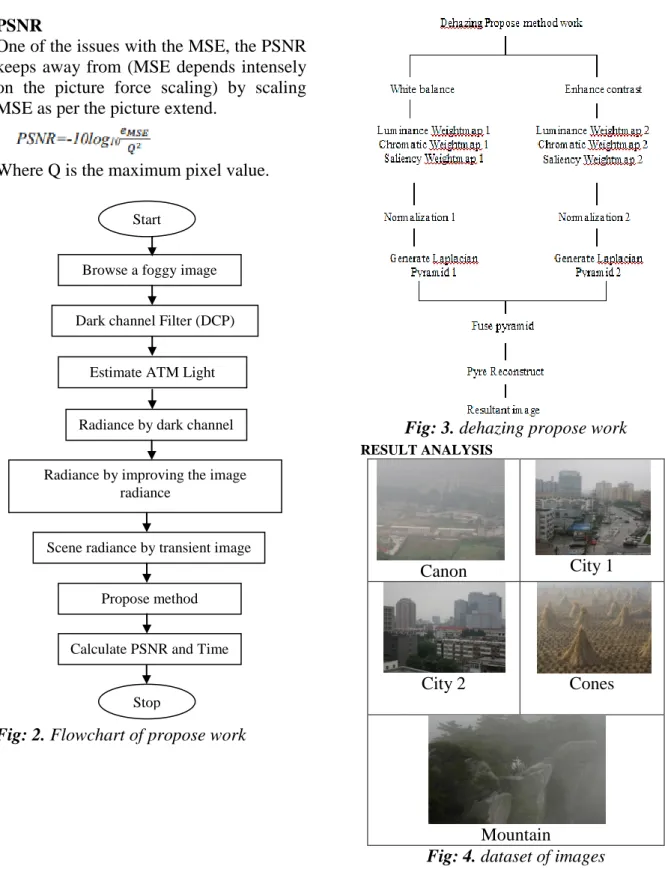
STEP 1: Browse a foggy image from dataset.
STEP 2: Apply dark channel prior (DCP) to eliminate fog from an image.
STEP 3: Now, Apply ATM light.
STEP 4: Then, scene radiance by dark channel prior method.
STEP 5: Then, scene radiance by improving the image
STEP 6: Scene radiance by transient image
STEP 7: Apply to propose method.
STEP 8: calculate parameter PSNR and Time.
15 Page 11-19 © MAT Journals 2018. All Rights Reserved PSNR
One of the issues with the MSE, the PSNR keeps away from (MSE depends intensely on the picture force scaling) by scaling MSE as per the picture extend.
Where Q is the maximum pixel value.
Fig: 2. Flowchart of propose work
Fig: 3. dehazing propose work
RESULT ANALYSIS
Canon City 1
City 2 Cones
Mountain
Fig: 4. dataset of images Start
Browse a foggy image
Dark channel Filter (DCP)
Estimate ATM Light
Radiance by dark channel
Radiance by improving the image radiance
Scene radiance by transient image
Stop Propose method
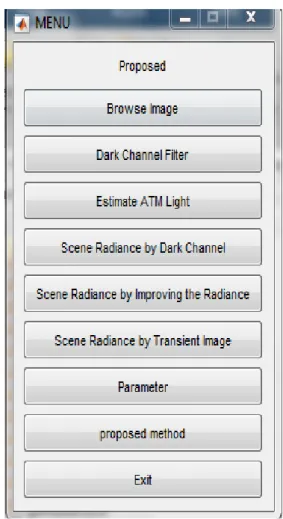
16 Page 11-19 © MAT Journals 2018. All Rights Reserved Fig: 5. First, We ‘Run’ our code and then
obtain this type of menu bar. In this menu bar there are 8steps.
Fig:6. Browse a foggy host image from dataset.
Fig: 7. Apply DCP Technique on an original image to eliminate fog from an
image.
Fig: 8. Apply Radiance by dark channel.
Fig: 9. Apply Radiance by improving the image radiance.
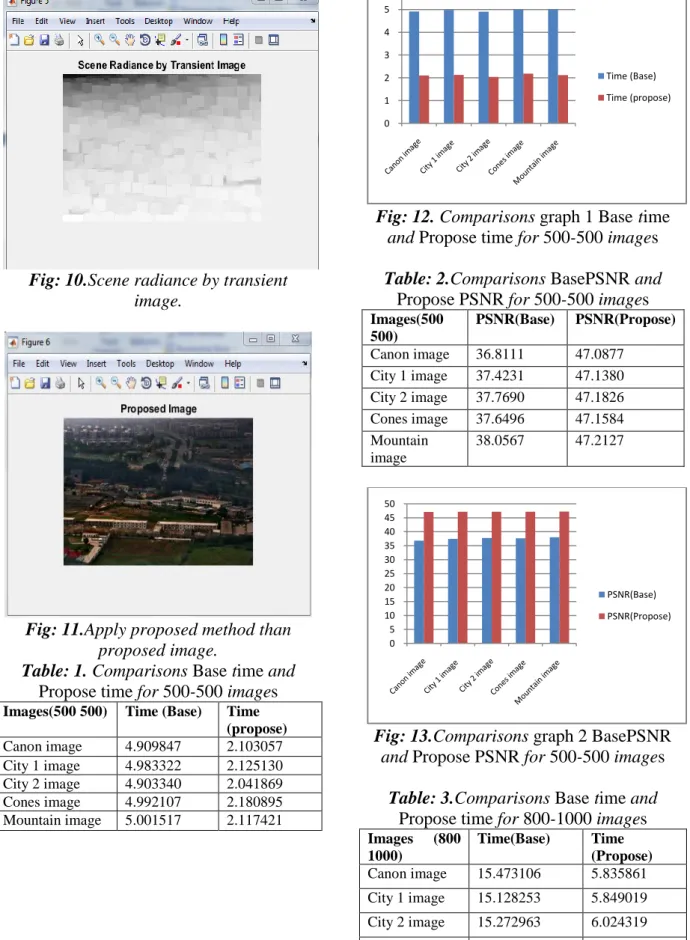
17 Page 11-19 © MAT Journals 2018. All Rights Reserved Fig: 10.Scene radiance by transient
image.
Fig: 11.Apply proposed method than proposed image.
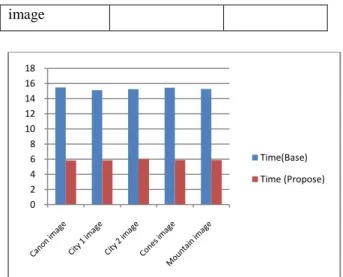
Table: 1. Comparisons Base time and Propose time for 500-500 images
Images(500 500) Time (Base) Time (propose) Canon image 4.909847 2.103057 City 1 image 4.983322 2.125130 City 2 image 4.903340 2.041869 Cones image 4.992107 2.180895 Mountain image 5.001517 2.117421
Fig: 12. Comparisons graph 1 Base time and Propose time for 500-500 images Table: 2.Comparisons BasePSNR and
Propose PSNR for 500-500 images
Images(500 500) PSNR(Base) PSNR(Propose) Canon image 36.8111 47.0877 City 1 image 37.4231 47.1380 City 2 image 37.7690 47.1826 Cones image 37.6496 47.1584 Mountain image 38.0567 47.2127
Fig: 13.Comparisons graph 2 BasePSNR and Propose PSNR for 500-500 images
Table: 3.Comparisons Base time and Propose time for 800-1000 images
Images (800 1000) Time(Base) Time (Propose) Canon image 15.473106 5.835861 City 1 image 15.128253 5.849019 City 2 image 15.272963 6.024319 Cones image 15.442986 5.875233 Mountain 15.279144 5.885617 0 1 2 3 4 5 6 Time (Base) Time (propose) 0 5 10 15 20 25 30 35 40 45 50 PSNR(Base) PSNR(Propose)
18 Page 11-19 © MAT Journals 2018. All Rights Reserved image
Fig: 14.Comparisons graph 3 Base time and Propose time for 800-1000 images Table: 4. Comparisons Base PSNR and
Propose PSNR for 800-1000 images
Images (800 1000) PSNR(Base) PSNR(Propose) Canon image 36.8011 47.0877 City 1 image 37.4018 47.1382 City 2 image 37.7446 47.1828 Cones image 37.6394 47.1585 Mountain image 38.0478 47.2128
Fig: 15. Comparisons Base PSNR and Propose PSNR for 800-1000 images CONCLUSION
Some continuous applications endure with poor differentiation issue in light of dimness or mist. Some natural impacts for instance cloudiness fog, smoke, dust and so forth, impact ineffectively the nature of the got picture. Picture murkiness expulsion strategies have taken reclamation esteem statically, that relies on the given
arrangement of pictures that restricts the execution of haze evacuation technique as rebuilding. This esteem should be versatile as impact of cloudiness on given picture changes scene to scene and air shroud. The exhibited strategies have dismissed the utilization of multi-target streamlining systems to enhance the adaptively of the advanced murkiness evacuation calculations. The Dehazing Propose method is efficient technique proposed in this article produces better results than the best of a number of earlier techniques implied for the solution of the problem. The output picture is clearer than base paper picture and empty impact is also reduced.
REFERENCES
1. MISS. MAYURI V. BADHE1 , PROF. PRABHAKAR L. RAMTEKE, “A Survey on Haze Removal using Image Visibility Restoration Technique”. International Journal of Computer Science and Mobile Computing. IJCSMC, Vol. 5, Issue. 2, February 2016
2. Chhamman Sahu1, Rajkumar Sahu2, “Comparative Study on Fusion Based Image Dehazing”. International Journal of Advanced Research in Computer and Communication Engineering. ISSN (Online) : 2278-1021 ISSN (Print) : 2319-5940, Vol. 3, Issue 6, June 2014
3. Manpreet Kaur Saggu†* and Satbir Singh, “A Review on Various Haze Removal Techniques for Image Processing”. International Journal of Current Engineering and Technology E-ISSN 2277 – 4106, P-ISSN 2347 – 5161 ©2015 INPRESSCO®, All Rights Reserved
4. Krishna Raj K R 1, Neena K A2, Pearlsy P V, “SINGLE IMAGE DEHAZING – A REVIEW”. International Research Journal of Engineering and Technology (IRJET) e-ISSN: 2395 -0056, p-ISSN: 2395-0 2 4 6 8 10 12 14 16 18 Time(Base) Time (Propose) 0 5 10 15 20 25 30 35 40 45 50 PSNR(Base) PSNR(Propose)
19 Page 11-19 © MAT Journals 2018. All Rights Reserved 0072. Volume: 04 Issue: 04 | Apr
-2017
5. Poonam1 Dr.VK Banga2 Gurjit singh, “A Review on Haze Removal Techniques”. International Research Journal of Engineering and Technology (IRJET) e-ISSN: 23950056 Volume: 04 Issue: 08 | Aug -2017 ISSN: 2395-007
6. Yin Gao, Yijing Su, Qiming Li, Jun Li*, “Single Fog Image Restoration via Multi-scale Image Fusion”. 2017 3rd IEEE International Conference on Computer and Communications, 978-1-5090-6352-9/17/$31.00 ©2017 IEEE 7. Zhigang Ling, Jianwei Gong, Guoliang Fan, Senior Member, IEEE, and Xiao Lu “Optimal Transmission Estimation via Fog Density Perception for Efficient Single Image Defogging” 1520-9210 (c) 2017 IEEE.
8. Changli Lii, Tanghuai Fan, Xiao Ma, Zhen Zhang Hongxin Wui, Lin Chen “An Improved Image Defogging Method Based on Dark Channel Prior” 2017 2nd International Conference on Image, Vision and Computing.
9. Md. Imtiyaz Anwar, Arun Khosla, and Gajendra Singh „Visibility
Enhancement with Single Image Fog Removal scheme using a Post-processing Technique‟2017 4th International Conference on Signal Processing and Integrated Networks (SPIN)
10. Jaiveer Singh Sikarwar, Abhinav Vidwans “Modified Dark Channel Prior Model and Gaussian Laplacian Filtering with Transmission Map For Fog Removal” International Conference on Electrical, Electronics, and Optimization Techniques (ICEEOT) – 2016 978-1-4673-9939-5/16/$31.00 ©2016 IEEE.
Cite as:
Ms. Ajeeta singh bhadoria, & Dr Vandana vikas thakre. (2018). Improved Multiple Fusion Techniques Based Single Image Dehazing. Journal of Embedded Systems and Processing, 3(3), 11– 19.
http://doi.org/10.5281/zenodo.1477 789