Smart Card Personalization
Environment
Smart card personalization management
Executive summary
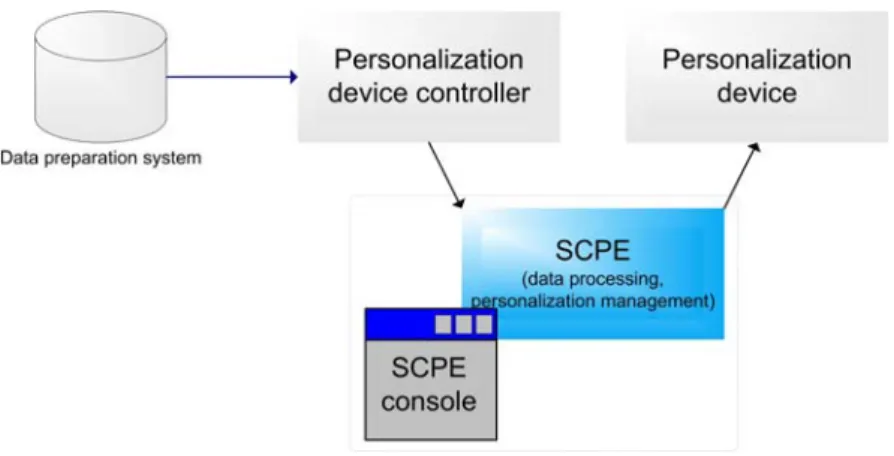
Smart Card Personalization Environment (SCPE) is universal server environment intended for the management of smart card personalization using Datacard personalization equipment.
Here are the key features of SCPE:
• Support for most memory cards and cards compliant with ISO 7816 (T=0 and T=1);
• Simultaneous personalization of multiple card types using several items of personalization equipment;
• Independence of smart card applications from personalization equipment used;
• Ability to use scripting technology to develop smart card applications to speed up and facilitate development, implementation, integration and maintenance of personalization solutions;
• Scalability of the personalization system (adding personalization devices does not require modifications of smart card applications;
• A number of ready smart card applications for personalization of popular native and GlobalPlatform produced by Axalto, Gemplus, Setec and other vendors;
SCPE features and capabilities
Flexibility
Components of a competitive card product (specifically, card type, set of personalized applications) are bound to change as the time passes. The operational environment that impacts personalization may also change: a set of personalization equipment, personalization data sources and format. Payment systems specifications are also bound to change, new applications and better card types are likely to appear.
SCPE architecture allows fast and effective modification to personalization systems. Smart card application development technology is not closed, thus applications may be developed either by PRONIT specialists, or by third parties.
Card types
Along with the development of smart technologies new chip types, less costly and more functional, are developed. SCPE enables to personalize new card types and simultaneously support several card vendors.
Applications
It is likely that in the near future loyalty and other additional applications will be an integral part of a competitive card product. SCPE personalization management process is adjusted and customized in accordance with the requirements of a certain system. In case new card applications require new data sources or personalization information has to be processed in some special way, necessary modifications to the system can be implemented at low cost and minimal time.
Personalization devices
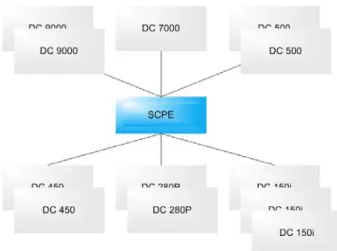
Many personalization systems require simultaneous using of several personalization devices of different models and types. Personalization system may consist of several desktop and/or high-volume devices. SCPE enables to simultaneously manage personalization on multiple Datacard devices.
Figure 1. Smart card personalization system configuration example.
Compatibility and versatility
Every institute issuing smart cards select a certain combination of card, a set of personalized applications and personalization equipment.
SCPE enables fast development, implementation and modification of smart card personalization system in accordance with certain requirements.
Figure 2. Most personalization devices, card types and applications are joined with
SCPE.
Card types
Most memory cards and cards, compliant with SIO 7816 (native and Global Platform) can be personalized with SCPE.
Visa (JCOPx0), Austria Card, Axalto, Gemplus, G&D, Oberthur, Setec – cards of these card vendors can be personalized with SCPE. Turnkey solutions for most popular cards are available.
See the complete list of turnkey solution later in this document
Applications
Financial applications (for instance, VSDC, M/Chip), loyalty, petrol purse and other custom applications and their combinations can be personalized using
SCPE.
Personalization devices
Most Datacard personalization devices, both desktop and high volume, can be used to personalize cards with SCPE.
See the complete list of supported personalization devices later in this document
Scalability
From pilots to high-volume issuance
In many cases rigid inflexible pilot systems are created to personalize a single type of cards with a certain set of applications. Such systems become inapplicable with transition to high-volume issuance. And the issuer has to create a new high-volume oriented system based on the experience, received
In case of using SCPE major settings are implemented on installation of the initial configuration. Hence, if cards are successfully personalized on a single desktop device, they can be issued using a set of high-volume devices. This entails only purchasing additional licenses for programming stations added to the personalization system. No program modifications are required for such transition.
Promotional pricing of SCPE fosters pilot projects.
Support
In most cases PRONIT specialists support not only SCPE software, but also the entire smart card personalization system.
Both at the initial stage, and during operation PRONIT specialists: • Install and adjust SCPE;
• Train the operation staff and provide relevant documentation; • Develop and modify smart card applications;
• Adopt the personalization system to input data formats; • Provide support in office, via e-mail or phone.
In addition, experienced PRONIT specialists with high expertise in creating successful card issuance systems are eager to assist in relevant fields of data preparation, cryptography and card testing.
SCPE components
Architecture overview
SCPE technology includes four major components:
• SCPE server, which provides for interaction of smart card applications and personalization devices;
• SCPE console, which enables personalization system management and monitoring;
• Two applications, intended for:
o Data preprocessing (for instance, for cryptographic data processing before personalization);
o Personalization management (mostly for writing data into the chip).
Server
SCPE server manages the interaction of applications and personalization equipment, ensuring stability and efficiency of the smart card issuance process and independence of smart card applications from the personalization equipment in use.
Smart card applications independence
SCPE creates the environment, that ensures interaction of smart card applications and programming stations of personalization devices. SCPE
architecture makes the applications invariant from types and number of personalization devices, allowing the application developer to feel free regarding the types and number os personalization devices used in the personalization system. This ensures that applications, which personalize cards on a desktop tevice, can be successfully applied in a system of several high-volume Datacard devices (DC 9000/7000/500).
Figure 4. Smart card applications are independent from personalization equipment
used.
System resources
SCPE has a standard set of requirements to operating systems and communication channels. SCPE parameters and functions management is built on the MMC technology (Microsoft Management Console).
SCPE console
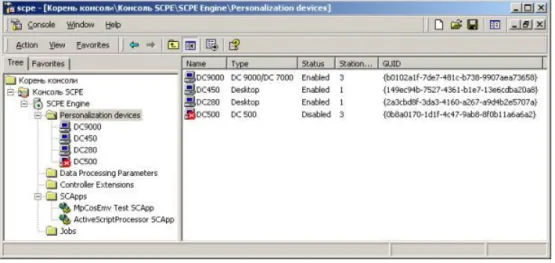
SCPE architecture allows centralized configuration of parameters and monitoring of the entire system by means of the console.
SCPE console displays current information regarding the state of every personalization device and every programming station in it.
The console displays the number of personalized cards, average, maximal and minimal speeds of personalization for each active programming station.
SCPE environment generates trace protocol of the personalization process, containing detailed information regarding the personalization process flow, including the cases of card defects.
In addition, SCPE console enables to:
• Add and delete personalization devices and programming stations; • Set smart card applications for a certain batch of cards;
Figure 5. SCPE console.
Smart card applications
Smart Card applications are software modules, which implement specifics of personalizing a set of applications on a certain card type. Activities, carried out by smart card applications, may include data input (including data input from an external source), data formatting, cryptographic processing and data personalization into the chip.
Personalization time reduction
If card personalization requires time-consuming prepersonalization data preparation activities, such as continuous cryptographic processing and/or getting data from a remote source, their contribution to the increase of total personalization time may be significantly reduced. With smart card applications such activities can be carried out simultaneously and independently from the personalization process, generating a reserve and decreasing the total personalization time.
Output fields
SCPE enables to return to controller a piece of information, generated during personalization. This can be used, for instance, for card serial number embossing or printing, or when personalizing MULTOS of UEPS cards.
In addition, before starting to process a batch of cards, the personalization system enables to request initialization data form operator (for instance, a password or a card batch unblocking key).
Standard platform
Standard development platforms are used to develop smart card applications: Microsoft Visual C++, standard scripting languages, supporting Active Scripting™ technology (for instance, VBScript, JavaScript, Active Perl).
PRONIT specialists can develop smart card applications in undertime. Applications can be developed and adopted by third parties, because relevant documentation and SDK are available.
Turnkey solutions
The following turnkey solutions for native and GlobalPlatform cards are developed and are currently in operation.
Native cards
• GemVision (VSDC) • GemShare (M/Chip) • eGalleon (VSDC, M/Chip) • Palmera Swift (VSDC) • SetCOS (VSDC, M/Сhip) • StarDC (VSDC, M/Сhip)GlobalPlatform cards
• GemXpresso Pro (VSDC)• GemXpresso Lite (VSDC, M/Chip) • JCOP (VSDC)
• Palmera Protect (VSDC)
Subordinate solutions
• Script to retrieve PAN from EMV applications. The script is used to identify a certain card during line production of EMV cards with photographs and/of individual design on desktop devices (printer + embosser).
Supported personalization devices
SCPE personalizes cards on the majority of Datacard personalization devices.
High-volume Datacard devices
• DC 500 • DC 7000 • DC 9000
Datacard embossers
• DC 150i • DC 280P • DC 450Graphic printers
• SP35 • SP55 • Image Card IV • Magna • SelectPlatform
Windows 2000 (Service Pack 3)
SCPE workstation
Windows XP (Service Pack 2)
Additional software
ActiveScriptProcessor Scripting technology support module;
GlobalScriptProcessor GlobalPlatform scripting technology support module; ScriptSDK Scripts development kit;