Testosterone ELISA Kit
Item No. 582701Customer Service 800.364.9897 *Technical Support 888.526.5351 www.caymanchem.com
3
GENERAL INFORMATIONTABLE OF CONTENTS
GENERAL INFORMATION 3 Materials Supplied 4 Safey Data 4 Precautions
5 If You Have Problems 5 Storage and Stability
5 Materials Needed but Not Supplied INTRODUCTION 6 Background
6 About This Assay
7 Description of AChE Competitive ELISAs 9 Biochemistry of Acetylcholinesterase 11 Definition of Key Terms
PRE-ASSAY PREPARATION 12 Buffer Preparation 13 Sample Preparation
ASSAY PROTOCOL 16 Preparation of Assay-Specific Reagents 18 Plate Set Up
17 Performing the Assay
ANALYSIS 22 Calculations 25 Performance Characteristics RESOURCES 29 Troubleshooting 30 References 31 Plate Template 32 Notes
32 Warranty and Limitation of Remedy
GENERAL INFORMATION
Materials Supplied
Item Number Item 96 wells
Quantity/Size
480 wells Quantity/Size
482702 Testosterone ELISA Antiserum 1 vial/100 dtn 1 vial/500 dtn 482700 Testosterone AChE Tracer 1 vial/100 dtn 1 vial/500 dtn 482704 Testosterone ELISA Standard 1 vial 1 vial 400060 ELISA Buffer Concentrate (10X) 2 vials/10 ml 4 vials/10 ml 400062 Wash Buffer Concentrate (400X) 1 vial/5 ml 1 vial/12.5 ml 400035 Polysorbate 20 1 vial/3 ml 1 vial/3 ml 400004/400006 Mouse Anti-Rabbit IgG Coated Plate 1 plate 5 plates
400012 96-Well Cover Sheet 1 cover 5 covers 400050 Ellman’s Reagent 3 vials/100 dtn 6 vials/250 dtn
400040 ELISA Tracer Dye 1 vial 1 vial
400042 ELISA Antiserum Dye 1 vial 1 vial
If any of the items listed above are damaged or missing, please contact our Customer Service department at (800) 364-9897 or (734) 971-3335. We cannot accept any returns without prior authorization.
4
GENERAL INFORMATION GENERAL INFORMATION5
!
WARNING: THIS PRODUCT IS FOR RESEARCH ONLY - NOT FOR HUMAN OR VETERINARY DIAGNOSTIC OR THERAPEUTIC USE.Safety Data
This material should be considered hazardous until further information becomes available. Do not ingest, inhale, get in eyes, on skin, or on clothing. Wash thoroughly after handling. Before use, the user must review the complete Safety Data Sheet, which has been sent via email to your institution.
Precautions
Please read these instructions carefully before beginning this assay.
The reagents in this kit have been tested and formulated to work exclusively with Cayman Chemical’s AChE ELISA Kits. This kit may not perform as described if any reagent or procedure is replaced or modified.
When compared to quantification by LC/MS or GC/MS, it is not uncommon for immunoassays to report higher analyte concentrations. While LC/MS or GC/MS analyses typically measure only a single compound, antibodies used in immunoassays sometimes recognize not only the target molecule, but also structurally related molecules, including biologically relevant metabolites. In many cases, measurement of both the parent molecule and metabolites is more representative of the overall biological response than is the measurement of a short-lived parent molecule. It is the responsibility of the researcher to understand the limits of both assay systems and to interpret their data accordingly.
If You Have Problems
Technical Service Contact Information
Phone: 888-526-5351 (USA and Canada only) or 734-975-3888
Fax: 734-971-3641
Email: [email protected] Hours: M-F 8:00 AM to 5:30 PM EST
In order for our staff to assist you quickly and efficiently, please be ready to supply the lot number of the kit (found on the outside of the box).
Storage and Stability
This kit will perform as specified if stored as directed at -20°C and used before the expiration date indicated on the outside of the box.
Materials Needed But Not Supplied
1. A plate reader capable of measuring absorbance between 405-420 nm. 2. Adjustable pipettes and a repeating pipettor.
3. A source of ‘UltraPure’ water. Water used to prepare all ELISA reagents and buffers must be deionized and free of trace organic contaminants (‘UltraPure’). Use activated carbon filter cartridges or other organic scavengers. Glass distilled water (even if double distilled), HPLC-grade water, and sterile water (for injections) are not adequate for ELISA. NOTE: UltraPure water is available for purchase from Cayman (Item No. 400000).
6
INTRODUCTION INTRODUCTION7
INTRODUCTION
Background
Testosterone is the prototypic and predominant circulating androgenic steroid. It plays a major role in the growth and function of many reproductive and non-reproductive tissues and organs including muscle, liver, and brain, directing the development of the male phenotype during embryogenesis and at puberty. Testosterone is synthesized from pregnenolone by two main pathways, the D4 and D5 pathways. Both of these pathways involve the same three enzymes:
the cytochrome P450 isoform CYP17, 3β-hydroxysteroid dehydrogenase/ isomerase, and 17β-hydroxysteroid dehydrogenase. The human CYP17 favors the D5 pathway, in which 17-hydroxypregnenolone is converted first to DHEA,
then androstenedione, and finally testosterone. The D4 pathway in which
17-hydroxyprogesterone is converted to androstedione is also important, but less favored in humans.1 While testosterone is the androgen responsible for biological
activity in tissues such as muscle, in other tissues including gonads and skin, it is converted to 5α-DHT by the action of 5α-reductase. 5α-DHT binds to the androgen receptor with higher affinity than testosterone itself and mediates androgenic activity in tissues where it is present. Aromatase (CYP19) is responsible for the conversion of testosterone to estradiol.1 Total serum testosterone levels range
from <1 ng/ml in women to 3-10 ng/ml in men, declining with age.1 The majority of
testosterone is glucuronidated prior to excretion in urine.2,3
About This Assay
Cayman’s Testosterone ELISA Kit is a competitive assay that can be used for quantification of testosterone in serum, plasma, tissue culture supernatants and other sample matrices. The assay does not recognize testosterone-17-glucuronide, the metabolite most prevalent in urine, and therefore is not recommended for use with urine samples. The assay has a range from 3.9-500 pg/ml and a sensitivity (80% B/B0) of approximately 6 pg/ml.
Description of AChE Competitive ELISAs
This assay is based on the competition between testosterone and a Testosterone-acetylcholinesterase (AChE) conjugate (Testosterone Tracer) for a limited amount of Testosterone Antiserum. Because the concentration of the Testosterone Tracer is held constant while the concentration of testosterone varies, the amount of Testosterone Tracer that is able to bind to the Testosterone Antiserum will be inversely proportional to the concentration of testosterone in the well. This antiserum-testosterone complex binds to mouse monoclonal anti-rabbit IgG that has been previously attached to the well. The plate is washed to remove any unbound reagents and then Ellman’s Reagent (which contains the substrate to AChE) is added to the well. The product of this enzymatic reaction has a distinct yellow color and absorbs strongly at 412 nm. The intensity of this color, determined spectrophotometrically, is proportional to the amount of Testosterone Tracer bound to the well, which is inversely proportional to the amount of free Testosterone present in the well during the incubation; or
Absorbance ∝ [Bound Testosterone Tracer] ∝ 1/[Testosterone] A schematic of this process is shown in Figure 1, on page 8.
8
INTRODUCTION INTRODUCTION9
Biochemistry of Acetylcholinesterase
The electric organ of the electric eel, E. electricus, contains an avid AChE capable of massive catalytic turnover during the generation of its electrochemical discharges. The electric eel AChE has a clover leaf-shaped tertiary structure consisting of a triad of tetramers attached to a collagen-like structural fibril. This stable enzyme is capable of high turnover (64,000 s-1) for the hydrolysis of acetylthiocholine.
A molecule of the analyte covalently attached to a molecule of AChE serves as the tracer in ACE™ enzyme immunoassays. Quantification of the tracer is achieved by measuring its AChE activity with Ellman’s Reagent. This reagent consists of acetylthiocholine and 5,5’-dithio-bis-(2-nitrobenzoic acid). Hydrolysis of acetylthiocholine by AChE produces thiocholine (see Figure 2, on page 10). The non-enzymatic reaction of thiocholine with 5,5’-dithio-bis-(2-nitrobenzoic acid) produces 5-thio-2-nitrobenzoic acid, which has a strong absorbance at 412 nm (ε = 13,600).
AChE has several advantages over other enzymes commonly used for enzyme immunoassays. Unlike horseradish peroxidase, AChE does not self-inactivate during turnover. This property of AChE also allows redevelopment of the assay if it is accidentally splashed or spilled. In addition, the enzyme is highly stable under the assay conditions, has a wide pH range (pH 5-10), and is not inhibited by common buffer salts or preservatives. Since AChE is stable during the development step, it is unnecessary to use a ‘stop’ reagent, and the plate may be read whenever it is convenient.
= Mouse Anti-Rabbit IgG = Blocking proteins = Acetylcholinesterase linked to testosterone (tracer)
= Free testosterone
= Specific antiserum to testosterone Plates are pre-coated with
mouse anti-rabbit IgG and blocked with a proprietary formulation of proteins.
2. Wash to remove all unbound reagents.
1. Incubate with tracer, antiserum, and either
standard or sample.
3. Develop the well with Ellman's Reagent. Figure 1. Schematic of the AChE ELISA
10
INTRODUCTION INTRODUCTION11
O S N + Acetylthiocholine O O- -S N + Thiocholine S S NO2 O2N COO--OOC 5,5'-dithio-bis -(2-Nitrobenzoic Acid) S S O2N -OOC N+ NO2 COO--S 5-thio-2-Nitrobenzoic Acid λmax: 412 nm ε: 13,600 Figure 2. Reaction catalyzed by acetylcholinesteraseDefinition of Key Terms
Blank: background absorbance caused by Ellman’s Reagent. The blank absorbance should be subtracted from the absorbance readings of all the other wells, including NSB wells.
Total Activity: total enzymatic activity of the AChE-linked tracer. This is analogous to the specific activity of a radioactive tracer.
NSB (Non-Specific Binding): non-immunological binding of the tracer to the well.
Even in the absence of specific antibody a very small amount of tracer still binds to the well; the NSB is a measure of this low binding. Do not forget to subtract the Blank absorbance values.
B0 (Maximum Binding): maximum amount of the tracer that the antibody can bind
in the absence of free analyte.
%B/B0 (%Bound/Maximum Bound): ratio of the absorbance of a particular
sample or standard well to that of the maximum binding (B0) well.
Standard Curve: a plot of the %B/B0 values versus concentration of a series of wells containing various known amounts of analyte.
12
PRE-ASSAY PREPARATION PRE-ASSAY PREPARATION13
PRE-ASSAY PREPARATION
NOTE: Water used to prepare all ELISA reagents and buffers must be deionized and
free of trace organic contaminants (‘UltraPure’). Use activated carbon filter cartridges
or other organic scavengers. Glass distilled water (even if double distilled), HPLC-grade water, and sterile water (for injections) are not adequate for ELISA. UltraPure water may be purchased from Cayman (Item No. 400000).
Buffer Preparation
Store all diluted buffers at 4°C; they will be stable for about two months. 1. ELISA Buffer Preparation
Dilute the contents of one vial of ELISA Buffer Concentrate (10X) (Item No. 400060) with 90 ml of UltraPure water. Be certain to rinse the vial to remove any salts that may have precipitated. NOTE: It is normal for the concentrated buffer to contain crystalline salts after thawing. These will completely dissolve upon dilution with water.
2. Wash Buffer Preparation
5 ml vial Wash Buffer Concentrate (400X) (96-well kit; Item No.
400062): Dilute to a total volume of 2 liters with UltraPure water and add
1 ml of Polysorbate 20 (Item No. 400035).
OR
12.5 ml vial Wash Buffer Concentrate (400X) (480-well kit; Item No.
400062): Dilute to a total volume of 5 liters with UltraPure water and add 2.5 ml of Polysorbate 20 (Item No. 400035).
Smaller volumes of Wash Buffer can be prepared by diluting the Wash Buffer Concentrate 1:400 and adding Polysorbate 20 (0.5 ml/liter of Wash Buffer).
NOTE: Polysorbate 20 is a viscous liquid and cannot be measured by a regular pipette. A positive displacement pipette or a syringe should be used to deliver small quantities accurately.
Sample Preparation
In general, tissue culture supernatant samples may be diluted with ELISA Buffer and added directly to well (see General Precautions section for more details). Plasma and serum, as well as other heterogeneous mixtures such as lavage fluids and aspirates often contain contaminants which can interfere in the assay. It is best to check for interference before embarking on a large number of sample measurements. To test for interference, dilute one or two test samples to obtain at least two different dilutions of each sample within the linear range of the assay (approximately 20-80% B/B0). If the two different dilutions of the sample show good correlation (differ by 20% or less), purification is not required. If you do not see good correlation at the different dilutions, purification is advised. The Extraction Protocol, on page 14, is one such method.
General Precautions
• All samples must be free of organic solvents prior to assay.
• AEBSF (Pefabloc SC®) and PMSF inhibit acetylcholinesterase. Samples
containing these protease inhibitors should not be used in this assay. • Fetal bovine serum (FBS) may contain significant amounts of steroids that
could interfere with this assay. For best results, we recommend using FBS that has been charcoal stripped or dialyzed to remove free hormone. • Samples should be assayed immediately after collection; samples that
cannot be assayed immediately should be stored at -20 or -80°C.
• Samples of rabbit origin may contain antibodies which interfere with the assay by binding to the mouse anti-rabbit IgG plate. We recommend that all rabbit samples be purified prior to use in this assay.
14
PRE-ASSAY PREPARATION PRE-ASSAY PREPARATION15
Tissue Culture Supernatants
Tissue culture supernatants may be diluted with ELISA Buffer and added directly to the well.
Serum and Plasma
Serum and plasma contain a number of other steroids that may interfere with this assay. It is essential that these samples be extracted in order to obtain accurate results. Failure to extract samples may result in spurious data
Extraction Protocol
The following protocol is recommended for extraction of serum and plasma samples. Use of this procedure will allow the quantification of total testosterone. If desired, recovery may be traced by spiking samples with tritium-labeled testosterone ([3H]-testosterone) and following the spiked-sample recovery
calculations in the Analysis section, on page 22. Otherwise, omit step 2.
NOTE: We do not recommend the use of plastic vials, caps, or pipettes for this procedure. The ether may extract interfering compounds from the plastic. For best results, avoid the use of ether that has been stored in a container containing polypropylene, polyethylene, or polystyrene.
1. Aliquot a known amount of each sample into a clean tube (500 µl is recommended).
2. Add 10,000 cpm of tritium-labeled testosterone ([3H]-testosterone).
Use a high specific activity tracer to minimize the amount of radioactive testosterone as the ELISA will be able to detect the added testosterone. 3. Add 5X the sample volume of diethyl ether and mix thoroughly with a
vortexer. Allow the layers to separate. Using a pasteur pipette, transfer 90% of the ether (upper layer) into a clean test tube. Repeat this extraction three more times.*
4. Evaporate the combined ether extracts by heating to 30°C under a gentle stream of nitrogen.
5. Dissolve the extract in 0.5 ml of ELISA Buffer. Use this sample for ELISA analysis.
*If it is necessary to stop during this extraction, samples may be stored in the diethyl ether solution at -20°C or -80°C.
16
ASSAY PROTOCOL ASSAY PROTOCOL17
ASSAY PROTOCOL
Preparation of Assay-Specific Reagents
Testosterone ELISA Standard
Equilibrate a pipette tip in ethanol by repeatedly filling and expelling the tip with ethanol several times. Using the equilibrated pipette tip, transfer 100 µl of the Testosterone ELISA Standard (Item No. 482704) into a clean test tube, then dilute with 900 µl UltraPure water. The concentration of this solution (the bulk standard) will be 5 ng/ml.
NOTE: If assaying culture medium samples that have not been diluted with ELISA Buffer, culture medium should be used in place of ELISA Buffer for dilution of the standard curve.
To prepare the standard for use in ELISA: Obtain eight clean test tubes and number them #1 through #8. Aliquot 900 µl ELISA Buffer to tube #1 and 500 µl ELISA Buffer to tubes #2-8. Transfer 100 µl of the bulk standard (5 ng/ml) to tube #1 and mix thoroughly. Serially dilute the standard by removing 500 µl from tube #1 and placing in tube #2; mix thoroughly. Next, remove 500 µl from tube #2 and place it into tube #3; mix thoroughly. Repeat this process for tubes #4-8. These diluted standards should not be stored for more than 24 hours.
50 ng/ml Standard 100 µl 500 µl 500 µl 500 µl 500 µl 500 µl 500 µl 900 µl ELISA Buffer 500 µl ELISA Buffer Final 500 pg/ml S1 S2 S3 S4 S5 S6 S7 S8 250 pg/ml pg/ml125 pg/ml62.5 pg/ml31.3 pg/ml15.6 pg/ml7.8 pg/ml3.9 500 µl ELISA Buffer 500 µl ELISA Buffer 500 µl ELISA Buffer 500 µl ELISA Buffer 500 µl ELISA Buffer 500 µl ELISA Buffer 500 µl 100 µl 900 µl H2O 5 ng/ml Bulk Standard
Figure 3. Preparation of the Testosterone standards
Testosterone AChE Tracer
Reconstitute the Testosterone AChE Tracer as follows:
100 dtn Testosterone AChE Tracer (96-well kit; Item No. 482700):
Reconstitute with 6 ml ELISA Buffer.
OR
500 dtn Testosterone AChE Tracer (480-well kit; Item No. 482700):
Reconstitute with 30 ml ELISA Buffer.
Store the reconstituted Testosterone AChE Tracer at 4°C (do not freeze!) and use within four weeks. A 20% surplus of tracer has been included to account for any incidental losses.
Tracer Dye Instructions (optional)
This dye may be added to the tracer, if desired, to aid in visualization of tracer-containing wells. Add the dye to the reconstituted tracer at a final dilution of 1:100 (add 60 µl of dye to 6 ml tracer or add 300 µl of dye to 30 ml of tracer).
Testosterone ELISA Antiserum
Reconstitute the Testosterone ELISA Antiserum as follows:
100 dtn Testosterone ELISA Antiserum (96-well kit; Item No. 482702):
Reconstitute with 6 ml ELISA Buffer.
OR
500 dtn Testosterone ELISA Antiserum (480-well kit; Item No. 482702):
Reconstitute with 30 ml ELISA Buffer.
Store the reconstituted Testosterone ELISA Antiserum at 4°C. It will be stable for at least four weeks. A 20% surplus of antiserum has been included to account for any incidental losses.
Antiserum Dye Instructions (optional)
This dye may be added to the antiserum, if desired, to aid in visualization of antiserum-containing wells. Add the dye to the reconstituted antiserum at a final dilution of 1:100 (add 60 µl of dye to 6 ml antiserum or add 300 µl of dye to 30 ml of antiserum).
18
ASSAY PROTOCOL ASSAY PROTOCOL19
Plate Set Up
The 96-well plate(s) included with this kit is supplied ready to use. It is not necessary to rinse the plate(s) prior to adding the reagents. NOTE: If you do not need to use all the strips at once, place the unused strips back in the plate packet and store at 4°C. Be sure the packet is sealed with the desiccant inside.
Each plate or set of strips must contain a minimum of two blanks (Blk), two non-specific binding wells (NSB), two maximum binding wells (B0), and an eight point standard curve run in duplicate. NOTE: Each assay must contain this minimum configuration in order to ensure accurate and reproducible results. Each sample should be assayed at two dilutions and each dilution should be assayed in duplicate. For statistical purposes, we recommend assaying samples in triplicate.
A suggested plate format is shown in Figure 4, below. The user may vary the location and type of wells present as necessary for each particular experiment. The plate format provided below has been designed to allow for easy data analysis using a convenient spreadsheet offered by Cayman (see page 22, for more details). We suggest you record the contents of each well on the template sheet provided (see page 31). Blk - Blank TA - Total Activity NSB - Non-Specific Binding B0 - Maximum Binding S1-S8 - Standards 1-8 1-24 - Samples A B C D E F G H 1 2 3 4 5 6 7 8 9 10 11 12 S1 S2 S3 S4 S5 S6 S7 S8 S8 S7 S6 S5 S4 S3 S2 S1 8 7 6 5 4 3 2 1 8 7 6 5 4 3 2 1 8 7 6 5 4 3 2 1 16 15 14 13 12 11 10 9 16 15 14 13 12 11 10 9 16 15 14 13 12 11 10 9 24 23 22 21 20 19 18 17 24 23 22 21 20 19 18 17 17 24 23 22 21 20 19 18 Blk Blk NSB NSB B0 B0 B0 TA
Figure 4. Sample plate format
Performing the Assay
Pipetting Hints
• Use different tips to pipette each reagent.
• Before pipetting each reagent, equilibrate the pipette tip in that reagent (i.e., slowly fill the tip and gently expel the contents, repeat several times).
• Do not expose the pipette tip to the reagent(s) already in the well.
Addition of the Reagents
1. ELISA Buffer
Add 100 µl ELISA Buffer to NSB wells. Add 50 µl ELISA Buffer to B0 wells. If culture medium was used to dilute the standard curve, substitute 50 µl of culture medium for ELISA Buffer in the NSB and B0 wells (i.e., add 50 µl culture medium to NSB and B0 wells and 50 µl ELISA Buffer to NSB wells).
2. Testosterone ELISA Standard
Add 50 µl from tube #8 to both of the lowest standard wells (S8). Add 50 µl from tube #7 to each of the next two standard wells (S7). Continue with this procedure until all the standards are aliquoted. The same pipette tip should be used to aliquot all the standards. Before pipetting each standard, be sure to equilibrate the pipette tip in that standard.
3. Samples
Add 50 µl of sample per well. Each sample should be assayed at a minimum of two dilutions. Each dilution should be assayed in duplicate (triplicate recommended).
4. Testosterone AChE Tracer
Add 50 µl to each well except the TA and the Blk wells.
5. Testosterone ELISA Antiserum
20
ASSAY PROTOCOL ASSAY PROTOCOL21
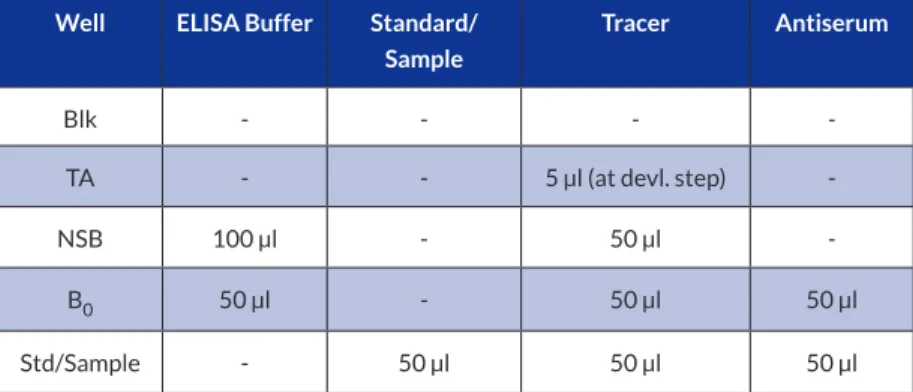
Well ELISA Buffer Standard/
Sample
Tracer Antiserum
Blk - - -
-TA - - 5 µl (at devl. step)
-NSB 100 µl - 50 µl
-B0 50 µl - 50 µl 50 µl
Std/Sample - 50 µl 50 µl 50 µl
Table 1. Pipetting summary
Incubation of the Plate
Cover each plate with plastic film (Item No. 400012) and incubate for two hours at room temperature on an orbital shaker.
Development of the Plate
1. Reconstitute Ellman’s Reagent immediately before use (20 ml of reagent is sufficient to develop 100 wells):
100 dtn vial Ellman’s Reagent (96-well kit; Item No. 400050): Reconstitute
with 20 ml of UltraPure water.
OR
250 dtn vial Ellman’s Reagent (480-well kit; Item No. 400050): Reconstitute
with 50 ml of UltraPure water.
NOTE: Reconstituted Ellman’s Reagent is unstable and should be used the same day it is prepared; protect the Ellman’s Reagent from light when not in use. Extra vials of the reagent have been provided should a plate need to be re-developed or multiple assays run on different days.
2. Empty the wells and rinse five times with Wash Buffer. 3. Add 200 µl of Ellman’s Reagent to each well.
4. Add 5 µl of tracer to the TA wells.
5. Cover the plate with plastic film. Optimum development is obtained by using an orbital shaker equipped with a large, flat cover to allow the plate(s) to develop in the dark. This assay typically develops (i.e., B0 wells ≥0.3 A.U. (blank subtracted)) in 60-90 minutes.
Reading the Plate
1. Wipe the bottom of the plate with a clean tissue to remove fingerprints, dirt, etc.
2. Remove the plate cover being careful to keep Ellman’s Reagent from splashing on the cover. NOTE: Any loss of Ellman’s Reagent will affect the absorbance readings. If Ellman’s Reagent is present on the cover, use a pipette to transfer the Ellman’s Reagent into the well. If too much Ellman’s Reagent has splashed on the cover to easily redistribute back into the wells, wash the plate three times with wash buffer and repeat the development with fresh Ellman’s Reagent.
3. Read the plate at a wavelength between 405 and 420 nm. The absorbance may be checked periodically until the B0 wells have reached a minimum of 0.3 A.U. (blank subtracted). The plate should be read when the absorbance of the B0 wells are in the range of 0.3-1.0 A.U. (blank subtracted). If the absorbance of the wells exceeds 1.5, wash the plate, add fresh Ellman’s Reagent and let it develop again.
22
ANALYSIS ANALYSIS23
ANALYSIS
Many plate readers come with data reduction software that plot data automatically. Alternatively a spreadsheet program can be used. The data should be plotted as either %B/B0versus log concentration using a four-parameter logistic fit or as logit B/B0versus log concentration using a linear fit. NOTE: Cayman has a computer spreadsheet available for data analysis. Please contact Technical Service or visit our website (www.caymanchem.com/analysis/elisa) to obtain a free copy of this convenient data analysis tool.
Calculations
Preparation of the Data
The following procedure is recommended for preparation of the data prior to graphical analysis.
NOTE: If the plate reader has not subtracted the absorbance readings of the blank wells from the absorbance readings of the rest of the plate, be sure to do that now.
1. Average the absorbance readings from the NSB wells. 2. Average the absorbance readings from the B0 wells.
3. Subtract the NSB average from the B0 average. This is the corrected B0 or corrected maximum binding.
4. Calculate the B/B0 (Sample or Standard Bound/Maximum Bound) for the remaining wells. To do this, subtract the average NSB absorbance from the S1 absorbance and divide by the corrected B0 (from Step 3). Repeat for S2-S8 and all sample wells. (To obtain %B/B0 for a logistic four-parameter fit, multiply these values by 100.)
NOTE: The TA values are not used in the standard curve calculations. Rather, they are used as a diagnostic tool; the corrected B0 divided by the actual TA (10X measured absorbance) will give the % Bound. This value should closely approximate the % Bound that can be calculated from the Sample Data (see page 25). Erratic absorbance values and a low (or no) % Bound could indicate the presence of organic solvents in the buffer or other technical problems (see page 29 for Troubleshooting).
Plot the Standard Curve
Plot %B/B0 for standards S1-S8 versus testosterone concentration using linear (y) and log (x) axes and perform a 4-parameter logistic fit.
Alternative Plot - The data can also be lineraized using a logit transformation. The equation for this conversion is shown below. NOTE: Do not use %B/B0 in this calculation.
logit (B/B0) = ln [B/B0/(1 - B/B0)]
Plot the data as logit (B/B0) versus log concentrations and perform a linear regression fit.
Determine the Sample Concentration
Calculate the B/B0 (or %B/B0) value for each sample. Determine the concentration of each sample using the equation obtained from the standard curve plot. NOTE: Remember to account for any concentration or dilution of the sample prior to the addition to the well. Samples with %B/B0 values greater than 80% or less than 20% should be re-assayed as they generally fall out of the linear range of the standard curve. A 20% or greater disparity between the apparent concentration of two different dilutions of the same sample indicates interference which could be eliminated by purification.
24
ANALYSIS ANALYSIS25
Spiked-Sample Recovery Calculation
10 x cpm of sample
[3H]-Testosterone added to sample (cpm)
Testosterone (pg) in purified sample =
Total Testosterone in sample (pg/ml) = Recovery Factor =
Testosterone (pg) in purified sample Volume of sample used for purification (ml) Value from ELISA (pg/ml)
Recovery Factor x 0.5 ml - added [
3H]-Testosterone (pg)
[
]
Performance Characteristics
Sample Data
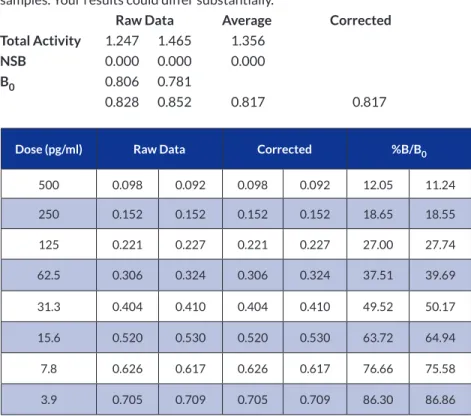
The standard curve presented here is an example of the data typically produced with this kit; however, your results will not be identical to these. You must run a new standard curve. Do not use the data below to determine the values of your samples. Your results could differ substantially.
Raw Data Average Corrected
Total Activity 1.247 1.465 1.356
NSB 0.000 0.000 0.000
B0 0.806 0.781
0.828 0.852 0.817 0.817
Dose (pg/ml) Raw Data Corrected %B/B0
500 0.098 0.092 0.098 0.092 12.05 11.24 250 0.152 0.152 0.152 0.152 18.65 18.55 125 0.221 0.227 0.221 0.227 27.00 27.74 62.5 0.306 0.324 0.306 0.324 37.51 39.69 31.3 0.404 0.410 0.404 0.410 49.52 50.17 15.6 0.520 0.530 0.520 0.530 63.72 64.94 7.8 0.626 0.617 0.626 0.617 76.66 75.58 3.9 0.705 0.709 0.705 0.709 86.30 86.86
26
ANALYSIS ANALYSIS27
Use data with confidence
%B/B 0 ____ %CV ----Testosterone (pg/ml) 0 20 40 60 80 100 0 20 40 60 80 100 1 10 100 1,000 Assay Range = 3.9-500 pg/ml Sensitivity (defined as 80% B/B0) = ~6 pg/ml Mid-point (defined as 50% B/B0) = ~20-50 pg/ml
The sensitivity and mid-point were derived from the standard curve shown above. The standard was diluted with ELISA Buffer.
Figure 5. Typical standard curve
Precision:
The intra- and inter-assay CVs have been determined at multiple points on the standard curve. These data are summarized in the graph on page 26 and in the table below. Dose (pg/ml) %CV* Intra-assay variation %CV* Inter-assay variation 500 4.4 7.7 250 4.6 2.8 125 6.1 4.7 62.5 6.0 7.2 31.3 6.6 7.5 15.6 9.9 8.5 7.8 14.0 10.7 3.9 19.1 14.2
Table 3. Intra- and inter-assay variation
*%CV represents the variation in concentration (not absorbance) as determined using a reference standard curve.
29
RESOURCES28
ANALYSISSpecificity:
Compound Cross Reactivity
19-Nortestosterone 140% Testosterone 100% 5a-dihydrotestosterone 27.4% 5b-dihydrotestosterone 18.9% Methyl Testosterone 4.7% Androstenedione 3.7% 11-keto Testosterone 2.2% 5-Androstenediol 0.51% Epi-Testosterone 0.2% Progesterone 0.14% Testosterone Enanthate 0.11% Androsterone 0.05% Androsterone Sulfate 0.04% Testosterone Sulfate 0.03% DHEA Sulfate 0.02% Estradiol <0.01% Testosterone Glucuronide <0.01%
Table 3. Specificity of the Testosterone Antiserum
RESOURCES
Troubleshooting
Problem Possible Causes Recommended Solutions
Erratic values; dispersion
of duplicates A. Trace organic contaminants in the water source
B. Poor pipetting/technique
A. Replace activated
carbon filter or change
source of UltraPure water
High NSB (>10% of B0) A. Poor washing
B. Exposure of NSB wells to
specific antibody
A. Rewash plate and redevelop
Very low B0 A. Trace organic
contaminants in the water source
B. Plate requires additional development time C. Dilution error in preparing
reagents
A. Replace activated
carbon filter or change
source of UltraPure water
B. Return plate to shaker and re-read later
Low sensitivity (shift in
dose response curve) Standard is degraded Replace standard Analyses of two dilutions
of a biological sample do not agree (i.e., more than 20% difference)
Interfering substances are present
Purify sample prior to analysis by ELISA4
Only Total Activity (TA)
wells develop Trace organic contaminants in the water source Replace activated carbon filter or change source of
30
RESOURCES RESOURCES31
References
1. Kicman, A.T. Biochemical and physiological aspects of endogenous androgens.
Handb. Exp. Pharmacol.195, 25-64 (2010).
2. Gomes, R.L., Meredith, W., Snape, C.E., et al. Analysis of conjugated steroid androgens: Deconjugation, derivatisation and associated issues. J. Pharm.
Biomed. Anal.49(5), 1133-1140 (2009).
3. Gower, D.B. Analysis of androgens and their derivatives, Chapter 6, in
Steroid Analysis. Makin, H.L.J. and Gower, D.B., editors, 2nd, Springer, New York, 457-558 (2010).
4. Maxey, K.M., Maddipati, K.R. and Birkmeier, J. Interference in enzyme immunoassays. J. Clin. Immunoassay15,116-120 (1992).
A
B
C
D
E
F
G
H
12
34
56
78
91
01
11
2
32
RESOURCESNOTES
Warranty and Limitation of Remedy
Buyer agrees to purchase the material subject to Cayman’s Terms and Conditions. Complete Terms and Conditions including Warranty and Limitation of Liability information can be found on our website.
This document is copyrighted. All rights are reserved. This document may not, in whole or part, be copied, photocopied, reproduced, translated, or reduced to any electronic medium or machine-readable form without prior consent, in writing, from Cayman Chemical Company.
©01/14/2016, Cayman Chemical Company, Ann Arbor, MI, All rights reserved. Printed in U.S.A.