Wayne State University Dissertations
1-1-2018
Scalable And Secure Provenance Querying For
Scientific Workflows And Its Application In Autism
Study
Fahima Amin Bhuyan
Wayne State University,
Follow this and additional works at:https://digitalcommons.wayne.edu/oa_dissertations
Part of theComputer Sciences Commons
This Open Access Dissertation is brought to you for free and open access by DigitalCommons@WayneState. It has been accepted for inclusion in Wayne State University Dissertations by an authorized administrator of DigitalCommons@WayneState.
Recommended Citation
Bhuyan, Fahima Amin, "Scalable And Secure Provenance Querying For Scientific Workflows And Its Application In Autism Study" (2018).Wayne State University Dissertations. 2011.
by
FAHIMA AMIN BHUYAN DISSERTATION
Submitted to the Graduate School of Wayne State University
Detroit, Michigan
in partial fulfillment of the requirements
for the degree of
DOCTOR OF PHILOSOPHY
2018
MAJOR: COMPUTER SCIENCE Approved By: ———————————————————– Advisor Date ———————————————————– ———————————————————– ———————————————————– ———————————————————–
Dedicated to my beloved husband Dr. Mohammad Shafkat Amin, my children Faaris Shadmehr Amin & Shehreen Farida Amin and
my mother Farida Begum.
I would first like to thank Almighty Allah for giving me the opportunity to pursue a Ph.D. degree in a fascinating field of Computer Science, for giving me a passion for
research, for protecting me, for answering my prayers, and for giving me the strength to persevere. I firmly believe, coming to Wayne State University to work with my advisor Dr. Shiyong Lu was a major decision in my life.
I would also like to express my profound and sincere gratitude to my advisor Dr. Shiy-ong Lu, for his constant encouragement, guidance, and support throughout my Ph.D. stud-ies. Dr. Lu’s vision and suggestion have enabled me to remain focused and to succeed in
my studies. I am deeply thankful for Dr. Lu’s empathy and kindness. I am also very grate-ful to all my dissertation committee members: Dr. Robert Reynolds, Dr. Alexander Kotov, and Dr. Jia Zhang, for being on my dissertation committee and for providing their helpful
feedback, valuable comments, and constructive suggestions.
I would also like to thank my bright academic colleagues from the Big Data Research Laboratory: Ishtiaq Ahmed, Changxin Bai, Dr. Andrey Kashlev, Dr. Aravind Mohan, Dr.
Dong Ruan, Dr. Mahdi Ebrahimi for their academic cooperation and close friendship, as well as alumni Dr. Artem Chebotko, Dr. Cui Lin, Dr. Chunhyeok Lim.
I am especially thankful to my beloved husband, Dr. Mohammad Shafkat Amin.
Through-out my study he has always been supportive, helpful, friendly, and has protected me from all the challenges life has given, with a smiling face. It was his faith in me which kept me going through rough times. I am thankful to my children Faaris Shadmehr Amin and
Shehreen Farida Amin, who have been incredibly supportive throughout my studies. With-out their immense sacrifices, it would not have been possible for me to complete my
My sincere gratitude goes to my mother Farida Begum and my father Dr. Aminul Haque Bhuyan. I am truly thankful to my two sisters Saima Amin Bhuyan and Shaila Amin
Bhuyan, for their unconditional love, encouragement and support since childhood. My special thanks to my niece, Aura Simrah Choudhury.
Dedication . . . ii
Acknowledgements . . . iii
Introduction . . . 1
Chapter 1 PROBLEM FORMULATION . . . 5
1.1 The OPM Provenance Model . . . 5
1.2 The PROV-DM Provenance Model . . . 7
1.3 Provenance Query Language: OPQL . . . 9
1.3.1 Apache Pig . . . 10
1.4 Provenance Security . . . 12
1.4.1 Role Based Access Control (RBAC) . . . 12
Chapter 2 RELATED WORK . . . 15
2.1 Related Work of Provenance . . . 15
2.1.1 Provenance Query and Big Data Provenance . . . 15
2.1.2 Provenance Capture and query in Scientific workflow systems . . . . 16
2.1.3 Provenance Analysis and Visualization . . . 18
2.1.4 Provenance Models and Applications . . . 19
2.2 Related Work on Provenance Security . . . 20
2.3 Related Work on Autism, Scientific Workflow and Machine Learning . . . 22
Chapter 3 SCALABLE PROVENANCE QUERY FRAMEWORK . . . 25
3.1 OP QLP ig Querying Framework . . . 26
3.1.1 Storage Engine . . . 28
3.1.2 Query Engine . . . 28
3.2.1 Provenance Constructs . . . 29
3.3 TranslatingOP QLto Pig Latin . . . 31
3.4 OP QLP ig: A Case Study . . . 36 3.4.1 Step 1 . . . 38 3.4.2 Step 2 . . . 39 3.4.3 Step 3 . . . 40 3.4.4 Step 4 . . . 40 3.5 Experiments . . . 41
3.5.1 Data Preparation with benchmark . . . 41
3.5.2 Performance Study . . . 42
3.5.3 Primitive or Built-in Query Constructs in DATAVIEW . . . 45
3.5.4 Executable Query Constructs in DATAVIEW . . . 46
3.6 Conclusions and Future Work . . . 51
Chapter 4 SECURITY MANAGEMENT IN PROVENANCE . . . 54
4.1 Introduction . . . 54
4.1.1 Security in Workflow vs. security in Provenance . . . 55
4.1.2 Examples for Importance of Provenance Security . . . 56
4.2 Provenance security framework . . . 58
4.3 Provenance Security Policy Life Span . . . 60
4.4 Security Policy Specification . . . 61
4.4.1 Task Level Specification . . . 61
4.4.2 Port Level Specification . . . 63
4.5 Security Policy Enforcement . . . 65
4.6 Security Policy Quality Requirements and Analysis . . . 67
4.6.1 Consistency . . . 67
4.6.2 Completeness . . . 69
4.6.3 Conciseness . . . 69
4.7 Security Policy Evolution . . . 73
4.8 ProvSec Prototype and Services . . . 73
4.8.1 Performance Study . . . 77
4.9 Conclusion and Future Work . . . 77
Chapter 5 PREDICTING ONSET OF AUTISM USING SCIENTIFIC WORKFLOWS 79 5.1 Introduction . . . 80
5.2 Background . . . 81
5.3 Problem statement . . . 83
5.4 Proposed Work . . . 84
5.4.1 Predictors of Improvement in Treatment Response . . . 84
5.4.2 Methods . . . 85
5.4.3 Modeling Scientific Workflow . . . 86
5.5 Implementation and Experiments . . . 87
5.5.1 DATAVIEW: A Big Data Workflow Management System . . . 87
5.5.2 SFARI Dataset . . . 89
5.5.3 Running Random Forest Algorithm in DATAVIEW . . . 90
5.5.4 Running Support Vector Machine Algorithm in DATAVIEW . . . 91
5.7 Conclusion and Future Work . . . 94
Chapter 6 CONCLUSIONS AND FUTURE WORK . . . 95
APPENDIX A: A Big Data Scientific Workflow Management Tool DATAVIEW . . . . 97
APPENDIX B: What is Autism Spectrum Disorder (ASD) . . . 99
References . . . 102
Abstract . . . 119
Autobiographical Statement . . . 121
Table 1 PROV-DM Core Concepts Mapping to Types and Relations [4]. . . 9
Table 2 Provenance Graph Nodes and Corresponding Node Identifiers. . . 36
Table 3 Representing Provenance Graph Relations of Fig. 8. . . 38
Table 4 Some Sample Queries from UTPB Benchmark. . . 38
Table 5 The Result of each UTPB Query in DATAVIEW. . . 53
Table 6 RBAC Security Specification for “Used" and “wasGeneratedBy" Relation. 67 Table 7 Role Based Access Control Policy for Provenance System. . . 68
Table 8 Factors Involved for Predicting Treatment Outcomes. . . 87
Table 9 Feature Prediction Based on Timestamp. . . 87
Table 10 Selected Features Based on Each Dataset. . . 90
Figure 1 OPM Provenance Model. . . 6
Figure 2 PROV-DM Provenance Model. . . 9
Figure 3 The Framework of Apache Pig. . . 11
Figure 4 OP QLP ig Architecture. . . 27
Figure 5 Driver Function of Multi-step USD* Construct. . . 32
Figure 6 Algorithm for Single-step USD Construct. . . 33
Figure 7 Algorithms for Multi-stepU SD∗ Construct. . . 35
Figure 8 A Sample Provenance Graph for Provenance Data Capturing [34]. . . 37
Figure 9 Graphical Representation of Query Processing Steps. . . 39
Figure 10 Dataset Size Vs. Number of Instances. . . 43
Figure 11 The Number of Nodes and Relations per Instance in Dataset. . . 43
Figure 12 Average Query Time for USD* Construct. . . 44
Figure 13 Average Query Time for WGB* Construct. . . 44
Figure 14 DATAVIEW with Primitive Query Construct Workflows. . . 45
Figure 15 DATAVIEW Query Execution for Composite Query 1. . . 47
Figure 16 DATAVIEW Query Execution for Composite Query 2. . . 48
Figure 17 DATAVIEW Query Execution for Composite Query 3. . . 49
Figure 18 DATAVIEW Query Execution for Composite Query 4. . . 50
Figure 19 DATAVIEW Query Execution for Composite Query 5. . . 51
Figure 20 DATAVIEW execution time for Composite Queries. . . 51
Figure 21 Autism Workflow. . . 57
Figure 22 Provenance of Autism Workflow. . . 57
Figure 23 Provenance Security Policy Life Span. . . 61
Figure 24 Task Level Security Specification. . . 63
Figure 25 Port Level Security Specification. . . 64
Figure 26 Data Channel Level Security Specification. . . 65
Figure 29 Workflow Permission for Teachers in Autism Provenance System. . . . 75
Figure 30 Security View of Teachers in Autism Provenance System. . . 75
Figure 31 Workflow Permission for Therapists in Autism Provenance System. . . 75
Figure 32 Security View of Therapists in Autism Provenance System. . . 76
Figure 33 The Average Time to Generate Provenance Access Control Policies. . 77
Figure 34 Overall View of Autism Spectrum Disorder. . . 82
Figure 35 Treatment Improvement Predictor. . . 85
Figure 36 Running Workflow Predicting Classes on Data Mining Technique. . . 88
Figure 37 RF Workflow in DATAVIEW. . . 92
Figure 38 PR Curve Based on Random Forest. . . 92
Figure 39 SVM Workflow in DATAVIEW. . . 93
Figure 40 PR Curve Based for Support Vector Machine. . . 93
Figure 41 DATAVIEW: A big data scientific workflow management tool. . . 98
Figure 42 Autism Spectrum Disorder Personal Traits . . . 99
Figure 43 Autism Spectrum Disorder Social Competence . . . 100
Figure 44 Autism Spectrum Disorder Medical History . . . 101
INTRODUCTION
Provenance is information about the history, origin, derivation, and context of data. Provenance management has become critical in various data systems such as database, workflow, and web systems [29, 46, 99]. For example, all major scientific workflow sys-tems [122, 133, 114, 48, 44] support provenance. The past few years have witnessed the much progress on provenance standardization, including OPM [100] and PROV [96], and active community engagement in the provenance challenge series [2]. Provenance is useful to interpret analysis of results, to repeat a scientific discovery, and to trace errors in data. Provenance is also useful to answer data lineage queries and decide the trustworthi-ness of a data product.
With the advent of internet scale data, the complexity of scientific workflows and en-suring provenance management systems have grown significantly. Traditional approaches to provenance queries do not adapt adequately to account for this scale, necessitating scalable provenance query and data management systems. As science becomes more and more interdisciplinary and collaborative, the notion of collaborative scientific workflows
has been proposed to address the increasing need of collective data analytics using the scientific workflow paradigm [90, 125, 132, 131, 55]. In such collaborative environments, adequate access control policies are necessary to safeguard sensitive information and fa-cilitate privacy-aware sharing of workflows, data products, and provenance information among collaborating parties [36].
It has been well recognized that the general provenance security problem is critical for modern scientific workflow systems [36, 92]. Unauthorized access to provenance might disclose confidential information about the related data products. The code for collecting, querying and mining of provenance can be compromised, forged, or replayed by intruders. The linkages among data products, provenance, and workflow specifications can be sev-ered or forged in a malicious environment. Compromised provenance can lead to misinter-pretation of analysis results, unintentional errors, and can compromise the confidentiality
of related datasets. In this research, we focus on the confidentiality of provenance so that provenance is accessible only to authorized users. This is important because provenance often encodes the detailed protocol of a scientific experiment and constitutes the intel-lectual property of the respective stakeholders. Various access control mechanisms have been proposed for the protection of the confidentiality of scientific workflow provenance [36, 92]. This is significantly underscored in workflows that process sensitive health or financial information.
In contrast to business workflows, which are relatively stable over time, scientific work-flows tend to evolve rapidly as scientists frequently generate, explore, and test multiple hypotheses about a scientific problem simultaneously [57]. For example, an existing work-floww1might be extended with additional sub-workflows into workfloww11to perform the more advanced scientific analysis. The sub-workfloww11can be further evolved into w111 andw112with additional sub-workflows, tasks, and data channels. All these workflows can be used simultaneously to explore different hypotheses or to perform different but related scientific analysis. As a result, it is important to evolve the corresponding access control policies as well. In dealing with such large sets of evolving policies, manually checking the quality of each policy becomes impractical, and automated analysis algorithms for access control policies of scientific workflow provenance are necessary to ensure the correctness and performance of the policy enforcement engine.
One domain, that could benefit from automation, computational power, and data in-tegrity that comes with scientific workflow, is in therapeutic treatment planning in autism spectrum disorders. Scientific workflows could seamlessly integrate disparate data sources, consolidate wisdom of the crowd, and harness the power of machine learning to aid ser-vice providers with their therapy and serser-vice planning. This, however, is a data-intensive process and requires an underlying provenance system that is flexible and scalable enough to cater to a deluge of data. Heterogeneity in data collections with disparate and sparse data sources make composing the workflow challenging and maintaining the provenance
system complex. In this research, we demonstrate the complexity and scale requirement of next-generation provenance systems by introducing a scientific workflow that consolidates heterogeneous data sources to predict efficacy of therapeutic services of autism spectrum disorder. This big scale data, inherent in such domains, has brought forth a new research direction.
With autism on the rise and a lack of retrospective study in management and alignment of behavior intervention and educational plan and how it affects the manifestation of ASD symptoms, parents, and the community at large are finding it challenging to individualize forward-looking goals and educational plans for kids with ASD. There is a flurry of anecdo-tal evidence, parent, caregiver and therapist data, that, if mined retrospectively, can lead to better understanding of how appropriate goals, given a child’s traits and needs, could po-tentially mitigate autistic behavior and result in overall improvement. In this work, we aim to delineate a scientific workflow framework that can be employed to apply data-mining techniques to improve predictability in the domain of autism spectrum disorder.
In Big data research, the provenance of big data [60, 59, 63, 33, 7] plays a major role. Big data provenance deals with many research challenges and open issues which need deep investigation like confidentiality of the data provenance process, secure and privacy-preserving big data provenance, flexible big data provenance query tools, etc [45]. One of the platforms used for handling big data provenance is Pig. Pig is a platform for analyzing large datasets on top of Hadoop, with a rich, multi-valued and nested data model. Pig’s language, Pig Latin is a comprehensive imperative query language that lets us express data transformations such as filtering datasets, merge them and apply functions to a groups of records. It is simple to understand data flow language, yet a fast iterative language with strong MapReduce compilation engine. Pig Latin gives a level of abstraction from MapReduce procedural model by providing join and filter like relational style operators which do not have out-of-the-box analogs in MapReduce framework.
we present the core concepts of provenance models along with scalable query and secure access control policies. In Chapter 2, we review research background on reasoning and analysis of secure and scalable workflow provenance system. In Chapter 3, we propose our query language and create the constructs to facilitate complex queries in a visual workflow style. In Chapter 4, we propose secure access control policies and validate it with policy quality requirements. In Chapter 5, we explore the use of data mining approaches in the DATAVIEW workflow system to understand the initial feasibility of our approach. Finally, in Chapter 6, we draw concluding remarks of the dissertation and provide the directions for future work.
CHAPTER 1 PROBLEM FORMULATION
Provenance refers to the information about the derivation history of a data prod-uct [46, 35]. It is important for evaluating the quality and trustworthiness of a data product and ensuring the reproducibility of scientific discoveries [64, 41]. Much research has been done on storing and querying scientific workflow provenance - a provenance that is produced in the execution of data-centric scientific workflows [35, 14]. Since scientific workflow provenance are essentially directed acyclic graphs, a leading trend of querying models is the graph-based querying models, represented by two provenance graph query languages: OPQL [85] and QLP [14]. While QLP provides query constructs for querying both structure and lineage information in provenance graphs, OPQL, in addition, supports the Open Provenance Model [100], a community-driven data model, which captures main aspects of the workflow provenance and does not enforce a particular physical representa-tion of the provenance data.
1.1
The OPM Provenance Model
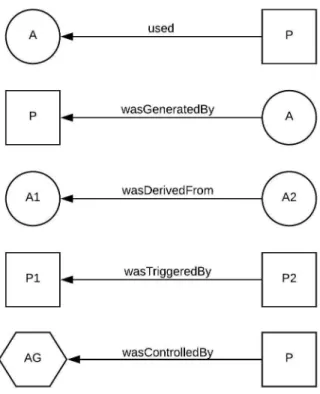
The Open Provenance Model (OPM) is the first community-based provenance model that supports the digital representation and inference of provenance [91]. In this model, provenance data is modeled as directed acyclic graphs in which there are three types of nodes,Artifact,Process, andAgent, and five types of edges,Used,WasGeneratedBy, WasCon-trolledBy,WasTriggeredBy, andWasDerivedFrom. In the domain of big data workflows, for example, artifacts are mapped to data products, processes are mapped to workflow tasks, andagents are mapped to data scientists who perform the execution of a workflow task. Meanwhile,Used links a workflow task to an input data product;WasGeneratedBylinks an output data product to a workflow task;WasControlledBylinks a workflow task to the data scientist who performs its execution;WasTriggeredBylinks a downstream workflow task to an immediate upstream workflow task, andWasDerivedFrom links an output data product of a workflow task to an input data product of the same workflow task. The OPM model is illustrated in Figure 1. The OPM model specification does not include querying languages
for provenance, which is the motivation for efforts including OPQL and QLP. Formally, a provenance graph PG = (N, E) consists of:
• a set of nodesN =AS
P S
AG, where A is a set of artifacts, P is a set of processes, and AG is a set of agents;
• a set of directed edges E =Eu SEg SEdSEtSEc
where i)Eu ⊆P×A and (p, a)∈Eu states that process pused artifact a.
ii)Eg ⊆A×P and (a, p)∈Eg states that artifact a was generated byprocess p.
iii)Ed ⊆A×A and (a1,a2)∈Ed states that artifacta1 was derived fromartifacta2. iv)Et ⊆P×P and (p1,p2) ∈Et states that processp1 was triggered byprocessp2. v)Ec ⊆P×AG and (p, ag)∈Ec states that process pwas controlled byagent ag.
1.2
The PROV-DM Provenance Model
Another provenance data model was introduced in 2013, named PROV-DM. Fig. 2 rep-resents PROV-DM provenance model. The PROV provenance model is more generic and domain-agnostic. The PROV set of specifications is designed to promote easily exploited nodes and relations for modeling specific domains. This provenance model offers interop-erability across diverse provenance management systems and accommodates data genera-tion from a diverse data sources.
PROV provenance model has flexibility when it deals with attributes. Most of the prove-nance statements are annotated with optional attributes. This proveprove-nance model has a mechanism for asserting provenance of provenance specified as ’bundles’. To avoid to make the model unnecessary complex, PROV-DM does not model uncertainty. In Table. 1, we can see the types and relations in PROV-DM.
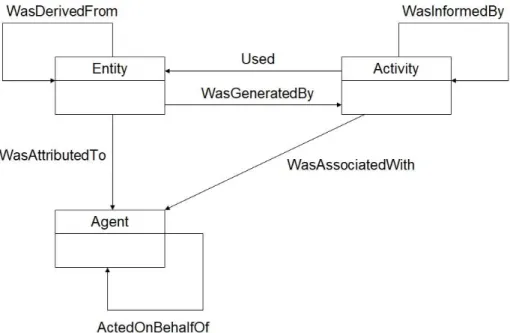
The PROV-DM provenance model is the conceptual data model that forms a basis for the W3C provenance (PROV) family of specifications [61], which currently contains four recommendations and eight notes. PROV-DM is one of the four recommendations, be-sides PROV-O, the PROV ontology, an OWL2 ontology allowing the mapping of the PROV data model to RDF; PROV-NA, a notation for provenance aimed at human consumption; PROV-CONSTRAINTS, a set of constraints applying to the PROV-DM data model. Like OPM, PROV-DM also models provenance as a directed acyclic graph, in which there are three types of nodes, Entity, Activity, and Agent, and seven types of edges, Used, Was-GeneratedBy, WasAssociatedWith, WasInformedBy, WasDerivedFrom, ActedOnBehalfOf, and
WasAttributedTo. The number of types of nodes in PROV-DM is the same as in OPM, but their names are different. In PROV-DM,Artifact becomesEntity,Process becomesActivity, andAgentremains the same. Moreover, two edge types are introduced: ActedOnBehalfOf, to model delegation relationships between agents, andWasAttributedTo, to model attribu-tion of entities to agents; and two edge types are renamed: WasTriggeredBy was renamed toWasInformedBy, and WasControlledBy toWasAssociatedWith. In the domain of big data
workflows, for example, entities are mapped to data products, activities are mapped to workflow tasks, and agents are mapped to data scientists who perform the execution of a workflow task. Meanwhile, Used links a workflow task to an input data product; Was-GeneratedBy links an output data product to a workflow task; WasAssociatedWith links a workflow task to the data scientist who performs its execution; WasInformedBy links a downstream workflow task to an immediate upstream workflow task, WasDerivedFrom
links an output data product of a workflow task to an input data product of the same work-flow task, ActedOnBehalfOf links a data scientist to another, and WasAttributedTo links a data product to a data scientist. The PROV-DM model is illustrated in Figure 2. Like OPM, the PROV-DM model specification does not include querying languages for provenance either. Formally, a provenance graph PG = (N, E) in PROV-DM consists of:
• a set of nodes N = EN S
AC S
AG, where EN is a set of entities, AC is a set of activities, and AG is a set of agents, based on the PROV-DM model.
• a set of directed edges E =Eu SEg SEdSEi SEaSEab SEat
where i)Eu ⊆AC×EN and (ac, en)∈Eu means that activity acused entity en.
ii)Eg ⊆ EN × AC and (en, ac) ∈ Eg means that entity en was generated by activity
ac.
iii)Ed ⊆EN×EN and (en1,en2) ∈Edmeans that entity en1 was derived fromentity
en2.
iv)Ei ⊆AC×AC and (ac1,ac2)∈Eimeans that activityac1was informed byactivity
ac2.
v)Ea ⊆AC×AG and (ac, ag)∈Ea means that activity acwas associated with agent
ag.
vi)Eab⊆AG×AG and (ag1,ag2)∈Eabmeans that agentag1 acted on behalf of agent
ag2.
Figure 2: PROV-DM Provenance Model.
Table 1: PROV-DM Core Concepts Mapping to Types and Relations [4]. PROV concepts PROV-DM types or relations Name
Entity Entity
Activity PROV-DM Types Activity
Agent Agent
Generation WasGeneratedBy
Usage Used
Communication WasInformedBy
Derivation PROV-DM Relations WasDerivedFrom
Attribution WasAttributedTo
Association WasAssociatedWith
Delegation ActedOnBehalfOf
1.3
Provenance Query Language: OPQL
OPQL (Open Provenance Query Language) is a provenance query language that en-ables the querying of provenance directly at the graph level. One advantage of OPQL is that, OPQL queries are tightly coupled to the underlying provenance storage strategies. As a result, OPQL can be implemented on top of various storage or database systems. Another advantage of OPQL is its practical expressiveness: a provenance query formulated in OPQL is more concise than its counterparts in other query languages such as SQL, SPARQL, and XQuery, which often need recursive formulation for lineage queries [85]. OPQL includes
six types of graph patterns, a provenance graph algebra, and has clear syntax and seman-tics to support querying provenance at the graph level. The initial implementation of OPQL shows the feasibility and efficiency of OPQL [85, 84]. A basic OPQL query can be defined in the following ways:
• Single node constructA,P, andAG.
• Single-step-edge-forward constructsU SD, W GB,W CB,W DF, andW T B.
• Single-step-edge-backward constructsU SD∧ ,W GB∧ ,W CB∧ ,W DF∧ , andW T B∧ . • Multi-step-edge constructsU SD∗,W GB∗,W DF∗,W T B∗,W DF∧ ∗andW T B∧ ∗. In addition, composite queries can be composed from basic queries by connectives UNION, INTERSECT, or MINUS. OPQL is based on the OPM provenance model. This paper extends OPQL to OPQL 2.0 to support the PROV-DM provenance model.
1.3.1 Apache Pig
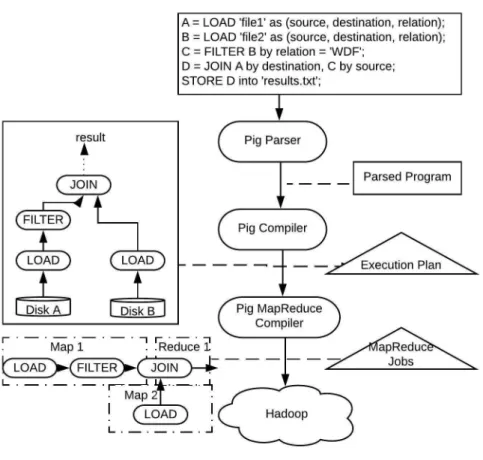
Apache Pig is a fairly competitive framework for processing and continuous optimiza-tion, enhanced with new features and maintained by Yahoo! Researchers [109]. It is a platform for analyzing large data sets. Pig’s language, Pig Latin, is a simple to understand data flow language. Its query algebra expresses data transformations such as merging data sets, filtering them and applying functions to records or groups of records. This supports rich, multi-valued and nested operations on large datasets. Pig Latin scripts describe Di-rected Acyclic Graph where edges are data flows, and the nodes are operators that process the data [1]. Pig is extensible to a user-defined function written in Java and other lan-guages. Pig scripts provide a high-level language to create the map-reduce jobs needed to process data in Hadoop cluster [1]. In Fig. 3, the overall framework of Apache pig is presented graphically.
The advantage of using Apache Pig is that it is independent of Hadoop framework changes and can be benefited by all the optimization techniques offered by Pig developer
Figure 3: The Framework of Apache Pig.
community. Moreover, as Pig is backward compatible, further developments or optimiza-tions will not affect any single line of code. During runtime, the resulting Pig Latin script automatically maps into a sequence of MapReduce iterations. Hence, complicated deploy-ment, configuration or installation do not require. We use Pig Latin operator in our transla-tion. One benefit of choosing Apache Pig to implement OPQL is that, further optimization and development in both the MapReduce community and the Apache Pig community can immediately benefit OPQL users, which do not need to rewrite a single OPQL query.
We explain each instruction of pig performed in our case in the later section. The more detail description of each operation of Apache Pig is in Pig Latin Manual [1].
1.4
Provenance Security
Recently, the notion of collaborative scientific workflows has been proposed to ad-dress the increasing need for collaborative data analytics using the scientific workflow paradigm. In such collaborative environments, adequate access control policies are neces-sary for controlling the sharing of workflows, data products, and provenance information among collaborating parties. In particular, the protection of workflow provenance is criti-cal as such provenance often encodes the detailed protocol of a scientific experiment and constitutes the intellectual property of the respective stakeholders. Meanwhile, scientific workflows feature quick evolution; therefore, corresponding access control policies for workflow provenance need to evolve as well, and it is important to ensure that the evo-lution of workflow provenance access control policies meets certain qualities to guarantee the correctness and performance of the policy enforcement engine.
1.4.1 Role Based Access Control (RBAC)
Role Based Access Control (RBAC) consists of the following components: U, R, P, S. Here U stands for a set of users in a system, R stands for a set of rules, P for permission and S for the session. In a dynamic system, User (U) might change, where a user might join or leave; Role (R) might change, an administrator might add more roles in the system or delete some roles from the system, and Permission (P) also might change.
The policy access control rights are associated with roles, where access rights are given to specified roles for accessing certain resources. Users are assigned to designated roles and be part of access control policies. Users can authenticate themselves through activation of one or more roles for themselves.
Some benefits of using Role-based access control are:
• Policy doesn’t require to be updated when a certain user with a role leaves the system.
• When a new user assigned to an active role, all the required resources automatically allocated to the user for that role.
• Revisiting least privilege, which means a user in one role has access to a subset of resources, and when they switch roles they gain access to other resources.
In RBAC, permission can be set based on objects with their actions. The action rep-resents the operation performed on the object which could be read or write operation or in perspective of database it could be select, update, delete operations, etc. The sign for permission is either positive or negative. Positive permission means positive authoriza-tion where a particular acauthoriza-tion is allowed on this object and negative permission means authorization of action on that object is not permitted.
There is permission assignment function which assigns permission to roles. For each role, this function assigns a set of permissions where an input is a role and output is a set of permission. This is a subset of the cross product of R ×P. For particular function, different permission can be assigned for a role in a different time frame. The assigned permission for a role can be changed over time to different permission.
In RBAC, there is also a user assignment function. One of the typical examples of user assignment function is one student who designated as a GRA now can be later appointed as GTA. In user function, each session assigns to a single user. The session is not shared between users, and each session only allows one user. But role can be different in a specific session. For example, for log-in a particular terminal in Unix, where a user can be a regular user or pseudo-user.
The administrator’s job is to specify access control policy first regarding the access rights. In policy enforcement phase, policies are enforced when users perform actions. The action rights are determined by access control policies. In other words, if access control policies are positive then the task can be executed; otherwise, the task cannot be accomplished. Concerning the databases, access control policies are consulted first before the update a table or delete a row or update a column, etc. Similarly, to open a file, close a file, delete a file, update a file, append a file in the operating system, we can also use access control policies to control the access to files. Policy analysis observes all the
actions performed in a particular system either in the database system, workflow system or operating system. Policy analysis evaluates the quality of the policy and then determine how to improve the quality of policy.
CHAPTER 2 RELATED WORK
2.1
Related Work of Provenance
In general, the provenance management system deals with efficiency and effective-ness of capturing, storing, representing, querying, and visualizing provenance data. In this chapter, we first discuss the provenance capture in perspective of different existing scientific workflow provenance management systems. We then discuss related work on provenance models and applications as well as their analysis and visualization. Lastly the recent trends in provenance query and big data provenance state-of-the-art frameworks, methods and mechanisms are presented.
2.1.1 Provenance Query and Big Data Provenance
Provenance problems become prohibitive and very hard to solve when applied to big data repositories. There are many avenues of research challenges and open issues in big data provenance research [52, 53]. Several relevant and advanced concepts and chal-lenges in big data provenance research can arise. They include accessing big data, an-alyzing big data, scalability issues, information sharing, query optimization issues, data modeling support for provenance, flexible provenance query tools, etc. [119]. Reduce and Map provenance (RAMP) [72, 103] is one of such big data provenance systems that pro-poses a wrapper based method as an extension of Hadoop by deploying on top of Hadoop. Another extension of Hadoop for implementing provenance detection in MapReduce jobs is called Hadoop-Prov [119, 9]. The proposed system minimizes overheads and computes provenance by providing flexible tools for querying the big data provenance graph.
There is a hybrid big data provenance system named Pig Lipstick [13], that combines the management of fine-grained dependencies, with the management of workflow-grained dependencies [119, 13]. Fine-grained dependencies are typical of database-oriented nance systems, and workflow-grained dependencies are typical of workflow-oriented prove-nance systems. Another type of big data proveprove-nance supports the functionalities of layer-based architecture by focusing on provenance collection, querying and visualization of
provenance in the context of specialized scientific applications [7]. In the cloud envi-ronment, there is a proposed framework for integration, modeling and monitoring data provenance called CloudProv [120]. For real-time applications, this framework continu-ously acquires and monitors all of the collected provenance information. Another proposed big data provenance framework [59] is based on fine-grained provenance through several operator instrumentations of a query. An innovative privacy-preserving public auditing mechanism in untrusted Cloud environments is Oruta [127]. This mechanism supports data sharing.
2.1.2 Provenance Capture and query in Scientific workflow systems
There are several scientific workflow provenance management system working towards data collection and capturing provenance.
In Kepler [25, 26] the provenance framework is called Collection Oriented Modeling and Design (COMAD) for nested data collections and captures explicit data dependencies. Here provenance information is automatically stored in the relational database with all immediate and transitive closure dependencies derived from provenance reasoning for each node [123, 15]. The COMAD-Kepler provenance system supports the querying of the imported provenance metadata through a high-level query language and an external reasoning engine.
Taverna [97, 95] keeps a logbook plugin based on a provenance ontology to capture provenance information from the workflow. The provenance collection plugin captures both internal provenances locally generated by workflow, and external provenance gath-ered from third party data providers. Taverna supports the use of a fine-grained data lineage model to perform query collection-based workflow provenance effectively [98]. To store, manage and query provenance, Taverna uses RDF store mechanism and Semantic Web technologies for representing provenance metadata.
Karma [113] captures both process and data provenance from a user-driven work-flow system by storing provenance meta-data in a two-layer information model. Karma’s
provenance model layers are registry level and execution level. Registry level records the metadata of services and data that may be used in an execution sequence. An execution level models instances of the registry level and records the execution-related information of data products generated by each invocation [31]. To store and query provenance meta-data Karma uses XML and relational meta-database technologies [31, 126, 112].
In VisTrails [111, 57], the provenance management system captures provenance infor-mation by using change-based provenance mechanism for data products. Also captures all the generated data products in the process of evolution of workflow. This uses relational database and XML to store and query provenance metadata. The provenance management system queries are supported by XQuery for querying exported XML specification and im-plementing recursive functions to query the transitive closure dependencies. VisTrails can visualize query results by matching query conditions with the VisTrails query language (vtPQL).
Another scientific workflow management system is Swift [134]. It uses provenance for on-demand data generation, tracking the data derivation history, and data product vali-dation. Swift also uses the relational database in order to manage and query provenance metadata.
VIEW [35, 84, 124, 107] supports provenance store and query for both prospective and retrospective provenance collection. Two independent systems RDFProv and OPM-Prov [37, 85] has developed under the umbrella of the VIEW system. The noWorkflow system [101] captures provenance information from scripts and YesWorkflow [94] pro-vides a script with an annotation mechanism to describe prospective provenance.
Panda [73] is a general purpose open-source system that supports provenance cap-ture, storage, operator, and queries. This system seamlessly merges both data-based and process-based provenance. It also develops a model and system from fine-grained to coarse-grained provenance, defines useful operators for taking advantage of captured provenance, defines general purpose language for querying, and analyzes provenance and
combining provenance with relevant data.
2.1.3 Provenance Analysis and Visualization
Provenance visualization can be classified into two ways: workflow management sys-tems that have built-in provenance visualization and standalone provenance visualization tools [79]. The built-in provenance visualization tools [11, 30, 70] allows the easy integra-tion of provenance collecintegra-tion and analysis. However, they do not support the visualizaintegra-tion of data by other workflow management systems and different standalone provenance gath-ering tools. These built-in provenance visualizations in workflow management systems also have shortcoming for viewing graph manipulation features for provenance graphs.
On the other hand, there are standalone provenance visualization tools. Provenance explorer [40] dynamically generate customized views of provenance trail by taking RDF-based provenance outputs from capture system. This provenance model is RDF-based on the ABC ontology model and lacking the support for data processing activities in the digital domain. Hence, they support only one expansion level instead of multiple levels of detail. The ZOOM prototype allows users to dynamically update the provenance graph for the new view by hiding irrelevant information. It supports users with an interface to query provenance information through SQL queries which generated by a workflow system.
There is a web-based visualization tool based on the PROV-DM model called PROV-O-Viz [68]. This tool uses Sankey Diagrams for visualization to visualize flow magnitude be-tween nodes in a network. Provenance Explorer is limited to specific domains and ZOOM, PROV-O-Viz requires additional knowledge, they are not compatible with provenance data from other tools like Kepler, VisTrails, Taverna. The stand-alone tools provide some inter-esting features such as interactive graphs, summary nodes, level of details, filters, merges, but do not implement them in an integrated way.
There is another prototype system called Provenance Difference Viewer (PDiffView) that enables users to compare the differences between two runs which is two provenance graphs of the same workflow specification. Based on [135], the PROV Translator tool
provides graph visualizations.
2.1.4 Provenance Models and Applications
In a provenance management system, one of the main issues is to make the system in-teroperability among different scientific workflow management systems. IPAW workshop first initiated this idea in 2006 through Provenance Challenge series and as a result came up with standardized provenance model called Open Provenance Model (OPM). The OPM model [3, 6, 104] efficiently allows provenance information exchange between systems regardless of compatibility layer on shared provenance model. This model defines prove-nance in a precise and technology-agnostic manner, facilitate developers to build and share tools to operate on any such provenance systems, defines a set of core rules to identify the valid inferences that can make on provenance representation. OPM was originally crafted in2007and released to the community with version OPMv1.00. Later revised in2008with version OPM v1.01and again in2009with OPMv1.1. OPM uses directed graph to express the dependencies.
Recently, the well-accepted provenance model is PROV-DM. PROV-DM was adopted here because of its core structures to distinct extended structures toward a step forward to interoperability. Core structures provide domain-agnostic vocabularies by serving essence of provenance information, whereas extended structures are more towards enhancing and refining more significant capabilities for more advanced uses of provenance.
Only a few of scientific workflow system have adopted the PROV extension. Taverna is one of them [15]. DataONE scientific workflow and provenance working group specified D-PROV provenance model [96]. Few PROV applications use and extend PROV, the name of those projects are UrbanMatch [118, 32], which extends PROV model by using Human computation ontology and CollabMap [105], to record provenance information that logs citizens actions [96].
2.2
Related Work on Provenance Security
For business workflows, the importance and requirements of security are well under-stood [117, 49, 24, 8, 67, 23, 17]. In perspective of the workflow system, the requirements for security can be managed by either the workflow system itself [121] or by an outside engine [42]. Most of the security work has been done in authentication [93], authoriza-tion [128, 18, 69, 108, 115, 76], data privacy and secure workflow models [71, 75]. The security issues of provenance have recently been identified by some researchers [27, 116]. The authors of [38] formalize a model for provenance with security properties like dis-closure and obfuscation on workflow provenance graph, database queries, and automata. They explain the most general form of provenance for the system through traces. Their framework defines primarily the static provenance situation, not dynamic provenance in an existing system.
In [28, 66], the authors address a number of research questions on provenance secu-rity and develop a mechanism for securing provenance by using appropriate encryption and digital signature. They allow auditors to check the integrity of provenance without necessary access to underlying data and vice versa [38]. In [66], the authors maintain the integrity of provenance records in a stateful system and prevent forgery.
Based on the work of Cheney et. al.[39], Chong [43] formulated a syntactic model of traces and proposed semantic definitions of provenance security policies. Chong [43] formalized two properties, "provenance security" and "data security". In provenance secu-rity, the provenance of a workflow run is not inferred from data, whereas, in data secusecu-rity, high-security workflow data are not inferred from its provenance.
In [47], Davidson et al. proposed a formal definition of privacy and confidentiality policies for workflow provenance and formalize the notion of privacy and focus on a math-ematical model for solving privacy-preserving view as a result of the query by an auditor. Their approach is theoretic and does not provide a framework for provenance models for addressing security.
In [16], the authors investigated the problem of securing data provenance in the cloud and propose the schema that supports encrypted search while protecting the confidentiality of data provenance stored in the cloud. Their main contribution of the proposed approach is that neither an adversary nor a cloud service provider learns about the data provenance or the query [16].
The Secure Provenance (SPROV) scheme in [66, 65], provides security assurances of confidentiality and integrity of the data provenance and automatically collects data prove-nance at the application layer. They ensure confidentiality by employing state-of-the-art encryption techniques where integrity is preserved by using the digital signature of the user who takes actions. SPROV scheme has some limitations too. It does not provide con-fidentiality to the source data whose data provenance is being recorded, and it does not provide any mechanisms to query data provenance [16].
PSecOn scheme in [74] proposes a cyber laboratory to collaborate and share scientific resources for provenance security from the origin. The integrity of the scientific results and corresponding data provenance can be ensured through PSecOn scheme in an e-science grid. This scheme encrypts the source data. The limitation of PSecOn is its strong as-sumption of relying on a trusted infrastructure, restricting the possibility of managing data provenance in the cloud [16].
Lu et al. [89], introduce a scheme to manage data provenance in the cloud and pro-vided users access to the online data where data is shared among multiple users. Confi-dentiality and integrity are guaranteed through user encryption. This work signs the data where a cloud service provider receives and verifies the signature before storing that data. The main drawback of this approach is that it only traces the user while it does not provide any details about how the data provenance is managed by the cloud service provider [16]. Aldeco et al. [10] provide concrete cryptographic constructs to ensure the integrity of data provenance. They describe four stages: recording provenance, storing provenance, querying provenance and analyzing provenance graph for answering questions regarding
the execution of the entities in the system. When data provenance is recorded and stored, integrity is ensured. The limitation is lack of details about how to provide confidentiality to data provenance.
In [28], data provenance is considered as a causality graph with annotations. They focus on security model of data provenance at the abstract level. They mention the security of data provenance is different from the source data. They describe access controls but do not address how to define and enforce these access controls.
Security issues related to a Service Oriented Architecture (SOA) based provenance sys-tem is discussed in [116]. Here they suggest to restrain auditors by limiting the access to the results of a query using cryptographic techniques, but they have no concrete solution.
In [36], the authors provide a secure view of workflow provenance where they define security specification based on only inheritance. They did not provide any provenance access control policies or any quality analysis for their proposed protocol.
2.3
Related Work on Autism, Scientific Workflow and Machine
Learn-ing
Little research has been conducted on the amalgamation of machine learning, data mining, and autism data analysis. Aforementioned is a comparatively new area where a behavioral and neurological problem can be deciphered in perspective of machine learning and data mining techniques. The research in this area mostly gained attention since2009. Currently, there is no uniform platform for addressing all the issues. We have discussed some of the related work done in the area of ASD based on scientific workflow system, machine learning, and data mining.
An automatic alert system, Autistic Child Sensor and Assistant System (ACSA), has been developed for autistic children and their families for protecting the child from over-stimulating environments, incidents, and injuries, using wireless sensor network [12]. This system is for detecting and processing autistic movement based on machine learning algo-rithms. The ACSA works on three different components: ACSA wearable sensory device is
worn by the autistic child on the appropriate location of their body determined by physi-cian or family; ACSA parent application is on parents’ smart devices, and machine learning algorithms are used for actively recognizing and accurately detecting child’s gesture and motion.
The presence of discriminative eye movement patterns in ASD individuals, a prediction system has been developed for discovering the latent patterns based on eye movement from the sequentially recorded image [88]. There are other studies that show how the machine learning process is used to optimize the diagnosis process by tracking eye move-ments of ASD children [22, 80, 50]. When compared to typically developing individual, ASD children and adults show reduced visual attention to faces [54]. Work in [129, 130] shows the evidence of different eye movement by ASD individuals when scanning faces.
There are Autism and Emotion sub-challenges introduced by INTERSPEECH 2013 com-putational Paralinguistics Challenge [83]. They provide the result based on an integration of multiple well-known machine learning techniques, like Support vector machine, Deep neural network, Weighted discrete K-nearest neighbor; and ASM (Acoustic segment model) approach.
A human-robot interaction technique is a possible future direction for modeling the be-havior of children with autism [110]. There are case studies and anecdotal evidence that shows children with autism exhibit improved social behavior with robots. They have used two machine learning techniques Conditional Random Fields(CRF) and Decision Trees. CRF is used to classify the segment in time series data generated by experiment and de-cision tree C4.5 algorithm is in order to predict vocalization. There are some research groups who have used robots for children with autism in [56, 81, 106].
The approach in [62] provides a better understanding of Autism Spectrum Disorder by selecting features for identifying subtypes of autism to determine the effectiveness of clustering for further classification purposes.
[19]. This is the first paper focusing on using Twitter for data-mining information related to ASD. Their investigation gives more concerns, practices and generally more topics in conversation with people interested in ASD and motivating further work towards that direction.
Another data mining technology has been used for investigating feature selection in gene expression [82]. They used classification method for selecting genes and gene se-quences between ASD and healthy cases.
AMP (Autism Management Platform) [87] is a mobile application and intelligent web interface for capturing, analyzing and managing data which is associated with diagnosis and treatment of ASD. Though continuous data management is a challenge, this analytic platform aggregates and mines patient data in real-time and gives relevant feedback based on automatically learned data by filtering preferences over time.
Although some research work has been done in the Autism community with machine learning and data mining, the scientific workflow community has not began to explore this area. There is no state-of-the-art collaboration of scientific workflow and autism.
CHAPTER 3 SCALABLE PROVENANCE QUERY FRAMEWORK
Recently, big data workflows have emerged as the next generation of data-centric work-flow technologies to address the five “V" challenges of big data: volume, variety, velocity, veracity, and value [122, 78]. While scientific workflows focused on data flow and au-tomation management [86], big data workflows focus on large-scale data processing and analytics with a “scale-out" architecture and a “moving-computation-to-data" processing paradigm [51]. As both data and workflow increase in their scale, the scale of provenance naturally increases as well, calling for new scalable storage and querying infrastructure for big data workflow provenance.To this end, we propose to leverage Pig Latin [102], a high-level platform for creating programs that run on Apache Hadoop, and OPQL [85], the most famous graph-level prove-nance query language, to build scalable proveprove-nance storage and querying system. Apache Pig is a platform for analyzing large datasets on top of Hadoop with a rich, multi-valued, and nested data model. Pig’s language, Pig Latin, is a comprehensive imperative query lan-guage that let users express data transformation such as filtering datasets, merging them and applying functions to groups of records or records. It is a simple data flow language, yet a fast iterative language with an efficient MapReduce compilation engine. Pig Latin gives a higher level of abstraction than the MapReduce procedural model by providing join, a filter like relational style operators, which are not feasible in MapReduce out of the box.
Meanwhile, OPQL is a graph-level provenance query language that includes graph pat-terns. It is based on a rigid provenance graph algebra and explicit syntax and semantics. As OPQL queries are not tightly coupled to the underlying provenance storage strategies, a OPQL user does not need to be aware of the underlying schema design. Moreover, OPQL is technology-independent, and therefore can be integrated with any big data workflow system. To the best of our knowledge, this is the first effort to ensure both scalability (leveraging a scalable platform) and usability (leveraging a graph-level provenance query
language) of provenance querying in the area of big data workflows.
Our main contributions are: i) we extend OPQL 1.0 (for the OPM model) to OPQL 2.0 in order to support the W3C PROV-DM standard provenance model, the current de facto standard provenance model. This model extends OPM with additional features to capture provenance and accommodate the Web; ii) we propose framework and efficient algorithms to translate OPQL constructs to equivalent Pig Latin programs; iii) we develop and evaluate our system on provenance datasets from the UTPB benchmark; and (iv) we create some visual OPQL constructs in the DATAVIEW big data workflow system to facilitate the easy creation of complex OPQL queries in a visual workflow style. Our preliminary experimental study shows the feasibility of our framework for big data workflow provenance storage and querying.
The rest of the chapter is organized as follows: In Section 3.1, we propose a new framework calledOP QLP ig to translate OPQL constructs to equivalent Pig Latin programs.
Section 3.2 proposes our extension of OPQL to support the PROV-DM provenance model. The algorithm for translating OPQL to Pig Latin is presented in Section 3.3. In Section 3.4, we explain our proposed framework and algorithm with a sample query case study. Finally, in Section 3.5, we discuss data preparation and an experimental section with some visualOP QLP ig constructs in the DATAVIEW, a big data workflow system to facilitate the easy creation of complexOP QLP ig queries in a visual workflow style.
3.1
OP QL
P igQuerying Framework
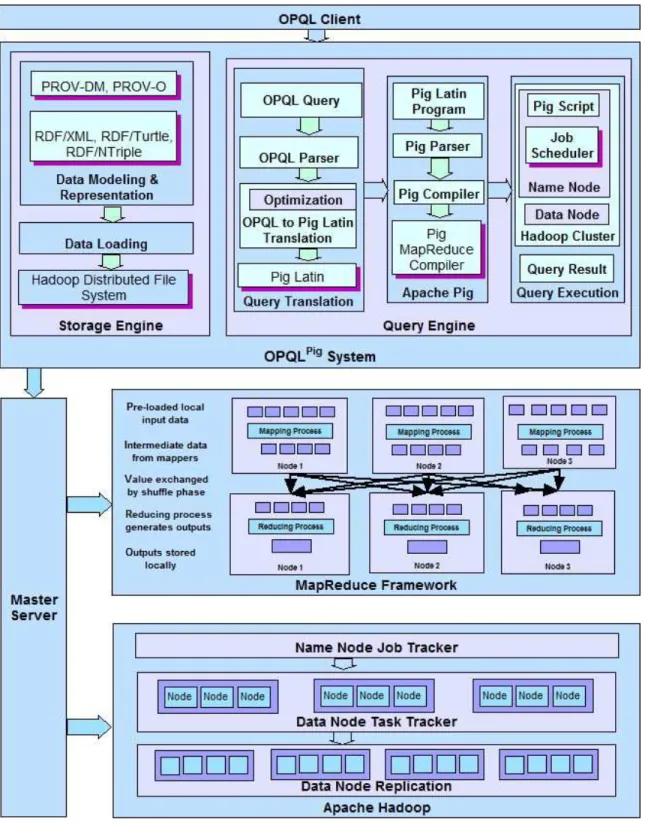
OP QLP ig is an integrated system of Storage and Query engines and its underlying
MapReduce and Apache Hadoop framework. Though there are several concurrent projects like DryadLINQ, Hive, Jaql, Sawzall, Scope, etc., blending Pig with its underlying Hadoop execution engine shows an impressive benefit of scalability and fault tolerance. OP QLP ig
system takes datasets from a OPQL client; processing the data in the storage engine; trans-late a OPQL query into Pig Latin program; parse and compile into Pig and one or more MapReduce Jobs; and execute those jobs in Hadoop cluster. We will discuss each of the
Figure 4: OP QLP ig Architecture.
3.1.1 Storage Engine
Data Modeling and Representation:
The provenance can be captured in any form of modeling and representation like PROV-DM, PROV-O and RDF/XML, RDF/Turtle or RDF/NTriple. For our OP QLP ig system we
have used UTPB benchmark for capturing provenance data from templates presented in [34].
Data Loading:
After capturing provenance data, we perform the data loading phase for creating the dataset in our feasible format and store that in Hadoop Distributed File system for query-ing. For storing the dataset the feasible format we have used is: source_node, source_node_type, destination_node, destination_node_type, relation_construct.
3.1.2 Query Engine
The proposed Query engine has three major functional units with three unique respon-sibilities: Query Translation, Apache Pig, and Query execution.
Query Translation:
First, allOP QLP ig queries are passed through theOP QLP ig parser in order to verify their
syntactic correctness. Each of the constructs of OP QLP ig is transformed into its
cor-responding Pig program through a dedicated shell script for each relation in PROV-DM model. The description of each translation from PROV-DM relations to its correspondence pig latin program is explained in section 3.3.
Apache Pig:
After translating theOP QLP ig query into a Pig Latin program which consists of a sequence
of instructions, each instruction performs a single data transformation. During the phase of Pig parser schema inference, type checking and all referenced variables are defined. The output of the parser is arranged as a Directed Graph which is a logical plan of one-to-one correspondence between pig latin statements and logical operators [58].
The MapReduce jobs in the graph are topologically sorted and submitted to the Job Sched-uler’s Name node. Finally, jobs are executed in that order inside Hadoop cluster’s data node. OP QLP ig Querying Framework is represented in Fig. 4.
3.2
Extending OPQL to support PROV-DM
3.2.1 Provenance ConstructsWe have modified the constructs based on the PROV-DM standard for all Single-node constructs, Single-step construct (edge-forward and edge-backward) and Multi-step-edge construct.
Single-node Construct:
We have formulated our single-node construct in the following formulation. As a single node construct we have Entities, Activities and Agents. Here enn, acn andagn are single
node identifiers and Xn is a node expression which can be denoted by either entity node
expressionXen, an activity node expressionXacor an agent node expressionXag.
EN(Xen) ={enn|enn∈Xen}
AC(Xac) ={acn|acn∈Xac}
AG(Xag) ={agn|agn ∈Xag}
Single-step Construct:
In a Single-step construct, there are edge-forward construct and Single-step-edge-backward construct. We formulate all the relations in both directions. For each relation in the PROV data model we develop single step constructs. For example; for “Used relation" we develop “USD construct"; for “wasGeneratedBy relation" we develop “WGB construct"; for “wasAssociatedWith relation" we develop “WAW construct"; for “was-DerivedFrom relation" we develop “WDF construct"; and for “wasInformedBy relation" we develop “WIB construct"; both for edge forward and edge backward direction. These con-structs support tracking the ancestor nodes associated with the relations. For every causal dependency between two nodes, if we provide a node expressionXnfor effect nodes, we
receive cause nodes in return. In any single-step-edge-forward constructs when the source node is given, it returns the cause node which is the destination node or nodes. For any single-step-edge-backward constructs, for a given cause node, it returns the effect node which the source of the arc.
U SD(Xac) ={enn |acn∈Xac and (acn, enn)∈Eu}
W GB(Xen) ={acn|enn∈Xen and (enn, acn)∈Eg}
W AW(Xac) ={agn |acn∈Xac and (acn, agn)∈Ea}
W DF(Xenn1) ={enn2 |enn1 ∈Xen and (enn1, enn2)∈Ed}
W IB(Xacn1) ={acn2 |acn1∈Xac and (acn1, acn2)∈Ei}
ACO(Xagn1) ={agn2 |agn1 ∈Xag and (agn1, agn2)∈Eab}
W AT(Xen) ={agn |enn∈Xen and (enn, agn)∈Eat} U SD∧ (Xen) ={acn|enn∈Xen and (acn, enn)∈Eu} W GB∧ (Xac) ={enn |acn∈Xac and (enn, acn)∈Eg} W AW∧ (Xag) ={acn|agn∈Xag and (acn, agn)∈Ea} W DF∧
(Xenn2) ={enn1 |enn2 ∈Xen and (enn1, enn2)∈Ed}
W IB∧
(Xacn2) ={acn1 |acn2∈Xac and (acn1, acn2)∈Ei}
ACO∧(Xagn2) ={agn1 |agn2 ∈Xag and (agn1, agn2)∈Eab}
W AT∧(Xag) ={enn |enn∈Xen and (enn, agn)∈Eat}
Multi-step Construct:
Multi-step Constructs are a little bit more complicated, it uses both directions of the single-step constructs in a repetitive way. In this multi-single-step construct, all nodes are returned with either direct or transitive dependencies in the relations. These constructs give us the flexibility and feasibility to track ancestor nodes without formulating any recursive queries. For example, in W DF∗
(Xen) construct, returns all the entities that contributed to derive
entity from the given entity. The same rule applies for W IB∗
all the activities that contributed to derive activity from the given activity. However, for multi-step constructs, such asW GB∗
(Xen)andU SD
∗
(Xac), this scenario is little different.
For construct W GB∗
(Xen), a given source entity first derives contributed activities and
then based on the set of returned activities it loops through W IB∗
construct, and finds all of the contributing activities; and then perform the join operation to find all transitive relations for given entity. The same building rule apply forU SD∗
(Xac). For theU SD∗(Xac)
construct, we can derive all of the contributed entities for a given activity. To do this
U SD(Xac) first returns the set of entities associated with that and then execute W DF
∗
construct to find all the rest of the entities contributed to that activity.
W DF∗ (Xen) ={enn| [ enn∈W DF(Xen) W DF∗ (enn) ∪ W DF(Xen)} W IB∗ (Xac) ={acn| [ acn∈W I B(Xac) W IB∗ (acn) ∪ W IB(Xac)} W GB∗ (Xen) ={acn| [ enn∈W GB(Xen) W IB∗ (acn) ∪ W GB(Xen)} U SD∗ (Xac) ={enn| [ acn∈U SD(Xac) W DF∗ (enn) ∪ U SD(Xac)}
3.3
Translating
OP QL
to Pig Latin
In this section, we explain the translation of OP QLtoOP QLP ig. We translate each of
the constructs to Pig Latin script. The implementation of each of the constructs is handled through separate shell scripts, because Pig Latin does not support loops and conditionals. As each of the constructs is designed to handle inference queries, it needs to traverse the whole provenance graph to provide query answer. In order to handle such a scenario, a shell script is used to run multi-step-edge-constructs by provisioning join operations in one pig file, going through a loop. In addition, the loop break condition is handled by a shell script. The join operation generates a set of records which provide transitive relation and the loop condition will break when there will be no new transitive relations. The loop break
condition measures the file size, and if there are no new relations, which means file size zero, then loop break will happen. The last step of each construct is to run another Pig file which will retrieve all the destination nodes along the path computed by join operations. The pseudo code of translating from OP QL to OP QLP ig for single-step and multi-step constructs are summarized in algorithms in Figs. 5, 6 and 7.
Figure 5: Driver Function of Multi-step USD* Construct.
In Figs. 5, 6 and 7 we have given the algorithm just for one example construct U SD∗
. When U SD∗
Construct is called it conducted three pig files call steps: i) call single-step
U SD Construct, ii) Based on returned entities of USD construct callW DF∗
construct, and iii) Make a union of destination nodes along the path.
the driver program that iteratively invokes the constituent functions until the completion condition is met. It can be noted that function1can be written as a driver program in the Map-Reduce framework as well and is preferred, we present it as a shell script to intuitively represent the flow. We assume that the input file has the following format: source_label, source_type, destination_label, destination_type, relation_type. We present the algorithm in terms of U SD∗
construct; however, the approach is a generic one and can be applied to any other construct type. In line 5, we invoke usd.pig, which essentially selects rows that have the relationU SD and have the source that we are interested in making a query against. This part of the algorithm essentially persists destinations that are reachable via one hop from the source of interest. Subsequently, in line 8, we prepare for the iterative self-join phase by cloning the input file. Line number 9 shows the termination condition for the iteration. Line 12 consists of invoking USD_star.pig with variable inputs. In each phase of the iteration, we join the original input with the recently computed output, as shown by the parameters of the pig file. The output of one phase of USD_star.pig is used as one of the inputs of the next phase of USD_star.pig. Finally in UnionPathUSD.pig, we combine outputs from usd.pig and USD_star.pig and project distinct destinations that are reachable. We persist them onHDF S for subsequent usage in the workflow.
Figure 6: Algorithm for Single-step USD Construct.
The function2in Fig. 6 calls the single-stepU SDconstruct. Here, the “load" command is used in Pig to load the CSV file of input data. In line2, “using PigStorage(’,’)" is a syntax
explaining how data is stored in the file. In this case, it is comma separated. The advantage of using Pig Latin is that we do not have to store schema at storage time, instead store data and define schema at loading time. Here “$fileName" is the argument for a name of the file we provided. In line3, we use FILTER operator in Pig for selecting records based on the given predicates. If the predicates are true only then it will proceed through the pipeline. In this case, we use the filter operation to collect only those entities where starting nodes match to our given input and check whether their relation is U SD or not. In line 4, FOREACH expression is used to go through a set of expressions and work like projection operator to send down the new records through the pipeline to next operator. In this case, we run our FOREACH operator on x, the set of records we retrieved using FILTER, to get only the destination of the schema. In line5and6, STORE command is used for storing the data after finishing the data processing. Like LOAD, “using PigStorage(’ ’)" syntax is used for specifying storage structure of data. In this case, we stored our data into ‘USDoutx/’ folder.
The function 3 in Fig. 7, returns entities of the U SD construct by calling W DF∗
con-struct. In line 3, here load the data into x and define its schema at load time. In line 4, filter out only those records where relation isW DF. In line 5, load another set of data in y for the purpose of Join operation. Here the argument ‘$input$inx’ is controlled by the shell and each time ‘$inx’ is incremented. In line6, we filter out only those relations which areW DF. The reason for doing the filtering first is to try to optimize our query. In line7, now, Join both x1 and y1, based on x1’s destination and y1’s source. In line8, the result of Join is a new set of transitivity relations, and it is the same schema as original schema out of those transitive relations. In line 9and10, we store our result. One noticeable point is that all results are stored in one folder’s different files. The reasons are two fold; one is - it will not expand our big data file even bigger, another one is - this will make error handling easier.
Figure 7: Algorithms for Multi-stepU SD∗
Construct.
2, a specific directory is provided for loading all the related files from that directory, the benefits of which are stated before. In line3, also loads the file from step 1 and where the value is the destinations. In line4, this join operation will be performed based on retrieved nodes in single-stepU SDconstruct. Line5retrieves all the destination nodes. Line6filter operation retrieves the output nodes of single-step U SD construct. In line 7, we only get destination values here. The union of both values provide complete inferred nodes after traversing the whole graph is in line8. In line9and10, the distinct operator has the same functionality as other distinct operators; and dump operator is responsible for showing the results.
3.4
OP QL
P ig: A Case Study
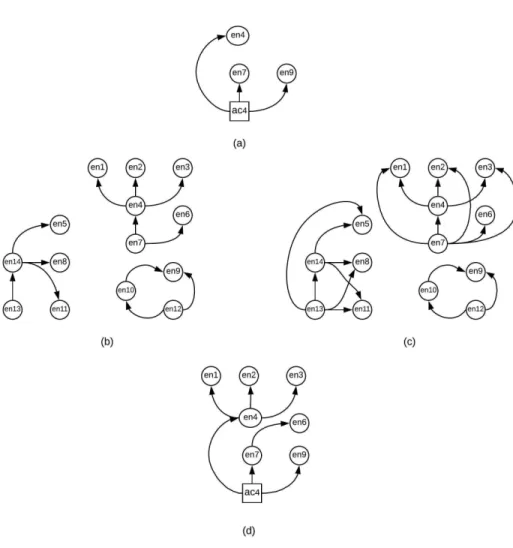
We now explain our proposed framework and algorithm in terms of a sample query. For capturing provenance data, we have used U T P B (University of Texas Provenance Benchmark). Fig. 8 shows a sample provenance graph from the U T P B benchmark that captured provenance data in PROV-DM format. In this provenance graph, each node is categorized as entity or activity or agent. The node identifier of this sample provenance graph is presented in Table. 2. Here, we have14Entities,7Activities and1Agent. We label each node with its corresponding identifier. Each of these nodes, when connected together, holds causal dependencies based on PROV-DM model. Each of causal dependencies, such as entity-entity, entity-activity, entity-agent, activity-agent - has a specific name of these relations. In Table. 3 we present those relations for Fig. 8 provenance graph.
Table 2: Provenance Graph Nodes and Corresponding Node Identifiers. Node Type Node Identifier Node Name
Entity en1 Create Table SQL Statements
en2 Create Index SQL Statements
en3 Create Trigger SQL Statements
en4 Schema en5 TimeT1 en6 Dataset en7 Instance en8 TimeT2 en9 SQL Query en10 Evaluation Plan en11 TimeT3 en12 Result en13 Performance Graph en14 Log
Activity ac1 Create Database Schema
ac2 Load Data ac3 Record Log ac4 Optimize Query ac5 Execute Plan ac6 Execute Query ac7 Visualize Performance
Agent ag1 Query Optimizer
OP QLP ig can answer any queries presented in UTPB benchmark. Some of the sample
queries are shown in Table. 4.
Based on our sample provenance graph in Fig. 8, the query we choose is:
Figure 8: A Sample Provenance Graph for Provenance Data Capt
![Figure 8: A Sample Provenance Graph for Provenance Data Capturing [34].](https://thumb-us.123doks.com/thumbv2/123dok_us/809984.2602420/49.918.177.718.130.670/figure-sample-provenance-graph-for-provenance-data-capturing.webp)