University of Tennessee, Knoxville
Trace: Tennessee Research and Creative
Exchange
Doctoral Dissertations
Graduate School
12-2008
Scalable Graph Algorithms with Applications in
Genetics
Yun Zhang
University of Tennessee - Knoxville
This Dissertation is brought to you for free and open access by the Graduate School at Trace: Tennessee Research and Creative Exchange. It has been accepted for inclusion in Doctoral Dissertations by an authorized administrator of Trace: Tennessee Research and Creative Exchange. For more information, please [email protected].
Recommended Citation
Zhang, Yun, "Scalable Graph Algorithms with Applications in Genetics. " PhD diss., University of Tennessee, 2008. https://trace.tennessee.edu/utk_graddiss/543
To the Graduate Council:
I am submitting herewith a dissertation written by Yun Zhang entitled "Scalable Graph Algorithms with
Applications in Genetics." I have examined the final electronic copy of this dissertation for form and
content and recommend that it be accepted in partial fulfillment of the requirements for the degree of
Doctor of Philosophy, with a major in Computer Science.
Michael A. Langston, Major Professor
We have read this dissertation and recommend its acceptance:
Michael W. Berry, Elissa J. Chesler, Lynne E. Parker
Accepted for the Council:
Carolyn R. Hodges
Vice Provost and Dean of the Graduate School
(Original signatures are on file with official student records.)
To the Graduate Council:
I am submitting herewith a dissertation written by Yun Zhang entitled “Scalable graph algorithms with applications in genetics.” I have examined the final electronic copy of this dissertation for form and content and recommend that it be accepted in partial fulfillment of the requirements for the degree of Doctor of Philosophy, with a major in Computer Science.
Michael A. Langston Major Professor
We have read this dissertation and recommend its acceptance:
Dr. Michael W. Berry
Dr. Elissa J. Chesler
Dr. Lynne E. Parker
Accepted for the Council:
Carolyn R. Hodges
Vice Provost and Dean of the Graduate School
Scalable Graph Algorithms
with Applications in Genetics
A Dissertation
Presented for the
Doctor of Philosophy Degree
The University of Tennessee, Knoxville
Yun Zhang
December 2008
Copyright c 2008 by Yun Zhang. All rights researved.
Dedication
This dissertation is dedicated to my parents, Youlin Liu and Minhua Zhang, and my husband Huadong Liu, who have always been there for me.
Acknowledgments
First, I would like to thank my academic and research advisor Dr. Michael A. Langston, for introducing me to the area of computational biology and for encouraging me to work in this area. I sincerely appreciate his expert guidance and consistent support. Throughout my studies he encouraged me to develop independent thinking and research skills. Second, I would like to thank my research supervisor Dr. Elissa J. Chesler for having patience in mentoring me to understand the biological meanings of the computational results and for always giving me encouragement and support. I would also like to express my gratitude to my other exceptional doctoral committee members, Dr. Lynne E. Parker and Dr. Michael W. Berry for their time and input to this dissertation.
Being a member of the Graph Theory group at the University of Tennessee, Knoxville, and the Systems Genetics group at Oak Ridge National Laboratory, I owe many thanks to both staff and students. I would like to give special thanks to Dr. Faisal N. Abu-Khzam, Dr. Henry Suters, and Dr. Nicole Baldwin, who gave me great help during my first semesters in the team. I would like to thank Dr. Nagiza Samatova for her guidance and support for two years. I would like to give thanks to Dr. Brynn H. Voy and Dr. Arnold Saxton for their advice in biology and statistics. I would like to thank Suzanne Baktash for her help on my dissertation. I would also like to give my thanks to Dr. Roumyana Kirova for helping me with techniques in statistics. I enjoyed working with Dr. Xinxia Peng, Dr. Lan Lin, Jon Scharff, John Eblen, Dr. Andy Perkins, Gary Rodgers, Jeremy Jay, Charles Philips, Vivek Philip, Bhavesh Borate, and Sudhir Naswa. I would like to thank them for the many conversations that have inspired my work.
I have been fortunate to meet many friends outside of my study. This dissertation could not have been written without their encouragement and support. The friendship with Xingyan Li, Yuanyuan Li, Siyuan Liu, Fang Tang, Yifan Tang, Chang Cheng, Teng Ma and many others have been the source of the greatest pleasures.
Finally I would like to give my heartfelt thanks to my family for providing an enormous support. My parents, Youlin Liu and Minhua Zhang were always there for me, guiding me to the right direction and supporting my decisions. Together with my mother-in-law, Yijuan Tao, they helped me finish the dissertation on time by providing love and care for my son. The largest thank you goes to my devoted husband, Huadong Liu, who deserves unique recognition for being incredibly understanding, supportive and, most of all, patient during the course of this dissertation. I also thank my new son Erick Liu, whose good sleeping habits helped make my work possible.
Lastly, I appreciate the financial support from DOE, NIH, NSF, and Jackson Laboratory that funded the research discussed in this dissertation.
Abstract
Graph theoretical approaches have been widely used to solve problems arising in bioinformatics and genomic analysis. In particular, enumeration problems such as maximal clique and maximal biclique finding are cores for addressing many biological problems, such as the integration of genome mapping data. However, the enumeration problems may become computation and memory bot-tlenecks for genome-scale elucidation of biological networks due to theirN P-hard nature and the huge memory requirements.
Therefore, this research is interested in developing exact, scalable, and efficient algorithms for these biological problems. The Clique Enumerator including a maximal clique enumeration algo-rithm and its parallel implementation is developed to provide scalable and exact solutions to the maximal clique problem by taking advantage of (a) ultra-large globally addressable memory archi-tectures, (b) the theory of fixed parameter tractability, and (c) a novel bitmap data representation scheme for memory and search space reduction. An implementation of the parallel algorithm scales linearly to at least 64 processors.
Maximal biclique finding on bipartite graphs is the other focus of this research because of its key role in the study of gene-phenotype association graphs built from heterogeneous data types. A general purpose algorithm is developed for enumerating maximal bicliques in a bipartite graph, without any problem restriction. Experimental results using both gene expression data and syn-thetic data indicate that the new algorithm can be two to three orders of magnitude faster than the best previous alternatives.
The clique and biclique enumeration algorithms are applied to two applications in genetics: the linkage disequilibrium analysis in population genetics with clique algorithms, and the ontology discovery for systems genetics with biclique algorithms. The clique model is applied to extract linkage disequilibrium networks from all loci on the whole-genome. The structures of such networks are analyzed to compare the genetic structure of populations. The biclique model is applied to enumerate bicliques in gene-phenotype association graphs constructed from empirical gene sets. Bicliques are integrated into a directed acyclic graph to provide an empirical discovery of phenotype ontology.
Contents
1 Introduction 1
1.1 Motivation . . . 2
1.2 Problem Definitions . . . 3
1.2.1 The Clique Problem . . . 3
1.2.2 Problems on Bipartite Graphs . . . 4
1.3 Applications . . . 5
1.4 Contributions . . . 7
1.5 Document Organization . . . 8
2 Literature Review 9 2.1 Algorithms for Clique Problems . . . 9
2.1.1 A Taxonomy of Maximal Clique Algorithms . . . 9
2.1.2 Efficiency Comparison . . . 11
2.1.3 Parallel Algorithms . . . 12
2.2 Algorithms for Biclique Problems . . . 12
2.2.1 Algorithms for Bipartite Graphs . . . 13
2.2.2 Algorithms for General Graphs . . . 15
2.3 Applications . . . 16
2.3.1 Applications of Clique Enumeration . . . 16
2.3.2 Applications of Biclique Enumeration . . . 18
3 Scalable Enumeration Algorithms 20 3.1 The Clique Enumerator . . . 20
3.1.1 Maximum Clique and Upper Bounds . . . 21
3.1.2 Ak-Clique Enumeration Algorithm . . . 22
3.2 The MCLEARS Algorithm . . . 22
3.2.1 Algorithmic Basics . . . 24
3.2.2 Bitmap Representation of Common Neighbors . . . 25
3.2.3 Algorithmic Details . . . 26
3.2.4 Algorithmic Complexity . . . 28
3.3 A Parallel Enumeration Algorithm on Shared-Memory Machines . . . 30
3.3.1 The NUMA S2MP Architecture . . . 30
3.3.2 Requirements for Parallelism . . . 30
3.3.3 The Task Scheduler . . . 30
3.3.4 Memory Management . . . 33
3.4 Performance Evaluation . . . 34
3.4.2 Results on the Parallel Algorithm . . . 34
3.4.3 Results on Memory Requirements . . . 36
4 Algorithms for Bipartite Graphs 38 4.1 The MBEA Algorithm . . . 38
4.1.1 Algorithmic Basics . . . 38
4.1.2 Algorithmic Details . . . 39
4.1.3 Algorithmic Complexity . . . 40
4.2 Improvements to MBEA Algorithm . . . 44
4.2.1 A tree pruning method . . . 44
4.2.2 A candidate selection method . . . 45
4.2.3 Algorithmic Details . . . 45
4.3 Performance Evaluation . . . 46
4.3.1 Results on Biological Graphs . . . 49
4.3.2 Results on Synthetic Graphs . . . 53
5 Applications in Genetics 57 5.1 Application I: Linkage Disequilibrium Analysis . . . 57
5.1.1 The Biological Problem . . . 57
5.1.2 The Clique-Based Model . . . 59
5.1.3 Conclusion . . . 63
5.2 Application II: Ontological Discovery . . . 65
5.2.1 The Biological Problem . . . 65
5.2.2 The Biclique-Based Model . . . 66
5.2.3 Conclusion . . . 71
6 Summary and Discussion 72
Bibliography 74
List of Tables
2.1 Algorithms for enumeration of maximal cliques or maximal independent sets . . . . 10
2.2 Algorithms for enumeration of maximal bicliques . . . 14
3.1 An example of bit string representation . . . 26
3.2 Wallclock run times of the MCLEARS algorithm on biological graphs . . . 35
4.1 Profile of the bipartite graphs generated from mouse gene expression data. . . 50
5.1 SNP sets of inbred mouse populations studied in LD analysis . . . 60
5.2 The observed and the expected combination frequencies between two SNPs . . . 61
5.3 The graph size, the number of maximal bicliques, and run times using MBEA for bipartite graphs constructed for gene sets selected from the ODE database. . . 69
List of Figures
1.1 A mapping of biological applications to graph theory problems . . . 2
1.2 An example of clique, maximal clique and maximum clique . . . 5
1.3 An example of edge maximum, vertex maximum and maximal bicliques . . . 6
1.4 Clique and biclique enumeration algorithms in biological applications . . . 7
2.1 Correspondent relation between bicliques in a bipartite graph, cliques in a general graph, and frequent itemsets in a transaction database. . . 15
3.1 Basic idea of the algorithm for enumeration of maximal cliques of sizes within a range 25 3.2 An example of the MCLEARS algorithm applied to a graph . . . 29
3.3 The memory layout of NUMA scalable shared memory multi-processor architecture . 31 3.4 The master/workers model for synchronization and load balancing in the parallel algorithm for maximal clique enumeration . . . 32
3.5 The load balancing strategy in parallel MCLEARS for maximal clique enumeration . 33 3.6 Run times of the parallel algorithm for maximal clique enumeration . . . 35
3.7 Absolute and relative speedups of the parallel algorithm for maximal clique enumer-ation . . . 35
3.8 Scalability and load balancing of the parallel algorithm for maximal clique enumeration 36 3.9 Memory usage in gigabytes for enumerating cliques of different sizes . . . 37
4.1 An example of MBEA algorithm . . . 42
4.2 An example for MBEA branch and bound rule . . . 43
4.3 An example for MBEA with further pruning . . . 45
4.4 An example for MBEA algorithm with a smarter candidate selection method . . . . 46
4.5 An example of improved MBEA algorithm . . . 48
4.6 Distribution of vertex degrees and maximal bicliques in biological bipartite graphs . 50 4.7 Performance comparison of MBEA and previous algorithms on biological bipartite graphs . . . 52
4.8 Time distribution of MBEA algorithm . . . 52
4.9 Search space of the MBEA algorithm . . . 53
4.10 Performance comparison of MBEA and improved MBEA algorithms on biological bipartite graphs . . . 54
4.11 Performance comparison of MBEA and previous algorithms on random bipartite graphs . . . 56
4.12 Performance comparison of MBEA and improved MBEA on random bipartite graphs 56 5.1 Example of SNPs and genetic recombination . . . 58
5.2 The breeding history of inbred mouse populations . . . 59
5.4 The size and edge density of SNP-SNP association graphs . . . 62 5.5 Sample results of linkage disequilibrium networks in inbred mouse populations . . . 64 5.6 The biclique-based model for ontological discovery . . . 67 5.7 Example of creating phenotypic ontology from source gene sets . . . 70
Chapter 1
Introduction
Advances in biochemistry and genome studies have opened new opportunities for interdisciplinary research related to biotechnology. The advent of microarrays and other high-throughput biological technologies has led to the rapid generation of immense data sets involving genes and gene prod-ucts, which has presented a number of computational challenges. Some of these challenges can be handled using combinatorial algorithms. In particular, many problems arising in bioinformat-ics and genomic analysis can be formulated in terms of optimization or enumeration problems in specifically constructed graphs.
Graph-theoretical methods sometimes become computational bottlenecks for large-scale biolog-ical network analysis. This is because our current understanding of the N P-hard nature of these problems translates to exponential run times. Therefore, these approaches tend not to scale as the problem size grows. Approximate solutions with polynomial run times have been proposed to save computation time, but exact solutions are widely preferred due to the time and expense involved in biological data capture. For example, recombinant inbred strains take more than eight years to become isogenetically pure; pathway/network elucidation of yeast requires 45,000 synthetic genetic arrays; and Affymetrix U133 arrays contain more than 30,000 probesets. Due to the high value of the underlying biological data, approximation algorithms are often unacceptable. Therefore, efficient and scalable optimization methods are crucial to systems-level biological applications.
Graph-theoretical approaches, especially those characterized as enumerative, are often memory-intensive and must share very large sets of data efficiently across many processors in parallel im-plementations. For example, a network with n nodes can have as many as 3n3 maximal cliques
[56]. The memory requirement may grow exponentially with the size of the network and may even reach terabyte scale on modest-sized genomes. Algorithms with efficient data representation that can take advantage of ultra-large shared memory architectures are apparently well suited for addressing these types of data-intensive problems in systems biology.
This dissertation provides scalable, exact, and efficient graph algorithms for genome-scale bi-ological applications. It analyzes and integrates bibi-ological networks using graph theoretical ap-proaches. The computational aspect concentrates on algorithm design and implementation for clique enumeration on general and bipartite graphs. The biological application aspect applies these graph algorithms to the linkage disequilibrium network analyses for the comparison of population structure and to the phenotypic ontology discovery for data integration and hypothesis discovery across species and experimental systems.
1.1
Motivation
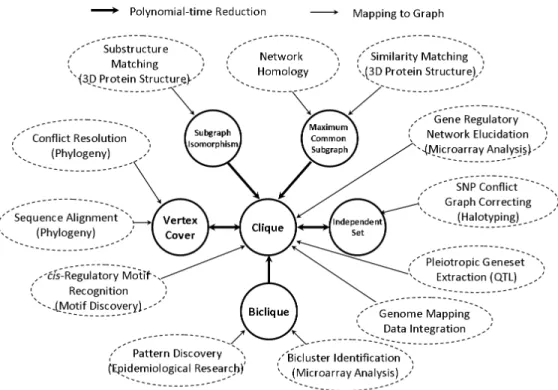
Many biological problems can be formulated as graph theory problems, where biological objects, such as genes, proteins, or phenotypes, are represented as vertices, and biological relations, such as protein-protein interactions, are represented as edges. Examples include matching molecular substructures bySubgraph Isomorphism [7], finding common patterns among 3D protein structures byMaximum orMaximal Common Subgraph [63], correcting the SNP conflict graph in haplotyping by Independent Set [35], computing perfect phylogeny haplotypes by Vertex Cover [9], identifying sets of putatively pairwise co-regulated genes by Clique [10], and discovering biclusters in gene expression data by Biclique [67].
Figure 1.1 maps biological applications to graph theory problems. It also shows how these graph theory problems relate to one another. The clique problem is the key among those graph theory problems because many graph theory problems, such as subgraph isomorphism and maxi-mum common subgraph, can be reduced to the clique problem in polynomial time. Moreover, the independent set and the vertex cover problems are closely related to the clique problem, where the former is complementary to it and the latter is a complementary dual of it.
The clique-centric model has been applied to a variety of problems in genomics and computa-tional biochemistry, such as the recognition of 3D substructure motif in proteins [42], the identifi-cation of maximal complementary sets of hydrogen bond donor/acceptor pairs in two proteins [31], the integration of genome mapping data [37], the visualization of plant metabolomic correlation networks [46], the extraction of co-regulated genes in regulatory networks based on massive mi-croarray data sets [1], the discovery ofcis regulatory motif [11], and the prediction of interactions in protein networks [80]. All of these applications involve the enumeration of maximal cliques in the constructed graphs. As a result, the enumeration version of the clique problem is a focus of this dissertation.
The biclique problem is a special version of the clique problem on bipartite graphs. The inte-gration of multiple genome-scale data sets has recently become an algorithmic challenge for modern systems biology [65, 19, 43, 57]. In such settings, bipartite graphs are often useful in representing relationships across pairs of heterogeneous data types, with the interpretation of such relationships accomplished through an enumeration of maximal bicliques. However, previously-known algorithms are highly inefficient and do not scale for this important task. The demand for efficient bipartite graph algorithms is pressing. With the biclique enumeration algorithm developed in this disser-tation, we were able to begin an empirical approach to the discovery of the ontology of biological processes based on the decomposition of gene-phenotype association graphs.
1.2
Problem Definitions
We will first define the problems to be solved in this dissertation, including the clique problem and the biclique problem. The focus is on the enumeration version of both problems. Algorithms designed for them must have the following three properties:
• Exact: The algorithms should provide exact solutions to these computationally intensive problems instead of providing approximation ones because of the underlying value of biological data sets;
• Scalable: the algorithms should scale to genome-wide data sets, and parallel implementations of these algorithms should scale to multiple processors;
• Efficient: the algorithms need to be efficient to problems on large-scale data sets to support spontaneous scientific research ideas. Graphs generated from biological data sets tend to be large but sparse; the algorithms should deliver solutions in practical time on such graphs. Graphs studied in this dissertation are finite, simple and undirected. For a given graph G = (V, E), V(G) and E(G), denote the set of vertices and the set of edges of G respectively. For simplicity, V and E are often used. The order (or size) of G is the cardinality of V, denoted by
n. Edges of a simple graph are uniquely identified by their endpoints. We use (u, v) to denote an edge whose endpoints are u and v. Loops that have equal endpoints (u, u) are ignored, that is, ∀u ∈ V,(u, u) ∈/ E. A complete graph is a simple graph whose vertices are pairwise adjacent; the complete graph with n vertices is denoted as Kn. A subgraph G[C] induced by a vertex set
C consists of C and all edges whose endpoints are contained in C. The neighborhood of a vertex
v is defined as the set of its immediately connected neighbors, N(v) = {u | u ∈ V, (u, v) ∈ E}. The degree of a vertexv, denoted byd(v) =|N(v)|, is the number of vertices in its neighborhood
N(v). The common neighborhood of a subset S ∈ V is the set of vertices that are immediately connected neighbors of all vertices in S, N(S) = {u | u ∈ V \S, ∀v ∈ S, (u, v) ∈ E}. In other words, the common neighborhood of a set of vertices is the intersection of their neighborhoods,
N(S) =T
v∈SN(v). These notations are used throughout the dissertation.
1.2.1 The Clique Problem
The clique problem is the central problem to be addressed here. A clique in a graph Gis defined as a set of vertices in G that are completely connected. That is, for every pair of vertices in the clique, there exists an edge between them. The size of a clique is the number of vertices it contains. Two versions of the clique problem are frequently used for the analysis of biological data sets: themaximum clique problem is the optimization version that requires the algorithm to
identify the largest clique in a graph; the maximal clique problem is the enumeration version that requires to find all maximal cliques in a graph where a maximal clique is defined as a clique that cannot be enlarged by the addition of any vertex. It should be noted that a maximum clique is one of the largest maximal cliques in a graph. The optimization problem is a well-known N P -complete problem [32]. The maximal clique problem is equally difficult since finding all maximal cliques identifies simultaneously the cliques of maximum size. An example clique, maximal clique, and maximum clique are shown in Figure 1.2. The enumeration problem of maximal clique is formulated as follows:
MAXIMAL CLIQUE
Input : A graph G= (V, E).
Output: All maximal cliques, or vertex subsets V0 ⊆ V, such that the induced subgraph
G[V0] is complete and there is no subsetV00 )V0 such thatG[V00] is also complete.
By definition, there is no constraint on the size of a maximal clique. Considering that cliques of interest are typically large in many biological applications, there is a potential exponential number of small maximal cliques that are of no interest in a graph. Thus, algorithms that are able to limit maximal clique enumeration by size are highly desirable. Users often choose to track the progress of algorithm execution in order to deal with computationally complex problems. One way to implement such a useful feature is to enumerate cliques in order of size.
The MCLEARS algorithm described in Section 3.2 uses the breadth-first tree search to identify all maximal cliques (exact) in non-decreasing order. The algorithm finds maximal cliques within a specific size range by avoiding the generation of small size cliques using thek-clique enumeration algorithm, by pruning out non-maximal candidates from the search tree, and by implementing a novel method for checking maximality to avoid pairwise clique comparison (efficient). To solve problems with thousands of vertices (scalable), the algorithm uses a compact data structure to maintain the list of cliques and a bitmap data representation to hold the neighborhoods of cliques. A parallel MCLEARS algorithm (Section 3.3) is developed on shared memory machines to lower the memory requirement of a single processor. The parallel MCLEARS algorithm achieves linear speedups (scalable) by taking advantage of process synchronization and load balancing techniques.
1.2.2 Problems on Bipartite Graphs
In the integration of multiple genome-scale data sets, bipartite graphs are useful in representing relationships across pairs of heterogeneous data types, and the interpretation of such relationships is accomplished through an enumeration of maximal bicliques. A bipartite graph is one whose vertices can be partitioned into a pair of non-empty, disjoint subsets such that no two vertices within the same subset are connected by an edge. A biclique is a complete bipartite graph, that is, a bipartite graph containing all permissible edges. The formal definitions are as follows:
Definition 1 A graphG= (U∪V, E) is abipartite graph if U∩V =∅,∀u1, u2 ∈U, (u1, u2)∈/E,
and ∀v1, v2∈V, (v1, v2)∈/ E.
Definition 2 Let G= (U∪V, E) be a bipartite graph, a biclique C= (U0, V0) is a subgraph ofG
induced by a pair of two disjoint subsetsU0 ⊆U,V0⊆V, such that∀ u∈U0,v∈V0, (u, v)∈E. Unlike the well-known maximum clique problem, there are two distinct variants of the maximum biclique problem: thevertex maximum biclique problem and the edge maximum biclique problem. For bipartite graphs, the former is to find a biclique with the largest total number of vertices from
(a)G (b)C1 (c)C2 (d) C3
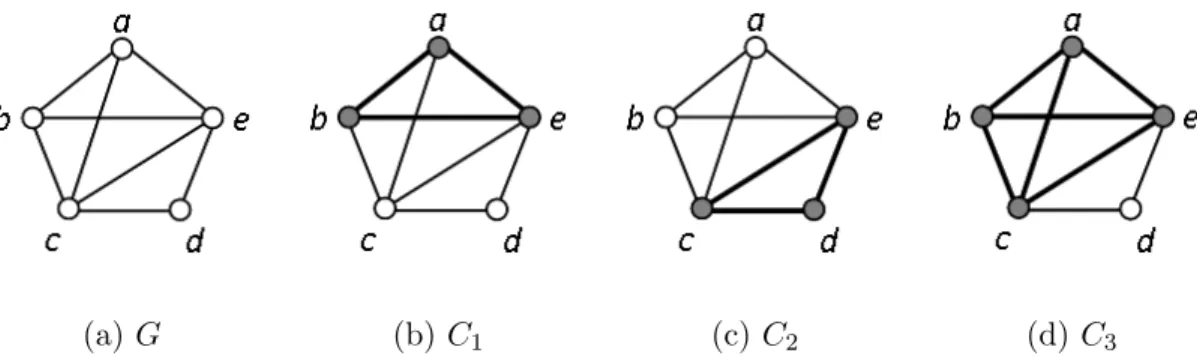
Figure 1.2: (a) A graph G of order 5; (b) A clique C1 = {a, b, e} of size 3 in G, which is not
maximal because it is a subgraph ofC3; (c) A maximal cliqueC2 ={c, d, e}of size 3 inG; and (d)
A maximum/maximal clique C3 ={a, b, c, e} of size 4 in G. Graph G has a total number of two
maximal cliques, C2 and C3.
each vertex set and the problem can be solved in polynomial time [32], while the latter is to find the one with the largest number of edges and it isN P-complete [62].
A maximal biclique in a bipartite graph is a complete bipartite subgraph that is not contained in any other complete bipartite subgraph. The enumeration version of the biclique problem is to find all maximal bicliques in a bipartite graph. An example of maximal and maximum bicliques is shown in Figure 1.3. All edge maximum bicliques and all vertex maximum bicliques can be generated by solving the enumeration problem. Thus, one of the most important elements of this study is the enumeration version of the maximal biclique problem, which is formalized as follows:
MAXIMAL BICLIQUE
Input : A bipartite graph G= (U ∪V, E).
Output: All maximal bicliques, or subsets U0 of U and V0 of V, for which the induced subgraph G[U0 ∪V0] is complete, and there are no subsets U00 ⊇ U0, V00 ) V0 or U00 )
U0, V00⊇V0 such that G[U00∪V00] is also complete.
As observed in [24], the maximal biclique enumeration problem cannot be solved in polynomial time simply because the number of maximal bicliques can be exponential in the input size. The solution requires efficient algorithms to provide exact solutions to large-scale datasets in practical time. The MBEA algorithm described in Chapter 4 finds all maximal bicliques (exact) by exploit-ing the inherent structure in bipartite graphs. The algorithm uses a branch-and-bound technique to prune non-maximal candidates on the search tree, which is further pruned by directly removing dominated vertices from the candidate set and by selecting candidates in the order of their degree (efficient). The reduced search space enables MBEA to scale to large biological data sets. Exper-imental results show that the average delay time for outputting a maximal biclique by MBEA is almost constant on graphs generated from biological data with tens of thousands nodes (scalable).
1.3
Applications
The clique and biclique enumeration algorithms are applied to two applications in genetics: the linkage disequilibrium (LD) analysis in population genetics with clique algorithms, and the ontology discovery for systems genetics with biclique algorithms. Both applications require exact solutions. The study of LD networks analyzes large sets of genetic variations throughout the genome, and the
Figure 1.3: A bipartite graphGhas an edge maximum bicliqueB1 = ({u1, u2},{v1, v2, v3}) with 5
vertices and 6 edges, and a vertex maximum bicliqueB2 = ({u3, u4, u5, u6, u7},{v5}) with 6 vertices
and 5 edges. BothB1 and B2 are maximal bicliques.
study of ontology integrates multiple genome-scale data sets of heterogeneous types such as gene expression data and phenotype data. Thus the algorithms must be exact and scalable.
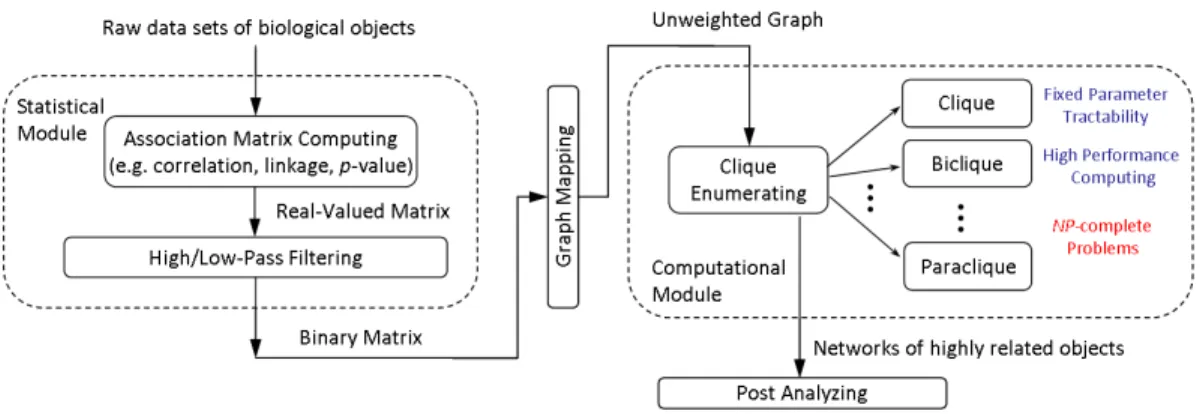
In both applications a matrix of association scores is calculated by statistical metrics (e.g. linkages, correlations) for pairs of biological objects (e.g. genes, phenotypes). The matrix is modeled as an unweighted graph after being transformed into a binary matrix by a threshold. Clique and biclique algorithms are then employed to identify networks of highly related objects in the graph. The resulting networks are further analyzed in the context of their applications. The roles of clique and biclique algorithms in these biological applications are shown in Figure 1.4.
In LD analysis, two genetic loci are said to be associated in LD when some of their allele combi-nations occur more often than expected assuming the loci segregate completely independently. The identification of LD networks, which contain groups of associated loci, is crucial to characterizing the biological drivers that contribute to LD. Using clique algorithms we comprehensively detect high-dimensional long-range LD networks in the graphs constructed from large sets of genetic mark-ers. Linkages are represented as an edge-weighted graph, with vertices representing genetic loci and edge weights representing linkages. This method allows the extent of LD at varying edge-weight thresholds to be evaluated. The size, distribution, and complexity of the detected LD networks can be analyzed to compare populations and sub-populations quantitatively.
The study of ontological discovery seeks to identify relations among genes and their roles in the biological processes. In this setting, gene-sets from various sources are regarded as phenotypes. The ontology of these gene-sets can be achieved by the creation and decomposition of gene-phenotype association graphs derived from a matrix of scores for the associations of genes to phenotypes, such as correlations, p-values, q-values, or binary values. Binary matrices derived by applying thresholds to the scores are represented as bipartite graphs. Using the MBEA algorithm, networks of phenotypes and the common genes with which they are associated are computationally derived and integrated into a directed acyclic graph of phenotype relationships. This provides an empirical discovery of the natural phenotype ontology.
Figure 1.4: Clique and biclique enumeration algorithms in biological applications
1.4
Contributions
The goal of this study is to provide exact, scalable and efficient solutions for N P-hard graph problems in large-scale biological applications. Algorithms are designed for the clique and biclique enumeration problems and are applied in two important applications in genetics: the linkage dis-equilibrium network analysis and the ontology discovery for heterogeneous data integration. The contributions of this dissertation can be summarized as follows:
An algorithm for clique enumeration A scalable and exact algorithm, MCLEARS [83] is developed to enumerate maximal cliques of ranged sizes in non-decreasing order so that the generation of exponential number of undesired maximal cliques can be avoided. A sequential implementation of MCLEARS is about 300 times faster than the previous algorithm that provided the same feature [46]. The parallel implementation on ultra-large globally addressable memory architectures with dynamic load balancing techniques provides a linear speedup.
An algorithm for biclique enumeration MBEA is the first general-purpose exact algo-rithm designed to enumerate all maximal bicliques in a bipartite graph [84]. Unlike other ap-proaches, the algorithm neither places undue restrictions on the problem nor inflates the problem size. Efficiency is achieved by exploiting the inherent structure of bipartite graphs, and by ensuring that biclique enumeration avoids duplication while pruning non-maximal candidates. Experiments using both biological data and synthesis data indicate that MBEA can be as much as three orders of magnitude faster than the best alternatives [6, 86].
Linkage disequilibrium networks analysis using clique algorithms The clique-centric model is used in the linkage disequilibrium analysis to compare the structure of inbred mouse populations [85]. Using MCLEARS, long-range LD networks are comprehensively enumerated throughout the genome from large-scale sets of genetic variations and are quantitatively analyzed to compare population structure. This goes beyond the traditional LD studies that focus on pairs or small blocks of loci.
Phenotype ontology discovery using biclique algorithms The MBEA algorithm has been employed in the “Ontological Discovery Environment” (http://ontologicaldiscovery.org), a web-based tool that allows public users in the biological sciences to upload sets of genes associated with phenotypic descriptors for the derivation of their own hierarchical trees of the phenome space.
Maximal sets of phenotypes, with the genes with which they are associated, are computationally derived by the MBEA algorithm and integrated into a directed acyclic graph that represents the phenotype ontology. Without a fast implementation of the biclique enumeration algorithm, such a tool would not be possible.
1.5
Document Organization
The remainder of this dissertation presents the details of this research. Chapter 2 reviews clique algorithms on general and bipartite graphs followed by a survey of their applications in computa-tional biology. Chapter 3 presents MCLEARS, an algorithm for clique enumeration and its parallel implementation. Chapter 4 describes MBEA, the first general-purpose algorithm for biclique find-ing in bipartite graphs. Chapter 5 provides the clique-based model for the linkage disequilibrium analysis with MCLEARS and the biclique-based model for phenotypic ontological discovery with MBEA. Chapter 6 summarizes works done in this study and discusses possible directions for further research.
Chapter 2
Literature Review
The study of clique algorithms is a classic area in graph theory research. Both optimization and enumeration problems have important applications in many domains. This chapter reviews the exact algorithms for clique and biclique enumeration. Biological applications of these problems are reviewed as well.
2.1
Algorithms for Clique Problems
The maximum clique problem is one of the earliest identified N P-complete [32] problems. An elaborative survey on algorithms, complexity, and applications of this problem can be found in [12]. The enumeration problem of finding all maximal cliques is at least as difficult as finding the largest clique. It has been demonstrated [56] that a graph can contain an exponential number (as many as 3n3) of maximal cliques. Also, [40] showed that a polynomial-delay time algorithm for
enumerating maximal cliques in reverse lexicographic order does not exist ifP 6=N P.
Surveys on maximal cliques can be found in [61] and [12]. These studies summarized the development of exact enumerative algorithms for maximal cliques and maximal independent sets (MISs) in the 1970s and 1980s. Enumerating maximal cliques (also called clique-finding) in a graph is equivalent to finding MISs in its complement graph. In the 1970s several maximal clique algorithms were compared experimentally and theoretically [41]. Recently, some of the popular clique-finding and MIS-finding algorithms were compared experimentally [38] on graphs generated from biological data sets.
2.1.1 A Taxonomy of Maximal Clique Algorithms
Most of the clique-finding algorithms can be classified into three categories based on the method they use: (a) thepoint removal method, (b) thebacktracking method, or (c) a combination of both. Other methods include graph decomposition, breadth first tree search, and matrix multiplication. These clique-finding and MIS-finding algorithms are listed in Table 2.1.
The Point Removal Method
The point removal method, also called thevertex sequence method, produces cliques of a graph G
from the cliques ofG\{v}, v ∈V. This method tends to find cliques of smaller size earlier. This method requires large memory to maintain the list of cliques found in core because cliques must be compared with those previously produced to ensure the maximality (the property of a clique that it is maximal or not). Algorithms based on this method include those in [13], [8], and [59].
Table 2.1: Algorithms for enumeration of maximal cliques or maximal independent sets Algorithms Clique
or MIS Methods Features Bierston [8] Clique Point removal
Requires to maintain a list of cliques in core; smaller cliques tend to be found earlier Osteen-Tou [59, 58] Clique Point removal Improved Bierstone algorithm Akkoyunlu [5] Clique Backtracking Operates on symbolic expressions;
hard to implement
Bron-Kerbosch (BK) [14] Clique Backtracking Larger cliques tend to be found earlier; polynomial storage
Johnston [41] Clique Backtracking
Simplified & generalized BK; experimental comparison of BK and its variants; theoretical comparison with other algorithms. Gerhards-Lindenberg [33] Clique Backtracking
A variant of BK that
generates cliques from partial cliques related to fixed vertices Koch [44] Clique Backtracking
Applied a variant of BK on the maximal common subgraph problem
Harley et al. [37, 38] Clique Backtracking
A variant of BK with adjacency list; more efficient on
genome overlap graphs Tomita et al. [71] Clique Backtracking A variant of BK with
worst-case timeO(3n/3)
Wan et al. [76] Clique Depth first search Utilizes idea of cluster coefficients; designed for complex network Chiba-Nishizeki [21] Clique Point removal
with backtracking
An improvement of Tsukiyama et al. withO(a(G)mµ) time, wherea(G) is the arboricity ofG
Meeusen-Curyvers [55] Clique Graph decomposition Designed for directed graph Kose et al. [46] Clique Breadth first search Requires to maintain a list
of previously found cliques Makino-Uno [54] Clique Matrix
multiplication
O(M(n)) delay time andO(n2)
storage, whereM(n) is time to multiply twon×nmatrices. Loukakis-Tsouros [53, 52] MIS Backtracking Finds cliques in lexicographical
order
Johnson et al. [40] MIS Depth first search O(n3) delay time
Eppstein [25, 26] MIS Depth first search Finds MISs of size smaller than a given parameter Tsukiyama et al. [72] MIS Point removal
with backtracking O(mnµ) time,O(n+m) storage Lawler et al. [47] MIS Point removal
with backtracking
Generalized the results in Tsukiyama et al.
The Backtracking Method
The backtracking method is a more popular method employed by many clique-finding algorithms. It systematically explores a search tree of possible solutions by means of a depth first search (DFS). This method not only eliminates the generation of duplicated cliques, but also avoids the exploration of some branches that cannot lead to new solutions. In addition, the backtracking method requires only polynomial storage space.
In 1973, two algorithms utilizing the recursive backtracking strategy were proposed [5, 14]. The algorithm presented in [5] operates on symbolic expressions and thus is difficult to implement. The algorithm described in [14](BK) has a storage requirement of at most O(12n(n+ 3)), and an improved BK algorithm tends to find larger cliques first. Many algorithms [41, 33, 70, 44, 37] proposed after that are variants of the algorithms in [14]. Other efforts include a backtracking algorithm for generating all MISs in lexicographical order [53], a DFS-based algorithm for finding MISs of a size smaller than a given parameter [25], and most recently, a DFS-based maximal clique algorithm for complex networks [76].
Algorithms in this category share the same advantage with DFS in that the storage requirement is polynomial, but they have the same drawback in that cliques of different sizes are discovered in a quasi-random fashion.
A Combined Method
An algorithm that combines the point removal method and the backtracking method was first proposed in 1977 [72] to find all MISs in a graph. This algorithm has a theoretical time complexity ofO(mnµ) and a storage requirement ofO(n+m), where n, mand µare the numbers of vertices, edges and MISs, respectively. Subsequently, a more efficient algorithm based on the algorithm in [72] was proposed in [21] for generating all maximal cliques of a graphGinO(a(G)mµ) time, where
a(G) is the arboricity (the minimum number of forests needed to cover all the edges of the graph) of Gand µis the number of maximal cliques inG.
Other Methods
Other algorithms for finding maximal cliques include graph decomposition [55], matrix multipli-cation [54], and breadth first tree search [46]. The algorithm in [46] enumerates maximal cliques in non-decreasing order of size, which is a feature not available in other methods. However, this method shares the same drawback with the point removal method in that all cliques must be main-tained in memory for checking maximality. The MCLEARS algorithm described in Chapter 3 is also based on the breadth first search. It finds maximal cliques in non-decreasing order of their sizes but with a lower storage requirement than the one in [46].
2.1.2 Efficiency Comparison
It has been shown [41, 38, 1] that the backtracking-based BK algorithm [14] and its variants are the most efficient. The BK algorithms have been generalized in [41], and a family of clique-finding algorithms based on them were described in the study. The research established that the so-called
simplified BK algorithm is the most efficient for large sparse graphs whose edge density is less than 25%. The study also analyzed theoretically four other enumeration algorithms, including those in [5] and [59], and concluded that none were more effective than the BK algorithm.
In [38], three BK algorithms including the improved BK algorithm [14], thesimplified BK [41], and a modified BK algorithm by using adjacency list to represent the graph [37], were compared
with three other algorithms [72, 53, 21], two of which were based on a combination of the point removal and the backtracking methods. The experiment results revealed that (a) the modified BK algorithm is the most efficient on large, sparse graphs that arise in genomic mapping data; and (b) the family of BK algorithms is faster than the other three algorithms. In [1], the relative efficiency of the BK algorithms and the algorithm in [46] were evaluated on microarray gene expression data. Results confirmed that the BK algorithms are more efficient.
According to the results of the survey above, the backtracking method-based algorithms, espe-cially the BK algorithms, are the most efficient in finding maximal cliques of a graph. However, these algorithms discover maximal cliques in a quasi-random fashion. In biological applications with large data sets, algorithms seeking to discover maximal cliques in the order of their sizes are preferred. Although the MCLEARS algorithm described in Section 3.2 is not as efficient as the BK algorithms, it can find maximal cliques in non-decreasing order. This is important when dealing with computationally complex problems because the user can track the execution progress of the algorithm.
2.1.3 Parallel Algorithms
The clique-finding problem has been well studied. However, only a few parallel algorithms can be found in the literature. One parallel algorithm was proposed in [15] to generate maximal cliques of a circle graph. The algorithm uses a coarse-grained multicomputer model and requiresO(logp) communication rounds wherepis the number of processors. This algorithm takes advantage of the special structure of circle graphs, which is not applicable to general graphs and not practical for graphs from biological applications. In addition, the study offered no experimental results. Another parallel algorithm was investigated in [23] for finding maximal cliques in large complex networks based on the maximal clique algorithm in [76]. However, the parallel model of the algorithm simply distributes the subtrees rooted at every vertex of the search tree to multiple processors. There is no load balancing strategy used in the algorithm to ensure balanced workloads. The experimental results showed that the parallel implementation does not scale well when using 30+ processors.
There have been some efforts to parallelize the maximum clique problem. The parallel exact algorithm presented in [60] solves the maximum clique problem using the Message Passing Interface (MPI). The algorithm uses a master/worker programming model: The master distributes prepro-cessed sub-tasks to workers and no communication is required between workers. The experimental results showed that the speedups ranged between 1.82 and 2.66 for unweighted graphs. However, the algorithm was tested using no more than 4 processors, which was not enough to determine whether the program could scale to a larger number of processors. A parallel algorithm using dynamic load balancing techniques was proposed in [3, 4] for the minimum vertex cover problem. The best performance results were obtained by directly launching secure shells on 32 processors at most.
The parallel MCLEARS algorithm described in Section 3.3 uses load balancing techniques in a master/worker framework to ensure balanced work across multiple processors. The algorithm is implemented with threads on shared memory machines to take advantage of the large, globally accessible memory architecture. The experimental results show the parallel implementation scales well up to 128 processors.
2.2
Algorithms for Biclique Problems
A variety of computational challenges in systems biology can be addressed by finding maximal bicliques in bipartite graphs. Applications of this approach include microarray data biclustering
[17, 67, 77], maximal concatenated phylogenetic datasets determination [65], gene-phenotype asso-ciations elucidation [19], proteome-transcriptome relationships analysis [43], and pattern discovery in epidemiological research [57].
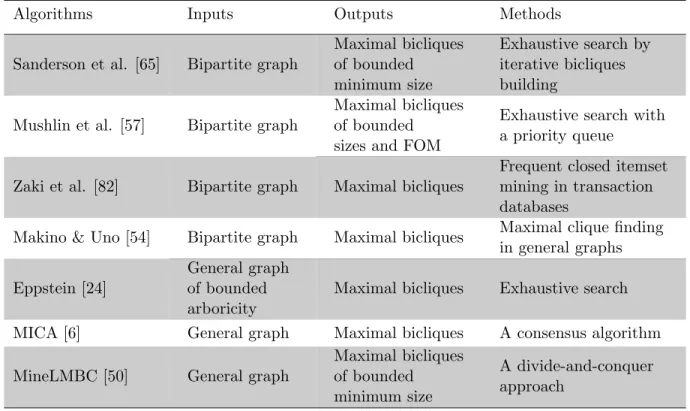
However, despite these kinds of applications no general-purpose biclique enumeration algorithm aiming at bipartite graphs has been described in the literature. Existing algorithms for solving this problem fall into two major categories: (a) algorithms designed for bipartite graphs but either placing restrictions on the problem or requiring the reduction of the biclique problem to other problems, and (b) those designed for general graphs and thus unable to take advantage of the inherent structure of bipartite graphs. Table 2.2 lists these maximal biclique algorithms, the inputs and outputs (with restrictions if there is any), and the methods that they use.
2.2.1 Algorithms for Bipartite Graphs
Algorithms for finding maximal bicliques on bipartite graphs usually take one of the following approaches: (a) exhaustive search with restrictions on outputs, (b) reduction to the clique enu-meration problem on general graphs, and (c) reduction to the frequent itemset mining problem in transaction databases.
Exhaustive Search with Problem Restrictions
The most intuitive method is to thoroughly build all subsets of one vertex set, finding their inter-sections in the other vertex set and examining the maximality. Algorithms based on an exhaustive search have to place some restrictions on the problem to reduce the enormous search space. More-over, that kind of comprehensive search requires storing generated bicliques in order to determine their maximality.
An iterative algorithm was suggested in [65] for building subsets from pairs of vertices to subsets of larger sizes. The algorithm limited the sizes of both vertex sets in bicliques to reduce the search space, but still required sizeable memory to maintain the list of found bicliques for generating larger bicliques and for examining the maximality of bicliques.
The algorithm described in [57] built bicliques based on set expansion and extension operations. It employed a hash table to determine the maximality that avoids pairwise biclique comparison, and a queue to maintain bicliques prioritized by figure-of-merit (FOM) values (e.g. p-values). Users could specify constraints on the FOM values in order to filter bicliques of no interest.
Reduction to Clique Enumeration on General Graphs
The second approach relies on graph inflation. As observed in [54], the enumeration of maximal bicliques on a bipartite graph can be turned into the enumeration of maximal cliques on a general graph by adding edges to the input until each of the two disjoint vertex sets is transformed into a clique. However, this approach is neither practical nor scalable due to the enormous number of edges that may be needed and the concomitant increase in problem difficulty that is incurred.
Given a bipartite graphG= (U∪V, E) where |U|=m, |V|=n, |E|=e, the number of edges needed to transform G to a corresponding graph ˆG is n2+ m2. Thus this method transforms the problem of finding maximal bicliques in a bipartite graph with edge density d(G) = e
m×n to
the problem of finding maximal cliques in a graph ˆG with edge density d( ˆG) = e+ n 2 + m2 m+n 2 . It should be noted that ˆGmight be dense even if G is sparse. WhenG has two vertex sets of equal
Table 2.2: Algorithms for enumeration of maximal bicliques
Algorithms Inputs Outputs Methods
Sanderson et al. [65] Bipartite graph
Maximal bicliques of bounded minimum size Exhaustive search by iterative bicliques building
Mushlin et al. [57] Bipartite graph
Maximal bicliques of bounded sizes and FOM
Exhaustive search with a priority queue
Zaki et al. [82] Bipartite graph Maximal bicliques
Frequent closed itemset mining in transaction databases
Makino & Uno [54] Bipartite graph Maximal bicliques Maximal clique finding in general graphs Eppstein [24]
General graph of bounded arboricity
Maximal bicliques Exhaustive search MICA [6] General graph Maximal bicliques A consensus algorithm MineLMBC [50] General graph
Maximal bicliques of bounded minimum size
A divide-and-conquer approach
size and no edges (i.e. |U|= |V|=n, |E|= 0), ˆG has a density n
2−n
2n2−n, which is close to 50%.
Figure 2.1 (a,b) illustrates the correspondence between these two problems. Reduction to Frequent Itemset Mining
The third approach comes from the field of data mining. It was observed in [82] that a transactional database can be represented by a bipartite graph. The paper showed a one-to-one correspondence between frequent closed itemsets of a transaction database and maximal bicliques of a bipartite graph. A subset of items is defined as a frequent itemset if it occurs in at least one transaction. On one hand, a frequent itemset and the set of transactions containing the frequent itemset form a biclique. On the other hand, the adjacency lists of a bipartite graph can be viewed as a transaction database by treating each vertex in one set as an item and each vertex in the other set as a transaction that contains a subset of items. A biclique can thus be mapped to a frequent itemset. A maximal biclique corresponds to a frequent closed itemset, where a frequent itemset I is said to be closed if the set of transactions containing I do not contain a superset of I. Figure 2.1 (a,c) shows a mapping between these two problems.
It was further proven in [49] of the correspondence between maximal bicliques of a general graph and frequent closed itemsets. The study recommended frequent itemset mining (FIM) techniques [81, 78, 34, 86, 73] to enumerate maximal bicliques. However, this approach needs a post-processing step to obtain the transaction set for each frequent closed itemset because FIM algorithms produce only frequent itemsets. The post-processing step can be costly when both vertex sets of a bipartite graph are large.
2.2.2 Algorithms for General Graphs
The other way to find maximal bicliques in bipartite graphs is to treat bipartite graphs as general graphs. Algorithms designed for general graphs are applicable to bipartite graphs but will not be efficient because the structure of bipartite graphs is not utilized.
The maximal biclique enumeration problem was studied theoretically in [24] on graphs of bounded arboricity. The research ascertained that all maximal bicliques of a graph can be enumer-ated in time O(a322an), where ais the arboricity of the graph and n is the number of vertices in the graph. Although the algorithm has a linear complexity when the arboricity of the input graph is bounded, it is not practical for large graphs sinceacan easily be around 20 in practice [82].
Transactions Items
v1 u1
v2 u1, u2,u4
v3 u1, u2,u3
(a)G (b) ˆG (c)T D(G)
Figure 2.1: (a) A bipartite graph G with a maximal biclique B = ({u1, u2},{v2, v3}). (b) The
graph ˆGtransformed fromGby adding edges (dashed lines) to all pairs of vertices in the same set. Biclique B in G becomes a maximal clique in ˆG. (c) The transaction database T D(G) mapped from G by treatingV as the set of transactions and U as the set of items. Biclique B becomes a frequent closed itemset in T D(G).
A suite of consensus algorithms were proposed in [6] for finding complete-though not necessarily induced-bipartite subgraphs of a graph. However these algorithms must keep all maximal bicliques in memory. The Modular Input Consensus Algorithm (MICA), the most efficient among them, has the space complexity O(B) and the time complexity O(n3B), where B is the number of maximal bicliques.
An algorithm (MineLMBC) based on divide-and-conquer was proposed in [50] to mine large maximal bicliques from general graphs by putting size constraints on both vertex sets in order to iteratively prune the search space. The algorithm reduces the space complexity to O(n2) and the time complexity to O(n2B). The algorithm on dense graphs from 2nd DIMACS Challenge benchmarks outperforms the MICA algorithm when the minimum biclique sizes are constrained by certain thresholds.
To solve the biclique enumeration problem, restrictions on either inputs or outputs have been proposed to reduce the search space. These limits include bounding the maximum input degree [67], bounding an input’s arboricity [24], bounding the minimum biclique size [50, 65], and bounding the FOM value of bicliques [57]. Of course no algorithm relying on these restrictions can solve arbitrary bipartite instances.
The MBEA algorithm described in Chapter 4 exploits the inherent structure in bipartite graphs to achieve efficiency without any restriction on inputs or outputs. Performance results for both biological and synthetic graphs show that the MBEA algorithm is as much as two to three orders of magnitude faster than MICA [6], the best algorithm for finding bicliques on general graph with no restrictions, and FPclose [34, 86], a state-of-the-art algorithm for mining closed itemsets.
2.3
Applications
The utility of clique and biclique algorithms has emerged in many application domains [12]. This study focuses on those in computational biology. This section reviews the biological applications of the maximal clique problem and the maximal biclique problem.
2.3.1 Applications of Clique Enumeration
With advances in genomics and computational biochemistry, maximal clique enumeration algo-rithms have been applied to a variety of graphs, including those from protein structures [31, 36, 39, 42, 45, 66, 79], from genome mapping data [37, 38], from metabolomic correlations [46], from microarray gene expression data [1, 10, 19, 20, 75], and from protein interactions [80].
Protein common structural pattern recognition. Maximal clique enumeration algo-rithms have been widely used since the early 1990s for 3D motif searches in proteins at the sec-ondary structure level [36, 39, 42, 45, 66, 79]. Comparison of proteins in a structure level may reveal common geometric arrangements of the secondary structures and thus provide clues to functional relationships between proteins. A protein is modeled as a graph where the secondary structure elements (SSEs), including α helices and β strands, are mapped as vertices, and the spatial and angular relationships between SSEs are mapped as edges. A “correspondence graph” is then con-structed for each pair of protein graphs by mapping every pair of nodes in the protein graphs as a vertex if the pair of SSEs are of the same type, and two vertices in the correspondence graph are connected if the differences in angles and distances between the two pairs of SSEs are below user-defined thresholds. A maximal clique detected in the correspondence graph is equivalent to a common structural pattern in the pair of proteins.
Protein docking. In [31], clique-finding algorithms were employed to solve the protein dock-ing problem, which is to determine whether two proteins interact to form a stable complex and, if they do, to determine how. To address this problem, a docking graph is constructed for two proteins, where vertices represent a set of potential hydrogen bond donor and acceptor atoms, and a pair of vertices is connected if the difference in distance between the two atoms in the pair of proteins is within a predefined tolerance. A maximal clique in the docking graph corresponds to a maximal set of possible hydrogen bonds.
Genome mapping data integration. The integration of genome data becomes an impor-tant problem due to the differences between two types of methods for mapping genome data: overlap-based and probe-based. In [37], the overlap data were effectively converted to probe-like data by finding maximal sets of mutually overlapping clones (i.e. small DNA fragments in the process of mapping). The clone overlaps were modeled as an interval graph, where vertices corre-sponded to the intervals and edges correcorre-sponded to pairs of intervals that have intersections. A maximal clique in the interval graph is a maximal set of mutually overlapping clones that share a common region of the genome, called a “virtual probe.”
Plant metabolomic correlation network visualization. Profiling gene products to the metabolite level may be a key to clarifying novel gene functions [68]. It was proposed in [46] to vi-sualize plant metabolomic correlation networks by means of clique-metabolite matrices. Metabolite correlations were modeled as a graph with vertices representing metabolites and edge weights rep-resenting correlation coefficients between pairs of metabolites computed from metabolite levels of a series of physiological snapshots. A threshold was then applied to the correlations in constructing an unweighted graph. A maximal biclique in the correlation graph thus corresponds to a maximal set of tightly co-regulated metabolites. The correlation network can then be visualized using the clique-metabolite membership matrix.
DNA sequence motif discovery. The availability of complete genomic sequences opens the door for computational methods to predict transcription factor binding sites. A suite of computa-tional tools was developed in [11] using maximal cliques for motif discovery in order to identify func-tional DNA in non-coding regions by sequence comparison. In this work, a graph was constructed for a specific motif length or pattern, where vertices corresponded to subsequences extracted from input DNA sequences, and edges were extracted from the set of maximal subsequences combined from overlapped and adjacent subsequences. Clusters of motifs can then be identified in the graph using maximal clique algorithms. These clusters correspond to transcription factor binding sites that are either known or novel.
Microarray gene expression data elucidation. Recent efforts have extended the appli-cations of the maximal clique problem to the analysis of microarray gene expression data. Clique-finding algorithms were used for elucidation of genetic co-expression networks from microarray data [1, 10]. Correlations for pairs of genes were computed and represented as a graph, from which cliques were extracted to represent clusters of genes having similar changing patterns of expression levels. In this framework, the regulatory loci underlying the shared genetic mediation of gene ex-pression can be identified by combining clique data with Quantitative Trait Loci analysis [20, 19]. Clique algorithms have also been used to extract gene networks for low-dose ionizing radiation and to identify the gene sets that are impacted by radiation exposure through the comparison of cliques found in control and exposed mouse samples [75].
Protein interactions prediction. Protein-protein interactions discovered using large-scale, high-throughput experiments typically suffer from a relatively high level of noise [74]. It was pro-posed in [80] that the quality of these datasets could be improved by predicting protein-protein interactions using so-called “defective” cliques (nearly complete subgraphs). In this setting, pro-teins are mapped as vertices and interactions detected by experiments between a pair of propro-teins are mapped as edges. A maximal clique corresponds to a maximal set of proteins that have pair-wise interactions; a defective clique is generated by merging two overlapped maximal cliques with constraints on the clique size and the number of missing edges. Missing edges in a defective clique are predicted as interactions.
2.3.2 Applications of Biclique Enumeration
Algorithms for the maximal biclique problem have been applied on bipartite graphs constructed from microarray gene expression data [17, 51, 67, 77], from sequence databases [65], from proteome-transcriptome relationships [18, 43], and from factor-individual associations in clinical surveys [57]. Microarray data biclustering. In gene expression data, the concept of bicluster was intro-duced as a subset of genes and a subset of conditions with a high similarity score [17]. To detect biclusters in large expression datasets, it was proposed [51, 67, 77] that graph theoretic approaches could identify bicliques in the bipartite graph representation of expression data by modeling genes and conditions as vertices on two sides and expression levels as edge weights.
Maximal concatenated phylogenetic datasets discovery. A phylogenetic tree shows the evolutionary interrelationships among various specious or other entities that are believed to have a common ancestor. The accuracy of phylogenetic tree reconstruction can be improved through the concatenation of the maximal multi-gene data sets obtained from a collection of sequences. Maximal data sets that contain at leastkgenes sampled from at leastmspecies are extracted from sequence databases. This is equivalent to finding maximal bicliques of vertex set sizes no less thank
and m. A method has been developed to discover complete phylogenetic data sets by enumerating all the maximal bicliques satisfying the size constraints [65].
Proteome-transcriptome relationships identification. Bipartite graphs and bicliques have been used to extract the relations between gene expressions and proteins [43]. The goal is to locate mRNA abundance that varies with disease symptoms and to identify the proteins that may be produced by individuals with particular mRNA up-regulation. Correlations between microarray expressions with peak intensities form a bipartite graph; maximal biclique algorithms were applied to identify relationships among the two data classes represented in the bipartite graph. These bicliques represent the largest sets of completely connected mRNA and protein peaks and allow forming biological meaningful hypothesis for the connection between mRNA and protein expressions.
Pattern discovery in epidemiological research. In epidemiological research, the maximal biclique enumeration for pattern discovery is especially useful when applied to case-control studies involving categorical features such as genotypes and exposures. A biclique-based approach was recommended in [57] for finding associations among multiple factors and groups of individuals (cases and controls) in a clinical survey. Bipartite graphs were used to capture the relationships between a set of individuals and the values of multiple factors including inherited genotypes, somatic
genotypes, demographic characteristics, and exposures. Maximal bicliques in such graphs represent the largest sets of people sharing a common set of features.
Chapter 3
Scalable Enumeration Algorithms
The N P-hard nature of the problems studied in this dissertation demands that the exact algo-rithms used are computation intensive. In addition to being computationally complex, many of the enumeration algorithms are particularly memory intensive. A graph withn nodes can have as many as 3n3 maximal cliques [56], thus the memory requirement may grow exponentially with the
size of the graph and may reach terabyte scale on even modest-sized genome scale graphs. There is a clear need for at least one terabyte of memory during the analysis of the Affymetrix U74Av2 microarray data to test 12,422 probe sets in samples from the brain ofMus musculus [83]. In order to deal with such large memory requirements an out-of-core algorithm [1] was developed based on the recursive branching procedure suggested by [46] in their analysis of metabolomic correlation networks. However, the algorithm could not finish after one week of execution on the graphs de-rived from the microarray data using various threshold values for correlation of genes. The large data structure used in the algorithm cannot fit into the memory, thus intensive disk I/O access has become the major bottleneck.
To address these computation and memory obstacles to genome-scale elucidation of biological networks,Clique Enumerator in this chapter proposes exact and scalable solutions to the problem of maximal clique enumeration by taking advantage of: (a) the theory of fixed parameter tractability; (b) a novel bitmap data representation scheme for memory saving and search space reduction; and (c) ultra-large globally addressable memory architectures such as SGI Altix. Algorithms developed underClique Enumerator for maximal clique enumeration include an algorithm to enumerate both maximal and non-maximal cliques of a given size (k-clique enumeration algorithm, see Section 3.1.2), an algorithm to enumerate maximal cliques of sizes in a given range with a novel bitmap representation scheme (MCLEARS, see Section 3.2), and a multithreaded parallel algorithm that takes advantage of large globally addressable memory architectures (parallel MCLEARS, see Section 3.3).
3.1
The
Clique Enumerator
By definition, there is no constraint on the size of a maximal clique. Considering that the cliques of interest are typically large [11] and that there are an exponential possible number of small maximal cliques in a graph, it is reasonable to assume that a method to limit the minimum size of maximal clique is desirable. Furthermore, it is preferable to discover maximal cliques in the order of size, which is an essential feature when dealing with computationally complex problems because users can track the progress of the algorithm execution and resume the program from any clique size if the program is halted.
The Bron-Kerbosch (BK) algorithms [14] are among the most efficient algorithms when com-pared to other popular maximal clique enumeration algorithms [37, 1]. Both BK algorithms, sub-sequently referred to as Base BK and Improved BK, discover maximal cliques in a quasi-random fashion, despite the tendency of Improved BK to discover larger cliques first. Therefore, neither algorithm satisfies the requirement for an algorithm to discover maximal cliques in the order of size.
Clique Enumerator is proposed to address the two issues above with three steps. It avoids the generation of maximal cliques of undesired sizes and allows users to track progress of the algorithm. 1. A reasonable upper bound on clique size is determined with efficient maximum clique algo-rithms. Algorithms using the theory of fixed parameter tractability are discussed in Section 3.1.1.
2. All maximal and non-maximal cliques of a given sizek are enumerated, wherekis the user-supplied lower bound. Non-maximal k-cliques are generated for the purpose of further enu-meration of maximal cliques of larger sizes. An algorithm modified from the BK algorithms is described in Section 3.1.2.
3. Using the non-maximal k-cliques as input, maximal cliques are enumerated in increasing order of size until the upper bound is reached. An algorithm using a novel bitmap data representation scheme is discussed in Section 3.2.
The algorithm in Step 3 can be parallelized to achieve performance speedups with multiple processors. A parallel algorithm with multithreaded implementation is described in Section 3.3. It takes advantage of large, globally addressable memory architectures in order to share data efficiently.
3.1.1 Maximum Clique and Upper Bounds
In maximal clique enumeration, it is often useful to first identify the size of a graph’s maximum clique. Computing the maximum clique is important in a variety of biological applications, such as when establishing the edge-weight threshold in microarray analysis [20], when searching for common
cis regulatory elements [11], and when solving the compatibility problem in phylogeny [30]. The maximum clique problem is a classic N P-complete problem. From an asymptotic stand-point, the fastest known general-purpose maximum clique algorithms are based on independent sets and run in O(2n/4) time, wheren is the order of the input graph [64]. A better method is to reduce the clique problem to the vertex cover problem and to employ the notion offixed parameter tractability (F PT) on the vertex cover problem, where avertex cover is a set of vertices that con-tains at least one endpoint of every edge. A problem is F PT if it has an algorithm that runs in
O(f(k)nc) time, wherenis the problem size,kis the input parameter,f() is an arbitrary function, andcis a constant independent of bothnandk[22]. When the input parameter kis fixed,f(k)nc
is, simply, a polynomial. Thus anF PT problem is tractable even if the growth off(k) is very fast (e.g. factorial). F PT can be traced back to work done on applications of well-quasi order theory [27, 28, 29], where the main objective was to demonstrate, via the Graph Minor Theorem, that a variety ofN P-complete problems are actually tractable when the relevant input parameter is fixed. Although it is known that the maximum clique problem is not in F PT, the problem can be tackled by solving its complementary dual problem, the minimum vertex cover problem, which has been extensively studied as a F PT problem. The fastest known fixed parameter algorithm for vertex cover runs in O(1.2759kk1.5+kn) time [16]. Clique Enumerator employs recent F PT