LEARNING CONDITIONAL MODELS
FOR VISUAL PERCEPTION
A Dissertation
Presented to the Faculty of the Graduate School of Cornell University
in Partial Fulfillment of the Requirements for the Degree of Doctor of Philosophy
by Andreas Veit
c
⃝2018 Andreas Veit ALL RIGHTS RESERVED
LEARNING CONDITIONAL MODELS FOR VISUAL PERCEPTION
Andreas Veit, Ph.D. Cornell University 2018
In recent years, the field of computer vision has seen a series of major advances, made possible by rapid development in algorithms, data collection and com-puting infrastructure. As a result, vision systems have started to be broadly adopted in everyday applications. Progress has been particularly promising in image recognition, where algorithms now often match human performance. Nevertheless, vision systems still largely fall behind humans in their ability to understand the complexities of the visual world and its apparent contradictions. For example, an image can carry different meanings to different people in dif-ferent contexts. However, being often limited to a single point of view, vision systems tend to focus on the meaning that dominates in the training data.
In this dissertation, we address this limitation by building conditional vi-sion models that can learn from multiple points of view and adapt their results to account for different conditions. First, we address the related tasks of image tagging and tag based image retrieval. In particular, we build a system that can take into account the fact that people may associate different meaning with certain images and tags. Thus, the system can personalize outputs for ambigu-ous tags such as #rock, which could refer either to a music genre, a geological object or even outdoor climbing. Further, we focus on the task of image based similarity search. Specifically, we design a system that can understand multiple notions of similarity. For example, when searching for related items to an input
images of a shoe, users might be interested in shoes of similar color, style, or for the same kind of activity. By capturing the multitude of aspects in terms of which objects can be compared, our system can find the right set of related items. Lastly, we explore how the underlying convolutional networks them-selves can be made aware of the context in which they are used. In a study, we first discover a new understanding of the roles that individual layers take on in modern convolutional networks. Then, we leverage our insights and design a network that can adaptively define its own topology conditioned on the input image to increase both accuracy and efficiency.
BIOGRAPHICAL SKETCH
Andreas Veit is a PhD Candidate in Computer Science at Cornell University working with Prof. Serge Belongie. His research focuses on Computer Vision and Machine Learning. Before joining Cornell, he obtained his B.Sc and M.Sc in Information Engineering and Management from Karlsruhe Institute of Technol-ogy (KIT), Germany, in 2010 and 2013 respectively. During his studies, Andreas spent visiting semesters at KTH in Stockholm, University of Connecticut as well as Carnegie Mellon University. While at Cornell, he was supported by an Oath PhD fellowship and his studies at KIT were supported by scholarships from Cusanuswerk, InterAct and the Baden-W ¨urttemberg Foundation. Andreas is recipient of the award for an outstanding bachelor degree and fellow of the col-lege for gifted students both of the Department of Informatics at KIT.
ACKNOWLEDGEMENTS
There are many people I would like to thank for contributing to the great experi-ence of my PhD journey. Foremost, I want to express my gratitude to my advisor Serge Belongie, for his mentorship, support and confidence in me throughout my years at Cornell. Serge helped me to become an independent researcher, by always giving me the space, freedom and encouragement to develop and pursue my own ideas. Furthermore, he was always present when I needed guidance both on academic as well as non-academic matters.
I would also like to thank my thesis committee members Mor Naaman and Jon Kleinberg for their invaluable suggestions. Their questions always provided different new perspectives and encouragement.
Further, I want to thank Hartmut Schmeck and Katia Sycara for advising me during my master studies and for introducing me to academic research. It was due to my stay in Katia’s lab at CMU that I decided to pursue a PhD.
I’ve been very fortunate to learn from and work with many remarkably in-spiring colleagues. Without my lab mates Michael Wilber, Hani Altwaijry and Yin Cui and my close collaborators Theofanis Karaletsos from MSKCC, Balazs Kovacs from Cornell and David Rolnick from MIT, the past few years would not have been such a great experience and much of this work would not have been possible. I also want to extend gratitude to my faculty collaborators Kavita Bala, Julian McAuley and Abhinav Gupta for their advice and support on vari-ous projects.
Besides my close collaborators, a number of other friends and colleagues have been a source of many interesting discussions and research ideas. In par-ticular, Tsung-Yi Lin, Baoguang Shi, Vlad Niculae, Xiying Wang, Xun Huang, Sean Bell, Omid Poursaeed, Eugene Bagdasaryan from Cornell, Ishan Misra
from CMU, Ramakrishna Vedantam from Georgia Tech, Sam Kwak from UCSD, Lucas Czech from HITS and Rajan Vaish from UCSC.
During the summers, I had the opportunity to intern with great researchers including Neil Alldrin, Gal Chechik, Laurens van der Maaten and Maximilian Nickel, whose advice helped me well beyond the summers.
I am thankful to several funding sources that supported my research, in-cluding a Facebook Research Award, a Google Focused Research Award and the Oath Program for Connected Experiences at Cornell Tech.
Thanks also to my dear friends Georg Arndt and Gargi Wable for their moral support during these years. A special thanks goes to Antonio Marcedone for being the best roommate and for always being there for me.
Finally, my deepest gratitude goes to my parents Rita and J ¨urgen, my sister Alexandra and my partner Yiqing Hua. Having them at my side has been a tremendous source of strength. Thank you for all the love, enthusiasm and support during this wonderful journey.
TABLE OF CONTENTS
Biographical Sketch . . . iii
Dedication . . . iv
Acknowledgements . . . v
Table of Contents . . . vii
List of Tables . . . ix
List of Figures . . . x
1 Introduction 1 2 User-conditional Image Tagging and Retrieval 7 2.1 Related Work . . . 10
2.1.1 Hashtag Prediction and Recommendation . . . 10
2.1.2 Large-scale Weakly Supervised Training . . . 11
2.1.3 Three-way Tensor Models . . . 11
2.2 Learning from Hashtags . . . 12
2.2.1 User-Agnostic Hashtag Modeling . . . 13
2.2.2 User-Specific Hashtag Modeling . . . 14
2.3 Experiments . . . 17
2.3.1 Dataset . . . 18
2.3.2 Hashtag Prediction . . . 20
2.3.3 Hashtag-Based Image Retrieval . . . 26
2.4 Conclusion . . . 29
3 Conditional Similarity Networks 31 3.1 Related Work . . . 34
3.1.1 Similarity Based Learning . . . 34
3.1.2 Deep Metric Learning . . . 35
3.1.3 Disentangling Representations . . . 35
3.1.4 Factorizing Latent Spaces . . . 36
3.1.5 Attention Mechanisms . . . 37
3.2 Conditional Similarity Networks . . . 37
3.2.1 Conditional Similarity Triplets . . . 38
3.2.2 Learning From Triplets . . . 39
3.2.3 Encouraging Regular Embeddings . . . 40
3.2.4 Joint Formulation For Convolutional CSNs . . . 41
3.3 Experiments . . . 43
3.3.1 Datasets . . . 44
3.3.2 Baselines and Model Variants . . . 45
3.3.3 Training Details . . . 47
3.3.4 Visual Exploration of the Learned Subspaces . . . 48
3.3.5 Qualitative Analysis Of Subspaces . . . 49
3.3.7 Analysis of Convolutional Features Using Off-Task
Clas-sification . . . 52
3.4 Conclusion . . . 54
4 On the Independence of Layers in Residual Networks 56 4.1 Related Work . . . 58
4.1.1 The Sequential and Hierarchical Computer Vision Pipeline 58 4.1.2 Residual Networks . . . 59
4.1.3 Highway Networks . . . 60
4.1.4 Investigating Neural Networks . . . 60
4.1.5 Ensembling . . . 61
4.1.6 Dropout . . . 61
4.2 The Unraveled View of Residual Networks . . . 62
4.3 Lesion Study . . . 65
4.3.1 Deleting Individual Layers in Neural Networks at Test-Time 65 4.3.2 Deleting Many Modules in Residual Networks at Test-Time 67 4.3.3 Reordering Modules in Residual Networks at Test-Time . 69 4.4 The Importance of Short Paths in Residual Networks . . . 69
4.4.1 Distribution of Path Lengths . . . 70
4.4.2 Vanishing Gradients in Residual Networks . . . 70
4.4.3 The Effective Paths in Residual Networks Are Relatively Shallow . . . 71
4.5 Discussion . . . 72
4.6 Conclusion . . . 75
5 Convolutional Networks with Input-conditional Topology 76 5.1 Related Work . . . 79
5.1.1 Neural Network Composition . . . 79
5.1.2 Adaptive Computation . . . 79
5.1.3 Regularization with Stochastic Noise . . . 80
5.1.4 Attention Mechanisms . . . 80
5.2 Adanets . . . 81
5.2.1 Adaptive Computation Graph . . . 82
5.2.2 Gating Unit . . . 82
5.2.3 Training Adanets . . . 86
5.3 Experiments . . . 87
5.3.1 Results on CIFAR . . . 87
5.3.2 Results on ImageNet . . . 89
5.3.3 Robustness to adversarial attacks . . . 97
5.4 Conclusion . . . 99
6 Conclusions 101
LIST OF TABLES
2.1 Most common hashtags in YFCC100M dataset . . . 18
2.2 Image tagging results of user-agnostic and user-specific models . 21 3.1 Triplet prediction results . . . 52
3.2 Off-task evaluation of triplet embedding networks . . . 54
5.1 Classification results of Adanet on CIFAR-10 . . . 88
LIST OF FIGURES
1.1 Complexity of the visual world and its apparent contradictions . 2
2.1 Sample image-retrieval results from user-conditional model . . . 8
2.2 Overview of the proposed user-conditional hashtag model . . . . 9
2.3 Statistics of YFCC100M hashtag dataset . . . 16
2.4 Image tagging results of user-agnostic and user-specific models . 19 2.5 Image tagging results as function of available training data . . . 23
2.6 Tagging examples from user-conditional and agnostic models . . 24
2.7 Image tagging results as function of user embedding size . . . . 25
2.8 Examples for hashtag-based image retrieval . . . 26
2.9 Hashtag-based image retrieval results . . . 27
2.10 Image retrieval results as function of hashtag frequency . . . 29
3.1 Objects can be compared according to multiple aspects . . . 32
3.2 Overview of the proposed Conditional Similarity Networks . . . 33
3.3 Illustration of masking operation . . . 38
3.4 2D embeddings of learned subspaces of the font space . . . 42
3.5 Learned shoe subspaces for categories and closure mechanisms . 43 3.6 Different model variants used in triplet embedding experiments 46 3.7 Learned shoe subspaces for genders and heel heights . . . 49
3.8 Visualization of learned masks . . . 51
3.9 Triplet prediction results as function of available training data . . 53
4.1 The Unraveled View of residual networks . . . 62
4.2 Deleting a layer in the unraveled view . . . 63
4.3 Deleting individual layers from a residual network on CIFAR-10 66 4.4 Deleting individual layers from a residual network on ImageNet 67 4.5 Deleting several layers from a residual network . . . 68
4.6 Effective paths in residual networks are relatively shallow . . . . 71
4.7 Fraction of paths remaining after deleting individual layers . . . 73
4.8 Impact of stochastic depth on resilience to layer deletion . . . 74
5.1 High-level structure of Adanets . . . 77
5.2 Overview of Adanets’ gating unit . . . 83
5.3 Accuracy vs computational cost of Adanets on ImageNet . . . . 90
5.4 Learned inference paths of Adanets on ImageNet . . . 93
5.5 Layer execution rates during training . . . 94
5.6 Distribution over the number of executed layers . . . 95
5.7 ImageNet validation images with least and most executed layers 96 5.8 Robustnes of Adanets towards adversarial attacks . . . 97
CHAPTER 1
INTRODUCTION
A longtime goal in computer vision is the development of methods that can achieve human-level understanding of the visual world. While there is still a long way to go, great progress has been made in the last years thanks to ad-vances in algorithms, data collection and computing infrastructure. Particu-larly impactful have been advances in image classification. Computers can now classify images into thousands of categories with accuracy similar to humans. Sometimes they even surpass human performance for tasks such as identifying different bird species. However, in spite of encouraging advances, modern com-puter vision systems largely lack the ability to understand the visual world from multiple different perspectives. While for humans contradicting answers can co-exist depending on the context, computer vision systems regularly lack the ability to capture contradictions. As a consequence, they often need to choose a single point of view and in practice tend to provide the answer that domi-nates in the training set. This becomes a challenge for many tasks such as, for instance, hashtag-based image retrieval, where different hashtags might carry different meaning for different people. Consider the example of searching for the hashtag #rock; some users might expect images of music concerts, whereas other users might look for images of outdoor climbing. Ideally, a vision system would be aware of the multitude of different aspects. Figure 1.1 illustrates an interaction with such a potential vision system.
In this dissertation, I present approaches to address this challenge and build computer vision systems that can model contradicting points of view and adapt to different conditions. In our studies, we look at context-adaptive models from
Which images are more similar?
According to what aspect?
Figure 1.1: Example illustrating how images can be compared according to a multitude of semantic aspects. A successful vision system needs to take the visual concept into account that objects are compared to.
two different perspectives. First, we study models that can incorporate context information to personalize and customize results in the tasks of image classifica-tion and image similarity search. Second, we focus on the underlying convolu-tional neural network (Convnet) in a study that provides a better understanding of Convnets and further leads to the design of an architecture that can under-stand the context in which it is used and define its network topology adaptively, conditioned on the input image.
In Chapter 2, we develop conditional models in the context of image cate-gorization. Here, the general goal is to learn a function that assigns images to a set of discrete categories or labels. This is one of the fundamental tasks for computer vision and important for a wide range of applications from image tagging to autonomous driving. The standard approach for this task comprises two main parts. A Convnet is trained to transform input images into a vector space, where each image can be represented by a vector, which is often called embedding vector. Further, one additional vector is learned for each category.
Images are then classified by choosing the categories with vectors closest to the image vector.
While effective on standard benchmark datasets, this model is inflexible in that the mapping between images and categories is fixed. To address this short-coming, one could imagine to train a separate network for each user to account for different meanings that users might associate with images and labels. How-ever, the idea is wasteful in terms of parameters and becomes infeasible by the associated need for training data. In our work, we present an alternative ap-proach. Instead of only learning a mapping between images and labels, we jointly model images, labels and users. In particular, we learn vector representa-tions for all three modalities and generate user-conditioned mappings between images and labels by conditioning the parameters of the mappings on the user embedding vector. Since the mapping is bidirectional, our approach allows to personalize both tag-based image retrieval as well as image tagging.
In Chapter 3, we study conditional perception in the area of visual simi-larity search. The goal here is to retrieve the most similar images to a given input image. Understanding image similarity provides the basis for many ap-plications such as recommendation systems and visual search. Here, the typical approach is again to train a Convnet to transform images into a vector space representation. However, instead of jointly embedding images with a fixed set of categories, the network is trained such that the distances between the images’ embedding vectors represent their relative semantic dis-similarity. One can then find related images to an input image by searching for nearest neighbors in the vector space.
func-tion between images, while images can be compared according to a multitude of semantic aspects. An illustrative example is the comparison of colored geo-metric shapes, a task toddlers are regularly exposed to with benefits to concept learning. Consider, that a red triangle and a red circle are very similar in terms of color, more so than a red triangle and a blue triangle. However, the trian-gles are more similar to one another in terms of shape than the triangle and the circle. To address this shortcoming, we introduce Conditional Similarity Net-works, which can learn embeddings that gracefully deal with multiple notions of similarity. In particular, the embeddings are separated into multiple semantic subspaces such that different dimensions encode features for different notions of similarity. Then, by selecting the appropriate subset of dimensions, images can be compared to a specific notion of similarity, for example, according to color or shape. In the proposed approach, the Convnet that learns the embed-ding and the masks that learn to select relevant dimensions are trained jointly.
In Chapter 4, we point our focus towards the underlying Convnets them-selves. Deep Convnets have enabled a series of major advances for many com-puter vision problems. Starting with image classification, they are now used for many other tasks as well, including object detection and segmentation. On a conceptual level, Convnets can be considered as a set of nonlinear transfor-mations, called layers, that are sequentially applied to an input image. The parameters of the layers are trained so as to optimize the performance on a fi-nal task such as image classification. In recent years we have seen that network depth, i.e., the number of layers, plays a key role for classification performance. The seminal work on Residual Networks (Resnets) further showed that adding identity skip-connections bypassing each layer greatly improves optimization, allowing the training of much deeper networks.
The drastic increase in the number of layers raises the questions what func-tions the individual layers learn and whether every single layer is necessary. To shed light on this question, we perform a lesion study investigating the effects of the skip-connection. In our study, we find that although all layers in a Resnet are trained jointly, they exhibit a high degree of independence. In fact, almost any individual layer can be removed from a trained Resnet without interfer-ing with other layers. Further, we find that the skip-connections ease traininterfer-ing by introducing short paths that carry gradient throughout the extent of very deep networks. However, the short paths also lead to parameter redundancy as many layers learn very similar functions. These results demonstrate that convolutional networks don’t need a fixed feed-forward structure and lead to the following research question: Could we assemble network graphs on the fly, conditioned on the input?
In Chapter 5, we build upon the result from the previous chapter and fo-cus on how to design an adaptive Convnet architecture. Since layers in Resnets exhibit a high degree of independence, what if, after identifying the high-level concept of an image, a network could move directly to a layer that can distin-guish fine-grained differences? Currently, a network would first need to execute sometimes hundreds of intermediate layers that specialize in unrelated aspects. Ideally, the more a network already knows about an image, the better it should be at deciding which layer to compute next.
To understand this goal, it is important to note that due to their success, Convnets are used to classify increasingly large sets of visually diverse cate-gories. Thus, most parameters are used to model high-level features, because in contrast to low-level and many mid-level concepts, high-level features are not
broadly shared across categories. This means that for any given input image the number of computed features focusing on unrelated concepts increases. To address this challenge, we propose Adanets, convolutional networks that adap-tively define their network topology conditioned on the input image. Following a high-level structure similar to Resnets, Adanets learn a set of convolutional layers and decide for each input image on the fly which layers are needed. By learning both general layers useful to all images and expert layers specializing on subsets of categories, Adanets allow only computing features relevant to the input image. It is worthy to note that Adanets do not require special supervision about label hierarchies and relationships. Our results demonstrate that Adanets both improve efficiency and also overall classification quality.
Chapter 6 concludes this dissertation and discusses future directions for this line of research.
CHAPTER 2
USER-CONDITIONAL IMAGE TAGGING AND RETRIEVAL
Convolutional networks have shown great success on image-classification tasks involving a small number of classes (1000s). An increasingly important ques-tion is how this success can be extended to tasks that require the recogniques-tion of a larger variety of visual content. An important obstacle to increasing variety is that successful recognition of the long tail of visual content [35] may require manual annotation of hundreds of millions of images into hundreds of thou-sands of classes, which is difficult and time-consuming.
Images annotated with hashtags provide an interesting alternative source of training data because: (1) they are available in great abundance, and (2) they describe the long tail of visual content that we would like to recognize. Further-more, hashtags appear in the sweet spot between capturing much of the rich information contained in natural language descriptions [54] whilst being nearly as structured as image labels in datasets like ImageNet.
However, using hashtags as supervision comes with its own set of chal-lenges. In addition to the missing-label problem that hampers many datasets with multi-label annotations (e.g., [15, 49, 58]), hashtag supervision has the prob-lem thathashtags are inherently subjective. Since hashtags are provided by users as a form of self-expression, some users may be using different hashtags to de-scribe the same content (synonyms), whereas other users may be using the same hashtag to describe very different content (polysemy). As a result, hashtags can-not be treated as oracle descriptions of the visual content of an image, but must be viewed as user-dependent descriptions of that content.
#rock
previous hashtags by user:
#livemusic #live #music #band #switzerland
#rock
#arizona #sport #climbing #bouldering #az
user A
previous hashtags by user:
user B
Figure 2.1: Image-retrieval results obtained using our user-specific hashtag model. The box above the query shows hashtags frequently used by the user in the past. Hashtag usage varies widely among users because they are a means of self-expression, not just a description of visual content. By jointly modeling users, hashtags, and images, our model disambiguates the query for a specific user. We refer the reader to the supplementary material for license information on the photos.
Motivated by this observation, we develop a user-specific hashtag modelthat takes the hashtag usage patterns of a user into account [102]. Instead of train-ing on simple image-hashtag pairs, we train our model on image-user-hashtag triplets. This allows our model to learn patterns in the hashtag usage of a par-ticular user, and to disambiguate the learning signal. After training, our model can perform a kind of intent determination that personalizes image retrieval
#goldengate Hashtag embeddings
W
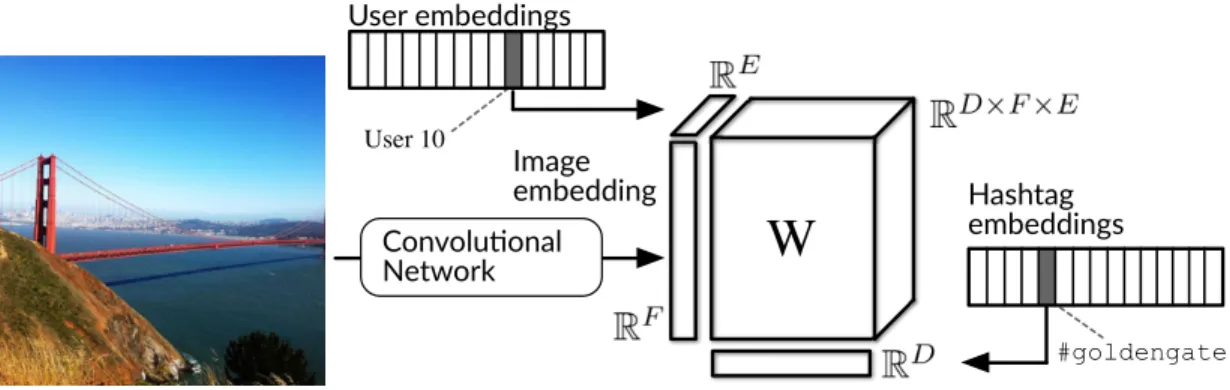
Convolu�onal Network Image embedding User embeddings User 10Figure 2.2: Overview of the proposed user-specific hashtag model. The three-way tensor product models the interactions between image features, hashtag embeddings, and user embeddings.
and tagging. This allows us to retrieve more relevant images and hashtags for a particular user. Figure 2.1 demonstrates how our user-specific hashtag model can disambiguate the ambiguous#rockhashtag by modeling the user.
Figure 2.2 provides an overview of this model. It is comprised of a convolu-tional network that feeds image features into a three-way tensor model, which is responsible for modeling the interaction between image features, hashtag em-beddings, and an embedding that represents the user. When multiplying the three-way interaction tensor by a user embedding, we obtain a user-specific bi-linear model. This personalized bibi-linear mapping between images and hashtags can take into account user-specific hashtag usage patterns. Our model can pro-duce a single score for an image-hashtag-user triplet; we use this score in a rank-ing loss in order to learn parameters that discriminate between observed and unobserved triplets. The user embeddings are learned jointly with the weights of the three-way tensor model.
We investigate the efficacy of our models in (user-specific) image tagging and image retrieval experiments on the YFCC100M dataset [86]. We
demon-strate that: (1) we can learn to recognize large sets of visual concepts ranging from simple shapes to specific instances such as famous personalities and archi-tectural landmarks by using hashtags as supervision; (2) our models success-fully learn to discriminate synonyms and resolve hashtag ambiguities; and (3) we can improve accuracy on tasks such as image tagging by taking the user that uploaded the photo into account.
A preliminary version of this chapter has been published at CVPR 2018 [97].
2.1
Related Work
Our study is related to prior work on (1) hashtag prediction and recommenda-tion, (2) large-scale weakly supervised training, and (3) three-way tensor mod-els.
2.1.1
Hashtag Prediction and Recommendation
Several prior works have studied hashtag prediction and recommendation for text posts [24, 78], infographics [10], and images [18, 103]. The most closely related to our study is [18], which studies hashtag prediction conditioned on image and user features. The main differences between our work and [18] are (1) that we train the convolutional network end-to-end with hashtag supervision rather than pre-trained ImageNet features and (2) that the user embeddings in our model arelearnedbased solely on the photos users posted and the hashtags they used. Our model does not receive any metadata about the user, whereas [18] assumes access to detailed user metadata. This allows us to model intent
on the level of individual users, which helps in disambiguating hashtags.
2.1.2
Large-scale Weakly Supervised Training
Our hashtag-prediction study is an example of large-scale weakly supervised training, which has been the topic of several recent studies. Specifically, [80] trains convolutional networks on 300 million images with noisy labels and show that the resulting models transfer to a range of other vision tasks. Similarly, [45, 54] train networks on the YFCC100M dataset to predict words or n-grams in user posts from image content, and explore transfer of these models to other vision tasks. Further, [93] explores augmenting large-scale weakly supervision with a small set of verified labels. Our study differs from these prior works both in terms of the type of supervision used (hashtags rather than manual annota-tion or n-grams from user comments), and in terms of its final objective (hashtag prediction rather than transfer to other vision problems).
2.1.3
Three-way Tensor Models
Tensor models have a long history in psychological data analysis [31, 87] and have increasingly been used in a wide range of machine-learning problems, in-cluding link prediction in relational and temporal graphs [20, 64], higher-order recommendation systems [67], and parameter estimation in latent variable mod-els [2]. In computer vision, prominent examples of tensor modmod-els include the modeling of style and content [85], the joint analysis of image ensembles [92], sparse image coding [71] and gait recognition [25, 91].
2.2
Learning from Hashtags
Our goal is to train image-recognition models that can capture a large variety of visual concepts. In particular, we aim to learn from hashtags as supervisory signal. Formally, we assume access to a set of N images I= {I1, . . . ,IN} with height H, width W and C channels so that Ii ∈ [0,1]H×W×C, a vocabulary of K hashtagsH={h1, . . . ,hK}, and a set ofU usersU={u1, . . . ,uU}. Each image is as-sociated with a unique user, and with one or more hashtags (we discard images without associated hashtags from the dataset). The resulting dataset comprises a set ofN tripletsT, in which each triplet contains an imageI∈ I, a useru∈ U, and a hashtag set H ⊆ H. Formally, T = {(I1,um(1),H1), . . . ,(IN,um(N),HN)}, in whichm(n)maps from the image/triplet index nto the corresponding user in-dex in{1, . . . ,U}.
Hashtag supervision differs from traditional image annotations in that it was not intended to objectively describe the image content, but merely to serve as a medium for self-expression by the user. This self-expression leads to user-specific variation in hashtag supervision that is independent of the image con-tent. We first study convolutional networks that are agnostic to the subjective nature of hashtags and simply treat them as image labels. Subsequently, we de-velop a user-specific model that explicitly incorporates the user as part of the hashtag-prediction model in order to capture variations in self-expression.
Throughout this work, we focus on two tasks: (1) a tagging task in which, given a query image I, we aim to retrieve the most relevant hashtags for that image; and (2) aretrievaltask in which, given a hashtag queryh ∈ H, we aim to retrieve the most relevant images for that hashtag.
2.2.1
User-Agnostic Hashtag Modeling
We investigate two approaches for training image-recognition models using user-agnostic hashtag supervision: (1) softmax multi-class classification and (2) hashtag-embedding regression [13]. In both cases, we learn an image model
f(·;θ) : [0,1]H×W×C → RDwhich maps images into anD-dimensional embedding space. The image model f(·;θ)is implemented by a residual network [32] with parameters θ. In addition to the image model, we learn hashtag embeddings
hi ∈RDfor all hashtagshi ∈ H.
Multi-Class Classification. Several prior studies [45, 80] suggest that softmax classification can be very effective even in multi-label settings with large num-bers of classes such as ours. Motivated by this, we train f(·;θ)with a softmax over the 100,000 most frequent hashtags by minimizing the multi-class logis-tic loss. Following [45], we select a single hashtag uniformly at random from hashtag setHnas target class for each image when training the softmax model. In particular, let fj = f(Ij;θ) ∈ RD be the image embedding, and hi ∈ Hj the randomly selected hashtag. We then learn jointly the embeddingshiand the pa-rametersθof the vision model f(·;θ)by minimizing the negative log-likelihood for the probability distribution:
P(hi|Ij)=
exp(h⊤i fj)
∑
ℓexp(h⊤ℓfj)
. (2.1)
Hashtag-Embedding Regression. This training method comprises two main stages. First, we learn an embedding hi ∈ RD for each hashtag hi ∈ H. Sec-ond, we follow [13] and learn the parameters θ of the image model f(·;θ) by minimizing the negative cosine similarity between the image embedding,
corre-sponding to imageIj:
ℓ(fj,hj;θ)=−
h⊤jfj
∥hj∥∥fj∥
. (2.2)
A potential advantage of this approach is that the embeddings of synonomous hashtags are likely very similar: this implies that the loss used for training the convolutional network, in contrast to the multi-class logistic loss, does not sub-stantially penalize predicting a synonymous hashtag that the user did not hap-pen to use to describe the image.
We experiment with two methods for learning the hashtag embeddings hi. The first method computes theDprincipal singular vectors of the positive point-wise mutual information (PPMI) matrix [53]. The second method [56] explicitly models ambiguous hashtags (i.e., hashtags with multiple meanings) by learning multi-sense hashtag embeddings. We follow [56] and use the global embed-ding vectors in their model as hashtag embedembed-ding. We train all models using mini-batch stochastic gradient descent (SGD).
2.2.2
User-Specific Hashtag Modeling
The models described above do not explicitly capture variations in hashtag la-bels that are due to variations in how users self-express. Here, we present a model that aims to capture these variations by modeling images, hashtags, and users jointly. We will show that this can help in disambiguating the meaning of hashtags assigned to images. As before, the model represents images via a convolutional network,fj = f(Ij;θ)∈RF, and hashtags via embeddingshi ∈RD. In addition, we learn user embeddings,uk ∈RE. We aim to learn a scoring func-tions(t;W)with parametersW∈RD×F×E that combines all three representations
to predict whether or not an image-hashtag-user triplettis correct. Specifically, we select a hashtaghifrom hashtag setHjuniformly at random, and model the score of the resulting triplett=(Ij,uk,hi)as:
s(t;W)= D ∑ r1=1 F ∑ r2=1 E ∑ r3=1 wr1r2r3hir1fjr2ukr3, (2.3) where wr1r2r3, hir1, fjr2, andukr3 are elements fromW, hi, fj, anduk, respectively. Equation 2.3 is a three-way tensor product between the embeddings of the im-age, hashtag, and user in which the weightswr1r2r3 specify the (positive or neg-ative) interactions of all possible feature combinations. The user-specific aspect of Equation 2.3 can be observed by considering the summation over the user dimension. In particular, when summing over the user dimension, weighted by the embedding for useruk, we obtain a user-specific weight matrixW(k) ∈ RD×F with entries: w(abk) = E ∑ r=1 ukrwabr. (2.4)
The score function of Equation 2.3 is then equivalent to:
s(t;W)=hi⊤W(k)fj. (2.5) Hence, our proposed model learns user-conditioned bilinear models between hashtags for images, by conditioning the weight matrix of the bilinear model on the user embedding.
Given a dataset of Mtriplets1 T ={t
1, . . . ,tM}, we estimate the parametersW using a ranking approach. In particular, we want the score of a true observed triplett+∈ T to be higher than that of an unobserved triplet t−<T. We achieve this by minimizing the following loss:
ℓ(t+;W)= max
(
0,max
t−<T s(t
−;W)−s(t+;W)+1)).
1Please note thatT contains image-hashtag-user triplets, whereasT contains image-hashtag
0 50k 100k 150k 200k 250k 300k 1 2 5 10 2 5 100 2 5 1000 2 5 10k 2 5 100k 0 20k 40k 60k 80k 100k 100 2 5 1000 2 5 10k 2 5 100k 2 5 1M
Images per User
users ordered by number of images
n u m b e r o f im a g e s in tr a in in g s e t
Images per Hashtag
hashtags ordered by frequency
fr e q u e n c y
Figure 2.3:Left: Frequency of hashtags in hashtag vocabularyH. Right: Num-ber of photos per user in user setU.
This ranking loss is better suited for our problem than a per-triplet binary lo-gistic loss, because the latter would consider any unobserved triplet as a “neg-ative”. This is problematic because (1) the hashtag annotations for an image are generally not exhaustive and (2) there are far more unobserved than ob-served triplets. The ranking loss only aims to assign a lower score to unobob-served triplets, and as a result it is not nearly as much affected by these problems.
In practice, the maximization over negative triplets t− can only be approx-imated. For our ranking loss to be effective, it is essential to develop good approximations for the maximization by mining “hard negatives” [73]. We per-form online hard negative mining along all three axes,i.e., we rank tags, images, and users. Specifically, we sample six negative triplets per positive sample, and uses each of them as a negative in the loss. We sample three “intermediate” and three “hard” negatives. In an “intermediate” negative, one of the three ele-ments (the image, hashtag, or user) of the positive triplet is replaced by another element that is selected uniformly at random from the training batch; the other
two elements remain the same. In a “hard” negative, we replace one of the three elements in the triplet by the (non-identical) element in the training batch that maximizes the scores(t;W).
As before, we train our user-specific hashtag model using mini-batch SGD. We first learn the parameters of the convolutional network, θ, by minimizing one of the losses from 2.2.1. We then jointly learn the image, hashtag and user embeddings as well as the parameters of the scoring function, W, in a subse-quent training stage. In our experiments, we use image and hashtag embed-dings withD= F =300dimensions and user embeddings of sizeE =50.
Once we have inferred the embeddings for users, hashtags, and images as well as W, we can then approach the aforementioned image tagging and re-trieval results in the following way. Given a user uk and an image Ij, we com-pute the most likely hashtag according to our model as:
arg maxhi∈Hh⊤i W(k)fj (2.6)
The most likely image given a hashtag-user pair can be retrieved analogously.
2.3
Experiments
The aim of our experiments is: (1) to compare the strategies for training user-agnostic convolutional networks using hashtag supervision introduced in Sec-tion 2.2.1 and (2) to investigate the effectiveness of the user-specific hashtag model we introduced in Section 2.2.2.
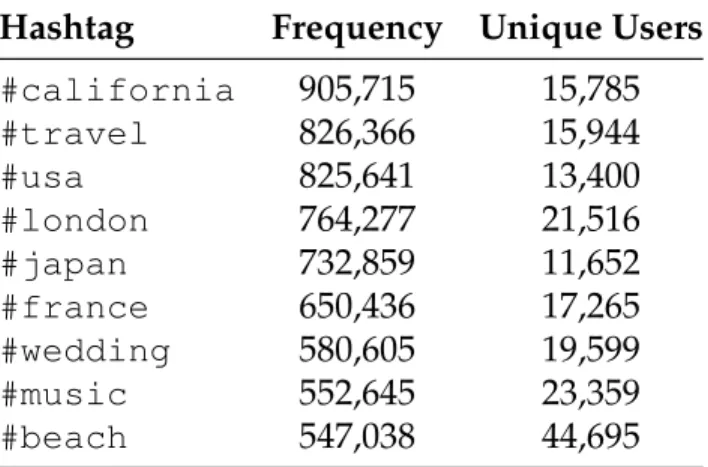
Table 2.1: Frequency of the most common hashtags in the data set.
Hashtag Frequency Unique Users
#california 905,715 15,785 #travel 826,366 15,944 #usa 825,641 13,400 #london 764,277 21,516 #japan 732,859 11,652 #france 650,436 17,265 #wedding 580,605 19,599 #music 552,645 23,359 #beach 547,038 44,695
2.3.1
Dataset
We conduct experiments on the YFCC100M dataset [86] of approximately99.2 million photos. More than60million of these photos have one or more associ-ated hashtags, and each photo has an associassoci-ated user, the user who uploaded it. We start by removing numerical hashtags and also remove the 10 most frequent tags because they are non-visual and non-informative (e.g., #iphonography,
#instagram, #square, and#canon). We define the hashtag set H as the set
of the 100,000most frequent (remaining) hashtags. The left plot in Figure 2.3 shows the resulting hashtag frequencies, and Table 2.1 lists the most frequent hashtags. The hashtag distribution is heavily skewed towards a few frequent hashtags and has a long tail of less frequent tags. For example, the most fre-quent hashtag, #california, appears over 900,000 times in the training set,
i.e., with1.78% of training images. The least frequent hashtags in our hashtag setHonly appear260times. Another characteristic of the hashtags is that while the most frequent tags tend to be English, less frequent tags are increasingly multilingual.
A c c u ra c y a t 1
user-agnostic models user-specific models
27.9%
17.2%
28.7% 29.2%
ImageNet MCLL NCSL-PPMI NCSL-MS (MCLL)Tensor (NCSL-PPMI)Tensor (NCSL-MS)Tensor
10 15 20 25 30 35 40 45 43.7% 40.4% 41.2%
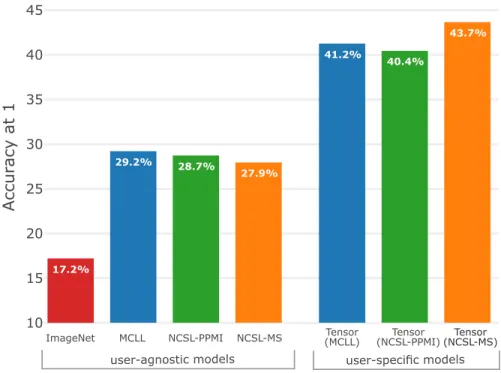
Figure 2.4: Image tagging: Accuracy@1 of four agnostic and three user-specific hashtag prediction models on the YFCC100M test set; see text for de-tails. Higher is better.
“spammers”,i.e., by users that use more than 15 hashtags per image on average. This results in a dataset of55.6million images and a user setUwithU=315,745 users. As shown in the right plot in Figure 2.3, the number of photos per user is also heavy-tailed.
To model a realistic use-case, we split the photos for training and testing ac-cording to their upload time stamps. We sort the photos of each user by times-tamp, assign the first90% of the images to the training set, and assign the re-maining photos to the validation and test sets. This results in a training set of
N=50.6million photos, a validation set of1 million images, and a test set of4 million images. Taken together, the dataset contains265million hashtags for an average of about4.7tags per photo.
2.3.2
Hashtag Prediction
In the first set of experiments, we use our models to predict hashtags that are rel-evant to a given image. We measure the tagging quality of our models by their ability to predict the hashtags associated with the image in terms of accuracy@k
(A@k). We denote the set of thekhighest-scoring hashtags for imageInbyR(kIn), and as before, denote the set of hashtags that are associated to that image byHn. Accuracy@kis then defined as:
A@k= 1 N N ∑ n=1 I[R(I)n k ∩ Hn ,∅ ] N . (2.7)
We evaluate accuracy atk=1andk=10to measure (1) how often the top-ranked hashtag is in the ground-truth hashtag set and (2) how often at least one of the ground-truth hashtags appears in the 10 highest-ranked predictions. A key challenge in this task is that different users assign different hashtags to similar visual content: ideally, tagging methods assign hashtags that are relevant to the image contentandare of importance to the user under consideration.
In addition to the user-specific model of Section 2.2.2, we evaluate four user-agnostic models: (1) a baseline model that trains a linear logistic regres-sor on features extracted by an convolutional network trained on ImageNet (ImageNet); (2) a network that is trained end-to-end for hashtag prediction us-ing multi-class logistic loss (MCLL); (3) an end-to-end trained network that uses PPMI hashtag embeddings [53] in the negative cosine similarity loss of Equa-tion 2.2 (NCSL-PPMI); and (4) an end-to-end trained network that uses the same loss but employs multi-sense hashtag embeddings [56] (NCSL-MS). In all experiments, our convolutional network is a ResNet-50. We evaluate three user-specific models that share the same architecture and training approach, but that vary in terms of the convolutional network that feeds image features into
Table 2.2: Image tagging:Accuracy@1(A@1) and accuracy@10(A@10) of two frequence baselines, four agnostic hashtag prediction models, and six user-specific hashtag prediction models; see text for details. Higher is better.
Method A@1 A@10 Global frequency 1.68% 9.65% User-specific frequency 38.07% 62.55% user -agnostic Imagenet 17.21% 40.01% MCLL 29.24% 56.47% NCSL-PPMI 28.72% 47.70% NCSL-MS 27.94% 46.65% user -specific MLP(MCLL) 35.58% 65.58% MLP(NCSL-PPMI) 37.31% 67.68% MLP(NCSL-MS) 41.66% 71.34% Tensor(MCLL) 41.24% 70.75% Tensor(NCSL-PPMI) 40.43% 68.86% Tensor(NCSL-MS) 43.65% 72.12%
the three-way tensor model (those three networks were trained using MCLL, NCSL-PPMI, and NCSL-MS, respectively).
Figure 2.4 presents the tagging accuracy@1of our four user-agnostic models three user-specific models on the test set. Additionally, Table 2.2 presents the accuracy@10 of these models, and three additional baselines: (1) a frequency baseline that predicts tags according to their frequency in the training set; (2) auser-specificfrequency baseline that predicts tags according to their frequency for the user under consideration; and (3) a series ofuser-specificmodels in which we concatenate the embeddings of the three modalities and score them using a multi-layer perceptron (MLP) rather than the three-way tensor model.
From the results presented in the figure and the table, we make five main observations. First, all models clearly outperform the (global) frequency base-line and generally perform quite well given that each image can be assigned one of 100,000 different hashtags. Second, the results show that training
net-works from scratch for hashtag prediction substantially outperforms Imagenet-trained networks, suggesting that the visual variety in ImageNet does not suf-fice for hashtag prediction. Third, the user-agnostic model that was trained using multi-class logistic loss (MCLL) outperforms user-agnostic trained us-ing negative cosine similarity loss (NCSL), in particular, in terms of accuracy at 10. Fourth, all user-specific models significantly outperform the user-agnostic models, which demonstrates the ability of these models to capture user-specific features in their predictions. Fifth, the three-way tensor models substantially outperform the user-specific frequency baseline and generally outperform the user-specific MLP baselines models, which suggests three-way tensor models are best suited for tailoring predictions based on visual content to a particular user. The highest accuracy is obtained by a three-way tensor model on top of a convolutional network trained using NCSL-MS, which is surprising because that network has the lowest accuracy of the user-agnostic models.
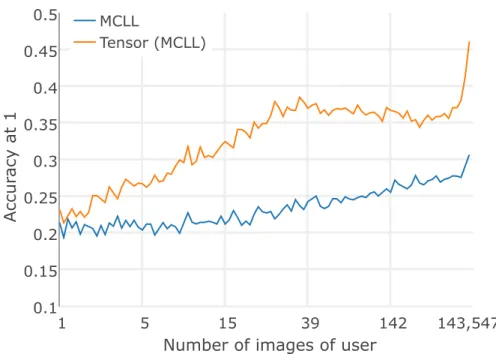
In Figure 2.5, we break down the tagging accuracy of our models per user by measuring accuracy as a function of the number of training images the models observed for that user. We show the accuracy break-down for the best per-forming user-agnostic model (MCLL) and its corresponding tensor model. The figure shows that the user-agnostic model works well across all users, but tends to perform better for users with large image libraries. We surmise this effect is due to the fact that those users have provided the majority of the images in our training set, as a result of which they dominate the data distribution. For the user-specific tagging model, we observe a stronger relationship between accu-racy and the number of images per user. Whilst the user-specific model outper-forms the user-agnostic one for all users, the main benefits of the user-specific modeling are for users with more than approximately27uploaded photos. For
1 5 15 39 142 143,547 0.1 0.15 0.2 0.25 0.3 0.35 0.4 0.45 0.5
Number of images of user
A c c u ra c y a t 1 MCLL Tensor (MCLL)
Figure 2.5: Image tagging: Accuracy@1 (A@1) of user-agnostic and respective user-specific tensor model as a function of the number of images by the user.
users with many photos, the tensor model has more data that it can use to pin down the user embeddings that capture their hashtag usage patterns.
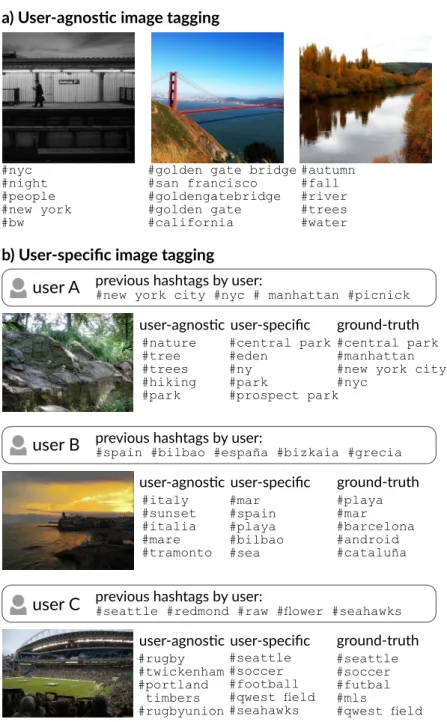
Figure 2.6 shows examples of user-agnostic and user-specific tagging re-sults. The tag predictions were obtained using the MCLL model and the Ten-sor (MCLL) model, respectively. The figure highlights the wide range of visual concepts that our convolutional networks learned to recognize. This range en-compasses objects such as “people”, “river”, and “trees”; specific instances and locations such as the “Golden Gate Bridge”, “San Francisco”, and “New York”; whole-image concepts such as “autumn”; and image styles such as “black and white”. The bottom part of the figure highlights the differences between the user-agnostic and user-specific models. Specifically, it shows tag predictions the user-agnostic model makes for a photo and predictions the user-specific model makes for that same photo for a particular user — we provide insight into the
a) User-agnos�c image tagging
b) User-specific image tagging
user-agnos�c user-specific ground-truth
#nyc #night #people #new york #bw #autumn #fall #river #trees #water #golden gate bridge
#san francisco #goldengatebridge #golden gate #california #nature #tree #trees #hiking #park #central park #eden #ny #park #prospect park #central park #manhattan #new york city #nyc
#new york city #nyc # manhattan #picnick
user-agnos�c user-specific ground-truth
#italy #sunset #italia #mare #tramonto #mar #spain #playa #bilbao #sea #playa #mar #barcelona #android #cataluña #spain #bilbao #españa #bizkaia #grecia
user-agnos�c user-specific ground-truth
#rugby #twickenham #portland timbers #rugbyunion #seattle #soccer #football #qwest field #seahawks #seattle #soccer #futbal #mls #qwest field #seattle #redmond #raw #flower #seahawks
previous hashtags by user:
user A
previous hashtags by user:
user B
previous hashtags by user:
user C
Figure 2.6: Image tagging: Example tagging results from the user-agnostic (MCLL) and user-specific (Tensor NCSL-MS) models.
user’s “profile” by showing the most frequent hashtags for that user.
We observe that the user-specific model can help in disambiguating (most likely) locations of a photo: e.g., it changes its prediction from #nature to
Dimensionality of user embedding
A
c
c
u
ra
c
y
a
t
1
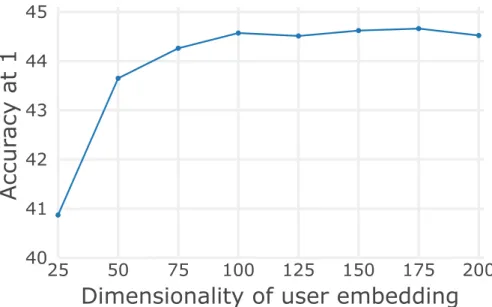
25 50 75 100 125 150 175 200 40 41 42 43 44 45Figure 2.7: Image tagging:Accuracy@1 (A@1) of the Tensor (NCSL-MS) model as a function of the user embedding size,E.
#central parkfor a user that often tags photos with concepts related to New
York. The user-specific model also can change predictions into the user’s pre-ferred language (e.g., from English to Spanish), and it can help in disambiguat-ing fine-grained categories, such as recognizdisambiguat-ing the difference between a rugby and a soccer stadium. We emphasize that all the information the user-specific model used to make these disambiguations comes from image-hashtag-user triples; the model does not employ any additional user metadata.
A key to the user-specific model are the user embeddings that personalize the mapping between images and hashtags. Figure 2.7 shows the accuracy of the top-performing user-specific model (Tensor NCSL-MS) as a function of the dimensionality of the user embedding. The results show that a substantial num-ber of dimensions is needed, suggesting that the user embeddings are playing an important role in the accuracy of the model.
#circle
#green
#sign
#lego
#star wars
#empire state building
#new york #travel #vacation #new york #30 rock #rockefeller plaza #empire state building
#new york #skyline #darth vader #lego #star wars #star wars #madrid #exhibition #cologne #gamescom #small #star wars #lego #moc #figher #lego #transformer #sign #route #michigan #united states #minnesota #minneapolis #highway #sign #shield #green #clover #macro #green #leaf #macro #singapore #unretouched #botanic gardens #gillingham #theatre #kent #california #circle #solvang #wheel #handpainted #costa rica
Figure 2.8: Hashtag-based image retrieval: Top-scoring photos and corre-sponding ground-truth hashtags for six hashtag queries. Results obtained using the user-agnostic MCLL model.
2.3.3
Hashtag-Based Image Retrieval
In a second set of experiments, we study hashtag-based image retrieval and measure the quality of our models by their ability to retrieve relevant images given a hashtag query in terms of precision@k(P@k). We define the set of thek
P re c is io n a t 1 0 ImageNet NCSL-PPMI NCSL-MS MCLL 9.9% 6.0% 3.5% 2.5% 0 2 4 6 8 10
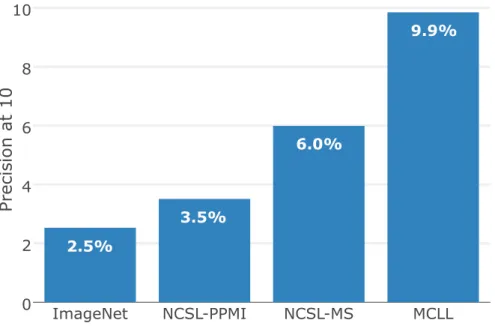
Figure 2.9:Hashtag-based image retrieval:Precision@10 (P@10) of four convo-lutional networks; see text for details. Higher is better.
highest-scoring images for hashtagh,R(kh), and the set of photos that are labeled with hashtagh,GT(h)={I| ∃u: (I,u,h)∈ T }. Precision@kis then defined as:
P@k= 1 |H| ∑ h∈H |R(h) k ∩ GT (h)| k . (2.8)
We measure P@10 in our experiments, i.e., the fraction of the 10 top-scoring images that have the query hashtag associated with it. A key challenge in this task is that hashtags can have multiple meanings: ideally, retrieval methods retrieve photos corresponding to all meanings of a hashtag.
Figure 2.9 presents theP@10 on the test set for the four user-agnostic mod-els that were also used in Section 2.3.2. From the results, we make three main observations. First, similar to the first experiment, the visual variety in Ima-geNet does not suffice for hashtag-based image retrieval, as reflected in the low precision of the ImageNet model. Second, multi-sense embeddings (MS) seem more suitable for training with the negative cosine similarity loss (NCSL) than PPMI embeddings, presumably, because they are better at modeling ambiguous
hashtags. Third, we observe that the network that was trained using multi-class logistic loss (MCLL) substantially outperforms all other models.
We emphasize that not every relevant photo for a hashtag query is also la-beled with that hashtag, which gives rise to the relatively low precision values in Figure 2.9. We show qualitative image-retrieval results produced by the MCLL model in Figure 2.8, which suggest that many of the retrieved photos are actu-ally relevant to the hashtag queries, even if they are not labeled as such. More importantly, Figure 2.8 illustrates the wide variety of visual concepts our mod-els learned to recognize; the concepts recognized range from simple shapes and colors to fine-grained concepts and individual instances of architectural land-marks. Figure 2.1 shows an example of images retrieved by our user-specific model for the same query, #rock, for two different users. The figure demon-strates how modeling the user can help to disambiguate hashtag queries.
In Figure 2.10, we break down the image-retrieval precision by the frequency of the hashtags we query. The plot shows that: (1) retrieval performance is higher for frequent tags and (2) the difference between the MCLL model and the NCSL models is primarily in the long tail of less frequent tags. When eval-uated on the 1,000 most frequent tags, the classification and the multi-sense embedding model achieve a very similar precision@10 of47%.
We surmise the relatively poor performance of the embedding-regression (NCSL) models in our image-retrieval experiments is due to the hashtag em-beddings being fixed in those models, whereas they are learned jointly with the visual features in the classification model. This reduces the effective capac-ity of embedding-regression models, resulting in weaker performances. This limitation is alleviated in the user-specific model, in which all embeddings are
905,715 1,542 729 464 338 264 0 0.1 0.2 0.3 0.4
Frequency of hashtag in YFCC100M
P
re
c
is
io
n
a
t
1
0
MCLL NCSL-MS NCSL-PPMI ImageNetFigure 2.10: Hashtag-based image retrieval: Precision@10 (P@10) of four con-volutional networks as a function of the frequency of the hashtag query. Higher is better.
learned jointly. For example, we observe competitive performance of the ten-sor model that builds on NCSL-trained convolutional networks in the tagging experiments.
2.4
Conclusion
This paper trained convolutional networks from scratch to perform hashtag pre-diction, and extended these networks with a three-way tensor model that learns user embeddings jointly with the final prediction model. This allows us to tailor the model’s prediction to a specific user at test time. We used two different proaches for training the convolutional networks: a standard classification
ap-proach and an apap-proach that regresses onto pre-learned hashtag embeddings. The classification approach performs consistently well across all tasks, whereas the embedding-regression approach mainly performs well for (user-specific) image tagging. Generally, the user-specific approach significantly outperforms the user-agnostic models demonstrating the ability to capture user-specific fea-tures in the predictions.
In future work, we intend to re-visit user-specific image retrieval in a setting in which explicit relevance information is available. Other directions for future work include incorporating user metadata [18] as well as spatial and temporal patterns [65] in our model.
CHAPTER 3
CONDITIONAL SIMILARITY NETWORKS
Understanding visual similarities between images is a key problem in computer vision. To measure the similarity between images, they are embedded in a feature-vector space, in which their distances preserve the relative dissimilar-ity. Commonly, convolutional neural networks are trained to transform images into respective feature-vectors. We refer to these as Similarity Networks. When learning such networks from pairwise or triplet (dis-)similarity constraints, the simplifying assumption is commonly made that objects are compared according to one unique measure of similarity. However, objects have various attributes and can be compared according to a multitude of semantic aspects.
An illustrative example to consider is the comparison of coloured geometric shapes, a task toddlers are regularly exposed to with benefits to concept learn-ing. Consider, that a red triangle and a red circle are very similar in terms of color, more so than a red triangle and a blue triangle. However, the triangles are more similar to one another in terms of shape than the triangle and the circle.
An optimal embedding should minimize distances between perceptually similar objects. In the example above and also in the practical example in Fig-ure 3.1 this creates a situation where the same two objects are semantically re-pelled and drawn to each other at the same time. A standard triplet embedding ignores the sources of similarity and cannot jointly satisfy the competing seman-tic aspects. Thus, a successful embedding necessarily needs to take the visual concept into account that objects are compared to.
similar
category
similar
color
similar
occasion
Figure 3.1: Example illustrating how objects can be compared according to mul-tiple notions of similarity. Here, we demonstrate three intuitive concepts, which are challenging to combine for a machine vision algorithm that has to embed ob-jects in a feature space where distances preserve the relative dissimilarity: shoes are of the same category; red objects are more similar in terms of color; sneakers and t-shirts are stylistically closer.
aspect of similarity. However, the idea is wasteful in terms of parameters needed, redundancy of parameters, as well as the associated need for training data.
In this work, we introduce Conditional Similarity Networks (CSNs) a joint architecture to learn a nonlinear embeddings that gracefully deals with multiple notions of similarity within a shared embedding using a shared feature extrac-tor. Different aspects of similarity are incorporated by assigning responsibility weights to each embedding dimension with respect to each aspect of similarity. This can be achieved through a masking operation leading to separate semantic subspaces. Figure 3.2 provides an overview of the proposed framework. Im-ages are passed through a convolutional network and projected into a nonlinear
select subspace
Convolutional Network
Images Disentangled
Embedding Conditional Rescalingof Embedding Space Conditional SimilaritySubspaces
compare according to: "color" category subspace color subspace close color categ ory fa r
{
far Masks with learned scaling parameter per dimension{
{
clo se{
Different dimensions encode features forspecific notions of similarity
Figure 3.2: The proposed Conditional Similarity Network consists of three key components: First, a learned convolutional neural network as feature extrac-tor that learns the disentangled embedding, i.e., different dimensions encode features for specific notions of similarity. Second, a condition that encodes ac-cording to which visual concept images should be compared. Third, a learned masking operation that, given the condition, selects the relevant embedding di-mensions that induce a subspace which encodes the queried visual concept.
embedding such that different dimensions encode features for specific notions of similarity. Subsequent masks indicate which dimensions of the embedding are responsible for separate aspects of similarity. We can then compare objects according to various notions of similarity by selecting an appropriate masked subspace. In the proposed approach the convolutional network that learns the disentangled embedding as well as the masks that learn to select relevant di-mensions are trained jointly.
In our experiments we evaluate the quality of the learned embeddings by their ability to embed unseen triplets. We demonstrate that CSNs clearly outper-form single triplet networks, and even sets of specialist triplet networks where a lot more parameters are available and each network is trained towards one single similarity notion. Further we show CSNs make the representation inter-pretable by encoding different similarities in separate dimensions.
approach that allows to to learn nonlinear embeddings that incorporate mul-tiple aspects of similarity within a shared embedding using a shared feature extractor, b) demonstrating that the proposed approach outperforms standard triplet networks and even sets of specialist triplet networks in a variety of hard predictive visual tasks and c) demonstrating that our approach successfully dis-entangles the embedding features into meaningful dimensions so as to make the representation interpretable.
A preliminary version of this chapter has been published at CVPR 2017 [95].
3.1
Related Work
3.1.1
Similarity Based Learning
Similarity based learning has emerged as a broad field of interest in modern computer vision and has been used in many contexts. Disconnected from the input image, triplet based similarity embeddings, can be learned using crowd-kernels [90]. Further, Tamuz et al. [83] introduce a probabilistic treatment for triplets and learn an adaptive crowd kernel. Similar work has been generalized to multiple-views and clustering settings by Amid and Ukkonen [1] as well as Van der Maaten and Hinton [89]. A combination of triplet embeddings with input kernels was presented by Wilber et al. [104], but this work did not include joint feature and embedding learning. An early approach to connect input fea-tures with embeddings has been to learn image similarity functions through ranking [11].
3.1.2
Deep Metric Learning
A foundational line of work combining similarities with neural network mod-els to learn visual features from similarities revolves around Siamese net-works [14, 30], which use pairwise distances to learn embeddings discrimina-tively. Related to our work, pairwise similarities have been used to learn visual clothing style [96]. In contrast to pairwise comparisons, triplets have a key ad-vantage due to their flexibility in capturing a variety of higher-order similarity constraints rather than the binary similar/dissimilar statement for pairs. Neu-ral networks to learn visual features from triplet based similarities have been used by Wang et al. [100] and Schroff et al. [69] for face verification and fine-grained visual categorization. A key insight from these works is that semantics as captured by triplet embeddings are a natural way to represent complex class-structures when dealing with problems of high-dimensional categorization and greatly boost the ability of models to share information between classes.
3.1.3
Disentangling Representations
Disentangling representations is a major topic in the recent machine learning literature and has for example been tackled using Boltzmann Machines by Reed et al. [66]. Chen et al. [12] propose information theoretical factorizations to im-prove unsupervised adversarial networks. Within this stream of research, the work closest to ours is that of Karaletsos et al. [46] on representation learning which introduces a joint generative model over inputs and triplets to learn a factorized latent space. However, the focus of that work is the generative as-pect of disentangling representations and proof of concept applications to
low-dimensional data. Our work introduces a convolutional embedding architec-ture that forgoes the generative pathway in favor of exploring applications to embed high-dimensional image data. We thus demonstrate that the genera-tive interpretation is not required to reap the benefits of Conditional Similarity Networks and demonstrate in particular their use in common computer vision tasks.
3.1.4
Factorizing Latent Spaces
A theme in our work is the goal of modeling separate similarity measures within the same system by factorizing (ordisentangling) latent spaces. We note the re-lation of these goals to a variety of approaches used in representation learning. Multi-view learning [79, 101] has been used for 3d shape inference and shown to generically be a good way to learn factorized latent spaces. Multiple ker-nel learning [6, 75] employs information encoded in different kerker-nels to provide predictions using the synthesized complex feature space and has also been used for similarity-based learning by McFee and Lanckriet [62]. Multi-task learning approaches [16] are used when information from disparate sources or using dif-fering assumptions can be combined beneficially for a final prediction task. In-deed, our gating mechanism can be interpreted as an architectural novelty in neural networks formulti-task triplet learning. Similar to our work, multiliniear networks [59] also strive to factorize representations, but differ in that they ig-nore weak additional information. An interesting link also exists to multiple similarity learning [5], where category specific similarities are used to approxi-mate a fine-grained global embedding. Our global factorized embeddings can be thought of as an approach to capture similar information in a shared space
directly through feature learning.
3.1.5
Attention Mechanisms
We also discuss the notion of attention in our work, by employing gates to at-tend to the mentioned subspaces of the inferred embeddings when focusing on particular visual tasks. This term may be confused with spatial attention such as used in the DRAW model [27], but bears similarity insofar as it shows that the ability to gate the focus of the model on relevant dimensions (in our case in latent space rather than observed space) is beneficial both to the semantics and to the quantitative performance of our model.
3.2
Conditional Similarity Networks
Our goal is to learn a nonlinear feature embedding f(x), from an image x into a feature spaceRd, such that for a pair of images x
1 and x2, the Euclidean dis-tance between f(x1)and f(x2)reflects their semantic dis-similarity. In particular, we strive for the distance between images of semantically similar objects to be small, and the distance between images of semantically different objects to be large. This relationship should hold independent of imaging conditions.
We consider y = f(x) to be an embedding of observed images x into coor-dinates in a feature space y. Here, f(x) = Wg(x) clarifies that the embedding function is a composition of an arbitrarily nonlinear function g(·)and a linear projectionW, forW ∈ Rd×b, where ddenotes the dimensions of the embedding andbstands for the dimensions of the output of the nonlinear functiong(·). In
{
embedding features masks condition selects mask masked features for specific subspaceFigure 3.3: The masking operation selects relevant embedding dimensions, given a condition index. Masking can be seen as a soft gating function, to attend to a particular concept.
general, we denote the parameters of function f(x)byθ, denoting all the filters and weights.
3.2.1
Conditional Similarity Triplets
Apart from observing images x, we are also given a set of triplet constraints sampled from an oracle such as a crowd. We define triplet constraints in the following.
Given an unknown conditional similarity function sc(·,·), an oracle such as a crowd can compare images x1, x2 and x3 according to condition c. A condition is defined as a certain notion of similarity according to which im-ages can be compared. Figure 3.1 gives a few example notions according to which images of fashion products can be compared. The condition c serves as a switch between attented visual concepts and can effectively gate between different similarity functions sc. Using image x1 as reference, the oracle can