Statistic and Econometric Series 04 Universidad Carlos III de Madrid
March 2008 Calle Madrid, 126
28903 Getafe (Spain)
Fax (34-91) 6249849
BOOTSTRAP PREDICTION INTERVALS IN STATE SPACE
MODELS
∗Alejandro Rodriguez
1and Esther Ruiz
2Abstract
Prediction intervals in State Space models can be obtained by assuming Gaussian innovations and using the prediction equations of the Kalman filter, where the true parameters are substituted by consistent estimates. This approach has two limitations. First, it does not incorporate the uncertainty due to parameter estimation. Second, the Gaussianity assumption of future innovations may be inaccurate. To overcome these drawbacks, Wall and Stoffer (2002) propose to obtain prediction intervals by using a bootstrap procedure that requires the backward representation of the model. Obtaining this representation increases the complexity of the procedure and limits its implementation to models for which it exists. The bootstrap procedure proposed by Wall and Stoffer (2002) is further complicated by fact that the intervals are obtained for the prediction errors instead of for the observations. In this paper, we propose a bootstrap procedure for constructing prediction intervals in State Space models that does not need the backward representation of the model and is based on obtaining the intervals directly for the observations. Therefore, its application is much simpler, without loosing the good behavior of bootstrap prediction intervals. We study its finite sample properties and compare them with those of the standard and the Wall and Stoffer (2002) procedures for the Local Level Model. Finally, we illustrate the results by implementing the new procedure to obtain prediction intervals for future values of a real time series.
Keywords: Backward representation, Kalman filter, Local Level Model, Unobserved Components.
∗Financial support from Project SEJ2006-03919 by the Spain government is gratefully acknowledged. The usual disclaims apply. 1 Department of Statistics, Universidad Carlos III de Madrid, e-mail: [email protected].
State Space Models
Alejandro Rodriguez and Esther Ruiz
∗†March 2008
Abstract
Prediction intervals in State Space models can be obtained by assum-ing Gaussian innovations and usassum-ing the prediction equations of the Kalman filter, where the true parameters are substituted by consistent estimates. This approach has two limitations. First, it does not incorporate the uncer-tainty due to parameter estimation. Second, the Gaussianity assumption of future innovations may be inaccurate. To overcome these drawbacks, Wall and Stoffer (2002) propose to obtain prediction intervals by using a boot-strap procedure that requires the backward representation of the model. Obtaining this representation increases the complexity of the procedure and limits its implementation to models for which it exists. The boot-strap procedure proposed by Wall and Stoffer (2002) is further complicated by fact that the intervals are obtained for the prediction errors instead of for the observations. In this paper, we propose a bootstrap procedure for constructing prediction intervals in State Space models that does not need the backward representation of the model and is based on obtaining the intervals directly for the observations. Therefore, its application is much simpler, without loosing the good behavior of bootstrap prediction inter-vals. We study its finite sample properties and compare them with those of the standard and the Wall and Stoffer (2002) procedures for the Local Level Model. Finally, we illustrate the results by implementing the new procedure to obtain prediction intervals for future values of a real time series.
Keywords: Backward representation, Kalman filter, Local Level Model, Unobserved Com-ponents.
∗Corresponding author, Department of Statistics, Universidad Carlos III de Madrid, e-mail:
†Financial support from Project SEJ2006-03919 by the Spain government is gratefully
1
Introduction
When analyzing economic and financial time series, sometimes it is useful to decompose them into latent components such as, for example, trend, seasonal, cyclic and irregular component which have a direct interpretation; see Harvey (1989) and Durbin and Koopman (2001) for extensive descriptions of Unobserved Component models. The empirical applications of these models are very wide; for instance, the evolution of inflation could be represented by a model with long-run level, seasonal and transitory components; see, for example, Ball et al. (1990), Evans (1991), Kim (1993) and Broto and Ruiz (2006). Cavaglia (1992) analyzes the dynamic behavior of ex-ante real interest differentials across countries by a linear model in which the post real interest differential is expressed as the ex-ante real interest differential (underlying unobserved component) plus the cross country differential inflation forecast error. When modelling financial returns, the volatility can also be modelled as an unobserved component as in the Stochastic Volatility (SV) models proposed by Taylor (1982) and popularized by Harvey et al. (1994).
The parameters of models with unobserved components can be estimated by Quasi-Maximum Likelihood (QML) by casting the model in the State Space (SS) form and using the Kalman filter to obtain the one-step ahead prediction error expression of the Gaussian likelihood. Once the parameters have been estimated, the unknown parameters can be substituted by the corresponding QML estimates, so that the filter provides estimations and predictions of the unobserved compo-nents. It also delivers future predictions of the series of interest together with their corresponding mean square errors (MSE). However, these MSEs are based on assuming known parameters and Gaussian errors. Therefore, the correspond-ing prediction intervals may be inaccurate, because they do not incorporate the variability due to parameter estimation, and also, because the Normal distribution could be different from the true one. In the context of ARIMA models several, authors propose to use bootstrap procedures to construct prediction intervals that overcome these limitations. The seminal paper in this area is Thombs and
Schu-cany (1990) who propose a bootstrap procedure to obtain prediction intervals for
AR(p) models based on estimating directly the distribution of the conditional predictions. They propose to incorporate the uncertainty due to parameter esti-mation by generating bootstrap replicates of the observed series and estimating parameters in each of them. All bootstrap replicates have the same last pvalues and, consequently, the procedure of Thombs and Schucany (1990) requires the use of the backward representation of the model. The need of this representa-tion complicates computarepresenta-tionally the procedure and limits its implementarepresenta-tion to models with it. On the other hand, Pascual et al. (2004) show that when trying to incorporate parameter uncertainty in prediction intervals, there is not need of fixing the last p observations of each bootstrap replicate. They only fix the last
p observations to obtain bootstrap replicates of future values of the series but the estimated parameters are bootstrapped without fixing any observation in the sample. Consequently, the backward representation is unnecessary, which simpli-fies the construction of bootstrap prediction intervals and allows to extend the procedure to models without such representation.
Unlike ARIMA models, models with unobserved components may have sev-eral disturbances. Therefore, the bootstrap procedures proposed by Thombs and Schucany (1990) and Pascual et al. (2004) cannot be directly applied to them. However, the innovation form of SS models has only one disturbance. Conse-quently, Wall and Stoffer (2002) propose using it to obtain prediction intervals for future observations. However, as in Thombs and Schucany (1990), the bootstrap procedure proposed by Wall and Stoffer (2002) requires the use of the backward representation. Furthermore, its implementation is complicated by the fact that the bootstrap density of the prediction errors is obtained in two steps. First, the density that takes into account the parameter estimation uncertainty is obtained and then the density that takes into in account the variability of future inno-vations. Finally, these two densities are combined in the overall density of the prediction errors that is itself used to obtain the density of future observations. They show that their procedure works well in the context of Gaussian SS models. Moreover, Pfeffermann and Tiller (2005) show that the bootstrap estimator of the
underlying unobserved component based on the innovation form is asymptotically consistent. However, it is computationally complicated to implement in practice and to extend to more general models the bootstrap procedure proposed by Wall and Stoffer (2002). Alternatively, following Pascual et al. (2004), in this paper we propose a bootstrap procedure to obtain directly prediction intervals of future observations in SS models that does not require the backward representation. As in Wall and Stoffer (2002), our proposed bootstrap procedure is based on the in-novation form of SS models. We show that the new procedure has the advantage of being much simpler without loosing the good behavior of bootstrap prediction intervals. The finite sample behavior of the new intervals is compared with in-tervals based on the standard Kalman filter and on the Wall and Stoffer (2002) procedure in the context of Gaussian and non-Gaussian linear SS models.
The rest of the paper is organized as follows. Section 2 describes the Kalman filter, the innovation representation and the construction of prediction intervals. Section 3 deals with the construction of bootstrap prediction intervals in SS mod-els. We first describe the procedure proposed by Wall and Stoffer (2002) (WS) and then the new procedure proposed in this paper. Section 4 analyzes the finite sample properties of the new procedure by means of Monte Carlo experiments. They are then compared with those of the standard and WS prediction intervals. Section 5 presents an application of the new bootstrap procedure to a real time series. Section 6 concludes the paper with our conclusions and some suggestions for future research.
2
State Space Models and the Kalman Filter
Consider the following SS model,
yt = Ztαt+dt+εt, (1a)
αt = Ttαt−1 +ct+Rtηt, t= 1, . . . , T. (1b)
whereyt is a univariate time series observed at timet, Zt is a 1×m vector, dt is a scalar andεt is a serially uncorrelated disturbance with zero mean and variance
Ht. On the other hand, αt is the m×1 vector of unobservable state variables, Tt is an m×m matrix, ct is anm×1 vector, Rt is an m×g matrix and ηt is a
g×1 vector of serially uncorrelated disturbances with zero mean and covariance matrix Qt. Finally, the disturbances εt and ηt are uncorrelated with each other in all time periods. The system matrices{Zt,Tt,Qt,Ht,Rt,ct,dt}are assumed to be time-invariant and the subindex t is dropped from them. The specification of the SS system is completed with the initial state vector, α0, which has mean
a0 and covariance matrix P0.
The Kalman filter is a recursive algorithm for estimating the state vector, αt, and its MSE based on the information available at time t. These estimates are given by the following updating equations
at = at|t−1+Pt|t−1Z0Ft−1vt, (2a)
Pt = Pt|t−1−Pt|t−1Z0Ft−1ZPt|t−1, (2b)
whereat|t−1 andPt|t−1 are the one-step ahead prediction of the state and its MSE
which given by the following prediction equations
at|t−1 = Tat−1+c (2c)
Pt|t−1 =TPt−1T0+RQR0. (2d)
Finally, vt = yt−d −Zat|t−1 is the innovation and Ft is its variance given by
Ft =ZPt|t−1Z’ +H. When the model in (1) is time-invariant the Kalman filter
converges to a steady state with covariance matrices Pt|t−1 = P and Pt = aP, where a is a constant, and Ft =F; see Anderson and Moore (1979) and Harvey (1989).
If the model is conditionally Gaussian, then at=E
t[αt], where the t under the expectation means that it is conditional on the information available at time t, and has minimum MSE. However, if the conditional Gaussianity assumption is not fulfilled, the filter provides estimates with minimum MSE among the linear estimators. Finally, if the initial conditions are not given as a part of the model specification, then, it is possible to initialize the filter via one of the following
approaches. First, when the state is generated by a stationary process, the filter can be initialized by the marginal mean and variance of the state. When the state is non stationary, we can assume thatα0 has a diffuse distribution with zero mean
and covariance matrixP0 =kIm, wherek −→ ∞, which is equivalent to using the first observations of the series as initial values. Also, in the non stationary case, it is also possible to assume that the initial state, α0, is fixed, i.e. its distribution is
degenerated withP0 = 0. In this case, its elements must be estimated by treating
them as unknown parameters in the model; see, for instance, Harvey (1989) for more details.
Although, the SS model in (1) has several disturbances, it is possible to express it in what is known as the Innovation Form (IF) which has a unique disturbance
yt=Zat|t−1+d+vt. (3a)
Combining equations (2c) and (2a) it is straightforward to see that at+1|t=Tat|t−1+c+KF
−1
vt, (3b)
where K =TPZ0. Equations (3a) and (3b) conform the IF. As an illustration, consider the Local Level model given by
yt=µt+εt, εt∼ IID(0, σε2), (4a)
µt=µt−1+ηt, ηt∼ IID(0, qσε2), (4b) where the unobserved state, αt, is the level of the series, denoted by µt, that evolves over time following a random walk. In this model Z = T = R = 1, c =d = 0, H =σε2 and Q =qσε2, where q is known as the signal to noise ratio. The corresponding IF is given by
yt = mt|t−1+vt, (5a) mt+1|t = mt|t−1+ P F vt, (5b)
a diffuse distribution, then the filter can be initialized using the first observation, i.e. m1|0 =y1 and P1|0 =σ2ε.
After the last observation is available, the Kalman filter can still be run without the updating equations, in (2a) and (2b). In this case, thek-step ahead predictions of the underlying unobserved components are given by
aT+k|T =TkaT + k−1
X
j=0
Tjc, k = 1,2, . . . , (6a)
while the associated MSE matrix is given by
PT+k|T = Tk PT Tk 0 + k−1 X j=0 h TjRQ R0 Tj0i, k= 1,2, . . . , (6b)
where PT =P. The k-step ahead prediction of yT+k is given by
e
yT+k|T =ZaT+k|T +d, k = 1,2, . . . , (7a) with prediction MSE given by
M SE(yeT+k|T)≡FT+k|T =ZPT+k|TZ’ +H, k = 1,2, . . . . (7b)
Consequently, assuming that future prediction errors are Normally distributed, prediction intervals for yT+k are given by
e yT+k|T −z1−α/2 p FT+k|T, yeT+k|T +z1−α/2 p FT+k|T , (8) where z1−α/2 is the 1−α2
-percentile of the Standard Normal distribution; see, for example, Durbin and Koopman (2001).
The point prediction yeT+k|T and its MSE in (7a) and (7b) respectively, are obtained assuming known parameters. However, in practice, the unknown pa-rameters are substituted by consistent estimates. In this paper, we consider the QML estimator due to its well known asymptotic properties; see, for example, Harvey (1989) and Durbin and Koopman (2001). Hence, denoting by ˆZ,dˆ and
ˆ
QML estimates, the k-step ahead prediction ofyT+k is given by ˆ
yT+k|T = ˆZaˆT+k|T + ˆd (9a)
with estimated MSE given by ˆ M SE yˆT+k|T = ˆFT+k|T = ˆZPˆZˆ 0 + ˆH (9b)
where ˆaT+k|T,Pˆ given by the filter run with QML estimates. Consequently, in practice, the prediction intervals for future values of yt are given by
ˆ yT+k|T −z1−α/2 q ˆ FT+k|T, yˆT+k|T +z1−α/2 q ˆ FT+k|T . (10)
We call the interval in (10) as standard (ST).
Note that the MSE in (9b) does not take into in account the uncertainty due to parameter estimation and therefore, the corresponding prediction intervals, in (10), underestimate, in general, the variability of the forecasting error. Moreover, these intervals could have inaccurate coverage when the prediction errors are not Gaussian.
Consider again the local level model. In this case, the estimated predictions of future observations, yT+k, are given by
ˆ
yT+k|T = ˆmT, k = 1,2, . . . , (11a)
with MSE
ˆ
FT+k|T =Pˆ +kqˆσˆε2+ ˆσ2ε. (11b) Finally, the ST prediction interval for yT+k is
ˆ mT −z1−α/2 q ˆ P + ˆσ2 ε(1 +kqˆ), mˆT +z1−α/2 q ˆ P + ˆσ2 ε(1 +kqˆ) . (12)
3
Bootstrap Prediction Intervals in State Space
Models
In this section we describe the bootstrap procedure proposed by Wall and Stoffer (2002) for constructing prediction intervals in SS models. Then, we propose a new simpler procedure which avoids using the backward representation and obtains directly the intervals of future observations.
3.1
The Wall Stoffer Procedure
Wall and Stoffer (2002) propose to use bootstrap procedures to construct pre-diction intervals for future values of series modeled by linear SS models. Their procedure is based on the IF in (3) that only has one disturbance. Following Thombs and Schucany (1990), they propose to use the backward SS represen-tation to generate bootstrap replicates of the series with fixed last observations. These replicates are used to incorporate in the density of the prediction errors, the uncertainty due to parameter estimation. Then, they obtain the density of the prediction errors constructed when considering that the parameters are fixed. Fi-nally, combining both densities, they obtain the density of the conditional forecast errors and use it for constructing the corresponding bootstrap prediction interval. Next, we describe in detail the Wall and Stoffer (2002) procedure.
The backward representation of SS models is based on the IF in (3). To simplify the procedure, we consider that d =c = 0. Let’s define vs
t = vt
√
F, t= 1, . . . , T, the standardized innovations. The following equations represent the backward recursion of the SS model in (1)
yt = Ntτt+1−Ltat|t−1+Mtvts, t=T −1, . . . ,1, (13a)
τt = T0τt+1+Atat|t−1−Btvst, t=T −1, . . . ,1, (13b) where τt is the reverse time estimate of the state vector with τT = VT−1aT|T−1.
The matrices in the backward recursions are given byNt=Z VtT0+FK
0 , Lt= F1/2B0t −Z VtAt, Mt = F 1/2 Ct −Z VtBt, At = V−t1 − T 0 V−t+11 T, Bt =
T0V−t+11K F1/2, Ct=I−F 1/2 K0V−t+11 KF1/2,andVt+1 =T VtT0+KFK 0 . These matri-ces are computed together with the forward Kalman filter withV1 =E
h
a1|0a01|0
i . Consider again the local level model. Its backward representation is given by
yt = Ntrt+1−Ltmt|t−1+Mtvst, t=T −1, . . . ,1, (14a) rt = rt+1+Atmt|t−1−Btvts, t=T −1, . . . ,1, (14b) where τT = VT−1mT|T−1, Nt = Vt +F P , Lt = F 1/2 Bt− VtAt, Mt = F 1/2 Ct − VtBt, At = Vt−1 −V −1 t+1, Bt = Vt−+11P F 1/2 , Ct = 1−F P 2 Vt−+11, Vt+1 = Vt+F P 2 , and V1 =P.
Notice that, as explained before, in practice the parameters are unknown and, consequently, the backward recursion in (13) should be carried out by substituting the unknown parameters by the corresponding QML estimates. In this case, the backward estimates of the state are denoted by ˆτt for t= 1, . . . , T.
The WS algorithm to obtain bootstrap prediction intervals ofyT+kconsists on the following steps:
Step 1: Estimate the parameters of model (1) by QML, ˆθ, and construct the standardized innovations {ˆvs
t; 1≤t≤T}.
Step 2: Construct a sequence of bootstrap standardized innovations{ˆvs∗
t ; 1≤t ≤T+
K} via random draws with replacement from the standardized innova-tions, ˆvs
t, with ˆv
∗s T = ˆvTs.
Step 3: Construct a bootstrap replicate of the series, {y∗t; 1≤t≤T −1} via the backward SS model, in (13), with estimated parameters, θ = ˆθ, using the innovations{vˆs∗
t ; 1≤t≤T −1}and keepingy
∗
T =yT fixed. Estimate the parameters of the model in order to obtain a bootstrap replicate, ˆθ∗, of them.
parameters and bootstrap errors a∗T+k|T = TˆkaˆT|T−1+ k−1 X j=0 ˆ Tk−1−jKˆFˆ −1 ˆ vT∗+j, (15a) yT∗+k|T = ZˆTˆkaˆT|T−1 + Zˆ k−1 X j=0 ˆ Tk−1−jKˆFˆ −1 ˆ v∗T+j+ ˆvT∗+k, k = 1, . . . , . (15b)
Step 5: Construct the conditional forecast valuesnyˆT∗+k|T; 1≤k ≤Kovia the IF with bootstrap parameters and future errors equal to zero, i.e.
ˆ
a∗T+k|T = Tˆ∗kˆaT|T−1 (16a)
ˆ
yT∗+k|T = Zˆ∗Tˆ∗kaˆT|T−1, k= 1, . . . , . (16b)
where ˆa∗T|T−1 = ˆaT|T−1
Step 6: Finally, compute the bootstrap forecast error by
d∗k =y∗T+k|T −yˆ∗T+k|T, for k= 1,2, . . . , K .
Steps 2 to 6 are repeated B times.
Notice that this procedure does not approximate directly the conditional distri-bution ofyT+kbut the distribution of the prediction errors. In step 4 the bootstrap replicates yT∗+k|T are constructed using the estimated parameters. They incorpo-rate the uncertainty due to the fact that when predicting, future innovations are equal to zero while in fact they are not. However these bootstrap replicates do not incorporate the uncertainty due to parameter estimation. Then, in step 5 the bootstrap replicates ˆyT∗+k|T incorporate the variability attributable to parameter estimation through the use of ˆθ∗ instead of ˆθ. However, in ˆy∗T+k|T, future innova-tions are assumed to be zero. Finally, the conditional bootstrap prediction errors,
d∗k, are computed as the difference between yT∗+k|T −yˆT∗+k|T. The corresponding prediction intervals, denoted by WS, are centered at the point prediction eyT+k.
They are given by h e yT+k|T +Q∗α/2,d∗k, eyT+k|T +Q ∗ 1−α/2,d∗k i (17) where Q∗α/2,d∗ k is the α
2-percentile of the empirical conditional bootstrap
distribu-tion of the k-step ahead prediction errors of yT+k.
3.2
A New Bootstrap Procedure
Our proposal is to construct bootstrap prediction intervals approximating the conditional distribution of yT+k by the distribution of bootstrap replicates that incorporate simultaneously the variability due to parameter estimation and the uncertainty due to unknown future innovations without using the backward filter.
The proposed procedure consists on the following steps:
Step 1: Estimate the parameters of model (1) by QML, ˆθ, and obtain the stan-dardized innovations {vˆs
t; 1≤t≤T}.
Step 2: Construct a sequence of bootstrap standardized innovations
{vˆts∗; 1≤t≤T +K} via random draws with replacement from the stan-dardized innovations, ˆvs
t.
Step 3: Compute a bootstrap replicate {yˆt∗; 1≤t≤T}by means of the IF in (3) using ˆvts∗ and the estimated parameters, ˆθ. Estimate the corresponding bootstrap parameters, ˆθ∗. Next, run the Kalman filter with ˆθ∗ in order to obtain bootstrap replicates of the state vector at timeT which incorporate the uncertainty due to parameter estimation, ˆa∗T|T−1.
following expressions ˆ a∗T+k|T = Tˆ∗kˆa∗T|T−1 + k−1 X j=0 ˆ T∗k−1−jKˆ ∗ ˆ F ∗−1 ˆ v∗T+j, ˆ yT∗+k|T = Zˆ∗Tˆ∗kaˆ∗T|T−1 + Zˆ∗ k−1 X j=0 ˆ T∗k−1−jKˆ ∗ ˆ F ∗−1 ˆ vT∗+j + ˆv∗T+k, k = 1, . . . , where ˆy∗T =yT.
Steps 2 to 4 are repeated B times.
The empirical distribution of ˆyT∗+k|T incorporates both the variability due to unknown future innovations and the variability due to parameter estimation in just one step. The procedure above, denoted as State Space Bootstrap (SSB), has three advantages over the WS procedure. First, it does not require to use the backward representation. Second, it is simpler as a unique set of bootstrap replicates of future observations is required instead of two as in the WS procedure. Third, unlike the WS procedure, in step 5, we do not fix ˆa∗T|T−1 = ˆaT|T−1 because
this value depends on the estimated parameters, and therefore it should be allowed to vary among bootstrap replicates in order to incorporate the uncertainty due to parameter estimation.
Finally, bootstrap prediction intervals are constructed directly by the per-centile method1. Hence, bootstrap prediction intervals are given by
h Q∗α/2,yˆ∗ T+k|T, Q ∗ 1−α/2,yˆ∗ T+k|T i (18) whereQ∗α/2,yˆ∗ T+k|T is the α
2-percentile of the empirical bootstrap distribution of the k-step ahead prediction ofyT+k.
4
Finite Sample Properties
In this section, we analyze the finite sample properties of the SSB prediction intervals and compare them with those of the ST and WS intervals when the series are generated by the local level model in (4).
Simulation results are based on R = 1000 replicates of series of sizes T = 50,100 and 500. The parameters of the model have been chosen to cover a wide range of different situations from cases in which the noise is large relative to the signal, i.e. q is small, to cases in which q is large. In particular, we consider
q ={0.1,1,2}. With respect to the disturbances, we consider two distributions, Gaussian and a centered and re-scaled Chi-square with 1 degree of freedom2,χ2
(1).
For each simulated series,{y1r, . . . , yrT},r = 1,2, . . . , R, we first generateB = 1000 observations ofyr
T+kfor prediction horizonsk = 1,5 and 15, and then obtain, 95% prediction intervals computed using, the ST intervals in (12), the WS intervals in (17) and the SSB intervals in (18). Finally, we compute the coverage of each of these intervals as well as the length and the percentage of observations left out on the right size and on the left size of the limits of the prediction intervals3.
T able 1: Mon te Carlo Av erage co v erages, length and p ercen tage of observ ations left out on the righ t and on the left of the prediction in terv als constructed using ST, WS and SSB w hen εt is N (0 , 1), ηt is N (0 ,q ) and the nominal co v erage is 95% k Mean co v erage Mean co v erage in tails Mean length ST WS SSB ST WS SSB ST WS SSB Belo w / Ab o v e Be lo w / Ab o v e Belo w / Ab o v e T = 50 q = 0 . 1 1 0.927 0.935 0.936 0.036 / 0.037 0.030 / 0 .0 35 0.031 / 0.033 4.530 4.597 4.774 5 0.927 0.940 0.943 0.036 / 0.037 0.029 / 0 .0 31 0.028 / 0.029 5.182 5.285 5.539 15 0.915 0.928 0.940 0.042 / 0.042 0.035 / 0 .0 37 0.030 / 0.031 6.460 6.633 7.052 q = 1 1 0.936 0.923 0.928 0.029 / 0.035 0.036 / 0 .0 41 0.036 / 0.035 6.157 6.250 6.280 5 0.927 0.921 0.938 0.035 / 0.039 0.037 / 0 .0 42 0.032 / 0.031 9.722 9.718 10.274 15 0.914 0.909 0.934 0.041 / 0.045 0.043 / 0 .0 47 0.033 / 0.033 15.258 15.194 16.469 q = 2 1 0.938 0.930 0.930 0.032 / 0.029 0.036 / 0 .0 34 0.036 / 0.034 7.424 7.56 7.433 5 0.926 0.924 0.931 0.037 / 0.036 0.038 / 0 .0 38 0.034 / 0.034 12.849 12.880 13.088 15 0.918 0.915 0.930 0.041 / 0.041 0.042 / 0 .0 42 0.035 / 0.035 20.889 20.830 21.632 T = 100 q = 0 . 1 1 0.945 0.941 0.943 0.025 / 0.030 0.031 / 0 .0 28 0.026 / 0.031 4.569 4.576 4.618 5 0.945 0.942 0.948 0.025 / 0.030 0.030 / 0 .0 28 0.024 / 0.029 5.206 5.238 5.334 15 0.938 0.938 0.945 0.029 / 0.033 0.032 / 0 .0 30 0.026 / 0.030 6.498 6.575 6.743 q = 1 1 0.944 0.940 0.939 0.028 / 0.028 0.030 / 0 .0 29 0.030 / 0.031 6.271 6.314 6.278 5 0.939 0.937 0.942 0.031 / 0.030 0.032 / 0 .0 31 0.029 / 0.029 9.874 9.873 10.120 15 0.934 0.932 0.940 0.033 / 0.033 0.034 / 0 .0 34 0.030 / 0.030 15.547 15.521 16.165 q = 2 1 0.945 0.937 0.939 0.028 / 0.027 0.032 / 0 .0 30 0.031 / 0.030 7.476 7.537 7.460 5 0.939 0.938 0.939 0.030 / 0.030 0.031 / 0 .0 31 0.031 / 0.031 13.137 13.155 13.210 15 0.935 0.935 0.937 0.032 / 0.032 0.032 / 0 .0 33 0.031 / 0.031 21.509 21.539 21.758 T = 500 q = 0 . 1 1 0.946 0.948 0.945 0.027 / 0.027 0.025 / 0 .0 28 0.028 / 0.027 4.592 4.577 4.582 5 0.946 0.947 0.946 0.026 / 0.028 0.025 / 0 .0 28 0.027 / 0.027 5.217 5.206 5.223 15 0.946 0.945 0.945 0.026 / 0.029 0.026 / 0 .0 29 0.027 / 0.028 6.515 6.477 6.511 q = 1 1 0.948 0.948 0.947 0.029 / 0.023 0.027 / 0 .0 25 0.027 / 0.025 6.339 6.335 6.314 5 0.948 0.947 0.947 0.027 / 0.025 0.027 / 0 .0 26 0.028 / 0.025 10.075 10.049 10.073 15 0.947 0.946 0.947 0.027 / 0.026 0.027 / 0 .0 27 0.027 / 0.026 15.956 15.919 15.944 q = 2 1 0.947 0.945 0.947 0.027 / 0.026 0.029 / 0 .0 26 0.027 / 0.026 7.563 7.546 7.540 5 0.948 0.948 0.948 0.027 / 0.027 0.027 / 0 .0 25 0.027 / 0.027 13.418 13.446 13.387 15 0.947 0.948 0.947 0.027 / 0.026 0.026 / 0 .0 26 0.026 / 0.027 22.066 22.112 22.051
T able 2: Mon te Carlo Av erage co v erages, length and p ercen tage of observ ations left out on the righ t and on the left of the prediction in terv als constructed using ST, WS and SSB w hen εt is χ 2 (1) , ηt is N (0 ,q ) and the nominal co v erage is 95% Case k Mean co v erage Mean co v erage in tails Mean length ST WS SSB ST WS SSB ST WS SSB Belo w / Ab o v e Bel o w / Ab o v e Belo w / Ab o v e T = 50 q = 0 . 1 1 0.941 0.940 0.942 0.010 / 0.049 0.030 / 0.030 0.027 / 0.031 4.513 4.909 4.73 4 5 0.943 0.934 0.946 0.013 / 0.044 0.039 / 0.027 0.027 / 0.026 5.221 5.507 5.596 15 0.930 0.919 0.950 0.025 / 0.045 0.053 / 0.029 0.027 / 0.023 6.572 6.665 7.32 9 q = 1 1 0.935 0.932 0.934 0.026 / 0.039 0.034 / 0.034 0.034 / 0.032 6.200 6.514 6.45 9 5 0.926 0.926 0.930 0.034 / 0.040 0.040 / 0.034 0.038 / 0.032 9.682 9.803 9.919 15 0.913 0.914 0.923 0.042 / 0.045 0.041 / 0.036 0.045 / 0.041 15.126 15.176 15.597 q = 2 1 0.937 0.933 0.932 0.028 / 0.035 0.034 / 0.034 0.035 / 0.033 7.378 7.714 7.57 5 5 0.927 0.924 0.927 0.035 / 0.038 0.040 / 0.036 0.038 / 0.035 12.805 12.897 12.957 15 0.919 0.917 0.923 0.040 / 0.041 0.043 / 0.040 0.040 / 0.037 20.839 20.880 21.236 T = 100 q = 0 . 1 1 0.947 0.939 0.943 0.006 / 0.048 0.033 / 0.028 0.027 / 0.029 4.552 4.773 4.71 0 5 0.946 0.937 0.942 0.010 / 0.043 0.037 / 0.026 0.031 / 0.027 5.196 5.356 5.414 15 0.939 0.929 0.944 0.021 / 0.040 0.045 / 0.026 0.032 / 0.024 6.491 6.597 6.91 2 q = 1 1 0.942 0.939 0.943 0.021 / 0.037 0.030 / 0.030 0.030 / 0.027 6.244 6.483 6.50 1 5 0.937 0.936 0.939 0.028 / 0.034 0.035 / 0.029 0.022 / 0.035 9.813 9.919 10.017 15 0.932 0.930 0.935 0.033 / 0.035 0.037 / 0.033 0.028 / 0.032 15.438 15.445 15.742 q = 2 1 0.947 0.944 0.945 0.022 / 0.031 0.028 / 0.028 0.027 / 0.028 7.507 7.685 7.68 6 5 0.942 0.941 0.943 0.028 / 0.030 0.031 / 0.028 0.030 / 0.027 13.220 13.307 13.399 15 0.938 0.937 0.940 0.030 / 0.031 0.033 / 0.030 0.032 / 0.028 21.659 21.752 21.941 T = 500 q = 0 . 1 1 0.948 0.940 0.950 0.006 / 0.045 0.033 / 0.026 0.023 / 0.027 4.575 4.697 4.70 7 5 0.948 0.939 0.947 0.011 / 0.041 0.036 / 0.025 0.028 / 0.025 5.184 5.272 5.314 15 0.946 0.937 0.946 0.019 / 0.035 0.039 / 0.024 0.031 / 0.024 6.455 6.507 6.63 1 q = 1 1 0.947 0.947 0.948 0.020 / 0.033 0.020 / 0.033 0.027 / 0.026 6.338 6.492 6.47 2 5 0.948 0.948 0.948 0.024 / 0.028 0.029 / 0.023 0.027 / 0.025 10.073 10.181 10.137 15 0.947 0.946 0.947 0.025 / 0.027 0.029 / 0.024 0.028 / 0.025 15.952 15.983 15.957 q = 2 1 0.944 0.945 0.944 0.026 / 0.030 0.027 / 0.028 0.029 / 0.026 7.554 7.648 7.63 6 5 0.947 0.947 0.948 0.026 / 0.027 0.028 / 0.025 0.028 / 0.024 13.369 13.447 13.466 15 0.947 0.947 0.948 0.026 / 0.027 0.028 / 0.025 0.027 / 0.025 21.968 21.992 22.085
Table 1 reports the Monte Carlo averages of these quantities when both dis-turbances are Gaussian, and the predictions are calculated for k = 1,5 and 15 prediction horizons. The table shows that the three procedures are very similar. The SSB procedure seems to be slightly better specially when the sample size is small and the prediction horizon increases. This result is illustrated in Figure 1 that plots kernel estimates of the ST, WS and SSB densities for the 15-steps ahead predictions for one particular series generated by each of the three models considered with T = 50,100 and 500 together with the empirical density. Note that when the signal to noise ratio is small, i.e. q = 0.1, the SSB procedure seems to be more similar to the empirical densities than the other procedures.
Table 2, that reports the results when εt is χ2(1) and ηt is Gaussian, shows that the mean coverage of the ST intervals is close to the nominal. However, they are not able of dealing with the asymmetry in the distribution of εt. The average coverage in the left tail is smaller than in the right tail. The difference between the coverage in both tails is larger in the model with q = 0.1 where the signal is relatively small with respect to the noise which has a non-Gaussian distribution. Note that the lack of capability of the ST intervals to deal with the asymmetry in the distribution of εt is larger the larger the sample size. On the other hand, the coverages of the WS and SSB intervals are rather similar with SSB being slightly closer to the nominal, for almost all models and sample sizes considered. Both bootstrap intervals are able to cope with the asymmetry of the distribution of εt. Consequently, according to the results reported in Table 2, using the much simpler SSB method does not imply a worse performance of the prediction intervals. Figure 2 illustrates these results plotting the kernel density of the simulated yT+1 together with the ST, WS and SSB densities obtained with
a particular series generated by each of the models and sample sizes considered. This figure also illustrates the lack of fit of the ST density when q = 0.1 and 1. On the other hand, the shapes of the WS and SSB densities are similar, with SSB being always closer to the empirical.
Figure 1: Kernel estimates densities of yT + k for k = 15. Normal case.
Figure 2: Kernel estimates densities of yT + k for k = 1. χ 2 (1) case.
5
Application
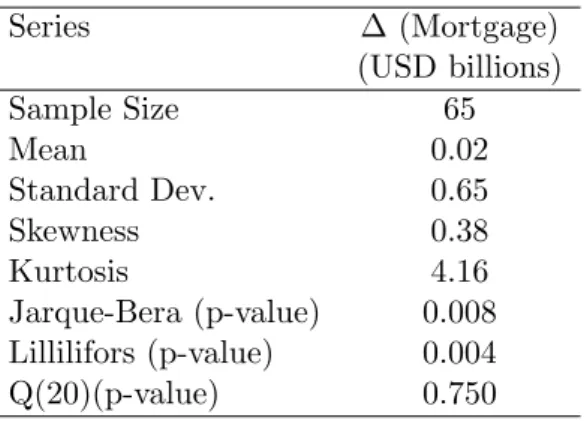
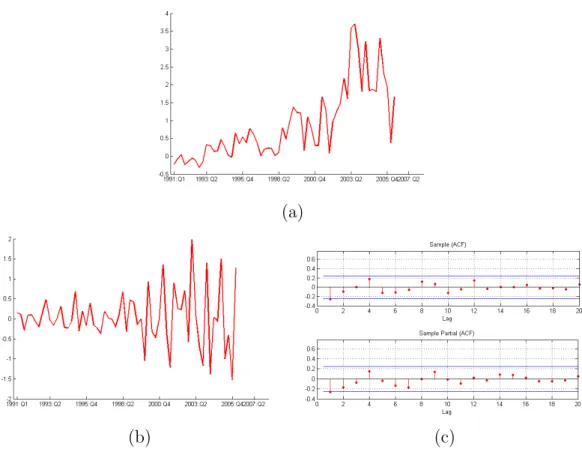
We illustrate the performance of the proposed procedure to construct bootstrap prediction intervals by implementing it on the standardized quarterly mortgages change in home equity debt outstanding, unscheduled payments, observed from 1st quarter of 1991 to the 2nd quarter of 2007 (Mortgages). The series is plotted in the panel (a) of Figure 3, which shows that it is not stationary. Its first differences are plotted in panel (b) together with its correlogram and partial correlogram, in panel (c). The pattern of the sample correlations and the partial correlations suggests that a moving average process of order one may represent adequately the dependence on the first differences of the series. Consequently, the local level model in (4) could be adequate for fitting the series of Mortgages. On the other hand, Table 3 reports several descriptive statistics for the first differences of Mortgages. This series shows excess of kurtosis and positive asymmetry with a non-Gaussian distribution reflected in small p-values for the Jarque-Bera and the Lilliefors tests for Normality.
Table 3: Descriptive statistics
Series ∆ (Mortgage) (USD billions) Sample Size 65 Mean 0.02 Standard Dev. 0.65 Skewness 0.38 Kurtosis 4.16 Jarque-Bera (p-value) 0.008 Lillilifors (p-value) 0.004 Q(20)(p-value) 0.750
We use the observations from the 1st quarter of 1991 up to the 1st quarter of 2001, T = 61, for fitting the model, leaving the rest of them for evaluating the sample forecast performance of the procedure.
The QML estimates of the parameters are given by ˆσ2
ε = 0.126 and ˆq= 0.671. These estimates are used for running the Kalman filter, to obtain estimates the
(a)
(b) (c)
Figure 3: (a) The Mortgages series. (b) First difference of Mortgages. (c) Sample Autocorrelation and Partial-Autocorrelation of the first difference of the Mort-gages data.
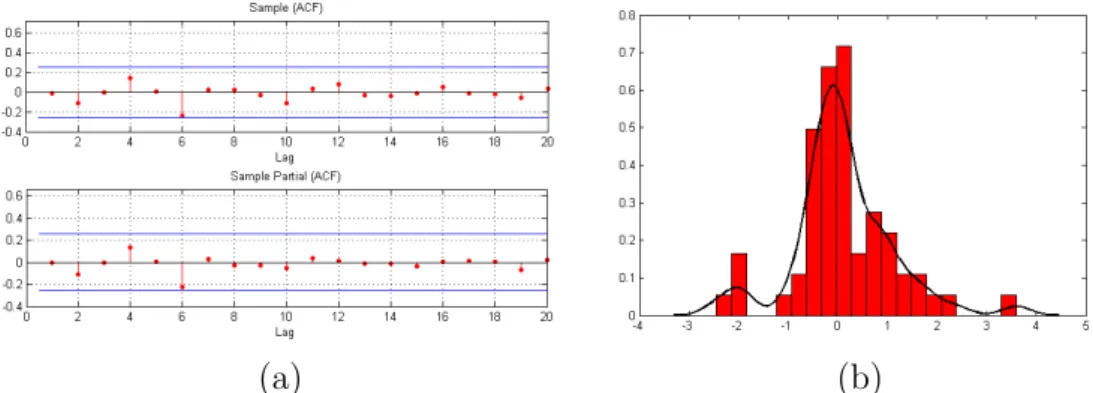
innovations and their variances. Figure 4 plots the correlogram and a kernel estimates of the density of the within sample standardized one-step ahead errors.
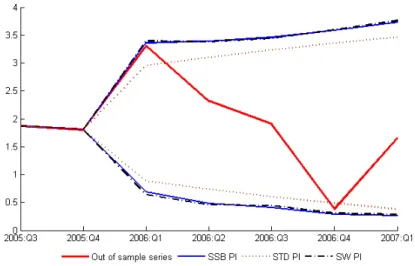
The correlations and partial correlations are not any longer significant. However, the density of the errors suggests that they are obviously far from Normality. Therefore, the local level model seems appropriate to represent the dependencies in the conditional mean of the Mortgages series although for predicting future values it is convenient to implement a procedure that takes into in account the non-Normality of the errors. We construct prediction intervals up to 5 steps ahead using the ST, WS and SSB procedures. The resulting intervals are plotted in Fig-ure 5 together with the observed values of the Mortgages series. First, observe that the two bootstrap procedures generate very similar intervals which are wider
(a) (b)
Figure 4: (a) Sample Autocorrelation and Partial-Autocorrelation of standardized one-step ahead error. (b) Empirical density and histogram for the standardized one-step ahead error.
than the ST intervals, as expected given that they incorporate the uncertainty due to parameter estimation. For two prediction horizons, the observations corre-sponding to the 2nd quarter of 2006 and the 1st quarter of 2007, fall outside the ST prediction interval. However, both bootstrap procedures still contain these two values. It is important to note that although bootstrap procedures are computa-tional intensive, in this application with B = 2000 bootstrap replicates, the BSS procedure requires 110 seconds using a MATLAB algorithm in an AMD Athlon 2.00GHz processor of a PC desktop with 2.00Gb of RAM. However, the Wall and Stoffer (2002) bootstrap procedure requires 160 seconds. There is a reduction of 31% in the computer time required.
6
Conclusion
This paper proposes a new procedure to obtain bootstrap prediction intervals in the context of State Space models. Bootstrap intervals are of great interest when predicting future values of a series of interest as they are able to incorporate parameter uncertainty and do not rely on any particular assumption on the error distribution. Wall and Stoffer (2002) propose a bootstrap procedure to obtain
Figure 5: Bootstrap and standard prediction intervals for the out of sample fore-casting evaluation for Mortgage series.
the density of the prediction errors in two steps. First, the uncertainty due to parameter estimation is taken into in account and then the uncertainty due to the distribution of the prediction error is considered. Furthermore, their procedure is implemented using the backward representation of the model in order to keep fixed the last observations of the series when bootstrapping the parameter estimates.
The procedure proposed in this paper has three advantages. First, it is based on obtaining directly the density of future observations instead of the density of the errors. Furthermore, this density is obtained in one single step that in-corporate simultaneously the uncertainty due to the parameters estimation and the uncertainty due to the error distribution. Finally and more important, the bootstrap procedure proposed in this paper does not rely on the backward repre-sentation. As a consequence, our procedure is much simpler from a computational point of view and can be extended to models without a backward representation. We analyze the small sample behavior of the proposed bootstrap intervals and compare it with those of the intervals proposed by Wall and Stoffer (2002) and the intervals based on assuming known parameters and a Normal distribution of the errors. We show that our procedure, although much simpler, has slightly better properties than the bootstrap intervals of Wall and Stoffer (2002). As expected,
we also show that bootstrap intervals are more adequate than standard intervals mainly in the presence of non-Normal errors. In general, the standard intervals are thinner than expected to have the nominal coverage and cannot deal with asymmetries.
Finally, our proposed bootstrap procedure to obtain prediction intervals in State Space models is illustrated by implementing it to obtain intervals for future values of a series of Mortgages modelled by the local level model. We show that there is an important improvement in terms of computer time when implementing our proposed procedure with respect to implementing the procedure proposed by Wall and Stoffer (2002).
When fitting State Space models to represent the dynamic evolution of a time series, it is often of interest to obtain prediction not only of future values of the series but also of future values of the unobserved states. We are also working on the adequacy of the proposed bootstrap prediction intervals when implemented with this goal. A issue left for further research is the implementation of the proposed procedure when the system of matrices are time-varying.
References
Anderson, B. D. O. and J. B. Moore (1979). Optimal Filtering. Prentice-Hall, Inc., Englewood Cliffs.
Ball, L., S. G. Cecchetti, and R. J. Gordon (1990). Inflation and uncertainty at short and long horizons. Broking Papers on Economic Activity 1990, 215–254.
Broto, C. and E. Ruiz (2006). Using auxiliary residuals to detect conditional heteroscedasticity in inflaction. Manuscript, Universidad Carlos III de Madrid.
Cavaglia, S. (1992). The persistence of real interest differentials: A Kalman fil-tering approach. Journal of Monetary Economics 29, 429–443.
Durbin, J. and S. J. Koopman (2001). Time Series Analysis by State Space Methods. New York: Oxford University Press.
Efron, B. (1987). Better bootstrap confidence intervals. Journal of the American Statistical Association 82, 171–185.
Evans, M. (1991). Discovering the link between inflation rates and inflation un-certainty. Journal of Money, Credit and Banking 23, 169–184.
Harvey, A. C. (1989). Forecasting, Structural Time Series Models and the Kalman Filter. Cambridge: Cambridge University Press.
Harvey, A. C., E. Ruiz, and N. G. Shephard (1994). Multivariate stochastic variance models. The Review of Economic Studies 61, 247–264.
Kim, C. J. (1993). Unobserved-component time series models with markov-switching heterskedasticity: Changes in regimen and the link between inflation rates and inflation uncertainty.Journal of Business and Economic Statistics 11, 341–349.
Pascual, L., J. Romo, and E. Ruiz (2004). Bootstrap predictive inference for ARIMA processes. Journal of Time Series Analysis 25, 449–465.
Pfeffermann, D. and R. Tiller (2005). Bootstrap approximation to prediction MSE for State-Space models with estimated parameters. Journal of Time Series Analysis 26, 893–916.
Taylor, S. J. (1982). Financial returns modelled by the product of two stochastic processes, a study of daily sugar prices, 1961-78. In Anderson (Ed.),Time Series Analysis : Theory and Practice 1, pp. 203–226. North Holland, Amsterdam.
Thombs, L. A. and W. R. Schucany (1990). Bootstrap prediction intervals for autoregression. Journal of the American Statistical Association 85, 486–492.
Wall, K. D. and D. S. Stoffer (2002). A State Space approach to bootstrapping conditional forecasts in ARMA models. Journal of Time Series Analysis 23, 733–751.
Notes
1We try alternative methods as the bias-corrected and the acceleration bias-corrected with
similar results; see Efron (1987) for a definition of these intervals.
2We are particularly interested in dealing with this distribution due to its relation with
the linear transformation of the Autoregressive Stochastic Volatility Model; see, for instance, Harvey et al. (1994). Results for other distributions are similar and are not reported to save space. Available for the authors upon request.
3All, simulation, estimation and prediction has been done with programs developed by the