University of Massachusetts Amherst University of Massachusetts Amherst
ScholarWorks@UMass Amherst
ScholarWorks@UMass Amherst
Doctoral Dissertations Dissertations and Theses
July 2020
INCREASING SENIOR HIGH SCHOOL STUDENTS'
INCREASING SENIOR HIGH SCHOOL STUDENTS'
MATHEMATICAL PROBLEM-SOLVING SKILLS THROUGH
MATHEMATICAL PROBLEM-SOLVING SKILLS THROUGH
IMPROVING THEIR SPATIAL VISUALIZATION SKILLS BY
IMPROVING THEIR SPATIAL VISUALIZATION SKILLS BY
LEARNING AND PRACTICING THREE-DIMENSIONAL DYNAMIC
LEARNING AND PRACTICING THREE-DIMENSIONAL DYNAMIC
GEOMETRY WITH CABRI 3D
GEOMETRY WITH CABRI 3D
Nurul Yaqin
University of Massachusetts Amherst
Follow this and additional works at: https://scholarworks.umass.edu/dissertations_2 Part of the Science and Mathematics Education Commons
Recommended Citation Recommended Citation
Yaqin, Nurul, "INCREASING SENIOR HIGH SCHOOL STUDENTS' MATHEMATICAL PROBLEM-SOLVING SKILLS THROUGH IMPROVING THEIR SPATIAL VISUALIZATION SKILLS BY LEARNING AND PRACTICING THREE-DIMENSIONAL DYNAMIC GEOMETRY WITH CABRI 3D" (2020). Doctoral Dissertations. 1980. https://scholarworks.umass.edu/dissertations_2/1980
This Open Access Dissertation is brought to you for free and open access by the Dissertations and Theses at ScholarWorks@UMass Amherst. It has been accepted for inclusion in Doctoral Dissertations by an authorized
Increasing Senior High School Students’ Mathematical Problem-Solving Skills through
Improving Their Spatial Visualization Skills by Learning and Practicing Three-Dimensional Dynamic Geometry with Cabri 3D
A Dissertation Presented
By
NURUL YAQIN
Submitted to the Graduate School of the
University of Massachusetts Amherst in partial fulfillment of the requirements for the degree of
DOCTOR OF EDUCATION
May 2020
© Copyright by Nurul Yaqin 2020 All Rights Reserved
Increasing Senior High School Students’ Mathematical Problem-Solving Skills through Improving Their Spatial Visualization Skills by Learning and Practicing
Three-Dimensional Dynamic Geometry with Cabri 3D
A Dissertation Presented By
NURUL YAQIN
Approved as to style and content by:
Joseph Berger, Chair
Claire Hamilton, Member
Ahmed Ghoniem, Member
Jennifer Randall, Associate Dean of Academic Affairs College of Education
DEDICATION
For my family, my father Nadlir Bambang Muslichin, my mother Fauziah Nurbaiti, my wife Hj. Siti Munawaroh, and my son H. Muhammad Nur Reza A’Masyi
ACKNOWLEDGMENTS
I can successfully write and present this dissertation because of the guidance, support, and encouragement of some great persons and friends. So, my great thanks and appreciation are due to those that follow:
Dr. Joseph Berger, my advisor and the chair of my dissertation committee, for his expertise, patience, and latitude to allow me to find my way, as well as his guidance throughout the years we have known each other. Our conversations and his feedbacks over the years spurred many thoughts in new directions.
Dr. Claire Hamilton and Dr. Ahmad Ghoniem, my dissertation committee, encouraged me to continue working on my doctoral study and research.
Dr. Shane Hammond (Graduate Program Director) and Dr. Raymond Sharick (Former Graduate Program Director), College of Education, who much helped me resolve my doctoral study problems so that I could successfully finish my doctoral study program in the College of Education.
Ms. Kristin Tyler (Graduate Program Manager), College of Education, who helped me a lot in resolving the administrative requirements and problems during my doctoral study program.
Dr. Beverly Woolf, Dr. Howard Peelle, and Dr. Linda Griffin (my former advisors), who helped me several years ago in the process of my doctoral candidacy.
Mr. Djoko Suwono (headmaster of SMAN 2 – a prestigious public senior high school in Jombang, Jatim, Indonesia) that permitted me to conduct research in the school and to use the school’s computer laboratory for my research.
Mr. Abdul Ghani, Ms. Nur Hasanah, and Ms. Sulisningyas (teachers at SMAN 2 in Jombang, Jatim, Indonesia), who helped me organize my research activities at the school so that I could successfully conduct research.
Mr. Brian Emond (a retired senior lecturer) much helped me resolve my academic problems in the College of Education so that I could successfully continue my doctoral study program in the College of Education.
Ms. Abigail Smith and Mr. Daniel O’Shea, who helped me voluntarily read and correct sentences in my dissertation draft.
The other great persons at the University of Massachusetts Amherst, unfortunately, cannot be listed here – who helped me realize my dream of having a doctoral degree.
Indonesian Ministry of Education’s Directorate General of Higher Education, which gave me a doctoral fellowship for studying at College of Education – University of Massachusetts Amherst, U.S.A.
Finally, I would also like to extend gratitude to my friends, younger brother, younger sisters, and family, particularly my patient wife (Hj. Siti Munawaroh) and my smart son (H. Muhammad Nur Reza A’Masyi), who always supported and encouraged me along the way of the long journey of my doctoral study program at College of Education – University of Massachusetts Amherst.
ABSTRACT
INCREASING SENIOR HIGH SCHOOL STUDENTS’ MATHEMATICAL PROBLEM-SOLVING SKILLS THROUGH IMPROVING THEIR SPATIAL
VISUALIZATION SKILLS BY LEARNING AND PRACTICING THREE-DIMENSIONAL DYNAMIC GEOMETRY WITH CABRI 3D
MAY 2020
NURUL YAQIN, B.A., INTERNATIONAL UNIVERSITY OF MISSOURI M.A., INTERNATIONAL UNIVERSITY OF MISSOURI
ED.D., UNIVERSITY OF MASSACHUSETTS AMHERST Directed by: Professor Joseph Berger
Problem-solving is one of the standards of mathematics processes developed by the National Council of Teachers of Mathematics. Many research studies indicated that there was a relationship between mathematics achievement and spatial visualization skills. But the research results still didn’t indicate whether or not there was a causal mediation relationship between the achievement of learning-and-practicing three-dimensional geometry and mathematical problem-solving skills mediated by spatial visualization skills. Therefore, it’s still necessary for us to specifically investigate whether or not spatial visualization skills can be a medial factor between the increase of mathematical problem-solving skills and the effects of learning and practicing three-dimensional geometry.
For effectively increasing mathematical problem-solving skills and enhancing spatial visualization skills through learning and practicing three-dimensional geometry, we
need an effective tool. And for investigating which tool was effective for learning and practicing three-dimensional geometry, experimental research was conducted at one of the prestigious public senior high schools in Indonesia. This experimentation applied Cabri 3D (dynamic geometry software) for the treatment group and traditional tools (non-dynamic geometry software) for the control group. The results of this experimental research indicated that both kinds of tools were significantly able to develop and enhance students’ spatial visualization skills, but with different effect sizes. The effect size in the treatment group was bigger than the effect size in the control group. The students in the treatment group outperformed the students in the control group in spatial visualization skills and mathematical problem-solving skills.
Further investigation was to investigate the causal mediation relationship between achievement in learning-and-practicing three-dimensional geometry with Cabri 3D and mathematical problem-solving skills mediated by spatial visualization skills. Mediation analysis in this research indicated that there was a significant indirect effect between achievement in learning-and-practicing three-dimensional geometry with Cabri 3D and the increase of mathematical problem-solving skills mediated by the enhanced spatial visualization skills. This experimental research was then completed with questionnaires (students’ feedback).
The conclusions of this experimental research are Cabri 3D (dynamic geometry software) is an effective tool for learning and practicing three-dimensional geometry, developing and enhancing spatial visualization skills, and indirectly increasing mathematical problem-solving skills.
TABLE OF CONTENTS
Page
ACKNOWLEDGMENTS ...v
ABSTRACT ... vii
LIST OF TABLES ... xiii
LIST OF FIGURES ...xv
CHAPTER 1. CONTEXT AND RATIONALE ...1
Context ... 1
Motivating Factors ... 7
Learning Theory ... 9
Constructivism Learning Theory ... 9
Brain-Based Learning Theory ... 10
Multiple-Intelligences Theory ... 11
Problem Statement ... 14
Mediation Analysis ... 15
Rationale: Significances of Spatial Visualization Skills and Problem-solving Skills ... 17
2. REVIEW OF LITERATURE ...19
Historical Perspective on Learning Theories ... 19
Dynamic Geometry Environment ... 23
Piaget's Theory of Spatial Development ... 28
Definition of Spatial Ability ... 31
Significance of Spatial Visualization Skills in Problem-solving ... 31
Assessment of Spatial Visualization Skills ... 34
Developing Spatial Visualization Skills ... 37
Problem Solving ... 41
Van Hiele Levels ... 42
Implications ... 47
Theoretical Framework... 49
Theoretical Implications ... 57
3. METHODOLOGY, DATA COLLECTION, AND ANALYSES ...60
Participants ... 61
Variables ... 62
Instruments ... 63
Reliability ... 65
Internal Reliability Test ... 66
Validity ... 66
Validity Tests ... 67
Treatments ... 70
Control Group's Tutorial Program ... 70
Treatment Group's Tutorial Program ... 72
Experimental Procedure ... 74
Threats to Validity ... 75
Procedure ... 80
Research Design ... 81
Sample and A Priori Calculations ... 87
Underlying Considerations ... 89
Data Collections Procedure... 89
Tool’s Effects on Spatial Visualization Skills and Mathematical Problem-solving Skills ... 90
Regression for Mediation Effect Model ... 91
Research Questions and Hypotheses ... 93
Research Questions ... 93
Hypotheses ... 94
Analyses ... 97
Test for Within-Subjects Research Design with Mixed Repeated Measures of ANOVA ... 97
Tool Effectiveness and Limitations ... 102
4. DATA ANALYSES AND RESULTS...104
Data Collections ... 104
Pre-analysis Activities ... 108
Analyzing the Effects of Treatment on Spatial Visualization Skills ... 120
Descriptive Statistics for SVS ... 121
Statistical Analysis for SVS ... 125
Mediation Analysis ... 136
Analyzing the Effects of Treatment on Mathematical Problem-solving Skills ... 143
Descriptive Statistics for MPS ... 144
Statistical Analysis for MPS ... 146
Students’ Feedback: Questionnaires ... 156
Questionnaire 1 ... 157
Questionnaire 2 ... 159
5. DISCUSSION, CONCLUSIONS, AND RECOMMENDATIONS ...162
Research Questions and Hypotheses ... 162
Research Questions ... 163
Hypotheses ... 164
Revisiting the Research Questions ... 170
Discussion and Conclusions ... 177
Effects of Treatment on Spatial Visualization Skills... 177
Mediation Analysis ... 178
Effect of Treatment on Mathematical Problem-solving Skills ... 179
Conclusions ... 180
Feedback: Results of Questionnaires ... 183
Implications and Recommendations ... 186
Implications for Research ... 186
Implications for Practice ... 187
Implications for Policy ... 189
APPENDICES
A. RELIABILITY AND VALIDITY OF INSTRUMENTS ...193
Test for Reliability_Data-Pilot ... 193
Reliability Data-Cabri3D_Pilot ... 193
Reliability Data-MPS_Pilot ... 194
Reliability Data-PSVT_Pilot ... 195
Test for Validity_Data-Pilot ... 197
Correlations Data-Cabri3D_Pilot ... 197
Correlations Data-MPS_Pilot ... 199
Correlations Data-PSVT_Pilot ... 201
rtabel Distribution forSignificance 5% and 1% ... 206
B. TEST OF PSVT – SVS ...208
C. TEST OF TEA – MPS ...235
D. TEST OF CABRI 3D ...249
LIST OF TABLES
Table Page
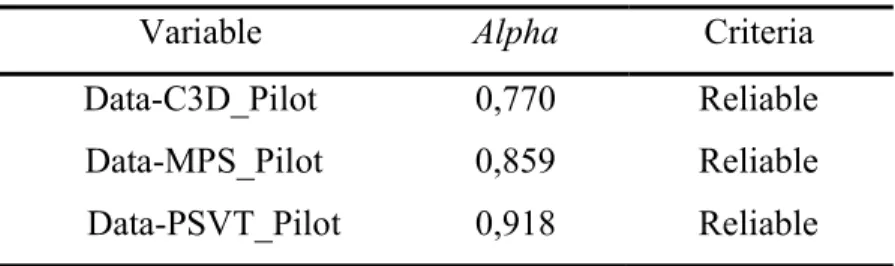
Table 3.1 Results of Reliability Tests ... 66
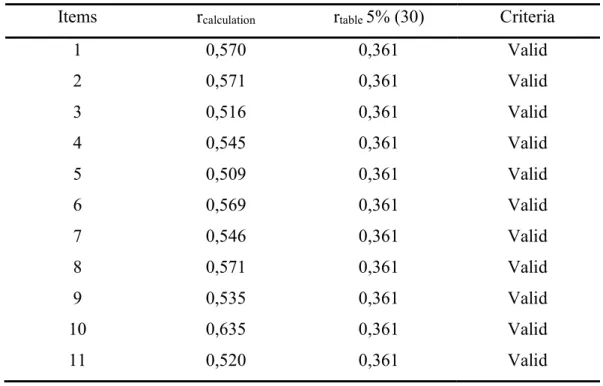
Table 3.2 Validity Tests for Variables of Data-C3D_Pilot _Pilot ... 67
Table 3.3 Validity Tests for Variables of Data-MPS_Pilot ... 68
Table 3.4 Validity Tests for Variables of Data-PSVT_Pilot ... 68
Table 3.5 Schedule of Activities for Control Group ... 71
Table 3.6 Schedule of Activities for Treatment Group ... 73
Table 3.7 Threats to Internal Validity and Actions to Minimize the Threats ... 76
Table 3.8 Threats to External Validity and Actions to Minimize the Threats ... 78
Table 4.1 Data of Pretest-Posttest on Spatial Visualization Skills ………..105
Table 4.2 Data of Posttests on Treatment Group ... 106
Table 4.3 Data of Pretest-Posttest on Mathematical Problem-solving Skills ... 107
Table 4.4 Percentiles of PSVT ... 111
Table 4.5 Extreme Values of PSVT ... 112
Table 4.6 Percentiles of MPS Tests ... 115
Table 4.7 Extreme Values of MPS Tests ... 116
Table 4.8 Tests of Normality of PSVT ... 118
Table 4.9 Test of Normality of MPS ... 119
Table 4.10 Within-Subjects Factors_SVS ... 121
Table 4.11 Between-Subjects Factors_SVS ... 122
Table 4.12 Descriptive Statistics_SVS ... 122
Table 4.13 Levene's Test of Equality of Error Variancesa _SVS ... 125
Table 4.14 Estimates_Measure: SVS-1 ... 125
Table 4.15 Pairwise Comparisons_Measure: SVS-1 ... 126
Table 4.16 Multivariate Tests_SVS-1... 126
Table 4.17 Estimates_Measure: SVS-2 ... 127
Table 4.18 Pairwise Comparisons_Measure: SVS-2 ... 128
Table 4.19 Univariate Tests_Measure: SVS ... 128
Table 4.20 Estimates_Measure: SVS-3 ... 131
Table 4.21 Pairwise Comparisons_Measure: SVS-3 ... 131
Table 4.22 Multivariate Tests_SVS-2... 133
Table 4.23 Mediation Analysis_PROCESS ... 138
Table 4.24 ANOVA ... 140
Table 4.25 Within-Subjects Factors_Measure: MPS ... 144
Table 4.26 Between-Subjects Factors_MPS ... 144
Table 4.27 Descriptive Statistics_MPS... 144
Table 4.29 Estimates_Measure: MPS-1 ... 147
Table 4.30 Pairwise Comparisons_Measure: MPS-1 ... 147
Table 4.31 Multivariate Tests_MPS-1 ... 148
Table 4.32 Estimates_Measure: MPS-2 ... 149
Table 4.33 Pairwise Comparisons_Measure: MPS-2 ... 149
Table 4.34 Univariate Tests_Measure: MPS ... 150
Table 4.35 Estimates_Measure: MPS-3 ... 152
Table 4.36 Pairwise Comparisons_Measure: MPS-3 ... 152
Table 4.37 Multivariate Tests_MPS-2 ... 153
Table 4.38 Control Group - Questionaire 1 ... 157
Table 4.39 Treatment Group - Questionaire 2 ... 159
Table 5.1 Hypotheses………...164
Table 5.2 Results of the Tests of Hypotheses ... 167
Table 5.3 Results of the Descriptive Statistics Calculations... 169
Table 5.4 Results of Questionnaire 1 for Group 1 ... 183
LIST OF FIGURES
Figure Page
Figure 1.1 The Intertwining of Reasoning and Sense-Making ...4
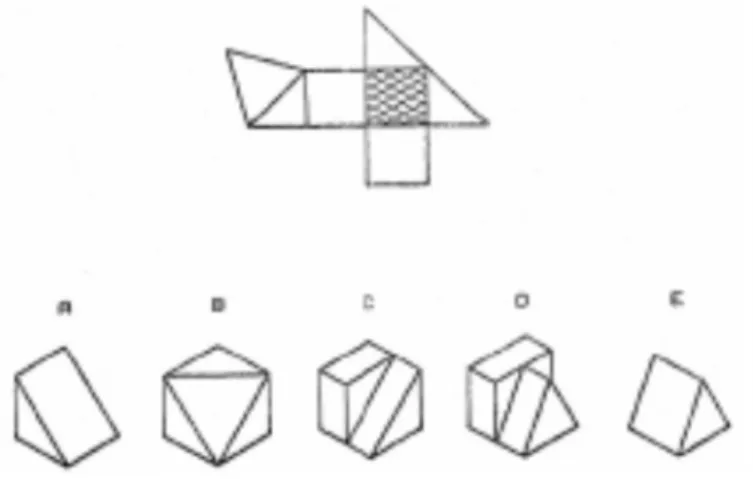
Figure 2.1 Sample question of Developments in PSVT……….35
Figure 2.2 Sample question of Rotations in PSVT ...36
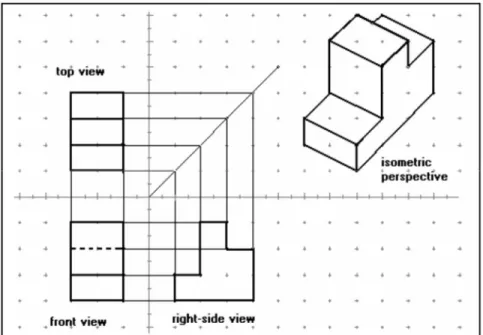
Figure 2.3 Sample question of Views in PSVT ...37
Figure 2.4 An example of the engineering drawing activities with PPT ...38
Figure 2.5 Development with Cabri 3D ...39
Figure 2.6 Three perpendicular lines ...39
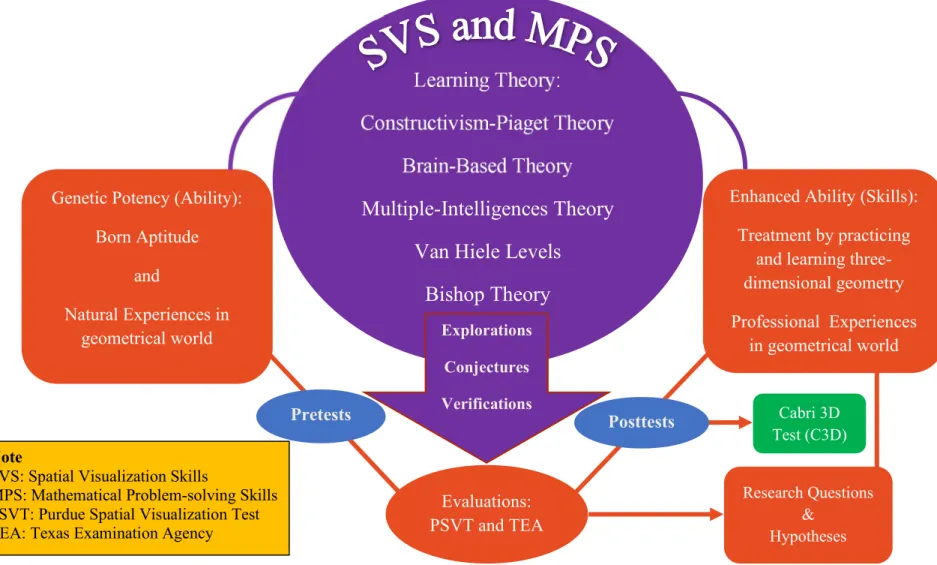
Figure 2.7 The protocol of SVS and MPS developments ...51
Figure 3.1 Tests of SVS and MPS before and after treatment ………84
Figure 3.2 The protocol of enhancing SVS-MPS and mediation relationship ...85
Figure 3.3 Central and noncentral distributions from GPower ...88
Figure 3.4 Causal mediation relationship between X dan Y mediated by M ...92
Figure 3.5 Rotation in View using Cabri 3D ...102
Figure 3.6 Rotation in View from the top using Cabri 3D ...103
Figure 4.1 Estimated Marginal Means of SVS for Group 1 and Group 2………135
CHAPTER 1: CONTEXT AND RATIONALE
Context
There is great variation in the demonstrated ability of some students in senior high schools to excel in mathematics while others struggle to do so. Such a great variation can be the result of varying interests in math as a subject “… there is a significant difference in interest in mathematics and academic achievement of high school level students … the students should train and exposed to various problem-solving skills as a supportive technique to reinforce the learning of the subject mathematics.” (Illiyas & Charles, 2017, p. 264)
For those who struggle with math achievement, a variety of approaches have been investigated regarding how best to help them succeed. To better understand how these students can be assisted with improvement in their mathematical skills, we need to examine cognitive factors that significantly influence students’ mathematical problem-solving skills. This approach is essential given that mathematical problem-solving activities are some of the most important processes in mathematics education, as mentioned in Gresham’s study “… using problem-solving situations … [is] very important for teaching and motivating students to learn mathematics.” (Gresham, 2018, p. 97). Furthermore, the NCTM (2014a) encourages teaching mathematical understanding and reasoning, the making of meaningful connections, and the understanding of concepts and procedures through problem-solving.Some studies have shown that spatial visualization skills have
positive relationships with problem-solving skills in geometry and mathematics (Fennema & Sherman, 1977; Tartre, 1990; Tartre & Fennema, 1995).
Mathematical problem solving is one of the standards of five mathematics processes developed by the National Council of Teachers of Mathematics, e.g. problem-solving, reasoning and proof, connections, communications, and representations NCTM (2000). Among the skills that are found to be related to mathematical learning and achievement are spatial skills (Tartre, 1990). Some research studies such as in Bishop's (1980) spatial visualization training indicate that there is a relationship between mathematics achievements and spatial visualization skills. Spatial visualization skills can be developed through instructions and practices (Alam, 2009). Again Allam (2009) notes that “spatial visualization skills in young adults can be enhanced through instruction and practice.” (p.1). In other words, spatial visualization skills can be developed and enhanced by learning and practicing. Bishop (1980) developed his spatial visualization training with three-dimensional geometry. So, according to Bishop's study, high school students’ spatial visualization skills might be developed and enhanced through learning geometry, especially through learning and practicing three-dimensional geometry.
The mathematical problem-solving process necessitates reasoning and sense-making because reasoning and sense-sense-making are the foundation of problem-solving skills (National Council of Teachers of Mathematics, 2010). “In the most general term, reasoning can be thought of as the process of drawing conclusions on the basis of evidence or stated assumptions” (National Council of Teachers of Mathematics, 2010, p. 4), whereas “sense-making [be thought of] as developing [an] understanding of a situation, contexts, or
concepts by connecting it with existing knowledge” (National Council of Teachers of Mathematics, 2010, p. 4). As identified in the book Focus in High School Mathematics: Reasoning and Sense-Making in Geometry (National Council of Teachers of Mathematics, 2010, p. 10) the key elements of reasoning and sense-making with geometry can be described as follows:
Conjecturing about geometric objects: reasoning inductively and deductively by using a variety of representations.
Construction and evaluation of geometric arguments: developing arguments (informal) to justify a conjecture.
Multiple geometric approaches: analyzing a situation by using transformational and synthetic approaches.
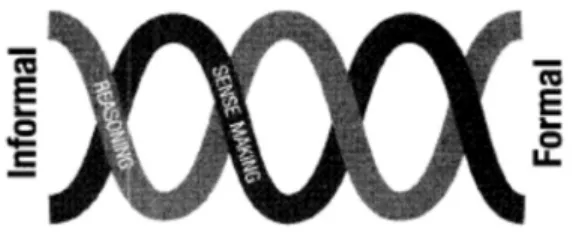
In practice, reasoning and sense-making are intertwined across the continuum from informal observations to formal deduction as shown in Figure 1.1. It identifies sense-making with the informal end of the continuum and reasoning (especially doing proofs) with a more formal end (National Council of Teachers of Mathematics, 2010). Therefore, we can understand that mathematical reasoning and sense-making are both important outcomes of mathematics instruction as well as important means by which students understand mathematics (National Council of Teachers of Mathematics, 2010).
Figure 1.1 The Intertwining of Reasoning and Sense-Making
Source: from NCTM (2010)
The type of this dissertation research is experimental research. In this research, the treatment group used Cabri 3D (DGS) and the control group used traditional tools (non-DGS) for learning and practicing three-dimensional geometry. DGS is a dynamic geometry software; and traditional tools are non-DGS such as paper-pencil, rulers, protractors, compass, set squares, and dividers. In a teaching-and-learning environment, DGS is the teaching-and-learning tool in a dynamic geometry environment (DGE), and traditional tools are the teaching-and-learning tools in a paper-pencil environment (PPE).
Further investigation in this experimental research was to investigate whether or not there was a direct or indirect causal relationship between the achievement of learning-and-practicing three-dimensional geometry with Cabri 3D and mathematical problem-solving skills mediated by spatial visualization skills.
Learning and practicing three-dimensional geometry with Cabri 3D in the DGS-based learning program could be very important associated with effectively increasing students’ problem-solving skills. “The effective role of the DGS-based lessons on students’ learning experiences is assumed to be associated with the aspects of motivation, … , conceptual understanding, and problem-solving strategies” (Denbel, 2015, p. 24).
However, many teachers and students in senior high schools are reluctant to teach and learn three-dimensional geometry due to the limitations of traditional tools’ features and properties. Traditionally, students in schools use papers, pencils, rulers, compasses, set squares, dividers, and protractors for learning and practicing three-dimensional geometry. The use of these traditional tools is time-consuming, and also with these tools students and teachers cannot freely manipulate and construct various three-dimensional objects.
Cabri 3D is a learning tool in DGE that has made learning and practicing three-dimensional geometry easier and less time-consuming than with traditional tools. In his article, Denbel (2015) also said that “Cabri offers more opportunities to construct and justify geometrical concepts than the pencil and paper settings.” (Denbel, 2015, p. 26), and it can help students learn, animate, and construct three-dimensional objects that cannot be easily done by traditional tools. “This process is thus facilitated by the dynamic features of the geometry software.” (Denbel, 2015, p. 24)
In the context of developing and enhancing spatial visualization skills and increasing mathematical problem-solving skills, the learning tools must be able to help students learn and practice easily in at least three basic problems, namely developments, rotations, and views. Furthermore, the learning tools have to be able to support students in doing explorations, making conjectures, and verifications. Hence, Cabri 3D can be an important learning tool for developing and enhancing students’ spatial skills and increasing their mathematical problem-solving skills as well.
explaining the physical world around them ….” (Guven & Kosa, 2008, p. 100). It has been clear that the physical world around us cannot only be explained with two-dimensional geometry but also with three-dimensional geometry. Because of that, “NCTM (2000) recommends that geometry instruction should include the study of three-dimensional geometry and provide students opportunities to use spatial abilities to solve problems.” (Guven & Kosa, 2008, p. 100)
Spatial ability consists of spatial visualization skills, such as changing, rotating, bending, and reversing an object presented for stimulation in the mind (McGee, 1979). According to Yurt and Tunkler (2016) “There is no consensus in the relevant literature about the components of spatial ability.” (p. 966). Spatial visualization seems to tap the ability of mental integration, which is done while consolidating several orthographic views into a single image of perspective. Given the obvious connection between spatial thinking and transformational geometry, which is the base of engineering drawing, one might hypothesize that work with the latter would improve skills in the former (Clements, Michael, & Battista, 1992). Spatial visualization skills are important not only for mathematicians but also for other professionals such as engineers and architects. Spatial visualization skills are needed for adequately modeling and representing three-dimensional objects.
Generally, we know that some students can easily reach high achievement in mathematics while others cannot. In response to this situation, a few questions have emerged such as: how to increase students’ achievement in mathematics and mathematical problem-solving skills (MPS); whether or not there is a causal mediation relationship
between achievement in learning and practicing three-dimensional geometry with Cabri 3D (C3D) and mathematical problem-solving skills (MPS) mediated by spatial visualization skills (SVS); and whether or not learning and practicing three-dimensional geometry with Cabri 3D can effectively develop and enhance spatial visualization skills.
In general, spatial skills are very important for understanding and representing mathematical concepts, and spatial skills can be considered to be the mental skills concerned with understanding, manipulating, reorganizing, or interpreting mathematical relationships visually (Tartre, 1990).
Motivating Factors
The ability to create and project mental representations is often referred to as spatial visualization skills. We need to conduct a research study for investigating spatial visualization skills that can be developed and enhanced through learning and practicing three-dimensional geometry with Cabri 3D. Spatial visualization skills are very important skills for learning geometry, particularly in geometrical problem-solving. Furthermore, we think that there could be a causal mediation relationship between mathematical problem-solving skills (MPS) and the achievement of learning and practicing three-dimensional geometry with Cabri 3D (C3D) mediated by spatial visualization skills (SVS).
Previous research studies only indicated there was a relationship between mathematics achievement and spatial visualization skills (SVS), and SVS could be enhanced by instruction and practice. The research still didn’t indicate about causal mediation relationships among the three factors, namely: learning and practicing
three-(SVS), in turn, increasing mathematical problem-solving skills (MPS). Figure 3.4 shows the causal mediation relationship between achievement in learning and practicing three-dimensional geometry with Cabri 3D (C3D) and mathematical problem-solving skills (MPS) mediated by spatial visualization skills (SVS).
Most mathematics teachers find that mathematical problem-solving is a big problem that their students face when learning mathematics, “that is, students without conceptual understanding may get better at performing procedures based on rote memorization in solving routine problems. However, when facing non-routine problems involving strategic skills, such students become at a loss to develop a new appropriate technique in solving them. Hence, a conceptual understanding was [needed] … for developing problem-solving strategies ….” (Denbel, 2015, p. 28). Therefore, the enhancement of students’ mathematical problem-solving skills ought to be the center of mathematics education in senior high schools. This experimental research also found that senior high school students’ mathematical problem-solving skills significantly improved through systematic training in spatial visualization skills.
The motivating factors in this study are:
Development and enhancement of spatial visualization skills will help students increase their achievement in learning mathematics.
Enhancement of spatial visualization skills will affect the results of mathematics processes – problem-solving, reasoning and proof, connections, communications, and representations.
Enhancement of spatial visualization skills will increase ability and skills in the understanding of mathematics and science.
Furthermore, high spatial visualization skills and mathematics achievement will facilitate students to learn other related knowledge like physics, chemistry, engineering, and architecture.
Learning Theory
This section will present the main learning theories, namely: Constructivism learning theory, Brain-based learning theory, and Multiple-intelligences theory. And these learning theories will be further described in the next chapter.
Constructivism Learning Theory
Constructivism is a philosophy of learning founded on the premise that people learn best through experiences. That is, people create their meaning through experience. “The idea of using constructivism theory is not a new theory in educational teaching and learning in Indonesia.” (Suhendi & Purwarno, 2018, p. 87). Indonesia is a country where this experimental research conducted.
Dewey’s theory states that constructivism can build personal and social knowledge. The essence of the constructivism theory is in the meaning of a learning process. “In the perspective of constructivism theory, students are motivated and directed to learn the main idea through discovery learning.” (Suhendi & Purwarno, 2018, p. 89)
Constructivist thinking is rooted in several aspects of Piaget and Vygotsky’s cognitive theories. “From Piaget, we get active learning, create schemes, assimilate, and accommodate all forms of science, etc. From Vygotsky, we get social constructivism, group work, internships, and so on. Constructivism embraces a ‘top-down’ rather than a ‘ bottom-up’ instructional methodology ….” (Aljohani, 2017, p. 98). The top-down instructional methodology means that the teachers give their students the main problem, and the students learn the main problem and then derive the detail. “The main principles in constructivism are: Knowledge is Constructed; the Learner is an Active Creator.” (Aljohani, 2017, p. 98). In recent decades, the constructivism learning theory has become more popular in the school system.
Brain-Based Learning Theory
The brain is a primary organ that human has. A part of its functions is to control human activities like teaching and learning processes. Therefore, for that necessity, brain-based learning theory is developed. Although this learning theory is relatively new, this learning theory has helped design a learning program in the classroom, for example, learning with calming music to decrease stress or create comfortable reading and study areas. “Brain-based learning refers to teaching methods, lesson designs, and school programs that are based on the latest scientific research about how the brain learns, including such factors as cognitive development—how students learn differently as they age, grow, and mature socially, emotionally, and cognitively” (Glossary of Education Reform, 2013, para. 1)
Brain-based learning is motivated by the general belief that learning can be accelerated and improved if educators base how and what they teach on the science of learning, rather than on past educational practices, established conventions, or assumptions about the learning process. For example, it was commonly believed that intelligence is a fixed characteristic that remains largely unchanged throughout a person’s life. However, recent discoveries in cognitive science have revealed that the human brain physically changes when it learns and that after practicing certain skills it becomes increasingly easier to continue learning and improving those skills. This finding—that learning effectively improves brain functioning, resiliency, and working intelligence—has potentially far-reaching implications for how schools can design their academic programs and how teachers could structure educational experiences in the classroom. (Glossary of Education Reform, 2013, para. 2)
As mentioned above, the human's brain physically changes because of the learning process and practice with specific skills and knowledge. Such learning and practicing will effectively improve brain functioning like problem-solving and spatial reasoning. Furthermore, learning and practicing three-dimensional geometry with Cabri 3D might enhance spatial visualization skills and increase mathematical problem-solving skills.
Multiple-Intelligences Theory
The theory of multiple-intelligences was introduced in 1983 by psychologist Howard Gardner in his book “Frames of Mind.” This theory suggests that traditional psychometric views of intelligence are too limited. The essence of the Multiple-intelligences theory is that each person has nine types of intelligence, and the core of intelligence is the ability to learn and solve problems.
The nine types of intelligence according to Gardner in his Multiple-intelligences theory, namely: visual-spatial intelligence, linguistic-verbal intelligence, logical-mathematical intelligence, bodily-kinesthetic intelligence, musical intelligence, interpersonal intelligence, intrapersonal intelligence, naturalistic intelligence, and existentialist intelligence. Naturalistic intelligence is the most recent intelligence addition to Gardner’s theory and met with more resistance than his original seven-intelligences.
When we hear the word intelligence, the concept of IQ testing may immediately come to mind. Intelligence is our intellectual potential, something we are born with, something that can be measured, and a capacity that is difficult to change. In recent years, however, other views of intelligence have emerged. One such concept is the theory of multiple intelligences that was proposed by Howard Gardner.
To capture the full range of abilities and talents that people possess, Gardner theorizes that people do not have just an intellectual capacity, but have many kinds of intelligence, including musical, interpersonal, spatial-visual, and linguistic intelligence. While a person might be particularly strong in a specific area like musical intelligence, the person might be also strong in verbal, musical, and naturalistic intelligence.
Gardner’s theory has come under criticism from both psychologists and educators. These critics argue that Gardner’s definition of intelligence is too broad and that his nine different-intelligences only represent talents, personality traits, and abilities. Cerruti (2013) said, “I criticize MI [Multiple Intelligences] for doing little to clarify for teachers a core misunderstanding, specifically that MI [Multiple Intelligences] was only an anatomical
map of the mind but not a functional theory that detailed how the mind … processes information.” (p. 1)
Cerruti’s core intention is plain, namely to advance the utility of intelligences theory to both teachers and researchers by building a functional Multiple-intelligences theory. He has argued that as the field of educational neuroscience grows, Multiple-intelligences theory may be a particularly useful foundation upon which to build a proper scientific theory of neurocognitive learning processes. However, “the theory of Multiple-intelligences enjoys considerable popularity with educators. Many teachers utilize multiple intelligences in their teaching philosophies and work to integrate Gardner’s theory into the classroom.”(Cherry, 2019, para. 5)
Although there are nine Gardner’s different-intelligences, only two Gardner’s different-intelligences correlate to this study, namely: Logical-Mathematical Intelligence and Visual-Spatial Intelligence.
Logical-Mathematical Intelligence:
The strength of this intelligence is on analyzing problems and mathematical operations.People who are strong in logical-mathematical intelligence are good at reasoning, recognizing patterns, and logically analyzing problems. These individuals tend to think conceptually about numbers, relationships, and patterns (Singh et al., 2017). Thinking logically and reasoning deductively are most often associated with scientific and mathematical thinking or problem-solving skills. Visual-Spatial Intelligence:
The strength of this intelligence is onvisual and spatial judgments. People who are strong in visual-spatial intelligence are good at visualizing things. These individuals are often good with directions as well as maps, charts, videos, and pictures (Levine, Ratliff, Huttenlocher, & Cannon, 2012). And people who are strong in this intelligence also enjoy drawing three-dimensional objects with dynamic geometry software and recognizing patterns easily. Hence, visual-spatial intelligence has a close relationship with spatial reasoning in geometry and spatial visualization skills.
The description of the three learning theories above indicates that spatial visualization skills and problem-solving skills can develop and enhance through learning, practicing, and connecting brain capacity to life experience. Discovery learning and explorations in the field of three-dimensional dynamic geometry might develop spatial visualization skills and increasing mathematical problem-solving skills. These learning theories, including Piaget’s theory of spatial development and Van Hiele Level, will be reviewed in Chapter 2.
Problem Statement
Problem-solving is one of the mathematics process standards. Mathematical problem-solving skills are primary skills for solving problems in mathematics and real-world situation. These skills relate to spatial visualization skills. Some research mentioned that there was a relationship between mathematics achievement and spatial visualization skills, and spatial visualization skills could be improved by practice. The problem is how to increase mathematical problem-solving skills effectively in the context of developing
and enhancing spatial visualization skills. Spatial visualization skills are the cognitive abilities that can be developed and enhanced by learning and practicing three-dimensional geometry with traditional tools and dynamic geometry software. By experimentation, we investigate which tool is more effective for developing and enhancing spatial visualization skills and increasing mathematical problem-solving skills.
This research study is to investigate the relationship between senior high school students' mathematical problem-solving skills and spatial visualization skills. And this research study is also to investigate a causal mediation relationship between the achievement of learning and practicing three-dimensional geometry with Cabri 3D and mathematical problem-solving skills mediated by spatial visualization skills.
Hence, as applied to this study, I would expect the independent variable to be students’ achievement in learning and practicing three-dimensional geometry with Cabri 3D to develop and enhance spatial visualization skills, the mediator variable to be spatial visualization skills, and the dependent variable to be mathematical problem-solving skills.
Mediation Analysis
The title of this dissertation is “Increasing senior high school students’ mathematical problem-solving skills through improving their spatial visualization skills by learning and practicing three-dimensional dynamic geometry with Cabri 3D.” Hence, the core of this dissertation is a research study in the mediation relationship and mediation analysis with a regression-based approach.
Mediation analysis is a statistical method used to help answer the question as to how some causal agent X transmits its effect on Y mediated by M (Hayes, 2013) where X is an independent variable, Y is a dependent variable, and M is a mediator variable between X and Y.
The reasons why some students can solve math problems and some others cannot solve them are always related to their spatial visualization skills. One of the desired suggestions to develop mathematical skills is to suitably emphasize and develop primary abilities such as spatial ability instead of just teaching mathematics (Bishop, 1980; Kayhan, 2005). The suggestion needs us to find a solution to the issue through experimental research.
This research is for investigating whether or not there is a direct or indirect causal relationship between the effect of learning and practicing three-dimensional geometry with Cabri 3D (X) and mathematical problem-solving skills (Y) independent of (or mediated by) spatial visualization skills (M), and then for investigating the indirect effect of how much two cases that differ by one unit on X are estimated to differ by ab units on Y as a result of the effect of X on M, in turn, affecting Y in where a and b are regression coefficients of X and M respectively (Hayes, 2013). Furthermore, the direct effect is two cases that differ by one unit on X but are equal on M are estimated to differ by c’ units on Y. Thus, the total effect is c = c’ + ab, and c quantifies how much two cases that differ by one unit on X are estimated to differ on Y (Hayes, 2013).
This mediation analysis is to investigate whether or not learning and practicing three-dimensional geometry with Cabri 3D can develop and enhance senior high school
students’ spatial visualization skills, in turn, can increase their mathematical problem-solving skills. Mediation analysis will be further described in the next chapters
Rationale: Significances of Spatial Visualization Skills and Problem-solving Skills
This experimental research is for investigating the use of dynamic geometry software (Cabri 3D) for developing and enhancing spatial visualization skills and increasing mathematical problem-solving skills. Allam (2009) said as he quoted from (Piburn et al., 2005; Crown, 2001, Deno, 1995; Lord, 1985; Pallrand & Seeber, 1984; Peters et al., 1995; Sorby & Baartmans, 1996) that, modern studies, however, have indicated that spatial visualization skills can be improved through practice. Additionally, spatial visualization skills are strongly related to problem-solving skills (Carter, LaRussa, & Bodner, 1987).
Spatial visualization skills are important skills for mathematicians and other professionals like engineers and architects. They need the skills for making and visualizing a model of problem-solving and representation. Therefore, it is necessary to investigate the use of Cabri 3D for developing and enhancing spatial visualization skills. In the future, Cabri 3D and other DGS might help students effectively learn and practice three-dimensional geometry in the context of developing-and-enhancing spatial visualization skills and increasing mathematical problem-solving skills.
The investigation of the interaction between spatial visualization skills and dynamic geometry software (Cabri 3D) could shed light on increasing mathematical
problem-solving skills. Problem-problem-solving is the process of logical-deductive thinking that requires spatial skills. So, spatial visualization skills become a logical prerequisite for successful mathematical problem-solving. Instructions and training with Cabri 3D have to be able to motivate and trigger students’ spatial and logical-deductive reasoning. Logical-deductive reasoning is the thinking rule of mathematical processes and mathematical problem-solving.
CHAPTER 2: REVIEW OF LITERATURE
There are several related sections in this chapter, namely: the historical perspective in learning theories, the significance of spatial visualization skills in problem-solving, dynamic geometry environment, developing spatial visualization skills, mathematical problem-solving skills, implications, summary, and theoretical framework. The section of the historical perspective in learning theories includes a literature review of some learning theories concerning the process of developing spatial visualization skills through learning three-dimensional geometry and the process of increasing mathematical problem-solving skills. The section about dynamic geometry environment mainly reviews Cabri 3D literature as an innovative tool for teaching and learning three-dimensional geometry, sub-sections of dynamic geometry environment are about the relationship between the significance of spatial visualization skills and mathematical problem-solving skills. And the last section of this chapter describes the development of the theoretical framework of this dissertation. Those sections and sub-sections are as follows:
Historical Perspective on Learning Theories
Constructivism is a philosophy of learning founded on the premise that, by reflecting on our experiences, we construct our understanding of the world where we live. Constructivism is a learning theory found in psychology that explains how people might acquire knowledge and learn. Therefore, constructivism has a direct application to education. The theory suggests that humans construct knowledge and meaning from their
learning theories and teaching methods in education and as an underlying theme of many education reform movements, such as using Cabri 3D software for teaching and learning three-dimensional geometry for enhancing spatial visualization skills and mathematical problem-solving skills.
Formalization of the theory of constructivism generally is attributed to Jean Piaget who articulated the mechanism by which knowledge is internalized by learners. He suggested that through processes of accommodation and assimilation, individuals construct new knowledge from their experiences. Assimilation is the incorporation of new experience into an already existing framework without changing that framework, and accommodation is the process of reframing mental representation of the external world to fit new experiences as the mechanism by which failure leads to learning. Constructivism is a theory of knowledge that argues that humans generate knowledge and meaning from an interaction between their experiences and their ideas. It has influenced several disciplines, including psychology, sociology, education, and the history of science (Eddy, 2004). “Constructivism has emerged in recent years as a dominant paradigm in education and has had a major intellectual impact on the development of pedagogy, rooted in the cognitive-developmental of Piaget and the sociocultural theory of Vygotsky (Aljohani, 2017, p. 97). In other words, knowledge is constructed individually and socially by experiences in the real practical world.
The development of senior high school students’ spatial visualization skills can be categorized into the fourth development stage of Piaget-and-Inhelder’s theory, namely the Formal Operational Stage. In this stage, the students’ understandings of geometrical
concepts develop in the complex formal system, especially in Euclidean geometry. Afterward, learning at higher levels can be successful after the students have passed through the four development stages.
Constructivism is the view in philosophy according to which all "knowledge is a compilation of human-made constructions" (Raskin, 2002, p. 4), and "not the neutral discovery of objective truth" (Castelló & Botella, 2016, p. 263). Hence, research support for constructivists’ discovery-based teaching techniques has been mixed, with some research supporting the teaching techniques and other research contradicting the teaching techniques and results.
Brain-based learning theory is a learning theory based on the structure and function of the brain. Caine and Caine (1994)wrote that if the brain is not prohibited from fulfilling its normal processes, learning will occur. The human brain is unique. With the help of modern brain-scanning techniques, we can see how brain structure and brain activities linked to cognitive abilities (Cooper, 2015). This brain-based learning theory doesn’t explicitly explain cognitive and spatial functions are unique to the brain. However, this theory mentions that spatial ability is a form of memory and the normal learning process will occur, wholes and parts, simultaneously with the brain as a parallel processor.
The relationship between the concepts of memory and intelligence is somewhat controversial. Behaviorists believe that intelligence is measured by the ability to learn or the capacity to think abstractly (Cooper, 2015). These skills are usually the focus of intelligence tests. Some researchers argue that both concepts (memory and intelligence)
(Cooper, 2015). In other words, if they are correlated then the relationship between spatial visualization skills as a form of memory and mathematical problem-solving skills as a form of intelligence still needs further investigation. Hence, brain-based learning theory is logically relevant to the theoretical framework of how to increase mathematical problem-solving skills through improving spatial visualization skills with Cabri 3D, because for significantly increasing mathematical problem-solving skills, one needs strong spatial memory and logical thinking as described in the theory of multiple intelligences, developed by Howard Gardner.
Multiple-intelligences theory is the theory of human intelligence, developed by psychologist Howard Gardner. The theory offers an alternative to the older conception of ability. Gardner formulated a list of nine types of intelligence as mentioned in Chapter 1. The first two types of intelligence (visual-spatial intelligence, linguistic-verbal intelligence) are typically valued in schools, the following three types of intelligence (logical-mathematical intelligence, bodily-kinesthetic intelligence, musical intelligence) are usually associated with the arts and mathematics, and the last two (interpersonal intelligence, intrapersonal intelligence) is what he calls ‘personal intelligence’ (Gardner, 1999, pp. 41-43). Furthermore, Gardner says that the seven types of intelligence (except interpersonal intelligence and intrapersonal intelligence) have allowed people to perceive and understand the world around them, and allowing them to identify and resolve the problems they face. However, only two types of intelligence from Gardner’s theory have a close relationship to the theoretical framework that I will develop in this chapter. The two types of intelligence are as follows:
Logical-Mathematical – The capacities of inductive-and-deductive thinking and reasoning, the use of numbers, and the recognition of abstract patterns. It also consists of the capacities for analyzing problems logically, investigating issues scientifically, and carrying out mathematical operations. Intelligence is most often associated with scientific and mathematical thinking.
Visual-Spatial – The ability and skill to visualize objects, spatial dimensions, and create internal images and pictures.
As cited in Chapter 1, Cerruti (2013) criticized Multiple Intelligences. He said that Multiple Intelligences was only an anatomical map of the mind but not a functional theory that detailed how the mind processes information. He argued that as the field of educational neuroscience grows, Multiple-intelligences theory may be a useful foundation for building the theory of neurocognitive learning processes.
Dynamic Geometry Environment
The dynamic geometry environment is the environment of teaching and learning two- and three-dimensional dynamic geometry by using software and computer. Software and computers are technological tools for assisting teachers and students in teaching and learning geometry. There are some advantages and disadvantages to learning geometry with software and computers. The advantages are: The technological tools are very appropriate for teaching and learning dynamic geometry as well as for constructing algebraic equations. The tools can also make teaching and learning three-dimensional geometry easy and interesting. The disadvantages of using the tools are: The tools will be
useless if students cannot operate a computer and its software appropriately, and if students don’t know algebraic equations and basic concepts of how and why their geometrical constructions show up on the computer screen in the forms of lines, curves, planes, and spaces. Ertekin (2014) said that “its equation [lines, planes, and spaces] can be algebraically identified … [with] the components of its normal vector in three-dimensional space” (p. 29).
So, teaching and learning mathematics with a computer requires strategy. For example, before using software for constructing images on a computer screen, a teacher must explain to their students concerning mathematics formulas and basic concepts of line, curve, and space, and the relationship between algebra and geometry. This teaching strategy will help students understand the relationship between algebra and geometry, and help the students visualize their abstract thinking algebraically and geometrically.
Cabri 3D, launched in 2004, is a dynamic geometry software for learning and exploring three-dimensional geometry. Cabri Geometry is a commercial interactive geometry software produced by the French company “Cabrilog” for teaching and learning geometry in high schools. It was designed with ease-of-use in mind. Accascina and Rogora (2006) made research using Cabri 3D Diagrams for teaching geometry, and they wrote that “Cabri 3D is potentially very useful software for learning and teaching geometry” (p. 11). Cabri 3D allows the user to animate geometric figures, proving a significant advantage over those drawn on a blackboard. Relationships between points on a geometric object can be easily demonstrated, which could be useful for the learning processes of geometry. As an advantageous tool for teaching and learning three-dimensional geometry, Cabri 3D can
be a better tool for developing and enhancing spatial visualization skills than traditional tools because, with its animation tool, Cabri 3D does help students easily explore and animate pictures/images they have created on a computer screen.
Animation tool in Dynamic Geometry Software (DGS) is a very useful tool for mathematics education research, where “animated learning materials can prove more useful than static representations” (Taylor, Pountney, & Malabar, 2007, p. 249) such as in transformational geometry. DGS allows students to alter the original geometric objects by moving or dragging their components, such as vertices and edges, to different locations on the computer screen. As the objects are dragged or transformed, those objects are updated immediately on the screen. Students also can measure lengths, angles, and areas of the dragged objects and observe how the measures are affected as the objects are altered dynamically (Clements, Sarama, Yelland, & Glass, 2008). Again, these learning activities will help students develop and enhance their spatial visualization skills.
Developing spatial ability is very important in geometry education, because “without spatial ability, students cannot fully appreciate the natural world. Spatial ability is also very important for work in various fields such as computer graphics, engineering, architecture, and cartography” (Guven & Kosa, 2008, p. 100). Eight years later, Kosa (2016) investigated how to use dynamic geometry software on pre-service mathematics teachers that affected the teachers’ spatial visualization skills; and their investigation showed that dynamic geometry software was effective for improving spatial visualization skills. At that time, Kosa used Geogebra software for learning and investigating spatial analytic geometry. For understanding the complexity of spatial analytic geometry, which
includes coordinate system, vectors, planes and lines in space, and surface in space, one needs well-developed three-dimensional geometry thinking and spatial visualization skills Visualization skills are often indicative of academic performance in the engineering curriculum (Yue, 2002). Spatial visualization skills are also important for physics and chemistry students when they want to visualize and model concepts and theories in science, such as when students want to model and visualize the structures of molecules and explain molecular or atomic reactions. Spatial visualization skills will enhance students’ understanding of scientific concepts and theories as well as promote their performance in problem-solving. Otherwise, academic failure is shown to be related to deficiencies in two- and three-dimensional perceptional abilities (Rochford, Fairall, Irvings, & Hurly, 1989). Because of that, spatial visualization skills should be applied throughout mathematics and science curriculums in schools as the representations and applications of two- and three-dimensional perceptions.
Furthermore, in this context, the use of Cabri 3D can be considered as the application of educational technology for enhancing spatial skills and helping students to understand mathematical problem-solving strategies. Zbiek and Hollebrands (2008) said that “There is ample evidence that the use of various forms of technology may enhance student understanding of mathematics. The key to enriched understanding lies not only in the skill development of the technology but also in how that technology is used by and with learners” (p. 287). “Dynamic interactive geometry software [DGS] allows students to create geometric constructions and manipulate them easily [and quickly]. Dragging, the dynamic feature of DGEs [or DGS], allows users to move certain elements of a drawing
freely and to observe other elements responding to the altered conditions.” (Goldenberg, Scher, & Feurzeig, 2008, p. 53). The statements above are very general. To better develop and enhance spatial visualization skills, we need a potentially useful software like Cabri 3D for learning and practicing three-dimensional geometry.
Cabri is truly interactive; "there is some form of communication between the student and the computer which enables the student to go further with mathematics than they would otherwise have been able to. The computer can only obey inputted instruction, and so the student must be precise about what he or she inputs” (Forsythe, 2007, p. 31) Students with interactive tools will easily transform, develop, and view various geometric objects on the computer screen. So, in a dynamic geometry environment, the students will have a bigger opportunity to develop and enhance their spatial visualization skills.
The National Council of Teachers of Mathematics (NCTM) recommends that "the mathematics curriculum for grade 5-8 should include the study of the geometry of one, two, and three dimensions in a variety of situations so that students can visualize and represent geometric figures with special attention to developing spatial sense" (National Council of Teachers of Mathematics, 1989); to do so, the most recent and powerful educational technology should be used. However, old geometry curricula [in the past decades] did not provide enough opportunity for the development of spatial skills (Usiskin, 1987). Therefore, now, educational technology such as DGS will be a very important tool for developing and enhancing spatial visualization skills and increasing mathematical problem-solving skills.
Dynamic Geometry Environment allows new opportunities for the teaching of geometry and descriptive geometry. “Descriptive Geometry is a method to study 3D geometry through 2D images thus offering insight into the structure and metrical properties of spatial objects, processes, and principles” (Nagy-Kondor, 2010). This environment makes it possible for us to create dynamic drawings quickly and easily. Nagy-Condor conducted a two-group experiment for two years using engineering students from a university in Germany as participants. She taught one of the groups with Dynamic Geometry Software (Cinderella and GeoGebra), and another group with paper-and-pencil tools (PPE). She used MCT (Mental Cutting Test) for evaluating the development of spatial ability in her experiment. From her experiment, she reported that learning descriptive geometry with dynamic geometry software like Cinderella and GeoGebra could be better for improving students’ spatial skills than the standard PPE.
Also, Noraini (2009) surveyed the effects of using Geometer’s Sketchpad (GSP) on 65 students at secondary school in Malaysia. Her survey indicated that most of the students felt that GSP was very useful for learning geometry. However, the subjects could be susceptible to the internal validity threat of selection because Noraini didn’t assign the subjects randomly.
Piaget's Theory of Spatial Development
Jean Piaget (1896-1980) is renowned as the constructor of a highly influential model of spatial development stages in learning geometry. His theory is based on the development of children's spatial and mental maps for understanding and responding to physical experiences within their environment.
Research by Piaget and Inhelder (1967) suggest that early spatial conceptions in the infants are topological. The relationship between spatial and topological conceptions are very general and inclusive. The spatial ability will grow and refine naturally or educatively more-and-more complex until adulthood. The four basic topological concepts that can become the foundation of spatial visualization development are as follows:
Proximity - the relative nearness of an object or event to any other object or event.
Order - the sequence of objects or events (in time) according to size, color, or some other attributes.
Separation - an object, event, or space, coming between other objects or events. It also involves distinguishing between objects and parts of objects.
Enclosure - an object or event surrounded by other objects or events, which involves the ideas of the inside, outside, and between.
Piaget and Inhelder proposed four stages of development in spatial ability that they described through features of various geometric objects:
Sensorimotor Stage 0-2 years: This stage is experienced by babies. Babies notice certain elementary features of objects, such as size and some contour in a topological way. According to Piaget and Inhelder, perceptions of surroundings will include events as well, such as a mother or father entering the room.
is in their drawings. As is typical around this age, children still have not yet developed the type of thinking that encompasses projective geometry and would, therefore, be unable to imagine the other sides of the object.
Concrete Operational Stage 7-12 years: Gradually, between the ages of about 4 and 9 years, children begin to perceive and represent objects from different points of view and incorporate ideas of perspective. These sorts of ideas can be classified as the type of projective geometry. In this stage, children also begin to use the ideas associated with Euclidean Geometry such as distinguishing between straight lines and curves, squares and circles, and the length and number of sides and angles. The measurement concepts will allow children to bring objects and parts of an object into relative proportions in their drawings. The development of the coordination of horizontal and vertical planes is illustrated in the sequence of drawings (McNally, 1975).
Formal Operational Stage 12-18 years: In this stage, the understanding of geometric concepts continues to develop until reaching complex formal systems of plane geometry. Piaget and Inhelder suggest that the developments of perception as described by the types of geometry are sequential (i.e. Topological, Projective, and Euclidean), while other researchers believe that all types of geometric thinking continue to develop over time and become increasingly integrated.
Piaget’s theories require that the stage of development precedes learning. Learning at higher levels becomes possible only if the individual has passed through the four stages of development.
Definition of Spatial Ability
Spatial ability has two principal factors namely: spatial visualization and spatial orientation. Spatial visualization refers to the ability to mentally rotate, manipulate, and twist two and three-dimensional stimulus objects (McGee, 1979). Spatial orientation involves “the comprehension of the arrangement of elements within a visual stimulus pattern, ….” (McGee, 1979).
Battista and Clements (1998) stated that spatial ability is the ability to formulate mental images and to manipulate these images in the mind. In literature, spatial ability refers to skills in representing, transforming, generating, and recalling symbolic nonlinguistic information (Linn & Peterson, 1985). According to Tartre (1990) spatial ability is the mental skills concerned with understanding, manipulating, reorganizing, or interpreting relationships visually. Also, Lohman (1993) expressed that spatial ability is the ability to generate, retain, retrieve, and transform well-structured visual images. Hence, spatial ability or skills is mental ability or skills in generating, presenting, interpreting, manipulating and transforming visually well-structured images and relationships, and the ability to retain, retrieve or recall symbolic nonlinguistic information.
Significance of Spatial Visualization Skills in Problem-solving
One of the important factors that have contributed to various achievements in mathematical problem-solving is spatial skills. We may have many definitions of spatial skills, but Linn and Peterson (1985) concluded that “Spatial abilities [skills] generally refer
to skill [skills] in representing, transforming, generating and recalling symbolic, nonlinguistic information” (p. 1482). On the other hand, Nuttall, Casey, and Pezaris (2005) said that: “Spatial skills involve the ability [skills] to think and reason using mental pictures rather than words” (p. 122). Also, Zhu (2007) said that MacCoby and Jacklin in 1974 identified that there are three cognitive abilities, namely visual-spatial ability, verbal ability, and quantitative ability. Hence, the spatial ability is a cognitive ability.
This research focuses on spatial visualization skills. Many studies have shown that spatial visualization skills have a positive relationship with problem-solving skills in geometry. In this context, spatial visualization skills are considered an important component of mathematical thought during mathematical problem-solving processes (Battista, 1990; Casey, 2003; Halpern, 2000). Therefore, the National Council of Teachers of Mathematics or NCTM (2000) strongly recommends that geometry instruction should include the study of three-dimensional geometry that provides students with opportunities to use spatial abilities and skills to solve problems.
Spatial skills are the factors that underlie mathematical aptitude, and the research study that investigated the relationship between spatial skills and mathematical aptitude mentioned: “hypothesizing that the effectiveness of certain instructional treatments in mathematics depends on students' spatial ability [spatial skills] ….” (Battista, Wheatley, & Talsma, 1982, p. 332). In other studies, researchers also attempted to improve students’ mathematical performance by training them with spatial tasks (Moses, 1977). At that time, the spatial task still used traditional tools (non-DGS).