Improving Mobile Network Performance Through
Measurement-Driven System Design Approaches
by Sanae Rosen
A dissertation submitted in partial fulfillment of the requirements for the degree of
Doctor of Philosophy
(Computer Science and Engineering) in The University of Michigan
2017
Doctoral Committee:
Professor Z. Morley Mao, Chair Professor Jason N. Flinn
Assistant Professor Harsha V. Madhyastha Associate Professor Vijay G. Subramanian
c
Sanae Rosen 2017 All Rights Reserved
ACKNOWLEDGEMENTS
First of all, I would like to thank Professor Morley Mao for her excellent advising over the years, for always believing in my ability to succeed and for encouraging me to always strive to be a better researcher. The depth and breadth of her knowledge and expertise have been an invaluable help, and I have learned an incredible amount working with her. I have been truly lucky to have her as my advisor .
I would also like to thank my thesis committee: Professor Jason Flinn, Professor Harsha Madhyastha and Professor Vijay Subramanian. Their expertise, advice and comments on my work have been invaluable in shaping my thesis, and in particular in leading my research in a strong direction for the last few projects. I am very glad I have had the opportunity to work with them.
My internships have also given me the opportunity to work with some truly excellent researchers who were instrumental to my grad student career: in particular, Professor S.J. Lee, J. K. Lee, Vijay Gopalakrishnan, Professor K. K. Ramakrishnan, Jeff Erman and Jeff Pang have all been wonderful to work with, and I am very lucky to have has the opportunity to work with such a large number of prominent researchers and benefit from their expertise. Outside of internships, I’ve collaborated with many great people at T-Mobile and AT&T more generally, including Shuai Hao, Bo Han, Shubho Sen, and Professor David Choffnes, all of whom I have greatly enjoyed working with.
I’ve also received a great deal of support and mentorship from grad students and former grad students in my lab. Ever since he was a grad student, Professor Feng Qian has been of great help and has acted as a mentor over the years, and Professor Zhiyun Qian did
an excellent job of helping introduce me to research when I was starting out and he was finishing up his PhD. I’ve had many other excellent grad student collaborators as well, including Haokun Luo, Ashkan Nikravesh, Qi Alfred Chen, and Yihua Guo. I’ve greatly enjoyed working with them and learning from them.
I’ve also received a great deal of support from many people over the years. My family, first and foremost, have been a source of endless encouragement: my parents, who have always believed in me, and my brother, who has been one of my greatest sources of sup-port, especially when I’ve started to have doubts about completing my PhD. I’ve also had many wonderful friends and colleagues: too many to name, but especially Lauren Hinkle, Lizzie Mamantov, and Rob Goeddel for helping me through some difficult times; and Erik Brinkman, James Kirk, Lynn Garrett, Elaine Wah, Nilmini Abeyratne, Zach Musgrave, Sai Gouravajhala, Ameer Rahmati, Eric Crockett and many others who have all provided a great deal of support and advice over the years.
I haven’t had the opportunity to work with everyone in my lab, but I’ve had many great conversations over the years with many of them, and I’ve enjoyed working with them even if I haven’t formally collaborated with them. In addition to the people I’ve worked with, Mehrdad Moradi, Jeremy Erickson, Yikai Lin, and Tracy Zhou among many others have all been a great help over the years. The people of SRG and SECRIT have helped me learn an incredible amount over the years, and the people of ECSEL have been a great source of support. Finally, I’ve gotten to know many great professors here over the years who I haven’t gotten a chance to collaborate with directly — in particular, I’ve enjoyed working with Professors Alex Halderman and Peter Honeyman in my last semester as a GSI. Finally, I’d like to thank the other staff of 388, including David Adrian and all the wonderful TAs, for helping me survive my final semester.
TABLE OF CONTENTS
DEDICATION . . . ii
ACKNOWLEDGEMENTS . . . iii
LIST OF FIGURES . . . ix
LIST OF TABLES . . . xiv
ABSTRACT. . . xv
CHAPTER I. Introduction . . . 1
1.1 Common Research Challenges . . . 7
1.2 Contributions . . . 11
1.2.1 Discovering Fine-grained RRC State Dynamics and Performance Impacts in Cellular Networks . . . 12
1.2.2 Revisiting Network Energy Efficiency of Mobile Apps: Performance in the Wild . . . 12
1.2.3 Push or Request: An Investigation of Server Push as a Means to Improve Mobile Performance . . . 13
1.2.4 CellShift: A System to Efficiently Time-shift Data on the Cellular Network . . . 14
1.2.5 Predicting App Network Traffic to Facilitate Prefetching 14 II. Background . . . 16
2.1 The cellular network . . . 16
2.1.1 RRC states . . . 17
2.1.2 Application traffic and RRC states . . . 18
2.2 HTTP/2 . . . 20
3.1 Measuring Factors that Impact Browsing Performance . . . 22
3.2 Building systems to improve performance . . . 25
3.3 RRC States and the Cellular network . . . 27
3.4 Background Traffic . . . 29
3.5 Long-term Prefetching and Characterizing Carriers . . . 31
3.6 Understanding New Application-Layer Protocols . . . 35
3.7 Cloudlets . . . 36
IV. Discovering Fine-grained RRC State Dynamics and Performance Im-pacts in Cellular Networks . . . 38
4.1 Introduction . . . 38
4.2 Measurement methodology . . . 42
4.2.1 Automated RRC Performance Measurement . . . 43
4.2.2 Root Cause Analysis with QxDM . . . 46
4.3 Global performance measurements . . . 49
4.4 Root Cause Analysis . . . 56
4.5 Application impact . . . 59
4.5.1 HTTP and DNS Results from Global Deployment . . . . 60
4.5.2 Controlled Web Browsing Experiments . . . 61
4.5.3 Case Study: Facebook Application . . . 62
4.6 Discussion . . . 64
4.6.1 Limitations of methodology . . . 65
4.7 Conclusion . . . 66
V. Revisiting Network Energy Efficiency of Mobile Apps: Performance in the Wild . . . 68
5.1 Introduction . . . 68
5.2 Data Collection and Overview . . . 70
5.2.1 Measurement Data Overview . . . 71
5.3 Background Energy Consumption . . . 73
5.3.1 Foreground Traffic not Terminated . . . 75
5.3.2 Transfers Initiated in the Background . . . 78
5.4 What-if Analysis: Preemptively Killing Idle Background Apps . . 81
5.5 Recommendations and Conclusion . . . 82
VI. Investigating using HTTP/2 Server Push for Improving Mobile Per-formance . . . 84
6.1 Introduction . . . 84
6.2 Dataset and Methodology . . . 86
6.3 Web Performance . . . 88
6.3.2 Impact of the Network . . . 92
6.3.3 Impact of the Web Page . . . 97
6.3.4 Summary . . . 98
6.4 Case Studies . . . 99
6.5 Energy Impact of Server Push . . . 102
6.6 Discussion . . . 103
6.7 Conclusion . . . 105
VII. CellShift: A System to Efficiently Time-shift Data on the Cellular Net-work . . . 107
7.1 Introduction . . . 107
7.2 Background and Motivation . . . 110
7.2.1 Incentives and Delay-Tolerant Data . . . 112
7.2.2 Limitations . . . 113
7.3 System Design . . . 114
7.3.1 Forecasting algorithm and evaluation . . . 116
7.3.2 Scheduling Algorithm . . . 120
7.3.3 Alternate design approaches . . . 121
7.4 Prototype Implementation and Performance . . . 122
7.5 Simulation Evaluation . . . 124
7.5.1 Impact of Scheduled Request Patterns . . . 126
7.5.2 Impact of Forecasting and System Design . . . 130
7.5.3 Alternate Cellular Network Characteristics . . . 132
7.6 Discussion and future work . . . 134
7.7 Conclusion . . . 135
VIII. Predicting App Network Traffic to Facilitate Prefetching . . . 136
8.1 Introduction . . . 136
8.2 Motivation and Use Cases . . . 138
8.3 Activity prediction . . . 142
8.4 Traffic prediction . . . 145
8.4.1 Overview of Prediction Techniques . . . 146
8.4.2 Predicting URLs . . . 147
8.4.3 Predicting parameters . . . 150
8.4.4 Using The Prefetching Engine . . . 152
8.5 Evaluation of URL prediction . . . 153
8.5.1 Results of trace-based prefetching simulation . . . 154
8.5.2 Wasted downloads . . . 155
8.5.3 Tradeoff between accuracy and excessive downloads . . 157
8.6 Cloudlet Feasibility Analysis . . . 158
8.7 Conclusion and future work . . . 163
9.1 Discussion and Future work . . . 166
LIST OF FIGURES
Figure
1.1 Overview of Research Projects . . . 8 2.1 (Simplified) overview of the cellular network. . . 17 2.2 A: Overview of RRC state machine design. B-C: possible 3G and 4G
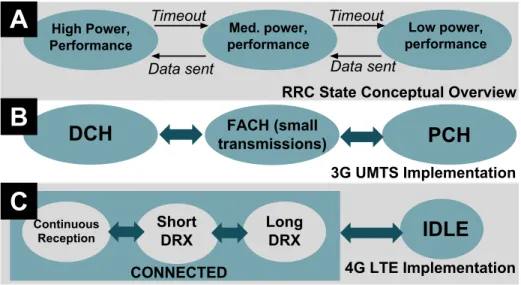
state machines. . . 19 2.3 Comparison of energy consumed for the same amount of data with
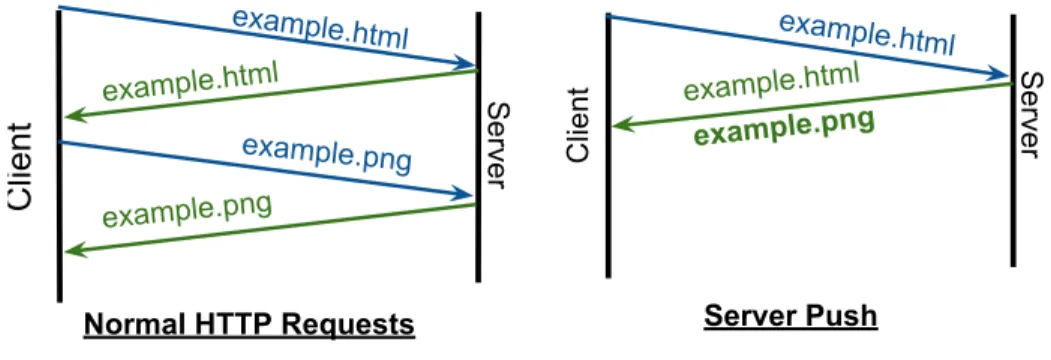
dif-ferent traffic patterns. . . 19 2.4 A simplified view of how Server Push results in performance benefits. . . 20
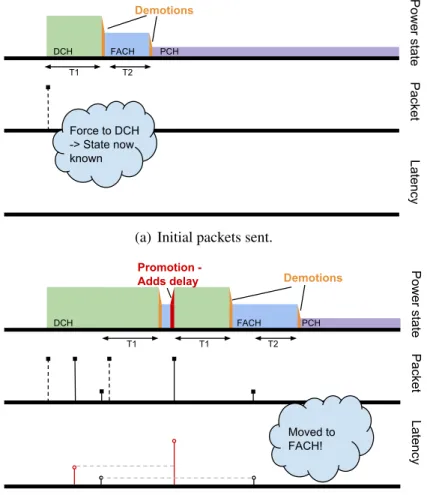
4.1 Impact of sending packets with varying interpacket intervals and how one can use those to infer RRC states. . . 44
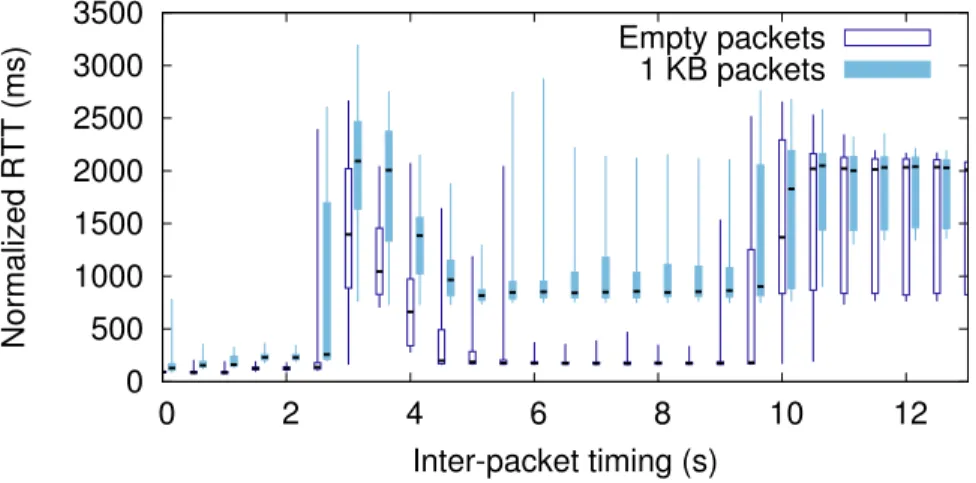
4.2 Measurement of demotion and promotion times for two carriers in QxDM. 48 4.3 Observed round-trip times while transitioning through RRC states.
Me-dian, quartile and 5%/95% values shown. . . 50 4.4 Variations in delays due to 3G states and state transitions, normalized
against the DCH RTT. Median, quartile and 5th/95th% values shown. . . 52 4.5 Delays due to LTE states and state demotions, normalized against the
RTT of an empty packet sent in CONNECTED with no DRX. . . 53 4.6 CDFs of distribution of latencies during state promotions over all carriers:
in the top graph, going from FACH and in the bottom from IDLE. . . 54 4.7 CDF over all carriers of additional latencies caused by transmissions
dur-ing state demotions (minus promotion transition times in the new RRC state). . . 54
4.8 Median values of sources of transmission delays for C1 , labeled based on the messages observed in QxDM. C2 is similar but lacks “Idle Con-fig.”, which seems to have to do with network configuration. . . 56 4.9 Breakdown of RTTs for varying inter-packet intervals, including a
de-motion to FACH at 3s and a dede-motion to PCH at 7s. The impact of the FACH⇒PCH demotion is essentially nonexistent in this case. . . 58
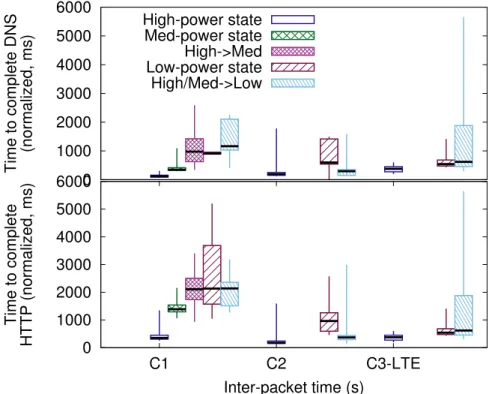
4.10 Performance of different carriers with different inter-packet timings, for DNS lookups and HTTP connections to a small website. . . 60
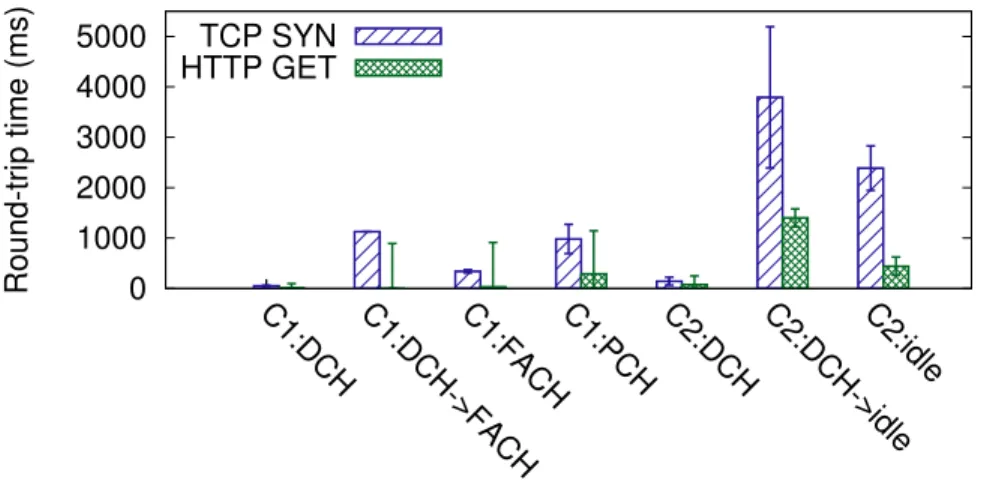
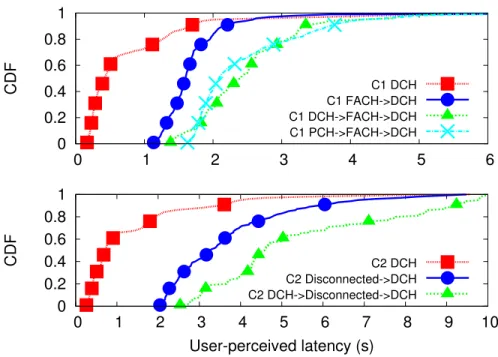
4.11 Effect of RRC states on TCP SYN RTTs and HTTP GET latencies. . . 61 4.12 Effect of RRC states and transitions on user-perceived latency in web
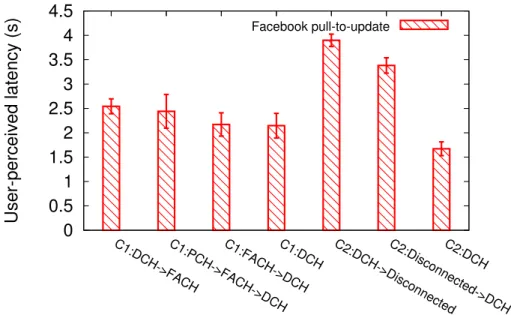
browsing experiments. . . 62 4.13 Impact of additional RRC state transition delays on Facebook’s
pull-to-update action. . . 63 5.1 Number of times each app appears in a user’s top 10 apps, ranked by total
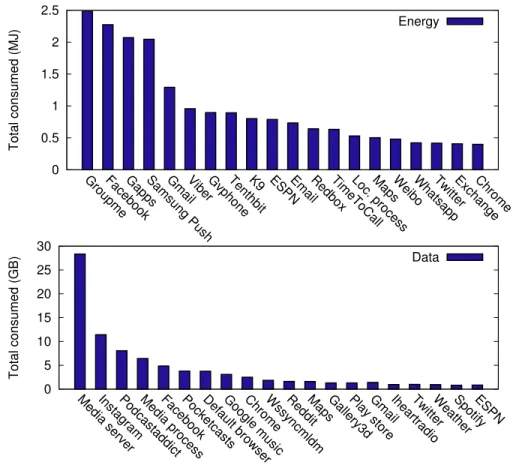
data consumption . . . 71 5.2 Highest cellular data and network energy usage by app across all users . . 72 5.3 Fraction of energy in each foreground/background state, based on process
codes assigned by the Android operating system . . . 74
5.4 Chrome allows webpages to continue sending and receiving data in the background . . . 76
5.5 Duration for which traffic continues to be sent/received after the app is sent to the background. Each data point represents one transition to the background . . . 77 5.6 Total background data sent by all apps, as a function of the time since
switching from a foreground state. Note the periodic spikes at 5 and 10 minute intervals, the large amount of traffic in the first minute, and the long tail of persisting, continuous flows . . . 77
6.1 Pushing all content versus pushing only Javascript and CSS files. PLT stands for Page Load Time. . . 90
6.2 Server Push PLT savings for mobile websites on a variety of networks. Negative values cut off at -0.5. . . 92
6.3 Impact of device processing power on Server Push. . . 93
6.4 Relative increase in the loading time of the initial HTML page with Server Push. . . 94
6.5 Impact of network latency on Server Push. Latencies shown are from ping; at 0ms, a small object takes about 30ms to load including server processing etc. . . 95 6.6 Impact of network packet loss on Server Push. . . 96
6.7 Impact of combined high latencies and loss rates. The loss rate is listed first, then the latency, as a percent and number of milliseconds, respectively. 97
6.8 Impact of bandwidth at 30ms latency. . . 97 6.9 Examining, through controlled experiments, the impact of web page
structure. . . 99 6.10 Waterfall diagram of loading the Ikea web site in a phone browser. . . 100 6.11 Waterfall diagram of loading the BBC website in a phone browser. . . 101
6.12 Waterfall diagram of loading the BBC website over WiFi on a laptop. . . 101 6.13 Radio energy trends for mobile devices. Server Push offers some savings
for LTE only. . . 102 7.1 Overview of time-shifting. Delay-tolerant data is scheduled by CellShift
around sensitive data. Our goal is for the peak load after time-shifting to be as close as possible to the peak time-sensitive load. . . 112 7.2 Architecture overview: Apps submit requests to an API on the phone,
which schedules requests with the help of an in-network server (INS). The server may also provide per-user forecasts to help users or apps de-termine whether to time-shift data. . . 115 7.3 Impact of time interval on forecast accuracy when predicting on a
per-user basis, in fraction of the total PRB utilization. . . 118 7.4 Example diurnal trends: note there is substantial variation between
7.5 Fraction of HTTP requests older than various possible target deadlines, based on last-modified dates on content headers, based on a one-day
sam-ple of hundreds of millions of HTTP requests. . . 119
7.6 CDF of top loads due to prefetching traffic with fixed deadlines, compar-ing against no time-shiftcompar-ing. We also show the peak load if we were to remove the delay-tolerant load from the network entirely. . . 126
7.7 Impact of deadline length on prefetching. Prefetching is more effective when scheduling with less constrained deadlines, particularly deadlines of 4h or longer. . . 126
7.8 Example eNodeB time-shifting traces for two eNodeBs with different loads with 4 hour deadlines, along with the peak load seen on previous days (“Threshold”). Examples chosen to illustrate cases of how time-shifting works and represent roughly average cases. . . 127
7.9 Time-shifting remains effective under a variety of loads, including both different sizes and distributions over time. . . 129
7.10 Impact of forecast accuracy and effectiveness of alternate design ap-proaches. While perfect forecasting achieves better results, less flexible scheduling approaches can support less data. . . 132
7.11 We examine some alternate loads of time-sensitive data. When non-CellShift-controlled, time-sensitive data is more even, time-shifting is easier, but when the network is already highly congested there is little room for CellShift to schedule data. . . 133
8.1 System diagram of how a cloudlet prefetching system might work. . . 140
8.2 Fraction of Activity transitions from each Activity that go to the most common, top two, and top three next Activities. . . 143
8.3 Fraction of Activity transition pairs from each Activity that go to the most common, top two, and top three next pair of consecutive Activities. . . 143
8.4 Fraction of application entry points covered by the top, top two, and top three next Activites. . . 144
8.5 Overview of how URLs are predicted based on past URL patterns. . . 147
8.6 Steps to generate a prefetching template. . . 148
8.8 Distribution of successfully prefetched objects by application. . . 154
8.9 Distribution of the amount of data successfully prefetched by application. 155 8.10 False positive rates of prefetching content, without immediately
follow-ing nested links. . . 156 8.11 False positive rates of prefetching one additional layer of nested content. . 157 8.12 Impact of varying the parameter for how many times we need to have
seen a static URL to prefetch it late. . . 159 8.13 Impact of varying the parameter for how many times we need to have
seen a match for this URL pattern when training in order to prefetch it later.159 8.14 Amount of data, total, downloaded for a short session of using an app. . . 161
8.15 Time to download and process the content to be loaded on initial batch load. . . 162
9.1 Overview of potential comprehensive measurement-oriented app and traffic management . . . 168
LIST OF TABLES
Table
1.1 Summary of work supporting thesis statement and main research
contri-butions . . . 2
4.1 Summary of results in figures and tables. . . 42
4.2 Comparison of ground truth demotion timers from QxDM with values measured through the application. . . 47
5.1 Case studies. Energy per flow and per day are averages over time, and one flow may not correspond to one periodic update. These can vary as apps change over time or as background apps are forced to close, and energy consumption values vary by device and carrier . . . 79
5.2 Example trends in background traffic when apps are infrequently used, and simulated energy savings from suppressing this traffic . . . 83
6.1 Summary of web page characteristics. . . 87
6.2 Summary of findings. . . 89
6.3 Summary of recommendations . . . 104 7.1 Prototype overhead metrics for a Samsung S4 device scheduling new
re-quests every 15 minutes. Data sent includes all bytes sent over the link for corresponding flows, and is a negligible fraction of an eNodeB’s capacity. 122
ABSTRACT
Improving Mobile Network Performance Through Measurement-Driven System Design Approaches
by Sanae Rosen
Chair: Professor Z. Morley Mao
Mobile networks are complex, dynamic, and often perform poorly. Many factors affect network performance and energy consumption: examples include highly varying network latencies and loss rates, diurnal user movement patterns in cellular networks that impact network congestion, and how radio energy states interacts with application traffic.Because mobile devices experience uniquely dynamic and complex network conditions and resource tradeoffs, incorporating ongoing, continuous measurements of network performance, re-source usage and user and app behavior into mobile systems is essential in addressing the pervasive performance problems in these systems.
This dissertation examines five different approaches to this problem. First, we discuss three measurement studies which help us understand mobile systems and how to improve them. The first examines how RRC state performance impacts network performance in the wild and argues carriers should measure RRC state performance from the user’s perspective when managing their networks. The second looks at trends in applications’ background network energy consumption, and shows that more systematic approaches are needed to
manage app behavior. The third examines how Server Push, a new feature of HTTP/2, can in certain cases improve mobile performance, but shows that it is necessary to use measurements to determine if Server Push will be helpful or harmful. Two other projects show how measurements can be incorporated directly into systems that predict and manage network traffic. One project examines how a carrier can support prefetching over time spans of hours by predicting the network loads a user will see in the future and scheduling highly delay-tolerant traffic accordingly. The other examines how the network requests of mobile apps can be predicted, a first step towards an automated and general app prefetching system. Overall, measurements of network performance and app and user behavior are powerful tools in building better mobile systems.
CHAPTER I
Introduction
Thesis statement: Because mobile devices experience uniquely dynamic and complex network conditions and resource tradeoffs, incorporating ongoing, continuous measure-ments of network performance, resource usage and user and app behavior into mobile systems is essential in addressing the pervasive performance problems in these systems. Mobile devices differ from traditional, stationary computers in many respects. In partic-ular, they are more resource-constrained, and rely on lower-performance networks such as cellular networks rather than wired networks. Furthermore, network conditions shift rapidly, in terms of network quality, the network used, user location, and whether there is any connectivity at all. To complicate the situation further, internal phone states (such as the radio state or the app process state) change to compensate for limited energy resources. These often happen in an opaque way, and also modify the power and performance tradeoffs of network activity. We show through five projects how a measurement-oriented approach can be used to address a variety of these sorts of problems on mobile devices.
The projects discussed in this dissertation are summarized in Table 1.1. Each addresses network performance problems from a different perspective, but they are complementary, each addressing how to improve a different aspect of network performance using different types of measurements The first project, Discovering Fine-grained RRC State Dynam-ics and Performance Impacts in Cellular Networks [103], measures the impact of radio
Main measurements Main contribution Performance problem addressed
Improving systems through measurements
Discovering Fine-grained RRC State Dynamics and Performance Impacts in Cellular Networks
Latency around radio state transitions worldwide
Client-oriented measure-ments → understand RRC states in the wild
Detect new RRC-related la-tency problems
Revisiting Network Energy Efficiency of Mobile Apps: Performance in the Wild
App energy usage, user be-havior and other context info
Long-term user study mea-surements → understand en-ergy problems and how to solve them
Reduce excessive background energy consumption
Push or Request: An Investigation of HTTP/2 Server Push for Improving Mobile Performance
Server Push performance, overhead, web page network request trends
Improved understanding of Server Push and when/if to use it
Reduce page load time
Time-shifting
CellShift: A System to Efficiently Time-shift Data on the Cellular Network
Use network load mea-surements to schedule delay-tolerant traffic
A system to time-shift data over hours to smooth network loads on the city scale
Avoid network congestion and associated costs
Predicting App Network Traffic to Facilitate Prefetching
Network traffic patterns: infer what to prefetch
A method of predicting net-work traffic and an evaluation of the challenges of predict-ing traffic for prefetchpredict-ing
Prefetch for reduced network latency
resource states in the wild to understand how these states and state transitions affect user-perceived performance. To conserve power while ensuring good performance on resource-constrained mobile devices, devices transition between different Radio Resource Control (RRC) states in response to network traffic and according to parameters specific to network operators. As RRC states significantly affect application power consumption and perfor-mance, it is important to understand how RRC states and network traffic interact.
In this project, we show that the impact of RRC states on performance is significantly more complex and diverse than found in previous work. We introduce an open-source tool for measuring RRC states as they affect users, in terms of their impact on network and application performance. We deploy the app in 23 countries around the world and collect data on a broad range of unmodified user devices and cellular network technologies. By ex-amining what the end user devices experience, we detect previously unknown performance problems. These problems create network latencies of up to several seconds, and for LTE can increase packet losses by an order of magnitude. Examining these transitions through cross-layer analysis, we determine that the highly complex state transitions of certain car-riers, and in particular poor interactions between state demotions and network traffic, can lead to substantial, unexpected latencies. Overall, our client-oriented measurements allow us to gain a better understanding of the complexity of RRC states. By examining RRC state transitions from the client perspective for the first time, we demonstrate that the inter-actions between client traffic and radio resource states is far more complex than previously described. Through ongoing performance measurements, we were able to monitor and ob-serve previously unknown radio performance problems. We recommend that carriers make use of a similar system when managing their networks.
The second project,Revisiting Network Energy Efficiency of Mobile Apps: Performance in the Wild[104], also evaluates the impact of RRC states and RRC state transitions (among other things), but in the context of how application traffic interacts with these transitions and the way in which these interactions impact how much energy is consumed. This project
is a two year user study of app energy usage on real user devices where client-based mea-surements were used to understand the behavior of users and applications and how the resulting network traffic interacts with RRC states to consume energy.
Energy consumption due to network traffic on mobile devices continues to be a signifi-cant concern, especially background traffic, which is responsible for about 84% of network energy in our study. Through our client-based measurements, we discover a new energy consumption problem where foreground network traffic persists after switching from the foreground to the background, potentially leading to unnecessary energy and data drain. Furthermore, while we find some apps have taken steps to improve the energy impact of periodic background traffic over the last few years, energy consumption differences of up to an order of magnitude exist between apps with very similar functionality. Finally, by examining how apps are used in the wild, we find that some apps continue to generate un-needed traffic for days when the app is not being used, and in some cases this wasted traffic is responsible for a majority of the app’s network energy overhead. We propose that these persistent, widespread and varied sources of excessive energy consumption in popular apps should be addressed through new app management tools that tailor network activity to user interaction patterns and that make use of active measurements of application behavior.
Next, we look at another approach to improving performance on mobile devices by measuring performance trends, this time focusing on web browsing rather than applica-tions, and latency rather than energy.Push or Request: An Investigation of Server Push as a Means to Improve Mobile Performance1, investigates the performance impact of HTTP/2’s
Server Push. Server Push is a new technique that is supposed to reduce network latency when loading web pages by pushing additional content in response to the first request for the initial HTML page before the additional content is explicitly requested. However, the performance benefits of this technique were previously not known. This study demon-strates that Server Push performs best when there is moderately high latency or packet loss
rates, motivating its use on mobile networks. Furthermore, there are slight energy benefits to using Server Push, especially on LTE. However, in many cases Server Push can actually degrade performance. Based on these findings, we recommend the cautious use of Server Push for mobile websites, but only after carefully testing the performance of Server Push on the site in question. This study motivates the use of ongoing measurements in conjunc-tion with Server Push deployments to ensure Server Push gives the expected performance benefits.
We then continue to look at how shifting when we transmit traffic can address perfor-mance problems in the cellular network, focusing on shifting traffic on larger time scales. Because mobile networks are heterogeneous and change significantly throughout the day, we show that prefetching and time-shifting could be used to take advantage of changes in network connectivity over periods of hours. InCellShift: A System to Efficiently Time-shift Data on the Cellular Network[102], we examine how a long-term time-shifting system can schedule large volumes of highly delay-tolerant data in a changing network with minimal additional load on the client. Recent work [113] has shown that users are interested in time-shifting certain types of data by several hours in exchange for discounted data. Such a system could enable new, innovative, data-heavy and delay-tolerant services, such as a prefetching system that can load entire TV shows onto user’s devices in advance of them being watched.
To examine how this approach would work on real cellular networks, we evaluate net-work load patterns from a major ISP in a major metropolitan area, demonstrating that there are substantial variations over time and between base stations that can be leveraged through time-shifting. Furthermore, we show these variations can be predicted hours in advance, even for individual, highly mobile users. We present CellShift, a scalable time-shifting framework that leverages these forecasts to efficiently schedule requests for millions of users. Through a city-scale simulation using real load data, we demonstrate CellShift can reduce the impact of a variety of data-heavy, highly delay tolerant traffic loads on peak base
station loads by 50-76% in most cases, and allow today’s cellular networks to support an increase in demand by 40% or more even in heavily congested cities. A prototype imple-mentation shows CellShift is scalable and efficient, in particular adding no more than a 2% battery overhead to the device.
Finally, we continue looking at how to address performance problems through prefetch-ing, in particular looking at how to make prefetching to mask performance problems in mo-bile devices a reality by addressing the problem of predicting what to prefetch. For the final project, Predicting App Network Traffic to Facilitate Prefetching, we examine how effec-tively the requests made by an app can be predicted, with the goal of building an automated prefetching system where a proxy makes prefetching decisions for unmodified apps. We start by showing that appActivitytransitions (transitions between different UI screens) can be predicted easily and accurately, as usually only a small set of transitions occur with any regularity. We then look at apps structured around populating relatively static Activities, such as social media apps or news apps, and find that about 60% of URLs for these apps can be predicted by a prefetching system that models how apps generate traffic requests. We then examine several other challenges, such as the data overhead, bandwidth requirements, and the time to download content to be prefetched, and determine that several challenges must be overcome to build such a prefetching system. While fully automated prefetching remains an open research project, our prediction system based around observing network traffic trends is a major step in the direction of developing such a system.
Overall, this thesis shows there are many ways in which measurements of mobile sys-tems can improve network performance, and in this thesis we envision a network where from the web server to the device, measurements are used to make more informed de-cisions, as shown in Figure 1.1. In addition to being complementary elements of a measurement-driven mobile network, there are several other themes among these projects tying them together. Three of the projects focus more specifically on client-oriented mea-surements: RRC State Inference,Network Energy Efficiency, andServer Push. Measuring
the performance experienced by the client allows the impact of existing systems on power and performance to be understood, and can inform how we build systems in the future. The remaining two projects, Cellshift and App Traffic Prediction, focus on determining how to build systems that make use of measurements directly and actively. The first set of projects also motivate the need for dynamic systems that make use of the measurements we use, though. Taking this more active approach would be the next step for that first set of projects. Another common theme is using measurements to change when content is sent to mitigate performance problems, inServer Push,CellshiftandApp Traffic prediction.
Overall, these projects are complementary. The RRC State Inference project allows networks to be configured optimally and can work in conjunction with any of the other projects, andNetwork Energy Efficiency’s insights about background power consumption informs the designs of other systems that use periodic measurements, such as theRRC State Inferenceproject andCellshift. CellshiftandApp Traffic Predictiontarget time-shifting dif-ferent types of traffic and are thus complementary, and could even be incorporated into one cohesive carrier-facilitated prefetching system. Server Push, which shows Server Push would benefit from being run inside a proxy, could also be incorporated into such a com-prehensive prefetching system. Overall, these five projects can be viewed as pieces of a new paradigm for managing network traffic.
1.1
Common Research Challenges
All of these research projects face similar challenges in terms of dealing with unique aspects of how mobile apps, devices and networks function, but these challenges also in-troduce opportunities to leverage measurements in order to build more intelligent systems that can improve performance. There are three broad categories of these challenges which we address for these projects: the dynamic nature of network, device and user behavior; the fact that devices are resource-constrained and the overhead of measurements can be significant; and the problem of collecting accurate mobile measurements.
RRC Inference App Traffic Prediction Cellshift Server Push 1 4 3 5 User Energy Study 2 Energy consumed by apps Network performance in different contexts App traffic trends Cell tower loads PLT in different contexts
Figure 1.1: Overview of Research Projects
Dynamic mobile requests: Dealing with the dynamic nature of mobile devices and networks is one of the main challenges for all of these projects. There are three main as-pects of dynamic networks that posed challenges. First, the RRC state machine means that the energy consumption and latency of cellular network traffic can be different at differ-ent points in time. Second, user mobility and dynamic trends in user traffic in particular complicate theCellshiftproject. Finally, app traffic patterns introduce challenges and op-portunities for building better mobile systems: the trend for apps to make requests in the background complicates the problem of managing application energy, but the relatively well-structured nature of certain types of app traffic is something which we are able to leverage.
Contending with the RRC state machine is the main focus of the RRC State Inference project, evidently, but also the Network Energy Efficiency project. The cellular network is unique in that devices shift between a variety of states with different power and perfor-mance tradeoffs, moving to high-power, high-perforperfor-mance states in response to network traffic, and lower-power, lower-performance states after timers set by the carrier expire.
We give more background in§2.1.1. As we find in the RRC State Inferenceproject, these state changes can also introduce significant performance problems. For this project, this complex series of state transitions and their performance tradeoffs are the main target of our investigation.
For theNetwork Energy Efficiencyproject, the RRC state machine is also a major focus of our analysis. Traffic patterns on mobile devices, and how they interact with the RRC state machine, have a major impact on energy consumption. Network traffic that occurs periodically tends to have a high cost, as the radio must be woken up for several seconds whenever traffic is sent. Batching traffic, conversely, tends to lead to better energy con-sumption. It turns out that how traffic interacts with the RRC state machine is one of the main factors impacting network energy consumption.
The second challenge related to dynamic networks is user mobility and the dynamic nature of demand for network resources, which is of particular concern to the Cellshift project. Cellshiftprimarily leveraged variations in network traffic over time and between locations. These variations represent inefficiencies in how the cellular network is utilized, as the network must support the peak load at each location even if that peak load occurs only for an hour a day, since network capacity must be built for that peak load. The goal of this project is to address these inefficiencies by shifting traffic to other times and locations. However, these variations reflect the fact that users tend to be mobile, and building a system that can adapt to changes in network load when scheduling traffic, as well as adapt to user mobility, were major challenges of this project.
Finally, the unique nature of network requests on mobile devices also offers opportuni-ties and challenges. TheNetwork Energy Efficiency project is based on the fact that apps tend to have a significant amount of background traffic, something which is not a concern in the same way for desktops where power is less of a concern. Detecting and understand-ing this background traffic was a major focus of the study. For theApp Traffic Prediction project, we are able to leverage the fact that mobile apps have unique approaches to
net-work traffic: a large class of apps have well-organized approaches to loading content based on well-structured files that specify what future content to load, allowing us to model and predict what to load.
Resource-constrained devices and measurement overhead: A major challenge in working with mobile devices is that they are quite resource-constrained. We have to worry about power consumption as well as data usage when designing measurements.
One major problem when collecting measurements is that periodic network traffic, as we discuss in §2.1.2, is a harmful pattern for network traffic on the cellular network. But in these projects, particularly the RRC State Inference project and the Network Energy Efficiencyproject, ongoing measurements collected on the phone needed to be transmitted to a central server. We decided to reduce how up to date the information collected would be to save energy, and uploaded data once a day on WiFi. For theRRC State Inferencestudy, we started off collecting two measurements a day and reduced to one measurement a day. As a result, it took about a year to get enough data from enough users for us to properly analyze the results (also due to the slowness of advertising the app to users), but we could be sure we weren’t negatively impacting the user.
This also informs the design of the entireCellshiftproject. Ideally, we would have the cellular network constantly communicating with the device to inform it when to transmit data, but the energy overhead would be prohibitive. As a result, determining how to built a system that can schedule data in an intermittent way was a major challenge for this project. Another concern with the Cellshift project and other projects is the overhead at the server. While not unique to mobile measurements, when collecting measurements at a large scale, reducing the storage needs and networking needs at the server is also impor-tant. For Cellshift, limiting the amount of data that would need to be stored, as well as making sure that most decisions could be made in a relatively decentralized manner, are important design constraints. For App Traffic Prediction , we examine the limitations of storing and moving data from cloudlet to cloudlet and how that would impact the
feasibil-ity of a cloudlet prefetching deployment. ForRRC State Inference, limiting the amount of data that would be collected in a global measurement study is an important consideration.
Accurate mobile measurements: There are various factors that make it challenging to collect accurate mobile measurements, and with any measurement study, there are chal-lenges in ensuring that high-quality, useful measurements are collected.
For the RRC state measurement system, a major challenge is how to accurately measure RRC states in the wild. It is necessary to first collect data on the phone about whether the device is being used at the time and about the current type of network. Measurements can be scheduled accordingly, and discarded if needed if we detect that other packets were sent while the tests are performed, as background traffic affects the accuracy of the results. While less of a fundamental challenge for the user study project, it is also necessary to collect a significant amount of context data for this project, such as on the running state of each application, to properly interpret network traffic and energy measurements and understand how applications behave.
This is also a challenge forServer Push. It was not possible to collect measurements on real servers, as there are not enough servers running Server Push. It is thus necessary to mirror content as well as to construct artificial websites for controlled experiments to explore how various factors impact Server Push performance. For the Cellshift and App Traffic Prediction projects, the challenges are more in making use of the measurements effectively. For the Cellshift project, determining how to make use of measurements of network load is one of the major challenges, especially in predicting load for users as they move around. For the App Traffic Prediction project, the challenge is in making use of network log data in order to accurately predict network load.
1.2
Contributions
Next, I will summarize the research contributions in this thesis, organized by research project.
1.2.1 Discovering Fine-grained RRC State Dynamics and Performance Impacts in Cellular Networks
In this project, we examine how client-based measurements that can help us understand RRC states. In particular, our contributions are:
• We develop a measurement approach that allows RRC state machine dynamics to be measured and observed on uncontrolled devices in the wild.
• Using Mobiperf, an app into which we incorporated this technique, we create a large database of RRC state performance worldwide, the only such dataset to date as far as we know.
• We uncover and examine some previously unknown, severe latency problems that can increase round trip times by seconds.
• We demonstrate the degree to which RRC state performance, including the perfor-mance problems we uncovered, impact application-layer delays and app QoE, in-cluding through crowdsourced measurements.
Overall, our client-based measurements allow for a deeper understanding of complex RRC states and their impact on performance, and we argue that carriers should use our approach to monitor and manage their networks, as these client-based measurements give a different perspective on performance than the information exposed by device manufac-turers..
1.2.2 Revisiting Network Energy Efficiency of Mobile Apps: Performance in the Wild
In this project, we also focus on measurements, but this time instead of measuring RRC states themselves, we examine how apps interact with them. Our main contribution was a better understanding of how apps consume energy due to background traffic that keeps the
RRC radio active, gathered through a measurement study over several years. In particular, our key findings are:
• We discover a new form of excessive energy consumption, where an app continues sending likely unintended background traffic after the app is moved to the back-ground.
• We show there is high variability in how much energy is consumed even by very similar apps, and that app energy usage has evolved differently among apps over time, demonstrating that the adoption of best practices is still not universal.
• We discover that many apps that send background traffic are not used for days. At the time, App Standby and Doze did not exist, and we proposed that there should be some mechanism to suppress traffic from apps that are not currently being used.
Overall, our long-term measurement study helps us understand how apps consume en-ergy and propose concrete guidelines to app developers as to how to build more enen-ergy- energy-efficient systems. We argue that active measurements of app energy consumption and be-havior are needed to manage these problems.
1.2.3 Push or Request: An Investigation of Server Push as a Means to Improve Mo-bile Performance
In this project, we measure the impact of Server Push, demonstrating it is likely most suitable to mobile networks. The main contributions of this paper are:
• Determining that Server Push is more effective on high loss or high latency networks, motivating its use on WiFi and cellular networks.
• Determining that pushing all content on a web page is more effective than pushing a few key objects.
• Determining that Server Push can sometimes decrease performance: various web page factors can influence if it’s successful, but ultimately web page developers should check if Server Push results in performance benefits through measurement before deploying it.
• Server push leads to power savings on LTE of about 9%, another way it is particularly suitable for mobile devices.
Overall, through controlled, in-lab experiments, we are able to gain a greater under-standing of how Server Push can effectively be used to improve performance, particularly for mobile devices, and demonstrate that website developers should incorporate perfor-mance measurements when deploying Server Push.
1.2.4 CellShift: A System to Efficiently Time-shift Data on the Cellular Network
In this project, we leverage measurements of network load in order to determine how to schedule delay-tolerant data over time spans of hours. Key contributions include:
• A city-scale examination of eNodeB usage trends over several months, determining that there is a significant amount of underused capacity on today’s cellular networks.
• A method of predicting network loads on a per-eNodeB basis 15 minutes in advance (with an accuracy of 2% of the eNodeB’s total capacity), and predicting loads a user will experience in a location-agnostic manner up to a day in advance (with an accuracy of 8% of an eNodeB’s capacity).
• The design and evaluation, in simulation, of a highly scalable system that schedules data over time scales of hours on resource-constrained mobile devices.
1.2.5 Predicting App Network Traffic to Facilitate Prefetching
In this project, we determine how to effectively predict network traffic from mobile applications, using cloudlet-based prefetching as a motivating example. The key
contribu-tions are:
• A method for predicting URLs and their parameters in advance for a large class of applications, by observing prior network traffic and leveraging common app patterns.
• An evaluation of the accuracy and overhead of predicting URLs to facilitate prefetch-ing: in particular, that about 60% of traffic can be predicted, but with a overhead of about 150% in terms of unneeded requests.
• The identification and examination of the challenges in making automated prefetch-ing based on this approach feasible, includprefetch-ing examinprefetch-ing the storage overhead, the cost of migrating application state and the time to download content.
• The finding that application entry points and Activity transitions are highly pre-dictable: for most apps, 50% of Activity transitions from one Activity go to the same next Activity.
Overall, we show how, by examining network traffic, we can build the prediction frame-work that would be needed for a cloudlet prefetching system that could reduce application latency.
CHAPTER II
Background
2.1
The cellular network
The cellular network is unique in many ways. The cellular network architecture reflects the fact that users are highly mobile. Also, there are unique ways that network radio en-ergy management features inform the design of any work involving cellular devices. Users move around without switching networks, and the network allocates resources to users dy-namically, while seamlessly transferring users between cell towers. I discuss two network types in this dissertation: 3G, and 4G LTE, the latter being more the more recent cellular network technology. I will first summarize the LTE network, drawing from “An Introduc-tion to LTE” [24]. I then focus in more depth on RRC states and their impact on energy consumption.
An overview of the cellular network is shown in Figure 2.1. Users connect to the network with mobile devices, commonly known as UE (User Equipment). They connect to the cell tower (base station or eNodeB), which conveys both data and control plane messages to and from the device. In general, latency over the channel between the UE and eNodeB is a concern, and transmitting data over this channel has substantial energy costs, described in the section on RRC states below.
Furthermore, each eNodeB can only support a certain amount of traffic. Resources are allocated to devices in the form ofPhysical Resource Blocks, or PRBs. The amount of data
Physical Resource Blocks (PRB)
Phones (UE)
eNodeB or
base station ISP
Network
The Internet
SGW
MME PGW
Figure 2.1: (Simplified) overview of the cellular network.
that can be sent for a given number of allocated PRBs is a function of the signal quality. The cost of sending data over this last hop is often a major overhead for the carrier. In particular, the cellular network in a given place has a fixed amount of capacity, and the cost of supporting network traffic at a location is related to thepeak loadat that location, rather than the average load. This fact is a major motivator for theCellshiftproject.
The remainder of the network is less critical for understanding this dissertation. There are a variety of middleboxes: P-gateways, which connect the cellular network to the rest of the carrier’s network; the S-gateway, which forwards data from the base station to the P-gateway and the Mobility Management Entity (MME) that manages the mobile devices. More importantly, the carrier also introduces a large number of middleboxes after the P-gateway and before the traffic reaches the outside world, such as NATs and firewalls [130], giving the opportunity to introduce other sorts of proxies as well.
2.1.1 RRC states
For cellular networks, there is a tradeoff between latency and battery consumption. Mobile devices do not maintain a constant, active network connection due to their limited battery life. Switching to an active connection, however, introduces delays, so mobile
devices switch between network states based on when network traffic is sent. Figure 2.2A gives a conceptual overview of these states as well as two common implementations, for LTE and 3G. When data needs to be sent, devices switch to a high-power, active state. This transition incurs additional delays, so to avoid making this transition more often than needed, since network traffic is often comes in bursts, the device remains in this state for several seconds. That way, only the first few packets in a burst are delayed by the state promotion. A timer determines how long the device waits for additional traffic before falling back to a lower power state. This timer, thedemotion timer, is usually fixed, and set by the carrier. There may also be an intermediate state where small amounts of data can be transmitted without the high power consumption of the fully active state.
These are known as RRC States, and are defined by 3GPP specifications [4, 5]. Each carrier configures their RRC state machine timers, subject to the constraints of the protocol specification. For 3G network technologies [4], there are two to three main states. The first is DCH, which is high-power and high-bandwidth. FACH, an optional state, is lower power and can only transmit small amounts of data before needing to switch to DCH. Fi-nally, in PCH, no transmission is possible and a state promotion is needed before sending data, but very little energy is consumed. An example of a 3G state machine is shown in Figure 2.2B. There can be slight variations in the possible state transitions depending on the carrier. For 4G LTE, as shown in Figure 2.2C, there are two main states: CONNECTED, a higher-power state, and IDLE, a lower-power state where no data is transmitted. The former may be broken down further into smaller sub-states. For these sub-states, the con-nection is active at regular intervals of tens or hundreds of milliseconds. This is known as Discontinuous reception, or DRX.
2.1.2 Application traffic and RRC states
It has been shown that these RRC timers can have a substantial impact on application performance and power consumption [36, 35, 63]. In particular, periodic messages may
High Power, Performance Med. power, performance Low power, performance Timeout Timeout
Data sent Data sent
RRC State Conceptual Overview
DCH
transmissions)FACH (small3G UMTS Implementation
PCH
Continuous Reception Long DRX 4G LTE ImplementationIDLE
Short DRX CONNECTEDA
B
C
Figure 2.2: A: Overview of RRC state machine design. B-C: possible 3G and 4G state machines. Case A: Case B: Power Power Time Time Tail energy State promotion Data transmission energy
Figure 2.3: Comparison of energy consumed for the same amount of data with different traffic patterns.
be affected by long promotion latencies as well as lead to the device being in a high-power state longer than needed. Essentially, every state promotion incurs a performance penalty due to the state promotion, and later incurs an energy penalty due to the tail timer, regardless of how much data is sent, as shown in Figure 2.3. For some number of seconds after traffic has been sent (depending on the carrier), the device continues to consume energy, keeping the radio in a high-powered state. Since network transmissions can often be of a similar length to the tail timer, or potentially even shorter, having many network
Client Server example.html example.png Normal HTTP Requests Client Server example.html example.html example.png example.html example.png Server Push
Figure 2.4: A simplified view of how Server Push results in performance benefits.
requests sent separately can cause a substantial increase in the energy consumed. In that figure, substantially less energy is consumed in case A, even though case A sends just as much traffic. By batching traffic and halving the number of bursts, the tail energy is halved as well.
This problem can be addressed in part through fast dormancy [45], where the device transitions to a low-power state early when no additional data transmissions are expected. In Chapter IV, we find that fast dormancy is rarely enabled in practice, perhaps due to the added complexity of implementing such a system, and problems with certain implementa-tions to date [84, 10].
2.2
HTTP/2
HTTP/2 has been recently proposed as a replacement to HTTP/1.1, promising to offer better performance, and to address some of the performance limitations of HTTP/1.1 [54, 14]. It builds on SPDY, a protocol developed by Google [95].
HTTP/2 differs from HTTP/1.1 in many ways. One feature is that HTTP/2 connections now consist of a number of streams in a single HTTP/2 connection. Multiple streams can be open concurrently, and theframes of the streams, which are units of data, can be interleaved. Streams can be open or closed by either endpoint. Notably, this means fewer TCP connections are required for a HTTP/2 session, which has performance advantages
and disadvantages [127]. Other features include giving each stream a priority, indicating that more resources should be allocated to some strings; explicitly indicating dependencies between streams; and mandatory encryption.
One of the more interesting new features in HTTP/2 is Server Push. We focus on this feature primarily in Chapter VI. As shown in Figure 2.4, in HTTP/1.1, even if the server knows what content the user will need, the content needs to be requested by the user. First, the user fetches the initial HTML page, then parses it, and looks for additional content that will be needed. Then, it requests that content. It is possible that due to additional HTML files or javascript that further round trips would be needed for complex pages. Overall, this means there can be substantial delays to fetch all the images on a page.
Server Push assumes that in many cases, as the server generates the content the user will see, the server knows what the user should fetch. HTTP/2’s stream-based construction supports streams being opened from either direction, and thus the server can initiate a con-nection where data the server things the user will need is sent to the user. The step of having the user parse the initial HTML page and request further content can thus be eliminated, which should lead to performance improvements. We examine this in Chapter VI.
CHAPTER III
Related Work
The projects described in this thesis build on a substantial amount of prior work, which has been organized into seven categories. We start by discussing past work on measuring browsing performance generally, followed by discussing some systems that aim to improve browsing and app performance. Next, we focus on RRC states, background traffic and the cellular network, including both measurement studies and proposals of how to better work with RRC states.
Then, we discuss more specific themes that pertain to specific chapters. As background to the Network Energy Efficiency project, we discuss prior work on understanding back-ground traffic and dealing with energy consumption due to that traffic. As backback-ground to theCellshiftproject, we discuss work on traffic forecasting and characterizing how cellular networks are used on a large scale, followed by a section on long-term prefetching. For Server Push, we examine other research on next-generation network protocols. Finally, we examine how cloudlets, which are used as a motivating example to theApp Traffic Predic-tionproject, have been discussed in the past.
3.1
Measuring Factors that Impact Browsing Performance
First, we discuss general related work on browsing performance, before focusing on more specific aspects of performance in later sections. Work by Qian et al [97] examines
how existing websites are designed and the impact on performance and resource usage. They develop a tool to measure website performance in the lab through cross-layer analysis and find that a wide range of factors impact power and performance, such as the use of Javascript causing the radio to be on for too long. Work by Wang et al [129] examines sources of delays in mobile web browsers by instrumenting the browser directly. They find that at the time the paper was written, object loading times are still the bottleneck, but that device CPU power still has a major impact due to the overhead of networking operations and other OS operations. Work by Butkiewicz et al [15] examines how website complexity impacts performance, developing a series of metrics to do so, and evaluate how they impact loading time. They find that the number of objects to load is a good predictor of network loading time, more than the size of the object.
Other work examines longitudinal trends in browsing performance: work by Nikravesh et al [88] examines longitudinal trends in mobile network performance generally, and find that in addition to temporal and geographic trends in performance, that there is a significant degree of instability in performance that cannot be attributed to these factors. Work by Imh et al [60] characterizes websites, looking at five years of network data from 70,000 users around the world and examining how network traffic has evolved. They discover Javascript and video are increasingly important factors, that half of traffic is not due to the initial page load, and that content-based caching rather than object-based caching would be valuable. We make use of a longitudinal approach in our measurement studies, focusing on different problems.
Thiagarajan et al [122] examine what types of browsing content leads to higher energy consumption. They find complex Javascript and CSS, as well as certain image types, are a problem, and propose a series of concrete guidelines to building better websites. Gember et al [42] discuss the challenges of accurately measuring cellular networks from actively used devices. They find that it is best to measure network performance at times when the user uses the device, which unfortunately was not possible in RRC State Inference but which
motivates measuring app energy consumption in the context of a user study. Work by Xu et al [133] measures country-wide trends in app usage, including the types of apps used, the times of day, and the context in which they are used. They find a substantial number of apps are only used locally, that use of certain apps is correlated, that many apps have clear diurnal traffic patterns, and that some apps are more likely to be used while mobile, all findings that could inform how carriers manage traffic. Unlike these projects, we examine different factors that impact browsing performance: we focus on the impact of Server Push on browsing, or propose systems such asApp Traffic Predictionto improve performance.
Other work looks at networking performance. Work by Sundaresan et al [119] inves-tigates residential broadband, and determines that the round trip time is still a bottleneck, motivating theServer Pushstudy. Their solution is to place a cache in home routers, a sim-ilar concept to the cloudlets discussed in theApp Traffic Predictionproject. Work by Zaki et al [135] examines factors affecting network performance in a developing country, and find that a lack of CDN and caching infrastructure is a major factor in poor performance. In particular, relevant to theServer Pushproject, they find that SPDY1works particularly well in this context. Work by Halepovic et al [29] presents a method of passively measuring HTTP time to first byte from within the packet core, whereas previously expensive active probing is needed. This tool could help carriers better manage their network. Work by Narayanan et al [81] observes that content is often poorly distributed among CDNs. They also observe that a significant percentage of content is served from CDNs, which may have implications for Server Push deployment by third parties. These papers are complementary to our examination of Server Push and RRC states, addressing different aspects of network performance
User studies and app based measurement studies, such as those in Chapter IV and Chap-ter V are approaches that also have a substantial amount of related work. The Livelab project [18] makes use of users running a measurement app on their phones. A wide range
of findings on how users interact with mobile devices have been published based on this project, including measuring web usage in the wild [17]. In that study, they find substan-tial differences between mobile web usage and desktop web usage, with less usage of the browser, and a higher dependence on search, which might inform how browsers on phones are designed. JamLogger [90] is an ongoing project to collect general performance and user activity on mobile devices — to date, there are no related publictions. “Diversity in Smartphone Usage” [37] examines how users use the phone, such as for how long or how much data they use, and find a large amount of diversity in all of these characteristics, with differences of orders of magnitude between users. They argue that as a result mechanisms to improve performance for users should be tailored to individual users, and demonstrate that energy prediction can be done in such a manner. These studies highlight the impor-tance of user studies in understanding performance in the wild. Unlike these papers, we focus specifically on using user studies and measurement studies to address two problems in this thesis: network energy consumption and RRC state performance.
3.2
Building systems to improve performance
Next, we discuss approaches to building systems to improve browsing performance. WProf [126] finds performance dependencies in browsers through an in-browser tool, and finds that computation is a major part of the critical path and that caching is not neces-sarily helpful, and that SPDY is not helpful with low RTTs. Follow-up work [82] extends this analysis to mobile phones. This allows for a better understanding of the factors im-pacting mobile performance: they find that a major cause of slow mobile browsing is the computation overhead, that elements on the critical path may differ between the mobile and browser version of the page, and that mobile performance only really suffers for large pages. WebProphet [75] predicts page load times from object dependencies, and infers ob-ject dependencies using a novel technique based on timing perturbations. As a result, it is able to recommend simple approaches to optimizing web page loading performance.
Po-laris [83] makes computation more efficient by better detecting dependencies and schedul-ing requests through a client-side scheduler in a way that minimizes round trips. This approach is able to reduce page load times by 34% in the median case. The projects fo-cused on system building in this thesis are complementary to these papers and use different techniques: long-term time-shifting forCellshiftand prediction of network traffic forApp Traffic Prediction.
Using proxies to improve network performance is another common theme. Parcel [117] splits browsing functionality between a proxy and mobile browser to improve performance. The proxy downloads objects and pushes them to the browser, and interactive functionality happens entirely on the client where possible. As a result the page load time and energy consumption of loading a site is substantially reduced. Flywheel [6] is a compression proxy for mobile devices used in the wild which halves the size of mobile pages. It also applies other optimizations such as SPDY, and the paper discusses the engineering challenges of implementing a complex proxy at scale, concerns that would need to be addressed for projects such as theApp Traffic Predictionproject. They find overall that the performance benefits of this approach are mixed, and work better for larger pages. Flexiweb [116] finds that compression proxies can sometimes harm performance depending on network per-formance, and dynamically adapts proxy optimizations based on network conditions and website characteristics. By adapting to network conditions, they are able to greatly im-prove the performance of a compression proxy. A similar method of dynamically applying optimizations would be highly valuable to Server Push, as we show in this thesis.
Klotski [16] examines automatically detecting dependencies and scheduling object downloads using a proxy to meet arbitrary priorities. A back-end proxy analyzes the depen-dencies of a page and a front-end prioritizes the content, doubling the amount of high-utility content delivered early. We apply some similar methods to generalizing dynamic URLs in theApp Traffic Predictionproject. Shandian [128] optimizes the order and manner in which content is loaded at the granularity of HTML or CSS elements, using a proxy server. They
focus in particular on eliminating unneeded HTML and CSS content during the initial load, and find significant performance benefits of 50 to 60% on mobile devices. We propose the use of proxies in different contexts: forServer Push, to facilitate Server Push, and forApp Traffic Prediction, to predict network traffic to facilitate prefetching.
3.3
RRC States and the Cellular network
Next, I discuss related work that gives background information on the cellular network and examines the impact of RRC states on browsing specifically. This is most relevant to the RRC Inference and Energy User Study projects, but most of the projects I discuss deal with the cellular network. Work by Huang et al [57] examines LTE in depth, with a focus on poor interactions between the cellular network and TCP flows. They argue that transport control mechanisms that are LTE-friendly are needed, as currently TCP often operates at below half of the maximum bandwidth and spends a lot of time in slow start. Sani et al [108] examine trends in data consumption by app. They find substantial differences between even very similar apps — similarly, we find major differences in energy consumption in the Network Energy Efficiency project. They suggest that users could use these findings to select an appropriate data plan based on the data they use. Work by Huang et al [58] measures the performance of 3G and its difference between devices using crowdsourcing, as well as controlled analysis on a variety of devices. They find substantial differences between the performance of carriers and devices — the main contribution of this paper is a comprehensive evaluation of the performance of 3G in a range of circumstances. This work is complementary to this thesis, as we focus on measuring other factors of performance such as the impact of RRC states or the background energy consumption of apps.
Other work has focused specifically on RRC states, a common feature in much of the work in this thesis, especially theRRC State Inference chapter. Previous work examines power and performance characteristics of RRC state machines in both 3G [35] and 4G LTE networks [63, 70] in controlled environments, as well as specific features of those
networks such as DRX [65]. The work on 3G [35] introduced a method of probing RRC state machine parameters which we adapted in theRRC State Inferenceproject, and through trace-based analysis determine that state promotions cause substantial delays and that RRC state timers are suboptimal for many applications, motivating the use of variable RRC state timers. The work on 4G LTE networks [63] also characterizes the power and performance characteristics of LTE. It first generates a power model for RRC states and analyzes the power efficiency of LTE, and by examining the performance of applications, determines that with LTE computation is less of a bottleneck. Work by Zhou et al [70] examines DRX specifically, building a model of DRX performance and power consumption, and showing that different parameters for the length of time in DRX and the DRX frequency are suitable for different types of applications.
A web page by Souders [106] estimates RRC state machine performance through a web app, at a coarser granularity than we do and without accounting for background network activity on phones. This demonstrates that there is interest in RRC state machines outside the academic community, though. RILAnalyzer [123] monitors 3G RRC state transition events and measures directly how applications cause excessive RRC state promotions by leveraging chipset-specific functionality. They find RRC state transitions in the wild are more diverse than have been measured in the lab, and find that applications in the wild often interact poorly with RRC state transitions. Examining lower-layer control messages specifically, a Qualcomm whitepaper [77] explains how control plane messages in dif-ferent network technologies are expected to lead to difdif-ferent promotion latencies. In the RRC State Inference chapter, we focus on RRC state transition dynamics: measuring and understanding how RRC state transitions vary and cause different performance trends on different carriers, and in particular non-ideal transition behavior.