Procedia Computer Science 57 ( 2015 ) 782 – 788
1877-0509 © 2015 The Authors. Published by Elsevier B.V. This is an open access article under the CC BY-NC-ND license (http://creativecommons.org/licenses/by-nc-nd/4.0/).
Peer-review under responsibility of organizing committee of the 3rd International Conference on Recent Trends in Computing 2015 (ICRTC-2015) doi: 10.1016/j.procs.2015.07.475
ScienceDirect
3rd International Conference on Recent Trends in Computing 2015 (ICRTC-2015)
Application Based Vertical Handoff Decision in Heterogeneous
Network
Aabha Jain
a*
, Dr. Sanjiv Tokekar
b a Sushila Devi Bansal College of Technology,Indore (M.P.)IndiabInstitute of Engineering & Technology,Devi Ahilya University,Indore(M.P.)India
Abstract
The future generation of wireless system is expected to provide multimedia, multi class services any time anywhere with seamless mobility and Quality of service (QoS). In such environment, optimal vertical handoff is a challenging issue. Unnecessary handoff causes wastage of network resources and thus affects the QoS of network. In this paper, we have proposed the vertical handoff decision depends on coverage area of the network and the velocity of the mobile user. We have determined application-wise critical speed for particular coverage range of network during which handoff is beneficial. In our work, we have considered applications like HDTV, MPEG-4, and H.261 in heterogeneous network of UMTS (Universal Mobile Telecommunication System) and WLAN. The simulation is performed using Network Simulator NS-2 with NIST (National Institute of Standards and Technology) mobility module.
© 2015 The Authors. Published by Elsevier B.V.
Peer-review under responsibility of organizing committee of the 3rd International Conference on Recent Trends in Computing 2015 (ICRTC-2015).
Keywords: Heterogenous Wireless Network; Vertical handoff; Velocity;QoS;IEEE802.21
1. Introduction
Future generation of wireless system is expected to provide multimedia, multi class services any time anywhere. Such systems are envisaged to include the multitude of cellular and wireless networks like wireless LAN, wireless
* Corresponding author. Tel.: +91-0731-2416620
E-mail address:[email protected]
© 2015 The Authors. Published by Elsevier B.V. This is an open access article under the CC BY-NC-ND license (http://creativecommons.org/licenses/by-nc-nd/4.0/).
Peer-review under responsibility of organizing committee of the 3rd International Conference on Recent Trends in Computing 2015 (ICRTC-2015)
MAN, and third generation (3G) cellular network. Hence, the next generation systems represent a heterogeneous environment with different networks that differs in bandwidth, latency, cost, coverage range etc. In such networks, one of the vital issues that affect the QoS of Network is the decision about handoff. Handoff is a mechanism by which mobile node keeps its connection active even when it wanders from the coverage area of one network to another. Handoff can be intra-network i.e. horizontal handoff or inter network i.e. vertical handoff. In horizontal handoff, decisive parameter for handoff is mainly signal strength. Vertical handoff is more critical as the participating networks are heterogeneous and have different characteristics like radio access technology, cell capacity, etc. In case of vertical handoff, the static signal strength sometimes is not sufficient to trigger the handoff and therefore adaptive signal strength that changes with dynamic parameters like velocity, signal delay etc should be considered. Vertical handoff process can be accomplished in three phases namely- Network discovery, Handoff decision and Handoff execution. Network discovery is a procedure to find appropriate network in such a way that the target network satisfies user preferences with required QoS. After successful discovery of appropriate network, next decisive factor which affects seamless vertical handoff is when to make a handoff decision. Too early handoff results unnecessary handoff whereas an outcome of late handoff is reduced QoS. Finally, handoff execution should be at optimal time. In this work, we have considered heterogeneous network comprising of UMTS and WLAN. UMTS [1] (Universal Mobile Telecommunication System), the network of third generation (3G), can support multimedia services over a wide range of coverage with moderate bandwidth whereas WLAN network covers a limited area with high bandwidth. So UMTS and WLAN are complementary to each other and integration of these two networks overcome limitations of individual network and the user can enjoy best features of both technologies viz large bandwidth, universal coverage with low cost, concisely required services with best possible QoS. For simulation work, it is assumed that UMTS is available all over the area and the WLAN hot spot is within the coverage range of UMTS. Mobile nodes are equipped with multiple interfaces to access varied networks. In such overlapped coverage field, downward (UMTS to WLAN) and upward (WLAN to UMTS) vertical handoff decision criteria are different. Conventionally, due to the high bandwidth and low cost of WLAN, first choice is WLAN i.e. a mobile node usually handoff from UMTS to WLAN whenever WLAN connectivity is available. However, it is also possible for the mobile node to keep the connection to the UMTS network alive even when WLAN connection is available. In this situation, whether to perform handoff or not is a crucial decision. Appropriate vertical handoff decision reduces the number of unnecessary handoffs. Unnecessary handoff is considered in situation where a mobile node moves back to its previous point of attachment within a very short time period [2]. Also, when the mobile node has high velocity and the WLAN has small coverage area, the vertical handoff becomes unnecessary. In this paper, we present an approach for application specific vertical handoff decision based on velocity of mobile node and the coverage of network.
2. Literature review
A number of proposals have been made for vertical handoff decision algorithms. The traditional approach for vertical handoff decision algorithm is based on RSS (Received Signal Strength) [3]. Johann et al [4] evaluate a technology-aware VHDL which considers availability and capacity of the network for decision making process under IEEE 802.21 standard. Authors have concluded that the VHO processes drop packets due to the restriction of bandwidth availability whenever downgrading from one network to another. Some proposals for vertical handoff decision are based on artificial intelligence techniques [5-6]. Yaw et al [5] has proposed vertical handoff scheme using fuzzy logic. Their proposal is in two parts, first a fuzzy logic inference system (FIS) to process a multi criteria vertical handoff initiation metrics while the second applies a unique fuzzy multiple attribute decision making (FMADM) access network selection function to select a suitable wireless access network. Johnson [6] reported on the design and implementation of multi-criteria vertical handoff decision algorithms in a heterogeneous wireless wide area network and a wireless local area network environment. Fuzzy logic algorithm is implemented in mobile node for handoff decision and the parameter considered as input are RSSI (received signal strength indicator), available bandwidth, network coverage area of WLAN and user preferred network. However, artificial intelligence based algorithms are normally complex and are sometimes difficult to implement. Some authors have considered other metrics like power consumption, bandwidth and access cost for handoff decision [7]. Daojing et al [8] proposes policies considering parameters such as monetary cost, security, power consumption, network condition,
battery power and other parameters that differ among different heterogeneous networks. For each policy, a cost function is defined as a weighted sum of normalized policy parameters. These weights vary according to user preferences and the mobile node status (e.g., power reserve). Periodical comparison of the cost of different networks is decisive parameter for vertical handoff. Difficulty with this approach is to estimate the cost of dependence parameters like available bandwidth, the channel condition as they normally change dynamically. In [9], Author has proposed vertical handover decision in UMTS-WLAN network based on the load in the network, QoS constraints, and velocity of the user. Piyali D [10] analyzed impact of vertical handoff in heterogeneous network for HDTV, MPEG-4, and H.261 applications. Author has claimed that user mobility influences the behaviour of the wireless access network and the video stream transmitted over such network. Based on above papers, it has been realized that the velocity of mobile node plays an important role in vertical handoff decision. In view of this, present work proposes a technique that uses velocity along with coverage range of network for decision of vertical handoff.
3. Simulation And Description
3.1. Handoff in NS-2
NIST support for vertical handoff developed for version ns-2.29 of NS -2 with addition and modification of numerous files in standard release of NS-2 in order to maintain seamless mobility. The 802.21 add on module contain an implementation of MIHF (media independent handover function) based on draft 3 of IEEE 802.21 specification [11-12]. The MIHF and MIH user are implemented as an Agent, extension of class Agent defined in NS-2. The MIH agent can communicate with both the lower layers (i.e. MAC) and higher layers (i.e. MIH) users and can handle communication with remote MIHF. NIST created the concept of multiFace node in order to support multiple interfaces. The interface node triggers events and send them to multiFace node.
3.2. System Model
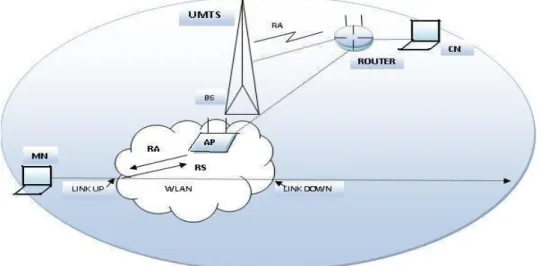
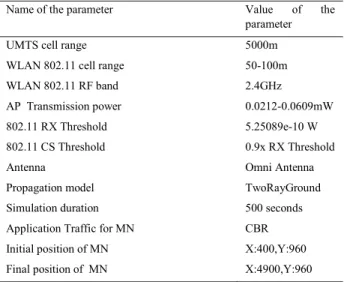
The system model considered for determined application-wise critical speed for particular coverage range of network consists of overlapped UMTS –WLAN cell as shown in Fig. 1. In considered scenario MN (Mobile Node) is currently served by UMTS BS (Base Station) and moving in straight line with constant velocity towards AP (Access point). Real time application traffic using HDTV or MPEG-4 or H.261, is created between CN (correspondent node) and MultiFace node as shown in Table I. Simulation parameters are as shown in Table II.
Table 1 Real Time Application
Real time traffic Interval Packet Size Data rate
HDTV 2ms 1024bytes 4Mb/s
MPEG-4 6ms 800bytes 1Mb/s
H.261 26ms 660bytes 200kb/s
Table 2 Simulation Parameter
Name of the parameter Value of the parameter
UMTS cell range 5000m
WLAN 802.11 cell range 50-100m WLAN 802.11 RF band AP Transmission power 802.11 RX Threshold 802.11 CS Threshold Antenna Propagation model Simulation duration Application Traffic for MN Initial position of MN Final position of MN 2.4GHz 0.0212-0.0609mW 5.25089e-10 W 0.9x RX Threshold Omni Antenna TwoRayGround 500 seconds CBR X:400,Y:960 X:4900,Y:960 3.3 Simulation Setup
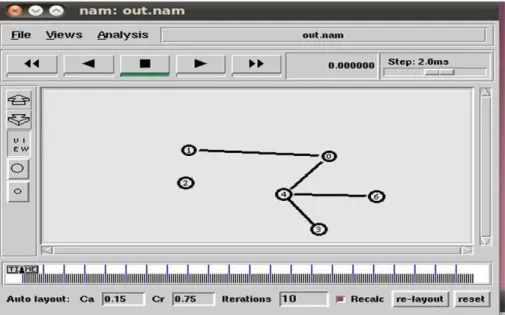
The aim of this simulation is to show the impact of the mobile node velocity on the performance metrics for real time traffic. The simulation is carried out using ns-2.29 with NIST mobility and 802.21 add on module. To illustrate the performance we have used UMTS and WLAN networks for the simulation. UMTS is the network with large coverage area i.e. 5000m where as WLAN has the smallest coverage area 50m and 100m. Screen shot of NAM window during simulation is shown in the Fig. 2. It consists of one WLAN Access Points AP (node no. 6) and UMTS base station (node no. 1) with one MN (node no. 2). The MN is configured to use two multiple interfaces, WLAN and UMTS. AP and BS are connected to backbone network as shown in the Fig. 2. The bandwidth between CN (node no. 3) and Router 1 (node no. 4) is set to 100Mbps.Total Simulation time is set to 500sec. Real time application traffic is created between CN (correspondent node) and MultiFace node in different scenarios with MN velocity varied from 10m/s to 50m/s for the coverage range of WLAN 50m and 100m respectively. At the beginning, MN connects to UMTS and starts moving in straight line towards WLAN network. When it detects WLAN network, it generates Link Detected trigger. The NIST handoff algorithm selects a new network based on the Radio Signal Strength and hence WLAN is considered a better network than UMTS and handoff takes place. Now MN continues with WLAN network until it reaches the boundary region of WLAN. Signal strength decreases at this point and hence signal generates Link_Going_Down trigger and finally handoff to UMTS takes place. Two scenarios are created, first when handoff to WLAN took place (With Handoff) and second when MN remains connected with UMTS for total time period (Without Handoff). The simulation is repeated number of times with different values of velocity of mobile node and different values for coverage
Fig. 2. Screen Shot NAM Window
3.4. Result Analysis
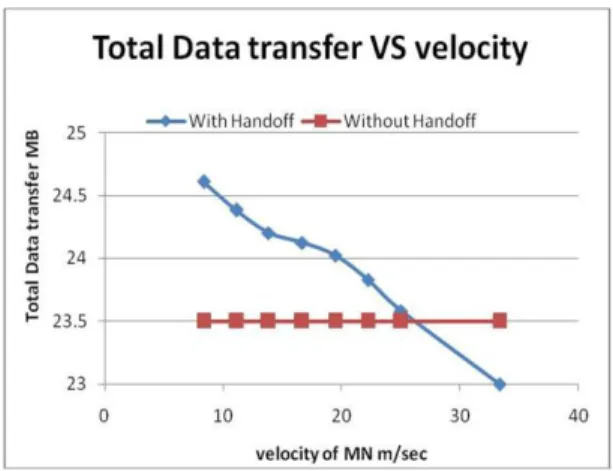
In this section, we compare total data transfer achieved between CN and MN nodes in different coverage area of WLAN for various applications considered. Figure 3 and Figure 4 depicts the total data transfer VS velocity of mobile node when the application is HDTV and coverage range of WLAN is 100m and 50 m respectively. As shown in Fig. 3 when speed of MN is 8.33m/s, total data transfer with handoff is 34 MB in comparison to 23.5MB in case of without handoff during total simulation time of 500sec. As velocity of MN increases, difference between data transfer with handoff and without handoff decreases and at the speed of 50m/s handoff to WLAN does not remain beneficial as shown in Fig 3. Similarly, in Fig. 4 where coverage range of WLAN is 50m, handoff is beneficial only up to velocity of 44.44m/s.
Fig.5. WLAN: 100m, Application: MPEG-4 Fig.6. WLAN: 50m, Application: MPEG-4
Figure 5 and Figure 6 represent total data transfer VS velocity when applied application is MPEG-4. Critical speed for 100m range of WLAN is 33.33m/s and for 50m range of WLAN 25m/s, above this speed handoff to WLAN is not beneficial in terms of total data transfer.
As shown in Fig.7 and Fig.8 for application H.261, total data transfer with handoff is beneficial only when MN moves with the speed <10 m/s. Simulation results show that even for real time application (H.261) that requires low data rate, handoff from UMTS to WLAN network results in data loss of 52kB/s for the user moving with the velocity of 11.11m/s in case of WLAN range is 50m and 20 kB/s if WLAN range is 100m.
Fig.7. WLAN: 100m, Application: H.261 Fig.8. WLAN: 50m, Application:H.261
Above results conclude that in the application like HDTV that requires high data rate, handoff into the network having high bandwith is beneficial as high data rate compensate the loss of data during dual handoff i.e UMTS to WLAN and WLAN to UMTS. But again it depends upon the residence time of MN in the network having high bandwidth. When the velocity of MN is high (say 40m/s), it remains in the WLAN for less time (2.5sec), and so the advantage of high bandwidth of WLAN is reduced due to increasing velocity. In case of application like H.261 that requires low data rate, handoff to WLAN is not very useful because data loss during dual handoff is not reimbursed with low data transfer.
4. Conclusion
In heterogeneous UMTS_WLAN network, the required QoS can be achieved through efficient vertical handoff decision that combines the advantages of data rate and coverage. In this paper, we have analyzed the effect of velocity of mobile user on decision of vertical handoff from UMTS to WLAN network. We have considered real time applications like HDTV, MPEG-4, and H.261 for analysis. Simulation is done using NS 2.29 simulator integrated with the IEEE 802.21 standard add on NIST simulation package. Simulation results show that for applications like H.261 that require low data rate vertical handoff to WLAN is not beneficial for the user moving with velocity more than 10 m/sec. In case of application like MPEG-4 benefit of vertical handoff can be achieved till the moderate velocity of user i.e. 33.33m/sec if the coverage range of WLAN is 100m and 25m/sec if WLAN coverage range is 50m. For high data rate applications like HDTV vertical handoff is advantageous even if user move with the high speed of 45m/sec. To conclude, vertical handoff decision determined using velocity of mobile node and coverage range reduces the number of unnecessary handoff and consequently improves QoS.
References
[1] UMTS Forum, “3G/UMTS towards mobile broadband and personal internet,” White Paper, Tech. Report. October 2005.
[2] X. Yan, N. Mani, Y.A. Sekercioglu, “A travelling distance prediction based method to minimize unnecessary handovers from cellular networks to WLANs,” IEEE Communications Letters, Vol. 12, No. 1, pp. 14–16, 2008
[3] A. H. Zahran, B. Liang, A. Saleh, “Signal threshold adaptation for vertical handoff in heterogeneous wireless networks,” Springer Mobile Networks and Applications, Vol. 11, no. 4, pp. 625-640, August 2006.
[4] Johann Marquez Barja et al., “Performance analysis of an IEEE 802.21 based Vertical Handover protocol using ns-2,” XXII Jornadas de
Paralelismo, La Laguna, Spain. 7-9 September, 2011.
[5] Yaw Nkansah, Gyekye, Johnson I. Agbinya, “Vertical Handoff Decision Algorithm for UMTS-WLAN,” IEEE Wireless Broadband and
Ultra Wideband Communication, 2007.
[6] Johnson et al., “Vertical Handoff Decision Algorithms Using Fuzzy Logic,” Proceeding AUSWIRELESS '06
[7] Wen-Tsuen Chen, Yen-Yuan Shu, “Active Application Oriented Vertical Handoff in Next-Generation wireless Networks,” IEEE
Communication Society/WCNC 2005
[8] Daojing He et al., “A Simple and Robust Vertical Handoff Algorithm for Heterogeneous Wireless Mobile Networks,” Springer Wireless Personal Communications Vol 59, Issue 2, pp 361-373, July 2011
[9] Rastin Pries, Dirk Staehle,David Hock, Matthias Hirth, “A Policy-Based Vertical Handover System,” Research Report Series, Report No.
471 University of Wuerzburg, www3.informatik.uni-wuerzburg.de/TR/tr471.pdf. May 2010
[10] Piyali Dutta, “ Handover techniques for 4G networks,” Proc of Second Internatinal Conference on Computer Applications [ICCA 2012] Vol-1, 2012
[11] “The Network Simulator NS-2 NIST add-on,” IEEE 802.21 model (based on IEEE P802.21/D03.00) January 2007
[12] K. Taniuchi, Y. Ohba, V. Fajardo, S. Das, M. Tauil, Y.-H. Cheng, A. Dutta, D. Baker, M. Yajnik, D. Famolari, “IEEE 802.21: media