IAEA-TECDOC-464
CURRENT TRENDS
IN NUCLEAR BOREHDLE LOGGING TECHNIQUES
FOR ELEMENTAL ANALYSIS
PROCEEDINGS OF A CONSULTANTS MEETING ORGANIZED BY THE
INTERNATIONAL ATOMIC ENERGY AGENCY AND HELD IN OTTAWA, CANADA
2-6 NOVEMBER 1987
A TECHNICAL DOCUMENT ISSUED BY THE
CURRENT TRENDS IN NUCLEAR BOREHOLE LOGGING TECHNIQUES FOR ELEMENTAL ANALYSIS
IAEA, VIENNA, 1988 IAEA-TECDOC-464 Printed by the IAEA in Austria
PLEASE BE AWARE THAT
ALL OF THE MISSING PAGES IN THIS DOCUMENT
WERE ORIGINALLY BLANK
The IAEA does not normally maintain stocks of reports in this series. However, microfiche copies of these reports can be obtained from
INIS Clearinghouse
International Atomic Energy Agency Wagramerstrasse 5
P.O. Box 100
A-1400 Vienna, Austria
Orders should be accompanied by prepayment of Austrian Schillings 100,-in the form of a cheque or 100,-in the form of IAEA microfiche service coupons which may be ordered separately from the INIS Clearinghouse.
FOREWORD
Nuclear borehole logging techniques have a potential to provide immediate and representative information about elemental concentrations in geological media. Several techniques are well established and widely used while other techniques have been emerging during recent years because of
improvements in instrumentation.
The Agency convened the consultants' meeting in order to assess the present technical status of nuclear borehole logging techniques, to find out the well established applications and the development trends.
This report contains a summary report giving a comprehensive overview of the techniques and applications, and a collection of research papers describing work done in individual institutes.
The consultants' meeting was held in conjunction with a research coordinated meeting (RCH) on "Nuclear borehole logging techniques for the determination of rock characteristics". The progress reports on the RCM presented at the meeting are not included in this report but all participants of the RCH participated in writing the summary report.
The Agency is grateful to the Geological Survey of Canada which hosted the meeting, the main organizer of the meeting, Mr. Quentin Bristow, who also chaired the meeting and all participants who contributed to the meeting by presenting papers and contributing to the fruitful discussions.
EDITORIAL NOTE
In preparing this material for the press, staff of the International Atomic Energy Agency have mounted and paginated the original manuscripts as submitted by the authors and given some attention to the presentation.
The views expressed in the papers, the statements made and the general style adopted are the responsibility of the named authors. The views do not necessarily reflect those of the govern-ments of the Member States or organizations under whose auspices the manuscripts were produced. The use in this book of particular designations of countries or territories does not imply any judgement by the publisher, the IAEA, as to the legal status of such countries or territories, of
their authorities and institutions or of the delimitation of their boundaries.
The mention of specific companies or of their products or brand names does not imply any endorsement or recommendation on the part of the IAEA.
Authors are themselves responsible for obtaining the necessary permission to reproduce copyright material from other sources.
CONTENTS
1. INTRODUCTION ... 7
2. NUCLEAR TECHNIQUES FOR ELEMENTAL ANALYSIS ... 8
2.1. Natural y-ray spectrometry ... 8
2.2. Prompt gamma neutron activation analysis ... 9
2.3. Prompt inelastic neutron activation analysis ... 10
2.4. Delayed gamma neutron activation analysis ... 10
2.4.1. DGNAA with thermal neutrons ... 11
2.4.2. DGNAA with high energy neutrons ... 11
2.5. Spectral 7-7, 7-density ... 12
2.6. Neutron porosity measurement ... 12
2.7. Energy dispersive X-ray fluorescence ... 13
3. APPLICATIONS ... 14
3.1. Applications of natural gamma ray spectrometry ... 14
3.2. Applications of 7-7 and spectral 7-7 logging ... 15
3.3. Applications of activation analysis techniques ... 16
3.4. Applications of neutron porosity measurement ... 17
4. FUTURE TRENDS ... 19
5. TECHNICAL AND ECONOMICAL BENEFITS ... 20
6. CONCLUSIONS ... 21
Downhole assaying in Canadian mineral deposits with the spectral gamma-gamma method ... 23
P. G. Killeen, C.J. Mwenifumbo Quantitative nuclear borehole logging based on neutron excited gamma reactions ... 31
M. Borsaru, P.L. Eisler, J. Charbucinski Elemental concentrations from gamma ray spectroscopy logs ... 55
J.S. Schweitzer, D.V. Ellis, J.A. Grau, R.C. Hertzog Borehole capture gamma ray spectrometry in very dry rock ... 67
F.E. Senfile, J.L. Mikesell Nuclear quantitative analysis of P, Si, Ca, Mg, Fe, Al in boreholes on a phosphate mine . . . . 93
J.-L. Pinault Analysis of boron, samarium and gadolinium in rock samples by neutron capture gamma ray spectrometry ... 105
C.W. Tittle, M.D. Glascock
The Monte Carlo Library Least-Squares Analysis principle for borehole nuclear well
logging elemental analyzers ... Ill
Advances in bulk elemental analysis using neutron interactions ... 123
T. Gozani
The assay of gold and platinum in rocks and ore — an option ... 135
C.G. Clay ton
1. INTRODUCTION
The analysis of elemental concentrations in boreholes require
techniques which are element specific, sufficiently sensitive to detect anomalies as well as economically recoverable deposits, and penetrating enough to overcome mineral heterogenity and enable determination in water filled boreholes.
These specifications can in principle be found only in nuclear methods. In spite of the obvious advantages on in-situ analysis in mineral exploration, the techniques have not found the widely spread use, which could be expected. The main reason is that the logging systems developed until now have not filled all the requirements mentioned above. The analyzers are either specific and sensitive but not penetrating enough, or penetrating but not sensitive enough. Calibration presents a significant problem rendering accurate quantitative analysis difficult.
Recent years have brought new promising development mainly because of improved measuring electronics and computers. Therefore it is time to review the current status and development trends in borehole logging techniques for elemental analysis.
The meeting was convened by the Agency in Ottawa, with the Geological Survey of Canada acting as host, to provide a forum for scientists to present the results of their work and to discuss the present status and future development trends of the techniques.
The technical proceedings include a summary report together with the written versions of all the papers presented. This summary describes the individual nuclear techniques, and their main applications. The summary was produced by working groups of two or three of the
participants whose areas of expertise were most relevant to the technique in question.
The research papers describe development work and applications made in the different institutes represented by the participants.
2. NUCLEAR TECHNIQUES FOR ELEMENTAL ANALYSIS
2.1. Natural Y-Ray Spectrometry
The method involves the detection of natural gamma radiation which is used to determine the concentrations of the three naturally occurring radioéléments, potassium, uranium and thorium. Detection can be made with either scintillation detectors (usually Nal(Tl), CsI(Na), or BGO) or solid state detectors (usually high purity Germanium) operating at liquid nitrogen temperature.
At present the use of scintillation detectors dominates the
applications primarily because of difficulties associated with cooling
problems and low detector efficiency of solid state detectors. Maximum count rate is limited by the concentrations of Th, U and K. However, solid state detectors have the advantage of very high energy resolution which make it possible to do uranium and thorium determinations without
assumptions regarding radioactive equilibrium in the U and Th decay
series.
In addition to K, U, and Th determinations, natural gamma-ray
spectrometry is used as an aid to lithological correlation and mineral identification, determination of organic material of higher U content, and detection of alteration associated with mineral deposits.
Recent technological developments indicate that room temperature solid state detectors will soon become available and their usage will
therefore become greatly increased. In addition, increased knowledge about effects of variations in measurement parameters, both of the boreholes and of the equipment, now make it possible to improve interpretations using computer models, which at the same time take advantage of recent developments in the field of computer technology. Hence higher accuracy of quantitative measurements can be expected in the near future.
Natural gamma-ray spectrometry encounters a problem when radioélément concentrations are low and the natural gamma-ray flux is statistically difficult to work with in computing results. The solution to the problem lies in the area of increasing the detector efficiency or detector size if hole diameter permits.
Another important problem exists in the area of calibration standards. At present, calibration models for uranium logging (with gross count gamma-ray equipment) exist in many countries. Model boreholes for calibration of thorium and potassium are relatively rare and some attention should be directed to their establishment in the future.
2.2. Prompt gamma neutron activation analysis
The prompt production of gamma-rays resulting from the capture of slow ("thermal and epithermal") neutrons is the basis for prompt £amma neutron activation analysis (PGNAA).
The resulting gamma-rays are specific for the nuclei that capture the thermal neutrons. Hence the presence of specified gamma-rays and their intensity allows for the quantitative determination of the elemental concentration in the neutron interrogated object (e.g. stream of coal, ores, formation around borehole probe, etc.).
Because of the prompt production of thermal neutrons at depth in the sample and the resulting gamma-rays are of high energy (0.5 to 11 MeV), PGNAA is ideal for non-intrusive on-line measurement of bulk samples and streams and borehole measurements.
A PGNAA system is composed of a neutron source and its shielding, sample presentation, detection system and data processing system. As all practical sources of neutrons (isotopic or electronically
generated) are of high energy (1 to 14 MeV), the neutrons from the source must be externally (e.g. by use of polyethylene) or internally moderated by the hydrogen present in the sample (as in the case of
coal). The most common and readily available neutron sources are the 252
isotopic sources Cf, Am-Be other alpha-Be and the 14 MeV neutron generator. The sources are listed according to ease of moderation. Thus, in most cases cost and complexity will be in favour of the
252
Cf source.
The PGNAA technique has been researched, developed and applied over a period of more than three decades. The last decade shows major
The main stumbling block to seeing a wide beneficial industrial use of PGNAA is bridging the general acceptance gap between the developer and/or manufacturer of such systems and the potential user, and
demonstrating the material properties, e.g. mineralogy, that may be determined from elemental concentrations.
2.3. Prompt inelastic neutron activation analysis
The prompt production of gamma-rays resulting from the inelastic scattering reaction (n.n'y) is the basis for p_rompt inelastic neutron activation analysis. Prompt gamma-rays can also be produced by other fast neutron reactions (n, X) where X can be a proton, deuteron, tritium alpha or 2 neutrons.
The technique is complementary to PGNAA. The resulting gamma-rays are different but are also generally specific to the nuclei that interact with the fast neutrons.
The PINAA is better suited for analysis of low and medium atomic weight elements such as carbon, nitrogen and oxygen, where the PGNAA response is low.
The most practical source for the PINAA is the electronic neutron generator based on the fusion reaction (D, T) which prolifically generates 14 MeV neutrons. For some applications, when the wealth of gamma-ray lines generated by the 14 MeV neutrons is not beneficial, an
241
(a, Be) (e.g. AmBe) source with a lower average neutron energy ~ 5MeV is more appropriate.
Most of the 14 MeV neutron generators for borehole exploration are pulsed so that one can combine PINAA during the pulse and PGNAA during the ensuing die-away time of the thermalized neutrons.
2.4. Delayed Gamma Neutron Activation Analysis
Delayed gamma neutron activation analysis (DGNAA) is the detection of specific gamma-rays produced by the decay of radioactive nuclei formed through neutron absorption by a stable nucleus. From a practical point of view, radioactive nuclei with half lives ranging from about 1 sec to
about a few months are of the greatest interest. In general, DGNAA techniques, as compared with other analytical techniques, are favoured for minor and trace element analysis because of the reduced background which is one of the major factors contributing to improved
sensitivity. Maximum data rates require the use of the largest
intensity neutron sources consistent with radiation safety. Inorganic scintillators can frequently be used when only a few elements are of interest. A more complete multi-element analysis usually requires a semi-conductor detector which has much better resolution than can be achieved with scintillators. In the DGNAA technique the delay between neutron irradiation and gamma-ray detection can be adjusted to enhance the selectivity for specific elements. DGNAA can be performed either with thermal or high-energy neutrons.
2.4.1. DGNAA with Thermal Neutrons
252
Isotopic neutron sources, e.g. Cf, are currently used for thermal DGNAA (future developments on d,d or y»n accelerators may also be suitable), and the lowest energy neutron sources are preferable to minimize interference from high-energy neutron-induced reactions. A
unique advantage of this technique is the unambiguous association between the detected gamma-rays and the specific elements in the rock. This advantage occurs because thermal neutron capture will create only radioactive isotopes of the original element.
2.4.2. DGNAA with High Energy Neutrons
Neutron generators based on the d,t reaction are used to produce high-energy neutrons (E = 14MeV) that can be used for DGNAA. In
extended media, such as a borehole, the neutron flux will contain both high-energy and thermal neutrons. High-energy neutrons can create radioactive nuclei of elements other than the original element. This can result in improved sensitivity for particular elements (e.g., Si, Fe, 0 ...). Particular gamma-rays may now be produced from more than one element, and unlike thermal DGNAA, require improved resolution and precision to allow unambiguous quantitative analysis of elemental
concentrations. The higher energy and intensity of the source neutrons increase the importance of careful shielding to protect the detector and eliminate background from the spectrometer.
2.5. Spectral Y-Y. Y-Density
The method involves emission of y-rays by a source in thé probe and the detection of the gamma-rays backscattered from the rocks
surrounding the borehole. Variations of the method involve counting with one or more detectors at different distances from the source and applying simple (single window) or sophisticated (multichannel) energy discrimination techniques.
Most commercial logging companies use multiple-detectors but very simple energy discrimination, and no energy stabilization. The information is primarily limited to density determinations. Often information is qualitative showing only density variations, although
some systems have been properly calibrated in density models and
quantitative density data are possible.
There is a trend towards more widespread use of calibration models and
hence quantitative measurements. In addition the incorporation of the
spectral gamma capability arising from developments in natural
gamma-ray spectral logging are making it possible to obtain much more
information in the form of spectral gamma-gamma data that allows a
simultaneous determination of density and average photoelectric
absorption cross section. At the same time spectral stabilization methods have improved and are being incorporated in these probes for more accurate measurements. In favourable environments (e.g. iron deposits) elemental determinations can be made from spectral y-y data. It is also possible to combine both natural spectral y and spectral y-y measurements in a single detector in a single run in a borehole.
Multi-element deposits are difficult to analyze, for example, when
barite is present in association with the element of primary interest.
2.6. Neutron Porosity Measurement
Though intended to be specific to hydrogen, which is then regarded as a measure of porosity, neutron porosity devices tend to be influenced by the solid rock matrix. Nevertheless, these devices, especially when coupled to a complementary method such as the gamma-gamma density log,
are capable of precise porosity determination, because hydrogen is so often directly related to porosity. All existing neutron porosity devices determine hydrogen through strong influence on either the neutron slowing length or the slowing down time.
These methods, as presently implemented, are just as sensitive to hydrogen found in the solid component as to that associated with fluids, which is the basis for porosity estimation. Thus, bound hydrogen, as in hydrates or clays, adversely affects the porosity measurement. Means of reducing these effects are worthy of
investigation.
The three practical neutron sources for neutron porosity logging are: (1) californium-252; (2) alpha-beryllium sources such as Am-Be; and (3) d-t sources (neutron tubes). On the average, these sources have increasing fast neutron energy in the order listed. In that same
order, porosity sensitivity decreases, while depth of investigation and matrix effects increase.
If thermal neutrons are detected as the primary measurement, the indicated porosity is also influenced by the thermal absorption cross section (sigma) of the formation. This, in part, explains the interest in laboratory methods for rapid determination of sigma in rock
samples. The epithermal slowing down time porosity logging method promises to alleviate some of the difficulties.
The useful character of the neutron porosity log has found very wide application on the oil industry and is being used increasingly in other fields such as coal and hydrology.
2.7. Energy Dispersive X-ray Fluorescence
Because of the relatively low energies involved, this technique has limited application, except in shallow, dry boreholes for mine control.
An increased use of high resolution detectors, as a result of the increased lifetime of cryogens, and more rapid, if not instantaneous, data analysis are the only significant developments forecast for the future.
The most important area of application is believed to be in assessing the ore grade of tin deposits in regions where hard rock mining
prevails.
3. APPLICATIONS
The following is not intended as a comprehensive description of all possible applications of the known techniques, or all the techniques which are needed for a complete evaluation of a specific geological formation or ore. The discussion is limited to the most important established applications and the most important development trends.
3.1. Applications of Natural Gamma-Ray Spectrometry
Passive gamma-ray spectrometry is primarily used in uranium mining exploration for determination of uranium concentrations in the presence of thorium and potassium. It is also used for lithological
correlations in non-uranium mining related problems, especially in situations where gross gamma-ray counting fails. In some geological environments characteristic radioélément ratio can be established to
delineate certain zones of interest, and in many cases characteristic
radioélément concentrations and/or ratios are associated with economic mineralization.
In general determination of K, U and Th by natural gamma-ray
spectrometry is extremely useful for solving geological problems, such
as the North Sea oil exploration problems.
The future should see increased usage of natural gamma-ray spectrometry to solve geological problems through the associations of minerals of interest with characteristic variations in K, U and Th. Examples are gold associated with potassium alterations, uranium associated with phosphorus deposits, and radioéléments associated with tin/tungsten deposits. Characteristic radioélément distributions are also
associated with differentiation at the time of cooling of magma.
Natural gamma-ray spectral logs also have a potential for geothermal reservoir identification.
In an active geothermal field, potassium rich hydrothermal fluid-flows which are connected with some magmatic activity, rise up through
permeable zones such as fractures, and this potassium tends to
precipitate in formations which are located in the path of hydrothermal fluid-flows .
It was found that the concentration of potassium in altered rocks can be easily detected by the use of a natural gamma-ray spectral log. This detection method can be applied not only for recognition of hydrothermal potassium minerals such as K-feldspar and Sericite in drill wells, but also for interpretation of distribution of potassium caused by hydrothermal activity. The natural gamma-ray spectral log is a useful tool for the evaluation of geothermal hydrology in an active geothermal field.
Future applications include the detection of man-made radioisotopes associated with nuclear waste disposal and related environmental problems.
3.2. Applications of Y-Y and spectral Y-Y
The method is primarily used for density determinations, usually for coal logging. Zone thickness and ash determinations can often be computed from the density log.
In general density logging is widely used in coal, oil, and gas exploration as a lithological tool for correlation purposes and for determining the pore volume of rocks.
Spectral gamma gamma logs provide lithological information resulting from the different effective atomic numbers of different rocks. Quantitative determinations of the concentrations of certain heavy elements can be made with a properly calibrated system. More accurate quantitative density computations can also be made based on the
spectral y-y data.
Spectral y-y logs may also be used in geotechnical applications for density of soils and stability of benches in open pit mining, dams and other foundation problems.
In general there is a very high potential for widespread application of spectral y~Y techniques in both developed and developing
countries. This is primarily because there is a natural progression from familiarization with spectral logging to spectral gamma-gamma logging. In addition the radioactive sources involved are relatively weak. Interpretation of y~Y spectra is also easier than
interpretation of neutron-gamma spectra. Methods to realize this potential as soon as possible should be developed.
3.3. Applications of Activation Analysis Techniques
All elements of interest manifest, to various degrees, clear signatures in PGNAA and/or PINAA. The actual application depends on technical
feasibility (e.g. levels of concentration required for a given element, background, interferences, etc.) and ultimately on economic issues. Only the technical considerations are discussed in this summary.
PINAA has been used for the last 15 years (but unfortunately not
extensively) for the quantitative determination of: -Al, P, S, Fe, Ni,
Zn, Pb and a few other intermediate elements in ore and ore
processing. Carbon is being measured in ash from power stations prior
to its use in cement manufacture. Carbon and oxygen are now measured using (a, Be) or 14 MeV neutron sources, in addition to non nuclear techniques, to determine relative amounts of water in light and heavy oil near the extraction point and to determine oil content of
subsurface geological formations.
PGNAA has an increasing importance in borehole logging for oil and gas evaluation and the geosciences by providing absolute elemental
concentrations.
For coal exploration the new trend is to develop nuclear borehole logging techniques for elemental analysis, particularly the PGNAA and
252
DGNAA based on HPGe and Am-Be as well as Cf sources. It has been found in the laboratory that more than 20 elements could be detected by
using this method. They are as follows: C, H, S, N, 0, Si, Fe, Al, K, Na, Ca, Mg, Mn, Cl, Zn, B, Cd, Gd, Ge, V, Ti, Sm, As, Pb, Au.
These techniques can be used to determine not only the location and thickness of the coal measures, but also the ash content and the calorific value of the coal, and the concentrations of toxic elements (As, ...) and useful by-products (Ge, Gd, Ti, Sm, Au, etc.). Moreover, an evaluation of the formation can be made from the concentration ratio
of Si, Fe, Al, etc.
The main problem is the leading edge technology involved in fabricating a probe containing the HPGe detector which is needed, and in
dissipating the heat which is generated during logging. An additional problem is separating the radiation flux induced in the borehole fluid from that of the formation from which the elemental analysis must be made.
The advantages of PGNAA are also demonstrated by its emerging
applications in on-line analysis. PGNAA has gained in popularity over the last decade, finding use in on-line elemental analysis of coal moving on belts or chutes. The main use is in the determination of sulphur content to ensure compliance with environmental regulations. Most of the existing on-line instruments (there are about ten of them currently in use) can determine a few elements (such as Fe and Ca) in addition to sulphur. One system can determine most of the eleven elements in coal directly, and can infer the concentration of the rest
(e.g. Na, Mg).
Two PGNAA instruments are now installed in cement plants, one for full
elemental analysis and the other for Ca and Fe. There are numerous
laboratory applications of PGNAA that have been reported, that include the determination of phosphorus in phosphate ore using a Ge detector; the elemental composition of rocket propellant; and the boron content of large samples and nitrogen content in explosives.
3.4. Applications of Neutron Porosity Measurement
Neutron porosity measurements are mainly used for hydrocarbon
exploration and production. For quantitative interpretation of neutron logs additional information concerning the rock matrix such as sigma values are needed. Several kinds of neutron logs have found wide application in the petroleum industry. These include:
1. Single detector probes
(a) Neutron-thermal neutron (b) Neutron-epithermal neutron (c) Neutron-gamma
2. Dual detector probes
a, b, c as above
3. Multiple detector probes
(a) Combination of 2(a) and 2(b) in one probe
(b) Proposed multi-detector probes whose purpose is to correct for borehole effects
Neutron porosity logs provide information on total hydrogen content in rocks (including hydrogen content in rocks, in organic matter, in water and hydrogen bound in mineral matter) when coupled to a complementary method such as gamma-gamma density or the PGNAA technique. Neutron
porosity measurements can be applied for determining the most important
coal characteristics like calorific value or the moisture and mineral matter (ash) content of coal.
A type of neutron log called a moisture gauge has been used for studying soil and rock properties related to building foundations, bridges, highways and other structures. Another application has been the location of the best producing horizon in a water well for general use and for irrigation.
4. FUTURE TRENDS
Significant progress has been made in recent years in the performance and reliability of logging probes. In oil exploration and production boreholes the greater reliability and extended lifetime of neutron tubes is already having a significant effect on the quality and value of extracted information and this trend is expected to continue.
In minerals exploration the development of efficient cryogens now allows high resolution gamma-ray detectors (HPGe) to be used downhole so that a vastly increased amount of data has now become available. In particular, this is giving rise to accurate determination of elemental concentrations which in turn is leading to important advances in
formation analysis.
Significant progress has also been made in high level data transfer from the probe to the logging equipment located at ground level.
The application of micro- and mini-computers in the logging equipment now permits rapid assessment of the characteristics of underlying studies, but perhaps the most important development in computer application is in the modelling of real situations through the
development of sophisticated Monte-Carlo and associated codes. This latter development, in particular is expected to have a profound effect on all aspects of operational strategies and on data interpretation in the future.
5. TECHNICAL AND ECONOMICAL BENEFITS
Activities involved in the identification, evaluation, recovery, and processing of geologic material require the acquisition of remote
samples and subsequent analysis at a distant location. In-situ nuclear techniques generally provide technical and economical benefits.
Technical and economical benefits are not mutually exclusive. The following two paragraphs will emphasize the technical and economical aspects, respectively.
Samples acquired by remote acquisition must necessarily be small and discrete. The techniques of acquiring the samples are frequently costly and time consuming. Once acquired, they undergo subsequent analysis which can be both costly and time comsuming. Because of the size of the samples, they are generally not statistically
representative of the material from which they were taken. Nuclear analysis techniques can ameliorate these limitations. They typically are sensitive to volumes that are 100-1000 times larger than the remotely-acquired samples. In-situ nuclear analyses are continuous, faster, frequently cheaper, and produce results which are more
statistically significant.
The most important economic consequence of in-situ nuclear analysis is the more accurate and complete description of the region under
investigation. Improvement of the data quality allows better economic evaluation. The costs associated with discrete sampling can be
minimized. Immediate analysis permits better control and improved efficiency of all operations. An additional benefit is the better understanding of any resources and the geological environment. The stringent requirements of modern geologically-related operations
necessitate quality control that can only be achieved with the maximum amount of rapidly available data.
6. CONCLUSIONS
Nuclear techniques have assumed a major role in obtaining data on geological strata for geoscience purposes, for in-situ evaluation of oil, gas, and mineral resources, and for on-line control of process streams, especially for mineral production. The techniques employed include the measurement of gamma-ray scattering, neutron scattering, and elemental-specific spectroscopic measurements of either natural activity or gamma-rays induced by neutron interactions. The technical complexity of the techniques range from very simple to highly advanced, providing a range of applications that can be applicable at all levels of technological sophistication. These techniques have demonstrated the ability for more precise evaluation of extended media leading to more efficient evaluation and processing of geological material.
Recent advances have also demonstrated the utility of nuclear-measured parameters for determining other material properties. Optimum use of these nuclear techniques can be enhanced by hardware improvements, analysis enhancements through a better understanding of the measurement physics and the relationship of the measurements to geological
properties, and greater education and training to permit wider use of established analysis techniques.
The present status and future of the different techniques can be summarized as follows:
1. Although problems of low counting rates and tool calibration exist, the use of natural gamma-ray spectroscopy has proved erainentally useful for the determination of Th, U, and K,
lithological correlation, detection of regions of alteration of ore bodies, etc.
2. Borehole elemental analysis using gamma-rays produced both by radiative capture or inelastic scattering have been well tested over the past 15 years, and these methods are gaining recognition as useful analytical techniques. The technology is in place, and therefore, once it has gained more widespread acceptance by
geologists, it should become a standard method of borehole analysis.
3. Borehole elemental analysis by delayed gamma-ray spectroscopy is attractive for specific elements with appropriate half-lives and neutron absorption cross-sections. The method has the advantage of a better signal-to-noise ration than prompt gamma-ray
techniques, but the disadvantage of requiring a strong neutron source,
4. Spectral y-y and Y-density logs are improving in quality and
use primarily because of better calibration techniques and more useful data. The y-density measurements can be helpful in correcting a porosity determination, so that quite accurate porosity measurements can be obtained.
5. Neutron porosity logs are well established and commonly used means for determination of total hydrogen content of rocks when coupled to a complementary method such as gamma-gamma density log. Most important applications are in exploration for oil, gas, coal and water.
6. New technology, especially computer data reduction techniques and new electronic counting systems, is expected to improve all the borehole activation methods.
DOWNHOLE ASSAYING IN CANADIAN MINERAL DEPOSITS WITH THE SPECTRAL GAMMA-GAMMA METHOD
P.O. KILLEEN, C.J. MWENIFUMBO Mineral Resources Division,
Geological Survey of Canada, Ottawa, Ontario, Canada Abstract
The Borehole Geophysics Section at the Geological Survey of Canada is conducting research into the Spectral Gamma Gamma (SGG) logging method with the objective
of developing a borehole assay technique suitable for use in Canadian mineral
exploration and mine development. The SGG method is based on the different
interactions of gamma rays with matter. After gamma rays from a radioactive
source have interacted with rock the gamma ray energy spectrum contains information about the atomic number (Z) of the elements in the rock. A special radioactive source holder has been designed to attach to the nose of a spectral gamma ray logging probe in order to make SGG measurements. A series of different collimators designed to focus the gamma rays radially out into the rock at angles of 90°, 60°, 45° and 30° to the probe, and a series of different spacers to permit variations in source-detector spacing have been fabricated from tungsten. In addition, sources with different gamma ray energies (Cobalt 60, Cesium 137,
Iridium 192) have been tested. A number of experiments have been conducted,
varying all of the above parameters and the energy windows. The SGG probe has been field tested using some of the experimental configurations in boreholes intersecting different types of mineralization. The high Z values of lead in lead deposits is easily detectable and semi quantitative assay logs have been produced.
Barite and pyrite associated with gold mineralization has also been detected and
sphalerite-rich zones have been delineated in a zinc mining area.
1. INTRODUCTION
Direct assaying techniques for use in boreholes have numerous advantages
over assaying of drill core taken from the hole. These include rapid return of results compared to laboratory analysis of core, the possibility of assaying the borehole wall in sections where core recovery may have been poor, and perhaps most
importantly, the large sample volume analyzed in the borehole compared to the
core size.
Borehole assaying techniques that have been tried, with varying degrees of success, are generally based on nuclear techniques such as X-Ray Fluorescence (XRF)
and Neutron Activation Analysis (NAA). The low penetration of X-rays in rock
severely restricts the sample volume, and the neutron based techniques have met
with resistance related to the elaborate safety precautions required in handling the relatively strong radioactive sources involved.
One nuclear technique, Spectral Gamma Gamma (SGG) logging, appears to
offer the significant depth penetration of gamma rays as well as the possibility of
minimizing radiation safety problems by appropriately designing a logging tool
with a relatively weak gamma ray source. In addition the technology for natural spectral gamma ray logging is already well developed, and can be adapted for SGG logging [1].
The possibilities for elemental analysis based on the different interactions of gamma rays with matter, (in this case rocks and minerals) was first described by
Czubek in 1966 [2]. The dominant interaction is Compton scattering in which
gamma rays are reduced in energy by scattering as they collide with electrons in the
outer shells of atoms. The second type of interaction is photoelectric absorption in
which a gamma ray loses all its energy in a collision with an electron and ceases to
exist. The probability of photoelectric absorption is roughly proportional to the
fifth power of the atomic number, 2, of the element with which the gamma ray interacts, and inversely proportional to about the third power of the gamma ray
energy E. The probability of Compton scattering is roughly proportional to Z/E. Thus, if a spectral gamma ray logging tool is used to measure the distribution of
energies of gamma rays from a radioactive source after they have interacted with
rock as shown in Figure 1, the shape of the spectrum will contain information about the atomic number of the elements in the rock. In particular, as shown in Figure 2
the observed count rate at low energies will be greatly reduced if heavy elements
(i.e., high Z) are present in the rock. An example of practical work in this area is that of the CSIRO in Melbourne in which an iron ore assay method was developed for use in mines of Western Australia [3].
Cable D e t e c t o r Signal B a c k s c a t t e r e d gamma ray > E N E R G Y Shielding s p a c e r Energy s p e c t r u m , P h o t o e l e c t r i c ~i~ a b s o r p t i o n B o r e h o l e
Figure 1: The spectral gamma gamma method consists of recording the energy
spectrum of backscattered gamma rays from a source m the borehole probe as shown. The main components of the probe; source, collimator, spacer, and detector are indicated.
5 0 0
I T T
2 0 0 4 0 0 E n e r g y ( k e V )
Figure 2 Typical gamma ray spectra recorded in country rock and an ore zone
containing heavy elements The increase in effective atomic number of the ore causes an increase in photoelectric absorption of low energy gamma rays The resultant decrease in count rate at low energies is evident The ratio of count rate m appropriate energy windows (e g W3/W10) can be used to indicate the presence of heavy elements in the form of a spectral ratio log of a borehole.
2 THE SPECTRAL GAMMA GAMMA PROBE
At the GSC, a special gamma-ray source holder has been designed to attach to the nose of a spectral gamma ray logging probe in order to make SGG measurements In making the measurements it is important to optimize the source-detector spacing and the collimation angle at the source A series of different collimators designed to focus the gamma rays radially out into the rock at angles of 90°, 60°, 45° and 30° to the probe, and a series of different spacers to permit
variations m source-detector spacing have been fabricated from tungsten (see Figure 3) Tungsten provides high gamma ray attenuation, and permits the use of short source-detector distances if desired The source holder is omm-azimuthal and is designed for use in the slim holes (e g , AQ, 46 mm) commonly drilled in Canadian mineral exploration The source can be of relatively low strength compared to
those commonly used in gamma gamma density probes because the collimators are
radially symmetrical focussmg gamma rays at the appropriate angle, outward into
the borehole wall in all directions In the gamma-gamma density type of probe
commonly used for coal and petroleum well logging, the gamma rays are usually strongly collimated in a narrow beam and therefore most of the gamma radiation
emitted by the source is not utilized This is because the probe must be "side walled" in the large diameter holes for consistent measurements In addition to the
different collimators and source detector spacmgs, sources with different gamma ray energies (Cobalt 60, Cesium 137, Indium 192) have been tested
The principle of the SGG log can best be understood by referring to the two spectra shown in figure 2 The positions of a low energy window (W10) and a high energy window (W3) are indicated in the figure When there is a change in the
density of the rock being measured, the count rates recorded in both windows will increase or decrease due to the associated change m compton scattered gamma rays reaching the detector However, if there is an increase in the content of high Z elements in the rock, the associated increase in photoelectric absorption will cause a
Figure 3: Experimental spectral gamma gamma probe components showing the
source holder, four collimators (90°, 60°, 45°, 30°], and shielding spacers of three
different diameters (32 mm, 38mm and 50 mm). The adaptors are used to attach the 32 mm diameter source holder assembly to the desired spacer. Experiments with different combinations of these components (including different sources and spacer lengths) are carried out to determine the optimum parameters for borehole assaying using the SGG method.
significant decrease in count rate in the low energy window W10, but no change in
W3. W10 is affected by both density and Z effect while W3 is only affected by
density. Therefore a ratio of counts in W3 to the counts in W10 can be used to obtain information on changes in Z.
The SGG ratio log is a ratio of counts in W3 to counts in W10 (i.e. W3/W10).
This ratio increases when the probe passes through zones containing high Z
materials. Experimentation is continuing to determine the optimum energy
windows to use for this spectral ratio, as well as to optimize all of the other parameters mentioned. In particular the characteristics of the most common
Canadian mineral exploration boreholes are taken into consideration (e.g. BQ; 60
mm diameter, water-filled).
Preliminary field testing indicates that the SGG method is a promising
technique for development of quantitative borehole assaying for Canadian mining.
3. FIELD TESTS IN MINERAL DEPOSITS
A series of experiments has been conducted varying all of the above parameters including the energy windows. The SGG probe has been field tested using some of the experimental configurations, in boreholes intersecting mineralization of different types. The high Z of lead in lead deposits is easily detectable and semi-quantitative assay logs have been produced. Barite associated with gold mineralization has also been detected and sphalerite-rich zones have been delineated in a zinc mining area. Three examples illustrating SGG logs
recorded in a lead deposit, zinc deposit and a gold deposit are presented in Figures
4, 5, and 6 respectively, and are described below. 3.1 Yava Sandstone Lead Deposit, Nova Scotia
This deposit located in Nova Scotia consists of galena in sandstones, a
relatively simple geology and mineralogy. The lead in galena with its high atomic number (Z = 82) causes the spectral ratio values in the SGG log to increase in
DENSITY SPECTRAL LOW HIGH RATIO
LEAD Sandstone [••;';' Black shale IE 10mLimestone M 2 0 m -breccia ^ Windsor shale Rhyolite breccia Rhyolite 30m 40m -DDH 405 1.5 2.5 0 4i
Figure 4: The spectral ratio log and a density log recorded in the Yava sandstone lead (galena) deposit in Nova Scotia. The lead assays from drill core shown in histogram form, show excellent correlation with the high values of the spectral ratio. The density log is not as sensitive to changes in lead content. Narrow zones of high ratio values are also lead-rich zones which were not assayed since they were not considered to be of economic significance.
The lead assays from drill core, plotted in histogram form in the figure show that the SGG log can be considered a semi-quantitative assay log. Note the lead concentration is less than 4%. A qualitative density log is also shown in figure 4 for comparison.
3.2 Zinc Deposit, Daniels Harbour, Newfoundland
This deposit consists primarily of sphalerite in limestone, another relatively simple geological setting. Although the atomic number of zinc is only 30, average grades of considerably less than 8% Zn are clearly defined by the high spectral ratio values shown in the SGG log (figure 5).
3.3 Gold deposits, Hemlo area, Ontario
An SGG log from a borehole in this area is shown in figure 6, along with a qualitative density log. The gold is not directly detectable but the barite and pyrite with which it is associated is easily detected. Optimizing the choice of energy windows for barium (Z = 56) and iron (Z = 26) may make it possible to determine the location and width of the gold-mineralized barite-rich zones within the broader pyritized zones.
4. QUANTITATIVE ASSAYING WITH THE SGG METHOD
Experiments are underway to quantify the relationship between the spectral ratio and lead content at the Yava lead deposit. A combination of detailed assays in drill core and model boreholes with different ore grades is being used. Additional work with barite and pyrite in model boreholes wilfalso be carried out.
ZINC % S P E C T R A L R A T I O 15m 20m 25m -30m _ 8.0 I 1 . 8
-1
3.0 _lFigure 5 The spectral ratio log recorded in a zinc (sphalerite) deposit at Daniels Harbour, Newfoundland Because of the large samples, the zinc assays of drill core do not show the zinc distribution as well as the SGG log
DENSITY LOW HIGH SPECTRAL RATIO 7D 7E 3A 660m- 680m- 700m- 720m-12% 8%
»20%:
'30% O R E Z O N E O R E Z O N E DDH NGG18 0.5 3.5Figure 6 The spectral ratio log and density tog recorded in a gold mineralized zone in the area of the Hemlo gold deposits, Ontario The gold is associated with barite-nch zones within a broaderpyntized zone The high spectral ratio values delineate the ore zones but the bânte is not distinguishable from the pyrite Here the heavy mineral content is sufficiently high to affect the density log m the same way
Besides optimizing energy windows for measuring the desired elements, it is likely that the probe configuration for each deposit can be optimized for the particular geologic setting to provide the most accurate results.
5. REFERENCES
[1] KILLEEN, P.G., Gamma ray spectrometric methods in uranium exploration -application and interpretation; m Geophysics and Geochemistry in the Search for Metallic Ores, (HOOD, P.J., Ed.), Geol. Surv. Can., Economic Geology
Report 31 ,(1979), 163-229.
[2] CZUBEK, J.A., Physical possibilities of gamma-gamma logging; jri Radioisotope Instruments in Industry and Geophysics, (Proc. of Warsaw
Symp., Oct. 1965) IAEA, Vienna, (1966), Vol. 2, 249-275.
[3] CHARBUCINSKI, J., EISLER, P.L., MATHEW, P.J. and WYLIE, A.W., "Use of
backscattered gamma radiation for determining grade of iron ores in blast holes and development drill holes", (Proc. Australas, Inst. Min. Metall., No.
QUANTITATIVE NUCLEAR BOREHOLE LOGGING BASED ON NEUTRON EXCITED GAMMA REACTIONS
M. BORSARU, P.L. EISLER, J. CHARBUCINSKI Division of Mineral Engineering,
Commonwealth Scientific and Industrial Research Organization,
Port Melbourne, Victoria, Australia
Abstract
The application of the spectrometric neutron-gamma method for coal ash and soil salinity quantitative determinations has been described. The results of field tests for ash-in-coal determinations carried out in dry and water-filled boreholes of eight Australian black coal deposits are dis-cussed. The borehole logging system-SIROLOG, now commercially available is described. The latest version of SIROLOG neutron-gamma probe achieved values of rms deviation better than 2% ash in most tests, both in water-filled and dry boreholes and for coals of ash content in the range 3 to 50%. The laboratory measurements and the preliminary field tests for quan-titative logging of salinity in soils are described. A spectrometric
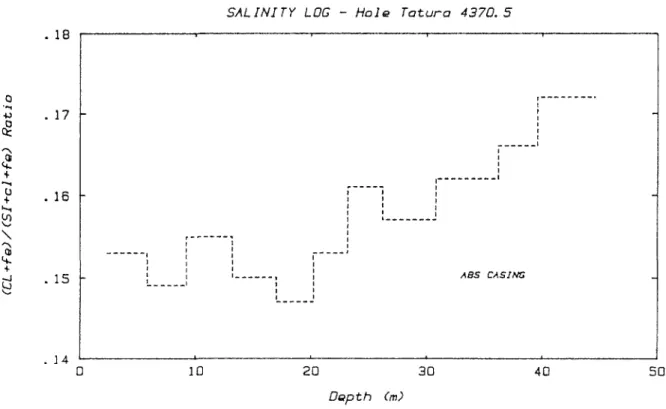
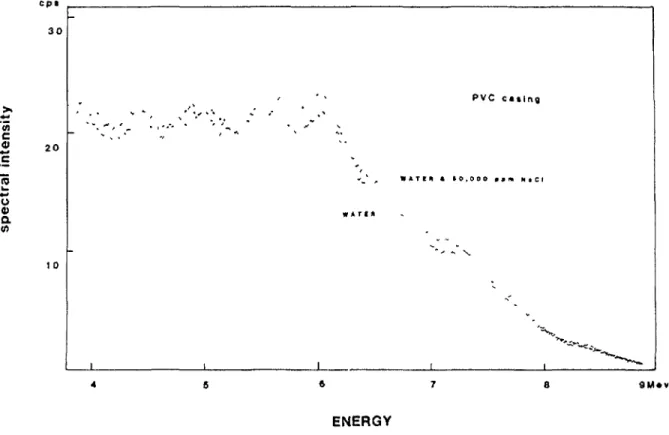
neutron-gamma method using a 252-Cf source and a BGO detector was applied. Major constraints affecting salinity logging were identified. The most important of these were simulated in laboratory tests and evaluated.
1. INTRODUCTION
At CSIRO, the Borehole Logging Group, which is in the Division of Mineral Engineering, has for some years conducted research and carried out technology development in borehole logging based on nuclear geophysics. The group has contributed to the basic methodologies developed for the natural gamma, gamma-gamma, and neutron excited gamma-ray spectrometric logging techniques.
For those borehole logging methods based on the neutron excited gamma reactions, the group's past research was applied to the quantitative
analysis of ore grades in nickel, coal, mineralised beach sands, and
manganese ore deposits. Prompt neutron-gamma techniques, based on the use of radioisotopic sources (Am-Be and 252-Cf), were applied and tested for suitability in all these situations. However, neutron activation analysis methods were also applied successfully in the coal and manganese depo-sits. Also, it is worth noting that the group successfully tested pulsed neutron generator methods in coal deposits, to differentiate spectro-metrically between gamma rays generated in neutron inelastic, radiative capture and neutron activation reactions.
Recently, the group has been involved in research for the coal mining industry to develop improved prompt neutron-gamma methods for measuring the raw ash content in coal strata, and in water and soil conservation problems by researching methods of measuring chlorine concentrations in water bores. In coal applications, the anticipated advantages of the neutron-gamma technique over that of spectrometric gamma-gamma logging (also developed by the CSIRO group) were its greater suitability in water-filled boreholes of varying width and turbidity. From theory, the neutron gamma technique is
also the more suitable for ash measurements in coals of variable chemical composition of the mineral matter. This technique is also relevant to the analysis of sintered coals if combined with the spectrometric gamma-gamma.
For salinity logging, neutron-gamma is the only nuclear geophysical approach which appears feasible at this stage. The work, as indicated below, is still at an early stage of progress.
Some laboratory measurement were commenced with disseminated gold samples, in artificial borehole models, using the neutron activation analysis method. However, this investigation is only at a preliminary stage.
The present paper therefore deals with the recent work carried out in coal and salinity applications.
2. PROMPT NEUTRON-GAMMA LOGGING FOR COAL ASH IN WATER-FILLED AND DRY BOREHOLES.
In the operations of the Australian coal industry, there has been a shift in the requirements for monitoring coal quality during recent years. These requirements have diminished in exploration and have grown in mine production.
Coal quality is measured by the raw ash content, calorific value, rank, moisture content, volatiles, and sulfur content. Determining all the parameters mentioned above, together with the elemental composition of the coal, would require core drilling and analysis of the cores in the labora-tory. These processes are time-consuming and costly. In many applications it is sufficient to measure only thickness, depth, and raw ash content of the seam, which can be achieved with fast borehole geophysical methods in open holes.
Because of the deep penetration of neutrons and gamma rays Into the coal matrix, nuclear techniques are appropriate for borehole logging appli-cations. The volume of coal Investigated by nuclear radiation is much larger that the core analysed from a cored borehole, and it therefore pro-vides a more representative sample. The gamma-gamma technique is currently employed in the coal industry to evaluate the coal seam parameters men-tioned above. The ash content of the coal is derived from the correlation between ash and density. Although a universal correlation between ash and density does not exist, good correlations were found for many individual coal formations in Africa and Australia [1,2], Variations in the physical properties of coal, such as rank and porosity, also influence the correl-ation between density and ash content in core samples. Agostini [3] and Daniels et al. [4] described cases where the ash content predicted from gamma-gamma density logs differs substantially from that of the corres-ponding core.
Another shortcoming of ash determination based on gamma-gamma density logs is the sensitivity of the density measurement to variations in bore-hole diameter. This results in reduced accuracy in rough, cavernous bore-holes.
The prompt neutron-gamma method is an alternative nuclear technique with potential in borehole logging for coal [5,6]. This technique was investigated more recently [7-9] and reported to be competitive in perfor-mance with the most accurate gamma-gamma methods. Borsaru et al. [10] described initial field tests of the prompt neutron-gamma method in the Surat Basin. Satisfactory accuracy for ash determination was achieved. The previous work was for water-filled boreholes only. Here we deal with the application of the prompt neutron-gamma method for measuring the raw ash content of black coal in both water-filled and dry boreholes. The method described forms part of the SIROLOG* technology being developed by CSIRO.
The neutron flux distribution in dry boreholes differs markedly from that in water-filled boreholes, because of the thermalising effect of the hydrogen in the water. Therefore, it is invalid to extrapolate the coal ash measurements from water-filled to dry boreholes. This is important when considering the logging method for open cut mine-production
situa-tions, where most boreholes are dry, which contrasts with the situation for coal-exploration holes in Australia, where most holes are at least partly water-filled.
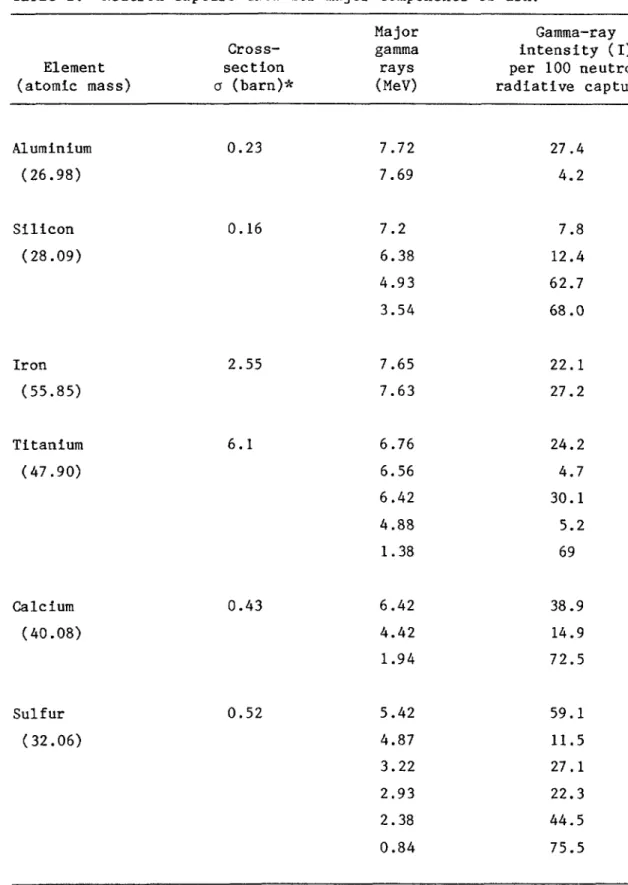
The logging method described here employs the neutron capture re-action. The compound nucleus formed in neutron capture decays almost instantaneously, emitting gamma radiation. Due to its high hydrogen content, coal is an excellent matrix for this technique. The neutrons emitted are thermalised by colliding with the hydrogen nuclei present in coal, and they subsequently interact with the nuclei in the coal matrix. Another advantage of the prompt neutron-gamma technique for coal is that the major gamma rays, produced by the main constituents of the mineral matter in coal (Al, Si, Fe, Ca, Ti, S), have energies above 3 MeV
(Table I).
The deeply penetrating high-energy gamma radiation detected in a borehole logging probe emanates from a large volume of coal ; hence the
technique is not as sensitive to the rugosity and condition of the borehole as the gamma-gamma technique.
The ash content of a coal sample is the weight percentage of residue after combustion, it is closely related to the mineral content of coal. There also is a good correlation between the ash content of coal and the main constituents of ash: AI, Si, and Fe, or a combination of two of these elements [7,8,10]. An analysis of correlation between the ash content and combined SiCL and Fe?03 concentrations in Australian black coals showed
that a standard deviation of 1.4 percent ash [10] can be obtained by measuring SiO and Fe„0~ only. On this basis, the prompt neutron-gamma method can measure the ash content of Australian black coals satisfac-torily.
A more detailed discussion of the prompt neutron-gamma technique for coal ash application was described in our earlier paper [11] where such aspects as choice of neutron source and choice of gamma-ray detector were
analysed.
2.1 EQUIPMENT
The electronic equipment comprising of separate electronic modules (amplifier, gain stabiliser, multichannel analyser) used in previous work [12, 13], was replaced in the present work by a single unit (SIROMCA) [14]. SIROMCA was designed for those applications in which a full energy spectrum is required. SIROMCA is based on a successive approximation ADC which divides the energy spectrum into 480 channels. SIROMCA contains a dual memory bank, one of which is used as a buffer for the rapid transfer of data to the computer for computation and for subsequent output of spectral parameters and ash prediction, while the other is in readiness to receive data from the ADC. This permits rapid transfer of the complete spectra, ensuring minimum loss of strata information as the probe traverses the borehole. A schematic diagram of the borehole logging system is shown in Fig. 1 and a schematic diagram of SIROMCA is shown in Fig. 2.
The logging probe is modular so that the source-to-detector distance can be varied (15, 23, and 33 cm). The probe is fabricated from aluminium alloy and has an external diameter of 70 mm and a wall thickness of 3.2 mm. Two types of scintillation detectors were used for the measurements: a 38 x 76 mm Nal(Tl) detector and a 51 * 51 mm BGO detector. The energy resolutions at 662 keV were 7.0 percent for the Nal(Tl) detector and 13.7 percent for the BGO detector. Both detectors were shielded against thermal
Table I. Neutron capture data for major components of ash. Element (atomic mass) Aluminium (26.98) Silicon (28.09) Iron (55.85) Titanium (47.90) Calcium (40.08) Sulfur (32.06) Major Cross- gamma section rays a (barn)* (MeV) 0.23 7.72 7.69 0.16 7.2 6.38 4.93 3.54 2.55 7.65 7.63 6.1 6.76 6.56 6.42 4.88 1.38 0.43 6.42 4.42 1.94 0.52 5.42 4.87 3.22 2.93 2.38 0.84 Gamma-ray intensity (I) per 100 neutron radiative captures 27.4 4.2 7.8 12.4 62.7 68.0 22.1 27.2 24.2 4.7 30.1 5.2 69 38.9 14.9 72.5 59.1 11.5 27.1 22.3 44.5 75.5
WINCH CONTROLLER
SIRO-MCA
HOST COMPUTER
WINCH SPUD t DIRECTION CONTROLLER WINCH - MCA INTEPfAEf T E M P E R A T U R E DISPLAY MPEOANCE MATCHING NETWORK CHARGE SENSITIVE PREAMPLIFIER H T. G E N E R A T O R PHOT OMUL TIPL IE R N » l I T I I C R Y S T A L SHIELDINGT I V E S O U R C E
'////
SINGLE BOARD COMPUTER
AHOLOG TO DIGITAL CONVfRTOR IAOCI BOARD
SPECTRAL MEMORY
B O A R D
I N P U T / OUTPUT ( 1 / 0 1 B O A R D
POWER SUPPLY
FIG. 1. Schematic of nuclear geophysical borehole logging system
PREAMPLIFIER SIGNAL IN SHAPING AMPLIFIER SBC CONTROLLED VARIABLE BAIN AMPLIFIER PEAK STORAGE A N A L O G TO DIGITAL C O N V E R T E R
SINGLE BOARD COMPUTER
ADC BOARD
I B A N K S OF DUAL P O R T E D MEMORY L I V E TIME t DEAD TIME C O U N T E R SMEMORY BOARD
HIGH S P E E D PARALLEL INTERFACE WINCH INTERFACE PORT P R I N T E R PORTF R O N T PANEL PORT F R O N T PANEL B O A R D
INPUT/OUTPUT
BOARD
FRONT PANEL
BOARD
FIG. 2. SIROMCA block diagramneutrons by a thin coating ( «16 mg/cm2) of 10-B. The intensity of the
478 keV gamma-ray peak due to neutron capture by 10-B provides a measure of the thermal neutron flux around the detector. The strength of the 252-Cf neutron source was 0.7 or 2.5 \ig, depending upon the source-to-detector distance in the probe. The detector, located above the source, was shielded from the primary gamma radiation of the 252-Cf source by Bi and Pb. The logging probe was centralised by two flat, star-shaped centra-Users made of flexible plastic (Lurethane), one located above the detector and the other located below the neutron source. The gain of the electronic equipment was automatically stabilised by using the 2.22 MeV capture gamma-ray peak of hydrogen. Gain stabilisation is especially important with the BGO detector because of its extreme sensitivity to temperature variations.
2.2 FIELD TESTS
The field tests of the neutron-gamma logging method were carried out in eight areas of eastern Australia in both cored and open boreholes. Three of these areas were in the Hunter Valley of New South Wales, two of the areas were in the Surat Basin of southern Queensland and the remaining three areas were in the Bowen Basin of central Queensland. The nominal diameter of the holes was 96 mm, but the real diameter, even in a given area, varied from 96 to about 175 mm.
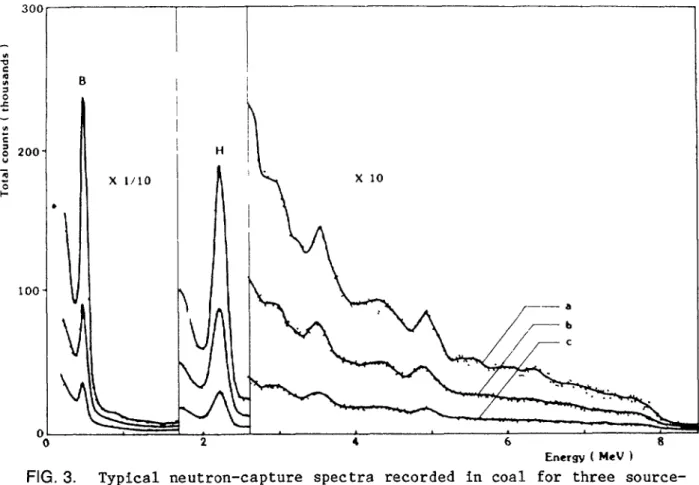
Typical neutron-gamma spectra in a coal seam are shown in Fig. 3. The three gamma-ray spectra were collected when logging an X2 m thick coal stratum at a logging speed of «,008 m/s with the same logging probe
equipped with a 51 x 51 mm BGO detector. The peaks visible in the spectra are from boron (0.48 MeV), hydrogen (2.22 MeV), and silicon (3.54 and 4.93 MeV). The resolution of the BGO detector and the counting statistics are insufficient to observe clearly identifiable peaks corresponding to Fe, Al,
300
" 0 2 4
Energy ( MeV )
FIG. 3. Typical neutron-capture spectra recorded in coal for three source-detector separations: (a) 15 cm; (b) 23 cm; (c) 33 cm.
Ça, and Tl. Although individual concentrations cannot be measured, it Is possible to set windows in the spectrum which correspond to combinations of these elements. These windows are indicated by horizontal lines In Fig. 4, which shows schematically the distribution of the major neutron capture
gamma rays corresponding to the ash constituents (Al, Si, Fe, Ti, S and Ca), and also to H and B which are used to monitor the neutron flux. The heights of the vertical lines shown In Figure 4 are the products of the neutron capture cross-section and the relative intensities (photons/100 neutrons).
0 1 2 3 4 5 6 7 8
Energy, kteV
FIG. 4. The energy distribution and relative Intensities of the neutron-capture gamma rays of B, H, and the common constituents of ash.
Measurement of ash in coal by the prompt neutron-gamma method entailed setting windows in the gamma-ray spectrum and fitting a linear regression model of the form:
percent ash a + a-, where a,
0 n are constants and X, , X„, X are variables,n The variables were the gamma-ray count rates in various energy windows and also the spectral ratios between the count rates measured in the same selected windows.
The results and discussion of field tests, carried out In dry and water-filled boreholes, are presented separately because the space-energy distributions of the neutron flux differ markedly under these borehole conditions.
2.2.1 Logging in Water-Filled Boreholes
In planning the series of field trials for the prompt neutron-gamma technique, the first objective was to confirm that quantitative measure-ments of coal ash were feasible.
At the time of the first field trial, at deposit A In the Hunter Valley, the detector chosen for the prompt neutron-gamma probe was a
strata were used as observations for the regression analysis. The thick-ness of the strata varied from 50 cm (a single ply) to 260 era (a stratum consisting of coal and stone bands). Values of ash content were obtained from chemical analysis of core samples. The rms deviation between the assays obtained from prompt neutron-gamma logging and the laboratory analyses was 2 percent ash, confirming that the technique was feasible.
The aim of the next two field trials was to investigate ways of
improving the accuracy of measuring ash. At Deposits A and B in the Surat Basin, the Nal(Tl) detector previously used in the Hunter Valley was
replaced b y a S l x S l m m BGO detector. The greater efficiency of the detector is advantageous for measuring the gamma-ray lines above 3 MeV, which characterise the mineral constituents of the coal.
At Deposit A, the value of the rms deviation using 25 strata as obser-vations was 1.4 percent ash. The precision of measurement, calculated from the results of duplicate logs in 23 strata, was 0.6 percent ash (1 a). Similar duplicate logs were carried out in other deposits where the method was tested, and values obtained for the precision of measurements were
similar (0.5-0.8 percent ash) to those of Deposit A.
Two further modifications of the probe were considered: to apply shielding against slow neutrons on the outside of the probe, and to vary the source-detector separation. In the measurements described, the
detector and the photomultiplier were shielded with a thin layer of 10-B. Measurements previously carried out in the laboratory using a water tank had shown that the background spectrum at high energies was reduced by about half when external neutron shielding was used on the probe. The intent of this external shielding was to reduce the flux of gamma rays excited by neutron reactions in the probe housing, the bismuth shield, and
the various electronic components. The external coating of 10-B (15 mg/cm2)
was applied by painting the probe barrel with a mixture of 10-B and
Araldite 488E epoxy resin (1:3 proportion). The shielding was mechanically strong and did not crack during logging operations.
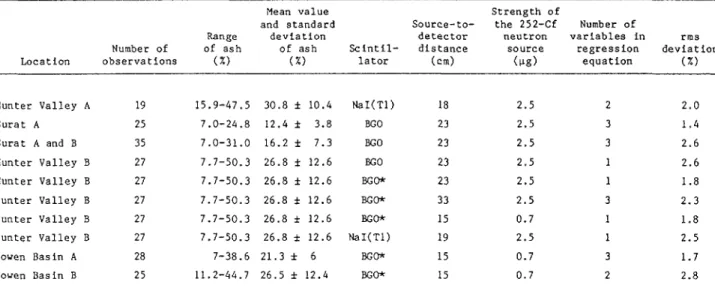
The improved shielding arrangement was field tested at Deposit B in the Hunter Valley. Using the same configuration as in the Surat Basin, the value of the rms deviation obtained using external neutron shielding was
1.8% ash, whereas without this shielding it was 2.6% ash.
Having established that external neutron shielding gives the better rms deviation, further trials were undertaken using this probe with two other source-detector separations, 15 and 33 cm. The results from this field trial (Deposit B of the Hunter Valley) show that the best probe configuration consists of a BGO detector, a short source-detector spacing of 15 cm, and external thermal neutron shielding (10-B) for the barrel of the probe. Such a configuration gives both the best vertical resolution for seam delineation and the best accuracy of ash prediction.
The same configuration was used for subsequent trials in two coal formations in the Bowen Basin. In the first trial (Bowen A), data were collected in two deposits approximately 40 km apart in the German Creek formation. The data from these deposits were combined to provide
sufficient observations for a regression analysis. In the second trial data were collected in two deposits in the Rangal formation (Bowen B). These deposits were also approximately 40 km apart.
Table II summarizes the results obtained in all of the field trials described. The values of rms deviation quoted are not solely dependent upon the inherent accuracy of the prompt neutron-gamma technique. They also include errors due to the initial sampling of the core material for chemical analysis, the chemical analysis itself, and geostatistical vari-ations in the deposits. Sampling errors can be quite significant, and the fact that we had no control over sampling in this work may account for some of the large variation in the rms deviations obtained at the different deposits.
Table II. Summary of ash determination In various Australian black coal deposits by the neutron capture
method. (water-filled boreholes)
Number of Range of ash Location o b s e r v a t i o n s ( 7 . ) H u n t e r Valley A Surat A Sura t A and B Hunter V a l l e y B H u n t e r Valley B Hunter Valley B H u n t e r V a l l e y B H u n t e r Valley B Bouen Basin A Bowen Basin B 19 25 35 27 27 27 27 27 28 25 15 7 7 7 7 7 7 7 11 .9-47.5 . 0 - 2 4 . 8 .0-31.0 .7-50.3 .7-50.3 .7-50.3 .7-50.3 .7-50.3 7-38.6 . 2 - 4 4 . 7 Mean value and s t a n d a r d d e v i a t i o n of ash ( X ) 30.8 ± 1 2 . 4 ± 16.2 ± 2 6 . 8 ± 26.8 ± 26.8 ± 26.8 ± 26.8 ± 2 1 . 3 ± 2 6 . 5 ± 10.4 3.8 7 . 3 12.6 12.6 12.6 12.6 12.6 6 12.4 Source-to-detector Sclntll- distance lator N a l ( T l ) BGO BGO BGO BGO* BGO* BGO* N a l ( T l ) BGO* BGO* (cm) 18 23 23 23 23 33 15 19 15 15 Strength of the 252-Cf neutron source ( H i 2. 2. 2. 2 . 2. 2 . 0. 2. 0. 0. !> 5 5 5 5 5 5 7 5 7 7 Number of variables In regression equation 2 3 3 1 1 3 1 1 3 2 rras deviation ( % ) 2 . 0 1.4 2 . 6 2.6 1.8 2 . 3 1.8 2.5 1.7 2.8
* The outside of the logging probe was painted with 10-B In the area where the BGO detector was located in addition to the inner shielding.
2.2.2 Logging In Dry Boreholes
The neutron capture technique in dry boreholes was tested in two deposits, Bowen C and Hunter Valley C, of black coal located in Queensland and New South Wales respectively.
In Deposit Bowen C, the test was carried out with two
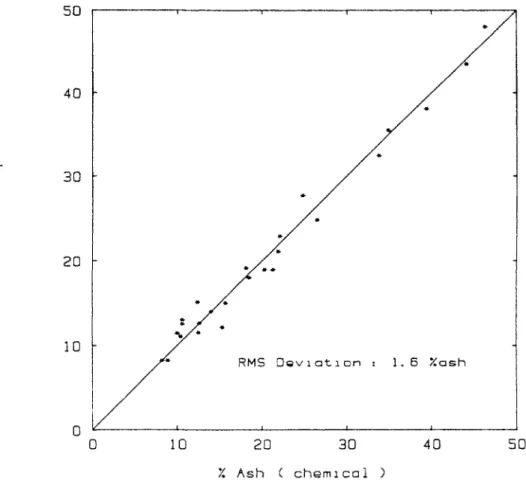
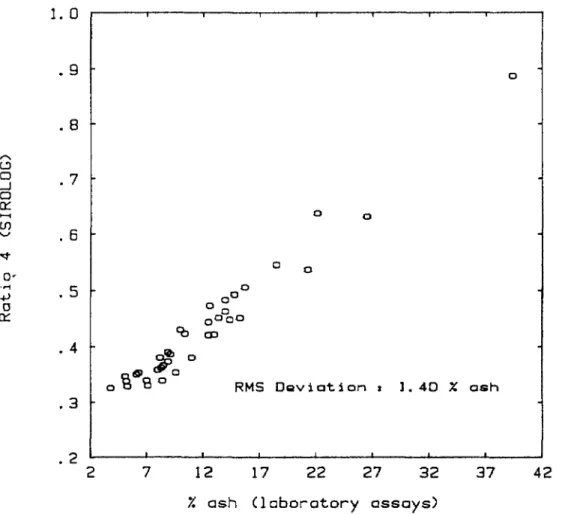
source-to-detector distances: 23 cm and 15 cm. Nine dry-cored holes were logged with a source-to-detector distance of 23 cm and four boreholes were logged with a source-to-detector distance of 15 cm. Fig. 5 is a cross plot of the calibration data for the chemical assays and the neutron capture predic-tions of the 23 cm source-to-detector distance probe using a regression equation of the form:
ash = -12.02 + 58.380 R (D
where R, the parameter derived from the capture spectrum, is the ratio between the number of gamma rays recorded in the energy windows 2.6-5.2 MeV and 2.0-2.4 MeV. Thus, the ratio R can be interpreted as a normalisation of the count rate in the 2.6-5.2 MeV energy window with respect to that of the 2.22 MeV hydrogen peak. This normalisation helps to correct for the perturbation of the neutron flux due to variations in the bulk density, hydrogen content and elemental composition of the coal, and the physical condition of the borehole. The rms deviation (between log and laboratory assays) for ash determination using the regression equation given above was
1.6% ash, where the ash content of the coal seams varied from 8 to 46% ash. A similar value of rms deviation (1.7% ash) was obtained using the probe with a 15 cm source-to-detector distance. The results confirmed that neu-tron capture is a useful technique for coal ash measurement and coal seam delineation in dry boreholes.
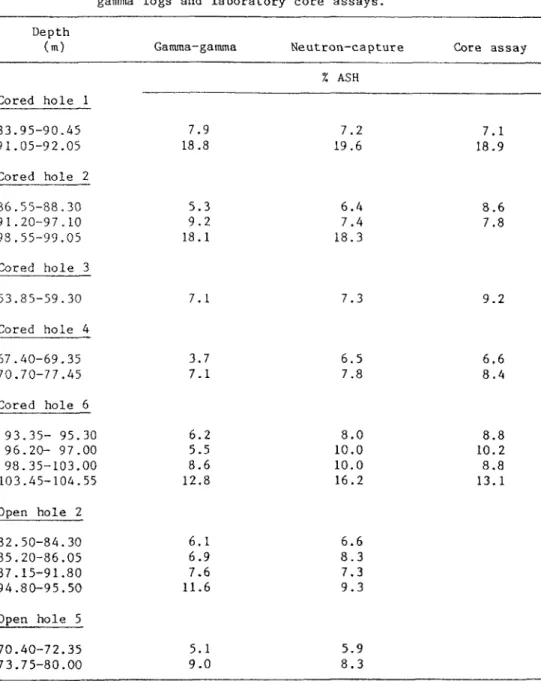
Six cored and five open boreholes were logged in the second Deposit (Hunter Valley C). Logging in this area was carried out with the 15 cm source-to-detector distance probe only. The probe was calibrated using 24 core assays from five of the six cored holes. The ash content in the seams used for calibration varied from 5 to 26% ash. The rms deviation value of