Title
Beyond Learning Analytics: Framework for Technology-
Enhanced Evidence-Based Education and Learning
Author(s)
OGATA, Hiroaki; MAJUMDAR, Rwitajit; AKÇAPINAR,
Gökhan; HASNINE, Mohammad Nehal; FLANAGAN,
Brendan
Citation
26th International Conference on Computers in Education
Workshop Proceedings (2018): 493-496
Issue Date
2018-11-24
URL
http://hdl.handle.net/2433/237322
Right
Copyright 2018 Asia-Pacific Society for Computers in
Education. All rights reserved. No part of this book may be
reproduced, stored in a retrieval system, transmitted, in any
forms or any means, without the prior permission of the
Asia-Pacific Society for Computers in Education. Individual papers
may be uploaded on to institutional repositories or other
academic sites for self-archival purposes.
Type
Conference Paper
Wu, Y.-T. et al. (Eds.) (2018). Workshop Proceedings. 26th International Conference on Computers in Education. Philippines: Asia-Pacific Society for Computers in Education
Beyond Learning Analytics:
Framework for Technology-Enhanced
Evidence-Based Education and Learning
Hiroaki OGATA a*, Rwitajit MAJUMDARa, Gökhan AKÇAPINARa b, Mohammad Nehal HASNINEa, Brendan FLANAGANa
a
Academic Center for Computing and Media Studies, Kyoto University, Japan b
Department of Computer Education & Instructional Technology, Hacettepe University, Turkey [email protected]
Abstract: Currently eLearning infrastructure across various institutions often includes a Learning Management System (LMS), various ubiquitous and classroom learning tools, Learning Record Stores (LRS) and Learning Analytics Dashboards (LAD). Such an infrastructure can apply Learning Analytics (LA) methods to process log data and support various stakeholders. Teachers can refine their instructional practices, learners can enhance learning experiences and researchers can study the dynamics of the teaching-learning process with it. While LA platforms gathers and analyses the data, there is a lack of specific design framework to capture the technology-enhanced teaching-learning practices. This position paper focuses the research agenda on evidence in a data-driven educational scenario. We propose the Learning Evidence Analytics Framework (LEAF) and present the research challenges involved.
Keywords: Evidence Based Education, Learning Evidence Analytics Framework, Evidence Analytics
1. Background
The concept of Evidence-Based Practices has its root in medicine and coined by doctors at McMaster University in Hamilton, Ontario in early 1990s (Kvernbekk T., 2017). According to Kvernbekk, EBP involves the use of the best available evidence to bring about desirable outcomes, or conversely, to prevent undesirable outcomes. Davies, P. (1999) reviews the concept of evidence-based practices in education. He proposes that evidence in the context of education needs to be established where its lacking and can be used in the following four ways:
1. Pose an answerable question about education;
2. Know where and how to find evidence systematically and comprehensively using the electronic (computer-based) and non-electronic (print) media;
3. Retrieve and read such evidence competently and undertake critical appraisal and analysis of that evidence according to agreed professional and scientific standards;
4. Organize and grade the power of this evidence and determine its relevance to their educational needs and environments.
While literature takes various theoretical perspective on Evidence-based education (Davies, P. 1999), Research-based education (Hargreaves, 1996), Literature-based education (Hammersley, 1997), Context-sensitive practice (Greenhalgh and Worrall, 1997) they mostly debate about rigorous studies to establish causalities similar to medical practices. What is missing is any research agenda of how technology can support the process and relevant discussions regarding issues in the current age of data-driven education. This position paper focuses on the notion of evidence-based education in the age of e-learning. Technology now supports logging of teaching-learning (TL) interactions and Learning Analytics has matured tremendously over the period to provide robust methods to analyze and predict learning behaviors and outcomes in different TL contexts. Hence there is
relevance in rethinking about the question Davies (1999) asked regarding “What is evidence?” and how the four objectives can be supported by technology. This would push the boundaries of learning analytics and move towards an evidence-based education system that can assist the various stakeholders in the teaching-learning scenarios.
In the Learning Analytics community, SOLAR, the term evidence has recently come up in the context of a workshop in LAK 18 regarding evidence-based institutional LA policy (Tsai Y.S., Gašević D., Scheffel, M., 2018, sheilaproject.eu) and in LAK 17 by work presented by Ferguson & Clow (2017) where they introduce Learning Analytics Community Exchange (LACE) project's Evidence Hub. The Evidence Hub (http://evidence.laceproject.eu/) followed the evidence-based medicine paradigm to synthesize published LA literature and meta-analyze four propositions about learning analytics: whether they support learning, support teaching, are deployed widely, and are used ethically. But neither of the works look at technological affordances required to extract evidence of learning from logged data and make it available for the practitioners to adopt in their own context. This position paper proposes a technological design framework for evidence-based education and learning using existing learning analytics infrastructure and discusses its research agenda.
2.
Conceptualizing LEAF – Learning Evidence Analytics Framework
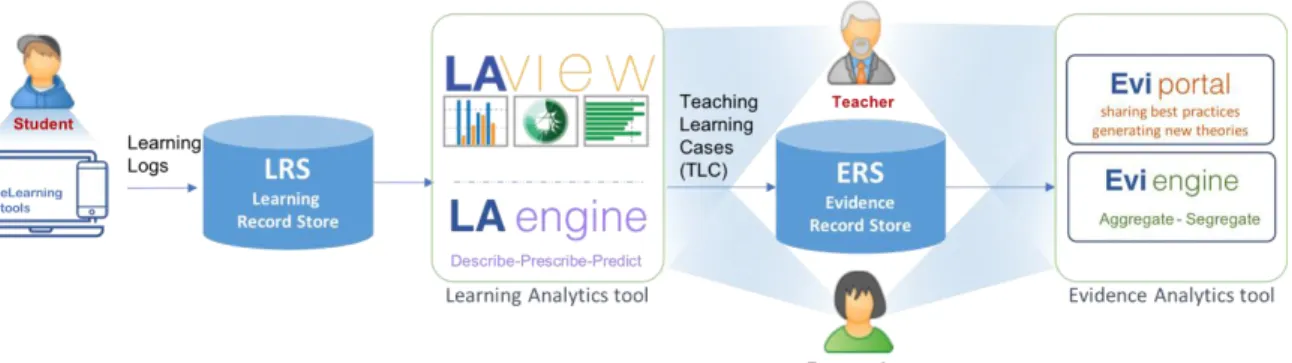
In this data driven age we want to find evidence of learning from the logged data of teaching-learning interactions. We are developing Learning Evidence Analytics Framework (LEAF) a technological design framework to support evidence-based education system. The components of LEAF are overviewed in Figure 1. We follow the DAPER (Data-Analysis-Planning-Execution monitoring-Reflection) model of data driven activities (Majumdar et.al 2018, in press) to guide the activity flow within the described framework.
Figure 1. Components of Evidence-based Education and Learning system
The learner uses various e-learning tools and their learning traces are collected in the learning record store (LRS). The process starts with the Data phase to systematically gathering indicators of learning from the log data in the LRS. The Analysis phase is supported by LA tool which has two components. The LA engine does the statistical computation and LA View is the dashboard which visualizes the indicators. Stakeholders look at the visualized indicators to identify problems. Based on the identified problem, they can Plan intervention to mitigate it. In the Execution monitoring phase, the LA tool can assist to monitor the learning behaviors in terms of the identified indicators. We propose to capture this process and its various metadata as a teaching-learning case (TLC) in an evidence record store (ERS). Each TLC would capture the following:
Context: The details of the scenario of the teaching-learning. (for e.g. in class learning for an undergraduate course in specific subject domain)
Problem: The teaching-learning issue as diagnosed by the teacher or other stakeholder with the support of the learning analytics engine. (for e.g. low engagement in reading)
Indicator: The visualized information that highlights the problem. (for e.g. reading completion graph is an indicator for reading engagement. Lower completion indicates lower engagement)
Intervention Plan: The details of the remedial action that is taken in the context by the teacher. (for e.g. reminder email to the cohort of low engagement student)
Result: The effect of the intervention as seen by the change in the indicator. (e.g. the average engagement line improves after the intervention is given to the students).
An Evidence Analytics toll can assist users to Reflect on the effectiveness of practices recorded as TLCs and label it as an evidence. The evidence engine can be used to aggregate and segregate TLCs and the evidence portal would help the stakeholders to search evidence and follow the TLC for future implementation or review. We are currently working to augment the evidence component in our existing LA framework (Flanagan, B., & Ogata, H. 2017).
3.
Technology Enhanced & Evidence-Based Education and Learning – research
agenda
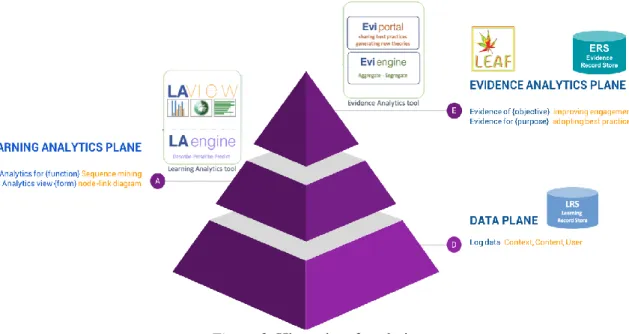
We conceptualized a multi-level view of analytics (see Figure 2) similar to hierarchy of evidence in the evidence-based medicine. The data plane is the bottom most plane supported by LRS. Above the data plane, in the Learning Analytics plane, the LA engine analyses the log data and visualizes indicators in the dashboard. Beyond the LA plane is the Evidence Analytics plane which aims to meta analyze the indicators from a specific context and store as evidence.
In this context, some of the research issues and challenges are enlisted for further investigation:
How to extract evidences from data?
How to design data format of evidences?
How to evaluate evidences (rate them, evaluate similarities, meta-analysis, etc)?
How to support search or context-aware recommendation of evidences?
How to support teachers and students to apply evidences in their context?
While their exists endeavors to synthesize evidence from literature, LEAF aims to extend that and extract evidences from log data, considering contextual teaching-learning practices and harnessing the power of learning analytics methods and infrastructures. Our research agenda would give a fresh perspective on Davies’ four use of evidence in education in this technology enhanced data-driven age.
Acknowledgements
This research was supported by JSPS KAKENHI Grant-in-Aid for Scientific Research (S) Grant Number 16H06304 and JSPS KAKENHI Research Activity Start-up Grant Number 18H05746.
References
Davies, P. (1999). What is evidence‐based education? British journal of educational studies, 47(2), 108-121. Ferguson, R., & Clow, D. (2017). Where is the evidence? : A call to action for learning analytics. In
Proceedings of the 7th International Learning Analytics & Knowledge Conference (pp. 56-65). ACM. Flanagan, B., & Ogata, H. (2017) Integration of Learning Analytics Research and Production Systems While
Protecting Privacy. In Proceedings of the 25th ICCE 2017, New Zealand, Nov 2018
Tsai Y.S., Gašević D., Scheffel, M. (2018). Developing an evidence-based institutional learning analytics policy. In the 8th International Learning Analytics & Knowledge Conference. ACM.
Greenhalgh, T. and Worrall, J.G. (1997) From EBM to CSM: The evolution of context-sensitive medicine,
Journal of Evaluation in Clinical Practice, 3, (2), 105–8.
Hargreaves, D.H. (1996) Teaching as a Research-Based Profession: Possibilities and Prospects. Cambridge Teacher Training Agency Annual Lecture.
Kvernbekk, T. (2017) Evidence-Based Educational Practice, in Oxford research encyclopedias, DOI: 10.1093/acrefore/9780190264093.013.187
Majumdar R., Yang Y.Y., Li H., Akçapınar G., Flanagan B. and Ogata H. (2018) Supporting Learner’s Development of Self-Direction Skills using Health and Learning Data, In Proceedings of 26th ICCE, Manila, Philippines, Nov 2018