Munich Personal RePEc Archive
Is there a Harrod-Balassa-Samuelson
effect? New panel data evidence from 28
European countries
Lenarčič, Črt and Masten, Igor
12 May 2020
Online at
https://mpra.ub.uni-muenchen.de/100647/
Is there a Harrod-Balassa-Samuelson effect? New
panel data evidence from 28 European countries
ˇ
Crt Lenarˇciˇc
∗Igor Masten
†May 12, 2020
Abstract
Harrod-Balassa-Samuelson phenomenon describes the relationship between pro-ductivity and price inflation within different sectors of a particular economy, where the sectoral productivity differential stands as one of the possible drivers of the (structural) price inflation. The Harrod-Balassa-Samuelson effect could therefore represent an additional inflation source of the economy. From an economic policy perspective it is important to address this issue, in order to contain inflation suffi-ciently low with adequate policy measures. Using a dynamic panel data model the Harrod-Balassa-Samuelson hypothesis is tested and confirmed by applying a strict distinction between the sectoral price inflation and the average labour productivity growth data from the 1990-2017 period for 28 European countries. Additionally, we provide inflation simulations based on the results that confirm the existence of the Harrod-Balassa-Samuelson effect.
JEL Classification Numbers: C12, C23, E31
Keywords: Harrod-Balassa-Samuelson effect, productivity, inflation, dynamic panel
data model
∗Analysis and Research Department, Bank of Slovenia. The views presented herein are those of the authors and do not necessarily represent the official views of Banka Slovenije or of the Eurosystem. Email of the correspondent author: [email protected]
1
Introduction
The Harrod-Balassa-Samuelson (henceforth HBS) phenomenon describes the relationship between productivity and price inflation within different countries, regions or sectors. Harrod (1933), Balassa (1964) and Samuelson (1964) independently developed and for-mulated a productivity approach, which is now known as the Harrod-Balassa-Samuelson model.1
The idea behind it is that the growth in the productivity of a tradable sector via
wages, first in a tradable and later on in a non-tradable sector, implies an increase in the real exchange rate or just in the price inflation (depends on the country’s exchange rate regime). Betts and Kehoe (2008) studied the relationship between the real exchange rate and the relative price of non-tradable to tradable goods. Their conclusion is that the relation between the two variables is stronger in an intense trade environment.2 Based
on this, we assume that the relationship between the relative growth in the productivities of the tradable to non-tradable sector and the relative prices of non-tradable to tradable goods is relatively straightforward using sectoral data for European countries. In addi-tion to the close trade environment, the sole euro area integraaddi-tion process suppresses the ability of economies to adjust through the nominal exchange rate channel. This could consequently put more pressure on the non-tradable price inflation rather than on the nominal exchange rate.
This paper contributes to the empirical literature by examining the HBS proposition that the relative productivity between both the tradable and non-tradable sectors de-termines the domestic relative inflation between non-tradable and tradable sector goods and services. We carry out an empirical analysis based on a simple two-sector theoretical model. For the purpose of the estimation a lot of attention is devoted to the construction of a 28-country panel database that spans from 1990 to 2017. Following the relevant literature we construct the tradable and non-tradable sector variables that are needed for the analysis. Since the observation period includes the global financial crisis period as well we additionally try to assess the effect of the latter on the magnitude of the HBS effect. By employing the dynamic panel regression methodology the presence of the HBS
1
A similar model was devised by Baumol and Bowen in 1967, describing the relationship between productivity and wages instead of the relationship between productivity and prices.
2
Such agreements are for instance the North Atlantic Free Trade Agreement (NAFTA), the free trade agreement in the European Union (EU) or the free trade agreement of the Association of Southeast Asian Nations (ASEAN).
phenomenon is empirically tested.
The results confirm the existence of the HBS effect, meaning that the relative pro-ductivity between the tradable and non-tradable sectors does drive the relative inflation between the non-tradable and tradable sectors. As we include a crisis dummy variable that defines the crisis period, the results hint that the HBS effect could decrease in crisis times. To use the results in a more practical manner we use them to simulate inflation for each country based on the HBS productivity approach and compare it to the respected country’s official HICP inflation and aggregate deflator of the gross value added. Based on this, we find that the simulated inflation mostly undershoots the average HICP inflation in the period of 1990 to 2017, however, it closely fits the aggregate gross value added deflator. In section 2 the review of the related literature on the HBS theory is presented and discussed. In section 3 the empirical work and dataset description is presented based on the classification and definition of the economic activities. Based on the latter, sectoral price indexes and time series of sectoral labour productivity growths are obtained. The HBS model results are presented in section 4, while in section 5 inflation simulations and policy implications are provided. Conclusions are presented in the section 6.
2
The theory
In this section we describe the theoretical structure of the model. Balassa (1964) and Samuelson (1964) independently constructed a theoretical benchmark model of the real exchange rate determination. They argue that a faster productivity growth in the tradable in comparison to the non-tradable sector leads to an increase in the price of non-tradable goods relative to the price of tradable goods.
The theoretical model is defined by a two-sector economy. A particular economy therefore consumes non-tradable and tradable goods and supplies labour services to firms producing those two type of goods. Firms of both sectors are subject to the following Cobb-Douglas production functions (1928)
yT,t=AT,tlαT
T,tk 1−αT
and
yN,t =AN,tlαN
N,tk 1−αN
N,t , (2)
where y denotes output,l labour input, k capital input, and Ais stationary productivity disturbance. Subscripts T and N denote tradable and non-tradable goods, whereas α
denotes the output elasticity of capital and 1−α denotes the output elasticity of labour input. Under the assumption of perfect competition in capital and labour markets, wages in the two sectors will be equal to the marginal product of labour
wT,t=pT,tαTAT,t kT,t lT,t 1−αT , (3) and wN,t=pN,tαNAN,t kN,t lN,t 1−αN . (4)
If we take into consideration a case of a small open economy with perfect labour mobil-ity, nominal wages in the tradable and non-tradable sectors will be the same,wT,t=wN,t. Combining and rearranging (3) and (4) we get
pN,t pT,t = αTAT,tkT , lT ,t 1−αT αNAN,tkN,t lN,t 1−αN = αTyT ,t lT ,t αNyN,t lN,t . (5)
Log-differentiating equation (5) leads to
b
pN,t−pT,tb =baT,t−baN,t, (6)
where baT,t = log (yT,t/lT,t) and baN,t = log (yN,t/lN,t) are average labour productivities of both sectors. The intuition behind the equation (6) is that there is a positive link between faster productivity growth in the tradable sector relative to the non-tradable sector and the growth of non-tradable prices relative to prices of tradable goods. This is known as the
Harrod-Balassa-Samuelson effect. Wagner and Hlouskova (2004), however, discuss that what most of the existing literature study, such as De Gregorio et al. (1994), Alberola and Tyrv¨ainen (1998), Coricelli and Jazbec (2004), Halpern and Wyplosz (2002), Sinn and Reutter (2001), Guo and Hall (2008), is actually the Baumol-Bowen effect. The im-precision in the distinction may stem from the fact that the relative price of non-tradables to tradables is often used as an internal measure for the real exchange rate. This measure will in general differ from other real exchange rate variables, based on the GDP or CPI deflators or also the trade weighted real exchange rate. The Baumol-Bowen effect is only concerned with domestic variables, thus it cannot explain any inflation differentials across countries. As we consider mostly euro area countries and countries that are economi-cally closely tied to the euro area, we can apply the Betts and Kehoe (2008) assumption that the relationship between the relative productivity growths and the relative prices is stronger in an intense trade environment. In this respect, the Baumol-Bowen effect therefore represents the most important part of the Harrod-Balassa-Samuelson effect.
The productivity growth and consequently the output growth has always been in the center of interest of researchers. Jones (2016) in his substantial overview chapter of lit-erature present different aspect of the output growth drivers. Based on Cobb-Douglas production functions Klenow and Rodr´ıguez-Clare (1997), Hall and Jones (1999) and Jones (2016) equations (1) and (2) are divided with yα
tnt, where the term nt denotes
total hours worked. They get an augmented form of the Cobb-Douglas function which is given as (yt/nt) = (kt/yt)
α
1−α (lt/nt)At. Growth in output per hour yt/nt thus depends
on growth of the capital-output ratio kt/yt, growth in human capital per hour lt/nt and growth in labour-augmenting total factor productivity (henceforth TFP) At. Hall and Jones (1999) show that the differences in the physical and human capital only partially explain changes in output per worker/hour (yt/nt) and that the main driver of output growth is the TFP, or the so-called Solow residual.
3
Empirical methods and data analysis
In their comprehensive survey working paper, Tica and Druˇzi´c (2006) gathered empirical evidence regarding the presence of the HBS effect. They pointed out that most of the empirical work supports the presence of the HBS effect. Especially strong evidence comes from the work based on the cross-section empirical studies, similar to Balassa’s (1964) work. A large number of the papers focus on studying the magnitude of the HBS effect in
accession countries in the EU. ˇCih´ak and Holub (2001) for instance studied the presence of the HBS effect in Czech Republic vis-`a-vis the EU countries, while allowing for differ-ences in structures of relative prices. Jazbec (2002) considers Slovenia as the HBS case of an accession country, while Dedu and Dumitrescu (2010) tested the HBS effect using only Romanian data. Papers, as from Cipriani (2000), Halpern and Wyplosz (2002), Arratibel, Rodr´ıguez-Palenzuela and Thimann (2002), Breuss (2003), Coricelli and Jazbec (2004), Wagner and Hlouskova (2004), Mihaljek and Klau (2008), consider larger country panels. Some of the work focuses also on emerging economies. Jabeen, Malik and Haider (2011) tested the HBS hypothesis on Pakistani data, while Guo and Hall (2010) tested HBS the effect on Chinese regional data.
During the course of empirical testing of the HBS hypothesis, the models became more and more complex. Rogoff (1992) was the first to implement a general equilibrium frame-work, with which the demand side of the economy within the HBS theory was introduced. This opened new possibilities for further investigation of the effects of relative produc-tivities of production factors and the effects of the demand side of the economy on price levels.3 However, Asea and Mendoza (1994) concluded that the proof of the HBS theory
within a general equilibrium framework cannot reliably asses the relationship between output per capita and domestic relative prices. In other words, conclusions regarding the HBS theory from cross-country analyses can only be conditionally accepted since it is dif-ficult to account for cross-country trend deviations from purchasing power parity (PPP). Even more, Bergin, Glick and Taylor (2004) showed that the relationship between output per capita and domestic relative prices had historically oscillated too much in order to provide sufficient evidence for the existence of the HBS theory by cross-section empirical studies. Their suggestion is that it should be tested within a sector-specific analysis, thus focusing more on a Baumol-Bowen type of model.
These conclusions opened up new questions regarding data issues and were related mostly to availability in reliability of the sectoral data. As databases, especially in Eu-rope, had become more complete, new available data also made it possible to study the HBS effect between individual tradable and non-tradable sectors of a particular economy.
3
For instance, Mihaljek and Klau (2002) concluded that the HBS effect can have important policy implications for the EU accession countries in order to satisfy the Maastricht inflation criterion. To build on Mihaljek’s point, Masten (2008) constructed a two-sector dynamic stochastic general equilibrium model whether the Maastricht inflation criterion could be threatened by the HBS effect. Further on, Natalucci and Ravenna (2002) compared the magnitude of the HBS effect within different exchange rate regimes in the general equilibrium model, while Restout (2009) allowed for varying mark-ups in its general equilibrium framework.
Since it is difficult to clearly divide between tradable and non-tradable commodities in the real world, some of the early papers tried to identify the tradability/non-tradability of commodities. Officer (1976) proposed that manufacturing and/or industry belong in the tradable sector, while the services belong in the non-tradable sector. De Gregorio, Giovannini and Wolf (1994), however, used a ratio of exports to total production of each sector to define the tradability of both.
As mentioned above, most studies of the HBS effect use datasets from the accession or transition European countries. The biggest setback of all empirical studies of the HBS effect is that most of the studies suffer from sample problems, especially from the short time series issue. By pooling data from different accession/transition economies re-searchers compensated for short time series problem (as for example De Broeck and Sløk, 2006). Others, such as Lojschov´a (2003) and Fischer (2004), used fixed effects panel data regressions in trying to bypass both, the short time series problem as well as the possible data-pooling problem. For the same reason ´Egert (2002) and Sonora and Tica (2014) use the panel cointegration tests model.
Another problem, that could arise, is the decision regarding the choice of a productiv-ity proxy in the HBS model. In the empirical studies mostly TFP or average productivproductiv-ity of labour are used. Marston (1987), De Gregorio et al. (1994), De Gregorio and Wolf (1994), Chinn and Johnston, (1997), Halikias, Swagel and Allan (1999), Kakkar (2002), and Lojshov´a (2003) use total factor productivity as a productivity proxy, while due to the lack of TFP data many others, such as Coricelli and Jazbec (2004), ˇZumer (2002), use the average productivity of labour. In comparison between the total factor produc-tivity and the average producproduc-tivity of labour, the argument against the use of the average productivity of labour is that it is not completely clear, if the average labour productiv-ity should be regarded as a reliable indicator of representing a sustainable productivproductiv-ity growth, which can have a long term effect on an economy (De Gregorio and Wolf, 1994). However, according to Canzoneri, Cumby and Diba (1999) the argument against the TFP is that the TFP is a result of a possibly unreliable data collection of sectoral capital stocks comparing to the data collection of sectoral employment and sectoral gross value added, especially in the case of the shorter term series. Sargent and Rodriguez (2000) also con-cluded that if the intent of research is to examine trends in an economy over a period of less than a decade or so, the average labour productivity would be a better measure than the TFP. According to Kov´acs (2002), another setback of using the TFP is that, dur-ing a catch-up faze the capital accumulation intensifies faster in the transition/accession
countries in comparison to the developed countries, due to the lower starting point in macroeconomic fundamentals of the transition/accession countries. Therefore the HBS effect might be overestimated. Hall and Jones (1999), Jones (2016) see capital-output ratio, human capital and TFP as factors that influence the growth of output. They em-pirically tested their proposition on US data and find that the capital-output ratio and the growth in human capital are relatively stable over time, meaning that the main driver of the output growth per worker/hour yt/nt is the growth in TFP.4 If we assume the
sta-bleness of the capital-output ratio and human capital variables over time, we can assume that the TFP variable shares the same dynamics as output per worker/hour, i.e. average labour productivity.5 Due to the availability and consistency of the data as well as listing
some of the arguments against the usage of the TFP, the average labour productivity as a productivity proxy in the model is considered.
3.1
Dynamic panel model
So far, the HBS hypothesis was tested in numerous papers using a vast range of economet-ric methods. Several papers that studied single-country models, such as Bahmani-Oskooee (1992), Bahmani-Oskooee and Rhee (1996), Chinn (1997), Halikias et al. (1999), Deloach (2001), Taylor and Sarno (2001), ´Egert (2002) consider different cointegration method-ologies, i.e. E/G method (Engle and Granger, 1987) or Johansen and Juselius’ (1990) method. With the intention of studying a larger set of countries generalized method of moments was used by Halpern and Wyplosz (1998), and Arratibel et al. (2002). Hsieh (1982) uses an instrumental variable method, while Fischer (2004) and De Broeck and Sløk (2006) tested the HBS effect with an autoregressive distributed lag method. Despite the wide variety of different econometric methods applied in testing the HBS hypothesis, the most widely used techniques are still the OLS and GLS estimation methods (Can-zoneri et al., 1999; Coricelli and Jazbec, 2004; Halpern and Wyplosz, 2001; ´Egert et al., 2003). With the availability of additional sectoral data the fixed effects panel data model was introduced (Lojschov´a, 2003; Fischer, 2004).
The reason of choosing the fixed effect dynamic panel data model is straightforward.
4
The correlation between the growth of the TFP and the output growth stands at 89% (Hall & Jones, 1999).
5
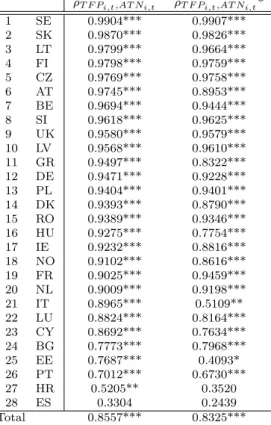
In order to confirm this, we tested for correlations between both variables across 28 European coun-tries. With the exception of two countries the values of correlation coefficients are quite high (see Ap-pendix Table A1).
It allows us to control for variables that cannot be observed and is suitable for multilevel modelling. In our case the unobservables are the country-specific differences. In other words the model accounts for cross-country heterogeneity. This estimated model follows De Gregorio et al. (1994) type of static model setting with an internal identification of the HBS effect, however it is upgraded into a 28 European country dynamic panel data model, which can be written as
∆pN T i,t =β1∆p N T i,t−1+β2∆A T N i,t +β3∆A T N i,t−1
+β4∆gdpi,t+β5∆expi,t+β6∆govi,t+βj+6Dj,i,t+vi,t (7)
where the variable ∆pN T
i,t represents the growth of the relative price of non-tradable sector
goods to tradable goods, β’s measure the impact of the independent variables, while i is the number of countries entering the estimation process. The key explanatory variable, ∆AT N
i,t , is the growth of the labour productivity differential between the tradable and
non-tradable sector, i.e. the HBS effect. The term vi,t corresponds to vi,t =ui+εi,t, where ui
captures the unobserved individual effects and εi,t is the error term. The variable Dj,i,t
is the matrix of dummies entering the model, where j = 1, ..., n is the number of dummy variables.
The control variables also enter the model and are the following: the growth of GDP denoted as ∆gdpi,t, growth of exports denoted as ∆expi,tand growth of government spend-ing denoted as ∆govi,t. The above mentioned control variables are used as instrumental variables as well. The growth rate of GDP ∆gdpi,t explains general changes of a par-ticular economy and is tied to business cycle dynamics. Assuming that, we can expect that the value of the coefficient of the GDP variable β4 should be statistically
insignif-icant. This means that the growth of GDP has an equal effect on the increase of both sectoral inflations. A positive (statistically significant) coefficient would represent a non-tradable sector bias of the GDP, while the negative (statistically significant) coefficient would represent a tradable sector bias of the GDP (Halpern and Wyplosz, 2001). The export growth variable ∆expi,t explains changes in the export behaviour of a particular economy. It should have a bigger effect on the tradable sector inflation in comparison to the non-tradable inflation (Halpern & Wyplosz, 2001). On the other hand, the growth of government spending ∆govi,t should affect the non-tradable inflation, since most of
the government spending comprises the non-tradable sector services (Fischer, 2004). The general reason of using the control variables is to control for unwanted effects and devi-ations in the relative inflation variable. The control variables comprise the movements of market imperfections and rigidities, institutional characteristics, demand and foreign shocks and are uncorrelated to the growth of relative productivity variable ∆AT N
i,t .
In the HBS literature the use of control variables is common. In general we can divide them into several group types. The first type is the income type control variables (GDP or consumption type variables) and help to explain the general fluctuations of an economy (De Gregorio, Giovannini and Wolf, 1994; Halpern and Wyplosz, 2001; Frensch, 2006; Gubler and Sax, 2011). The second type control of variables are related to the public ex-penditure and activities (government spending, budget deficit, public debt, public sector wages, etc.). These mostly influence the deviations in the non-tradable sector prices. The government spending variable is used by De Gregorio, Giovannini and Wolf (1994), Fis-cher (2004), Sonora and Tica (2014) and Gubler and Sax (2011). The public sector wages are used by Halikias, Swagel and Allan (1999) and Mihaljek and Klau (2008). Arratibel, Rodr´ıguez-Palenzuela and Thimann (2002) use the budget deficit, while Rogoff (1992) uses public debt as the second type of a control variable. The third type of the control variables are related to the openness of an economy and help to explain the deviations in the tradable sector prices. These are changes in the exports of goods and services (Halpern and Wyplosz, 2001), current account (Gubler and Sax, 2011), ratios between exports and GDP, and other indicators that depict the openness of an economy. The last type are the different types of variables that were used as control ones. Changes in nominal exchange rate regimes are used in Arratibel, Rodr´ıguez-Palenzuela and Thimann (2002), while Chinn (1997), Chinn and Johnston (1997) and De Broeck and Sløk (2006) used changes in the capital accumulation and changes in oil prices. But before moving to the empirical results, we should deal with data issues and definitions first.
3.2
Tradability of the sectors
Much attention is dedicated to data treatment and the specification of both sectors. The yearly data is from the European Commission’s Eurostat database.6 The panel contains
6
Available at http://epp.eurostat.ec.europa.eu/portal/page/portal/eurostat/home/. The database also includes data with quarterly frequency, which are used for robustness checks. The results of the quarterly dynamic panel model are presented in the Appendix Table A3.
data from 28 European countries and spans from 1990 to 2017.7 It contains NACE
Revi-sion 2 standard 10 sector classification data on gross value added, price deflator indexes, number of employees and number of hours worked.
To begin with, the tradability of the sectors has to be defined first. Officer (1976) pro-posed that manufacturing and/or industry activities represent the tradable sector, while the services represent the non-tradable sector. For the purpose of the division of sectors into tradables and non-tradables, De Gregorio, Giovannini and Wolf (1994) take a step further and use a ratio of exports to total production to define both sectors. Their division threshold is set to 10 percent. The sector is defined as tradable, if the ratio of exports exceeds the 10 percent threshold, while the sector is defined as non-tradable, if the ratio of exports does not exceed the 10 percent threshold.8
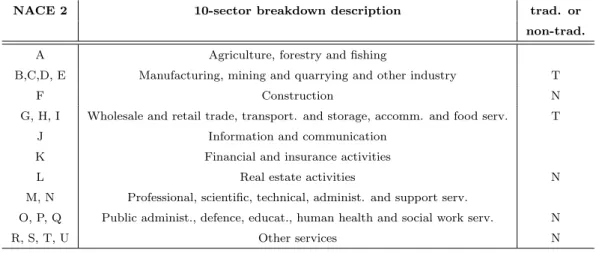
Data on the share of exports in total value added is extracted from the input-output tables available at the World Input-Output Database (WIOD). We use a standard NACE Revision 2 ”high-level”aggregation category, which is used for reporting data from the System of National Accounts (SNA) for a wide range of countries. A 10-sector break-down is presented in the Table 1. In order to define the tradability of the 10 NACE Revision sectors and combine them into the tradable and non-tradable sectors, we use a similar threshold approach as De Gregorio et al. (1994). However, we put emphasis merely only on strictly tradable and non-tradable sector, meaning that we exclude those NACE sectors from the analysis, that are not distinctively tradable or non-tradable. In other words, if their ratio of exports to total production oscillates around the 10 percent threshold too much, the sector is excluded. More precise, a sector is treated as a tradable one if its ratio of exports to production exceeds the 10 percent threshold for at least 75 percent of time using the WIOD data for all 28 European countries and a timespan from 2000 till 2011. The same principle is applied for the definition of the non-tradable sector. A sector is treated as a non-tradable one if its ratio of exports is under the 10 percent threshold for at least 75 percent of time using the WIOD data for all of the 28 European countries and a timespan from 2000 till 2011.
7
Austria, Belgium, Bulgaria, Croatia, Cyprus, Czech Republic, Denmark, Estonia, Finland, France, Germany, Greece, Hungary, Ireland, Italy, Latvia, Lithuania, Luxembourg, Netherlands, Norway, Poland, Portugal, Romania, Slovakia, Slovenia, Spain, Sweden, and United Kingdom.
8
A possible setback of the macroeconomic data used in the dynamic panel model is that the threshold between the exports and total production does not foresee the carry-along-trade process of the imported and exported intermediate goods as Bernard, Van Beveren and Vandenbusche (2010) and Damijan, Konings and Polanec (2014) find on studying firms’ microdata. They conclude that the carry-along-trade process can additionally affect firm’s productivity, expenses and production factor allocation.
Table 1: NACE Revision 2 10-sector classification of economic activities
NACE 2 10-sector breakdown description trad. or
non-trad.
A Agriculture, forestry and fishing
B,C,D, E Manufacturing, mining and quarrying and other industry T
F Construction N
G, H, I Wholesale and retail trade, transport. and storage, accomm. and food serv. T
J Information and communication
K Financial and insurance activities
L Real estate activities N
M, N Professional, scientific, technical, administ. and support serv.
O, P, Q Public administ., defence, educat., human health and social work serv. N
R, S, T, U Other services N
Source: Eurostat.
Applying stricter conditions regarding the division of sector means that NACE Rev. 2 sectors such as agriculture, forestry and fishing (A), information and communication (J), financial and insurance activities (K), professional, scientific, technical, administration and support services (M and N) are excluded from the analysis. These excluded sectors account for around 20 percent in total value added. Therefore manufacturing, mining, quarrying and other industry (B, C, D and E), wholesale, retail, transportation, storage, accommodation and food services (G, H and I) are treated as tradable sectors, while con-struction (F), real estate activities (L), public administration, defence, education, human health, and social work services (O, P and Q), and other services (R, S, T and U) are treated as non-tradable sectors.
3.3
Sectoral inflation and productivity
Considering the yearly data available from the European Commission’s statistical database Eurostat, the classification of economic activities into a tradable and non-tradable sector (as defined in Table 1) and time-varying sectoral gross value added weights expressed in millions of euros in 2010, the inflation indexes for the tradable and non-tradable sectors can be obtained for the 28 European countries. In most countries it is evident that the non-tradable inflation is accelerating at a faster pace than the tradable inflation (see Fig-ure A1 in the Appendix). This is especially evident in the cases of Austria, Cyprus, Czech
Republic, Finland, France, Greece, Italy, Netherlands, Portugal, Slovenia and Sweden. In other countries the non-tradable sector inflation acceleration is less distinctive (for exam-ple Ireland), however, none of the countries exhibit a larger tradable sector inflation in comparison to the non-tradable sector inflation.
The same principle that is applied to divide economic activities into tradable and non-tradable sectors is also used to divide sectoral average labour productivities.9 This is
done by expressing sectoral gross value added, expressed in millions of euros in 2010, per number of employees an/or number of hours worked. As was done for the tradable and non-tradable inflation growth figures the tradable and non-tradable labour productivity indicators are also supported by the time-varying sectoral gross value added weights. The labour productivity indexes of both sectors by country are shown in the Appendix in Fig-ure A2. As we would expect, the average productivity of the tradable sector is increasing faster than in the non-tradable sector. Even more so, the productivity of the non-tradable sector is steadily decreasing in quite a few countries, while the tradable sector produc-tivity is constantly increasing in most of the countries, except in the countries such as Cyprus, Greece, Italy, Norway and Spain.10 With respect to different dynamics of the
tradable sector productivity in comparison to the non-tradable sector productivity, we suspect that that the relative productivity index should increase through time.
What is left to do, is to construct the relative inflation (pN T
i,t ) and relative productivity
(AT N
i,t ) variables between both sectors. If there is an HBS effect present, the expectation is
that both, relative inflation and productivity, would have a common dynamic. Based on the Figure A3 in the Appendix we can observe that both relative indexes share a common dynamic in most of the 28 countries, suggesting a positive relationship between them and making a case for the HBS effect.
Since we include control variables in the empirical analysis we show their dynamics as well. In Figure A4 of the Appendix, indexes of GDP, export of goods and services and government spending with the base year of 2010 are shown. Exports are by expectation the most volatile series in comparison to the GDP and government spending. In most
9
Since the total factor productivity (TFP), which is defined as the portion of output not explained by the amount of inputs used in production and measures the efficiency and the intensity of input utilization in the production process (Comin, 2008), has its setbacks, especially in the form of the availability of relevant data. Input-output tables are at best available on yearly frequency and the time series of the input-output data for European countries are relatively short.
10
Except for Norway, the countries that were mentioned were one of the most hit countries by the financial crisis, which started in 2008.
countries the acceleration dynamics are observable before the start of the financial crisis in 2008. During the crisis period, the acceleration in the variables dynamics slowed down, even reversed in some countries. In the recovery period, that for most countries started in 2013, all three indexes started to steadily and continuously increase.
3.4
Descriptive statistics
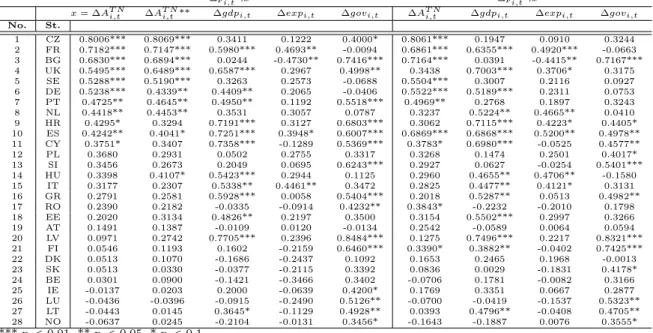
The panel database of the 28 countries is an unbalanced panel with the longest observing period spanning from 1990 and 2017 and the shortest period spanning from 2000 and 2017. All the variables before the transformation were expressed in an index form. The indexes are transformed into logarithmic first differences so that we obtain growth rates. We also check for the correlation coefficient values between the relative inflation growth rate and the explanatory (independent) variables in order to get a general overview between the relationships between the variables. In Table 2, we see that in most cases the correlation coefficient between the relative inflation and relative labour productivity is positive. The exception are the cases of Norway, Lithuania, Luxembourg and Ireland, as their correla-tion coefficient takes a small negative value. Based on the correlacorrela-tion coefficient values we cannot imply that a higher correlation coefficient value would be observed only in less developed countries, i.e. new member states and periphery countries for example. A higher correlation coefficient value is also present in the developed euro area countries, such as France, Germany and Netherlands. Higher correlation coefficient values are also present in the developed non-euro area countries, as in our case United Kingdom and Sweden. Slovenia’s correlation coefficient does not deviate much more in comparison to other countries as it takes the value of 0.3456 (0.2673 considering the productivity based on number of hours worked).
We have also taken into account the case where we additionally excluded the public sector (O, P and Q) from the analysis, since the government can act as a monopsonistic buyer and sets prices and wages outside market forces. Consequently we construct vari-eties of relative inflation and productivity indexes across countries that do not consider the public sector (O, P and Q).11 Despite that, it is clear from Table 2 that the
corre-lation coefficients do not differ much between the varieties of the relative infcorre-lation and productivity indexes.
11
Table 2: Correlations between the growth of the dependable variable and the independent variables across countries
Corr. coef. ρ
∆pN Ti,t,x ρ∆pN Ti,t,x*
x= ∆AT N
i,t ∆AT Ni,t** ∆gdpi,t ∆expi,t ∆govi,t ∆AT Ni,t ∆gdpi,t ∆expi,t ∆govi,t
No. St. 1 CZ 0.8006*** 0.8069*** 0.3411 0.1222 0.4000* 0.8061*** 0.1947 0.0910 0.3244 2 FR 0.7182*** 0.7147*** 0.5980*** 0.4693** -0.0094 0.6861*** 0.6355*** 0.4920*** -0.0663 3 BG 0.6830*** 0.6894*** 0.0244 -0.4730** 0.7416*** 0.7164*** 0.0391 -0.4415** 0.7167*** 4 UK 0.5495*** 0.6489*** 0.6587*** 0.2967 0.4998** 0.3438 0.7003*** 0.3706* 0.3175 5 SE 0.5288*** 0.5190*** 0.3263 0.2573 -0.0688 0.5504*** 0.3007 0.2116 0.0927 6 DE 0.5238*** 0.4339** 0.4409** 0.2065 -0.0406 0.5522*** 0.5189*** 0.2311 0.0753 7 PT 0.4725** 0.4645** 0.4950** 0.1192 0.5518*** 0.4969** 0.2768 0.1897 0.3243 8 NL 0.4418** 0.4453** 0.3531 0.3057 0.0787 0.3237 0.5224** 0.4665** 0.0410 9 HR 0.4295* 0.3294 0.7191*** 0.3127 0.6803*** 0.3062 0.7115*** 0.4223* 0.4405* 10 ES 0.4242** 0.4041* 0.7251*** 0.3948* 0.6007*** 0.6869*** 0.6868*** 0.5200** 0.4978** 11 CY 0.3751* 0.3407 0.7358*** -0.1289 0.5369*** 0.3783* 0.6980*** -0.0525 0.4577** 12 PL 0.3680 0.2931 0.0502 0.2755 0.3317 0.3268 0.1474 0.2501 0.4017* 13 SI 0.3456 0.2673 0.2049 0.0695 0.6243*** 0.2927 0.0627 -0.0254 0.5401*** 14 HU 0.3398 0.4107* 0.5423*** 0.2944 0.1125 0.2960 0.4655** 0.4706** -0.1580 15 IT 0.3177 0.2307 0.5338** 0.4461** 0.3472 0.2825 0.4477** 0.4121* 0.3131 16 GR 0.2791 0.2581 0.5928*** 0.0058 0.5404*** 0.2018 0.5287** 0.0513 0.4982** 17 RO 0.2390 0.2182 -0.0335 -0.0914 0.4232** 0.3843* -0.2232 -0.2010 0.1798 18 EE 0.2020 0.3134 0.4826** 0.2197 0.3500 0.3154 0.5502*** 0.2997 0.3266 19 AT 0.1491 0.1387 -0.0109 0.0120 -0.0134 0.2542 -0.0589 0.0064 0.0594 20 LV 0.0971 0.2742 0.7705*** 0.2396 0.8484*** 0.1275 0.7496*** 0.2217 0.8321*** 21 FI 0.0546 0.1193 0.1602 -0.2159 0.6460*** 0.3390* 0.3882** -0.0402 0.7425*** 22 DK 0.0513 0.1070 -0.1686 -0.2437 0.1092 0.1653 0.2465 0.1968 -0.0013 23 SK 0.0513 0.0330 -0.0377 -0.2115 0.3392 0.0836 0.0029 -0.1831 0.4178* 24 BE 0.0301 0.0900 -0.1421 -0.3466 0.3402 -0.0706 0.1781 -0.0082 0.3166 25 IE -0.0137 0.0203 0.2000 -0.0639 0.4200* 0.1769 0.3351 0.0667 0.2877 26 LU -0.0436 -0.0396 -0.0915 -0.2490 0.5126** -0.0700 -0.0419 -0.1537 0.5323** 27 LT -0.0443 0.0145 0.3645* -0.1129 0.4928** 0.0393 0.4796** -0.0408 0.4705** 28 NO -0.0637 0.0245 -0.2104 -0.0131 0.3456* -0.1643 -0.1887 0.0076 0.3555* *** p<0.01, ** p<0.05, * p<0.1. *Note: Correlation coefficientρ∆pN T
i,t,xis calculated without public sector (O, P and Q). **Note: Variable ∆AT N
i,t is based on hours worked.
Source: Eurostat, own calculations.
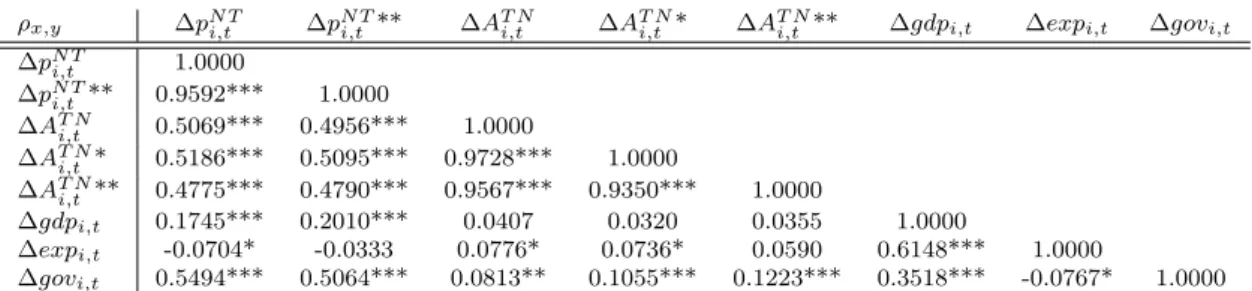
More intuitively is to show a joint correlation matrix of the variables entering the dy-namic panel model (Table 3). The values of the correlation coefficients are in-line with the theory. The relationship between the relative labour productivity growth ∆AT N
i,t and
rela-tive inflation ∆pN T
i,t is positive (0.5069),12 which could be interpreted as the pre-condition
for the HBS effect existence. The control variables (∆gdpi,t, ∆expi,t and ∆govi,t) take lower correlation coefficient values than the correlation coefficient value of the relative labour productivity and inflation variables. Nonetheless, they are also in-line with the theory. The GDP growth variable ∆gdpi,t is in a weak positive relationship with the relative inflation variable ∆pN T
i,t , thus suggesting a slight bias of economies towards the
non-tradable sector inflation. The correlation coefficient is also positive for the govern-ment spending variable ∆govi,t in relation to the relative inflation suggesting that the government spending also has an effect on the non-tradable sector inflation. On the other hand, the sign is negative for the correlation coefficient of the export variable ∆expi,t, but the value of the correlation coefficient is extremely low and statistically insignificant. Nevertheless, the negative correlation coefficient value would suggest a slight bias of the
12
0.5186 in the case of productivity based on hours worked and 0.4775 considering the case without the public sector (O, P and Q).
export growth variable towards the tradable sector inflation.
Table 3: Correlation matrix of the variables entering the dynamic panel model
ρx,y ∆pN Ti,t ∆pN Ti,t ** ∆AT Ni,t ∆AT Ni,t * ∆AT Ni,t ** ∆gdpi,t ∆expi,t ∆govi,t
∆pN T i,t 1.0000 ∆pN T i,t ** 0.9592*** 1.0000 ∆AT N i,t 0.5069*** 0.4956*** 1.0000 ∆AT N i,t * 0.5186*** 0.5095*** 0.9728*** 1.0000 ∆AT N i,t ** 0.4775*** 0.4790*** 0.9567*** 0.9350*** 1.0000 ∆gdpi,t 0.1745*** 0.2010*** 0.0407 0.0320 0.0355 1.0000 ∆expi,t -0.0704* -0.0333 0.0776* 0.0736* 0.0590 0.6148*** 1.0000 ∆govi,t 0.5494*** 0.5064*** 0.0813** 0.1055*** 0.1223*** 0.3518*** -0.0767* 1.0000 *** p<0.01, ** p<0.05, * p<0.1. *Note: Variable ∆AT N
i,t based on hours worked.
**Note: Variables ∆pN T
i,t and ∆AT Ni,t calculated without public sector (O, P and Q).
Source: Eurostat, own calculations.
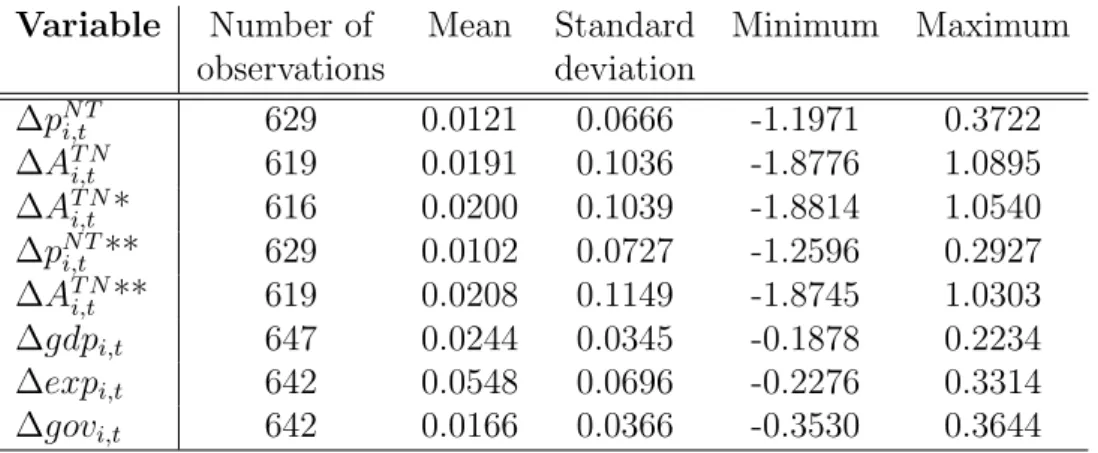
Before we move to the empirical results of the dynamic panel model, lets show the descriptive statistics of the variables entering the model (Table 4). The relative labour productivity variable ∆AT N
i,t is more volatile in comparison to the relative inflation
vari-able ∆pN T
i,t since the standard deviation of the labour productivity is almost twice as high
than of the relative inflation. Higher standard deviations are related to high volatility of the relative productivity in less developed countries, especially in the transition period of the eastern and southern European countries, as well as in the financial crisis period of the countries that were hit the most by the crisis. The number of observations of the variables deviates between 616 and 642 due to different lengths of the time series variables across countries.
Table 4: Descriptive statistics of the variables entering the dynamic panel model
Variable Number of Mean Standard Minimum Maximum
observations deviation ∆pN T i,t 629 0.0121 0.0666 -1.1971 0.3722 ∆AT N i,t 619 0.0191 0.1036 -1.8776 1.0895 ∆AT N i,t * 616 0.0200 0.1039 -1.8814 1.0540 ∆pN T i,t ** 629 0.0102 0.0727 -1.2596 0.2927 ∆AT N i,t ** 619 0.0208 0.1149 -1.8745 1.0303 ∆gdpi,t 647 0.0244 0.0345 -0.1878 0.2234 ∆expi,t 642 0.0548 0.0696 -0.2276 0.3314 ∆govi,t 642 0.0166 0.0366 -0.3530 0.3644
*Note: Productivity based on hours worked. **Note: Without public sector (O, P and Q).
Source: Eurostat, own calculations.
4
Empirical results
4.1
Dynamic model results
In this subsection we provide the results of the dynamic panel model as it is defined in equation (7). For the estimation process we use the Arellano-Bond difference GMM two-step estimator with the robust Windmeijer correction (Arellano & Bond, 1991; Arellano & Bover, 1995; Blundell & Bond, 1998; Windmeijer, 2005; Roodman, 2009a; Roodman, 2009b).13 Standard estimators are in dynamic sense inconsistent, as the unobserved panel
effects are correlated with the lagged dependent variables. With the Arellano-Bond GMM estimator we avoid this problem, especially when the coefficient value of the lagged de-pendent variable is relatively high and when the number of observation is relatively small. In the dynamic panel model we use the relative inflation between the two sectors ∆pN T i,t
and the relative labour productivity variable ∆AT N
i,t as collapsed GMM instruments with
lags from 2 to 10. The control variables ∆gdpi,t, ∆expi,t and ∆govi,t and the dummy variables are used as exogenous instruments. The total number of instruments depends on the variety of the dynamic model but we take into account the rule of thumb sugges-tion by Roodman (2009b) that the number of instruments does not exceed the number of groups (countries) in the analysis. The crisis dummy is defined to take the value 1 if the
13
Windmeijer (2005) proposes the use of a two-step GMM estimator since it provides more consistent results with less bias and lower standard errors in comparison to a one-step method.
GDP growth in the respected year is negative. The interaction dummy variable is defined as the product between the crisis dummy and the relative labour productivity variable (∆AT N
i,t ) and is meant to capture the size of the HBS effect in the crisis period relative to
normal times.14
Turning our attention back to the Table 5, the main point of interest are the HBS effect coefficient values. There are six varieties of the dynamic panel model from the equation (7). In model versions 1, 2, 5 and 6 the results are based on the average labour productivity based on number of employees in the denominator, while in model versions 3 and 4 we have used the average labour productivity based on hours worked. Additionally, in the model versions 5 and 6 we consider relative inflation and productivity that exclude the public sector (O, P and Q). In the model versions 2, 4 and 6 we control the HBS effect by deploying a time trend dummy. We see that both the instantaneous ∆AT N
i,t as well as
the lagged ∆AT N
i,t−1 HBS effect coefficients are statistically significant under the
assump-tion of the labour productivity based on the number employees. The magnitude of the instantaneous HBS effect coefficient is around 0.3, while the magnitude of the lagged HBS effect coefficient stands at 0.1. Considering the productivity based on hours worked, the results are slightly less significant (models 3 and 4) as only the instantaneous HBS effect coefficient is less statistically significant and smaller in comparison to model versions 1 and 2. On the other hand, the estimated value of the instantaneous HBS effect coefficient is the strongest in model versions 5 and 6 that do not consider the public sector (O, P and Q) in the relative inflation and productivity but the lagged coefficient of the HBS effect is statistically insignificant. The interaction dummy DAT N
i ×crisis that tries to explain the
effect crisis on the HBS effect suggests that the HBS effect decreases during a financial crisis, but we cannot confirm this with certainty, since it is statistically insignificant re-gardless of the model version.
We check the results from Table 5 with different econometric tests. The Hansen tests suggest that all model versions satisfy the over-identifying restrictions condition, since we cannot reject the null hypothesis. The Hansen test probability results vary from 0.3 to 0.6, depending on the variety of the model. We also test for consistency with the auto-correlation test. As expected, transforming the model variables into growth rates helps to reject the null hypothesis of the AR(1), while we cannot reject the null hypothesis in
14
In the crisis times we assume, that the tradable sector variables would respond more in comparison to the non-tradable sector variables, as the tradable sector variables should (in theory) be more elastic. In principle, this should lower the HBS effect in the crisis times.
the AR(2) test.
Table 5: Results of the dynamic panel model
Variable Model 1 Model 2 Model 3* Model 4* Model 5** Model 6**
∆pN T i,t−1 0.1094*** 0.1048*** 0.1039*** 0.1025** 0.1299*** 0.1302*** (0.034) (0.037) (0.035) (0.039) (0.033) (0.033) ∆AT N i,t 0.2932* 0.3292** 0.2246 0.2534* 0.4369* 0.4672* (0.168) (0.151) (0.154) (0.146) (0.220) (0.263) ∆AT N i,t−1 0.0927** 0.0860** 0.0667 0.0605 0.0468 0.0403 (0.036) (0.036) (0.047) (0.048) (0.033) (0.034) ∆gdpi,t -0.1333 -0.1309 -0.0431 -0.0430 -0.0430 -0.0333 (0.176) (0.173) (0.197) (0.183) (0.260) (0.290) ∆expi,t -0.0652 -0.0661 -0.0789 -0.0844 -0.1072 -0.1039 (0.044) (0.048) (0.053) (0.059) (0.066) (0.069) ∆govi,t 0.5195*** 0.5162*** 0.5616*** 0.5796*** 0.3117** 0.3270* (0.102) (0.111) (0.121) (0.118) (0.148) (0.166) Dcrisis -0.0179 -0.0152 -0.0128 -0.0113 -0.0234 -0.0193 (0.014) (0.011) (0.015) (0.016) (0.022) (0.022) DAT N i ×crisis -0.1393 -0.1938 -0.0984 -0.1310 -0.3805 -0.4135 (0.148) (0.134) (0.136) (0.123) (0.239) (0.271) time trend -0.0004 -0.0002 -0.0001 (0.000) (0.000) (0.000) constant 0.0043 0.7632 0.0029 0.3953 0.0026 0.1432 (0.006) (0.663) (0.007) (0.691) (0.010) (0.602) Number of observations 591 591 588 588 591 591
Number of countries (groups) 28 28 28 28 28 28
Number of instruments 24 25 24 25 24 25 AR(1) test (P r > z) 0.007 0.007 0.007 0.007 0.008 0.008 AR(2) test (P r > z) 0.611 0.685 0.563 0.605 0.590 0.601 Hansen testχ2 (15) 12.38 12.68 15.02 16.84 16.13 15.26 Prob. (p)> χ2 0.650 0.627 0.450 0.328 0.374 0.433
Instruments – standard: ∆gdpi, ∆expi, ∆govi,Dcrisis,DAT N i ×crisis,
const., (time trend) – GMM: ∆pN T
i , ∆AT Ni
*** p<0.01, ** p<0.05, * p<0.1; standard deviation in brackets. *Note at models 3 and 4: productivity based on hours worked. **Note at models 5 and 6: without public sector (O, P and Q).
Source: own calculations.
The interpretation of the results of dynamic regression models is not that straightfor-ward in comparison to the static models. Nevertheless, from the instantaneous and the lagged variable coefficient values we can obtain a long-run HBS effect. In the long-run it holds that ∆pN T
i = E(∆pN Ti,t ) and ∆AiT N =E(∆AT Ni,t ) for all t. This means that the
variables have a tendency to move towards the long-run steady state. We simplify the dynamic panel model as it is defined in the equation (7) into
∆pN T
i =β1∆pN Ti +β2∆AT Ni +β3∆AT Ni (8)
∆pN T i = β2+β3 1−β1 ∆AT N i =k(∆A T N i ) (9)
wherek = (β2+β3)/(1−β1) represents the long-run multiplicator of the relative labour
productivity.15 Considering the values of the estimated coefficients from the Table 5, we
get the long-run multiplicator with the value of 0.45.16 This means that in the long-run,
the rise in the relative labour productivity of the tradable sector to the non-tradable sec-tor for 1 p.p. yields in a 0.45 p.p. rise in the relative inflation of the non-tradable secsec-tor to the tradable sector.
The estimated values of the HBS effect coefficients of all model varieties are in-line with the existing literature. They lay in the interval between 0.1 and 1.1.17 In the
esti-mation of the dynamic panel model we also considered the control variables. Despite the statistical insignificance (with exception of government spending) they all have the appro-priate coefficient sign and are in-line with the theory. The coefficients of the government spending growth are positive and statistically significant and reflect the pressure that the government spending puts on the non-tradable inflation. The statistically insignificant coefficients of the GDP growth variable confirm our assumptions from the theory above that the GDP represents a general driver of inflation and has no particular bias towards a non-tradable or tradable sector. The sign of the export growth variable coefficient is negative, but statistically significant. Based on this, we cannot conclude with certainty that the export sector only affects the tradable sector inflation. The coefficients of the lagged relative inflation variable ∆pN T
i,t−1 are in all model varieties constant and take the
value around 0.1. We also considered additional dummy variables in the model. The crisis dummy as well as the interaction dummy both take a negative coefficient sign but are both statistically insignificant. We can only speculate that the results of the dummy variables suggest that the HBS effect decreases in crisis periods.
From the robustness checking we have thought out alternative model specifications. First, we relax the strictness of the tradable and non-tradable criteria. In the first case we assume that the manufacturing, mining and quarrying and other industry sector (B, C, D
15
For the sake of simplicity we leave out the estimated coefficients of the control and dummy variables.
16
The case of the model 1 in Table 5: k=cβ2+cβ3 /1−cβ1 = (0.2932 + 0.0927)/(1−0.1094) = 0.433. 17
For a general overview regarding the empirical work done on the HBS effect Tica and Druˇzi´c (2006) comprehensively gathered the empirical literature into a joint table.
and E) and the wholesale and retail trade, transport and storage services, accommodation and food services sector (G, H and I) represent the tradable sector, while we treat the other sectors as non-tradable. In this case the results of the dynamic panel model confirm the presence of the HBS effect. The magnitude of the coefficient of the instantaneous HBS effect variable takes the value of around 0.2, while the lagged value is statistically insignificant (see Appendix Table A2 model versions 1 and 2). In the second case, we consider sectors construction (F), real estate activities (L), public administration, defence, education, human health and social work services (O, P and Q) and other services (R, S, T and U) as non-tradable and treat all other sectors as tradable. The results are less clear and are statistically insignificant, thus in this model setup we cannot confirm the presence of the HBS effect (see Appendix Table A2 model versions 3 and 4). The model specification of both cases are the same as above, while econometric tests in both cases satisfy the test conditions.
Second, we also consider an alternative specification with 4 varieties of the dynamic panel model that is based on quarterly data (see Appendix Table A3). The coefficients of the HBS effect are statistically significant, while the magnitude of the coefficients is smaller, i.e. 0.15 for the instantaneous variable ∆AT N
i,t and 0.05 for the lagged variable
∆AT N
i,t−1. The model specification of instruments is similar to the specifications of the
models above that use yearly data. We add quarterly dummies to the variable list (cri-sis dummy, interaction dummy, constant, growth of GDP, growth of exports, growth in government spending) that are use as exogenous instruments. On the other hand, both relative inflation between the two sectors ∆pN T
i,t and the relative labour productivity
variable ∆AT N
i,t serve as collapsed GMM instruments with lags from 2 to 10. Again the
Arellano-Bond difference GMM two-step estimator with the robust Windmeijer correction is used. The econometric tests are robust with the exception of the AR(2) test that is on the limit of acceptance.
5
Inflation simulations and policy implications
In this subsection we conduct an inflation simulation exercise following Alberola and Tyrv¨ainen (1998) and later on Wagner and Hlouskova (2004) paper where the inflation rate in the tradable sector is assumed to be identical across all countries. This allows us to compute country specific inflation rates in the non-tradable sector. Combining the two sectors and adding the weighted inflation of the sectors that were excluded from the
analysis18, we try to obtain a simulation for the GDP deflator based inflation rate that
could mimic the dynamics of the HICP inflation rate. In order to increase the accuracy of the simulation, we additionally allow for time-varying weights that are defined below.
With ϕt,i we denote the output share of country i in the whole group of 28 countries. Then the inflation rate of the 28 countries could be written as
∆pt=
28
X
i=1
ϕt,i∆pt,i (10)
where pt,i is the GDP deflator inflation in country i. The GDP deflator inflation is given by the weighted average of the inflation in the tradable and non-tradable sector, ∆pTt,i+N
and by inflation ∆pother
t,i in the excluded sectors. The time-varying weights are given by
the respective value added sector shares, ωT+N
t,i and (1−ω T+N t,i ) ∆pt,i =ωt,iT+N∆p T+N t,i + (1−ω T+N t,i )∆p other t,i (11)
The latter equation can be partitioned onto
∆pt,i =ωt,iT+N
(1−δt,i)∆pTt,i +δt,i∆p N t,i + (1−ωt,iT+N)∆p other t,i =ωT+N t,i ∆pT t,i+δt,i∆p N T t,i + (1−ωT+N t,i )∆p other t,i =ωT+N t,i [∆p T
t,i+δt,i(βb1∆pN Ti,t−1+βb2∆A
T N
i,t +βb3∆AT Ni,t−1
+βb4∆gdpi,t+βb5∆expi,t+βb6∆govi,t+βjb+6Dj,i,t]
+ (1−ωT+N t,i )∆p
other
t,i (12)
where the overall GDP deflator inflation is determined by the weighted tradable sector inflation ∆pT
t,i, the excluded sectors inflation ∆pothert,i and the estimated parameters of the
HBS effect in Table 5 model variety 1. The relative inflation between the tradable and non-tradable sector is additionally weighted by the parameter δt,i. The parameter δt,i
18
Agriculture, forestry and fishing (A), information and communication (J), financial and insurance activities (K), professional, scientific, technical, administration and support services (M and N).
represents the time-varying share of non-tradable sector in the tradable and non-tradable sectors basket.
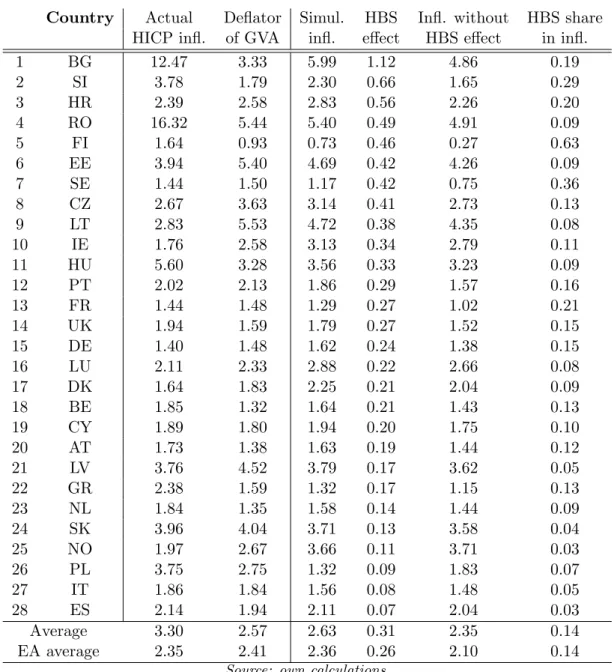
The following methodology enables us to construct an estimated/simulated inflation indexes for all 28 countries, which is then used for the comparison with the HICP and the gross value added deflator indexes of each country. The results of the average yearly growths throughout the observation period are presented in Table 6, from the country with the biggest HBS effect to the smallest (column 6). We see that the simulated infla-tion on average undershoots the HICP inflainfla-tion, but is almost in-line with the gross value added deflator. Further on, based on the equation 11, we can extract the HBS effect in the simulated inflation by bearing in mind ωTt,i+Nδt,i(βb2∆AT Ni,t +βb3∆AT Ni,t−1). The sixth column
in Table 6 shows the HBS effect. The disaggregation calculation of the HBS effect onto separate countries helps us to confirm that the HBS effect is present more or less in all observed countries. Out of all 28 countries the average HBS effect accounts for 0.31 p.p. and 0.26 p.p. in the euro area countries. In terms of shares, on average the HBS effect accounts for 14% or roughly one sixth of the inflation. In Finland Sweden and Slovenia, for example, the presence of the HBS effect is amongst the highest ones in comparison to other countries, where the share of the HBS effect amounts to almost a third of the simulated inflation or even more.
Table 6: Average yearly HICP inflation, aggregate deflator of gross value added, inflation simulation (in %) and the average yearly HBS effect across countries (in p.p.)
Country Actual Deflator Simul. HBS Infl. without HBS share
HICP infl. of GVA infl. effect HBS effect in infl.
1 BG 12.47 3.33 5.99 1.12 4.86 0.19 2 SI 3.78 1.79 2.30 0.66 1.65 0.29 3 HR 2.39 2.58 2.83 0.56 2.26 0.20 4 RO 16.32 5.44 5.40 0.49 4.91 0.09 5 FI 1.64 0.93 0.73 0.46 0.27 0.63 6 EE 3.94 5.40 4.69 0.42 4.26 0.09 7 SE 1.44 1.50 1.17 0.42 0.75 0.36 8 CZ 2.67 3.63 3.14 0.41 2.73 0.13 9 LT 2.83 5.53 4.72 0.38 4.35 0.08 10 IE 1.76 2.58 3.13 0.34 2.79 0.11 11 HU 5.60 3.28 3.56 0.33 3.23 0.09 12 PT 2.02 2.13 1.86 0.29 1.57 0.16 13 FR 1.44 1.48 1.29 0.27 1.02 0.21 14 UK 1.94 1.59 1.79 0.27 1.52 0.15 15 DE 1.40 1.48 1.62 0.24 1.38 0.15 16 LU 2.11 2.33 2.88 0.22 2.66 0.08 17 DK 1.64 1.83 2.25 0.21 2.04 0.09 18 BE 1.85 1.32 1.64 0.21 1.43 0.13 19 CY 1.89 1.80 1.94 0.20 1.75 0.10 20 AT 1.73 1.38 1.63 0.19 1.44 0.12 21 LV 3.76 4.52 3.79 0.17 3.62 0.05 22 GR 2.38 1.59 1.32 0.17 1.15 0.13 23 NL 1.84 1.35 1.58 0.14 1.44 0.09 24 SK 3.96 4.04 3.71 0.13 3.58 0.04 25 NO 1.97 2.67 3.66 0.11 3.71 0.03 26 PL 3.75 2.75 1.32 0.09 1.83 0.07 27 IT 1.86 1.84 1.56 0.08 1.48 0.05 28 ES 2.14 1.94 2.11 0.07 2.04 0.03 Average 3.30 2.57 2.63 0.31 2.35 0.14 EA average 2.35 2.41 2.36 0.26 2.10 0.14
Source: own calculations.
Since we only present average yearly growth rates in Table 6, we also try to show the simulated inflation dynamic alongside the HICP inflation and the aggregate gross value added deflator in index form across the 28 European countries (see Figure A5 in the Ap-pendix). Evidently, the simulated inflation closely fits the aggregate gross value added deflator, while the HICP inflation in some countries seems to deviate from the simulated inflation and the aggregate gross value added deflator dynamics.
Explaining factors that influence inflation dynamics through the productivity theory
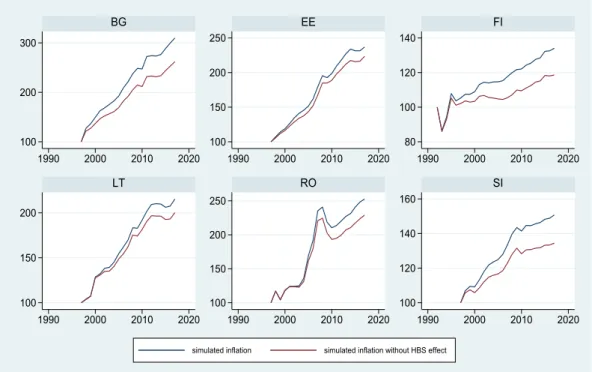
via HBS effect is interesting from the economic policy point of view. Deeper trade integra-tion between European countries (Betts & Kehoe, 2008) as well as the euro area formaintegra-tion downsized the importance of the nominal exchange rate, but on the other hand had put more pressure on the overall inflation. Consequently we try to present the dynamics of the simulated inflation and compare it to the simulated inflation without the HBS effect (see Appendix Figure A6). In most of the 28 European countries the accumulated HBS effect is evident from the start of the observations across countries. In Slovenia, for example, the accumulated HBS effect amounted to 16 p.p. in the period from 1995 to 2017 (see Figure 1). Among countries that stand out are also Bulgaria (47 p.p. accum. diff.), Romania (23 p.p. accum. diff.), Finland (16 p.p. accum. diff.), Lithuania (15 p.p. accum. diff.) and Estonia (13 p.p. accum. diff.).
Figure 1: Indexes of the inflation simulation and inflation simulation without the HBS effect for the selected countries with the highest HBS effect (100 = beginning of the observation sample - varies across countries)
100 200 300 100 150 200 250 80 100 120 140 100 150 200 100 150 200 250 100 120 140 160 1990 2000 2010 2020 1990 2000 2010 2020 1990 2000 2010 2020 1990 2000 2010 2020 1990 2000 2010 2020 1990 2000 2010 2020 BG EE FI LT RO SI
simulated inflation simulated inflation without HBS effect
Source: Eurostat, own calculations.
On the other hand, Figure 2 presents the countries with the smallest accumulated HBS effect through the observed period (that varies across countries). These are Poland (1 p.p. accum. diff.), Italy (2 p.p. accum. diff.), Spain (2 p.p. accum. diff.), Netherlands (3 p.p. accum. diff.), Norway (4 p.p. accum. diff.) and Austria (5 p.p. accum. diff.). Despite
the HBS effect being small, the accumulated HBS effect is positive in all of these countries.
Figure 2: Indexes of the inflation simulation and inflation simulation without the HBS effect for the selected countries with the lowest HBS effect (100 = beginning of the ob-servation sample - varies across countries)
100 120 140 100 120 140 160 100 120 140 100 120 140 100 150 200 250 80 100 120 1990 2000 2010 2020 1990 2000 2010 2020 1990 2000 2010 2020 1990 2000 2010 2020 1990 2000 2010 2020 1990 2000 2010 2020 AT ES IT NL NO PL
simulated inflation simulated inflation without HBS effect
Source: Eurostat, own calculations.
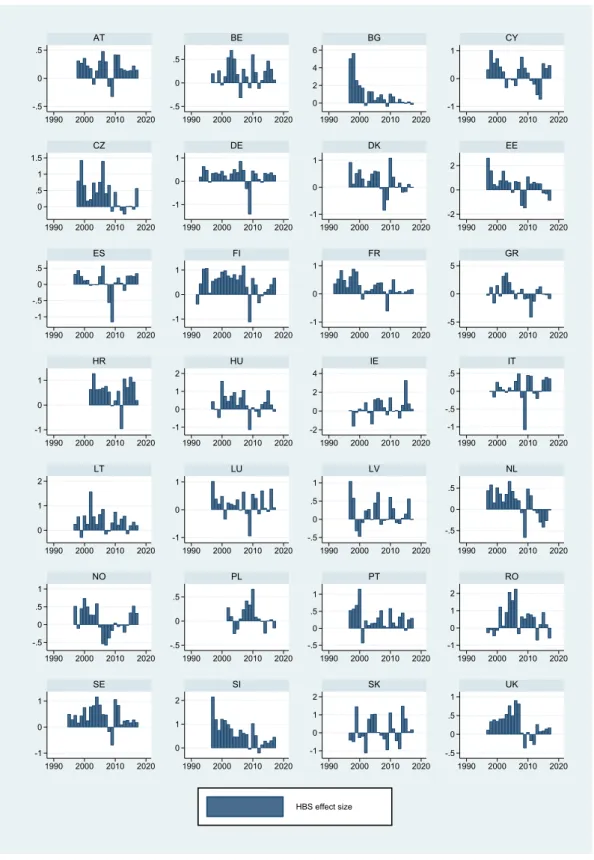
Alongside the simulated inflation we show the HBS dynamics across the 28 European countries (Figure 3). We see that most of the observed time the HBS effect was positive. During the financial crisis it seems that for most countries the contribution of the HBS effect reversed and turned negative.19 This turn in the HBS effect could be explained
with a decrease in the relative labour productivity growth, as the tradable sector produc-tivity decreased more than the non-tradable sector producproduc-tivity. Additionally, due to the rigidity of the non-tradable sector prices the tradable sector inflation decreased more as well in comparison to the non-tradable sector inflation. This means that the relationship between the relative inflation and relative labour productivity turned negative, implying the negative contribution of the HBS effect during the financial crisis. In the recovery period, the contributions of the HBS effect returned to the positive territory for most of the countries, but not all the way to the pre-crisis levels. In Slovenia, for example, the steadily decreasing trend in the size of the HBS effect is clearly visible from the beginning
19
of the observation period in the late 90s. In its peak it amounted up to 2 p.p.. Countries that experienced similar size of the HBS effect were also Czech Republic, Hungary, Ro-mania, Lithuania and Bulgaria, as well as Finland, France, Latvia and Slovakia.
Figure 3: Size of the HBS effect through time across countries (in p.p.) -.5 0 .5 -.5 0 .5 0 2 4 6 -1 0 1 0 .5 1 1.5 -1 0 1 -1 0 1 -2 0 2 -1 -.5 0 .5 -1 0 1 -1 0 1 -5 0 5 -1 0 1 -1 0 1 2 -2 0 2 4 -1 -.5 0 .5 0 1 2 -1 0 1 -.5 0 .5 1 -.5 0 .5 -.5 0 .5 1 -.5 0 .5 -.5 0 .5 1 -1 0 1 2 -1 0 1 0 1 2 -1 0 1 2 -.5 0 .5 1 1990 2000 2010 2020 1990 2000 2010 2020 1990 2000 2010 2020 1990 2000 2010 2020 1990 2000 2010 2020 1990 2000 2010 2020 1990 2000 2010 2020 1990 2000 2010 2020 1990 2000 2010 2020 1990 2000 2010 2020 1990 2000 2010 2020 1990 2000 2010 2020 1990 2000 2010 2020 1990 2000 2010 2020 1990 2000 2010 2020 1990 2000 2010 2020 1990 2000 2010 2020 1990 2000 2010 2020 1990 2000 2010 2020 1990 2000 2010 2020 1990 2000 2010 2020 1990 2000 2010 2020 1990 2000 2010 2020 1990 2000 2010 2020 1990 2000 2010 2020 1990 2000 2010 2020 1990 2000 2010 2020 1990 2000 2010 2020 AT BE BG CY CZ DE DK EE ES FI FR GR HR HU IE IT LT LU LV NL NO PL PT RO SE SI SK UK HBS effect size
Source: Eurostat, own calculations.
The negative effect of the financial crisis on the real GDP growth and the productiv-ity in a particular economy could decisively influence the response of the economic policy
making. Based on the dynamic panel model results we can conclude that the normal rela-tionships between the macroeconomic aggregates are disrupted during the financial crisis periods. These disruptions reflect the productivity transmission mechanism onto inflation
via HBS effect. For the economic policy maker it is important to take into consideration these results in the restructuring of the economy by setting up policies that promote ro-bustness of the productivity of the economy, especially in times of crisis. Inactivity of economic policy making and the competitiveness pressure from abroad could lead to a slowdown of an economy and consequently reducing its long-run potential. In this re-spect, for an economy that operates in a monetary union taking these considerations into account might that more important, since it cannot affect the competitiveness through the nominal exchange rate channel.
6
Conclusions
Despite the theory of the HBS effect being old (Harrod, 1933; Balassa, 1964; Samuelson, 1964), the empirical testing became popular relatively late, mostly due to the advances in the empirical methodologies and tools, as well as the availability of new economic sectoral data. One of the possible reasons of the sectoral data occurrence might be the establish-ment of the European Union and its expansion process, as it forced the relevant countries to harmonize and deepen the economic data and databases. At the same time the HBS theory became interesting from the economic policy making point of view. Deeper trade integration (Betts & Kehoe, 2008) and the euro currency acceptance caused to lower the importance of the nominal exchange rate between the member countries and lifting the internal inflation pressures.
By transforming and combining the NACE Revision 2 data onto tradable and non-tradable sectors we confirm the existence of the HBS effect in 28 European countries with a dynamic panel data regression model. We tested the response of the relative inflation between both sectors by regressing it onto two types of relative labour productivity in-dicators. The first relative productivity indicator is based on the number of employees while the second one uses the number of hours worked in the denominator. Additionally, with respect to the estimated HBS effect results and the inflation simulation we suspect that an occurrence of a financial crisis might had an effect on the disruptions between the main macroeconomic aggregates. The results hint that during a financial crisis the contribution of the HBS effect reverses negatively, but we could not confirm it with a
statistical significance.
References
1. Alberola, A., and Tyrv¨ainen. (1998). Is there Scope for Inflation Differentials in EMU? An Empirical Investigation of the Balassa-Samuelson Model in EMU Coun-tries. Bank of Finland Discussion Paper 15/98.
2. Arellano, M., and Bond, S. (1991). Some Tests of Specification for Panel Data: Monte Carlo Evidence and an Application to Employment Equations. The Review of Economic Studies, 58(2), 277-297.
3. Arellano, M., and Bover, S. (1995). Another Look at the Instrumental Variable Estimation of Error-Components Models. Journal of Econometrics, 68(1), 29-51. 4. Arratibel, O., Rodr´ıguez-Palenzuela, D. and Thimann, C. (2002). Inflation
Dynam-ics and Dual Inflation in Accession Countries: A New Keynesian Perspective. ECB Working Paper, 132.
5. Asea, P., and Mendoza, E. (1994). The Balassa-Samuelson Model: A General Equilibrium Appraisal. Review of International Economics, 2(3), 244-267.
6. Balassa, B. (1964). The Purchasing Power Parity Doctrine: A Reappraisal. Journal of Political Economy, 72(6), 584-596.
7. Bahmani-Oskooee, M. (1992). A Time-Series Approach to Test the Productivity Bias Hypothesis in Purchasing Power Parity. Kyklos, 45(2), 227-236.
8. Bahmani-Oskooee, M., and Rhee, H. (1996). Time Series Support for Balassa’s Productivity-Bias Hypothesis: Evidence from Korea. Review of International Eco-nomics, 4(3), 364-370.
9. Baumol, W.J., and Bowen, W.G. (1967). Performing Arts - The Economic Dilemma. A Study of Problems Common to Theater, Opera, Music and Dance. College Music Symposium, 7, 127-142.
10. Bernard, A., Van Beveren, I., & Vandenbusche, H. (2010). Multi-product Exporters, Carry-Along Trade and the Margins of Trade. National Bank of Belgium Working Paper 203.
11. Bergin, P., Reuven, G., and Taylor, A.M. (2006). Productivity, Tradability, and the Long-Run Price Puzzle. National Bureau of Economic Research Working Paper 10569.
12. Betts, C.M., and Kehoe, T.J. (2008). Real Exchange Rate Movements and the Relative Price of Non-traded Goods. Federal Reserve Bank of Minneapolis.
13. Bond, S. (2002). Dynamic Panel Data Models: A Guide to Micro Data Methods and Practice. The Institute for Fiscal Studies Department of Economics, UCL, cemmap Working Paper CWP09/02.
14. Blundell, R., and Bond, S. (1998). Initial Conditions and Moment Restrictions in Dynamic Panel Data Models. Journal of Econometrics, 87(1), 115-143.
15. Breuss, F. (2003). Balassa-Samuelson Effects in the CEEC: Are they Obstacles for Joining the EMU?. Wirtschaftsuniversit at Wien IEF Working Paper, 52.
16. Canzoneri, M.B., Cumby, R.E. and Diba, B. (1999). Relative Labor Productivity and the Real Exchange Rate in the Long Run: Evidence for a panel of OECD countries. Journal of International Economics, 47(2), 245-266.
17. Chinn, M.D. (1997). Paper pushers or paper money? Empirical assessment of fiscal and monetary models of exchange rate determination. Journal of Policy Modeling, 19(1), 51-78.
18. Chinn, M.D., and Johnston, L. (1997). Real Exchange Rate Levels, Productivity and Demand Shocks: Evidence from a Panel of 14 Countries. IMF Working Paper, WP/97/66.
19. Cipriani, M. (2001). The Balassa-Samuelson Effect in Transition Economies. IMF. 20. Cobb, C.W., and Douglas, P.H. (1928). A Theory of Production. American
Eco-nomic Review, , 18 139-165.
21. Comin, D. (2008). Total Factor Productivity.The New Palgrave Dictionary of Eco-nomics, 2nd ed. Palgrave Macmillan.
22. Coricelli, F., and Jazbec, B. (2004). Real Exchange Rate Dynamics in Transition Economies. Structural Change and Economic Studies, 15(1), 83-100.
23. ˇCih´ak, M., and Holub, T. (2001). Convergence of Relative Prices and Inflation in Central and Eastern Europe. IMF Working Paper, WP/01/124.
24. Damijan, J.P., Konings, J., & Polanec, S. (2014). Import Churning and Export Performance of Multi-product Firms. The World Economy, , 37(11), 1483-1506. 25. De Broeck, M., and Sløk, T. (2006). Interpreting Real Exchange Rate Movements
in Transition Countries. Journal of International Economics, 68(2), 368-383. 26. De Gregorio, J., Giovannini, A., and Wolf, H.C. (1994). International Evidence on
Tradables and Nontradables Inflation. IMF Working Paper, WP/94/33.
27. De Gregorio, J., and Wolf, H.C. (1994). Terms of Trade, Productivity, and the Real Exchange Rate. The National Bureau of Economic Research Working Paper 4807. 28. Dedu, V., and Dumitrescu, B.A. (2010). The Balassa-Samuelson Effect in Romania.
Romanian Journal of Economic Forecasting, , 0(4), 44-53.
29. Deloach, S.B. (2001). More Evidence in Favor of the Balassa-Samuelson Hypothesis.
Review of International Economics, 9(2), 336-342.
30. ´Egert, B. (2002). Investigating the Balassa-Samuelson Hypothesis in Transition: Do We Understand What We See?. Discussion Papers no. 6, Bank of Finland, Institute for Economies in Transition.
31. ´Egert, B., Drine, I., Lommatzsch, K., and Rault, C. (2003). The Balassa-Samuelson Effect on Inflation in Central and Eastern Europe: Myth or Reality?Journal of Comparative Economics, 31(3), 552-572.
32. Engle, R.F., and Granger, C.W.J. (1987). Co-integration and Error Correction: Representation, Estimation and Testing. Econometrica, 55(2), 251-276.
33. Fischer, C. (2004). Real Currency Appreciation in Accession Countries: Balassa-Samuelson and Investment Demand. Review of World Economics, 140(2), 179-210. 34. Frensch, R. (2006). Balassa-Samuelson, Product Differentiation and Transition .
Osteuropa-Institut Muenchen Working Papers no. 266.
35. Gubler, M., and Sax, C. (2011). The Balassa-Samuelson Effect Reversed: New Evidence from OECD Countries. Swiss Journal of Economics and Statistics, 155(1), 1-21.
36. Guo, Q., and Hall, S.G. (2010). A Test of the Balassa-Samuelson Effect Applied to Chinese Regional Data. Romanian Journal of Economic Forecasting, 0(2), 57-78.