Toward an Integrated Framework of Information and Communication Behavior:
College Students’ Information Resources and Media Selection
Soo Young Rieh, Brian Hilligoss, and Jiyeon Yang
School of Information, University of Michigan, 1085 S. University Avenue, Ann Arbor, MI 48109-1107;
Tel: 734-647-8040 [email protected]
This study investigated college students’ selection of information resources and engagement in information
activities from the perspective of an integrated framework of information and communication behavior, by
examining students’ interactions with many different types of information resources and media across their
school, personal, entertainment, problem solving, and other daily routines. Both web-based diaries and
semi-structured interviews were used to capture students’ information behavior in natural settings. The subjects
logged into a web-based diary and recorded the details of their most important information seeking activity on
that day by responding to eleven questions including information seeking topic, resources used, time taken,
difficulty, familiarity, and confidence. Two hundred and forty-five information seeking episodes reported by
twenty-four subjects from three different colleges and universities were collected over a ten-day period.
Findings indicate that the students used multiple information resources in one information seeking episode to
verify the content in, often, both information and communication behaviors. The results also reveal that
information seeking can be better understood from a social framework because students were aware that
human information behavior is influenced by other people’s opinions and recommendations and may also
affect other people’s lives
.
Introduction
With the development of the Internet and web search engines, it can be assumed that it is quite easy for most
people to find information they need. It certainly has become easy to access information. However, it does not
necessarily mean that people have easier time finding information for which they are looking. In fact, many
people might complain of overload, confusion, and frustration in the process of information seeking. Two
sub-processes of information seeking in particular pose challenges to most people. One is how to evaluate
information and make judgments of usefulness and credibility after they obtain the information. The other is
where to go to find what they need given so many choices of available media and resources. The problem of
evaluating information in the process of information seeking has been reported elsewhere (Rieh & Hilligoss, in
press). This paper focuses on the problem of information resources and media selection.
The information seeking process has been traditionally defined as a series of activities: recognizing an
information problem, defining the problem, choosing a search system, formulating a query, executing the
search, examining the results, and extracting information (Marchionini, 1995). Marchionini’s framework
presents a broad process of information seeking including information problems, seeking, evaluation, and use
beyond the limited notion of information retrieval. In the current information-intensive environment, people
employ various information seeking strategies in interacting with many different information types, formats, and
sources in diverse media. Therefore, an even broader framework is needed, one that includes not only
interacting with information systems in which information is stored and represented but also with
communication in which the exchange of information and creation of new meaning are accomplished through
interactions among social actors (Rice, McCreadie, & Chang, 2001).
An integrated framework of information and communication behavior is not an entirely novel concept in the
field of information science. For instance, Buckland (1991) claimed that “interpersonal communications and
mass communications clearly ought to be within our scope” (p. 8), meaning that information and information
systems should be viewed broadly. Rice, McCreadie, and Chang (2001) explicitly argue that “accessing and
browsing information and communication are highly consequential and multidimensional aspects of the
information user’s entire experience” (p. 3). Cool and Belkin (2002) distinguished communication behavior from
information behavior in their classification of interaction with information. According to them, communication
behaviors refer to those behaviors that an individual or group engage in during communicative interactions with
another person or persons, while the primary goals of information behaviors are engagement with information
objects or groups of information objects. Cool and Belkin claim that they needed to maintain both types of
behaviors within the integrated scheme because some combinations of information behaviors and
communication behaviors would arise.
People’s information seeking rarely occurs in isolation from other people (Hargittai & Hinnant, 2006). In their
daily lives, people seek and use information with the help of their social support networks. Seeking information
from interpersonal sources, especially from people like themselves, is well known practice in the field of human
information behavior (Harris & Dewdney, 1994). Harris and Dewdney also point out that the most frequently
accepted theory is the principle of least effort, also known as Zipf’s law, which states that people tend to solve
their information problems in the “easiest and least painful way” (Harris & Dewdney, p. 22). The Internet has
influenced people’s information seeking not only by offering a tremendous amount of information but also by
providing easy access to other people. As a result, the boundaries of information behavior and communication
behavior are blurring.
This study examines a series of information activities in the context of everyday life information seeking from
the perspective of an integrated information and communication behavior framework. To investigate
information activities in the broadest context of information and communication behaviors, the research had to
be designed in such a way as would allow inclusion of all types of information resources accessed through a
variety of media ranging from face-to-face interpersonal communication to Web search engines. To capture
both information and communication behaviors in natural settings, the self-reporting diary and in-depth
interviews were therefore used as data collection methods.
The sampled population of this study is college students. Given that the personal computer has been in use for
more than two decades and the Web for more than a decade, today’s college students represent the first
generation to “grow up digital” (Tapscott, 1997). Computers were already commonplace when they were born,
and the Internet has been available since they were elementary school students. According to the Pew Internet
and American Life Project’s survey conducted in 2002, 20% of college students started using computers
between the ages 5 - 8, and virtually all of today’s college students were using computers by the time they
were 16-18 years old (Jones, 2002). Considering that this survey was conducted five years ago, it is presumed
that an even greater percentage of today’s college students started using computers and the Internet in their
early years. Therefore, the ways that college students use new digital media to seek for and communicate with
others may fundamentally differ from that of older generations.
The purpose of this research was to better understand the types of information resources and media that
college students select to achieve their various information seeking goals ranging from academic achievement,
personal information need, entertainment, and problem solving. It also intends to identify the types of
resources and media with respect to information seeking tasks as they pertain subject searching, question
answering, fact retrieval, known item searching, and advice/recommendation/opinion. Specifically, the following
research questions are addressed:
- How do college students select information resources and media differently depending on their information
seeking goals and tasks?
- To what extent do they rely on online information to find information for their
important
information
problems?
- Do their information seeking strategies demonstrate an integrated framework of information and
communication behavior?
Related Literature
The report from the Pew Internet and American Life Project (Jones, 2002) demonstrated that use of the
Internet has effectively been integrated into college students’ daily routines. The respondents in their study
reported that the Internet has had a positive impact on their college academic experience given the extent to
which it has changed the ways in which they interact with others as well as with information in the course of
engaging in their studies. They also reported that they used the Internet nearly as much for social
communications as they did for learning and education. The limitation of the Pew survey is that it examines
only the use of the Internet in academic settings. Furthermore, it does not focus on how the Internet is used
along with more traditional information resources and media such as print materials and face-to-face
interpersonal communications.
A number of researchers and practitioners have concerned themselves with the extent to which college
students use online resources for their assignments. For instance, Valentine (2001) reported that students
focus considerable time and energy attempting to figure out the proverbial “what the professor wants” and so
look for “what they perceive to be the most time-effective and cost-effective methods of finding information.” (p.
108). That is, they use what is most familiar and easiest to obtain. Based on a survey of 156 undergraduate
students, Dilevko and Gottlieb (2002) examined the types of library resources employed when completing
assignments and essays. The findings indicate that their study subjects used both online sources and print
sources in their assignments: while online resources were used by 63.9% of undergraduates at least 75% of
the time, 44.2% still used print book sources and 45.2% print journal sources at least 75% of the time for their
assignments.
When studying students’ information behavior, however, it is important to include both everyday life as well as
academic contexts because they can inform one another and are thus tightly interwoven (Given, 2002).
Although her informants were limited to undergraduate students 21 years of age or older, Given’s study
appears to have a number of implications for efforts to achieve a holistic picture of typical college students’
information seeking. As with the informants in Given’s study, most college students exhibit an extensive
overlap between academic and everyday information needs and seeking. According to Given, the decision to
seek academic information can be initiated by knowledge acquired through everyday life information seeking in
other situations and vice versa.
Julien and Michels (2000) collected the diary entries from nine participants for ten weeks and conducted
interviews in New Zealand. They found that students used 3.4 sources on average for each instance of
information seeking. For both personal and work situations, the participants approached another person in in
54-57% of the cases. For their school-related information seeking, print sources were approached first in 45%
of the cases. Electronic information resources were the second most popular for school-related cases but the
least frequently used for personal and work-related information seeking cases. It can be argued that their data
is rather out-of-date and might not reflect the current information access environments. In a more recent study,
however, Weiler (2005) supported Julien and Michels’ findings given that her study participants also relied on
other people as information sources because they preferred discussing information needs with a “real person”
rather than locating all the needed information on their own.
These findings contradict the results of Graham and Metaxas’ (2004) research which examined college
students’ reliance on the Internet. They found that 98% of students included Internet sources when asked to
conduct research though they could use other kinds of resources. They also discovered that students often
turned to a search engine immediately and exhibit high confidence in search engines.
Despite the mixed findings on college students’ information seeking behaviors, there are a few identifiable
trends. Doubtlessly today’s college students prefer online resources both from library electronic resources and
from the general Web because they prefer to find information “as quickly and with as little effort as possible
(Shenton & Dixon, 2004, p. 192).” However, they still rely on “real people” given that the Internet provides
greater connectivity to the social environment. As students engage in a variety of information seeking tasks in
their academic work and everyday life, they tend to choose certain information resources and strategies
depending on the types of information seeking goals and tasks they target. As Dresang (2005) pointed out,
researchers need to focus on new human information behaviors nurtured and facilitated by the digital
environment. The next sections will examine the new patterns and strategies of information seeking as they
have emerged in the current information-intensive environment.
Research Design
Self-reporting diaries serve the researcher both as data and as a source for generating questions in a
semi-structured interview (Zimmerman & Wieder, 1977). While this method has been employed most extensively in
other fields such as health care (e.g., Morrison, Leigh, & Gillmore, 1999), diaries have also proven useful to a
number of library and information science (LIS) researchers given that the method permits collection of a
wealth of detailed, actual information behaviors in specific context (Toms & Duff, 2002).
LIS researchers have employed diaries as a substitute for direct observation to collect data on information
seeking activities that arise naturally in work settings (Byström, 2002; Cool & Belkin, 2002; Xie, 2006), school
(Kuhlthau, 2004), or at home (Rieh, 2004). Byström (2002) used semi-structured task diaries to gather details
about information seeking tasks, including perceptions of the complexity and frequency of the tasks, actual
steps involved in seeking the information, and evaluations of the sources selected. Cool and Belkin (2002)
provided their study participants with Activity Notes forms which they used to record the details and intentions
behind the information seeking activities in which they engaged over the course of a single day. Xie (2006)
asked participants to keep an information interaction diary in which they were instructed to record two tasks
over the course of a two-week period. Participants made note of the task itself, time spent on the task,
information systems and resources consulted, specific queries used, and reflections on the outcome of their
efforts. Kuhlthau’s (2004) study participants also kept “search logs” in which they recorded the names of the
sources used, procedures for finding sources, and whether sources were useful, highly useful, or not useful.
Finally, Rieh (2004) provided her participants with a search activities diary in which they recorded their Web
information seeking over the course of 3-5 days. In each of these studies, the diary data were then used to
formulate questions and elicit deeper details during interviews.
This study also employed the diary to gather details about college students’ information seeking activities and
then used the data from the diary to guide an in-depth interview. Unlike previous studies, however, the study
reported here gathered diary data over a longer period of time (10 days) and for a greater range of activities
that included work, school, and personal interest. Once a day for ten consecutive days, subjects logged into a
web-based, password-protected diary and recorded the details of what they considered their
most important
information seeking activity that day. The written instructions in the diary were: “Think about situations today in
which you needed to find information. Choose the one that was most important to you; then answer the
following questions, providing as much detail as you can.” The diary collected this data from responses to
eleven questions, seven of which were open-ended questions about the activity: (1) the information sought; (2)
the need that motivated the information seeking; (3) the resources used to solve the need; (4) the steps taken
to find the information; (5) the intended use of the information; (6) any remaining, unmet, or additional need
realized after the search; and (7) additional comments. Another question inquired as to how much time
subjects spent in seeking for the information. Finally, three scales were used to gather data about the subjects’
familiarity with the topic prior to the searching, level of confidence after the seeking was completed, and rating
of the overall difficulty of the activity.
When we recruited the subjects from three different institutions in a Midwestern state including a large
research university, a regional university, and a two-year community college, we had an information session
with each of subjects so that they became familiarized with the study, learned about the role of the diary, and
received a password to their log-in web-based diary. One of the advantages of the web-based diary entries
was that we were able to monitor the subjects’ progress on the diary for a period of ten days. A few subjects
failed to provide diary entries for multiple days; in these instances, we sent email reminders encouraging them
to continue recording their activities. There were only two instances in which subjects failed to complete their
diaries.
Short Questionnaire and In-Depth Interview
At the conclusion of the ten days, an interviewer met one-on-one with each subject for a semi-structured
interview on the ten information seeking episodes. The interviews were conducted at the subjects’ schools in
small, private study rooms located in a campus library. These locations were used to provide a neutral,
comfortable, and conveniently accessible environment.
Before the interview, each subject first completed a questionnaire on demographic information (major, age,
gender), general use of the Internet, and frequency of Internet applications such as email, instant messaging,
searching, news, and games. The subjects also responded to the question about how they had been using the
university library online catalog as well as their experience of attending a training program provided by the
university or high school library.
On completion of the questionnaire,
subjects were provided printed copies of their diary data to which they
could refer during the interview. The interviewer initiated the interview about the information problem reported
in the diary. The core questions of the interview were to ask the subjects to describe their information seeking
process, resources selected, and plans for information use. Other questions included information quality,
cognitive authority, difficulty, and confidence and those are reported in elsewhere (Rieh & Hilligoss, in press).
All of these questions were repeated for each activity entered in the diary. While the interviews focused on the
ten recorded activities, additional activities not recorded in the diaries were occasionally discussed as they
arose during the interviews. Each interview lasted about one and a half hours and was tape recorded.
Participants
Between Fall 2005 and Summer 2006, twenty-four undergraduate students from three institutions completed
their diaries and participated in the interviews. Of the twenty-four subjects who went on to complete the study,
thirteen were students at the large research university, three attended the regional university, and eight were
enrolled in the community college. Fourteen were female and ten were male. Half of the subjects were in their
first year of college, and their average age was 21.8 years. Eleven were eighteen years old, three were
nineteen years old, and a few others were in their early twenties. The average age appears slightly high given
the inclusion of three non-traditional students from the community college and regional university: their ages
were twenty-nine, thirty-one, and forty-three. The subjects represented a fairly diverse sample as evidenced by
the fact that they attended three very different educational institutions and were enrolled in a variety of
academic majors including pre-medicine, business, film studies, nursing, English, construction technology,
education, computer engineering, dance, and others.
Prior to the interviews, the subjects completed a short questionnaire that gathered data about their use of the
Internet. When compared with data from the Pew Internet and American Life Project (Jones, 2002), the
subjects in this study appeared to be fairly representative in terms of their Internet use. On average, they
claimed to use their institution’s online library catalog system approximately 0.75 hours weekly and the Internet
3.6 hours daily. Similarly, the Pew study found that nearly three-quarters (73%) of college students use the
Internet more than they did their campus library. Twenty-one (87.5%) of the subjects said they used email
multiple times daily, a response comparable to the Pew study which found 72% checked their email daily.
Other uses of the Internet reported by subjects include searching for information for personal use one or more
times daily (n=17) and searching for information for school work one or more times daily (n=14). Seventeen
subjects (71%) said they used instant messaging one or more times weekly. Eight subjects (33%) claimed they
used the Internet for playing games one or more times weekly while on average, subjects used the Web for
news information four or more times weekly.
Data Analysis
The audiotapes of the twenty-four interviews were transcribed. Given that each subject addressed ten
information seeking episodes, the data set included a total of 245 episodes representing a variety of
information activities. A coding scheme composed of user goals, tasks, and resources/media used in
information activities was developed. Subjects’ information seeking processes in general and information
seeking strategies in particular were identified. The content analysis method was then employed as a
technique for identifying and characterizing information seeking strategies as well as information resources or
media chosen.
Results
Understanding information seeking goals is the first step in analyzing information seeking behaviors given that
it is goals that motivate people to undertake information seeking activities. According to Xie (2000), the several
levels of user goals range from long-term goals (personal goals over a long period of time), and leading search
goals (current information task-related goals) to current search goals (specific search results sought) and
interactive intentions (subgoals to be achieved during the seeking process). Of primary concern here were the
long-term goals because they tend to remain the same while current search goals and interactive intentions
can change during the process (Rieh, 2004; Xie, 2000).
Table 1. Information seeking goals and resources/media Used
Goal N (%) Resources used
in total
Resources used on average
Personal information need 99 (40.4%) 239 2.41
Academic achievement 82 (33.5%) 185 2.26
Entertainment 42 (17.1%) 88 2.09
Problem solving 12 (4.9%) 27 2.25
Routines 10 (4.1%) 22 2.20
Total 245 (100%) 561 2.24
The information seeking goals reported in the diaries and discussed in the interviews can be categorized as
follows: (1) personal information need, (2) academic achievement, (3) entertainment, (4) problem solving, and
(5) routines. The category of personal information need refers to the cases in which subjects deal with personal
information problems such as nutrition, health, shopping, bus schedules, housing, restaurants, phone carriers,
etc. The academic achievement category was set up for the cases of research projects, homework, class
scheduling, exam dates, and course-related questions. The entertainment category was created for episodes
in which subjects talked about movies, games, and sports. The difference between the personal information
need and entertainment categories is the goals of information seeking. If the subject was seeking information
out of curiosity or to enjoy himself/herself, the activity was categorized as entertainment. If the subject needed
some information in order to undertake certain actions (e.g., send a gift to a family member, rent an apartment,
start a diet, etc.), it was coded as personal information need. The category of problem solving refers to the
cases in which the subjects described episodes that required high-order cognitive processing beyond simple
information finding. The examples include one in which a person needed to find out why she was recorded as
being an inactive student when she was checking her student account balance and another in which a person
needed to contact a staff member because the website in which she was uploading her resume crashed
several times. Still another subject arranged for a cab to pick him up but the cab had not arriving. The cases
falling into the routines category included subjects checked out news, weather, or stock information to keep up
to date.
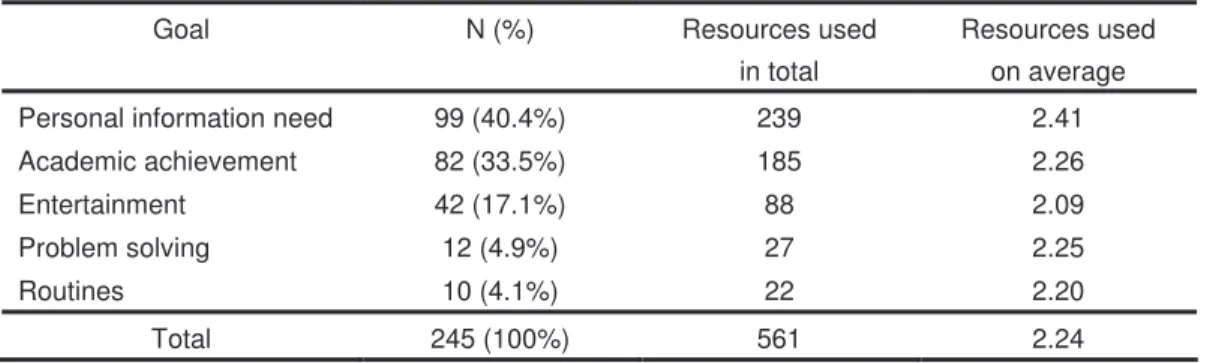
As seen in Table 1, the subjects reported personal information need most frequently (40.4%), followed by
academic achievement (33.5%). Because subjects were asked to select their “most important” information
seeking episodes, routines were not included to a great extent in the diary (4.1%). On average, subjects
employed 2.24 information resources per information seeking episode. It was noted that the number of
information resources employed did not dramatically differ across the types of goals.
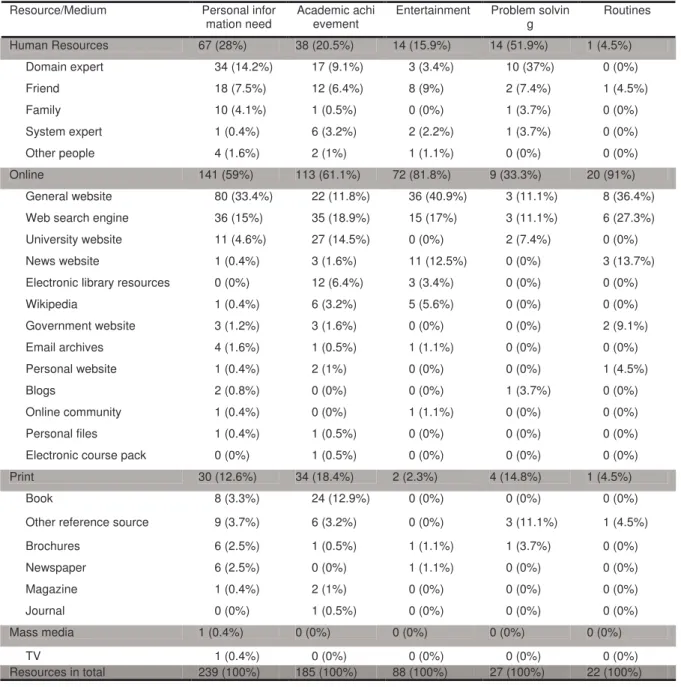
We were interested in comparing how the kinds of information resources or media selected by the subjects
differed with respect to types of goals. Contrary to the general assumption about college students’ information
seeking, online information was not always a primary resource. Although online resources were used more
frequently than human or print resources for most of goals, when the subjects engaged in some problem
solving-related information seeking, they relied on human resources to the greatest extent (51.9%). For
personal information need, they turned to online resources to the extent of 59% while relying on human
resources to the extent of 28%. In cases of academic-related information seeking, the subjects relied on online
resources to the extent of 61.1%, but they still turned to human resources in 20.5% of the cases. The extent of
using print resources varied depending on the types of goals. Not surprisingly, print resources were used most
often for academic-related information seeking (18.4%) and least often for entertainment (2.3%) or routine
(4.5%) goals. It was interesting to note that the subjects employed print resources for problem solving to some
extent (14.8%).
Table 2. Information seeking goals and resources/media selected
Resource/Medium Personal infor
mation need Academic achievement Entertainment Problem solving Routines
Human Resources 67 (28%) 38 (20.5%) 14 (15.9%) 14 (51.9%) 1 (4.5%) Domain expert 34 (14.2%) 17 (9.1%) 3 (3.4%) 10 (37%) 0 (0%) Friend 18 (7.5%) 12 (6.4%) 8 (9%) 2 (7.4%) 1 (4.5%) Family 10 (4.1%) 1 (0.5%) 0 (0%) 1 (3.7%) 0 (0%) System expert 1 (0.4%) 6 (3.2%) 2 (2.2%) 1 (3.7%) 0 (0%) Other people 4 (1.6%) 2 (1%) 1 (1.1%) 0 (0%) 0 (0%) Online 141 (59%) 113 (61.1%) 72 (81.8%) 9 (33.3%) 20 (91%) General website 80 (33.4%) 22 (11.8%) 36 (40.9%) 3 (11.1%) 8 (36.4%)
Web search engine 36 (15%) 35 (18.9%) 15 (17%) 3 (11.1%) 6 (27.3%)
University website 11 (4.6%) 27 (14.5%) 0 (0%) 2 (7.4%) 0 (0%)
News website 1 (0.4%) 3 (1.6%) 11 (12.5%) 0 (0%) 3 (13.7%)
Electronic library resources 0 (0%) 12 (6.4%) 3 (3.4%) 0 (0%) 0 (0%)
Wikipedia 1 (0.4%) 6 (3.2%) 5 (5.6%) 0 (0%) 0 (0%) Government website 3 (1.2%) 3 (1.6%) 0 (0%) 0 (0%) 2 (9.1%) Email archives 4 (1.6%) 1 (0.5%) 1 (1.1%) 0 (0%) 0 (0%) Personal website 1 (0.4%) 2 (1%) 0 (0%) 0 (0%) 1 (4.5%) Blogs 2 (0.8%) 0 (0%) 0 (0%) 1 (3.7%) 0 (0%) Online community 1 (0.4%) 0 (0%) 1 (1.1%) 0 (0%) 0 (0%) Personal files 1 (0.4%) 1 (0.5%) 0 (0%) 0 (0%) 0 (0%)
Electronic course pack 0 (0%) 1 (0.5%) 0 (0%) 0 (0%) 0 (0%)
Print 30 (12.6%) 34 (18.4%) 2 (2.3%) 4 (14.8%) 1 (4.5%)
Book 8 (3.3%) 24 (12.9%) 0 (0%) 0 (0%) 0 (0%)
Other reference source 9 (3.7%) 6 (3.2%) 0 (0%) 3 (11.1%) 1 (4.5%)
Brochures 6 (2.5%) 1 (0.5%) 1 (1.1%) 1 (3.7%) 0 (0%) Newspaper 6 (2.5%) 0 (0%) 1 (1.1%) 0 (0%) 0 (0%) Magazine 1 (0.4%) 2 (1%) 0 (0%) 0 (0%) 0 (0%) Journal 0 (0%) 1 (0.5%) 0 (0%) 0 (0%) 0 (0%) Mass media 1 (0.4%) 0 (0%) 0 (0%) 0 (0%) 0 (0%) TV 1 (0.4%) 0 (0%) 0 (0%) 0 (0%) 0 (0%) Resources in total 239 (100%) 185 (100%) 88 (100%) 27 (100%) 22 (100%)
More interesting results were found within the sub-categories of resources. Probably the most surprising
finding was that web search engines were not necessarily always the most frequently used system for
information finding. For both personal information need and entertainment-related information seeking goals,
subjects selected general websites (33.4% for personal information need and 40.9% for entertainment) more
often than search engines (15% for personal information need and 17% for entertainment). Rather, search
engines (18.9%) were chosen more often than general websites (11.8%) in the cases in which subjects were
looking for academic related information. It is because while the subjects already had their favorite sites for
their personal information needs including sports, shopping, games and entertainment web sites, they may not
have those favorite sites when they had to deal with in academic-related or problem-solving information
seeking. Of online resources, university web sites (14.5%) and electronic library resources (6.4%) were used
more often for academic related information seeking than any other purposes.
It should be noted that human resources were coded regardless of medium of contact: face-to-face, email, or
phone. We believed that emailing someone to ask questions as opposed to obtaining information and
searching on web sites should be differentiated because the former affords interaction with a “real person”
while the latter gives interaction with documents. As Table 2 shows, the subjects relied more frequently on a
“domain expert” than on their own friends for problem solving (37%), personal information need (14.2%), and
academic achievement (9.1%). Domain experts were their professors, teaching assistants, staff members, or
any other people whom they considered as experts in a particular topic area. Friends were the people they
would turn to consistently across all kinds of information seeking goals. Librarians or information professionals,
coded here as “system experts,” were contacted occasionally only for academic-related information seeking
(3.2%).
Types of Information Tasks and Resources/Media Selection
Selections of resources/media were compared with type of task, which was categorized by the kind of
information sought. Tasks were characterized in terms of subject searching, fact retrieval, question answering,
known item searching, and advice/recommendation/opinion seeking. Subject searching refers the cases in
which the individuals looked for the kind of information about a topic that often required them to read,
comprehend, and interpret the content from the information found. In the category of fact retrieval, a fact was
defined as an indisputable truth, which can be numbers of short statements. The category of question
answering was considered as tasks situated between subject searching and fact retrieval. There could be more
than one answer for the question, but the question was not completely open-ended. The known item searching
category refers to the cases in which the individuals already knew that there was such an information object.
Further, they knew some parts of the characteristics of information, such as book title or author name.
Table 3. Information seeking tasks and resources/media used
Task N (%) Resources used
in total Resources used on average Subject searching 89 (37.2%) 207 (37.6%) 2.32 Question answering 87 (36.4%) 179 (32.6%) 2.06 Fact retrieval 24 (10.1%) 62 (11.3%) 2.58
Known item searching 22 (9.2%) 65 (11.8%) 2.95
Advice, recommendations, opinions 17 (7.1%) 37 (6.7%) 2.17
Total 239 (100%) 561 (100%) 2.24
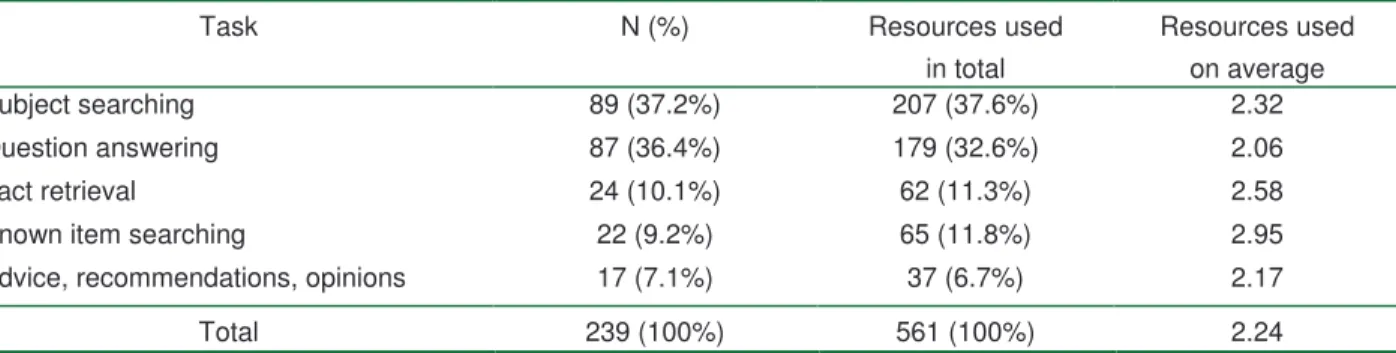
Table 3 summarizes the tasks that the subjects undertook and the number of information resources/media that
they selected to find such information. It turned out that subject searching tasks (37.2%) and question
answering tasks (36.4%) were the two most popular information tasks. On examining whether the subjects
employed more or fewer information resources per information seeking episode depending on information task
type, it was noticed that the subjects employed slightly fewer information resources for question answering
tasks (2.06 on average) than for other types of tasks. Interestingly, the subjects used virtually three different
kinds of resources (2.95) when they conducted known item searching.
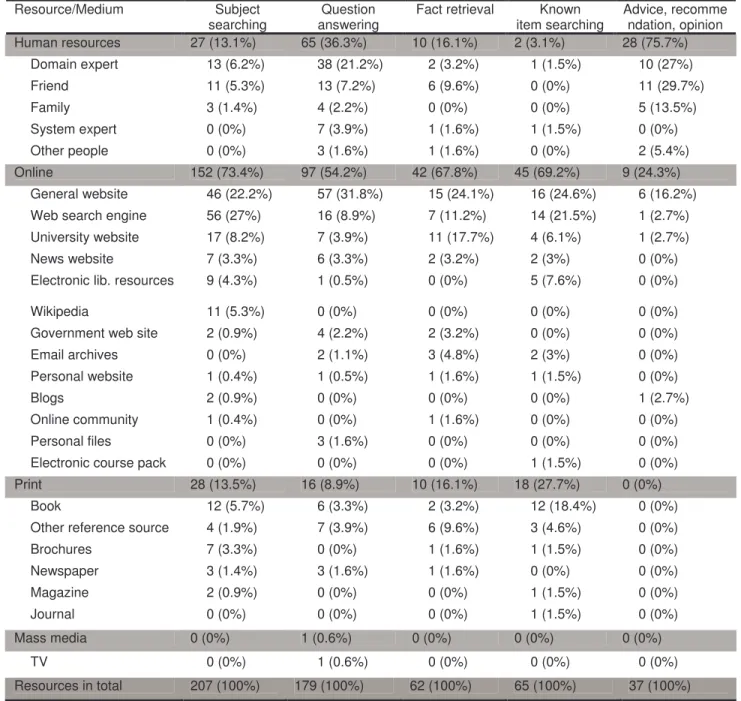
As shown in Table 4, the subjects in this study used human resources and online resources for different
purposes. When looking for advice, recommendation, and opinion, they relied most heavily on human
resources (75.7%). For question answering tasks, they preferred relying on human resources (36.3%) more
often than they did for fact retrieval tasks (16.1%) or subject searching tasks (13.1%). Another interesting
finding is that the subjects turned more frequently to domain experts when looking for answers (21.2%) than
when subject searching (6.2%). When the subjects were looking for advice, recommendation, and opinion,
they were likely turning to friends (29.7%) or domain experts (27%) more often than other people (5.4%) or
family (13.5%). System experts (librarians or information professionals) were chosen relatively more frequently
for the tasks of question answering (3.9%) although subjects in general did not contact them very often.
Table 4. Information seeking tasks and resources/media selected
Resource/Medium Subject
searching answering Question Fact retrieval item searching Known Advice, recommendation, opinion
Human resources 27 (13.1%) 65 (36.3%) 10 (16.1%) 2 (3.1%) 28 (75.7%) Domain expert 13 (6.2%) 38 (21.2%) 2 (3.2%) 1 (1.5%) 10 (27%) Friend 11 (5.3%) 13 (7.2%) 6 (9.6%) 0 (0%) 11 (29.7%) Family 3 (1.4%) 4 (2.2%) 0 (0%) 0 (0%) 5 (13.5%) System expert 0 (0%) 7 (3.9%) 1 (1.6%) 1 (1.5%) 0 (0%) Other people 0 (0%) 3 (1.6%) 1 (1.6%) 0 (0%) 2 (5.4%) Online 152 (73.4%) 97 (54.2%) 42 (67.8%) 45 (69.2%) 9 (24.3%) General website 46 (22.2%) 57 (31.8%) 15 (24.1%) 16 (24.6%) 6 (16.2%)
Web search engine 56 (27%) 16 (8.9%) 7 (11.2%) 14 (21.5%) 1 (2.7%)
University website 17 (8.2%) 7 (3.9%) 11 (17.7%) 4 (6.1%) 1 (2.7%)
News website 7 (3.3%) 6 (3.3%) 2 (3.2%) 2 (3%) 0 (0%)
Electronic lib. resources
9 (4.3%) 1 (0.5%) 0 (0%) 5 (7.6%) 0 (0%)
Wikipedia 11 (5.3%) 0 (0%) 0 (0%) 0 (0%) 0 (0%)
Government web site 2 (0.9%) 4 (2.2%) 2 (3.2%) 0 (0%) 0 (0%)
Email archives 0 (0%) 2 (1.1%) 3 (4.8%) 2 (3%) 0 (0%)
Personal website 1 (0.4%) 1 (0.5%) 1 (1.6%) 1 (1.5%) 0 (0%)
Blogs 2 (0.9%) 0 (0%) 0 (0%) 0 (0%) 1 (2.7%)
Online community 1 (0.4%) 0 (0%) 1 (1.6%) 0 (0%) 0 (0%)
Personal files 0 (0%) 3 (1.6%) 0 (0%) 0 (0%) 0 (0%)
Electronic course pack 0 (0%) 0 (0%) 0 (0%) 1 (1.5%) 0 (0%)
Print 28 (13.5%) 16 (8.9%) 10 (16.1%) 18 (27.7%) 0 (0%)
Book 12 (5.7%) 6 (3.3%) 2 (3.2%) 12 (18.4%) 0 (0%)
Other reference source 4 (1.9%) 7 (3.9%) 6 (9.6%) 3 (4.6%) 0 (0%)
Brochures 7 (3.3%) 0 (0%) 1 (1.6%) 1 (1.5%) 0 (0%) Newspaper 3 (1.4%) 3 (1.6%) 1 (1.6%) 0 (0%) 0 (0%) Magazine 2 (0.9%) 0 (0%) 0 (0%) 1 (1.5%) 0 (0%) Journal 0 (0%) 0 (0%) 0 (0%) 1 (1.5%) 0 (0%) Mass media 0 (0%) 1 (0.6%) 0 (0%) 0 (0%) 0 (0%) TV 0 (0%) 1 (0.6%) 0 (0%) 0 (0%) 0 (0%) Resources in total 207 (100%) 179 (100%) 62 (100%) 65 (100%) 37 (100%)