A Prospective Study of Heart Rate Response
Following Trauma and the Subsequent Development
of Posttraumatic Stress Disorder
Arieh Y. Shalev, MD; Tali Sahar, MSc; Sara Freedman, MA; Tuvia Peri, PhD; Natali Glick, MD; Dalia Brandes, MSc; Scott P. Orr, PhD; Roger K. Pitman, MD
Background: Physiological arousal during traumatic events may trigger the neurobiological processes that lead to posttraumatic stress disorder (PTSD). This study pro-spectively examined the relationship between heart rate and blood pressure recorded immediately following a trau-matic event and the subsequent development of PTSD. Methods:Eighty-six trauma survivors who presentd at the emergency department of a general hospital were fol-lowed up for 4 months. Heart rate and blood pressure were recorded on arrival at the emergency department. Heart rate, anxiety, depression, and PTSD symptoms were assessed 1 week, 1 month, and 4 months later. The cli-nician-administered PTSD scale defined PTSD status at 4 months.
Results:Twenty subjects (23%) met PTSD diagnostic criteria at the 4-month assessment (PTSD group), and
66 (77%) did not (non-PTSD group). Subjects who de-veloped PTSD had higher heart rates at the emergency department (95.5±13.9 vs 83.3±10.9 beats per minute, t=4.4,P<.001) and 1 week later (77.8±11.9 vs 72.0±9.5 beats per minute,t=2.25,P<.03), but not after 1 and 4 months. The groups did not differ in initial blood pres-sure meapres-surement. Repeated-meapres-sures analysis of vari-ance (ANOVA) for heart rate showed a significant group effect (P<.02), time effect (P<.001), and group3time interaction (P<.001). The time effect and group3time interaction remained significant when adjusted for sex, age, trauma severity, immediate response, and dissocia-tion during the traumatic event.
Conclusion:Elevated heart rate shortly after trauma is associated with the later development of PTSD. Arch Gen Psychiatry. 1998;55:553-559
P
OSTTRAUMATIC STRESSdisor-der (PTSD) is a pervasive anxiety disorder that occurs in 15% to 25% of trauma sur-vivors. Symptoms of PTSD have been observed in up to 94% of trauma survivors 1 week following trauma.1Yet the intensity of such symp-toms decreases in most survivors, leav-ing only a few with chronic PTSD.2The mechanism that links exposure to a trau-matic event with the development of PTSD remains largely unidentified.
According to classical conditioning theory, the traumatic event serves as an un-conditioned stimulus that evokes an im-mediate and “hardwired” response from the organism (unconditioned response).3,4 Stimuli associated with the traumatic event then become conditioned stimuli, ca-pable of subsequently eliciting condi-tioned responses in the form of PTSD symptoms (eg, reactivity “upon expo-sure to cues that symbolize or resemble an aspect of the traumatic event”).5 Addition-ally, the avoidance of stimuli associated with the traumatic event may be re-warded by a reduction in distress, and
thereby be reinforced and fail to extin-guish with time.6,7
The intensity of the traumatic event (unconditioned stimulus) has been shown to correlate with the subsequent develop-ment of PTSD.8-11However, it is the reac-tion to the traumatic event at the time of its occurrence (unconditioned response) that may hold the key to the pathogen-esis of PTSD.12,13The psychological com-ponent of the immediate reaction has been the object of a few studies,14,15and is gen-erally believed to contribute to the devel-opment of PTSD above and beyond the in-tensity of the exposure. The physiological component of the response to trauma, however, has received relatively little attention.
Physiological activation during stress-ful events may play a central role in the pathogenesis of PTSD. Peripheral admin-istration of epinephrine immediately af-ter aversive training enhances the consoli-dation of amygdala-mediated learning in animal models.16,17Low cortisol levels fol-lowing rape have been found to be asso-ciated with a higher risk for developing PTSD,18and low corticosterone levels may ORIGINAL ARTICLE
From The Center for Traumatic Stress, Department of
Psychiatry, Hadassah University Hospital, Jerusalem, Israel (Drs Shalev, Peri, and Glick and Mss Sahar, Freedman, and Brandes); and Manchester Veterans Affairs Research Service, Harvard Medical School, Manchester, NH (Drs Orr and Pitman).
prolong the adrenergic response to stress19and enhance the effect of catecholamines on memory consolidation in animals.20
Studying bodily responses to traumatic stress is there-fore of particular interest. It is also important to know whether measurable dimensions of such responses can improve the prediction of PTSD over and above predic-tions made from psychometrics. Our study prospec-tively evaluates the relationship between 2 measures of physiological activation recorded immediately follow-ing the trauma, heart rate and blood pressure, and the subsequent development of PTSD.
RESULTS
DIAGNOSTIC CLASSIFICATION AND DEMOGRAPHIC DATA
Eighty-six trauma survivors (34 women and 52 men) were included in this study. Thirty-three (38%) met diagnostic criteria for PTSD at 1 month, and 20 (23%) had PTSD at the 4-month assessment (PTSD group). Sixty-six (77%) did not have PTSD at 4 months
(non-PTSD group). Traumatic events in the (non-PTSD group included motor vehicle crashes (n=17, 85%), terrorist attacks (n=2, 10%) and a mechanical accident occur-ring at home (n=1, 5%). Traumatic events in the non-PTSD group included motor vehicle crashes (n=53, 80%), work-related accidents (n=5, 7.5%) terrorist attacks (n=4, 6%), mechanical accidents occurring at home (n = 3, 4.5%), and witnessing violence (n = 1, 1.5%). The difference between the groups in type of traumatic events (motor vehicle crashes vs all others) was not statistically significant (x2test, 0.22;P=.64).
Eight PTSD subjects (40%) and 16 non-PTSD subjects (24%) had at least 1DSM-III-RAxis I disorder prior to the traumatic event (x2 test, 1.89; P=.16). Lifetime diagnoses in the PTSD group (more than one per subject allowed) included simple phobia (n=6), social phobia (n=3), major depression (n=3), panic disorder (n=1), bipolar disorder (n=1), and agorapho-bia without panic attacks (n=1). Lifetime diagnoses in the non-PTSD group included major depression (n=6), social phobia (n=5), somatoform disorders (n = 4), simple phobia (n = 1), and panic disorder (n=1).
SUBJECTS AND METHODS
SUBJECTSThe results presented here are part of a large-scale
pro-spective study of the effect of trauma (see Shalev et al21for
discussion of the parent project). Patients arriving at the emergency department of Hadassah University Hospital, Jerusalem, Israel, were recruited into the study during a pe-riod of 2 years. Patients were examined by a research psy-chiatrist and considered for the study if they were be-tween 16 and 65 years of age and had experienced a
traumatic event meeting the criterion A of the
DSM-III-R.22Subject candidates received information about the study,
were invited to participate, and gave written informed con-sent. They were subsequently interviewed 1 week, 1 month, and 4 months after the traumatic event. The follow-up in-terviews included self-reported psychometrics, structured clinical interviews, and assessments of resting heart rate. Blood pressure was measured in the emergency depart-ment but not during follow-up.
To reduce the heart rate and blood pressure variability that might result from severe physical injuries, treatment pro-vided on the way to the hospital (eg, fluid substitution, medi-cation), and different methods of vital sign monitoring in the emergency department (severely injured patients are moni-tored on-line), only patients with mild injuries who did not need surgical intervention and who were released to their homes within 12 hours of emergency department arrival were included. Other exclusion criteria were head injury, current or lifetime abuse of alcohol or illicit drugs (relatively rare in Israel), past or present psychosis, a life-threatening medical illness, and burn injury.
A total of 239 subjects agreed to participate in the par-ent study and 191 (79.9%) completed all 3 follow-up in-terviews. Of these, 105 failed to meet the more stringent
exclusion criteria of the current study, leaving a total of 86 participants (45% of all completers). Subjects who were ex-cluded from this study did not differ from those inex-cluded
in type of traumatic events (83% motor vehicle crashes;x2
test, 0.02;P=.9) and in prior and event-related variables
(ie, age [29.3±10.4 years among excluded patients], num-ber of past traumatic events [4.2±1.8 among excluded pa-tients], event severity [5.0±1.6], Peritraumatic
Dissocia-tion Responses QuesDissocia-tionnaire14(PDEQ) score [18.7±7.6]
and immediate response scores [73.2±27.7]; multivariate
analysis of variance [MANOVA] F5,186=1.56;P=.2). The
sub-groups did not differ in the prevalence of 4-month PTSD
(17% in the parent sample;x2test, 2.54;P=.12), in
1-week and 1-month scores on the Impact of Events Scale23
(IES) (36.4±15.5 and 24.8±15.4, Fs,1), in 1-month scores
on the Mississippi Scale for Combat-Related PTSD–
Civilian Version24(MISS) (70.6±20.7; F,1) and in
1-month scores on the Clinician-Administered PTSD Scale
(CAPS) (23.9±26.2, F,1). Finally, the subgroups did not
differ in heart rate measures at 1 week (75.1±10.3 among
those excluded,t=0.41), 1 month (72.6±9.4,t=0.67) and
4 months (73.0±11.2,t=0.44).
PSYCHOMETRICS
Self-report instruments included the IES, State-Trait
Anxiety Inventory,2 5 (STAI), MISS, PDEQ, an
im-mediate-response questionnaire, and a trauma history questionnaire.
The IES, STAI, and MISS have been used in numer-ous studies of PTSD and other disorders and will not be
described here (see Shalev21for detailed discussion of
psy-chometric properties and predictive power) in this study’s sample. The PDEQ is an 8-item questionnaire about expe-riences related to the construct of dissociation, validated
by Marmar et al14with 238 male Vietnam war veterans and
PSYCHOMETRICS
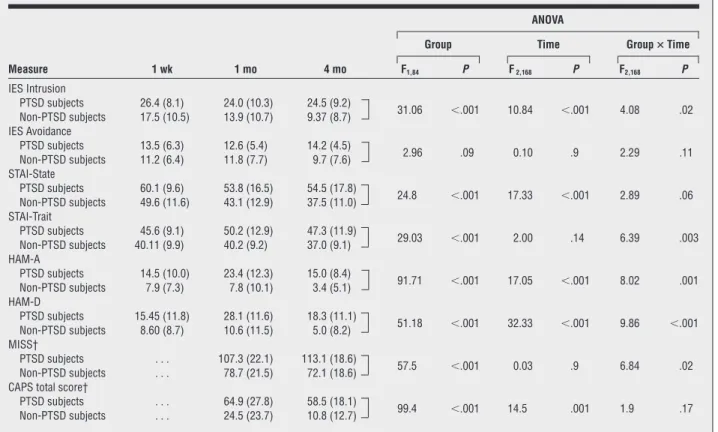
Table 1provides demographic and psychometric infor-mation for the 2 groups. The groups did not differ in the average number of past traumatic events, but did differ in objective ratings of current event severity, self-reported se-verity of the immediate response, and PDEQ (MANOVA F3,81=3.56,P,.02). Group differences at 1 and 4 months are consistent with the group selection procedure and re-flect the presence vs absence of PTSD. More importantly, these differences significantly increased with time (Table 2).
HEART RATE AND BLOOD PRESSURE Differences Between PTSD Subjects
and Non-PTSD Subjects
Repeated-measures ANOVA for heart rate revealed a sig-nificant main effect of diagnostic group (F1,84=5.73, P,.02), a significant main effect of time (F3,252=62.2, P,.001), and a significant group3 time interaction (F3,252=8.71,P,.001).Figure 1illustrates changes in mean heart rate over time.
The PTSD group had higher heart rates in the emer-gency department (96.4±13.9 vs 83.3±10.9 beats per minute;t[84]=4.40;P,.001) and higher 1-week heart rates (77.8±12.9 vs 72.0±9.46 beats per minute; t[84]=2.26;P,.03) than the non-PTSD group.Figure 2 illustrates the distribution of individual heart rate mea-surements in the emergency department and 1 week later, showing an overlap between the groups and the lack of remote outliers in the PTSD group. The groups did not differ in 1-month heart rate measurements (74.06±12.8 vs 74.02±10.52 beats per minute;t[84]=0.02) or in 4-month heart rate measurements (72.7±13.3 vs 72.2±9.78 beats per minute;t[84]=0.21). The groups did not dif-fer in emergency department systolic (139.8±24.9 vs 128.2±17.8 mm Hg;t[84]=0.53) or diastolic (79.8±12.4 vs 78.5±9.04 mm Hg,t=0.52) blood pressure.
Controlling for Prior Variables, Event Severity, and Immediate Responses
Repeated-measures ANCOVA for heart rate (emergency department, 1 week, 1 month, and 4 months), using PTSD as grouping factor and controlling for sex, age, past Axis The immediate-response questionnaire included 14 items
that assessed the intensity of physical (eg, pain), emotional (eg, fear, anger), and negative cognitive (eg, expectation of doom) experiences during the event. Each item was rated from 1 to 10 (1=none, 10=highest possible intensity), yielding re-sponse intensity scores ranging from 10 to 140.
The trauma history questionnaire26assessed the
na-ture and number of previously experienced traumatic events (eg, natural and man-made disasters, war, motor vehicle crashes, rape, physical assault, and others). The number of distinct traumatic events endured by each subject con-stituted the questionnaire’s score.
In addition to the above, 12 mental health profession-als, blinded as to subjects’ PTSD status, listened to audio-taped scripts describing each of the traumatic events (for
detailed procedure see21,26-28) and independently rated the
severity of the traumatic event on a 1 to 10 scale (1=not severe at all, 10=extreme severity). The average score of the 12 observers is reported.
STRUCTURED CLINICAL INSTRUMENTS
These included Hebrew versions of the Hamilton
Depres-sion and Hamilton Anxiety scales,29CAPS,30and the
Struc-tured Clinical Interview forDSM-III31(SCID). All
instru-ments had been previously validated and used in studies
of PTSD,15,28,32,33and all were administered by clinicians
(D.B., S.F., T.P., and A.S.) with extensive experience in PTSD diagnosis and treatment. The PTSD status at 4 months was
determined according toDSM-III-Rcriteria as measured by
the CAPS. Current and lifetime diagnoses of other mental disorders were identified via the SCID.
HEART RATE AND BLOOD PRESSURE
Heart rate and blood pressure were obtained from all patients on presentation to the emergency department. A
registered nurse, using a vital signs monitor (Critikon Dynamap, Tampa, Fla), measured and then immediately transcribed these measures into the patient’s medical record. During subsequent assessments, resting heart rate was recorded as part of a larger study of responses to auditory startle in the psychophysiological laboratory of the Center for Traumatic Stress, Hadassah University Hospital, according to a previously described
proce-dure.33,34 A Coulbourn Modular Instrument System
(Coulbourn Inc, Allentown, Pa), interfaced with a per-sonal computer through a Coulbourn Lablinc Computer Interface was used to record heart rate via standard limb electrocardiogram leads connected to a high-gain bioam-plifier and inputting to a Coulbourn Tachometer. The analog signal was sampled and digitized by a Coulbourn Lablinc Analog-to-Digital Converter at a rate of 2 Hz.
The laboratory sessions took place in an 3.232.4-m
humidity- and temperature-controlled room, connected via wires to an adjoining portion of the laboratory in which the experimental apparatus was located. The ject was seated in a comfortable armchair. After the sub-ject was familiarized with the laboratory, the electrodes were attached, and he or she was asked to sit quietly for 5 minutes. Heart rates were sampled continuously dur-ing this period and averaged to yield a measure of rest-ing heart rate.
STATISTICAL ANALYSIS
Statistical analyses follow the general linear model for group
comparisons (ANOVAs and MANOVAs), group3time
comparisons (repeated-measures ANOVA), control of con-founds (analysis of covariance [ANCOVA]), and analyses of multiple correlations (multiple regression). Logistic
re-gression was used to assess the prediction of PTSD. Ana
level of .05 conferred statistical significance. All values are given as mean±SD unless otherwise indicated.
I disorders (as a dummy 0,1 variable), event severity, re-sponse severity, and peritraumatic dissociation, yielded a nearly significant group effect (F1,77=2.94,P=.09), a sig-nificant main effect of time (F3,249=61.06,P<.001), and a significant group3time interaction (F3,249=8.63,P<.001). The adjusted mean heart rate in the emergency depart-ment was 95.1 beats per minute for PTSD subjects and 84.7 beats per minute for non-PTSD subjects (F1,78=10.92, P<.002). The adjusted mean heart rate at 1 week was 77.3 beats per minute for PTSD subjects and 72.6 beats per minute for non-PTSD subjects (F1,78=2.78,P=.09).
Correlations Between Emergency Department Heart Rate and Other Measures
Prior Variables.Heart rate levels in the emergency de-partment were higher in male (88.6±13.6 beats per minute) than in female subjects (82.9±11.03 beats per minute). Two-way ANOVA failed to show a sex3PTSD interaction (F1,82=0.11), while showing a significant main effect of PTSD (F1,82=16.75,P<.001) and a trend toward a main effect of sex (F1,82=3.39,P<.07). The correlations with age and with peritraumatic dissociation were not significant.
Table 1. Means and SDs of Demographic and Psychometric Variables in PTSD Subjects and Non-PTSD Subjects*
PTSD Subjects (n = 20) Non-PTSD Subjects (n = 66) t (df = 84) P Demographic variables Age, y 27.4 (10.6) 27.3 (10.5) 0.04 .96 Sex, M/F 13/7 53/13 0.22* .6
No. of past traumatic experiences† 4.1 (2.1) 3.92 (3.0) 0.24 .8 Event-related variables
Event severity 6.2 (2.09) 4.9 (1.25) 3.28 .002
Immediate response 80.7 (32.9) 66.1 (27.2) 2.00 .05 Peritraumatic dissociation (PDEQ)‡ 22.6 (10.4) 19.7 (7.0) 1.46 .14 *x2Test.
†Number of past traumatic experiences as assessed by the Trauma History Questionnaire. ‡PDEQ indicates Peritraumatic Dissociation Responses Questionnaire.14
Table 2. Means, SDs, and Repeated-Measures Analyses of Variance (ANOVA) of Psychometric Measures*
Measure 1 wk 1 mo 4 mo
ANOVA
Group Time Group3Time
F1,84 P F2,168 P F2,168 P IES Intrusion PTSD subjects 26.4 (8.1) 24.0 (10.3) 24.5 (9.2) 31.06 ,.001 10.84 ,.001 4.08 .02 Non-PTSD subjects 17.5 (10.5) 13.9 (10.7) 9.37 (8.7) IES Avoidance PTSD subjects 13.5 (6.3) 12.6 (5.4) 14.2 (4.5) 2.96 .09 0.10 .9 2.29 .11 Non-PTSD subjects 11.2 (6.4) 11.8 (7.7) 9.7 (7.6) STAI-State PTSD subjects 60.1 (9.6) 53.8 (16.5) 54.5 (17.8) 24.8 ,.001 17.33 ,.001 2.89 .06 Non-PTSD subjects 49.6 (11.6) 43.1 (12.9) 37.5 (11.0) STAI-Trait PTSD subjects 45.6 (9.1) 50.2 (12.9) 47.3 (11.9) 29.03 ,.001 2.00 .14 6.39 .003 Non-PTSD subjects 40.11 (9.9) 40.2 (9.2) 37.0 (9.1) HAM-A PTSD subjects 14.5 (10.0) 23.4 (12.3) 15.0 (8.4) 91.71 ,.001 17.05 ,.001 8.02 .001 Non-PTSD subjects 7.9 (7.3) 7.8 (10.1) 3.4 (5.1) HAM-D PTSD subjects 15.45 (11.8) 28.1 (11.6) 18.3 (11.1) 51.18 ,.001 32.33 ,.001 9.86 ,.001 Non-PTSD subjects 8.60 (8.7) 10.6 (11.5) 5.0 (8.2) MISS† PTSD subjects . . . 107.3 (22.1) 113.1 (18.6) 57.5 ,.001 0.03 .9 6.84 .02 Non-PTSD subjects . . . 78.7 (21.5) 72.1 (18.6)
CAPS total score†
PTSD subjects . . . 64.9 (27.8) 58.5 (18.1)
99.4 ,.001 14.5 .001 1.9 .17 Non-PTSD subjects . . . 24.5 (23.7) 10.8 (12.7)
*IES indicates Impact of Events Scale; PTSD, posttraumatic stress disorder; STAI, State-Trait Anxiety Scale; HAM-A, Hamilton Anxiety Scale; HAM-D, Hamilton Depression Scale; MISS, Mississippi Rating Scale for Combat-Related PTSD–Civilian Version; CAPS, Clinician-Administered PTSD Scale; and ellipses, not applicable.
Trauma-Related Variables.Heart rate levels in the emer-gency department showed a small but significant corre-lation with systolic blood pressure (r=0.24,P<.03), di-astolic blood pressure (r=0.32,P<.01), event severity (r=0.36, P<.001), and immediate response (r=0.26, P<.02).
Continuous Outcome Variables.Heart rate scores in the emergency department produced significant corre-lation with 4-month IES Intrusion subscale scores (r= 0.43, P<.001) IES Avoidance subscale scores (r=0.28, P=.02), STAI-State scores (r=0.31, P<.01), MISS scores (r=0.24,P=.03), and total CAPS score (r=0.31,P<.005). Systolic and diastolic blood pressure did not correlate significantly with any of the 4-month variables.
Predicting PTSD From Prior Variables, Immediate Responses, and Heart Rate
Stepwise hierarchical logistic regression, estimating the effects of sex, age, trauma history, event severity, imme-diate response, dissociation, and initial (emergency de-partment) heart rate (in that order) on 4-month PTSD status showed a significant effect of event severity (x2test, 0.01;P<.04) and a significant additional effect (increase inx2test, 9.97;P=.002) of initial heart rate (totalx2test, 20.37;P=.005), with no other variable contributing sig-nificantly to 4-month PTSD.
COMMENT
The results of this study showed that on arrival to an emergency department following a traumatic event, and regardless of whether PTSD developed, survivors of traumatic events showed elevated heart rates, which later normalized. Survivors who subsequently devel-oped PTSD showed higher emergency department and 1-week heart rates than those who did not. The heart rate difference between diagnostic groups was not accounted for by rated intensity of the trauma nor by self-reported responses. This finding suggests that heart rate expresses a dimension of the response to traumatic events that is not entirely captured by psychometrics.
Initial blood pressure measurements did not differenti-ate the groups, nor did they correldifferenti-ate with any of the outcome measures.
There are several limitations to this study, mostly resulting from its “naturalistic” design. First, while all subjects had come to the emergency department directly from the site of their trauma, the exact timing of their arrival relative to the time of their traumatic incident was unavailable. However, traumatic events are not limited to the impact phase but often include the evacuation phase as well. Second, heart rate levels in the emergency department were obtained by single measurement, while those obtained at 1 week represent an average of 5 minutes of continuous recording. How-ever, the persistence of higher heart rate levels at 1 week in PTSD supports the validity of the study’s main finding. Data on blood pressure, in contrast, rely on a single measurement.
Within the above-mentioned conditioning model, the finding of elevated heart rate in the emergency department in the PTSD group may be interpreted as reflecting higher intensity of the unconditioned re-sponse. Theoretically, excessive adrenergic activation may contribute to the development of PTSD through enhanced memory consolidation of the traumatic event (unconditioned stimulus).4,19The lack of blood pres-sure elevation in this study, despite heart rate increase, suggests a mainly adrenergic as opposed to noradrener-gic activation.
Our study does not exclude a possible effect of a prior trait (eg, hyperresponsiveness) on both heart rate response and the development of PTSD. Posttraumatic stress disorder has been associated with increased physiological responses to trauma-related cues3,27,28,35-37 and to other stimuli, including loud tones33,34; nontrau-matic stressors, such as waiting to receive medical treat-ment38; and chemical stimulation, such as yohimbine
24 20 16 12 PTSD No PTSD 8 4 0 No. of Cases 24 20 16 12 8 4 0 No. of Cases 58-63 52-57 ≤51 70-75 76-81
Frequency Distribution of Heart Rate Scores at 1 wk Frequency Distribution of Heart Rate Scores in the Emergency Department
64-69 82-87 88-93 94-99 >99
73-78 66-72
<66 79-84 85-90 91-96 97-102103-108109-114 >114
Heart Rate (Deciles, Beats per Minute)
Figure 2.Frequency distribution of heart rate scores in the emergency department and 1 week later. PTSD indicates posttraumatic stress disorder.
120 110 100 90 80 70 60 50 Emergency Department 1 wk 1 mo PTSD (n=20) No PTSD (n=66) 4 mo Time
Heart Rate, Beats per Minute
Figure 1.Means and SDs of heart rates in subjects with and without posttraumatic stress disorder (PTSD).
administration.39Hypothetically, increased physiologi-cal responsiveness may precede the traumatic event, be expressed during the event, and become part of PTSD after the trauma. The source of such hyperresponsive-ness may be genetic. A twin study of Vietnam veterans has shown that about 30% of the liability to developing PTSD symptoms of hyperarousal and avoidance are accounted for by heredity.40Alternatively, the elevated heart rate responses in PTSD patients may reflect the priming effect of earlier traumatization or a combina-tion of inherited vulnerability and lifetime exposure. A family history of mental disorders has been associated with increased likelihood of both exposure to traumatic events and of developing PTSD on such exposure.41
Interestingly, the heart rate responses of the 2 groups overlapped (Figure 2) and were not extreme. This find-ing does not support theories postulatfind-ing that PTSD typically results from “extreme” or “catastrophic” re-sponses to stress.42Indeed, these results are in line with previous research showing that moderate sympathetic ac-tivation has a greater effect on learning and memory than more extreme activation.17
Despite increasing differences in symptom inten-sity, the 2 study groups had similar resting heart rates 1 and 4 months after trauma. This may reflect a slow return to baseline following the trauma and/or habitua-tion to the laboratory setting. Studies of resting heart rate in PTSD37are often confounded by an expectation of a stressful task, such as psychophysiological testing. Conversely, when PTSD subjects were maintained in supine position for 30 minutes without an expectation of a challenge, their heart rate, blood pressure, and plasma norepinephrine levels were not found to differ from those of controls.43Accordingly, Prins et al35 con-cluded that baseline heart rate may not be higher in PTSD. It is possible that in the emergency department and during the first visit to the laboratory, PTSD sub-jects reacted as toward a challenge, and therefore showed higher heart rate levels. By their second and third visits to the laboratory, however, they may have became accustomed to the setting and learned that they were not in a threatening environment, so that no dif-ferences were seen.
Previous studies have suggested that an altera-tion in noradrenergic brain funcaltera-tions may exist in chronic PTSD.36,37,39This study does not address central noradrenergic mechanisms, nor those through which peripheral hormones affect central catecholamines and memory consolidation. The effect of peripheral epi-nephrine on memory may be mediated through the brainstem nucleus of the solitary tract, projecting into the locus ceruleus,44or through epinephrine-related increase in circulating glucose levels.17Future prospec-tive studies should explore such endocrine and meta-bolic variables shortly after trauma. They should also address the interaction between circulating catechol-amines and cortisol during acute stress43 and its rela-tionship with subsequent PTSD.
Accepted for publication September 4, 1997.
This research was supported by grant MH-50379 from the US Public Health Service, Washington, DC.
Reprints: Arieh Y. Shalev, MD, Department of Psy-chiatry, Hadassah University Hospital, PO Box 12000, Jerusalem 91120, Israel.
REFERENCES
1. Rothbaum BO, Foa EB. Subtypes of posttraumatic stress disorder and duration of symptoms. In: Davidson JRT, Foa EB, eds.Posttraumatic Stress Disorder: DSM-IVand Beyond. Washington, DC: American Psychiatric Press; 1993: 23-35.
2. Kesslar RC, Sonega A, Bromet E, Hughes M, Nelson CB. Posttraumatic stress disorder in the National Comorbidity Survey.Arch Gen Psychiatry. 1995;52: 1048-1060.
3. Kolb LC, Multipassi LR. The conditioned emotional response: a subclass of the chronic and delayed posttraumatic stress disorder.Psychiatr Ann. 1982;12: 979-987.
4. Pitman RK. Posttraumatic stress disorder, hormones, and memory.Biol Psy-chiatry. 1989;26:221-223.
5. American Psychiatric Association. Diagnostic and Statistical Manual of Mental Disorders, Fourth Edition. Washington, DC: American Psychiatric Association; 1994.
6. Mowrer OH.Learning Theory and Behavior. New York, NY: John Wiley & Sons; 1960.
7. Keane TM, Zimmering RT, Caddell JM. A behavioral formulation of post-traumatic stress disorder in Vietnam veterans.Behav Ther. 1985;8:9-12. 8. Foy DW, Rueger DB, Sipprelle RC, Carroll EM. Etiology of posttraumatic stress
disorder in Vietnam veterans: analysis of premilitary, military, and combat ex-posure influences.J Consult Clin Psychol. 1984;52:79-87.
9. Breslau N, Davis GC. Posttraumatic stress disorder: the stressor criterion.J Nerv Ment Dis. 1987;175:255-264.
10. Goldberg J, True WR, Eisen SA, Henderson WG. A twin study of the effects of the Vietnam war on posttraumatic stress disorder.JAMA. 1990;263: 1227-1232.
11. March JS. What constitutes a stressor? the criterion A issue in posttraumatic stress disorder. In: Davidson JRT, Foa EB, eds.Posttraumatic Stress Disorder: DSM-IVand Beyond. Washington, DC: American Psychiatric Press; 1993: 37-54.
12. Feinstein A, Dolan R. Predictors of post-traumatic stress disorder following physi-cal trauma: an examination of the stressor criterion.Psychol Med. 1991;21: 85-91.
13. Perry S, Difede J, Musngi G, Frances AJ, Jacobsberg L. Predictors of post-traumatic stress disorder after burn injury.Am J Psychiatry. 1992;149: 931-935.
14. Marmar CR, Weiss DS, Schlenger WE, Fairbank JA, Jordan BK, Kulka RA, Hough RL. Peritraumatic dissociation and posttraumatic stress in male Vietnam the-ater veterans.Am J Psychiatry. 1994;151:902-907.
15. Shalev AY, Peri T, Canetti L, Schreiber S. Predictors of PTSD in injured trauma survivors: a prospective study.Am J Psychiatry. 1996;153:219-225. 16. McGaugh JL, Liang KC, Bennet C, Sternberg DB. Adrenergic influence on memory
storage: interaction of peripheral and central systems. In: Lynch G, McGaugh JL, Weinberger NM, eds.Neurobiology of Learning and Memory. New York, NY: Guilford Press; 1984:313-332.
17. Gold PE, McCarthy RC. Stress regulation of memory processes: role of periph-eral catecholamines and glucose. In: Friedman MJ, Charney DS, Deutch AY, eds. Neurobiological and Clinical Consequences of Stress. Philadelphia, Pa: Lippincott-Raven Publishers; 1995:151-162.
18. Resnick HS, Yehuda R, Pitman RK, Foy DW. Effect of previous trauma on acute plasma cortisol level following rape.Am J Psychiatry. 1995;152: 1675-1677.
19. Munck A, Guyre PM, Holbrook NJ. Physiological functions of glucocorticoids in stress and their relation to pharmacological actions.Endocr Rev. 1984;93: 9779-9783.
20. Bohus B. Humoral modulation of learning and memory processes: physiologi-cal significance of brain and peripheral mechanisms. In: Delacour J, ed.The Memory System of the Brain. Singapore: World Scientific; 1984:337-364.
21. Shalev AY, Freedman S, Peri T, Brandes D, Sahar T. Predicting PTSD in civilian trauma survivors: prospective evaluation of self report and clinician adminis-tered instruments.Br J Psychiatry. 1997;170:558-564.
22. American Psychiatric Association.Diagnostic and Statistical Manual of Mental Disorders, Revised Third Edition. Washington, DC: American Psychiatric Asso-ciation; 1987.
23. Horowitz M, Wilner N, Alvarez W. Impact of Events Scale: a measure of subjec-tive stress.Psychosom Med. 1979;41:209-218.
24. Keane TM, Caddell JM, Taylor KL. Mississippi Scale for Combat-Related Post-traumatic Stress Disorder: three studies in reliability and validity.J Consult Clin Psychol. 1988;56:85-90.
25. Speilberger CD.Manual for State-Trait Anxiety Inventory. Palo Alto, Calif: Con-sulting Psychologists Press; 1983.
26. Green BL. Psychometric review of Trauma History Questionnaires (Self Re-port). In: Stamm BH, ed.Measurement of Stress, Trauma, and Adaptation. Luther-ville, Md: Sidran Press; 1996.
27. Pitman RK, Orr SP, Forgue DF, de Jong JB, Claiborn JM. Psychophysiological assessment of posttraumatic stress disorder imagery in Vietnam combat veter-ans.Arch Gen Psychiatry. 1987;44:970-975.
28. Shalev AY, Orr SP, Pitman RK. Psychophysiologic assessment of traumatic im-agery in Israeli civilian patients with post-traumatic stress disorder.Am J Psy-chiatry. 1993;50:620-624.
29. Hamilton M. A rating scale for depression.J Neurol Neurosurg Psychiatry. 1960; 23:56-62.
30. Blake DD, Weathers FW, Nagy LM, Kaloupek DG, Klauminzer G, Charney DS, Keane TM. A clinician rating scale for assessing current and lifetime PTSD: the CAPS-1. Behav Ther. 1990;13:187-188.
31. Spitzer RL, Williams JBA, Gibbon M.Structured Clinical Interview for DSM-III-R:Patient Version. New York, NY: New York State Psychiatric Institute; 1987. 32. Solomon Z, Benbenishty R, Neria Y, Abramowitz M, Ginzburg K, Ohry A. As-sessment of PTSD: validation of the revised PTSD Inventory.Isr J Psychiatry Relat Sci. 1993;30:110-115.
33. Shalev AY, Orr SP, Peri T, Schreiber S, Pitman RK. Physiologic responses to loud tones in Israeli posttraumatic stress disorder patients.Arch Gen Psychiatry. 1992; 49:870-875.
34. Orr SP, Lasko N, Shalev A, Pitman RK. Physiologic responses to loud tones in Vietnam veterans with PTSD.J Abnorm Psychol. 1995;104:75-82. 35. Prins A, Kaloupek DG, Keane TM. Psychophysiological evidence for autonomic
arousal and startle in traumatized adult populations. In: Friedman MJ, Charney DS, Deutch AY, eds.Neurobiological and Clinical Consequences of Stress. Phila-delphia, Pa: Lippincott-Raven Publishers; 1995:291-314.
36. Murburg MM, McFall ME, Veith RC. Basal sympathoadrenal function in patients with PTSD and depression. In: Murburg MM, ed.Cathecholamine Function in Posttraumatic Stress Disorder: Emerging Concepts. Washington, DC: American Psychiatric Press; 1994:175-188.
37. McFall ME, Murburg MM. Psychophysiological studies of combat-related PTSD: an integrated view. In: Murburg MM, ed.Cathecholamine Function in Posttrau-matic Stress Disorder: Emerging Concepts. Washington, DC: American Psychi-atric Press; 1994:161-173.
38. Geraradi RJ, Keane TM, Cahoon BJ, Klauminzer GW. An in vivo assessment of physiological arousal in posttraumatic stress disorder.J Abnorm Psychol. 1994; 103:825-827.
39. Southwick SM, Krystal JH, Morgan CA, Johnson D, Nagy LM, Nicolaou A, Heninger GR, Charney DS. Abnormal noradrenergic function in posttraumatic stress dis-order.Arch Gen Psychiatry. 1993;50:266-274.
40. True WR, Rice J, Eisen SA, Heath AC, Goldberg J, Lyons MJ, Nowak J. A twin study of genetic and environmental contributions to liability for posttraumatic stress symptoms.Arch Gen Psychiatry. 1993;50:257-264.
41. Breslau N, Davis GC, Andreski P, Peterson E. Traumatic events and posttrau-matic stress disorder in an urban population of young adults.Arch Gen Psychia-try. 1991;48:216-222.
42. Hobfoll SE.The Ecology of Stress. New York, NY: Hemisphere Publishing Cor-poration; 1988.
43. McFall ME, Veith RC, Murburg MM. Basal sympathoadrenal function in PTSD. Biol Psychiatry. 1992;31:1050-1056.
44. Williams CL, McGaugh JL. Reversible inactivation of the solitary tract impairs retention performance in an inhibitory avoidance task.Behav Neural Biol. 1992; 58:204-210.
Announcement
Free Patient Record Forms Available
Patient record forms are available free of charge to ARCHIVESreaders by calling or writing FORMEDIC, 12D Worlds Fair Dr, Somerset, NJ 08873-9863, telephone (908) 469-7031.