A Lightweight RFID Security Protocol Based on
Elliptic Curve Cryptography
Quan Qian, Yan-Long Jia, Rui Zhang
(Corresponding author: Quan Qian)School of Computer Engineering & Science, Shanghai University 99 Shangda Rd., Baoshan District, Shanghai, China
(Email: [email protected])
(Received Nov. 12, 2013; revised and accepted Mar. 13 & Nov. 6, 2014)
Abstract
Radio Frequency Identification (RFID) is a promising new technology that is widely deployed for object track-ing and monitortrack-ing, tickettrack-ing, supply-chain management, contactless payment, etc. However, RFID related security problems attract more and more attentions. This paper has studied a novel elliptic curve cryptography (ECC) based RFID security protocol and it shows some great features. Firstly, the high strength of ECC encryption provides convincing security for communication and tag memory data access. Secondly, the public-key cryptog-raphy used in the protocol reduces the key storage re-quirement and the backend system just store the private key. Thirdly, the new protocol just depends on simple calculations, such as XOR, bitwise AND, and so forth, which reduce the tag computation. Finally, the compu-tational performance, security features, and the formal proof based on BAN logic are also discussed in detail in the paper.
Keywords: BAN logic, elliptic curve cryptography, RFID security protocol
1
Introduction
Internet of Things (IoT) refers to uniquely identifiable ob-jects and their virtual representations in an Internet-like structure [30]. In IoT, each kind of sensor equipment, such as RFID (Radio-frequency identification), barcodes, two-dimension code, QR codes, GPS, etc. can integrate with Internet to get a huge network. Among them, RFID was seen as a prerequisite for the Internet of Things. If all objects and people in daily life were equipped with iden-tifiers, they could be managed and interacted effectively. IoT has been regarded as the another technological revo-lution after Internet. For instance, the Intelligent Earth, Sensing China, U-Japan, IT839 of Korea has been pushed the IoT to a unprecedented level whether in application or research field [4]. However, with the fast development
of IoT, the security issues have brought some negative in-fluence, which has attracted the industry or scientific re-search to this hot area. Among them, the RFID security is the at the top list of primary concerns and RFID sys-tems must need severval security requirements [7, 19, 32]. So far, there are some research results in this area.
Sarma proposed a Hash-lock RFID security proto-col, which has been the basis for research on challenge-response hash encryption based RFID protocols [23, 24]. [27] is another hash function based mutual authenti-cation protocol. Lin presented a random sequence based RFID protocol, which use hash function and random se-quences to guarantee the freshness of the authentication message [13]. But to some extent, the security strength largely depends on the random sequence length. And be-cause of the cost limit of tag, the sequence length is not very long, which limits the security. Molnar proposed a David Library RFID protocol [17]. Although this proto-col has almost no security vulnerability in design, but it requires the tag has the function of generating random numbers, which limits the protocol use in low cost tags. Wu et al. improved the digital library RFID security pro-tocol, and changed the security assumptions of the orig-inal protocol which can be compatible with the origorig-inal one but resists new attacks [31]. Some light weight and low cost RFID authentications are provided in [18, 20, 29]. Similar to [1], the protocol’s security heavily relies on the synchronous update between the back end database and the tag. Once there occurs abnormal in authentication (e.g. power interruption), the information will appear not synchronous, resulting in the tag not available. More-over, the protocol is too computation complicated, fac-ing challenges in terms of reliability. Khan and Moessner use a light weight computation and the protocol provide the synchronization and security by timestamp [10]. The main feature of the protocol lies in the back end database, which use a special Key-Class data structure, can find the target ID efficiently. But the protocol also has some dis-advantages. Firstly, the mutual authentication is not too ideal. Secondly, the tag should not only generate random
number, but also save a certain amount of privacy data, which make it not applicable for low cost tags. Khedr proposed an authentication scheme for passive RFID tags combining a random key scheme with a strong cryptogra-phy [11]. And Wei et al. provided a improved authenti-cation protocol for mobile agent device for RFID privacy protection [28]. Sun et al presents a RFID protocol based on cryptographic hash function, which mainly focuses on preventing an attacker tracking a target tag by observing unsuccessful previous session, that is the forward privacy service [26]. Moreover, the proposed RFID protocol is evaluated according to both the privacy attribute and the implementation performance.
Concerning about the ECC based RFID protocols, Martinez focuses on the protocol’s scalability [15]. The protocol combines ECC and zero knowledge authentica-tion, and the forward security is quite reliable. Martinez proposed an elliptic curve and zero knowledge based for-ward secure RFID protocol [14], which can resist some common attacks, but there is a higher demand on tag computation ability. [9] also make use of ECC, but the key synchronization policy is not perfect. Besides that, the protocol, similar to [15], requires the tag to generate the random key and can do scalar multiplication. Batina et al. put forward a public-key cryptography for RFID tags [5], which provides online and offline, the two ways of authentication. However, at the online phase, the tag use plaintext communication and at the offline phase, the tag need to do some complicated computations. It is not suitable for those low cost tags. Kumar et al introduce some implementation details of ECC hardware and dis-cuss the performance factors on the chip size, memory and computation time [12]. Babaheidarian et al analyze the ECC-based RFID authentication protocols known as EC-RAC [3]. It mainly focuses on the reasons why some ver-sions of EC-RAC protocols are exposed to privacy and/or security threats.
As mentioned above, some research have been con-ducted in RFID security protocols, as space limited we cannot described them one by one. In this paper, we propose an ECC based RFID security protocol. The con-tributions of the protocol are: (1) all sensitive information are encrypted by ECC, which ensure the confidentiality of transmitted information. (2) The computations involved are not too complicated that can been applied to low cost tags. (3) Due to the random number generated by the reader constantly updated, the corresponding authenti-cation messages change continuously, which increase the difficulties for adversaries to decode them.
The organization of the paper are as follows. Section 2 presents the main idea of our ECC based RFID security protocol, including the protocol description and authen-tication process. Section 3 discusses the correctness from the points of tag and reader authentications. The proto-col security will be discussed in section 4 and the formal proof with BAN logic in Section 5. Finally, the Section 6 gives a conclusion and the future work.
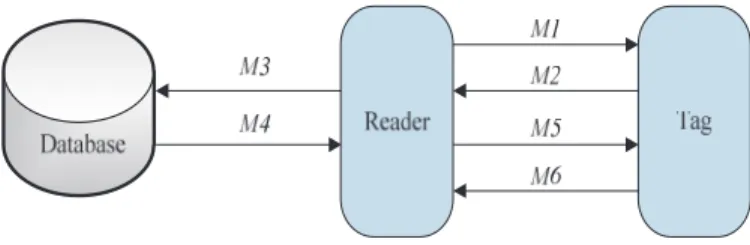
Figure 1: An ECC based RFID secure protocol model. Here, M1 : {Query, R}; M2 : {ECC(M(id)) +R,Pt+
R}; M3 :{ECC(M(id)) +R,Pt+R, R}; M4 :{H(id)⊕
Kx,(Kx+Rx)⊕H(id
0
)};M5 :{H(id)⊕Kx,(Kx+Rx)⊕
H(id0)};M6 :{ECC(M(data)) +R,Pt+R}.
2
ECC-based RFID Security
Pro-tocol
Generally speaking, the designing goal of RFID security protocol is to implement the authentication and secure communication, which includes ensuring the integrity, confidentiality and security of the user secret informa-tion. At the same time, the protocol itself can resist the adversary sniffing, deleting, tampering or other malicious operation on the tag data. In addition, the protocol can resist the RFID common attacks, such as replaying, loca-tion tracking, denial of service, etc. The procedure of our protocol is illustrated in Figure 1.
In Figure 1, there are six messages interacted among three participants, the tag, reader and the backend database. Among different messages, Ps = n∗G, Ps
is the database public key and n is the database private key. Similarly, inPt=t∗G,tis the tag’s private key, and
Ptis the tag’s public key. InK=r∗G,ris the database
temporary communication key, andK is the temporary public key. Kx, Rx is the x-coordinate of pointK andR
on ecliptic curve.
Furthermore, in Figure 1, M(x) refers to encode in-formation x to a point on ecliptic curve. ECC(m) =
m+r×P, where r is the private key of sender, m the message to be sent,P the public key of the receiver. The backend database need to choose a private keyn(n < m,
nis a big integer) and to create the public keyP =n×G. The sensitive date of tag, for instance, the tagIDand the privacy data, are encoded to a point (x, y) on the ecliptic curve.
2.1
Protocol Description
ECC is an approach to public-key cryptography based on algebraic structure of elliptic curves over finite fields. For current cryptographic purposes, suppose choosing a ecliptic curve in the finite fieldFq, any point inFq, (x, y)∈
Fq∗Fq must satisfy the following equation:
y2≡x3+ax+b(mod q)
where, the elliptic curve group is made up of non-negative integer solutions P less than q, P = (x, y) and infinite
point 0. aandb are constants that satisfy 4a3+ 27b26= 0(mod q) and Fq(q > 3). To choose a base point G =
(x, y) inEq(a, b), and this base point satisfy the condition
that exists a minimum positive integer m (mis a big prime number), letmG=O∞(mis regarded as theG0sorder).
In our protocol, hash function is very important, where some lightweight algorithms can be used [2, 25]. SQUASH is a quite simple hash method [25], and it has great en-cryption performance without random number creation. In addition, the security of SQUASH is almost equal to public-key approach. The QUARK [2], is another lightweight encryption scheme, also can be used for mes-sage authentication, stream encryption, with great iden-tification, anti-collision and security.
2.2
Procedure of Protocol
Authentica-tion
1) Authentication Request. First of all, the
reader starts a authentication request and sends aQuery
and a random numberRto the tag. And theRis a point coordinate in the elliptic curve.
2) The Tag Authentication. Once the tag has
received the reader’s authentication request, it sends
M0 = {ECC(M(id)) +R, Pt+R} to the reader, where
ECC(M(id)) =id+t×Pt, andtis the private key of the
tag. When the reader has receivedM2, forwardsM2 and sends its own random numberRto the backend database at the same time.
When the database has receivedM3, computes ID=
M0−R−n×Pt, and then searches the database’s index
table to determine whether there exists id0 = ID. If it finds successfully, the tag authentication succeeds. Other-wise, the tag authentication fails and the database keeps silence.
3) The Reader Authentication. Once the tag has
authenticated successfully, the database creates the ran-dom key r(2 ≤ r ≤ n), and gets the temporary public key K = r×G. Using the point K and R’s x coordi-nate Kx and Rx, the tag sends the server’s id. After
that, the database, using its saved tag’s id0, computes
H(id)⊕Kx,(Kx+Rx)⊕H(id
0
), and then sends M4 to the reader.
After the reader receiving M4, sends M5 to the tag. Once the tag receive M5, computes the result according to the tag’s H(id), R and the data in M5. If the M4 is expressed as M1 and M2, where M1 = H(id)⊕Kx and
M2 = (Kx+Rx)⊕H(id
0
), then we can get H(id0) = (H(id)⊕M1 +Rx)⊕M2. At the same time, ifH(id
0
) =
H(id), then the reader authenticated successfully; other-wise, unsuccessfully. And if the authentication fails, the tag keep silence.
4) The Data Transmission. When the reader
is authenticated successfully, the tag send M6 to the
reader. M6 = {ECC(M(data)) + R, Pt + R} and
ECC(M(data)) =data+t×Pt(tis the tag private key).
After that, the tag clear R from its memory. Once the reader receives M6, calculatesData=M3−R−n×Pt,
andDatais the confidential information that the tag will send. AsData has been encoded as a point in the ellip-tic curve, so we can verify its correctness by computing whether it is really on the curve.
3
The Protocol Correctness
Veri-fication
3.1
Verification for Tag Authentication
When tag has receivedM2, does pre-judgment, only those messages being accordance with the predefined criteria, can be sent to the database. First of all, the reader re-ceivesM3, and then determines whether the tag informa-tion has been saved in the database.
The known facts are the database has been saved the private key n and tags’ ID list ID1, ID2, ..., IDn. The
database receives the message sent by a reader, which containsM0 =ECC(M(id)) +R, Pt+R, R. From M
0
, we can get R,Pt,and m
0
= ECC(M(id)) +R. More-over, we can get ECC(M(id)) = m0 −R, and ID =
ECC(M(id))−n×Pt.
Using the ID to search in theIDlistID1, ID2, ..., IDn
from the database, if finds successfully, then it says the validity of the tag and the authentication is successfully; otherwise, fails.
3.2
Verification for Reader
Authentica-tion
As mentioned above, supposing we have a secure commu-nication between the reader and the backend database, for instance, a secure wired communication. And the back-end database saves each tag’s ID. When the tag has received M5, depending on its own saved related infor-mation, the tag verifies the reader’s validity. Supposing the tag has receivedM5 and got H(id) and Rx. Given
m1=H(id)⊗Kx and m2= (Kx+Rx)⊗Hid0, then we
can get: Kx0 =m1⊗H(id), then: Hid0 = (K
0
x+Rx)⊗m2. So, if H(id0) = H(id), then it indicates the reader’s validity. The reason is only the valid reader has the cor-rect H(id0). And if H(id0) 6= H(id), then the reader’s authentication fails.
4
The Protocol Security
Verifica-tion
1) Tag Authentication and Reader Authorized
Access. Through the above analysis, it shows that the
tag’s validity can be verified uniquely by itsID. Mean-while, the reader’s validity can be verified through the
correctness of H(id0), which guarantees the reader’s au-thorized access to the tag.
2) Tag Anonymity. In the above protocol, the
con-fidential information, for instance, the tag’sIDand data, are not transmitted in plaintext. All of the sensitive data are encrypted by ECC, e.g. ECC(M(id)) and
ECC(M(data)). So, even the adversary sniffed the secret information, it is very difficult to decipher them, that is, the tag anonymity.
3) The Backward Security. A major security
con-cern in every cryptosystem is the protection of secret in-formation from exposure. In general, the backward secu-rity is designed to prevent the compromise of a long-term secret key from affecting the confidentiality of future con-versations.
The RFID backward security is what the adversary got the secret information at timet1 cannot be used for future
t2 authentication, which can prevent the replay attack. In order to satisfy the backward security, it should require the secret information are changing each time, further-more, the information after changed cannot be deduced by the previous ones. In our protocol, we embedded ran-dom number R in authentication, which can ensure the freshness and backward security. The detailed proof are as follows.
Supposing at time t1, the tag sent message Mt1−1 =
ECC(M(id)) +R1, Mt1−2 = Pt+R1. At time t2, the random number in the reader isR2. When the data oft1 has been transferred to the database, thenPt0 =Mt1−2−
R2. As R1 and R2 are random numbers, there are very low probability that the two are equal. So, the low equal probability is forPt, P
0
t. In other words, we cannot solve
the tag’sIDbyPtandP
0
t, and the authentication fails.
4) The Forward Security. Similar to the backward
security, the forward security for RFID security that is to say, even if the adversary acquires the current state t2, he/she cannot create any relationships betweent2and any past statet2, which can prevent the malicious tracking or tag privacy leakage.
In our mentioned protocol, all the messages in authen-tication have utilized random numberR or variant ofR, which ensure the freshness of each message and can pro-tect the privacy as a result.
5
The Protocol Formal Analysis
Security protocol generally refers to a sequence of oper-ations that ensure providing secure delivery of data be-tween different communication parties. Security protocols must achieve certain goals when an arbitrary number of sessions are executed concurrently or an adversary may use information acquired in one session to compromise the security of another. Since security protocols form the
basis of modern secure networked systems, it is impor-tant to develop formal, accurate and applicable methods for finding errors and proving that the target protocols meet their expected security requirements. In order to guide the security protocol designing and debugging, to discover the security flaws as soon as possible, the formal verification method is regarded as an effective way. Cur-rently, there are three kinds of formal methods: modal logic of knowledge and belief, theorem proof, and process calculus [22, 8, 33]. Next, we will use BAN, a kind of logical method, to prove that our proposed protocol is correct.
5.1
The BAN Logic
The BAN (named after its inventors Burrows, Abadi, and Needham) logic is a modal logic of belief, and it has been widely used for security protocol formal verification [6, 21, 16]. Specially, BAN logic has a set of rules for defining and analyzing information exchange protocols, which can help its users determine whether the exchanged information are trustworthy and secure against eavesdropping.
5.1.1 Basic Operators of BAN Logic
The main objects in BAN contains communication par-ticipants(P andQ), sessionkey(K) and some operators. And X represents any statements. BAN has 10 basic modal operators including: P believes X(P|≡X); P sees
X(PCX); P once said X(P|∼ X); P has jurisdiction overX(P ⇒X);X is fresh (#(X));P and Qshare key
K(P ←→K Q); P has a published public key K(−→K P), and corresponding private keyK−;P andQshare secret
X(P
X
Q); Message encryption ({X}K) and Message
combination (<X>Y). The detailed introduction can be
found in [6].
5.1.2 Main Inference Rules of BAN Logic
(1) Message meaning: IfP believesKis Q’s public
key andP sees{X}K−, thenP believesQsaidX.
P|≡−→K Q, PC{X}K−
P|≡Q|vX
For sharing key case, the similar rule is:
P|≡P←→K Q, PC<X>Y
P|≡Q| ∼X
(2) Jurisdiction: If P believes Q has jurisdiction
overX andP believesQbelievesX, thenP believesX.
P|≡Q|⇒X, P|≡Q|≡X P|≡X
(3) Nonce verification: IfPbelievesXis fresh and
P believes Q believes once said X, then P believes Q
believes X.
P|≡#(X), P|≡Q|∼X P|≡Q|≡X
(4) Belief: IfP believes X, andP believesY, then
P believes the combined (X, Y).
P|≡X, P|≡Y P|≡(X, Y)
IfP believes the combined (X, Y), thenP believesX.
P|≡(X, Y)
P|≡X
If P believes Qbelieves the combined (X, Y), thenP
believes Qbelieves X.
P|≡Q|≡(X, Y)
P|≡Q|≡X
(5) Freshness: IfP believesX is fresh, then P be-lieves the combined (X, Y) is fresh.
P|≡#(X)
P|≡#(X, Y)
(6) Message receiving: IfP believesKis the
pub-lic key ofP, andP sees{X}K−, thenP sees X.
P|≡−→K P, PC{X}K−
PCX
Since BAN logic is based on knowledge and belief, we can add another message meaning rule for our protocol inference.
(7)Complex message meaning: If P believes K
is the public key of P and R is public key of Q, and P
sees the encrypted message {{X}K}R−, then P believes
QsaidX.
P|≡−→K P, P|≡−→R Q, P C{{X}K−}R−
P|≡Q∼X
5.2
The Protocol Formal Analysis
There are three participants in the protocol: the tag A, the reader B, and the backend database S. Further, A
and B share the public key of the database S. Suppos-ing there is a secure communication channel between the readerB and databaseS, for instance, using a wired se-cure communication. datarepresents the secret data that the tag saved.
5.2.1 The initial assumption
1) The assumptions trusted by all participants:
• S|≡#(R) : the backend databaseS believes the reader’s random numberR is fresh;
• A|≡#(R) : the tagA believes the reader’s ran-dom numberRis fresh.
2) The initial keys trusted by all participants: • S|≡ Pt
−→A: the databaseS believesPtis the tag
A public key; • S|≡ Ps
−→S: the databaseSbelievesPsis his own
public key; • A|≡S
id
A : the tag A believes it shares the secret idwith the databaseS.
3) The controlled services provided by all participants: • S|≡A|⇒id: the databaseS believes the tagA
has jurisdiction over id;
• A|≡S|⇒id0 : the tagAbelieves the databaseS
has jurisdiction over its own savedid0.
5.2.2 The Ideal Model of the Protocol
In order to formally analyze the protocol, the abstracted ideal model of the original protocol are as follows:
1
A→B: {R, Pt,{{id, R}Ps}Pt−}: That is the tag send
message {R, Pt,{{id, R}Ps}Pt−}to the reader.
2
B →S: {R, Pt,{{id, R}Ps}Pt−}: That is the reader
forward the {R, Pt,{{id, R}Ps}Pt−} to the backend
database. 3
S→B: <id0, R, K>id: That is the database send the
combined secret <id0, R, K>id to the reader.
4
B → A: <id0, R, K>id: That is the reader forward
the combined secret<id0, R, K>id to the tag.
5
A → B: {Pt, R,{{data, R}Ps}Pt−}: That is the tag
send the final secret information {Pt, R, {{data,
R}Ps}Pt−}to the reader.
5.2.3 The Expected Goal of the Protocol
Supposing the communication between the reader and the backend database is secure and the database saves each tag’s ID in advance. So, the expected goal of the pro-posed protocol includes: 1 S|≡ id, that is the backend database believes the id that the tag send. 2 A|≡ id0, that is the tag believes theid0 that the backend database send.
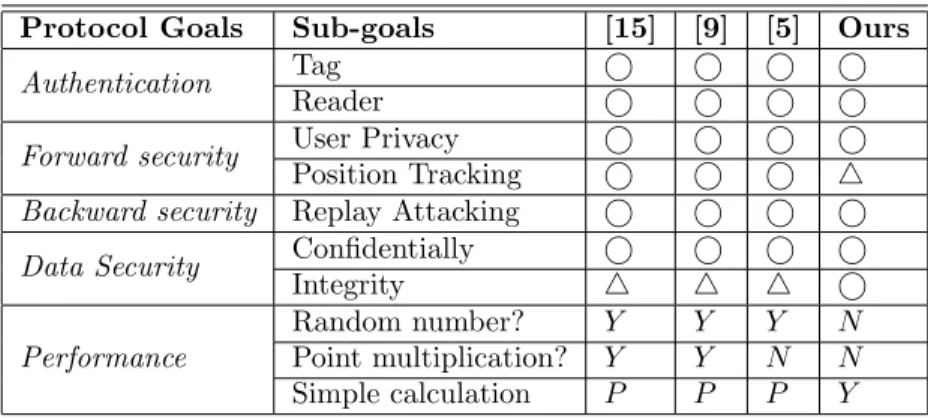
Table 1: Performance comparison among several public-key encryption based RFID secure protocols
Protocol Goals Sub-goals [15] [9] [5] Ours
Authentication Tag
Reader
Forward security User Privacy
Position Tracking 4
Backward security Replay Attacking Data Security Confidentially
Integrity 4 4 4
Performance
Random number? Y Y Y N
Point multiplication? Y Y N N
Simple calculation P P P Y
5.2.4 BAN Logic Inference
1) From message 1, we can get B C{R, Pt, {{id,
R}Ps}Pt−}, but cannot understand the encrypted
message and forward it toS.
2) From message 2, we can get B C{R, Pt, {{id,
R}Ps}Pt−}. Then, according to the initial
assump-tion S|≡ Pt
−→ A and S|≡ Ps
−→ S, using Rule(7) can yield: S|≡Av{id, R}. Next, by initial assumption
S|≡ #(R) and Rule(5), can get S|≡#(id, R). After that, using Rule(3), can get S|≡A|≡ {id, R}. Next, using Rule(4), can obtain S|≡ A|≡ id. After that, according to the initial assumption S|≡A|⇒id, can getS|≡id. Finally,S send message 3.
3) Once B receive message 3, forward and send mes-sage 4. OnceA received message 4, it says AC< id0, R, K>id. According to the initial assumptionA|≡
S
id
A and Rule(1), can yieldA|≡ S v{id0, R, K}. Then, by initial assumption A|≡#(R) and Rule(5), can getA|≡#{id0, R, K}. After that, using Rule(3), can yield A|≡S|≡ {id0, R, K}. Next, using Rule(4), can get A|≡S|≡id0. Finally, using Rule(2), we can get the goal A|≡ id0, that is what the protocol ex-pected.
From the above inference, it shows that the protocol obtains the final belief goal, S|≡ id and A|≡ id0. That is to say the protocol reaches its security goal and the authentication succeeds.
6
The
Comparison
of
Relative
RFID Protocols
Our proposed protocol is based on ECC, which can pro-vide strong encryption only by a short length of key. Fur-thermore, the protocol only use some simple operators, reducing the tag computational complexity, which is suit-able for those low cost tags. Next, we will give a compar-ison between our protocol and some typical public-key
based protocols from the point of security and perfor-mance. It is shown in Table 1.
In Table 1, [15] and [9] are two ECC-based RFID secu-rity protocols, and [5] is a public-key based one. And the notation “” represents the protocol implements well or provides this service. “4” means partially provided or not well implemented. “Y” means yes, “N” means no, and “P” means partial.
From Table 1, it shows that from the point of secu-rity, our protocol is almost equivalent to the existing pro-tocols. However, concerning the computation compared with other related protocols, ours has great advantages, especially for those ECC based protocol, the point mul-tiplication requires considerable computing capacity. So, our protocol is suitable for those low cost, low computa-tional ability tags.
7
Conclusion and Future Work
RFID as the core technology of IoT, the security issues have been emerged widely. It is meaningful to develop lightweight RFID security protocols for those low cost and low computation capability tags. In this paper, we pro-posed a elliptic curve cryptography based protocol, ana-lyzed its security, performance, and verified using BAN logic. From the analysis, it shows that the protocol can provide mutual authentication for the tag and the reader. Meanwhile, it can resist some common RFID related at-tacks. Moreover, our proposed protocol just use some simple operators, such as XOR, bitwise AND, etc., reduc-ing the computation complexity for those low cost tags.
The future directions we can do further are: simulat-ing the protocol in some real IoT environments to eval-uate its real performance; using more factors not only random number to improve the forward security; devel-oping our own lightweight hash function to balance the tradeoff between the computation pressure and security requirements.
Acknowledgments
This study was supported by the Shanghai Mu-nicipal Natural Science Foundation under grant No.13ZR1416100. The authors gratefully acknowledge the anonymous reviewers for their valuable comments.
References
[1] P. D. Arco and A. D. Santis, “On ultralightweight RFID authentication protocols,”IEEE Transactions on Dependable and Secure Computing, vol. 8, no. 4, pp. 548–563, 2011.
[2] J. P. Aumasson, L. Henzen, W. Meier, and M. N. Plasencia, “Quark: A lightweight hash,” Journal of Cryptology, vol. 26, no. 2, pp. 313–339, 2013. [3] P. Babaheidarian, M. Delavar, and J. Mohajeri, “On
the security of an ECC based RFID authentication protocol,” in 9th International ISC Conference on Information Security and Cryptology (ISCISC’12), pp. 111–114, Tabriz, Sept. 2012.
[4] Baidu Encyclopedia,Intelligent Earth, July 24, 2015. (http://baike.baidu.com/view/2168958.htm) [5] L. Batina, J. Guajardo, T. Kerins, N. Mentens,
P. Tuyls, and I. Verbauwhede, “Public-key cryptog-raphy for RFID-tags,” inProceedings of PerCom’07, pp. 217–222, White Plains, NY, Mar. 2007.
[6] M. Burrows, M. Abadi, and R. M. Needham, “A logic of authentication,” ACM Transaction on Computer Systems, vol. 8, no. 1, pp. 18–36, 1990.
[7] T. J. Cao and P. Shen, “Cryptanalysis of two RFID authentication protocols,” International Journal of Network Security, vol. 9, no. 1, pp. 95–100, 2009. [8] M. L. Deng, J. F. Ma, and L. H. Zhou, “Design of
anonymous authentication protocol for RFID,” Jour-nal of Communications, vol. 30, no. 7, pp. 20–26, 2009.
[9] G. Godor, P. Szendi, and S. Imre, “Elliptic curve cryptography based authentication protocol for small computational capacity RFID systems,” in Proceed-ings of the 6th ACM Workshop on QoS and Security for Wireless and Mobile Networks, pp. 98–105, Bo-drum, Turkey, Oct. 2010.
[10] G. N. Khan and M. B. Moessner, “Secure authen-tication protocol for RFID systems,” in 20th Inter-national Conference on Computer Communications and Networks (ICCCN’11), pp. 1–7, Hawaii, USA, July 2011.
[11] W. Khedr, “On the security of moessner and KHAN authentication scheme for passive EPCglobal C1G2 RFID tags,”International Journal of Network Secu-rity, vol. 16, no. 5, pp. 369–375, 2014.
[12] E. S. Kumar and C. Paar, “Are standards compliant elliptic curve cryptosystems feasible on RFID?,” in Proceedings of RFIDSec’06, New York, USA, 2006. [13] G. B. Lin, Y. H. Wang, and Y. J. Zhan, “RFID
secu-rity protocol based on random sequence,”Computer Engineering, vol. 34, no. 20, pp. 151–153, 2008.
[14] S. Martnez, M. Valls, C. Roig, F. Gin, and J. M. Miret, “An elliptic curve and zero knowledge based forward secure RFID protocol,” in3rd conference on RFID-Sec, pp. 42–52, Malaga,Spain, July 2007. [15] S. Martnez, M. Valls, C. Roig, J. M. Miret, and
F. Gin, “A secure elliptic curve-based RFID proto-col,” Journal of Computer Science and Technology, vol. 24, no. 2, pp. 309–318, 2009.
[16] J. L. Meng and Z. Wang, “A RFID security proto-col based on hash chain and three-way handshake,” in Fifth International Conference on Computational and Information Sciences (ICCIS’13), pp. 1463– 1466, Shiyang, June 2013.
[17] D. Molnar and D. Wagner, “Privacy and security in library RFID issues, practices, and architectures,” in 11th ACM Conference on Computer and Communi-cations Security (CCS’04), pp. 210–219, Washington, DC, USA, Oct. 2004.
[18] M. Naveed, W. Habib, U. Masud, U. Ullah, and G. Ahmad, “Reliable and low cost RFID based au-thentication system for large scale deployment,” In-ternational Journal of Network Security, vol. 14, no. 3, pp. 173–179, 2012.
[19] R. K. Pateriya and S. Sharma, “The evolution of RFID security and privacy: a research survey,” in 2011 International Conference on Communica-tion Systems and Network Technologies (CSNT’11), pp. 115–119, Katra, Jammu, June 2011.
[20] P. Peris-Lopez, J.C. Hernandez-Castro, J.M.E. Tapi-ador, and A. Ribagorda, “Lmap: A real lightweight mutual authentication protocol for low-cost RFID tags,” in Workshop on RFID Security (RFID-SEC’06), pp. 1–6, Graz, Austria, July 2006.
[21] Q. Qian, X. Guo, and R. Zhang, “RFID proto-col based on random number and encryption hash,” in IET International Communication Conference on Wireless Mobile and Computing (CCWMC’11), pp. 169–174, Shanghai, China, Nov. 2011.
[22] S. H. Qing, “Design and logical analysis of secu-rity protocols,” Journal of Software, vol. 14, no. 7, pp. 1300–1309, 2003.
[23] S. E. Sarma, S. A. Weis, and D. Engels, “Radio-frequency identification: Secure risks and chal-lenges,”CryptoBytes, vol. 6, no. 1, pp. 2–9, 2003. [24] S. E. Sarma, S. A. Weis, and D. W. Engels, “Rfid
systems and security and privacy implications,” in Cryptographic Hardware and Embedded Systems (CHES’02), pp. 454–469, CA, USA, Aug. 2002. [25] A. Shamir, “SQUASH - A new mac with
prov-able security properties for highly constrained de-vices such as RFID tags,”Fast Software Encryption, LNCS 5086, pp. 144–157, Springer, 2008.
[26] D. Z. Sun and J. D. Zhong, “A hash-based RFID se-curity protocol for strong privacy protection,”IEEE Transactions on Consumer Electronics, vol. 58, no. 4, pp. 1246–1252, 2012.
[27] C. H. Wei, M. S. Hwang, and A. Y. Chin, “A mutual authentication protocol for RFID,”IEEE IT Profes-sional, vol. 13, no. 2, pp. 20–24, 2011.
[28] C. H. Wei, M. S. Hwang, and A. Y. Chin, “An im-proved authentication protocol for mobile agent de-vice in RFID,”International Journal of Mobile Com-munications, vol. 10, no. 5, pp. 508–520, 2012. [29] C. H. Wei, M. S. Hwang, and A. Y. Chin, “An
au-thentication protocol for low-cost RFID tags,” Inter-national Journal of Mobile Communications, vol. 9, no. 2, pp. 208–223, 2011.
[30] Wikipedia,Internet of Things, July 24, 2015. (http: //en.wikipedia.org/wiki/Internet-of-Things) [31] H. W. Wu, S. H. Qing, and H. L. Li, “Security
anal-ysis and improvement to digital library RFID proto-col,” in 2nd International Conference on Consumer Electronics, Communications and Networks (CEC-Net’12), pp. 2834–2837, Yichang, China, Apr. 2012. [32] X. L. Zhang and B. King, “Security requirements for RFID computing systems,”International Journal of Network Security, vol. 6, no. 2, pp. 214–226, 2008. [33] Y. B. Zhou and D. G. Feng, “Design and analysis of
cryptographic protocols for RFID,”Chinese Journal of Computers, vol. 29, no. 4, pp. 581–589, 2006.
Quan Qianis a Professor in Shanghai University, China. His main research interests concerns computer network and network security, especially in cloud computing, IoT and wide scale distributed network environments. He received his computer science Ph.D. degree from University of Science and Technology of China (USTC) in 2003 and conducted postdoc research in USTC from 2003 to 2005. After that, he joined Shanghai University and now he is the lab director of network and multimedia.
Yan-Long Jiais a master degree student in the school
of computer science, Shanghai University. His research interests include IoT, computer and network security.
Rui Zhangreceived her B.E. and Ph.D. degree from
De-partment of Electronic Engineering & Information Sci-ence, University of Science and Technology of China, in 2003 and 2008, respectively. After that, she joined the School of Computer Engineering and Science, Shanghai University. Now, she is an associate professor and her main research interests include computer networks, net-work coding for wireless netnet-works and wireless communi-cation, etc.