Received March 5, 2004; revisions requested August 10, 2004; revised version accepted February 23, 2005.
Address all correspondence to Daniel J. Kruger, Prevention Research Center and Institute for So-cial Research, University of Michigan,1420 Washington Heights, Ann Arbor, MI 48109. Email: [email protected]
Human Nature, Spring 2006, Vol. 17, No. 1, pp. 74–97. 1045-6767/98/$6.00 = .15
An Evolutionary Life-History
Framework for Understanding
Sex Differences in Human
Mortality Rates
Daniel J. Kruger and Randolph M. Nesse
University of Michigan
Sex differences in mortality rates stem from genetic, physiological, behavioral, and social causes that are best understood when integrated in an evolutionary life history framework. This paper investigates the Male-to-Female Mortality Ratio (M:F MR) from external and internal causes and across contexts to illustrate how sex differ-ences shaped by sexual selection interact with the environment to yield a pattern with some consistency, but also with expected variations due to socioeconomic and other factors.
KEYWORDS: Life history; Mortality; Sex differences; Sexual selection
T
hree accomplished researchers recently published a book documenting mortal-ity patterns in the United States in great detail. An entire chapter was devoted to the analysis, using the most comprehensive dataset available, of differences in the mortality rates of men and women. It examined how the sexual mortality differ-ential was influenced by age, race, employment status, income equivalence, educa-tion, marital status, cigarette use, alcohol use, exercise, and body mass. Despite this impressive analytical power, the authors concluded that “a full understanding of the explanatory factors [for excess male mortality] remains elusive” (Rogers, Hum-mer, and Nam 2000:49). The authors suggested that additional proximal variables, such as gang membership, might be the missing pieces of the puzzle.More pieces of data would perhaps slightly improve prediction, but no amount of data can substitute for a theoretical framework that can join all the pieces of the puzzle together. Reports of sex differences in mortality rates and factors that influ-ence them provide only a descriptive explanation. A causal explanation for sex dif-ferences in mortality must be based on an understanding of how sex difdif-ferences were shaped by natural selection, and how those differences interact with environ-mental factors to create observed patterns and variations. The principles of sexual selection offer a well-developed framework for explaining both the basic differ-ences and why they are likely to be influenced by certain environmental factors and not others (Andersson 1994; Cronin 1991). Furthermore, this framework incorpo-rates the findings into the larger context of life history characteristics shaped by natural selection, of which mortality patterns are a central characteristic of any species (Low 1998; Stearns 1992). Age—and sex-specific mortality patterns re-flect the ecological factors that influence reproductive success for any species, and the life history characteristics of any species need interpretation in an evolutionary and ecological context.
This perspective focuses attention on aspects of the data that might otherwise be neglected. In humans, for instance, although the male-female gap in life expect-ancy is well known, few are aware of the relative magnitudes of the mortality differ-ential at different phases of the lifespan. Instead of examining only absolute mortality rates, an evolutionary life history perspective suggests careful attention to the ratio of male mortality rates to female mortality rates at different ages and in different circumstances. Prior research has called attention to the importance of exploring age and sex variations in one causal factor—behavioral risk-taking (Wilson and Daly 1993). Such differences in risk-taking explain some, but not all, of the differ-ences in mortality.
This paper summarizes the literature on factors that influence sex differences in mortality and shows how these factors can be illuminated by examining the Male:Female Mortality Ratio (M:F MR). It describes how the ratios vary across age groups, for different proximate causes of mortality at different ages, and how they are influenced by socioeconomic circumstances. Although it does not attempt to provide a full comparative analysis, it extends the methods to look at the similari-ties and differences between the mortality ratios in modern populations, pre-con-tact hunter-gatherers, and wild chimpanzees.
SEXUAL SELECTION AND SEX DIFFERENCES
Most sex differences are shaped by sexual selection. In sexual species, the repro-ductive success of male individuals usually depends in part on their ability to com-pete for mates. In most species, males comcom-pete for females because females usually invest more in offspring and therefore are selected to be more discriminating in selecting mates (Trivers 1972). Sometimes male competition involves fighting other males for rank or territory; sometimes it requires elaborate traits and displays that
females prefer in their mates (Darwin 1871). Males who succeed in these competi-tions have more offspring, and this shapes traits that foster such success, even if those traits result in physiological and behavioral differences that lead to injury, sickness, and early death. This is a classic illustration of the principle that selection shapes traits not for the welfare of individuals or species, but to benefit their genes (see Williams 1966; Dawkins 1976).
The intensity of sexual selection in a species depends on several factors. In highly polygynous species, a few males will have many offspring while many others will have none, thus creating powerful selection for traits that lead to success in mating competition. The results include elaborate ornaments (such as the peacock’s tail) and armaments (such as a deer’s antlers), all with substantial costs. Humans are far less polygynous than most other primates, but the variation in male reproductive success is still substantially higher than that for females, and a few males gain a disproportionately high number of matings, creating a positively skewed distribu-tion of male reproductive success that makes mating competidistribu-tion a potent selecdistribu-tion force (Betzig 1986).
Parental investment in offspring is another major factor influencing human char-acteristics (see Lancaster et al. 1987). In species such as humans, where males make a substantial investment in caring for offspring, the variation and skew in male reproductive success are lower, but females in such species tend to be espe-cially discriminating in their choice of mates, thus strongly shaping traits that make males likely to be chosen (Darwin 1871; Mealey 2000; Trivers 1972). Females seek males not only for good genes, but also for protection, access to resources, and tendencies to share resources and to be good fathers. Trade-offs among these traits often require difficult choices. Paternal investment is much larger in humans than in other primates (Buss and Schmitt 1993; Geary and Flinn 2001). This may be related to the high payoffs for large investments in the care and instruction of off-spring compared with our primate relatives (Fisher 1992) and to concealed ovula-tion in human females and its possible role in increasing male paternity confidence (Strassmann 1981, 1996). Whatever its origins, the high investment by human males in their children is a crucial characteristic of our species, one that may somewhat decrease the relative importance of direct male-male competition but will tend to increase female choosiness and its power to select for certain male characteristics, such as ability and willingness to invest in potential offspring (Low 2000).
Females usually invest more in offspring than males (Trivers 1972). In addition to the costs of a nine-month pregnancy, costs include childbirth, lactation, and childcare that frequently lasts to the teenage years. These commitments involve not only caloric and effort costs but also health risks that increase mortality. In child-birth alone, for example, there were 582 maternal deaths per 100,000 live child-births in the United States in 1935 (Guyer 2000) and in 2001 there were still 283 deaths per 100,000 live births across the populations of 196 nations (UNICEF 2003). These costs and risks would have been greater for ancestral populations without modern food production, public health, and medicine. Because women invest so
substan-tially in offspring, they should be particularly choosy when evaluating possible mates. There is no room here for a comprehensive survey of the human ecological niche (see Alexander 1979) in comparison with other species, but it is essential to frame the discussion with a description of the differences in the factors that influence the strength and nature of sexual selection and consequent sex differences in mortality across many species.
SEX-BASED MORTALITY DIFFERENTIALS
In recent decades, existing explanations of sex-based mortality differences in ani-mals based only on proximate factors have been augmented by explanations of how these differentials emerge from characteristics shaped by sexual selection that in-teract with environmental factors (including culture, for humans) (e.g., Daly and Wilson 1978). In most animal species, females have a longer average lifespan than males (Hazzard 1990). This is, as noted above, because males in many species have been shaped by trade-offs that increase competitive abilities and risk-taking, which in turn increase male reproductive success at the expense of health and longevity (Daly and Wilson 1978; Møller, Christe, and Lux 1999; Trivers 1985). The inten-sity of sexual selection depends on mating patterns. For instance, higher degrees of polygyny in a species are associated with greater male-male competition and risky male behavior (Plavcan, 2000; Plavcan and van Schaik 1997; Plavcan, van Schaik, and Kappeler 1995), larger size and armor of males, and higher male mortality rates as compared with females (Leutenegger and Kelley 1977). Male-male compe-tition does not, however, only harm males. In Drosophila, for instance, males manu-facture toxic substances that are transmitted to the female during mating, perhaps to reduce the possibility of further matings by the female (Rice 1996). In chimpan-zees, one reason females may form a consortship is to avoid harm and harassment from other males (Palombit, Seyfarth, and Cheney 1997; Smuts 1995).
When the effects of phylogeny are controlled, the degree of sex-based dimor-phism in body size is correlated with the discrepancy between male and female adult mortality (Promislow 1990). Wilson and Daly (1985) note the prevalence of violent male conflict across species and its high correlation with rates of male mor-tality. In langur monkeys, for instance, vicious male-male competition for posses-sion of harems results in high male mortality rates (Hrdy 1977). Higher male than female mortality rates have been documented in both wild chimpanzees (Hill et al. 2001; Goodall 1986; Nishida 1990) and captive populations (Dyke et al. 1995).
Rather than maximizing lifespan, natural selection maximizes the transmission of genes that make reproductively successful phenotypes (Williams 1957). Both males and females have characteristics that sacrifice health and longevity for the sake of reproductive success, but because the variance and skew in reproductive success are much higher for males, an additional increment in competitive ability gives them a greater fitness payoff with associated higher risks of mortality from certain causes (Bateman 1948; Trivers 1985). The exact relationship of male and
female mortality rates depends, of course, on environmental factors that influence the relative contributions of various causes of death in a particular time and culture.
RISKY BEHAVIOR AND MORTALITY IN A LIFE HISTORY CONTEXT
Medawar (1952) recognized that the selection pressure on genes affecting survival or fecundity is higher for those genes whose effect occurs earlier in the lifespan because of the declining cohort size with advancing age owing to unavoidable sources of mortality. Medawar’s proposal that this could help explain senescence was for-malized by Williams’s (1957) explanation of how selection would increase the fre-quency of pleiotropic genes that cause senescence if they also offer benefits early in life. Hamilton (1966) provided a mathematical model using the partial deriva-tives of r with respect to age-specific survival and fecundity.
The relative roles of pleiotropy and mutation accumulation remain uncertain (Austad 1997; Finch 1990; Nesse 1988; Rose and Charlesworth 1981), but increased male mortality from sexual competition early in life would decrease selection against senescence in males relative to females. Also the higher variance of male reproduc-tive success means that male fitness may benefit more than female fitness from greater investments in reproductive competition at the expense of longevity. Life history theory describes these inherent trade-offs of somatic vs. reproductive effort, mating vs. parental effort, current vs. future reproduction, and quantity vs. quality of offspring (Roff 1992; Stearns 1992). Because the maximum number of offspring is much higher and more variable for males, females are selected to invest more effort per offspring. Males, by contrast, are selected for more investment in repro-ductive vs. somatic effort, mating vs. parenting effort, current vs. future reproduc-tion, and quantity vs. quality of offspring.
These theoretical predictions are confirmed by many characteristics of males in general, and in humans, where men consistently show a higher desire for sexual variety than women (Buss 1994) and invest little in offspring under certain ecologi-cal conditions (Hawkes, Rogers, and Charnov 1995). Male mating effort peaks in young adulthood, possibly in part because young men may not yet have partners or offspring to invest in, and they may be more attractive to females because they have not committed their resources (Hill and Kaplan 1999). Young males who do not have substantial resources or status may be unable to establish enduring partner-ships. Among Ache foragers, younger men were responsible for a greater propor-tion of offspring produced through extra-pair copulapropor-tions than older men, who produced most of their offspring within established, long-term relationships (Hill and Hurtado 1996).
The shift in the male allocation of effort from mating to parenting over the life course helps to explain the peak in sex differences in mortality from behavioral causes in young adulthood. Gardner (1993:67) notes that “the belief in the reckless-ness of youth is more than folk wisdom: It is a foundation of our social institu-tions.” He notes that young adult males form the front ranks of every nation’s military,
and “lacking the opportunity for warfare, some [young adult men] will find other ways to place their lives at risk.” The absence of an evolutionary perspective of the sort provided by Daly and Wilson (1999) or Hill and Kaplan (1999) has left many researchers lamenting the lack of a convincing account for why adolescents and young adults are so prone to morbidity and mortality from voluntary risky behav-iors (e.g., Gardner 1993).
The risky behavioral strategies of young males were selected for because they tended to promote social status and resource control as well as mating competition, ultimately enhancing reproductive success (Wilson and Daly 1993). At least in an-cestral times, men who controlled more resources married younger women, mar-ried more women, and produced offspring earlier (Low 1998). Even in relatively egalitarian foraging societies there is some differentiation of status, and men with higher status have increased access to mates (Chagnon 1992; Hill and Hurtado 1996). Present-day hunter-gatherer women tend to mate and have offspring as soon as they become fertile, although initial reproduction for males is both later and more variable. The observed peak of risky behaviors in late adolescence and young adulthood corresponds with entrance into mating competition.
Some researchers note that steep discounting of the future by young people could be a rational response to uncertainty (e.g., Gardner 1993; Wilson and Daly 1997). This parallels the well-established prediction from evolutionary life history theory that individuals who develop in relatively uncertain environments will develop riskier behavioral strategies to take advantage of possibly fleeting opportunities (Chisholm 1999; Roff 1992; Stearns 1992). The mechanism presumed to underlie this phe-nomenon is a convex-upward association between proximate outcomes of risk-tak-ing (e.g., social status) and reproductive success in unpredictable environments. The mean fitness benefit of risky strategies is more favorable than that of cautious strategies, even if the majority of those exhibiting risky strategies have detrimental outcomes (Wilson and Daly 1997).
MORTALITY RATES IN HISTORICAL AND SOCIAL CONTEXT
Human mortality patterns have been influenced by numerous historical factors. The rise of agriculture about 10,000 years ago increased population growth and density, and further elevated mortality from infectious diseases, which may have prevailed over other causes of death at the time (Diamond 1997). Nonetheless, by the beginnings of state society, females were living longer than males. Archival death records indicate that British females had a higher life expectancy than British males for all cohorts born during 1330–1949, except for 1725–1749 (Hollingsworth 1957). In modern times, public health and sanitation measures, vaccination, antibi-otics, and other features of scientific medicine have together resulted in a precipi-tous decline in infectious disease mortality (Lopez 1998). These causes have been somewhat supplanted by novel mortality risks from weapons, automobiles, and other machinery, as well as by the fatal effects of consuming excess dietary fats, tobacco,
alcohol, and other drugs. Overall, the pattern is dominated by a huge decline in mortality rates from infectious diseases, which has given increasing prominence to the effects of other causes, many of which pose higher risks to men. Consistent with this, the discrepancy between male and female mortality rates has been steadily increasing in developed nations across the twentieth century (Lopez 1998; Zhang, Sasaki, and Kesteloot 1995).
These mortality risks do not exist in a vacuum. Social norms may inflate or decrease behavioral tendencies that give rise to differential mortality risks. For in-stance, social forces encouraging risky male behavior (see Kraemer 2000) include social pressure for boys to be tough and discouragement of emotions such as anxi-ety and shame (Kindlon and Thompson 1999). The belief that males are tougher may also contribute to excess mortality if they are thought to be less in need of medical assistance in life-threatening situations (Moynihan 1998). However, favor-itism for boys in some cultures leads to higher female mortality rates in infancy and childhood owing to infanticide and neglect (Hrdy 1999; Rahaman et al. 1982).
Over a broad perspective, the decline of infectious disease in developed coun-tries over the course of the past century has greatly increased the relative contribu-tions of other causes of death, many of which are profoundly influenced by behavioral and cultural factors, thus escalating patterns of sex differences in mortality.
INTERNAL AND EXTERNAL CAUSES OF MORTALITY
Although some of the increased male mortality comes from risk-taking that leads to accidents and other external causes of mortality, internal causes of mortality are higher for men as well. Males are more vulnerable to infection, injury, stress, physi-cal challenge, and degenerative diseases (Kraemer 2000). Some of these differ-ences result from differdiffer-ences in male and female structural, physiological, endocrinological, and immunological systems (Hazzard 1990). These include vul-nerability from the effects of deleterious recessive genes on the X chromosome whose effects are exposed because there are no corresponding genes on a paired chromosome as there are for females, who have two X chromosomes (Smith and Warner 1989). Other factors include the deleterious effects of testosterone on im-mune function (Hazzard 1990; Owens 2002); the physiological costs of large body sizes (Owens 2002); higher parasite load (Moore and Wilson 2002); and the ab-sence of beneficial effects of female sex hormones, such as estrogen (Lawlor, Ebrahim, and Smith 2001). Increased physiological susceptibilities for males re-flect their selection for proportionately more reproductive than somatic effort com-pared with females.
None of this minimizes the substantial special health hazards that are associated with being female (see Fisher 1992) which have led to much-needed special health clinics for women. In addition to the dangers of pregnancy and childbirth, females in many species are subject to dangers from males, the costs of provisioning
off-spring, and the risks involved in protecting their offspring from predators and con-specifics (Hrdy 1977; Smuts 1995). On balance, however, male investment in re-productive competition ends up being more costly and leading to more vulnerability to sickness and death.
In addition to internal causes of death, external causes resulting directly from behavior also contribute to the human sex differential in mortality, almost all in the direction of increased male mortality. The substantially higher rate of accidents in males has been attributed to a pervasive pattern of poor motor and cognitive regula-tion (Kraemer 2000). In the United States, accidental deaths rank fourth in mortal-ity causes for men and seventh for women (Anderson 2001). The relatively higher male risk of motor vehicle mortality persists when the amount of driving is con-trolled for, suggesting that risk-taking is primary (Jonah 1986). Males also have much higher rates of violent behaviors and use of alcohol, tobacco, and other drugs (Daly and Wilson 1997; Kraemer 2000), as well as suicide. Suicides among young men are several times more frequent than among young women in several Western nations, a pattern evident since at least the late 1970s (McClure 2000). Risky male behaviors that increase mortality rates also include higher rates of working in haz-ardous occupations (Hazzard 1986).
Mortality rates change in predictable ways with cultural changes. For instance, the mortality gap between men and women in lung cancer and stroke is narrowing because of both decreases in male smoking rates (Lopez 1998) and increases in female smoking rates (Pampel 2002). Differential rates of alcohol intake contribute to substantially higher male mortality from chronic liver disease and cirrhosis (Zhang, Sasaki, and Kesteloot 1995). The male-biased heart disease epidemic in industrial-ized countries began a few decades after an increase in dietary fat consumption. Here it appears that the effect results not so much from males taking in more fat than females, but from the increased susceptibility of males to atherosclerosis at a given fat intake (Lawlor, Ebrahim, and Smith 2001). An understanding of risky male behavior in an evolutionary framework is beginning to surface in epidemiolo-gists’ recommendations for health-promoting interventions (e.g., Nell 2002); how-ever, the evolutionary origins of male vulnerability to internal causes of death are not yet widely appreciated.
STUDY 1: M:F MR BY CAUSE IN THE U.S. IN 2001
The information presented above supports the expectation that males will have higher mortality rates for most causes of death across the life span, with maximal differ-ences in young adulthood when mate competition is most vigorous. During these years, the highest male:female mortality ratios in a modern society such as the United States are expected for direct behavioral (or external) causes of death, such as homicide, suicide, and accidents. The ratios for behaviorally influenced internal causes with later effects, such as cardiovascular disease, are expected to peak
de-cades after the behaviors that increase their prevalence. These predictions are con-sistent with those made by previous evolutionary researchers (e.g., Wilson and Daly 1985).
Procedure
We used U.S. mortality data from the National Center for Health Statistics for the year 2001 to compute the M:F MR by five-year age groups for specific leading causes of death, summarized into external causes (auto accidents, other accidents, homicide, and suicide) and internal causes (cardiovascular disease, cerebrovascular disease, liver disease and cirrhosis, malignant neoplasms, and infectious diseases). We computed (M:F MR by dividing the male mortality rate by the female mortality rate for each age group. Because we are calculating the ratio of mortality rates for each age group, rather than mortality counts, the M:F MR can be above 1.0 across the lifespan.
In order to estimate the total number of deaths each year that can be attributed to excess male mortality, we used 1999 U.S. data from the Human Mortality Database (www.mortality.org). Following previously described methods, we calculated the actual number of male deaths at each age and subtracted the number that would have occurred if male mortality rates had been equal to those of females at that age (see Michaud, Murray, and Bloom 2001). Using the same data, we also calculated the number of life years lost before age 80 because of higher male mortality rates by taking the number of excess male deaths at each age, multiplying by the remain-ing years of female life expectancy for that age, and summremain-ing across all age groups.
Results
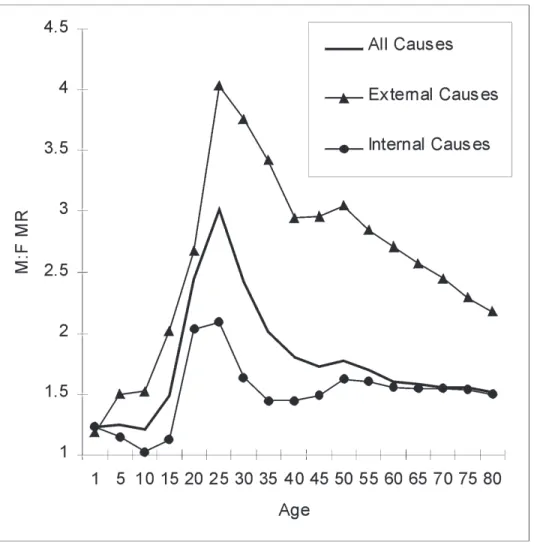
In the United States in 2000, the M:F MR for all causes showed higher mortality rates for males throughout the entire lifespan (Figure 1). It was greater than 1.0 from birth, exhibited a sharp increase at adolescence, peaked at 3.01 in the 20–24 age range, declined rapidly to 2.01 in the 30–34 age range, and then decreased more gradually to 1.51 for the 75–79 age range. The M:F MR from combined external causes (deaths caused directly from behaviors) was highest in adolescents and young adults with a peak at 4.03 in the 20–24 age range (Figure 1). The M:F MR for combined internal causes was less extreme and showed some bimodality; the high-est level of 1.62 was reached in the 50–54 age range.
Examination of the available data for the specific leading causes of death (where mortality incidence was substantial enough for mortality rates to be reported) yielded 170 combinations of causes of death by 5-year age intervals. Of those, 160 (94.1%) showed mortality rates higher for males than for females. The only substantial trend (at least two adjacent age groups) where females had higher mortality rates than males was for malignant neoplasms in the 25–49 age range.
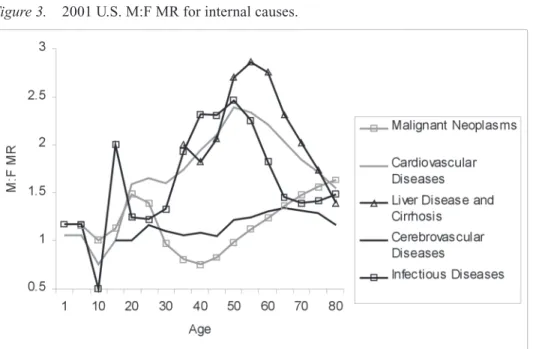
was 4.7 from suicide; suicide also had the highest peak at any age: 7.8 for ages 75– 79 (Figure 2). Non-automobile accidents and homicide followed, reaching peaks of 4.89 and 4.35, respectively, in the 20–24 age range. The internal cause of death with the highest M:F MR was infectious disease, which peaked at 2.46 in the 45–49 age range (Figure 3).
The overall impact of higher male than female mortality rates is substantial. If male mortality rates had been the same as those for women at comparable ages in the United States in 1999, an estimated 300,705 men would not have died in that year. This represents 38.5% of all 780,201 male deaths before age 80 that year. Projected ahead in comparison with anticipated female mortality rates at each fu-ture age, these excess male deaths in the year 1999 will result in an eventual loss of 6,302,781 life-years.
STUDY 2: SOCIOECONOMIC INFLUENCES
Increased extrinsic mortality should lead to less investment in intrinsic mortality reduction efforts, such as tissue maintenance. When mortality rates are low and predictable, however, the lower number of urgent adaptive problems shifts the ad-vantage to less-risky, long-term strategies. It is not only the general environment but also the individual’s perception of the environment that influences behavioral strategies. Individuals adopt more risk-accepting, short-term payoff strategies if they perceive a harsh environment, resource scarcity, predator vulnerability, or high variability in male resource holding because of the higher mean payoff of these strategies (Roff 1992; Stearns 1992; Wilson and Daly 1993, 1997). Such short-term outlooks should increase the mortality discrepancy between men and women. Wil-son and Daly (1993, 1997) believe that the high rates of risky predatory crime and interpersonal violence in urban ghettoes reflect an escalation of the tactics of social competition in response to meager prospects for the future and expectations of a short life-span.
The famous Whitehall studies of British civil servants demonstrated that those at the base of the status hierarchy had disease rates four times higher than those at the top (Marmot et al. 1987). Even though none of the workers was very rich or very poor and all lived in a country with universal health care, the social gradient strongly impacted health status. The effect remained even when controlling for numerous variables, such as smoking, blood pressure, physical activity, obesity, and social
support. Even among doctors, lawyers, and other professionals, those in the second tier had disease rates twice as high as those of their superiors, supporting the con-clusion that health depended on one’s status relative to the hierarchy, not one’s ab-solute status (Marmot et al. 1987). These results support the continuing search for physiological correlates of social status that may influence health (Kaplan 1999).
Among modern humans, these considerations suggest that that M:F MRs will be higher for groups that live in relatively more hazardous and unpredictable environ-ments, as indicated by lower levels of income and education. In the ancestral envi-ronment these conditions would favor riskier, shorter-term life history strategies that have a higher mean payoff in reproductive success. The M:F MR should gener-ally be higher for unmarried individuals because males can be expected to shift toward less-risky, longer-term strategies, increasing parental effort and decreasing mating effort, after successfully obtaining a mate. There is a potential confound in that healthier men may be more likely to marry. Also, men’s testosterone levels decrease following marriage and increase following divorce (Mazur and Michalek 1998), concurrent with the notion of a strategy shift in the allocation of effort, and possibly accounting for some of the observed mortality differences.
Procedure
We calculated the M:F MR by income level in the United States from 1979– 1989 using data from the National Longitudinal Mortality Study (http://
www.nhlbi.nih.gov/resources/deca/descriptions/nlms.htm) and by educational at-tainment and marital status with data from the National Center for Health Statistics’ National Vital Statistics Report for 1999 (http://www.cdc.gov/nchs/datawh/statab/ unpubd/mortabs.htm).
Results
This simple preliminary analysis shows that the M:F MR was higher for those who had not attended college than for those with some college education (Figure 4). The M:F MR was also inversely related to the level of income, with those in the lowest income group having the highest M:F MR (Figure 5). The M:F MR was greater for the never married than for married individuals across the lifespan (Fig-ure 6). Extensive fut(Fig-ure studies of cultural and environmental factors that influence the M:F MR are likely to offer important insights about how social factors mediate and moderate sex differences in mortality rates.
Extensive comparisons of conditions for ancestral humans, other primates, and modern humans in different cultures are not a major focus here. However, to
firm the generality of the principle, we also expect to find M:F MRs greater than 1.0 for hunter-gathering humans living in conditions similar to those in ancestral environments.
STUDY 3: ACHE HUNTER-GATHERERS
Hill and Hurtado’s (1996) rich description of forest-dwelling Ache indicates that the life history of pre-contact hunter-gatherers differed considerably from that of individuals in modern Western populations. Mating partnerships in the Ache are relatively short compared with those in the United States; most adult women had children by several different fathers, and partner desertion was common for both sexes. Adult men were expected to participate in perilous, organized club fighting among Ache bands, which give women opportunities to evaluate men on mate-selection criteria such as strength, bravery, agility, and alliance connections. New relationships would often begin after club fights; mutual partner choice was com-mon. Such conditions would be consistent with a high level of male mating effort throughout adulthood. Hill and Hurtado report that blatant public sexual flirtation and sexual gossip were quite frequent.
Hill and Hurtado (1996) note that flexible social systems allowing for easy re-marriage, such as with the Ache, are related to relatively high adult mortality rates. The major causes of death for forest-dwelling Ache were also substantially
ent from those in modern, Western societies. Cardiovascular disease, accounting for the largest proportion of deaths in the United States, did not appear to be re-sponsible for any reported deaths in pre-contact Ache. Homicide accounted for about half of all deaths; about two-thirds of these were from external warfare with Paraguayan peasants and neighboring tribes. Illness and disease (primarily gas-trointestinal) accounted for one quarter of all deaths. Accidents, the third most com-mon cause of mortality, accounted for one-eighth of deaths. Accidental deaths were most frequently associated with food acquisition.
The ratio of male to female mortality may have been shaped by these patterns. Women’s behavior is highly constrained by the need to protect infants from the many hazards pervasive in the forest setting. Women stay closer to camp while foraging. They extract fiber from palm trees and gather fruits and insect larvae. Men travel several kilometers away from the band while searching for game and are thus exposed more environmental hazards, including predators, poisonous snakes, and dangerous prey.
Procedure
We used data from the Ache of Paraguay during their pre-contact forest-dwelling period, 1890–1971, from Hill and Hurtado (1996).
Results
The Ache had an overall M:F MR of 1.77. The Ache ratio increased in early adulthood and remained high through the remainder of the lifespan (Figure 7). The small sample size led to large fluctuations by age, so Figure 7 shows data smoothed
by taking three iterations of a running average over 5 points. Hill and Hurtado (1996) report that twice as many men as women died from accidents. Females face higher mortality risks than males from conspecific homicide during infancy and childhood. Pre-contact Ache frequently buried an infant or child, usually a female, along with an adult who died. Childbirth accounted for 8% of the deaths among reproductive-age women.
STUDY 4: WILD CHIMPANZEES
Common chimpanzees (Pan troglodytes) exhibit sex differences in the slight to moderate range; adult males weigh about 133% the adult body weight of females (Zihlman 1997), indicating substantially more intensive sexual selection, which is consistent with the polygamous mating pattern with its intense male-male competi-tion. The chimpanzee ecological niche is similar to that for humans but the mating pattern is very different, as are group structures. Females have shorter daily travel ranges than males (Doran 1989; Hasegawa 1990; Wrangham and Smuts 1980), and females have even smaller ranges when caring for young (Hasegawa 1990). Males engage in predatory behavior more frequently than females (Boesch and Boesch 1989). These characteristics of our close primate relatives mirror those of the hu-man Ache. Males engage in aggressive displays (Kuroda 1980; Nishida and Hiraiwa-Hasegawa 1987) and patrol the boundaries of the community with other males, where they may encounter and attack members of neighboring communities. Males
physically attack other chimps more than females do, and they also react to aggres-sion in a greater variety of ways than females (de Waal 1989; Goodall 1986). Chimps mature around 10–11 years of age and live a maximum of 40–45 years. Mating is nonseasonal, and females are promiscuous and migrate to a different community during an adolescent estrous period (Zihlman 1997). These patterns lead to the prediction that male chimpanzees will exhibit higher mortality rates than females across the adolescent and adult phases of the lifespan owing to higher rates of vio-lence and hazards encountered while foraging, hunting, and patrolling. Greater male body weight is indicative of polygyny, and thus greater male expenditures in mat-ing effort (includmat-ing risky male-male competition) at the cost of other forms of investment.
Method
We obtained life tables for wild chimpanzees from Hill and colleagues (2001).
Results
For wild chimpanzees, the M:F MR was 1.43 over the lifespan. The chimpanzee ratio was noticeably elevated during young adulthood, bearing a striking resem-blance to the human M:F MR (Figure 8). The small sample size led to large fluctua-tions by age, so Figure 8 shows data smoothed by taking three iterafluctua-tions of a running average over 5 points.
CONCLUSION
Examination of the M:F MR demonstrates the dramatic differences between mor-tality rates for men relative to women from a variety of causes and across the life span. Early in life, sexually selected male tendencies for pursuing risky competitive strategies interact with conditions in local environments to result in higher male death rates from behavioral causes. As expected, in the U.S. data the M:F MR peak was in young adulthood and resulted mainly from external causes of death. The M:F MR for behaviorally moderated internal causes peaked in mid to late adult-hood, consistent with the lag in the impact of health-related behaviors on mortality. These patterns also reflect the modern epidemiological environment in the United States.
As previously noted, historical changes in the human environment have greatly affected mortality patterns, especially the decline in mortality from infection. Com-parisons of modern patterns with the Ache data support the notion that these transi-tions have changed the relative contributransi-tions of various mortality causes, resulting in changes in the M:F MR. The female mortality rate was higher than the male mortality rate among pre-contact Ache into the teenage years. This may be due to the practice of sacrificing an infant or child, usually a female, to be buried with an
adult Ache (see Hill and Hurtado 1996). The Ache M:F MR remained high across the lifespan, with fluctuations most likely due to the small population size. This pattern probably relates to the life history patterns of the Ache, where mating effort is distributed across adulthood and males are susceptible to deaths or injury from hunting and club fights throughout adulthood. Given that conspecific violence was the largest component of early adult mortality in the Ache, Hill and Hurtado (1996) provisionally concluded that conspecific violence rates are largely responsible for evolved human life history.
The M:F MR for wild common chimpanzees, our nearest hominid relatives (along with bonobos), closely mirrored the M:F MR in the contemporary United States.
Pan troglodytes males hold territory and defend resources (food sources and fe-males) from other males in the community, and male-male competition is fierce. This could account for the pronounced aggression among males (Zihlman 1997) and the associated higher levels of male mortality. Although age—and sex-specific mortality data for wild chimpanzees are scarce, perhaps future research will add to existing life tables and indicate whether the M:F MR pattern is consistent with the one reported here. If this is the case, it would support the notion that male chimpan-zees exhibit especially risky behavioral patterns at the age of sexual maturity. This pattern may be sustained because early reproductive efforts may be relatively more valuable to reproductive success when extrinsic mortality is high, and many indi-viduals do not live full life spans even after reaching adulthood.
Among modern humans, the discrepancy between male and female mortality rates was higher for those of comparatively lower socioeconomic status and the unmarried, supporting predictions based in life history theory. These results sug-gest that males experiencing greater uncertainly or deprivation in social status and resources may develop riskier life strategies, leading to higher mortality rates. This environmentally contingent strategy is probably based in the mean reproductive payoffs of risky strategies in uncertain conditions in the ancestral environment. Although many individuals exhibiting risky strategies would have died early, possi-bly without reproducing, for a sufficient number of others it enhanced reproductive success. In some cases where the male reproductive skew was very large, a risky strategy may have been the only way to gain the social status and/or resources needed to obtain a partner and produce viable offspring.
As extrinsic mortality rates influence life history strategies, perceptions of ex-trinsic mortality may be an important mediator of high-risk behavior. Communities with high rates of father absence, incarceration, or other features that mimic high extrinsic mortality rates may be especially prone to encouraging shorter-term, higher-risk strategies, which will in turn lead to higher rates of early mortality (Wilson and Daly 1997). Thus, multiple generations may exhibit similar behavioral and health patterns.
The overall impact of increased male mortality is substantial. Being male is now the single largest demographic risk factor for early mortality in developed coun-tries. Currently in the United States, twice as many men as women die before age 50. In public health terms, reducing male mortality rates to those of females at the same age would eliminate one-third of deaths below age 50 and would save 10 million person-years of life each year. By comparison, each year about 3 million male life-years are lost from cancer and nearly 4 million male life-years are lost from cardiovascular diseases.
Further comparisons of mortality patterns across modern human cultures and history will help illustrate the range and correlates of sex differences in mortality across the lifespan. More detailed data from hunter-gatherer populations would be especially useful in examining patterns in natural conditions. All of these data need to be examined in a comparative analysis of sex differences mortality patterns across primate species that takes into account knowledge of life history characteristics. We anticipate not only that the M:F MR can reveal much more about health, but that it may, with proper controls, provide an indicator that reflects the degree of male-male competition and skew of outcomes in a population.
Finally, this approach illustrates how evolutionary explanations can offer a frame-work for understanding complex phenomena that result from traits shaped by natu-ral selection that interact with environmental and cultunatu-ral variations to give rise to complex patterns of findings. An evolutionary perspective offers an integrative and comprehensive causal framework for understanding phenomena of crucial interest to us all.
Daniel J. Kruger earned his Ph.D. in Social Psychology at Loyola University Chicago and is currently an Assistant Research Scientist at the University of Michigan. His evolutionary research interests include altruism, cooperation, competition, risk, life history, mortality patterns, mating strategies, and applications for social and ecological sustainability.
Randolph M. Nesse is Professor of Psychiatry, Professor of Psychology, and Research Professor at the Institute for Social Research at the University of Michigan, where he directs the Evolution and Hu-man Adaptation Program. His research interests are focused on Darwinian medicine, especially the origins of depression and other forms of psychopathology.
REFERENCES Alexander, Richard D.
1979 Darwinism and Human Affairs. Seattle: University of Washington Press. Anderson, Robert N.
2001 National Vital Statistics Reports 49(11): Deaths: Leading Causes for 1999. Center for Dis-ease Control. Available on-line at http://www.cdc.gov/nchs/data/nvsr/nvsr49/nvsr49_11.pdf. Andersson, Malte
1994 Sexual Selection. Princeton: Princeton University Press. Austad, Stephen
1997 Why We Age: What Science Is Discovering about the Body’s Journey through Life. Hoboken: John Wiley & Sons.
Bateman, A. J.
1948 Intra-Sexual Selection in Drosophila. Heredity 2:349–368. Betzig, Laura
1986 Despotism and Differential Reproduction: A Darwinian View of History. New York: Aldine de Gruyter.
Boesch, Christophe, and Hedwige Boesch
1989 Hunting Behavior of Wild Chimpanzees in the Tai National Park. American Journal of Physi-cal Anthropology 78:547–573.
Buss, David M.
1994 The Evolution of Desire: Strategies of Human Mating. New York: Basic Books. Buss, David M., and David P. Schmitt
1993 Sexual Strategies Theory: An Evolutionary Perspective on Human Mating. Psychological Review 100:204–232.
Chagnon, Napoleon A.
1992 Yanomamo, fourth ed. New York: Harcourt Brace. Chisholm, James. S.
1999 Death, Hope and Sex: Steps to an Evolutionary Ecology of Mind and Morality. Cambridge: Cambridge University Press.
Cronin, Helena
1991 The Ant and the Peacock : Altruism and Sexual Selection from Darwin to Today. New York: Cambridge University Press.
Daly, Martin, and Margo Wilson
1978 Sex, Evolution, and Behavior: Adaptations for Reproduction. North Scituate, Massachu-setts: Duxbury Press.
1997 Crime and Conflict: Homicide in Evolutionary Perspective. Crime and Justice 22:251–300. 1999 An Evolutionary Psychological Perspective on Homicide. In Homicide Studies: A Sourcebook of Social Research, Dwane Smith and Margaret Zahn, eds. Pp. 58–71. Thousand Oaks, Califor-nia: Sage.
Darwin, Charles
1871 The Descent of Man and Selection in Relation to Sex. London: John Murray. Dawkins, Richard
de Waal, Frans
1989 Peacemaking in Primates. Cambridge: Cambridge University Press. Diamond, Jared
1997 Guns, Germs, and Steel: The Fates of Human Societies. New York: W.W. Norton. Doran, Diane
1989 Chimpanzee and Pygmy Chimpanzee Positional Behavior: The Influence of Environment, Body Size, Morphology, and Ontogeny on Locomotion and Posture. Ph.D. dissertation, State Uni-versity of New York at Stony Brook.
Dyke, Bennett, Timothy B. Gage, Patricia L. Alford, Brent Swenson, and Sarah Williams-Blangero 1995 Model Life Table for Captive Chimpanzees. American Journal of Primatology 37:25–37. Finch, Caleb E.
1990 Longevity, Senescence, and the Genome. Chicago: University of Chicago Press. Fisher, Helen
1992 Anatomy of Love. New York: Norton & Company. Gardner, William
1993 A Life-Span Rational-Choice Theory of Risk Taking. In Adolescent Risk Taking. Nancy J. Bell and Robert W. Bell, eds. Pp. 66–83. Newbury Park, California: Sage Publications. Geary, David C., and Mark V. Flinn
2001 Evolution of Human Parental Behavior and the Human Family. Parenting: Science and Practice 1:5–61.
Goodall, Jane
1986 The Chimpanzees of Gombe: Patterns of Behavior. Cambridge: Harvard University Press. Guyer, Bernard, Mary Anne Freedman, Donna M. Strobino, and Edward J. Sondik
2000 Annual Summary of Vital Statistics: Trends in the Health of Americans during the 20th Century. Pediatrics 106:1307–1317.
Hamilton, William D.
1966 The Moulding of Senescence by Natural Selection. Journal of Theoretical Biology 12:12– 45.
Hasegawa, Toshikazu
1990 Sex Differences in Ranging Patterns. In The Chimpanzees of the Mahale Mountains, Toshisada Nishida, ed. Pp. 99–114. Tokyo: Tokyo University Press.
Hawkes, Kristen, Alan R. Rogers, and Eric L. Charnov
1995 The Male’s Dilemma: Increased Offspring Production Is More Paternity to Steal. Evolu-tionary Ecology 9:1–16.
Hazzard, William R.
1986 Biological Basis of the Sex Differential in Longevity. Journal of the American Geriatrics Society 34:455–471.
1990 The Sex Differential in Longevity. In Principles of Geriatric Medicine and Gerontology, second ed., William R. Hazzard, Reuben Endres, Edwin L. Bierman and John P. Blass, eds. Pp. 37–47. New York: McGraw Hill.
Hill, Kim, and Magdalena Hurtado
1996 Ache Life History: The Ecology and Demography of a Foraging People. New York: Aldine de Gruyter.
Hill, Kim, and Hillard Kaplan
1999 Life History Traits in Humans: Theory and Empirical Studies. Annual Review of Anthropol-ogy 28:397–438.
Hill, Kim, Christophe Boesch, Jane Goodall, Anne Pusey, Jennifer Williams, and Richard Wrangham 2001 Mortality Rates among Wild Chimpanzees. Journal of Human Evolution 40:437–450. Hollingsworth, Thomas Henry
1957 A Demographic Study of the British Ducal Families. Population Studies 9:4–26. Hrdy, Sarah Blaffer
1977 The Langurs of Abu: Female and Male Strategies of Reproduction. Cambridge: Harvard University Press.
1999 Mother Nature: A History of Mothers, Infants, and Natural Selection. New York: Pantheon Books.
Jonah, Brian. A.
1986 Accident Risk and Risk-Taking Behavior among Young Drivers. Accident Analysis & Pre-vention 18:255–271.
Kaplan, George A.
1999 What Is the Role of the Social Environment in Understanding Inequalities in Health? An-nals of the New York Academy of Science 896:116–119.
Kindlon, Daniel, and Michael Thompson
1999 Raising Cain: Protecting the Emotional Life of Boys. London: Michael Joseph. Kraemer, Sebastian
2000 The Fragile Male. British Medical Journal 321:1609–1612. Kuroda, Suehisa
1980 Social Behavior of the Pygmy Chimpanzees. Primates 21:181–197. Lancaster, Jane B., Jeanne Altmann, Alice S. Rossi, and Lonnie R. Sherrod, eds.
1987 Parenting across the Life Span. New York: Aldine de Gruyter. Lawlor, Debbie A., Shah Ebrahim, and G. Davey Smith
2001 Sex Matters: Secular and Geographical Trends in Sex Differences in Coronary Heart Dis-ease Mortality. British Medical Journal 323:541–545.
Leutenegger, W., and J. T. Kelley
1977 Relationship of Sexual Dimorphism in Canine Size and Body Size to Social, Behavioral, and Ecological Correlates in Anthropoid Primates. Primates 18:117–136.
Lopez, Alan D.
1998 Morbidity and Mortality, Changing Patterns in the Twentieth Century. In Encyclopedia of Biostatistics, Peter Armitage and Theodore Colton, eds. Pp. 2690–2701. New York: John Wiley & Sons.
Low, Bobbi
1998 The Evolution of Human Life Histories. In Handbook of Evolutionary Psychology: Issues, Ideas, and Applications, Charles Crawford and Dennis Krebs, eds. Pp. 131–161. Mahwah, New Jersey: Lawrence Erlbaum Associates.
2000 Why Sex Matters: A Darwinian Look at Human Behavior. Princeton: Princeton University Press.
Marmot, Michael, Manolis Kogevinas, and Maryann A. Elston
1987 Social/Economic Status and Disease. Annual Review of Public Health 8:111–135. Mazur, Alan, and Joel Michalek
1998 Marriage, Divorce, and Male Testosterone. Social Forces 77: 315–330. McClure, G. M. G.
2000 Changes in Suicide in England and Wales, 1960–1997. British Journal of Psychiatry 176:64– 67.
Mealey, Linda
2000 Sex Differences: Developmental and Evolutionary Strategies. San Diego: Academic Press. Medawar, Peter B.
1952 An Unsolved Problem of Biology. London: H.K. Lewis. Michaud, Catherine M., Christopher J. Murray, and Barry R Bloom
2001 Burden of Disease—Implications for Future Research. Journal of the American Medical Association 285:535–539.
Møller, A. P., P. Christe, and E. Lux
1999 Parasitism, Host Immune Function, and Sexual Selection. Quarterly Review of Biology 74:3– 20.
Moore, Sarah L., and Kenneth Wilson
2002 Parasites as a Viability Cost of Sexual Selection in Natural Populations of Mammals. Sci-ence 297:2015–2018.
Moynihan, Clare
1998 Theories in Health Care and Research: Theories of Masculinity. British Medical Journal 317:1072–1075.
Nell, Victor
2002 Why Young Men Drive Dangerously: Implications for Injury Prevention. Current Direc-tions in Psychological Science 11:75–79.
Nesse, Randoph M.
1988 Life Table Tests of Evolutionary Theories of Senescence. Experimental Gerontology 23:445– 453.
Nishida, Toshisada
1990 The Chimpanzees of the Mahale Mountains. Tokyo: University of Tokyo Press. Nishida, Toshisada, and Mariko Hiraiwa-Hasegawa
1987 Chimpanzees and Bonobos: Cooperative Relationships among Males. In Primate Societies, Barbara B. Smuts, Dorothy L. Cheney, Robert M. Seyfarth, Richard W. Wrangham, and Thomas T. Struhsaker, eds. Pp. 63–97. Tokyo: Tokyo University Press.
Owens, Ian P. F.
2002 Sex Differences in Mortality Rate. Science 297:2015–2018. Palombit, Ryne A., Robert M. Seyfarth, and Dorothy L. Cheney
1997 The Adaptive Value of “Friendships” to Female Baboons: Experimental and Observational Evidence. Animal Behavior 54:599–614.
Pampel, Fred C.
2002 Cigarette Use and the Narrowing Sex Differential in Mortality. Population and Develop-ment Review 28:77–104.
Plavcan, J. Michael
2000 Inferring Social Behavior from Sexual Dimorphism in the Fossil Record. Journal of Human Evolution 39:327–344.
Plavcan, J. Michael, and Carel P. van Schaik
1997 Interpreting Hominid Behavior on the Basis of Sexual Dimorphism. Journal of Human Evolution 32:345–374.
Plavcan, J. Michael, Carel P. van Schaik, and Peter M. Kappeler
1995 Competition, Coalitions and Canine Size in Primates. Journal of Human Evolution 28:245– 276.
Promislow, Daniel E. L.
1990 Costs of Sexual Selection in Natural Populations of Mammals. Proceedings of the Royal Society of London B 247:230–210.
Rahaman, Mujibur M., K. M. S. Aziz, M. H. Munshi, Yakub Patwari, and Mizanur Rahman 1982 A Diarrhea Clinic in Rural Bangladesh: Influence of Distance, Age, and Sex on Attendance
and Diarrheal Mortality. American Journal of Public Health 72:1124–1128. Rice, William R.
1996 Sexually Antagonistic Male Adaptation Triggered by Experimental Arrest of Female Evolu-tion. Nature 381:232–234.
Roff, Derek A.
1992 The Evolution of Life Histories: Theory and Analysis. New York: University of Chicago Press.
Rogers, Richard G., Robert A. Hummer, and Charles B. Nam
2000 Living and Dying in the USA: Behavioral, Health, and Social Differences of Adult Mortal-ity. San Diego: Academic Press.
Rose, Michael R., and Brian Charlesworth
1981 Genetics of Life History in Drosophila melanogaster, 1: Sib Analysis of Adult Females. Genetics 97:187–196.
Smith, David W. E., and Huber R. Warner
1989 Does Genotypic Sex Have a Direct Effect on Longevity? Experimental Gerontology 24:277– 288.
Smuts, Barbara
1995 The Evolutionary Origins of Patriarchy. Human Nature 6:1–32. Strassmann, Beverley
1981 Sexual Selection, Paternal Care, and Concealed Ovulation in Humans. Ethology and Socio-biology 2:31–40.
1996 The Evolution of Endometrial Cycles and Menstruation. Quarterly Review of Biology 70:181– 220.
Stearns, Stephen C.
1992 The Evolution of Life Histories. Oxford: Oxford University Press. Trivers, Robert
1972 Parental Investment and Sexual Selection. In Sexual Selection and the Descent of Man: 1871–1971, B. Campbell, ed. Pp.136–179. Chicago: Aldine.
1985 Social Evolution. Menlo Park, California: Benjamin Cummings. UNICEF (United Nations Children’s Fund)
2003 Official Summary: The State of the World’s Children, 2002. New York: Oxford University Press.
Williams, George C.
1957 Pleiotropy, Natural Selection, and the Evolution of Senescence. Evolution 11:398–411. 1966 Adaptation and Natural Selection: A Critique of Some Current Evolutionary Thought.
Princeton: Princeton University Press. Wilson, Margo, and Martin Daly
1985 Competitiveness, Risk Taking, and Violence: The Young Male Syndrome. Ethology and Sociobiology 6:59–73.
1993 Lethal Confrontational Violence among Young Men. In Adolescent Risk Taking, Nancy J. Bell and Robert W. Bell, eds. Pp. 84–106. Newbury Park, California: Sage Publications. 1997 Life Expectancy, Economic Inequality, Homicide, and Reproductive Timing in Chicago
Neighbourhoods. British Medical Journal 314:1271–1274. Wrangham, Richard W., and Barbara Smuts
1980 Sex Differences in the Behavioral Ecology of Chimpanzees in the Gombe National Park, Tanzania. Journal of Reproduction and Fertility (supplement) 28:13–31.
Zhang, Xin Hua, Satoshi Sasaki, and Hugo Kesteloot
1995 The Sex Ratio of Mortality and Its Secular Trends. International Journal of Epidemiology 24:720–729.
Zihlman, Adrienne L.
1997 Natural History of Apes: Life History Features in Females and Males. In The Evolving Female: A Life History Perspective, M. E. Morbeck, A. Galloway, and A. L. Zihlman, eds. Pp. 86– 103. Princeton: Princeton University Press.