M e t h o d o l o g i e s a n d
w o r k i n g p a p e r s
ISSN 1977-0375Statistical regions for the EFTA countries and
the Candidate countries 2008
2008 edition
Europe Direct is a service to help you find answers to your questions about the European Union
Freephone number (*):
00 800 6 7 8 9 10 11
(*) Certain mobile telephone operators do not allow access to 00 800 numbers or these calls may be billed.More information on the European Union is available on the Internet (http://europa.eu). Luxembourg: Office for Official Publications of the European Communities, 2008 ISBN 978-92-79-04765-7
ISSN 1977-0375
Cat. No. KS-RA-07-023-EN-N
Theme: General and Regional Statistics
Collection: Methodologies and working papers
Eurostat is the Statistical Office of the European Communities. Its mission is to
pro-vide the European Union with high-quality statistical information. For that purpose,
it gathers and analyses figures from the national statistical offices across Europe and
provides comparable and harmonised data for the European Union to use in the
defi-nition, implementation and analysis of Community policies. Its statistical products
and services are also of great value to Europe’s business community, professional
organisations, academics, librarians, NGOs, the media and citizens.
Eurostat’s publications programme consists of several collections:
•
News releases
provide recent information on the Euro-Indicators and on social,
economic, regional, agricultural or environmental topics.
•
Statistical books
are larger A4 publications with statistical data and analysis.
•
Pocketbooks
are free of charge publications aiming to give users a set of basic
figures on a specific topic.
•
Statistics in focus
provides updated summaries of the main results of surveys,
stu-dies and statistical analysis.
•
Data in focus
present the most recent statistics with methodological notes.
•
Methodologies and working papers
are technical publications for statistical
experts working in a particular field.
Eurostat publications can be ordered via the EU Bookshop at
http://bookshop.euro-pa.eu.
All publications are also downloadable free of charge in PDF format from the Eurostat
website http://ec.europa.eu/eurostat. Furthermore, Eurostat’s databases are freely
available there, as are tables with the most frequently used and demanded short-
and long-term indicators.
Eurostat has set up with the members of the ‘European statistical system’ (ESS) a
network of user support centres which exist in nearly all Member States as well as in
some EFTA countries. Their mission is to provide help and guidance to Internet users
of European statistical data. Contact details for this support network can be found
on Eurostat Internet site.
EUROSTAT
5
Statistical regions for the EFTA countries and the Candidate countries 2008Table of contents
PageIntroduction . . . .7
Table 1: Correspondence between Statistical regions and administrative units . . . 10
Table 2: Average area and average population by country and by level . . . .11
EFTA countries . . . .13 Iceland . . . .14 Liechtenstein . . . 18 Norway . . . 20 Switzerland . . . 24 Candidate countries . . . 28 Croatia . . . 30
The former Yugoslav Republic of Мacedonia . . . 34
Turkey . . . 37
NACE:
Introduction
and background
chapter
1
Introduction
9
Statistical regions for the EFTA countries and the Candidate countries 2008Introduction
There is an ever-increasing demand for statistical information at a regional level for the Candidate countries to EU membership and the EFTA countries. In order to achieve common definitions, Eurostat and the National Statistical Institutes of the Candidate countries (CC) and EFTA have agreed that the regional levels contained in this document are to be used by the European Commission for statistical purposes whenever possible.
The regions presented in this document have been defined according to principles similar to those used in the establishment of the Community nomenclature of territorial units for statistics (NUTS). However, the classifications presented does not preclude any decision on the NUTS which will be taken as and when individual countries join the EU.
Some statistical regions appear at several levels (example: Liechtenstein appears as the country and at levels 1, 2 and 3). In this case, codes end in zero for a region with identical territory at the next lower level. The labels need not be identical at the different levels even if the regions concerned cover identical territory.
The maps in this document are simply intended to enable the reader to locate the regions; the regional boundaries shown are also purely indicative. The scale used may differ depending on the country.
EFTA countries
The EEA (European Economic Area) comprises 30 countries - the 27 EU Member States and three of the EFTA countries (Iceland, Liechtenstein and Norway). The fourth EFTA country, Switzerland, is not part of EEA but has a bilateral agreement with EU, including statistics. The coding structure is similar to that of NUTS for all EFTA countries, although they are not legally binding.
Candidate countries
The Candidate countries consist of three countries whose applications have all been accepted by the EU. The coding system presented in this publication is an updated version of the Eurostat publication “Statistical regions for the EFTA countries and CEC” published in 2001.
It should be noted that some countries are undergoing, or are likely to undergo, reforms to their administrative structure that may result in changes to the regions defined in this document.
Notes on the labels
The names of the regions are given in the language(s) of the country or the region itself.
A non-Latin alphabet is in use in the former Yugoslav Republic of Macedonia. For the reason of better understanding, the list of regions is repeated in Latin characters after the official version.
Related issues
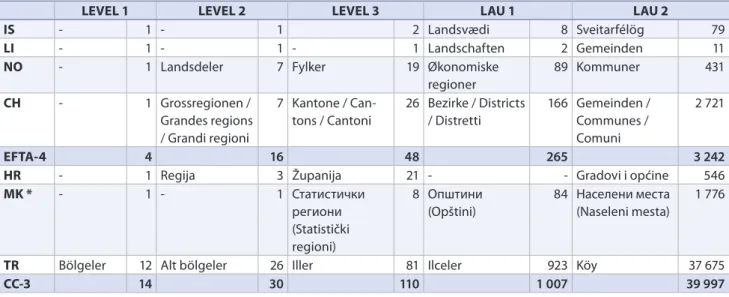
Statistical regions are defined at three different levels. For the EFTA countries, codes have been assigned also on Local administrative units (LAU) levels 1 and 2. In the Candidate countries it is planned to assign codes for local units. For most of these countries, lists of local units have been collected and are available at Eurostat, unit D2. An indication of which kind of local units will be used can be found in Table 1. The NUTS nomenclature is defined only for the 27 Member States of the European Union. An updated version of the NUTS was published by Eurostat in 2007.
Statistical data for the regions comprising the first 3 levels of the NUTS (EU-27) and Statistical regions are available on the web site of Eurostat.
NUTS
The Nomenclature of Territorial Units for Statistics (NUTS) was introduced by Eurostat more than 30 years ago in order to provide a single uniform breakdown of territorial units for the production of regional statistics for the European Union. The NUTS classification has been used in Community legislation since 1988,1 but it was only in 2003 that a
Regulation of the European Parliament and of the Council on NUTS was adopted.2 From 1 May 2004, the regions of
the 10 new Member States were added and from 1 January 2007 the regions of Bulgaria and Romania. A particularly important goal of the Regulation is to manage the inevitable
1 Council Regulation (EEC) No 2052/88 on the tasks of the Structural Funds: OJ L 185, 15 July 1988. 2 OJ L 154, 21 June 2003.
10
Statistical regions for the EFTA countries and the Candidate countries 2008Introduction
process of change in the administrative structures of Member States in the smoothest possible way, so as to minimise the impact of such changes on the availability and comparability of regional statistics.
The NUTS classification is available in a separate publication by Eurostat.
* MK: Provisional code which does not prejudge in any way the definitive nomenclature for this country, which will be agreed following the conclusion of negotiations
currently taking place on this subject at the United Nations.
Table 1: Correspondence between the Statistical regions and administrative units (2008)
LEVEL 1 LEVEL 2 LEVEL 3 LAU 1 LAU 2
IS - 1 - 1 2 Landsvædi 8 Sveitarfélög 79
LI - 1 - 1 - 1 Landschaften 2 Gemeinden 11
NO - 1 Landsdeler 7 Fylker 19 Økonomiske
regioner 89 Kommuner 431 CH - 1 Grossregionen / Grandes regions / Grandi regioni 7 Kantone / Can-tons / Cantoni 26 Bezirke / Districts / Distretti 166 Gemeinden / Communes / Comuni 2 721 EFTA-4 4 16 48 265 3 242
HR - 1 Regija 3 Županija 21 - - Gradovi i općine 546
MK * - 1 - 1 Статистички региони (Statistički regioni) 8 Општини (Opštini) 84 Населени места (Naseleni mesta) 1 776
TR Bölgeler 12 Alt bölgeler 26 Iller 81 Ilceler 923 Köy 37 675
Introduction
11
Statistical regions for the EFTA countries and the Candidate countries 2008Table 2: Average area and average population by country and by level
Code Country Area, km2 Population
1/1/2007 (000) Level 1 Level 2 Level 3 Level 1 Level 2 Level 3Average area Average population (000)
IS Iceland 100 250 308 100 250 100 250 50 125 308 308 154
LI Liechtenstein 160 35 160 160 160 35 35 35
NO Norway 304 280 4 681 304 280 43 469 16 015 4 681 669 246
CH Switzerland 39 996 7 509 39 996 5 714 1 538 7 509 1 073 289
HR Croatia 56 594 4 441 56 594 18 865 2 695 4 441 1 480 211
MK * The former Yugoslav Republic of Macedonia
25 333 2 042 25 333 25 333 3 167 2 042 2 042 255
TR Turkey 769 604 73 423 64 134 29 600 9 501 6 119 2 824 906
13
Statistical regions for the EFTA countries and the Candidate countries 200814
Statistical regions for the EFTA countries and the Candidate countries 2008Iceland
ÍSLAND
Code Level 1 Level 2 Level 3
IS
IS0 ÍSLAND
IS00 Ísland
IS001 Höfuðborgarsvæði
15
Statistical regions for the EFTA countries and the Candidate countries 200816
Statistical regions for the EFTA countries and the Candidate countries 200818
Statistical regions for the EFTA countries and the Candidate countries 2008Liechtenstein
LIECHTENSTEIN
Code Level 1 Level 2 Level 3
LI
LI0 LIECHTENSTEIN
LI00 Liechtenstein
19
Statistical regions for the EFTA countries and the Candidate countries 200820
Statistical regions for the EFTA countries and the Candidate countries 2008Norway
NORGE
Code Level 1 Level 2 Level 3
NO
NO0 NORGE
NO01 Oslo og Akershus
NO011 Oslo
NO012 Akershus
NO02 Hedmark og Oppland
NO021 Hedmark NO022 Oppland NO03 Sør-Østlandet NO031 Østfold NO032 Buskerud NO033 Vestfold NO034 Telemark
NO04 Agder og Rogaland
NO041 Aust-Agder
NO042 Vest-Agder
NO043 Rogaland
NO05 Vestlandet
NO051 Hordaland
NO052 Sogn og Fjordane
NO053 Møre og Romsdal
NO06 Trøndelag NO061 Sør-Trøndelag NO062 Nord-Trøndelag NO07 Nord-Norge NO071 Nordland NO072 Troms NO073 Finnmark
21
Statistical regions for the EFTA countries and the Candidate countries 200822
Statistical regions for the EFTA countries and the Candidate countries 200824
Statistical regions for the EFTA countries and the Candidate countries 2008Switzerland
SCHWEIZ / SUISSE / SVIZZERA
Code Level 1 Level 2 Level 3
CH
CH0 SCHWEIZ / SUISSE / SVIZZERA
CH01 Région lémanique CH011 Vaud CH012 Valais CH013 Genève CH02 Espace Mittelland CH021 Bern CH022 Freiburg CH023 Solothurn CH024 Neuchâtel CH025 Jura CH03 Nordwestschweiz CH031 Basel-Stadt CH032 Basel-Landschaft CH033 Aargau CH04 Zürich CH040 Zürich CH05 Ostschweiz CH051 Glarus CH052 Schaffhausen CH053 Appenzell Ausserrhoden CH054 Appenzell Innerrhoden CH055 St. Gallen CH056 Graubünden CH057 Thurgau CH06 Zentralschweiz CH061 Luzern CH062 Uri CH063 Schwyz CH064 Obwalden CH065 Nidwalden CH066 Zug CH07 Ticino CH070 Ticino
25
Statistical regions for the EFTA countries and the Candidate countries 200826
Statistical regions for the EFTA countries and the Candidate countries 200828
Statistical regions for the EFTA countries and the Candidate countries 200829
Statistical regions for the EFTA countries and the Candidate countries 200830
Statistical regions for the EFTA countries and the Candidate countries 2008Croatia
HRVATSKA
Code Level 1 Level 2 Level 3
HR0 HRVATSKA HR01 Sjeverozapadna Hrvatska HR011 Grad Zagreb HR012 Zagrebačka županija HR013 Krapinsko-zagorska županija HR014 Varaždinska županija HR015 Koprivničko-križevačka županija HR016 Međimurska županija
HR02 Središnja i Istočna (Panonska)
Hrvatska HR021 Bjelovarsko-bilogorska županija HR022 Virovitičko-podravska županija HR023 Požeško-slavonska županija HR024 Brodsko-posavska županija HR025 Osječko-baranjska županija HR026 Vukovarsko-srijemska županija HR027 Karlovačka županija HR028 Sisačko-moslavačka županija HR03 Jadranska Hrvatska HR031 Primorsko-goranska županija HR032 Ličko-senjska županija HR033 Zadarska županija HR034 Šibensko-kninska županija HR035 Splitsko-dalmatinska županija HR036 Istarska županija HR037 Dubrovačko-neretvanska županija
31
Statistical regions for the EFTA countries and the Candidate countries 200832
Statistical regions for the EFTA countries and the Candidate countries 200834
Statistical regions for the EFTA countries and the Candidate countries 2008The former Yugoslav Republic of Мacedonia
ПОРАНЕШНАТА ЈУГОСЛОВЕНСКА РЕПУБЛИКА МАКЕДОНИЈА
Code Level 1 Level 2 Level 3
MK 3 MK0 ПОРАНЕШНАТА ЈУГОСЛОВЕНСКА РЕПУБЛИКА МАКЕДОНИЈА MK00 Поранешната југословенска Република Македонија MK001 Вардарски MK002 Источен MK003 Југозападен MK004 Југоисточен MK005 Пелагониски MK006 Полошки MK007 Североисточен MK008 Скопски
PORANEŠNATA JUGOSLOVENSKA REPUBLIKA MAKEDONIJA
4Code Level 1 Level 2 Level 3
MK 3
MK0 PORANEŠNATA
JUGOSLOVEN-SKA REPUBLIKA MAKEDONIJA
MK00 Poranešnata jugoslovenska Republika Makedonija MK001 Vardarski MK002 Istočen MK003 Jugozapaden MK004 Jugoistočen MK005 Pelagoniski MK006 Pološki MK007 Severoistočen MK008 Skopski
3 MK: Provisional code which does not prejudge in any way the definitive nomenclature for this country, which will be agreed following the conclusion of negotiations
currently taking place on this subject at the United Nations.
35
Statistical regions for the EFTA countries and the Candidate countries 200836
Statistical regions for the EFTA countries and the Candidate countries 200837
Statistical regions for the EFTA countries and the Candidate countries 2008Turkey
TÜRKİYE
Code Level 1 Level 2 Level 3
TR TR1 İSTANBUL TR10 İstanbul TR100 İstanbul TR2 BATI MARMARA TR21 Tekirdağ TR211 Tekirdağ TR212 Edirne TR213 Kırklareli TR22 Balıkesir TR221 Balıkesir TR222 Çanakkale TR3 EGE TR31 İzmir TR310 İzmir TR32 Aydın TR321 Aydın TR322 Denizli TR323 Muğla TR33 Manisa TR331 Manisa TR332 Afyon TR333 Kütahya TR334 Uşak TR4 DOĞU MARMARA TR41 Bursa TR411 Bursa TR412 Eskişehir TR413 Bilecik TR42 Kocaeli TR421 Kocaeli TR422 Sakarya TR423 Düzce TR424 Bolu TR425 Yalova TR5 BATI ANADOLU
38
Statistical regions for the EFTA countries and the Candidate countries 2008Turkey
Code Level 1 Level 2 Level 3
TR51 Ankara TR510 Ankara TR52 Konya TR521 Konya TR522 Karaman TR6 AKDENIZ TR61 Antalya TR611 Antalya TR612 Isparta TR613 Burdur TR62 Adana TR621 Adana TR622 İçel TR63 Hatay TR631 Hatay TR632 Kahramanmaraş TR633 Osmaniye TR7 ORTA ANADOLU TR71 Kırıkkale TR711 Kırıkkale TR712 Aksaray TR713 Niğde TR714 Nevşehir TR715 Kırşehir TR72 Kayseri TR721 Kayseri TR722 Sivas TR723 Yozgat TR8 BATI KARADENIZ TR81 Zonguldak TR811 Zonguldak TR812 Karabük TR813 Bartın TR82 Kastamonu TR821 Kastamonu TR822 Çankırı TR823 Sinop
39
Statistical regions for the EFTA countries and the Candidate countries 2008Turkey
Code Level 1 Level 2 Level 3
TR83 Samsun TR831 Samsun TR832 Tokat TR833 Çorum TR834 Amasya TR9 DOĞU KARADENIZ TR90 Trabzon TR901 Trabzon TR902 Ordu TR903 Giresun TR904 Rize TR905 Artvin TR906 Gümüşhane
TRA KUZEYDOĞU ANADOLU
TRA1 Erzurum TRA11 Erzurum TRA12 Erzincan TRA13 Bayburt TRA2 Ağrı TRA21 Ağrı TRA22 Kars TRA23 Iğdır TRA24 Ardahan TRB ORTADOĞU ANADOLU TRB1 Malatya TRB11 Malatya TRB12 Elazığ TRB13 Bingöl TRB14 Tunceli TRB2 Van TRB21 Van TRB22 Muş TRB23 Bitlis TRB24 Hakkari TRC GÜNEYDOĞU ANADOLU TRC1 Gaziantep TRC11 Gaziantep
40
Statistical regions for the EFTA countries and the Candidate countries 2008Turkey
Code Level 1 Level 2 Level 3
TRC12 Adıyaman TRC13 Kilis TRC2 Şanlıurfa TRC21 Şanlıurfa TRC22 Diyarbakır TRC3 Mardin TRC31 Mardin TRC32 Batman TRC33 Şırnak TRC34 Siirt
41
Statistical regions for the EFTA countries and the Candidate countries 200842
Statistical regions for the EFTA countries and the Candidate countries 200843
Statistical regions for the EFTA countries and the Candidate countries 2008Annex
Annex 1: Glossary
Country names
National language Deutsch English Français
ÍSLAND ISLAND ICELAND ISLANDE
LIECHTENSTEIN LIECHTENSTEIN LIECHTENSTEIN LIECHTENSTEIN
NORGE NORWEGEN NORWAY NORVÈGE
SCHWEIZ / SUISSE / SVIZZERA SCHWEIZ SWITZERLAND SUISSE
HRVATSKA KROATIEN CROATIA CROATIE
ПОРАНЕШНАТА
ЈУГОСЛОВЕНСКА РЕПУБЛИКА МАКЕДОНИЈА
DIE EHEMALIGE JUGOSLAWISCHE REPUBLIK MAZEDONIEN
THE FORMER YUGOSLAV REPUBLIC OF MACEDONIA
L’ANCIENNE RÉPUBLIQUE YOUGOSLAVE DE MACÉDOINE
TÜRKİYE TÜRKEI TURKEY TURQUIE
Other terms
Deutsch English Français
EFTA EFTA AELE
Europäische Freihandelsassoziation European Free Trade Association Association européenne de libre-échange
EWR EEA EEE
Europäischer Wirtschaftsraum European Economic Area Espace économique européen
Kandidatenland Candidate country Pays candidat à l’adhésion
Beitrittswilliger Staat Accession country Pays en voie d’adhésion
Systematik der Gebietseinheiten für Statistik
Nomenclature of territorial units for statistics
Nomenclature des unités territoriales statistiques
European Commission
Statistical regions for the EFTA countries and the candidate countries 2008
Luxembourg: Office for Official Publications of the European Communities 2008 — 43 pp. — 21 x 29.7 cm
ISBN 978-92-79-04765-7 ISSN 1977-0375