ContentslistsavailableatScienceDirect
Journal
of
Neuroscience
Methods
j ou rn a l h o m epa g e :w w w . e l s e v i e r . c o m / l o c a t e / j n e u m e t h
Basic
Neuroscience
Sparse
time
artifact
removal
Alain
de
Cheveigné
a,b,c,∗aLaboratoiredesSystèmesPerceptifs,UMR8248,CNRS,France bDépartementd’EtudesCognitives,EcoleNormaleSupérieure,France cUCLEarInstitute,UnitedKingdom
h
i
g
h
l
i
g
h
t
s
•TheSTARalgorithmaddresseschannel-specificnoisethatissparseintime.
•Itremoveselectrodeorsensornoiseandcertainformsofmyogenicartifact.
•Incontrasttoothertechniques,fewdataarelostandthedimensionalityofthedataispreserved.
•TheSTARalgorithmcomplementscomponentanalysistechniquessuchasICA.
a
r
t
i
c
l
e
i
n
f
o
Articlehistory:
Received25October2015 Receivedinrevisedform 23November2015 Accepted2January2016 Availableonline8January2016
Keywords: EEG MEG LFP ECoG Artifact Myogenic ICA Sensornoise
a
b
s
t
r
a
c
t
Background:MuscleartifactsandelectrodenoiseareanobstacletointerpretationofEEGandother elec-trophysiologicalsignals.Theyareoftenchannel-specificanddonotfullybenefitfromcomponentanalysis techniquessuchasICA,andtheirpresencereducesthedimensionalityneededbythosetechniques.Their high-frequencycontentmaymaskormasqueradeasgammabandcorticalactivity.
Newmethod:Thesparsetimeartifactremoval(STAR)algorithmremovesartifactsthataresparseinspace andtime.Thetimeaxisispartitionedintoanartifact-freeandanartifact-contaminatedpart,andthe correlationstructureofthedataisestimatedfromthecovariancematrixoftheartifact-freepart.Artifacts arethencorrectedbyprojectionofeachchannelontothesubspacespannedbytheotherchannels.
Results:Themethodisevaluatedwithbothsimulatedandrealdata,andfoundtobehighlyeffectivein removingorattenuatingtypicalchannel-specificartifacts.
Comparisonwithexistingmethods:Incontrasttothewidespreadpracticeoftrialremovalorchannel removalorinterpolation,veryfewdataarelost.IncontrasttoICAorotherlineartechniques,processing islocalintimeandaffectsonlytheartifactpart,somostofthedataareidenticaltotheunprocesseddata andthefulldimensionalityofthedataispreserved.
Conclusions:STARcomplementsotherlinearcomponentanalysistechniques,andcanenhancetheir abilitytodiscoverweaksourcesofinterestbyincreasingthenumberofeffectivenoise-freechannels.
©2016TheAuthor.PublishedbyElsevierB.V.ThisisanopenaccessarticleundertheCCBY-NC-ND license(http://creativecommons.org/licenses/by-nc-nd/4.0/).
1. Introduction
Amongthemanysourcesofnoiseandartifactthatplague stud-iesinvolvinghumanand animal electrophysiology, someaffect onlyonechannel atatime. Thispaperaddressessuch channel-specificartifacts,leavingasideothertypesthatimpingeonseveral channelssuchaseyeblink,heartbeatorbackgroundneural activ-ity.Signalsrecordedbymultichannelrecordingtechniquessuchas electroencephalography(EEG),magnetoencephalography(MEG),
∗ Correspondenceto:Audition,DEC,ENS,29rued’Ulm,75230Paris,France. Tel.:+33144322672/+447912504027.
E-mailaddress:[email protected]
electrocorticography(ECoG),invasiveelectrodearraysoroptical techniquesarerelatedtounderlyingsources byalinearmixing process:
xj(t)=
isi(t)uij, (1)
where t is time,si(t)are thesourcesignals, and uij are mixing coefficients.Wecall“channel-specific”a sourcesiforwhichthe uijarezeroforallchannelsjexceptone.
Channel-specificnoiseincludeselectrodecontactnoise, pulsa-tionnoise,andcertainformsofmuscleartifactinEEG,aswellas sensor noise inMEG or othertechniques.Electrode-tissue con-tactartifactsareusuallytemporallysparse,occurringasisolated events or bursts of events that affect one channel at a time. http://dx.doi.org/10.1016/j.jneumeth.2016.01.005
0165-0270/© 2016 TheAuthor. Published by ElsevierB.V. This is an open accessarticle under the CCBY-NC-ND license (http://creativecommons.org/licenses/ by-nc-nd/4.0/).
Muscleartifactsmayalsobechannel-specificiftheyareproduced bymotorunitsproximaltoasingleelectrode(Yilmazetal.,2014), althoughactivityfromdeepermusclesmayaffectmultiple elec-trodes.Suchartifactsoftenhaveaspectrumthatextendstohigh frequency,buttheymayalsoincludelow-frequencycomponents thatoverlapwithlow-frequencycorticalactivity(Goncharovaetal., 2003),sothatspectralfilteringisnotsufficienttoeliminatethem. Electromyogenicnoiseisparticularlytroublesomeasitcanbe con-fusedwithhigh-frequencycorticalactivity(Yuval-Greenbergetal., 2008;Whithametal.,2007;Muthukumaraswamy,2013;Yilmaz etal.,2014),particularlyasmuscleactivitymaycorrelatewith cog-nitivestate(Whithametal.,2008;Yuval-Greenbergetal.,2008; McMenaminetal.,2011).Cephalicskinpotential(Corbyetal.,1974) mayalsocovarywithcognitivestate,andcontactnoisemay corre-latewithbehavior.
Astandardapproachtodealingwithspatio-temporallysparse artifactsistodiscardeithertheoffendingchannel,orthe offend-ingtimeintervalortrial(Junghöferetal.,2000).Thisentailsloss ofdata,particularlyifartifactsaffectmultiplechannelsand/orare widelydistributedin time,and italsocomplicatesanalysisand interpretationstages,thatneedtobemadetoleranttothemissing data.
Another approach is to apply multichannel linear analysis techniquessuchasindependentcomponentanalysis(ICA), beam-forming,or joint diagonalization (JD) (de Cheveigné and Parra, 2014) to isolate noise components. Component signals yk(t) obtainedbythesemethodsarerelatedtoobservationsas:
yk(t)=
jxj(t)wjk, (2)
wheretistimeandthewjkareweights.TheJobservationchannels
spanaspacethatcontainsallsuchlinearcombinations,andthe dimensionalityofthedataisthenumberofdimensionsofthisspace (Jor less).Components belongtothisspace.Different methods (PCA,ICA,beamforming,etc.)differinhowtheyfindthe appropri-ateweightstoapplytothedata.ICAinparticularhasbeenproposed toremoveartifactsincludingmyogenic(Delormeetal.,2007;Ma etal.,2012;Crespo-Garciaetal.,2008).
Theappealoftheselineartechniquesisthatanoisesourcexi canpotentiallybeperfectlycanceled:acomponentykis insensi-tivetosourceiaslongas
juijwjk=0,whereuijarethemixing coefficientsandwjkthecomponentweights(Eqs.(1)and(2)).Withhigh-dimensionaldata(lotsofchannels)thereisconsiderable flex-ibilityin satisfyingthis constraint, and thestrength ofanalysis algorithms suchasICA liesin theirability tofind suchsets of weights.However,ifanoisesourceisspecifictoasinglechannelj, itcanonlybecancelledbysettingwjktozeroforeverycomponent
k,effectivelydiscardingthatchannel.Inthissituation,component analysisofferslittleoverthetime-honoredpracticeofdiscarding noisychannels.
Componentanalysisitselfisvulnerabletochannel-specificnoise becauseitreliesonthedimensionalityofthedata(determinedby thenumberofchannels)toresolvethevarioussources.Ifchannels arediscardedduetoartifacts,analysismaybeimpaired,whereasif theyarenotdiscarded(duetolackofknowledgeortheneedto con-serveenoughchannels),theartifactisinjectedintotheextracted componentsviaEq.(2).Thepresenceofartifactsmayalsointerfere withtheabilityofthealgorithmtofindtheoptimalwjk.For
exam-pleanalgorithmsuchasCSP(Kolesetal.,1990),thatsearchesfor componentsthatdifferinpowerbetweentwointervals,maylock ontoanartifactthatispresentinoneintervalbutnottheother. Finally,theartifactsmayinterferewiththeabilitytoestimatethe topographyassociatedwithcorticalactivity,possibly compromis-ingsourcemodeling.Channel-specificnoisethuslimitstheability
oflinearmethodstoimprovethesignaltonoiseratio(SNR)ofweak brainactivity.
Theseconsiderationsleadustofocusonchannel-specificnoise, leavingothertechniquessuchasICA,JD,orbeamformingtodeal withnoise sourcesthat impinge onmultipleelectrodes.Thisis importantscientifically,toobtainamoreaccuratepictureofbrain activity,andalsoforapplicationssuchasbrain-computerinterfaces (BCI),predictionofepilepticseizures,wearablebrain-monitoring devices,andsoon.Themethoddescribedhereiseffective,fully automatic,andamenabletoanonlineimplementationfor applica-tionsthatinvolverealtimemonitoring.
2. Methods
2.1. Signalmodelandassumptions
Eachobservationxj(t)isthesumofsignalsfrommultiplesources iwithin thebrainor theenvironment (Eq.(1)).We make sev-eralrestrictiveassumptions. Eachnoisesourceni(t)affectsonly oneparticularchannel(assumption1).Noiseactivityistemporally sparsesothatartifactsondifferentchannelsdo nottemporally overlap(assumption 2), andfor a significantproportionof time thedataareartifact-free(assumption3).Finally,weassumethat in theabsence of artifactsthedata are linearlydependent such thateachchannelbelongstothesubspacespannedbytheother channels.Inotherwordsfor eachchanneljthereexistajj such thatxj(t)=
j=/jajjxj(t)(assumption4).Thisisplausiblefor neu-rogenicactivityduetosource-to-sensormixing.Ofcourse,many kindsofnoisedonotmeettheseassumptions;thefocushereison thosethatdo.Inrealdata,theseassumptionswillbemetonlyas anapproximation,forexamplebecauseofnon-stationarityofthe brainandnoiseprocessesunderlyingthedata.Thequalityofthe outcomedependsonthequalityoftheapproximation.2.2. TheSTARalgorithm
Thealgorithmproceedsintwophases.Thefirstphasedetects thepresenceofchannel-specificartifacts,thesecondphasecorrects them.
Phase1.Thecovariancematrixofthedataisestimated,and fromitiscalculatedthematrix Athatprojectseachchannelon thesubspacespannedbytheotherchannels.Theprojection ¯xj(t)
ofchanneljistheweightedsumofthechannelsj =/ jthatbest approximatesxj(t).Intheabsenceofanartifactweshouldhave ¯
xj(t)−xj(t)=0asaresultofthelineardependenceassumption,soa
significantdeviationindicatesthepresenceofanartifact.Valuesof ¯
xj(t)−xj(t)arefitbyazero-meanGaussiandistribution,andvalues
eccentricfromthisdistribution(relativetoapredefinedthreshold )areflaggedasartifactual.Thisisrepeatedforallchannels,andthe unionofeccentrictimesamplesislabeledasartifact-contaminated. Thecovariancematrixisinitiallyestimatedfromtheentiredata, andsubsequentlyreestimatedonthepartofdatalabeledas artifact-free.Afewiterationsofthisprocessleadtoastablepartitionofthe timeaxisbetweenartifact-freeandartifact-contaminatedparts.
Phase 2. The artifact-contaminated part is further divided accordingtowhichchannelismostdegradedateachtimesample. Forthispurpose,asecondeccentricitymeasureiscalculatedfor eachchannelastheratioofinstantaneouspowertopower aver-agedovertheartifact-freeportion.Thechannelwiththehighest scoreatagiventimesample“owns”thatsample,anditsdataare replacedwithitsprojectiononthesubspacespannedbytheother channels,usingprojectioncoefficientscalculatedfromthe artifact-freepart.Datareplacementoccursonlyatthepartcorresponding totheartifact:atothertimesthedataareleftintact,somostofthe dataremainuntouchedbytheprocessing.
-1 0 1 A.U. target (a) -20 0 20 A.U.
mixed with noise (SNR=10) and artifact (b) time -20 0 20 A.U. cleaned by STAR (c) -20 0 20 A.U.
mixed with noise (SNR=10-8) and artifacts (d) -20 0 20 A.U. cleaned by STAR (e) -2 0 2 4 A.U. cleaned by JD (f) time -1 0 1 A.U. cleaned by STAR + JD (g)
Fig.1. Denoisingsimulateddata.(a)Targetsignal.(b)10-channeldataincludingtarget,Gaussiannoise(SNR=10),andanartifactononechannel.Theblackbarindicates STAR’sestimateofthe“artifact-contaminated”part.(c)DataafterremovaloftheartifactbytheSTARalgorithm.(d)10-channeldataincludingthesametargetandGaussian noiseatamuchlowerSNR(10−8)andwithtransientartifactsonallchannels.TheblackbarsindicateSTAR’sestimateofthe“artifact-contaminated”part.(e)Sameafter
removalofartifactsbytheSTARalgorithm.(f)ResultofapplyingtheJDalgorithmtotherawdatain(d),withtheaimofrecoveringthetarget.(g)Same,buttheSTARalgorithm wasfirstappliedbeforetheJDalgorithm.
2.3. Implementationdetails
AMatlabimplementationofthealgorithmisavailableinthe NoiseToolstoolbox(http://audition.ens.fr/adc/NoiseTools/).Inthe projectionsteps,toavoidissueswithrank-deficientdata,PCAis appliedandPCswithpowerbelowathresholdarediscarded.The algorithm operates ona sample-by-samplebasis, each channel switchingbetweenan artifact-free state(noprojection) and an artifact-contaminatedstate(projection). Tolimitthenumber of switches,theeccentricitymeasureistemporallysmoothedby con-volutionwithashorttriangularwindow.
Thealgorithmthushas4parameters:theeccentricitythreshold (thesamevalueisusedinphases1and2),thesizeofthe smooth-ingkernelinphase2,thenumberofneighborsusedtofixeach channel,andthetruncationthresholdforthePCA.Ofthese,only thefirstiscritical,asitdeterminestheproportionoftime sam-plesthatwillbelabeledasartifact-contaminated.Anexcessively lowthresholdleadstoinsufficient“artifact-free”datatoreliably determineitscorrelationstructure.For convenience,our imple-mentationisdesignedtoautomaticallyincrementthethreshold (byafactor1.1)ifthisoccurs.
Tosavecomputationandreduceoverfitting,channelsmaybe projectedonasubsetofneighbouringchannels,ratherthanonthe fullsetofchannels.Ontheassumptionthatcorticalsourcesof inter-estshouldaffectgroupsofphysicallyclosechannels,thissubset shouldsuffice.‘Neighborhood’canbequantifiedbasedon geomet-ricalproximity,orbymeasuringbetween-channelcorrelationin therawdata.Toimprovenoiserejectionitmaybeusefultoapply STARrepeatedly,sothateachiterationremovesartifactsmissedby thepreviousiteration.
2.4. Relaxingassumption2
Assumption2is oftenviolatedfor myogenicnoise thatmay occurinburstsaffectingmultiplemotorunits(Yilmazetal.,2014). Wecanrelaxittoallowseveralchannels[jC]tobecontaminated, aslongaswemodifyassumption(4)toassumethateachofthe contaminatedchannels[jC]canbeexpressedastheweightedsum
of the remainingnon-contaminated channels. The algorithm is modifiedtoprojecteachof[jC] onthesubspacespannedbythe non-contaminatedchannels.Thismodificationiscomputationally expensive(thenumberofcasestoconsiderisexponentialinthe numberof[jC]),andinourimplementationitisonlyapproximated, seebelow.
3. Results
3.1. Simulateddata
Asinusoidal targetand severalGaussian noise sourceswere
mixed together to simulate multichannel data, and
channel-specificartifactswereadded.Thesinusoidaltargetsignal(Fig.1(a)) wasmixedintothe10-channeldataviaa1×10mixingmatrixwith randomcoefficients,togetherwith8independentGaussiannoise sourcesmixedviaa8×10randommixingmatrix.Coefficientswere chosentoensureSNR=10,andapulse-likeartifactwasaddedto onechannel(Fig.1(b)).ApplyingSTAReffectivelysuppressesthe artifact(Fig.1(c)),apparentlywithoutdistortingthesignal.Thedata remaincontaminatedbytheothernoisesources,althoughatthis SNRthetargetstillemerges.Fig.1(d)showsasimilarmixturewith SNR=10−8 andoneartifactoneachchannel,andFig.1(e)shows theresultofapplyingSTAR.TheblackbarsinFig.1(b,d)indicate STAR’sestimateoftheartifact-contaminatedpart.Theartifactsare removed,butatthisSNRthetargetisinvisible.
AlinearalgorithmsuchasJD(deCheveignéandParra,2014) canbeusedtoextractaweaktargetsuchasFig.1(a)despiteavery unfavorableSNR.Howeverthisrequiresthedimensionalityofthe noisetobesmallerthanthatofthedata,arequirementthatfails inthepresenceofthechannel-specificartifactsinadditiontothe GaussiannoiseasinFig.1(d).Indeed,applyingJDtothe artifact-contaminateddatafailstorecoverthetarget(Fig.1(f)).However, ifSTAR isfirstappliedtoremove theartifacts(Fig.1(e)),JDcan successfullyrecoverthetarget(Fig.1(g)).Thisexampleshowsthat STARcaneffectivelyremovechannel-specificartifacts,thatitcando soforartifactsaffectingmultiplechannels,andthatsuchremoval
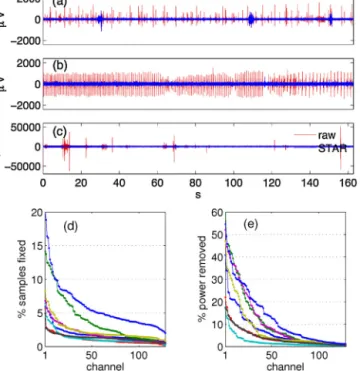
Fig.2.128-channelEEGdata.(a–c)Examplesofsingle-channelsignalsfroma 128-channelEEGrecordingbefore(red)andafter(blue)applyingSTAR.(d)Percentage ofsamplesremovedforeachchannel(sortedbydecreasingpercentage),foreach subject.(e)Proportionofpowerremovedforeachchannel(sortedbydecreasing power),foreachsubject.(Forinterpretationofthereferencestocolorinthislegend, thereaderisreferredtothewebversionofthearticle.)
maybeneededforacomponentanalysistechniquesuchasJDto succeed.
3.2. EEGdata
Afirstexampleinvolvesdatarecordedwitha128-channelEEG system(Biosemi).Thedatasampledat512Hzwerehigh-pass fil-tered with 20Hz cutoff (2nd order Butterworth) to emphasize thegammaregionthat isrelativelysusceptible toartifacts.The STARalgorithmwasappliedwiththresholdparameter=2to sup-presschannel-specificartifacts.Thesizeofthesmoothingwindow appliedtotheeccentricitymeasure was19 samples.Fig.2(a–c) shows three example signals from individual electrodes before (red)andafter(blue)processing.InFig.2(a)thedataare contam-inatedbywhatseemstobemuscleactivity.Thisissuppressedby STAR(thethreeremainingburstsreflectactivitycorrelatedacross sensorsandthereforenotremoved).InFig.2(b)thedataare con-taminatedbyapulsatilenoisewithaperiodofapproximately1s, mostlikelya“pulsationartifact”duetoaveinunderlyingthe elec-trode(NiedermeyerandLopezdaSilva,2005).InFig.2(c)thedata arecontaminatedbyaseriesofglitchesofhighamplitude(notethe scale)thatareequallywellsuppressed.
Data from this study were available for 8 subjects, about 1.5–2.5heach. Fig. 2(d) shows the percentage of samples cor-rectedbySTAR foreachchannel(channelssortedbydecreasing percentage)and subject, cumulated over therecording session. Thepercentagevaries acrosssubjectsandchannels,reflecting a differentprevalenceofchannel-specificartifactsbetweensubjects, andforagivensubject,betweenchannels.Fortheworstsubjectthe percentageisbelow5%formostchannels,implyingthat>95%of thedataofthosechannelswereuntouchedbytheprocessing.For goodsubjectsthepercentageofintactsamplesis>98%foralmost allchannels.Thesenumberssuggestthatthenegativeimpactof applyingSTAR,ifany,islikelytobeminimal.Fig.2(e)showsthe percentageofpowerremovedbySTARforeachchannel(channels
Fig.3. 128-channelEEGdata.(a)Onechannelwithmuscleartifactbefore(red)and after(blue)processing.(b,c)Spectrogramsofthesignalbeforeandafterapplying STAR.(d,e)Same,withsuperimposedchirpsignal,illustratingthatprocessingcan revealasignalotherwisemaskedbytheartifact.(Forinterpretationofthereferences tocolorinthislegend,thereaderisreferredtothewebversionofthearticle.)
sorted by decreasing percentage) and each subject (individual lines).Againthepercentagevariesacrosssubjectsandchannels.For theworstsubject,>20%ofpowerwasremovedfor>30channels, and>55%fortheworstchannel.Forothersubjectsthe percent-agesaresmaller,butstillsignificantforasubsetofchannels.To summarize,STARisbothsafeandofpotentiallysignificantbenefit. Fig.3(a)showsonechannelcontaminatedbyaburstofpulsatile activity,likelymuscleartifact,before(red)andafter(blue)applying STAR.ThespectrogramofthesedataisshowninFig.3before(b), andafter(c)processing.Artifactualactivitydominatesthehigher spectralregion,butthisisalleviatedbyprocessing.Fig.2(d)and(e) illustrateshowthisprocessingcouldpotentiallyrevealhigh fre-quencyactivity(hereasynthesizednarrowbandchirp)otherwise maskedbytheartifact.
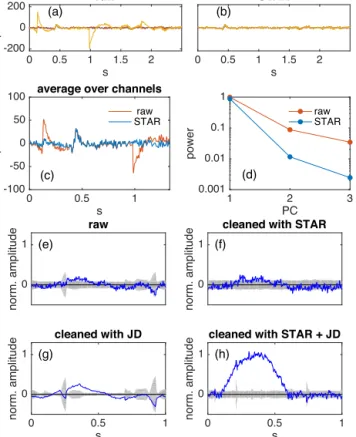
Asecondexampleusesdatarecordedfromthreeclosely-spaced EEGelectrodeswithintheearcanalofasubject(Kidmoseetal., 2012).The rationaleforrecording fromwithintheear is unob-trusiveness (for hearingaid-related applications) and the hope thatmuscleartifactswillbeweaker,however theclosespacing betweenelectrodesisexpectedtoresultinsignalshighly corre-latedacrosschannels.Fig.4(a)showsashortsegmentofsignals fromthethreeelectrodes.Contrarytoexpectations,onechannel (green)isaffectedbychannel-specific glitchesof possible mus-cularorigin.ApplyingSTAR removestheseartifactsresultingin signalsthataremuchmoresimilaracrosschannels,asexpected fromcollocatedelectrodes(Fig.4(b)).Anotherwaytoattenuate channel-specificartifactsistoaverageacrosschannels,butthe ben-efithereisrelativelysmall(Fig.4(c),red).HoweverapplyingSTAR beforeaveraginggreatlyincreasesthisbenefit(blue).Thedeflection near0.5sisnotremovedbecauseitissharedacrosssensors.The effectofartifactreductionofthe3-channeldataisreflectedinits PCAspectrum(Fig.4(d)).Corticalsignalsfromcloselyspaced elec-trodesshouldbehighlycorrelated,implyingarapidlydecreasing PCAspectrum,andthisexpectation isbettermetafterapplying STAR.ThisexampleshowsthatSTARcanbeeffectiveevenfora smallnumberofchannels.
3.3. SimulatedtargetembeddedinrealEEG
This example involves a simulated repetitive target (half-sinusoidpulse)superimposedonthesame3-channelEEGsignal asinthepreviousexample.Theadvantageofusingasimulated targetisthatthegroundtruthisknown,theadvantageofusing realEEGasnoiseisthatitisrepresentativeofrealEEGnoise.The
0 0.5 1 1.5 2 s -200 0 200 V raw (a) 0 0.5 1 1.5 2 s STAR (b) 0 0.5 1 s -100 -50 0 50 100 V
average over channels
(c) raw STAR 1 2 3 PC 0.001 0.01 0.1 1 power (d) raw STAR 0 1 norm. amplitude raw (e) 0 1 norm. amplitude
cleaned with STAR (f) 0 0.5 1 s 0 1 norm. amplitude cleaned with JD (g) 0 0.5 1 s 0 1 norm. amplitude
cleaned with STAR + JD (h)
Fig.4.Three-channelEEG.(a)Rawdata.(b)SameafterartifactremovalbySTAR.(c) Averageoverchannelsofraw(red)orprocessed(blue)data.(d)Eigenvalue spec-trumofraw(red)andprocessed(blue)data.ThesmallerpowerofPCs2and3 indicatesthatthesignalsareclosertobeingidenticalacrosschannels,asexpected forthreecollocatedelectrodes.(e,f)Simulatedtarget(290repetitionsofa half-sinusoid)embeddedin3-channelEEGnoise(SNR=0.03).Blueisaverageovertrials, graybandindicates±2SDofabootstrapresamplingofthemean.(e)Averageover trialsofthe“best”electrode.(f)Sameas(e)afterapplyingtheSTARalgorithmto sup-pressartifacts.(g)Sameas(e)afterapplyingtheJDalgorithmtoenhancethetarget. (h)Sameas(e)afterapplyingfirstSTARthenJD.Thevaluesplottedarenormalized toequatethevarianceovertrialsineachcondition,thusthegreateramplitudeofthe mean(blue)in(h)reflectsthebetterSNRoftherecoveredsignal.(Forinterpretation ofthereferencestocolorinthislegend,thereaderisreferredtothewebversionof thearticle.)
targetpulsewasrepeated290timesandaddedtothesecond chan-neloftheEEGwithSNR=0.03.Fig.4(e)showstheaverageover trialsofthesecondEEGchannel.Thegraybandrepresents±2SD ofabootstrapresamplingofthemean.Thepresenceofartifactsis reflectedbytheirregularwidthofthegrayband.Inprinciple,the SNRofsuchmultichanneldatacanbeenhancedbytheJD algo-rithm(deCheveigné andParra,2014)withtheappropriatebias functiontoenhancerepeatablecomponents.Howeverinthiscase thebenefitislimited(Fig.4(g))presumablybecauseallchannels areartifact-contaminatedsothatthereisnoartifact-freesubspace. ApplyingtheSTARalgorithmattenuatestheseartifacts(Fig.4(f)) andJDproducesawell-isolatedtargetsignal(Fig.4(h)).This exam-pleshowsagainthatremovingchannel-specificartifactswithSTAR canimprovetheeffectivenessofcomponentanalysis.
4. Discussion
TheSTARalgorithmexploitsthebetween-channelcorrelation oftheunderlyingdatatoidentifychannel-specific artifactsand repairthem.Figuratively,it“surfs”thecorrelationstructureofthe underlyingdata,selectively shavingoffthepartsthatdonotfit. Channel-specificartifactsareubiquitousinEEGandotherrecording techniques.Removingthemisusuallytedious(ifdonemanually)
orcomplexandunreliable(ifdoneautomatically),andareliable automaticmethodtosuppressthemisthususeful.
4.1. Comparisonwithotherapproaches
Themostcommonapproachtochannel-specificartifactsisto discardtheoffendingchannel(s),orelsetheoffendingsamplesor trials(Pictonetal.,2000).Validdataarelostasaresult,andthe strategyfailsiftoomanychannelsand/orsamplesareaffected. Incontrast,STARentailsminimaldataloss,becauseonlyasmall proportionofsamplesarediscarded.Dataarerejectedona sample-by-samplebasis,incontrastforexampletoSCADS(Junghöferetal., 2000)thatremoveslargerchunks(trials)oftheaffectedchannel,or AFOP(Boudetetal.,2012)thatoperatesonarelativelylongwindow (e.g.20s).
Asinseveralotherapproaches,missingchannelsare interpo-latedspatially.InSTARtheinterpolationisbasedonanestimate ofthecorrelationstructuregatheredovertheartifact-freepart,in contrasttomethodssuchasSCADSthatapplysphericalspline inter-polationtoreconstructthemissingdata(Perrinetal.,1989).STAR thusrequiresnogeometricalinformation(itispurelydata-driven) althoughitmaybenefitfromusingaproximitymaptorestrictthe numberofchannelsuponwhicheachchannelisprojected.STAR usesthemultivariatecorrelationstructureofthedata,incontrast towaveletorempiricalmodebasis(Safieddineetal.,2012)thatuse thewithin-channelautocorrelationstructuretointerpolatemissing values.
Averydifferentapproachistousecomponentanalysistoform linearcombinationsofchannelsasinEq.(1),andprojectthe com-ponents that correspondto artifactsout of thedata. Thereare manytechniquesavailable(ICA,beamforming,JD,etc.)that dif-ferinthewaytheydeterminetheweightswjk.InICA(Delorme
etal.,2007;Maetal.,2012;Crespo-Garciaetal.,2008)ameasure ofstatisticalindependence(e.g.kurtosis)isusedtoconstrainthe weights.Channel-specificnoiseisusuallybothkurtotic(lotsofzero orextremevalues)andindependentbetweenchannels,sothis pro-cedureislikelytoisolatecomponentsthatcontainchannel-specific noise.Inbeamforming(Grosse-Wentrupetal.,2009)aspatialfilter isusedtoisolatesources,eitherdesired(toextractthem)or unde-sired(tosuppressthem),onthebasisoftheirspatialposition.InCSP (Kolesetal.,1990)orJD(deCheveignéandParra,2014)thespatial filterisinsteaddesignedtomaximizeorminimizesomedesirable orundesirabletraitofthedata.
Regardlessofthemethod,componentanalysisfacesa funda-mentallimitation:itcannotresolvemoresourcesthandimensions inthedata.STARisnotsubjecttothislimitation,asillustratedby theexampleinFig.1(d–g)whereartifactswerepresentonall chan-nels,inadditiontotargetandnoisesources,butthetargetcould nonethelessbeseparated.NeitherICA,norJD,norbeamformingcan dealwiththissituationbecausethenumberofsourcestoresolve exceedsthenumberofchannels.ThereasonwhySTARsucceedsis thatitoperateslocallyintime(sothatthesolutionappliedtofix eachsampleneednotconsiderothersamples),andleavesmostof thedataintact(thedimensionalityofthecleaneddataisthatof thedatabeforeartifactswereadded).Incontrast,techniquessuch asICAapplyasinglelineartransformtoallthedata,eachartifact removedreducesthedatadimensionality,andtheremaynotbe enoughdimensionstoallowthemalltoberemoved.Asstressed inSection1,anartifactspecifictochanneljcanonlyberemoved bysettingallthewjktozeroinEq.(2),i.e.discardingthat
elec-trode,andthereforeifartifactsarepresentonmanychannelsthe dimensionalityisgreatlyreduced.Empirically,theeffectivenessof ICAasa tooltoreduce myogenicartifactshasbeenquestioned because ICs may be found to contain both artifact and neural activity(McMenaminetal.,2010,2011),presumablyasa conse-quenceofthelargenumberofdistinctgeneratorsofmuscleartifact.
SimilartoSTAR,thesensornoisesuppression(SNS)method(de CheveignéandSimon,2008b)addressessensor-specificnoiseby replacingeachchannelbyitsprojectiononthesubspacespanned bytheotherchannels.HoweverwithSNSthisoperationisapplied uniformlyacrossthetimeaxis,andthussharesthesamedrawbacks ofothercomponentanalysistechniques.
TheAFOPmethodofBoudetetal.(2012)appliesdifferent solu-tionstodifferentpartsofthetimeaxis(ortime-frequencyplane). Artifacts withina limited spectrotemporalwindow areisolated using a variantof the commonspatial pattern (CSP) algorithm (Kolesetal.,1990),andthedataoverthatwindowarefixedby projectingthemout.AFOPcanremoveanyactivityspecifictothat window,notjustchannel-specific,incontrasttoSTARwhichonly removeschannel-specificartifacts.Howeverasnotedabove,AFOP operatesatacoarsertemporalgranularity.
ThefocusofSTARonchannel-specificartifactscouldbeseen asalimitation.Howeverthisrestrictionallowsittoavoid remov-ingactivitysharedacrosschannels,ofdeeperandpossiblyneural origin. Most importantly, STAR is compatible with other tech-niques(ICAorother)thatcandealwithchannel-sharedartifacts, increasing their effectiveness by relieving them of the burden ofchannel-specific artifacts.Indeed,theprimary motivationfor developingSTARwastopushthelimitsofthesenoisereduction techniques,includingourownpreviousefforts(deCheveignéand Simon,2007,2008a,b;deCheveigné,2010,2012;deCheveignéand Parra,2014).
AnfeatureofSTARisthatitisautomatic,incontrastto tradi-tionalartifactrejectionthatrequires manualintervention,orto ICAthat requiresinspectionof componentsto decidewhichto remove.Itisrelativelyparameter-free,incontrasttomethodssuch asFASTER(Nolanetal.,2010)thatinvolvemultipleparameters.It isalsoconceptuallysimpleandcomputationallyfast.
Tosummarize themainfeatures that distinguishSTARfrom otherapproaches:(a) itis automatic andrequires little tuning, (b) dimensionality is not reduced and apart from the artifact portionsthedataareuntouched,(c)themethodaddressesonly channel-specificartifacts,leavingotherformsofartifacttoother approaches,thatitcomplementsandcanenhance.
4.2. Caveatsandcautions
Assumption4requiresthatthedimensionalityoftheactivity underlyingthedata(e.g.numberofsignificantneuralsources)be lessthanthenumberofchannels.Astherearepotentiallybillions ofneuralsourcesthiscanonlybeanapproximation.
Thecorrelationstructure isassumedtobestationarysothat theprojectionparameters estimated fromthe artifact-free part canbeappliedintheartifact-contaminatedpart.Adeparturefrom thisassumption(forexampleifadditionalneuralsourcescoincided withmuscleartifact)wouldreduceeffectiveness.
Thecalculationoftheprojectionmatrix,thatallowseach chan-neltobereplacedbyitsprojectionontheotherchannels,issubject tooverfittingifthereisalargenumberofchannelsorinsufficient data.Itisusefultolimittheprojectiontoasubsetofneighboring channels(10seemstoworkwell).
Assumptions2and3requirethatchannel-specificartifactsbe localintime,which excludesslowchannel-specificfluctuations. Itmaybeusefultoremovesuchslowfluctuationsbyhigh-pass filteringthedatabeforeapplyingSTAR(orsplitthedatainto low-andhigh-passstreams,processthelatter,thenrecombine).
Foreachchannel,thealgorithmswitchesbetweenan artifact-free state, for which the data are untouched, and an artifact-contaminated state for which the data are replaced by their projection.Thetransitionbetweenstatesmayproduceastep,and thismayparadoxicallyleadtoincreasedhigh-frequencynoiseif thetransitionsarenumerousand/orthestepsarelarge.Smoothing
theeccentricitymeasurereducesthenumberofswitches,andin practiceswitchingseemsrarelyaproblemunlessthedatacontain alotoflow-frequencypower(seepreviouspoint).
Assumption2,thatartifactsshouldoccurononlyonechannel atatime,isoftenviolatedformyogenicactivitythatmayoccur inburststhataffectseveralchannelssimultaneously.Thishastwo consequences.First,thealgorithm(initsbasicform)onlyfixesone channelatagiventimepoint,andsoartifactsontheotherchannels mayremain.Second,projectiononartifact-contaminatedchannels maycontaminatethechannelbeingfixed.Theextensiondescribed inSection 2.4addressestheproblem,althoughitsapplicabilityis limitedbythecomputationalcostofdealingwiththemany com-binationsofartifact-contaminatedchannels(exponentialintheir number).TheNoiseToolstoolboximplementsanapproximation thatappearstobeeffective.STARmaybeappliedrepeatedly,so thateachnewpassremovesartifactsmissedbypreviouspasses. 4.3. Applicabilitytoelectromyogenicactivity
ThereisevidencethatmuchEEGpowerbeyond20Hzis mus-cularin origin: when muscular activityis silencedby injection of a paralysingdrug, powerin that bandis greatly diminished (Whithamet al.,2007).Thefact thatmuscularactivitycovaries withmentalstatemakesitapotentialconfoundincognitive stud-ies(Whithametal.,2008;Yuval-Greenbergetal.,2008;Shackman etal.,2009).TheSTARalgorithmoffersapartialsolution,inthatit removesthetypeofmyogenicactivitythatislocaltoone elec-trode (Ma et al., 2012).This constitutes a subset of myogenic activity:activitythatisinsteadcorrelatedacrosselectrodes(e.g. fromdeeperordistantmuscles)mustberemovedbyothermeans (McMenamin et al.,2010; Yilmaz et al.,2014).Empirically, the amountofreductionobservedforeachartifactburstisvariable, rangingfrom100%toafewtensofpercent(e.g.Fig.3).Artifactsthat arecorrelatedacrosselectrodes(e.g.fromocularordeepmuscles) maybeaddressedbycomponentanalysissuchasICAorJD,towhich STARiscomplementaryinthatitavoidssquanderingdimensions usefultothosemethods.TheSTARalgorithmisthusofpotential benefitinstudiesofcorticalactivityathigherfrequencies. 4.4. Applicabilitytoreal-timeandBCIapplications
Thealgorithmcanoperateonlineinrealtime.Afteraninitial bootstrapphase(togetanestimateoftheartifact-freecovariance matrix),thealgorithmswitchesbetweentwostates:(1)noartifact, thecovariancematrixisupdated,(2)artifact,theoffending chan-nelsarecorrected.Updatingofthecovariancematrixestimatemay occurforexampleaccordingtoaleakyintegratormechanism,to allowforslowvariationsofthecorrelationstructure.
ApplicationssuchasBCIinvolvingawearableEEGdeviceare limitedby artifactsrelated tomovement,includingcontactand muscleartifacts(Fatourechietal.,2007;McFarlandetal.,2005; Reisetal.,2014)thatcanforexampledisruptanotherwise effec-tivetechniquesuchasCSP(Grosse-Wentrupetal.,2009).Manual correctionorofflineprocessingareobviouslyruledout,andSTAR thusisofpotentialbenefitfortheseapplications.
5. Conclusions
Thesparsetimeartifactreduction(STAR)algorithmdeals effec-tively with channel-specific artifacts that are common in EEG, includingelectrodecontactnoiseandcertaintypesofmuscle arti-fact.Itoperateslocallyintime,correctingonlythesamplesaffected bytheartifact,andleavingtheremainderintact,andthushas min-imalnegativeimpactontheunderlyingdata.Removalofanartifact doesnotreducethedimensionalityofthedata,incontrastto chan-nelrejectionorcomponentanalysistechniquessuchasICA.The
STARalgorithm cancomplementthose techniquesand enhance theireffectivenessbyrelievingthemoftheburdenofdealingwith channelspecificartifacts.TheSTARalgorithmoperates automati-cally,requiresfewparameters,iscomputationallyefficient,andcan beimplementedtoperformonlineprocessinginrealtime.
Acknowledgements
ThisworkwassupportedbytheEUH2020-ICTgrant644732
(COCOHA),andgrantsANR-10-LABX-0087IECand
ANR-10-IDEX-0001-02 PSL*. Ed Lalor and Giovanni Liberto contributed the 128-channelEEGdata,andThomasLunnerandCarinaGraverson contributedthe3-channelEEGdata.
References
BoudetS,PeyrodieL,ForzyG,PintiA,ToumiH,GalloisP.Improvementsofadaptive filteringbyoptimalprojectiontofilterdifferentartifacttypesonlongduration EEGrecordings.ComputMethodsProgBiomed2012];108:234–49.
CorbyJC,RothWT,KopellBS.Prevalenceandmethodsofcontrolofthecephalicskin potentialEEGartifact.Psychophysiology1974];11:350–60.
Crespo-GarciaM,AtienzaM,CanteroJL. Muscleartifactremovalfrom human sleep EEG by using independent component analysis. Ann Biomed Eng 2008];36:467–75.
de CheveignéA. Time-shiftdenoising source separation.J Neurosci Methods 2010];189:113–20.
deCheveignéA.Quadraticcomponentanalysis.NeuroImage2012];59:3838–44. deCheveignéA,ParraLC.Jointdecorrelation,aversatiletoolformultichanneldata
analysis.NeuroImage2014];98:487–505.
deCheveignéA,SimonJZ.Denoisingbasedontime-shiftPCA.JNeurosciMethods 2007];165:297–305.
deCheveignéA,SimonJZ.Denoisingbasedonspatialfiltering.JNeurosciMethods 2008a];171:331–9.
de Cheveigné A, Simon JZ. Sensor noise suppression. J Neurosci Methods 2008b];168:195–202.
DelormeA,SejnowskiT,MakeigS.EnhanceddetectionofartifactsinEEGdata usinghigher-orderstatisticsandindependentcomponentanalysis.NeuroImage 2007];34:1443–9.
FatourechiM,BashashatiA,WardRK,BirchGE.EMGandEOGartifactsinbrain computerinterfacesystems:asurvey.ClinNeurophysiol2007];118:480–94. Goncharova II, McFarland DJ, Vaughan TM, Wolpaw JR. EMG
contamina-tion ofEEG: spectral andtopographical characteristics. ClinNeurophysiol 2003];114:1580–93.
Grosse-WentrupM,LiefholdC,GramannK,BussM.Beamforminginnoninvasive brain–computerinterfaces.IEEETransBiomedEng2009];56:1209–19. JunghöferM,ElbertT,TuckerDM.Statisticalcontrolofartifactsindensearray
EEG/MEGstudies.Psychophysiology2000];37:523–32.
KidmoseP,LooneyD,MandicDP.AuditoryevokedresponsesfromEar-EEG recor-dings.In:InternationalConferenceoftheIEEEEngineeringinMedicineand BiologySociety.Proceedings2012;2012].p.586–9.
KolesZ,LazarM,ZhouS.Spatialpatternsunderlyingpopulationdifferencesinthe backgroundEEG.BrainTopogr1990];2:275–84.
MaJ,TaoP,BayramS,SvetnikV.MuscleartifactsinmultichannelEEG:characteristics andreduction.ClinNeurophysiol2012];123:1676–86.
McFarlandDJ,SarnackiWA,VaughanTM,WolpawJR.Brain–computerinterface (BCI)operation:signalandnoiseduringearlytrainingsessions.Clin Neuro-physiol2005];116:56–62.
McMenaminBW,ShackmanAJ,MaxwellJS,BachhuberDRW,KoppenhaverAM, GreischarLL,DavidsonRJ.ValidationofICA-basedmyogenicartifactcorrection forscalpandsource-localizedEEG.NeuroImage2010];49:2416–32.
McMenaminBW,ShackmanAJ,GreischarLL,DavidsonRJ.Electromyogenicartifacts andelectroencephalographicinferencesrevisited.NeuroImage2011];54:4–9. MuthukumaraswamySD.High-frequencybrainactivityandmuscleartifactsin
MEG/EEG:areviewandrecommendations.FrontHumNeurosci2013];7:138. NiedermeyerE,LopezdaSilvaF.Electroencephalography:basicprinciples,clinical
applicationsandrelatedfields.LippincottWilliams&Wilkins;2005]. NolanH,WhelanR,ReillyRB.FASTER:fullyautomatedstatisticalthresholdingfor
EEGartifactrejection.JNeurosciMethods2010];192:152–62.
PerrinF, PernierJ, BertrandO, EchallierJF.Spherical splinesforscalp poten-tial and current density mapping. Electroencephalogr Clin Neurophysiol 1989];72:184–7.
PictonTW,BentinS,BergP,DonchinE,HillyardSA,JohnsonR,MillerGA,Ritter W,RuchkinDS,RuggMD,TaylorMJ.Guidelinesforusinghumanevent-related potentialstostudycognition:recordingstandardsandpublicationcriteria. Psy-chophysiology2000];37:127–52.
ReisPMR,HebenstreitF,GabsteigerF,vonTscharnerV,LochmannM. Methodologi-calaspectsofEEGandbodydynamicsmeasurementsduringmotion.FrontHum Neurosci2014];8:156.
SafieddineD, Kachenoura A, AlberaL, Birot G, KarfoulA,Pasnicu A,Biraben A,WendlingF,SenhadjiL,MerletI.RemovalofmuscleartifactfromEEG data:comparisonbetweenstochastic(ICAandCCA)anddeterministic(EMD andwavelet-based) approaches.Eurasip JAdv SignalProcess 2012];2012: 127.
ShackmanAJ,McMenaminBW,SlagterHA,MaxwellJS,GreischarLL,DavidsonRJ. Electromyogenicartifactsandelectroencephalographicinferences.BrainTopogr 2009];22:7–12.
WhithamEM,PopeKJ,FitzgibbonSP,LewisT,ClarkCR,LovelessS,BrobergM, Wal-laceA,DeLosAngelesD,LillieP,HardyA,FronskoR,PulbrookA,Willoughby JO.Scalp electrical recording during paralysis: quantitative evidence that EEGfrequenciesabove20Hz arecontaminatedbyEMG.ClinNeurophysiol 2007];118:1877–88.
WhithamEM,LewisT,PopeKJ,FitzgibbonSP,ClarkCR,LovelessS,DeLosAngelesD, WallaceAK,BrobergM,WilloughbyJO.ThinkingactivatesEMGinscalpelectrical recordings.ClinNeurophysiol2008];119:1166–75.
YilmazG,UnganP,SebikO,UginˇciusP,TürkerKS.Interferenceoftonicmuscle activityontheEEG:asinglemotorunitstudy.FrontHumNeurosci2014];8:504. Yuval-GreenbergS,TomerO,KerenAS,NelkenI,DeouellLY.Transientinduced gamma-bandresponseinEEGasamanifestationofminiaturesaccades.Neuron 2008];58:429–41.