ROBUST MONOPOLY PRICING
By
Dirk Bergemann and Karl Schlag
July 2005
Revised April 2007
Revised September 2008
COWLES FOUNDATION DISCUSSION PAPER NO. 1527RR
COWLES FOUNDATION FOR RESEARCH IN ECONOMICS
YALE UNIVERSITY
Box 208281
Robust Monopoly Pricing
Dirk Bergemanny Karl Schlagz
September 2008
Abstract
We consider a robust version of the classic problem of optimal monopoly pricing with incomplete information. In the robust version, the seller faces model uncertainty and only knows that the true demand distribution is in the neighborhood of a given model distribution.
We characterize the optimal pricing policy under two distinct, but related, decision criteria with multiple priors: (i)maximin expected utility and (ii)minimax expected regret. The resulting optimal pricing policy under either criterion yields a robust policy to the model uncertainty.
While the classic monopoly policy and the maximin criterion yield a single determin-istic price, minimax regret always prescribes a random pricing policy, or equivalently, a multi-item menu policy. Distinct implications of how a monopolist responds to an increase in uncertainty emerge under the two criteria.
Keywords: Monopoly, Optimal Pricing, Robustness, Multiple Priors, Regret. Jel Classification: C79, D82
The …rst author gratefully acknowledges support by NSF Grants #SES-0518929, #CNS-0428422 and a DFG Mercator Research Professorship at the Center of Economic Studies at the University of Munich. We thank Rahul Deb, Peter Klibano¤, Stephen Morris, David Pollard, Phil Reny, John Riley and Thomas Sargent for helpful suggestions. We are grateful to seminar participants at the California Institute of Tech-nology, Columbia University, the University of California at Los Angeles, the University of Wisconsin and the Cowles Foundation Conference "Uncertainty in Economic Theory" for many comments.
yDepartment of Economics, Yale University, New Haven, CT 06511, [email protected]. zDepartment of Economics, Universitat Pompeu Fabra, 08005 Barcelona, Spain, [email protected].
1
Introduction
In the past decade, the theory of mechanism design has found increasingly widespread applications in the real world, favored partly by the growth of the electronic marketplace
and trading on the internet. Many trading platforms, such as auctions and exchanges, implement key insights of the theoretical literature. With an increase in the use of optimal design models, the robustness of these mechanisms with respect to the model speci…cation
becomes an important issue. In this paper, we investigate a robust version of the classic monopoly problem of selling a product under incomplete information. Optimal monopoly
pricing is the most elementary instance of a pro…t maximizing problem in mechanism design with incomplete information.
We investigate the robustness of the optimal selling policy by enriching the standard model to account for model uncertainty. In the classic model, the valuation of the buyer
is drawn from a given prior distribution. In contrast, in the robust version, the seller only knows that the true distribution is in the neighborhood of a given model distribution. The
size of the neighborhood represents the extent of the model uncertainty faced by the seller. We consider the neighborhoods induced by the Prohorov metric which is the standard
metric in robust statistical decision theory (see the Huber (1981) and Hampel, Ronchetti, Rousseeuw, and Stahel (1986)). In the context of our demand model, the Prohorov metric
gives a literal description of the two relevant sources of model uncertainty. With a large probability, the seller could misperceive the willingness to pay by a small margin, and with
a small probability, the seller could be mistaken about the market parameters by a large margin. The Prohorov metric incorporates exactly these two di¤erent types of deviations,
allowing both for a large probability of small errors and a small probability of large errors. The optimal pricing policy of the seller in the presence of model uncertainty is an instance
of decision-making with multiple priors. We therefore build on the axiomatic decision theory with multiple priors and obtain interesting new insights for monopoly pricing. The
methodological insight is that robustness can be guaranteed by considering decision making under multiple priors. The strategic insight is that we are able predict how an increase in
There are two leading approaches to incorporate multiple priors into axiomatic decision making: maximin utility and minimax regret. The maximin utility approach with multiple
priors is due to Gilboa and Schmeidler (1989). Here, the decision maker evaluates each ac-tion by its minimum expected utility across all priors. The decision maker selects the acac-tion
that maximizes the minimum expected utility. The minimax regret approach, originating in Savage (1951), was axiomatized by Milnor (1954) and recently adapted to multiple priors
by Hayashi (2008) and Stoye (2008). Here, the decision maker evaluates foregone oppor-tunities using regret and chooses an action that minimizes the maximum expected regret
among the set of priors.
From an axiomatic perspective, the maximin utility and minimax regret criteria
rep-resent di¤erent departures from the standard model of Anscombe and Aumann (1963) by allowing for multiple priors. The maximin utility criterion emerges by giving up the
inde-pendence axiom and replacing it with the weaker certainty indeinde-pendence axiom and adding a convexity axiom. The minimax regret criterion emerges by maintaining the certainty
inde-pendence axiom but relaxing the axiom of indeinde-pendence of irrelevant alternatives, to allow the choice to be menu dependent. A convexity axiom and a version of the betweenness
axiom complete the characterization. Both the maximin utility and the minimax regret criteria can interpreted as re…nements of subjective expected utility theory.
The analysis of the optimal pricing under the two decision criteria reveals that either criterion leads to a family of robust policies in the following sense. We say that a candidate
family of policies, indexed by the size of the uncertainty, is robust, if for any demand su¢ ciently close to the model distribution, the di¤erence between the expected pro…t under
the optimal policy for this demand and the expected pro…t under the candidate policy is arbitrarily small. While the optimal policies under maximin utility and minimax regret
share the robustness property, the response to the uncertainty leads to distinct qualitative features.
The pricing policy of the seller is obtained as the equilibrium strategy of a zero-sum game
between the seller and adversarial nature. The strategy by nature selects theleast favorable demand given the objective of the seller. Under maximin utility the seller is worse o¤ when
valuations subject to the restriction that the selected distribution is in the neighborhood of the model distribution. In particular, as we increase the uncertainty represented by an
increase in the size of the neighborhood, the buyers valuations as determined by the least favorable demand are lower in the sense of …rst order stochastic dominance. In consequence
the best response of the seller always consists in lowering her price.
When we analyze the behavior under regret minimization, the optimal pricing policy is
still determined by a zero-sum game between the seller and nature. The notion of regret modi…es the trade-o¤ for the seller and for nature. The regret of the seller is the di¤erence
between the actual valuation of a buyer for the object and the actual pro…t obtained by the seller. The regret of the seller can therefore be positive for two reasons: (i) a buyer
has a low valuation relative to the price and hence does not purchase the object, or(ii) he has a high valuation relative to the price and hence the seller could have obtained a higher
pro…t. In the equilibrium of the zero-sum game, the optimal pricing policy of the seller has to resolve the con‡ict between the regret which arises with low prices against the regret
associated with high prices. If the seller o¤ers a low price, nature can cause regret with a distribution which puts substantial probability on high valuation buyers. On the other
hand, if the seller o¤ers a high price, nature can cause regret with a distribution which puts substantial probability at valuations just below the o¤ered price. It then becomes evident
that a single price will always expose the seller to substantial regret. Consequently, the seller can decrease her exposure by o¤ering many prices. This can either be achieved by
a probabilistic price or, alternatively, by a menu of prices. With a probabilistic price, the seller diminishes the likelihood that nature will be able to cause large regret. Equivalently,
the seller can o¤er a menu of prices and quantities. The quantity element in the menu can either represent the quantity of a divisible object or the probability of obtaining an
indivisible object.
We provide additional intuition by contrasting the pricing policy under regret to the standard pro…t maximizing policy. An optimal policy for a given distribution of valuations
is always to o¤er the entire object at a …xed price (a classic result by Harris and Raviv (1981) and Riley and Zeckhauser (1983)). In contrast, here the policy will o¤er many prices
below the given price is substantial. On the other hand, if the seller were simply to lower the price, she would miss the chance of extracting pro…t from higher valuation customers.
She resolves this con‡ict by o¤ering smaller trades at lower prices to the low valuation customers. The size of the trade is simply the probability by which a trade is o¤ered or
the quantity o¤ered at a given price. In the game against nature, the seller will have to be indi¤erent between o¤ering small and large trades. In terms of the virtual utility, the
key notion in optimal mechanisms, this requires that the seller will receive zero virtual utility over a range of valuations. The resulting conditions on the distribution of valuations
determine the least favorable demand. Importantly, an increase in uncertainty may now lead to an increase in the expected price. In the special case of a linear model distribution,
we …nd that the expected price increases if the optimal price for the model distribution is low and decreases if the optimal price for the model distribution is high.
We conclude the introduction with a brief discussion of the directly related literature. The basic ideas of robust decision making (see De…nition 1) were …rst formalized in the
context of statistical inference, in particular, with respect to the classic Neyman-Pearson hypothesis testing framework. The statistical problem is to distinguish between two known
distributions on the basis of a sample. The model misspeci…cation and consequent concern for robustness come from the fact that each of the two distributions might be misspeci…ed.
Huber (1964), (1965) …rst formalized robust estimation as the solution to a minimax problem and an associated zero-sum game. A recent contribution by Prasad (2003) employs this
notion of robustness to the optimal policy without uncertainty, where it is referred to as -robustness, and demonstrates the non-robustness of some economic models. In particular,
he shows that the pro…t maximizing price in the optimal monopoly problem considered here is not robust to model misspeci…cation. The non-robustness is demonstrated by a simple
example. Suppose the model distribution is a Dirac distribution, which put probability one on a particular valuation v. Then the optimal monopoly price p is equal to v. This policy is not robust to model misspeci…cation, because if the true model puts probability
one on a value arbitrarily close, but strictly belowv, then the resulting revenue is 0rather than v. One of the objectives of this paper to identify robust policies, but not necessarily
pro…ts.1
A recent paper by Bose, Ozdenoren, and Pape (2006) determines the optimal auction
in the presence of an uncertainty averse seller and uncertainty averse bidders. Lopomo, Rigotti, and Shannon (2006) consider a general mechanism design setting when the agents,
but not the principal, have incomplete preferences due to Knightian uncertainty. In related work, Bergemann and Schlag (2008) consider the optimal monopoly problem under regret
without any priors. There, the analysis is concerned with optimal policies in the absence of information rather than robustness and responsiveness to uncertainty as in the current
contribution. The notion of regret was investigated in mechanism design by Linhart and Radner (1989) in the context of bilateral trade as well as by Engelbrecht-Wiggans (1989)
and Selten (1989) in the context of auctions. Recently, Engelbrecht-Wiggans and Katok (2007) and Filiz-Ozbay and Ozbay (2007) present experimental evidence indicating concern
for regret in …rst price auctions.
The remainder of the paper is organized as follows. In Section 2, we present the model,
the notion of robustness and the neighborhoods. In Section 3, we characterize the pricing policy under the maximin utility criterion. In Section 4, we characterize the pricing policy
under the minimax regret criterion. We show that the resulting policies are robust under either criterion. Section 5 concludes with a discussion of some open issues. The appendix
collects auxiliary results and the proofs.
2
Model
2.1 Monopoly
The seller faces a single potential buyer with value v 2[0;1] for a unit of the object. The value v is private information to the buyer and unknown to the seller. The buyer wishes to buy at most one unit of the object. The marginal cost of production is constant and
normalized to zero. The net utility of the buyer with value v of purchasing a unit of the 1There is also a rapidly growing literature on robust decision making in macroeconomics, see Hansen and Sargent (2007) for a comprehensive introduction, that uses related notions of robustness for maximizing the minimum utility in the context of intertemporal decision-making.
object at price p isv p. The pro…t of selling a unit of the object at a deterministic price
p2R+ if the valuation of the buyer isv is:
(p; v),pIfv pg;
whereIfv pg is the indicator function specifying:
Ifv pg = 8 < : 0; if v < p; 1; if v p:
By extension, if the valuation of the buyer is v, a random pricing policy 2 R+ yields
an expected pro…t:
( ; v),
Z
(p; v)d (p).
Given the risk neutrality of the buyer and the seller, a random pricing policy by the seller can alternatively by represented as a menu policy(q; t(q))whereq is the probability
that the buyer receives the object andt(q)is the tari¤ that the buyer pays for the probability
q. Given the random pricing policy , we can de…ne for everyp2suppf g:
q, (p); (1)
and the corresponding nonlinear pricet(q) as:
t(q),
Z p
0
yd (y): (2)
In the menu interpretation, q is either the probability of receiving the object if the object
is indivisible or the quantity if the object is divisible.
In the classic monopoly problem with incomplete information, the seller maximizes the expected pro…t for a given prior F over valuations. In the robust version, we assume that
the seller faces uncertainty (or ambiguity) in the sense of Ellsberg (1961). The uncertainty is represented by a set of possible distributions. We …rst introduce the basic notation for the
classic monopoly model and then de…ne the model with uncertainty. For given a distribution
F and given deterministic price p, the expected pro…t is:
(p; F),
Z
We note that the demand generated by the distributionF can either represent a single large buyer or many small buyers. In this paper, we phrase the results in terms of a single large
buyer, but the results generalize naturally to the case of many small buyers. With a random pricing policy 2 R+, the expected pro…t is given by:
( ; F),
Z Z
(p; v)d (p)dF(v).
A random pricing policy that maximizes the pro…t for given distribution F is denoted by
(F):
(F)2 arg max 2 R+
( ; F).
A well-known result by Riley and Zeckhauser (1983) states that for every distribution F,
there exists a deterministic pricep (F) that maximizes pro…ts, so:
(p (F); F) = max 2 R+
( ; F).
2.2 Uncertainty
We assume that the seller faces uncertainty (or ambiguity) in the sense of Ellsberg (1961). The uncertainty is represented by a set of possible distributions, where the set is described
by a model distribution F0 and includes all distributions in a neighborhood of size " of
the model distribution F0. The magnitude of the uncertainty is thus quanti…ed by the size
of the neighborhood around the model distribution. Given the model distribution F0 we
denote byp0 a pro…t maximizing price atF0:
p0,p (F0):
For the remainder of the paper we shall assume that at the model distributionF0: (i) p0 is
the unique maximizer of the pro…t function (p; F0) and(ii)the densityf0 is continuously
di¤erentiable near p0. These regularity assumptions enable us to use the implicit function
theorem for the local analysis.
We consider two di¤erent decision criteria that allow for multiple priors: maximin utility
and minimax regret. In either approach, the unknown state of the world is identi…ed with the valuev of the buyer.
Neighborhoods Given the model distributionF0, we de…ne the"neighborhoods, denoted
by P"(F0), through theProhorov metric:
P"(F0) =fFjF(A) F0(A") +"; 8measurable A [0;1]g, (3)
where the set A" denotes the closed "neighborhood of any measurable set A.2 Formally, the set A" is given by:
A"= x2[0;1] min
y2Ad(x; y) " ;
whered(x; y) =jx yjis the distance on the real line. The Prohorov metric has evidently two components. The additive term"in (3) allows for asmall probability oflarge changes in the valuations relative to the model distribution whereas the larger setA" permitslarge probabilities of small changes in the valuations. The Prohorov metric is a metric for weak convergence of probability measures.
Maximin Utility Under maximin utility, the seller maximizes the minimum utility, where the utility of the seller is simply the pro…t, by solving:
m2 arg max
2 R+
min
F2P"(F0)
( ; F):
Accordingly, we say that m attains maximin utility. We refer to Fm as a least favorable
demand (for maximin utility) if
Fm 2 arg min F2P"(F0)
max 2 R+
( ; F):
The least favorable demandFm minimizes pro…ts across all pro…t maximizing pricing poli-cies.3
2See Dudley (2002) for the de…nition of the Prohorov metric and the link to weak convergence and Huber (1981) and Hampel, Ronchetti, Rousseeuw, and Stahel (1986) for its application in robust statistics.
3
Klibano¤, Marinacci, and Mukerji (2005) propose a related and smooth model of ambiguity aversion by enriching the multiple prior model with a belief over distributions and with an increasing transformation
' representing ambiguity aversion. The additional elements, belief and ambiguity index ', render the analysis of multiple priors richer but also substantially more complex. In addition, the one-dimensional representation of ambiguity in terms of the size of the neighborhood is not available anymore.
Minimax Regret The regret of the monopolist at a given price p and valuation v of a buyer is de…ned as:
r(p; v),v pIfv pg=v (p; v); (4)
The regret of the monopolist charging price pfacing a buyer with value v is the di¤erence
between (i) the pro…t the monopolist could make if she were to know the value v of the buyer before setting her price and (ii) the pro…t she makes without this information. The regret is non-negative and can only vanish ifp=v. The regret of the monopolist is strictly
positive in either of two cases: (i) the value v exceeds the price p, the indicator function is then Ifv pg = 1; or (ii) the value v is below the price p, the indicator function is then
Ifv pg= 0.
The expected regret with a random pricing policy when facing a distribution F is
given by: r( ; F), Z r(p; v)d (p)dF(v) = Z vdF(v) Z (p; F)d (p). (5)
Thus, the probabilistic price is pro…t maximizing at F if and only if minimizes (ex-pected) regret when facing F: The pricing policy r 2 R+ attains minimax regret if it
minimizes the maximum regret over all distributions F in the neighborhood of a model distributionF0: r2 arg min 2 R+ max F2P"(F0) r( ; F): Fr is called aleast favorable demand if
Fr2 arg min F2P"(F0) min 2 R+ r( ; F) = arg max F2P"(F0) Z vdF(v) max 2 R+ ( ; F) :
Thus, a least favorable demand maximizes the regret of a pro…t maximizing seller who knows the true demand. It should be pointed out that while this regret criterion seems to
relate to foregone opportunities when the information is revealed ex post, this particular interpretation is solely an additional feature of the minimax regret model. In particular,
the decision maker does not need additional information to become available ex post. As in the case of the maximin utility criterion of Gilboa and Schmeidler (1989), the minimax
regret criterion in Hayashi (2008) and Stoye (2008) is completely characterized by a set of axioms.4
The notion of regret naturally extends to the case of many buyers as follows. The regret of the seller facing nbuyers is equal to the sum of the regret accrued over n buyers
and n, possibly distinct, prices. While the seller is thus allowed to o¤er a di¤erent price to each buyer, the additivity of the regret implies that we can con…ne attention to price
(distributions) which are identical across buyers.
2.3 Robust Pricing
For a given model distribution F0, we de…ne a robust family of random pricing policies,
f "g">0, which are indexed by the size of the neighborhood"as follows.
De…nition 1 (Robust Pricing)
A family of pricing policiesf "g">0 is called robust if, for each >0, there is " >0 such
that:
F 2 P"(F0) ) ( (F); F) ( "; F)< :
The above notion presents a formal criterion of robust decision making in the spirit of the statistical decision literature pioneered by Huber (1964). It requires that for every,
arbitrarily small, upper bound , on the di¤erence in the pro…ts between the optimal policy
(F) without uncertainty and an element of robust family of policies f "g, we can …nd a su¢ ciently small neighborhood "so that the robust policy " meets the upper bound for all distributions in the neighborhood. Each member " in the robust familyf "g">0 is
allowed to depend on the size "of the neighborhood. A natural and ideal candidate for a robust policy is the optimal policy (F) itself. In other words, we would require that for
each >0, there is" >0 such that:
F 2 P"(F0) ) ( (F); F) ( (F0); F)< : (6)
4In particular, the axiomatic approach to minimax regret is distinct from the ex-post measure of regret due to Hannan (1957) in the context of repeated games or from the more behavioral approaches to regret o¤ered by Bell (1982) and Loomes and Sugden (1982).
This notion of robustness, applied directly to the optimal policy (F), constitutes the de…nition of robustness in Prasad (2003) and his earlier mentioned example of the Dirac
distribution shows that the optimal policy (F)is in general not robust.5For a given model distributionF0, there are potentially many robust families of pricing rules. Our objective is
to select among these rules by considering decision making under multiple priors and then to show that the resulting pricing rules are robust in the above sense of statistical decision
making.
3
Maximin Utility
We consider the problem of the monopolist who wishes to maximize the minimum pro…t for
all distributions in the neighborhood of the model distributionF0. Following Von Neumann
(1928), the pricing rule that attains maximin utility can be viewed as the equilibrium
strat-egy in a game between the seller and adversarial nature. The seller chooses a probabilistic price and nature chooses a demand distributionF from the setP"(F0). In this game, the
payo¤ of the seller is the expected pro…t while the payo¤ of nature is the negative of the expected pro…t. Formally, a Nash equilibrium of this zero-sum game can be characterized
as a solution to the saddle point problem of …nding( m; Fm) that satisfy:
( ; Fm) ( m; Fm) ( m; F); 8 2 R+,8F 2 P"(F0). (SPm) In other words, at ( m; Fm) the probabilistic price m is pro…t maximizing at Fm andFm is a pro…t minimizing demand given m.
The objective of adversarial nature is to lower the expected pro…t of the seller. For a given price p o¤ered by the seller, the pro…t minimizing demand given p is achieved by
increasing the cumulative probability of valuations strictly below p as much as possible within the neighborhood. The pro…t minimizing demand then minimizes the probability of
sale by the seller. Given the model distributionF0 and the size "of the neighborhood, the
5In Prasad (2003), the de…nition of robustness evaluates the pro…ts at the model distributionF
0rather
than at the elementsF in the neighborhoodP"(F0)of the model distributionF0 as in (6). This di¤erence
is irrelevant in the case of a failure of robustness, which is the focus in Prasad (2003), due to the symmetry property of the Prohorov distance.
resulting distribution is uniquely determined for every p (up to a set of measure 0). The equilibrium analysis is now simpli…ed by the fact that the pro…t minimizing demand does
not depend on the, possibly probabilistic, price of the seller. We obtain the least favorable demand by shifting the probabilities as far down as possible, given the constraints imposed
by the model distribution F0 and the size"of the neighborhood.
The exact construction of the least favorable demand in the Prohorov metric is rather
transparent. Given a model demandF0and a neighborhood size", we shift, for everyv, the
cumulative probability of the model distributionF0 at the pointv+"downwards to be the
cumulative probability at the point v. In addition, we transfer the very highest valuations with probability " to the lowest valuation, namely v = 0: This results in the distribution
Fm that is within the"neighborhood ofF0, withFm given by:
Fm(v),minfF0(v+") +";1g: (7)
The …rst shift represents the possibility that small changes in valuations may occur with
large probability. The second shift represents the idea of large changes occurring with a small probability. It is easily veri…edFm is a pro…t minimizing demand for any price given the constraint imposed by the size of the neighborhood. We illustrate the least favorable demand Fm and the price pm that attain maximin utility below for a model distribution with uniform density on the unit interval and a neighborhood of size"= 0:05. We visualize the uncertainty around the model demand F0 by the grey shaded area, which represents
the smallest set that contains all cumulative distributions that lie within the Prohorov neighborhood of the uniform distribution (see also Lemma 1 for a characterization of the
distribution functions that lie within the Prohorov neighborhood.)
Insert Figure 1: Pricing and Least Favorable Demand under Maximin Utility
Given that the pro…t minimizing demand Fm does not depend on the o¤ered prices, the monopolist acts as if the demand is given byFm. In consequence, the seller maximizes pro…ts atFm by choosing a deterministic pricepm where
Proposition 1 (Maximin Utility)
For every " > 0; there exists a pair (pm; Fm), such that pm 2[0;1]attains maximin utility
and Fm is a least favorable demand.
An important implication of the above result is that a deterministic pricing policy pm can always attain maximin utility. In contrast, under minimax regret a random pricing policy will always be strictly preferred to a deterministic pricing policy.
We now ask how the optimal price will change with an increase in uncertainty. The rate of the change in the price depends on the curvature of the pro…t function at the model
distribution F0. By the earlier assumption of concavity, we know that the curvature is
negative and given by:
@2 (p
0; F0)
@p2 = 2f0(p0) p0f00 (p0)<0:
We can directly apply the implicit function theorem to the optimal price p0 at the model
distributionF0 and obtain the following comparative static result.
Proposition 2 (Pricing under Maximin Utility)
The price pm responds to an increase in uncertainty at "= 0 by:
dpm d" "=0= 1 + 1 f0(p0) @ 2(p 0; F0)=@p2 < 1 2:
Accordingly, the price that attains maximin utility responds to an increase in uncertainty with a lower price. Marginally, this response is equal to 1 if the objective function is
in…nitely concave. As the pro…t function becomes less concave, the rate of the price change increases as the pro…t function of the seller becomes less sensitive to a (downward) change
in price and a more aggressive response of the seller diminishes the impact that the least favorable demand has on the sales of the monopolist.
Consider now the pro…ts realized by the price pm;" - which attains maximin utility within the neighborhood P"(F0) - at a given distribution F 2 P"(F0). By construction,
these pro…ts will be at least as high as those obtained when facing the least favorable demandFm. We now use the lower bound on the pro…ts supported byFm to show that the optimal pro…ts are continuous in the demand distribution F. This will imply that pro…ts
achieved by pm;" when facing F are close to those achieved by p (F) when facingF: The family of pricing rules that attain maximin utility thus qualify as being robust.
Proposition 3 (Robustness)
The family of pricing policies fpm;"g">0 is a robust family of pricing policies.
4
Minimax Regret
4.1 Random Pricing
Next we consider the minimax regret problem of the seller. In contrast to the case of maximin utility, we now …nd that the seller chooses to o¤er a random pricing policy. The
minimax regret strategy r and the least favorable demandFr are the equilibrium policies of a zero-sum game. In this zero-sum game, the payo¤ of the seller is the negative of the
regret while the payo¤ to nature is regret itself. That is, ( r; Fr) can be characterized as a solution to the saddle point problem of …nding ( r; Fr) that satisfy:
r( r; F) r( r; Fr) r( ; Fr); 8 2 R+,8F 2 P"(F0). (SPr) The saddlepoint result permits us to link minimax regret behavior to payo¤ maximizing
behavior under a prior as follows. When minimax regret is derived from the equilibrium characterization in (SPr) then any price chosen by a monopolist who minimizes maximal regret, is at the same time a price which maximizes expected pro…t against a particular demand, namely, the least favorable demand. In fact, the saddle point condition requires
that ris a probabilistic price that maximizes pro…ts givenFrandFris a regret maximizing demand given r.6
In the equilibrium of the zero-sum game, the probabilistic price has to resolve the con‡ict between the regret which arises with low prices, against the regret associated with high
prices. The regret of the seller depends critically on the price o¤ered by the seller. If 6
We emphasize that we consider a simultaneous move game between the seller and nature. In this static environment, the earlier discussed axiomatic foundations lead the decision-maker, here the seller, to be concerned with the expected regret of the mixed pricing rule. In contrast, in a multi-stage game, one might analyze the regret relative to a realized price to avoid time inconsistency by the decision-maker.
she o¤ers a low price, nature can cause regret with a distribution which puts substantial probability on high valuation buyers. On the other hand, if she o¤ers a high price, nature can
cause regret with a distribution which puts substantial probability at valuations just below the o¤ered price. It now becomes evident that a single price will always expose the seller
to substantial regret. Conversely, the regret maximizing demand will now typically depend on the price o¤ered by the seller. In fact, the seller can decrease her exposure by o¤ering
many prices in form of a probabilistic price. In contrast to the maximin pro…t, the regret maximizing demand is the result of an equilibrium argument and cannot be constructed
independently of the strategy of the seller. We shall prove the existence of a solution to the saddlepoint problem (SPr) and thus existence of a probabilistic price attaining minimax regret using results from Reny (1999).
Proposition 4 (Existence of Minimax Regret)
A solution ( r; Fr) to the saddlepoint condition (SPr) exists.
The minimax regret probabilistic price of the seller has to respond to a set of possible
distributions. With an adversarial nature, the minimax regret policy of the seller is to o¤er many prices. We might guess intuitively that even the lowest price o¤ered by the seller is not very far away from p0, the optimal price for the model distribution. In consequence,
the price might not be low enough to dissuade nature from “undercutting” by placing probability just below the lowest price o¤ered by the seller. This in turn might suggest
that an equilibrium of the minimax regret pricing game fails to exist, however contradicting Proposition 4 above. Equilibrium strategies will be established by using the constraints on
the least favorable demand. Naturally, the seller will price close to the optimal price without uncertainty. A mass point in the pricing strategy of the seller will be placed precisely at the
point where nature is constrained by the neighborhood to shift any additional probability from above to just below the mass point of the seller. The seller then places the remaining
mass in a neighborhood [a; c]of this mass point b to protect against an increase in regret through local increases in values near this mass point.
Proposition 5 (Minimax Regret)
1. Given >0; if " is su¢ ciently small, there exist a; b and c with 0 < a < b < c < 1
and p0 < a < p0< c < p0+ such that a minimax regret probabilistic price r is
given by: r(p) = 8 > > > > > > < > > > > > > : 0 if 0 p < a; lnpa if a p < b; 1 lncp if b p c; 1 if c < p 1:
2. The boundary points a; b andc respond to an increase in uncertainty at "= 0:
(a) lim"!0a0(0) = 1;
(b) lim"!0b0(0) is …nite,
(c) lim"!0c0(0) =1:
We construct a probabilistic price that attains minimax regret by means of the implicit function theorem, for which we need the di¤erentiability of the density function near p0.
The least favorable demand makes the seller indi¤erent among all prices p 2 [a; c]. As uncertainty increases, the interval over which the seller randomizes increases substantially
in order to protect against nature either undercutting or moving mass to the highest possible prices. At the same time, the mass point bdoes not change drastically.
We now illustrate the equilibrium behavior with the uniform model distribution:
F0(v) =v;
where the pro…t maximizing pricep0 under the model distribution is given by p0 = 12:We
graphically represent the optimal behavior of the seller and nature for a small neighborhood.
Insert Figure 2: Pricing and Least Favorable Demand under Minimax Regret
The interior curve in the above graph identi…es the model distribution. Constraints induced by small changes in values cause the distribution function of Fr to be within an"
bandwidth of the model distribution. The large changes of values, occurring with probability of at most ", move the smallest valuation to the largest valuation, namely1. The strategy
of nature is then to place as little probability as necessary below the range of the prices o¤ered by the seller and to shift values above the range as high as possible. Inside the range
of prices o¤ered by the seller, nature uses a density function which maintains the virtual utility of the seller at 0. In turn, the seller sets the density to make nature indi¤erent
between all values above the mass point and all values below the mass point. Given the mass point set by the seller, nature shifts as much mass as possible below this point. We
observe that even with the small neighborhood of"= 0:05, the impact of the uncertainty on the probabilistic price is rather large and leads to a wide spread in the prices o¤ered by
the seller.
It remains to describe the comparative static of the probabilistic price and the regret
of the seller as a function of the size of the neighborhood. The behavior of regret and of the expected price to a marginal increase in uncertainty can be explained by the …rst
order e¤ects. For a small level of uncertainty, we may represent the regret through a linear approximation
r =r0+"
@r @",
wherer0is the regret at the model distribution. For a small level of uncertainty, the marginal
change in regret can then be computed by holding the probabilistic price of the seller at
the optimal pricep0 without uncertainty. Suppose then for the moment thatp0 12:If the
uncertainty increases marginally, the constraints on the choice of a least favorable demand
are relaxed. What precisely then can nature do, given the speci…cation of neighborhood. First, nature can place the density f0(p0) slightly below p0 to marginally increase regret
by p0f0(p0), then nature can shift each value up by " to marginally increase regret by 1
and …nally shift mass from 0 to 1 to marginally increase regret by 1 p0: The …rst two
changes correspond to small changes in valuation with large probability, the third to large changes in the valuation with small probability. So the overall marginal e¤ect on regret of
an increase in "near "= 0isp0f0(p0) + 1 + (1 p0). If instead the optimal price without
uncertainty were p0 > 12, then the robust modi…cation would only pertain to the third
would bep0f0(p0) + 1 +p0.
The optimal response of the seller to an increase in uncertainty is now to …nd a
proba-bilistic price which minimizes the additional regret
"@r @" ;
coming from the increase in uncertainty. Of course, the consequence of adjusting the price to minimize the marginal regret is that it changes the regret relative to the model distribution
F0. Locally, the cost of moving the price away from the optimum is given by the second
derivative of the objective function. With small uncertainty, the curvature of the regret
is identical to the curvature of the pro…t function. The rate at which the minimax regret price responses to an increase in uncertainty is then simply the ratio of the response of the
marginal regret to a change in price divided by the curvature of the pro…t function, or
@E @" [ r] = @2r @"@p @2 (p 0;F0) (@p)2 .
The next proposition shows that the above intuition can be made precise and shows its
implication for the net utility of the buyer.
Proposition 6 (Comparative Statics with Minimax Regret)
The expected price E[ r]responds to an increase in uncertainty at "= 0 by:
@ @" E[ r]j"=0 = 8 < : 1 f0(p0)+1 @ 2(p 0;F0)=@p2 > 1 if p0 1 2; 1 f0(p0) 1 @ 2(p 0;F0)=@p2 < 1 2 if p0 > 1 2: (8)
We observe that for p0 > 12, the response of the expected price E[ r]to an increase in uncertainty is identical under regret minimization and pro…t maximization. The di¤erence
arises at a low level of p0 at which the seller is less aggressive in lowering her price due to
an increase in uncertainty. For the case ofp0 12, it turns out that the expected price can
be strictly increasing in ": In fact, we …nd that in the class of linear densities the change in expected price as well as the change in the mass point is strictly positive if, and only
if, the density is strictly decreasing. This has to be contrasted with the maximin behavior where any increase in size of the uncertainty has a downward e¤ect on prices for all model
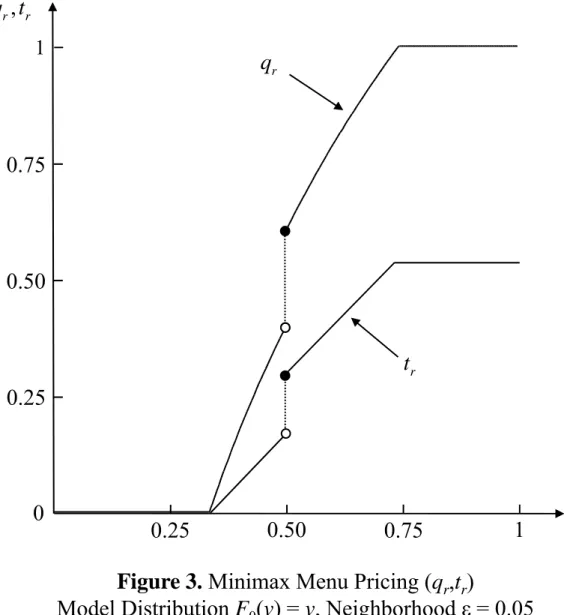
4.2 Menu Pricing
The equilibrium menu policy can be directly derived from the random pricing policy r. We identify the regret minimizing menu(q; tr(q))by determining the transfer price of every o¤ered quantity q through the random pricing policy r. The resulting net utility for a buyer with valuev is given by:
q v tr(q):
Speci…cally, the construction of the menu(q; tr(q))proceeds as follows. Every pricep2R+
of the random pricing policy r such thatp2supp ( r), determines a probability q in the menu by:
q, (p); (9)
and a corresponding nonlinear pricetr(q) for the quantity q by:
tr(q),
Z p
0
yd (y): (10)
By the very construction of the transfer function tr(q), it follows that a buyer with value
v will select the item q on the menu such that q = (v). The self-selection condition for a buyer with valuev is determined by choosing the quantityq, such that the net utility of
the buyer is maximized, or
v t0r(q) = 0,
which occurs at q = (v) as t0r(q) = v by (10). By the taxation principle in the theory of mechanism design, the menu (q; tr(q)) can also be viewed as an incentive compatible allocation plan(qr(v); tr(v))in the corresponding direct mechanism.
The equilibrium use of menus allows us to understand the selling policies from a di¤erent
and perhaps more intuitive point of view. The optimality of menus emphasizes the concern for robustness as menus would never be used in the standard setting for a given demand
distribution. The minimax regret menu o¤ered by seller has three important characteristics. These properties can be described with reference to the mass pointbin the random pricing
policy r of Proposition 5: (i) low volume o¤ers are made for buyers with low valuations, or v < b, (ii) a much higher o¤er is made for all buyers with valuation v = b, and (iii)
a standard o¤er as given by the quantity o¤ered at v = b. In addition, the seller o¤ers low volume downgrades and high volume upgrades. The expanded menu relative to the
optimal single item menu for the model distribution, seeks to minimize the exposure to regret. Obviously, the seller loses pro…ts on the high value buyers from making o¤ers to
the low value buyers by granting the high value buyers a larger information rent. The size of the information rent is kept small by o¤ering menu items to the low value buyers only
of substantially lower volume. This is the source of the gap in the quantities o¤ered in the menu.
Insert Figure 3: Menu Pricing Under Minimax Regret
The response of the seller to an increase in uncertainty is informative when we consider
menus. In a menu, the seller is o¤ering many di¤erent choices to the buyers. An immediate question therefore is how the size of the menu and the associated prices change with an
increase in the uncertainty. The size of the menu is simply the range of quantities o¤ered by the seller (and accepted by some buyers) in equilibrium.
Proposition 7 (Menus and Uncertainty) For small uncertainty ":
1. The size of the menu is increasing in ":
2. The price per unit tr(v)=qr(v) is decreasing in "for every v2(a; c)nb.
As the uncertainty increases, the seller seeks to minimize her exposure to regret by o¤ering more choices to the buyers and hence increasing the probability of a sale, even
if the sale is not “big” in terms of the sold quantity. For every given valuation v, the seller also increases the size of the deal o¤ered. As larger deals are o¤ered to buyers with
lower valuations, it follows that the seller is willing to concede a larger information rent to buyers with higher valuations. In consequence, the average price per unit is decreasing
as well. Jointly, these three properties imply that the seller is o¤ering her products more aggressively and to a larger number of buyers with an increase in uncertainty. We observe
the expected price may be increasing. The resolution of this apparent con‡ict comes from the fact that the seller is o¤ering larger quantities in response to an increase in uncertainty.
An interesting comparison to a minimax regret decision maker is a risk averse decision maker. In particular, we could ask how the behavior of a risk averse seller would di¤er
from the behavior of a minimax regret seller. Clearly, a risk averse seller would never …nd a probabilistic price optimal. However, if she were to be allowed to o¤er a menu, either of
lotteries (in terms of probabilities of receiving the good) or di¤erent qualities of the good, then a risk averse seller might indeed o¤er a menu. The menu would consist of a set of
possible quantity and price combinations. The di¤erence with respect to the minimax regret seller would then be in the shape of the menu. In particular, if a risk averse seller were
to face a continuous demand function (as expressed byF0), then the optimal menu can be
shown to be continuous. Yet, with a minimax regret seller, we saw that the optimal menu is
discontinuous (at a single jump point) and essentially o¤ers two (or three) classes of distinct service.
The minimax regret problem with uncertainty then o¤ers an interesting and novel reason for menus to complement existing insights. The literature currently o¤ers two leading
explanations for menus in the standard monopoly setting: menus can be optimal if the marginal willingness to pay changes with the quantity o¤ered as in Deneckere and McAfee
(1996) or if the buyers are budget constrained as in Che and Gale (2000).
4.3 Robustness
We conclude this section by showing that the solution to the minimax regret problem also generates a robust family of policies in the sense of De…nition 1.
Proposition 8 (Robustness)
If f r;"g">0 attains minimax regret at F0 for all su¢ ciently small ", then f r;"g">0 is a
5
Conclusion
In this paper, we analyzed pricing policies of a monopolist which are robust to model uncertainty. The introduction of uncertainty about the true demand distribution formally
lead to a decision theoretic model with multiple priors. The parsimonious representation of the uncertainty in terms of the neighborhood of a model distribution allowed us to deal with added complexity and maintain an intuitive understanding of how uncertainty a¤ects
optimal policies.
We analyzed the optimal pricing of a monopolist under two distinct, but related decision
criteria with multiple priors: maximin pro…t and minimax regret. We showed that the solution under either criterion yields a robust solution in the statistical sense. The expected
pro…t under either pricing rule is arbitrarily close to the optimal price for any distribution in a su¢ ciently small neighborhood of the model distribution. Despite the common robustness
property, the prices respond di¤erently to the uncertainty. The maximin policy uniformly maintains a deterministic price policy and uniformly lowers the price as a response to an
increase in uncertainty. In contrast, the minimax policy balances the downside versus the upside when responding to the uncertainty. Here the trade-o¤ is optimally resolved by
a probabilistic price. Importantly, the expected price does not necessarily decrease with an increase in uncertainty. Interestingly, an equivalent policy to the probabilistic price is
achieved by a menu. The menu o¤ers a variety of quantities, ranging from small to large, to the buyer. By o¤ering a menu, the seller can guarantee himself small deals on the downside
and large deals on the upside. In consequence, the seller hedges to reduce maximal regret by o¤ering multiple choices through a menu. A common feature of both models of decision
making is that we can analyze how uncertainty in‡uences pricing without adding degrees of freedom to the model. This renders our results parsimonious and falsi…able.
The problem of optimal monopoly pricing is in many respects the most elementary mechanism design problem. It would be of interest to extend the insights and apply the
techniques developed here to a wider class of design problems, such as the discriminating monopolist (as in Mussa and Rosen (1978) and Maskin and Riley (1984)) and optimal
information about their payo¤ environment. Given their known valuation and known price, each buyer simply has to make a decision as to whether or not to purchase the object. With
the complete information of the buyer, there is no need to look for a robust purchasing rule. A substantial task would consequently arise by considering multi-agent design problems
with incomplete information such as auctions, where it becomes desirable to simultaneously make the decisions of the buyers and the seller robust. The complete solution of these
6
Appendix
The appendix contains some auxiliary results as well as the proofs for the results in the main body of the text.
Proof of Proposition 1. As shown in the text, if Fm is such that
Fm(v) = minfF0(v+") +";1g,
then (p; Fm) (p; F) for all F 2 P"(F0): On the other hand, if pm = p (Fm), then
(pm; Fm) (p; Fm) holds for all p by the de…nition of pm: Together this implies that
(pm; Fm) is a saddle point as described in (SPm) and thuspm attains maximin payo¤ and
Fm is a least favorable demand.
Proof of Proposition 2. For su¢ ciently small"our assumptions onF0 imply thatFm is di¤erentiable near pm:Since pm is optimal given demandFm, we …nd thatpm satis…es the associated …rst order conditions:
d
dp(p(1 Fm(p)))jp=pm = 0:
The earlier strict concavity assumption on (p; F0) implies that we can apply the implicit
function theorem at "= 0 to the above equation to obtain
dpm d" j"=0 = 1 + 1 f0(p0) 2f0(p0) p0f00(p0) = f0(p0) +p0f 0 0(p0) + 1 2f0(p0) p0f00(p0) :
Since 2f0(p0) p0f00(p0)<0;we observe that the lhs of the above equation as a function
off0(p0)is increasing inf0(p0)and hence by taking the limit as f0(p0) tends to in…nity it
follows that this expression is bounded above by 1=2.
Proof of Proposition 3. We show that for any > 0, there exists " > 0 such that
F 2 P"(F0) implies (p (F); F) (pm; F) < : Note that (pm; F) (pm; Fm) and thus
(p (F); F) (pm; F) (p (F); F) (pm; Fm):
Since (pm; Fm) = (p (Fm); Fm) the proof is complete once we show that (p (F); F) is a continuous function ofF with respect to the weak topology. Consider F; G such that
G2 P"(F):Using the fact that
G(p) F(p+") +";
we obtain
(p (G); G) (p (F) "; G) = (p (F) ") (1 G(p (F) ")) (p (F) ") (1 F(p (F)) ") (p (F); F) 2":
Since the Prohorov norm is symmetric and thus F 2 P"(G), it follows that
(p (F); F) + 2" (p (G); G) (p (F); F) 2";
and hence we have proven that (p (F); F) is continuous inF.
Proof of Proposition 4. We apply Corollary 5.2 in Reny (1999) to show that a saddle point exists. For this we need to verify that the zero-sum game between the seller and
nature is a compact Hausdor¤ game for which the mixed extension is both reciprocally upper semi continuous and payo¤ secure.
Clearly we have a compact Hausdor¤ game. Reciprocal upper semi continuity follows directly as we are investigating a zero-sum game. So all we have to ensure ispayo¤ security.
Payo¤ security for the monopolist means that we have to show for each (Fr; r) with
Fr 2 P"(F0) and for every > 0 that there exists > 0 and such that F 2 P (Fr) implies r ; F r( r; Fr) + :
Let , =4 and let be such that (p) , r(p+ ): Then using the fact that
F(v) Fr(v ) we obtain Z 1 0 vdF(v) 2 + Z 1 0 vdFr(v):
Using the fact that F(v) Fr(v+ ) + we obtain
; F ( r(p+ );minfFr(v+ ) + ;1g) ( r; Fr) 2 ; and hence
To show payo¤ security for nature we have to show for each( r; Fr)withFr2 P"(F0) and
for every > 0 that there exists > 0 and F 2 P"(F0) such that 2 P ( r) implies
r ; F r( r; Fr) :
Here we setF ,Fr:Given >0consider any 2 P ( r). All we have to show is that
( ; Fr) ( r; Fr) + for su¢ ciently small :Note that (p) r(p+ ) + implies
( ; Fr) + Z (p+ ) Z 1 p dFr(v) d r(p+ ) = + Z p Z 1 p dFr(v) d r(p) = + ( r; Fr) + Z p Z [p ;p) dFr(v) ! d r(p) + ( r; Fr) + Z Z [p ;p) dFr(v)d r(p):
Given the continuity of the integral term
Z Z
[p ;p)
dFr(v)d r(p)
in the boundary point , the claim is established.
In order to derive the equilibrium policies in the case of uncertainty we present a
char-acterization of the Prohorov distance in Lemma 1 that builds on the following result of Strassen (1965).
Theorem (Strassen (1965)).
F andGhave Prohorov distance less than or equal to"if and only if there exist random
vari-ablesXandY such thatXhas distributionF; Y has distributionGandPr (jY Xj ") 1 ".
The two cumulative distributionsF; Gare close in terms of the Prohorov distance if and only if they are associated to two random variables that realize similar values with high
probability. Our characterization describes the Prohorov distance in terms of monotone functions that are identi…ed with positive additive measures and cumulative distribution
functions respectively. In order to stay within"distance of a given distribution functionG
one may …rst alter any value ofG(v)atv by at most ", this creates a probability measure
measure F2 while locations from where the mass has been taken is described by a measure
F3.
Lemma 1 (Decomposition)
Consider " >0 and probability measures F and G. F 2 P"(G) if and only if there exists a
probability measure F1 and positive additive measures F2 and F3 such that:
G(x ") F1(x) G(x+") 8x;
and
F2(1) =F3(1) ";
and
F ,F1+F2 F3:
Proof. (() SupposeF can be decomposed into F1; F2 and F3. We want to show that
F(A) G(A") +". To this purpose, it is clearly su¢ cient to consider only closed sets A. (a) We …rst prove the claim for A = [x; y] with 0 x y 1: Given a probability
measure H;letH (bv),limv"vbH(v):Then
F1([x; y]) =F1(y) F1 (x) G(y+") G (x ") =G([x; y]"):
Since F2([x; y]) "and F3([x; y]) 0 we obtain:
F([x; y]) =F1([x; y]) +F2([x; y]) F3([x; y]) G([x; y]") +":
(b) Next we consider A= [x1; y1][[x2; y2]withy1+ 2" < x2 which implies that
[x1; y1]"\[x2; y2]"=;:
Using part (a) together with the fact thatA" = [x
1; y1]"[[x2; y2]"holds for the[ ]"operator,
it follows that:
F1(A) =F1([x1; y1]) +F1([x2; y2]) G([x1; y1]") +G([x2; y2]") =G(A"):
(c) The arguments in part (b) are easily generalized for any setAthat can be decomposed into a …nite union of disjoint closed intervals of distance greater than2"soA=[m
k=1[xk; yk] withxk yk< xk+1 2"fork m 1:
(d) Finally, we show that we do not have to prove the statement for more general setsA.
Notice that ifA"1 =A"2; A1 A2 andF(A2) G(A"2) +"thenF(A1) G(A"1) +":So we
can restrict attention to proving the claim for closed setsAsuch thatA"=A"1 and A A1
implies A=A1:Consider x; y2Asuch that x < y x+ 2": Then fA[[x; y]g"=A" and
hence[x; y] A:It follows that Abelongs to the class of sets investigated in part (c).
()) Consider probability measures F and G with kF Gk ": We extend G to
[ ";1 +"] such that G(x) = 0 for " x < 0 and G(x) = 1 for 1 < x 1 + ":
Given the result of Strassen (1965), there exist random variablesX andY such thatX has distributionF; Y has distributionGand Pr (jY Xj ") 1 ".
LetZ1 be the random variable with cdfF1 such thatZ1,X ifjY Xj "andZ1 ,Y
ifjY Xj> ". Let"0 ,Pr (jY Xj> ") so"0 ": Then G(x ") F1(x) G(x+"):
LetZ2 be the random variable with cdfFb2 such that Z2 ,0 ifjY Xj "and Z2 ,X if
jY Xj> ": LetZ3 be the random variable with cdf Fb3 such that Z3 ,0 if jY Xj "
and Z3 , Y if jY Xj > ": Then X = Z1 +Z2 Z3 and Fb2(0);Fb3(0) 1 "0: Let
Fi,Fbi (1 "0)fori= 2;3:ThenF2 andF3are positive additive measures withF2; F3 "0
and the proof is complete.
Proof of Proposition 5. We start by assumingp0 > 12:The proof proceeds in three steps.
First we show the existence of the parametersa; bandcand use these to construct the least
favorable demand Fr: Second, we decompose the least favorable demand by using Lemma 1 to show that it is close to F0:Third, we use this decomposition to verify that we have a
saddle point.
such thata < b < c and a < p0< c such that F0(a ") " = 1 b2f 0(b+") a ; (11) F0(b+") = 1 b2f 0(b+") b ; (12) F0(c ") = 1 b2f 0(b+") c : (13)
Concerning the existence of b;note that b=p0 solves (12) if"= 0. As
d
db(1 F0(b+") bf0(b+"))j"=0= 2f(p0) p0f 0
0(p0)<0;
due to the strict concavity of pro…ts at p0, the implicit function theorem implies that a
continuous solution b=b(") to (12) (with b >0) exists for "in a neighborhood of 0 with
b(0) =p0:To prove existence ofc;de…ne
h"(v),1
b2f0(b+")
v F0(v ") forv >0:
We need to show that there existsc > b such thath"(c) = 0:Note that
h"(b) =F0(b+") F0(b ");
and hence h"(b)> 0 for su¢ ciently small " asf(p0)> 0 by assumption in the statement
of the proposition and as f is continuous in a neighborhood ofp0:Moreover,
h0"(b) = f0(b+") f0(b "); h00"(b) = 2f0(b+") b f 0 0(b ") 2f0(p0) +p0f00(p0) p0 <0:
In fact, one can easily show forv in a su¢ ciently small neighborhood aroundp0 thath0"(v) is small and that h00"(v) is bounded below 0. Here one uses the fact that f is assumed to be continuously di¤erentiable in the neighborhood of p0. Speci…cally one shows there
exists > 0 and a neighborhood of p0 such that if > 0 and " is su¢ ciently small then
0< h"(b) < and h0"(v)< and h00"(v)< for anyv in this neighborhood. This means that h"(v)< + (v b) (v b)2 for v in this neighborhood. Choosing su¢ ciently small, one then shows that for su¢ ciently small " there exists c > b such that h"(c) = 0 wherec!p0 as"!0.
For the existence of a; similar calculations for h"(v) +" show that there exists a < b such thath"(a) +"= 0 witha!p0 as"!0:
We can describe the local behavior of the parameters a; b and c by appealing to the implicit function theorem. Since 2f0(p0) +p0f00(p0) > 0;we know that b is di¤erentiable
and by implicitly di¤erentiating (12) we obtain:
b0(0) = f0(p0) +p0f 0 0(p0) 2f0(p0) +p0f00(p0) = 1 + f0(p0) 2f0(p0) +p0f00(p0) ; (14)
with 1< b0(0) 1=2. The second inequality follows from using the fact thatb0(0) as a function of f0(p0) is increasing. Next, we show that ais di¤erentiable. Since
b2f0(b+") a2f0(a ")
b a = (b+a)f0(b+") +a
2f0(b+") f0(a ")
b a
2p0f0(p0) + (p0)2f00(p0);
we …nd that b2f0(b+") > a2f0(a ") near " = 0. Hence we can implicitly di¤erentiate
(11) to obtain a0(") = aa+af0(a ") +bf0(b+") b2f 0(b+") a2f0(a ") ; (15) and so lim "!0 b a a a 0(") = 1 + 2f0(p0) 2f0(p0) +p0f00(p0) :
In particular, we obtain that
lim
"!0a
0(") = 1: (16)
Similarly for c, we …nd that:
c0(") = c cf0(c ") +bf0(b+") b2f 0(b+") c2f0(c ") ; (17) and hence lim "!0 c b c c 0(") = 2f0(p0) 2f0(p0) +p0f00(p0) ; and in particular, lim "!0c 0(") =1: (18)
Step 2. We now construct the least favorable demand on the basis of a; b and c. ConsiderFr given by:
Fr(v), 8 > > > > > > > > > < > > > > > > > > > : 0 if v2[0; "); maxf0; F0(v ") "g, if v2["; a]; 1 b2f0(b+") v , if v 2(a; c); F0(v "), if v2[c;1); 1; if v= 1:
The de…nitions of a and c imply that Fr is continuous at a and c. It follows that Fr is a probability measure.
Next we show that Fr 2 P"(F0) by using Lemma 1. The proof is by construction and
uses the decomposition of Lemma 1. De…ne F1 by: F1(v), 8 > > > > > > < > > > > > > : 0, if v2[0; "); F0(v "), if v2["; a]; maxfFr(v); F0(v ")g, if v2(a; b); Fr(v); if v2[b;1]:
Then F1 is a probability measure with F0(v ") F1(v) forv 2[";1]:By de…nition of b
we obtainFr(b) =F0(b+") and Fr0(b) = dvdF0(v+")jv=b:Moreover, given
Fr00(v) = 2b 2f 0(b+") v3 and d2 dv2F0(v+") =f00(v+");
strict concavity of pro…ts nearp0implies thatF000(v)< Fr00(v)forv2[a; c]and"su¢ ciently small. Thus, for su¢ ciently small";asaandcare close top0;we obtainF1(v) F0(v+")
with equality if v=b:So F0(v ") F1(v) F0(v+"). De…ne F2 by: F2(v), 8 > > > < > > > : 0, if v2[0; a]; " maxfF0(v ") Fr(v);0g, if v2(a; b]; "; if v2(b;1]:
Since F2 is right continuous, we will obtain that F2 is an additive measure once we show that d dv(Fr(v) F0(v ")) = b2f0(b+") v2 f0(v ") 0 (19)
holds if v 2 (a; b] and Fr(v) < F0(v "). Strict concavity of the pro…t function near
p=p0 can be used to show that v2f0(v ") is increasing in v for su¢ ciently small ": We
establish the inequality (19) forv=xwherex2(a; b)solvesFr(x) =F0(x "). Note that
x(1 Fr(x)) =b2f0(b+") and hence we aim to show that
x(1 Fr(x)) x2f0(x ") =x(1 F0(x ") xf0(x ")) 0;
which follows once we show that x < p0. By invoking the implicit function theorem on
Fr(x) F0(x ") = 0, we notice that the derivative with respect to x vanishes as "! 0
while the terms involving"and b(") combine to yield an expression that tends to 2f0(p0)
as"!0:Thus we …nd that the slope of xnear"= 0is unbounded and asx(")< b(") and
b0(0)is …nite it follows that x0(")! 1 as"!0. De…ne F3 by: F3(v), 8 < : 0, if v2[0; "]; minfF0(v "); "g, if v2(";1];
and so F3(v) is an additive measure and F3(1) = ": Since Fr = F1+F2 F3 we obtain
from Lemma 1 thatFr2 P"(F0):
Step 3. We now show that ( r; Fr) is a saddle point. For the monopolist we verify easily that (p; Fr) =b2f0(b+")forp2[a; c]:Next we consider pro…ts nearby but outside
[a; c]:Forp < awe verify that (p; Fr) b2f0(b+") by showing that
lim v!a d dvFr(v)<vlim!a+ d dvFr(v)
which means that
f0(a ")<
b2f0(b+")
a2 :
Similarly we need to show for the case where p > cthat
f0(c ")>
b2f
0(b+")
which is easily veri…ed for su¢ ciently small"by using the fact that c0(0) =1 while b0(0)
is …nite. Thus we have shown that there exists >0 such that
[a; c] = arg max
p2[p0 ;p0+ ]
(p; Fr):
In particular, can be chosen independently of " once "is su¢ ciently small.
Upperhemi-continuity of the set of pro…t maximizing prices then implies that[a; c] arg maxp (p; Fr). Consider now the incentives of nature. The regret r is an additive function over the
measures and so:
r( r; Fr) =r( r; F1) +r( r; F2) r( r; F3): (20)
We show that nature maximizes each term in (20) and then sets Fr = F1 +F2 F3;
subject to the constraints on F1; F2 and F3 speci…ed in Lemma 1. Notice that we assume
that F1(1) = F2(1) = ". Consider …rst F2: By construction of r, regret r( r; ) is constant over v 2[a; b) and over v 2[b; c]: Since r( r; a) < r( r; b) and since r( r; v) is monotone increasing on [0; a]and [c;1] it follows thatarg maxvr( r; v) [a; b)[ f1g:For su¢ ciently small "; r( r; a) p0 while r( r;1) 1 p0 and thus given p0 > 12 we obtain
[a; b) = arg maxvr( r; v) and thus maxF:F(1)="r( r; F) =r( r; F2):
Concerning F3 let v1 = inffv:F0(v ") "g: We have to show that r( r; v0)
r( r; v2) for v0 v1 v2: Given the above it is su¢ cient to consider only v0 = v1 and
v2 =cwhere r( r; c) =c E( r):Let ,2 supv>0(v=F0(v)), then
r( r; v1) =v1 "+ F0(v1 ") "(1 + ):
On the other hand, we showed in Step 1 that c0(0) =1and in the proof of Proposition 6, based only on arguments in Step 1, we …nd that @"@E( r)j"=0 <1so @"@r( r; c)j"=0 =1.
Hence,r( r; v1)< r( r; c)for"su¢ ciently small which shows thatminF:F(1)="r( r; F) =
r( r; F3).
Finally, considerF1:More mass cannot be allocated to regret maximizing values[a; b)as
F1(b) =F0(b+");weight on values belowaand abovecare shifted up as far as possible as
Fv(v) =F0(v ")forv < aandc < v <1and allocation ofF1 forF1 2(F1(b); F0(c "))
The case ofp0 12 proceeds in an analogous manner. It is easily shown that there exist
parameters a; b; csuch that a < b < c anda < p0 < c such that:
F0(a ") " = 1 b2f 0(b+") a ; F0(b+") = 1 b2f0(b+") b +"; F0(c ") " = 1 b2f0(b+") c ; where b0(0) = f0(p0) +p0f 0 0(p0) 1 2f0(p0) +p0f00(p0) = 1 + f0(p0) + 1 2f0(p0) +p0f00(p0) :
The least favorable demand Fr is now given by:
Fr(v), 8 > > > > > > < > > > > > > : maxf0; F0(v ") "g, if v2[0; a]; 1 b2f0(b+") v , if v 2(a; c); maxf0; F0(v ") "g, if v2[c;1); 1 if v= 1;
decomposed as Fr,F1+F2 F3 where we de…ne the measuresF1; F2; F3 as follows:
F1(v), 8 > > > > > > < > > > > > > : F0(v "), if v2[0; a]; 1 b2f0(b+") v +", if v2(a; c); F0(v "); if v2[c;1); 1; if v= 1: F2(v), 8 < : 0, if v2[0;1); ", if v= 1; and F3(v),minfF0(v "); "g; ifv2[0;1]:
Lemma 1 can be applied to show that Fr 2 P"(F0): In contrast to the previous case of
p0 > 12, nowv= 1 maximizes r( r; v) so thatF2 puts all mass atv= 1.
Proof of Proposition 6. We obtain that
E[ r] = Z c a p1 pdp+b 1 Z c a 1 pdp =c a+b 1 ln c a :
Asa; b; and care di¤erentiable as shown in Step 1 of Proposition 5, we have: @ @"E[ r] = b a a a 0(") +c b c c 0(") + 1 lnc a b 0("):
Using (14), (15) and (17) we obtain forp0 > 12 :
@ @"E[ r]j"=0= 1 + f0(p0) 1 2f0(p0) +p0f00(p0) < 1 2:
The same operations yield for p0 < 12 yield
@
@"E[ r]j"=0= 1 +
f0(p0) + 1
2f0(p0) +p0f00(p0)
> 1;
which concludes the proof.
Proof of Proposition 7. Following Proposition 5,lim"!0a0(") = 1andlim"!0c0(") =
1 and therefore the size of the menu is increasing in"for"su¢ ciently small which proves (1). Next we verify (2). Assumea < v < b. Thenqr(v) = lnva andtr(v) =
Rv a y
1
ydy=v a so given a0 <0 for"small we obtain @"@qr(v)>0; @"@tr(v)>0 and
@ @" tr(v) qr(v) = (v a) 1 a ln v a lnva 2 a 0(")<0; as d dv (v a) 1 a ln v a = 1 a 1 v >0:
Assume b < v < c. Then qr(v) = 1 lnvc and
tr(v) =v a+ 1 ln c a b=E[tr] +v c; so @"@qr(v)<0; @"@tr(v)<0 and @ @" tr(v) qr(v) = @ @"E[tr] 1 lncv + 1 c(E[tr] +v c) 1 ln c v 1 lnvc 2 c 0(")<0;
where we use the fact that c0(")is large and
d dv 1 c(E[tr] +v c) 1 ln c v = 1 c 1 v <0;
Proof of Proposition 8. Assume that r attains minimax regret but is not robust. So there exists >0;such that for all " >0;there existsF" such thatF"2 P"(F0) but
(p (F"); F") ( r; F") : (21)
Assume that( r; Fr) is a saddle point of the regret problem (SPr) given" >0. Then
( r; Fr) = (p (Fr); Fr):
We can rewrite the left hand side of (21) as follows:
(p (F"); F") ( r; F") (22)
= (p (F"); F") (p (Fr); Fr) + ( r; Fr) ( r; F"):
Using (SPr) we also obtain
0 r( r; Fr) r( r; F") = Z vdFr(v) Z vdF"(v) + ( r; F") ( r; Fr), so that: ( r; Fr) ( r; F") Z vdFr(v) Z vdF"(v):
Entering this into (22) we obtain from (21) that:
(p (F"); F") (p (Fr); Fr) +
Z
vdFr(v)
Z
vdF"(v) : (23)
Since F"; Fr2 P"(F0)and sinceh(v) =v is a continuous function and the Prohorov norm
metrizes the weak topology we obtain that
Z
vdFr(v)
Z
vdF"(v)< =2; (24)
if"is su¢ ciently small.
In the proof of Proposition 3 we showed that (p (F); F) as a function ofF is
contin-uous with respect to the weak topology. Hence
(p (F"); F") (p (Fr); Fr)< =2; (25)