High-Availability Algorithms for Distributed Stream Processing
∗Jeong-Hyon Hwang
†, Magdalena Balazinska
‡, Alexander Rasin
†,
U˘gur C
¸ etintemel
†, Michael Stonebraker
‡, and Stan Zdonik
††
Brown University
‡MIT
{jhhwang, alexr, ugur, sbz}@cs.brown.edu {mbalazin, stonebraker}@lcs.mit.edu
Abstract
Stream-processing systems are designed to support an emerging class of applications that require sophisticated and timely processing of high-volume data streams, often origi-nating in distributed environments. Unlike traditional data-processing applications that require precise recovery for cor-rectness, many stream-processing applications can tolerate and benefit from weaker recovery guarantees. In this paper, we study various recovery guarantees and pertinent recovery techniques that can meet the correctness and performance re-quirements of stream-processing applications.
We discuss the design and algorithmic challenges asso-ciated with the proposed recovery techniques and describe how each can provide different guarantees with proper com-binations of redundant processing, checkpointing, and remote logging. Using analysis and simulations, we quantify the cost of our recovery guarantees and examine the performance and applicability of the recovery techniques. We also analyze how the knowledge of query network properties can help decrease the cost of high availability.
1
Introduction
Stream-processing engines (SPEs) [1, 3, 5, 6, 16, 18] are designed to support a new class of data processing applica-tions, called stream-based applicaapplica-tions, where data is pushed to the system in the form of streams of tuples and queries are continuously executed over these streams. These applications include sensor-based monitoring (car traffic, air quality, battle field), financial applications (stock-price monitoring, ticker failure detection), and asset tracking. Because data sources are commonly located at remote sites, stream-based applica-tions can gain in both scalability and efficiency if the servers collectively process and aggregate data streams while routing them from their origins to the target applications. As a re-sult, recent attention has been focused on extending stream processing to distributed environments, resulting in so-called distributed stream-processing systems (DSPSs) [6, 7, 22].
In a DSPS, the failure of a single server can significantly disrupt or even halt overall stream processing. Indeed, such
∗This material is based upon work supported by the National Science
Foundation under Grants No. 0205445, 0325838, 0325525, IIS-0325703, and IIS-0086057. Any opinions, findings, and conclusions or rec-ommendations expressed in this material are those of the author(s) and do not necessarily reflect the views of the National Science Foundation.
a failure causes the loss of a potentially large amount of tran-sient information and, perhaps more importantly, prevents downstream servers from making progress. A DSPS there-fore must incorporate a high-availability mechanism that al-lows processing to continue in spite of server failures. This aspect of stream processing, however, has received little at-tention until now [23]. In this paper, we focus on approaches where once a server fails, a backup server takes over the oper-ation of the failed one. Tightly synchronizing a primary and a secondary so that they always have the same state incurs high run-time overhead. Hence, we explore approaches that relax this requirement, allowing the backup to rebuild the missing state instead.
Because different stream processing applications have dif-ferent high-availability requirements, we define three types of recovery guarantees that address these different needs.
Precise recovery hides the effects of a failure perfectly, ex-cept for some transient increase in processing latency, and is well-suited for applications that require the post-failure out-put be identical to the outout-put without failure. Many finan-cial services applications have such strict correctness require-ments.
Rollback recovery avoids information loss without guaran-teeing precise recovery. The output produced after a failure is “equivalent” to that of an execution without failure, but not necessarily to the output of the execution that failed. The out-put may also contain duplicate tuples. To avoid information loss, the system must preserve all the necessary input data for the backup server to rebuild (from its current state) the primary’s state at the moment of failure. Rollback recovery is thus appropriate for applications that cannot tolerate infor-mation loss but may tolerate imprecise output caused by the backup server reprocessing the input somewhat differently than the primary did. Example applications include those that alert when specific conditions occur (e.g., fire alarms, theft prevention through asset tracking). We show in Section 6 that this recovery guarantee can be provided more efficiently than precise recovery both in terms of runtime overhead and recovery speed.
Gap recovery, our weakest recovery guarantee, addresses the needs of applications that operate solely on the most re-cent information (e.g., sensor-based environment monitor-ing), where dropping some old data is tolerable for reduced recovery time and runtime overhead.
Sec-tion 3. To the best of our knowledge, commercial DBMSs typically offer precise or gap recovery capabilities [8, 19, 20, 21] and no existing solution addresses rollback recovery or a similar weak recovery model.
We also investigate four recovery approaches that can pro-vide one or more of the above recovery guarantees. Since each approach employs a different combination of redundant computation, checkpointing, and remote logging, they offer different tradeoffs between runtime overhead and recovery performance.
We first introduce amnesia, a lightweight scheme that pro-vides gap recovery without any runtime overhead (Section 4). We then present passive standby and active standby, two pairs [4, 10] approaches tailored to stream process-ing. In passive standby, each primary server (a.k.a. node) pe-riodically reflects its state updates to its secondary node. In active standby, the secondary nodes process all tuples in par-allel with their primaries. We also propose upstream backup, an approach that significantly reduces runtime overhead com-pared to the standby approaches while trading off a small fraction of recovery speed. In this approach, upstream nodes act as backups for their downstream neighbors by preserving tuples in their output queues while their downstream neigh-bors process them. If a server fails, its upstream nodes replay the logged tuples on a recovery node. In Section 5, we de-scribe the details of these approaches with an emphasis on the unique design challenges that arise in stream processing. Upstream backup and the standby approaches provide roll-back recovery in their simplest forms and can be extended to provide precise recovery at a higher runtime cost, as we discuss in Section 6.
Interestingly, for a given high-availability approach, the overhead to achieve precise recovery can noticeably change with the properties of the operators constituting the query net-work. We thus develop in Section 3 a taxonomy of stream-processing operators, classifying them according to their im-pact on recovery semantics. Section 6 shows how such knowledge helps reduce high-availability costs and affects the choice of most appropriate high-availability technique.
Finally, by comparing the runtime overhead and recovery performance for each combination of recovery approach and guarantee (Section 7), we characterize the tradeoffs among the approaches and describe the scenarios when each is most appropriate. We find that upstream backup requires only a small fraction of the runtime cost of others, while keeping re-covery time relatively short for queries with moderate state size. The size of query state and the frequency of high-availability tasks significantly influence the recovery perfor-mance of upstream backup and the runtime perforperfor-mance of passive standby. We also find that there is a fundamental tradeoff between recovery time and runtime overhead and that each approach covers a complementary portion of the solution space.
2
The System Model
A data stream is a sequence of tuples that are continuously generated in real time and need to be processed on arrival.
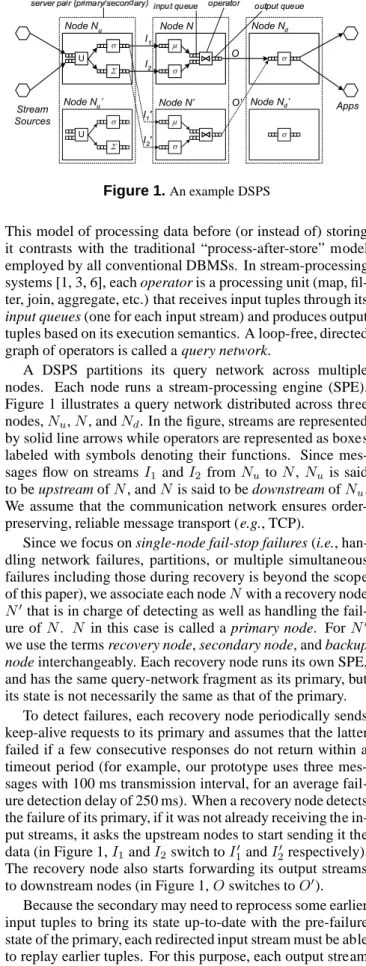
Figure 1.An example DSPS
This model of processing data before (or instead of) storing it contrasts with the traditional “process-after-store” model employed by all conventional DBMSs. In stream-processing systems [1, 3, 6], each operator is a processing unit (map, fil-ter, join, aggregate, etc.) that receives input tuples through its input queues (one for each input stream) and produces output tuples based on its execution semantics. A loop-free, directed graph of operators is called a query network.
A DSPS partitions its query network across multiple nodes. Each node runs a stream-processing engine (SPE). Figure 1 illustrates a query network distributed across three nodes,Nu,N, andNd. In the figure, streams are represented by solid line arrows while operators are represented as boxes labeled with symbols denoting their functions. Since mes-sages flow on streamsI1andI2 fromNu toN,Nu is said to be upstream ofN, andN is said to be downstream ofNu. We assume that the communication network ensures order-preserving, reliable message transport (e.g., TCP).
Since we focus on single-node fail-stop failures (i.e., han-dling network failures, partitions, or multiple simultaneous failures including those during recovery is beyond the scope of this paper), we associate each nodeNwith a recovery node
N0that is in charge of detecting as well as handling the
fail-ure ofN. N in this case is called a primary node. ForN0
we use the terms recovery node, secondary node, and backup node interchangeably. Each recovery node runs its own SPE, and has the same query-network fragment as its primary, but its state is not necessarily the same as that of the primary.
To detect failures, each recovery node periodically sends keep-alive requests to its primary and assumes that the latter failed if a few consecutive responses do not return within a timeout period (for example, our prototype uses three mes-sages with 100 ms transmission interval, for an average fail-ure detection delay of 250 ms). When a recovery node detects the failure of its primary, if it was not already receiving the in-put streams, it asks the upstream nodes to start sending it the data (in Figure 1,I1andI2switch toI10 andI20 respectively). The recovery node also starts forwarding its output streams to downstream nodes (in Figure 1,Oswitches toO0).
Because the secondary may need to reprocess some earlier input tuples to bring its state up-to-date with the pre-failure state of the primary, each redirected input stream must be able to replay earlier tuples. For this purpose, each output stream has an output queue as a temporary storage for tuples sent.
Finally, once a failed node comes back to life, it assumes the role of the secondary. As we discuss in Section 5, each ap-proach requires a different amount of time for recovery and, thus, for the system to tolerate a new failure.
3
High-Availability Semantics
In this section, we define three recovery types, based on their effects as perceived by the nodes downstream from the failure. Since some operator properties facilitate stronger re-covery guarantees, we also devise an operator classification based on their effects on recovery semantics.
3.1
Recovery Types
We assume that a query-network fragment, Q, is given to a primary/secondary pair. Qhas a set ofninput streams
(I1, I2, ..., In)and produces one output streamO. The defi-nitions below can easily be extended to query-network frag-ments with multiple output streams.
Because the processing may be non-deterministic, as we discuss in Section 3.2, executing Q over the same input streams may each time produce a different sequence of tu-ples on the output stream. We define an execution to be the sequence of events (such as the arrival, processing or produc-tion of a tuple) that occur while a node runs Q. Given an executione, we denote withOethe output stream produced bye. We express the overall output stream after failure and recovery as Of +O0, where isf the pre-failure execution of the primary andO0 is the output stream produced by the
secondary after it took over.
Precise Recovery: The strongest failure recovery guaran-tee, called precise recovery, completely masks a failure and ensures that the output produced by an execution with fail-ure (and recovery) is identical to the output produced by an executionewithout failure: i.e.,Of+O0=Oe.
Rollback Recovery: A weaker recovery guarantee, called rollback recovery, ensures that failures do not cause informa-tion loss. More specifically, it guarantees that the effects of all input tuples are always forwarded to downstream nodes in spite of failures. Achieving this guarantee requires:
1. Input preservation - The upstream nodes must store in their output queues all tuples that the secondary needs to rebuild, from its current state, the primary’s state. We re-fer to such tuples as duplicate input tuples because they have already entered the primary node.
2. Output preservation - If a secondary is running ahead of its primary, the secondary must store tuples in its output queues until all the downstream nodes receive the cor-responding tuples from the primary node. The tuples at the secondary are then considered duplicate.
Because the secondary may follow a different execution than its primary, duplicate output tuples are not necessarily identical to those produced by the primary. We consider an output tuple t at the secondary to be duplicate if the pri-mary has already processed all input tuples that “affected” the value oftand forwarded the resulting output tuples down-stream. We formally define rollback recovery and duplicate output tuples in [11].
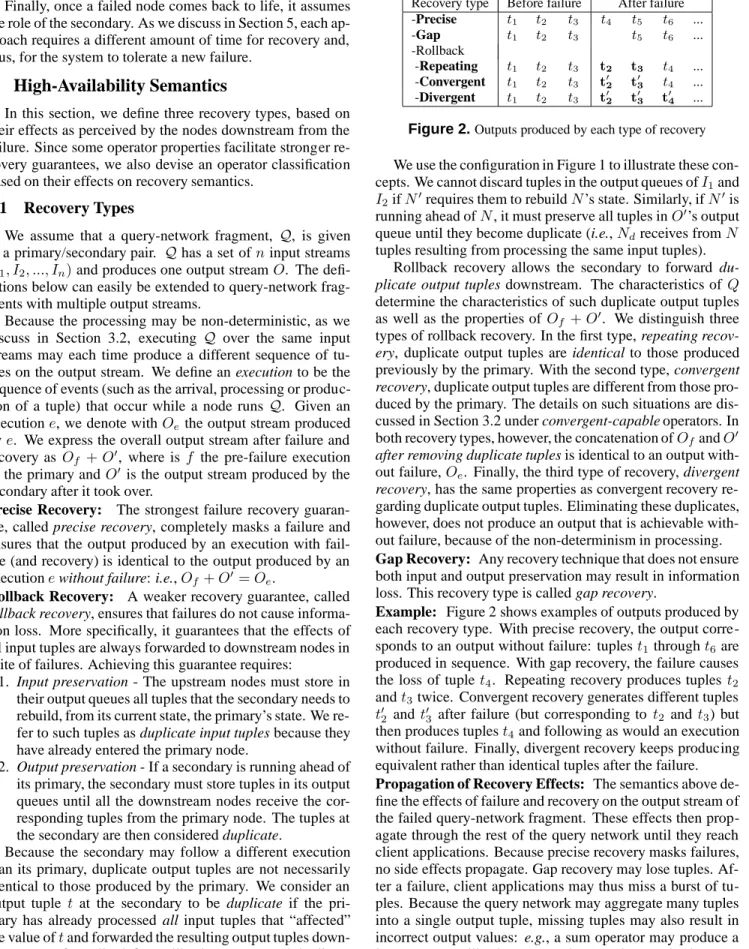
Recovery type Before failure After failure
-Precise t1 t2 t3 t4 t5 t6 ... -Gap t1 t2 t3 t5 t6 ... -Rollback -Repeating t1 t2 t3 t2 t3 t4 ... -Convergent t1 t2 t3 t02 t03 t4 ... -Divergent t1 t2 t3 t02 t03 t04 ...
Figure 2.Outputs produced by each type of recovery
We use the configuration in Figure 1 to illustrate these con-cepts. We cannot discard tuples in the output queues ofI1and I2ifN0requires them to rebuildN’s state. Similarly, ifN0is running ahead ofN, it must preserve all tuples inO0’s output
queue until they become duplicate (i.e.,Ndreceives fromN tuples resulting from processing the same input tuples).
Rollback recovery allows the secondary to forward du-plicate output tuples downstream. The characteristics of Q
determine the characteristics of such duplicate output tuples as well as the properties ofOf +O0. We distinguish three types of rollback recovery. In the first type, repeating recov-ery, duplicate output tuples are identical to those produced previously by the primary. With the second type, convergent recovery, duplicate output tuples are different from those pro-duced by the primary. The details on such situations are dis-cussed in Section 3.2 under convergent-capable operators. In both recovery types, however, the concatenation ofOfandO0 after removing duplicate tuples is identical to an output with-out failure,Oe. Finally, the third type of recovery, divergent recovery, has the same properties as convergent recovery re-garding duplicate output tuples. Eliminating these duplicates, however, does not produce an output that is achievable with-out failure, because of the non-determinism in processing. Gap Recovery: Any recovery technique that does not ensure both input and output preservation may result in information loss. This recovery type is called gap recovery.
Example: Figure 2 shows examples of outputs produced by each recovery type. With precise recovery, the output corre-sponds to an output without failure: tuplest1throught6are produced in sequence. With gap recovery, the failure causes the loss of tuplet4. Repeating recovery produces tuplest2 andt3twice. Convergent recovery generates different tuples t0
2 andt03 after failure (but corresponding to t2 andt3) but then produces tuplest4and following as would an execution without failure. Finally, divergent recovery keeps producing equivalent rather than identical tuples after the failure. Propagation of Recovery Effects: The semantics above de-fine the effects of failure and recovery on the output stream of the failed query-network fragment. These effects then prop-agate through the rest of the query network until they reach client applications. Because precise recovery masks failures, no side effects propagate. Gap recovery may lose tuples. Af-ter a failure, client applications may thus miss a burst of tu-ples. Because the query network may aggregate many tuples into a single output tuple, missing tuples may also result in incorrect output values: e.g., a sum operator may produce a lower sum. Rollback recovery does not lose tuples but may generate duplicate tuples. The final output stream may thus
Convergent−capable Deterministic
Repeatable
BSort, Resample, Aggregate (no timeout)
Filter, Map, Join (no timeout) Arbitrary Union, operators with timeout
Figure 3.Taxonomy of Aurora operators
contain a burst of either redundant or incorrect tuples: e.g., a sum operator downstream may produce a higher sum value. It is also possible, however, that duplicate-insensitive opera-tors (e.g., max) downstream can always guarantee correct re-sults. In general, the recovery type for a node must be chosen based on the applications’ correctness criteria and the charac-teristics of the operators on the node and downstream.
3.2
Operator Classification
We distinguish four types of operators based on their effects on recovery semantics: arbitrary (including non-deterministic), deterministic, convergent-capable, and re-peatable. Figure 3 depicts the containment relationship among these operator types and the classification of Aurora operators [1, 2]. The type of a query network is determined by the type of its most general operator.
An operator is deterministic if it produces the same out-put stream every time it starts from the same initial state and receives the same sequence of tuples on each input stream. There are three possible causes of non-determinism in op-erators: dependence on time (either execution time or input tuple arrival times), dependence on the arrival order of tuples on different input streams (e.g., union, which interleaves tu-ples from multiple streams), and use of non-determinism in processing such as randomization.
A deterministic operator is called convergent-capable if it yields a convergent recovery when it restarts from an empty internal state and re-processes the same input streams, start-ing from an arbitrary earlier point in time. To be convergent-capable, an operator must thus rebuild its internal state from scratch and update it on subsequent inputs in a manner that eventually converges to the execution that would have existed without failure. Window alignment is the only possible cause that prevents a deterministic operator from being convergent-capable. This is because window boundaries define the se-quences of tuples over which operators perform computa-tions. Therefore, a deterministic operator is convergent-capable if and only if its window alignments always converge to the same alignment when restarted from an arbitrary one.
A convergent-capable operator is repeatable if it yields a repeating recovery when it restarts from an empty internal state and re-processes the same input streams, starting from an arbitrary earlier point in time (the operator must produce identical duplicate tuples). A necessary condition for an oper-ator to be repeatable is for the operoper-ator to use at most one tu-ple from each input stream to produce an output tutu-ple. If a se-quence of multiple tuples contributes to an output tuple, then
p per-input-tuple processing time
d network transmission delay between any nodes
λ input tuple arrival rate
C size of checkpoint message
c size of queue-trimming message
M checkpoint or queue-trimming interval
D failure detection delay
r time to redirect input streams
nb ops number of operators in the query network
nb paths number of paths from input to output streams
∆ number of lost or redundant tuples
K delay before processing first duplicate input tuple
Q average number of input tuples to re-process
rec time time spent recreating the failed state (after failure detection)
bw overhead bandwidth consumed for tuple transmissionbandwidth consumed for high availability proc overhead processing required for ordinary tuple processingprocessing required for high availability
Table 1.Summary of notation
restarting the operator from the middle of that sequence may yield at least one different output tuple. Aggregates are thus not repeatable in general, whereas filter (which simply drops tuples that do not match a given predicate) and map (which transforms tuples by applying functions to their attributes) are repeatable as they have one input stream and process each tu-ple independently of others. Join (without timeout) is also re-peatable because its windows defined on input streams have alignments relative to the latest input tuple being processed.
In the following sections, we present approaches for gap recovery, rollback recovery, and precise recovery, respec -tively. For each approach, we discuss the impact of the query-network type on recovery and analyze the tradeoffs between recovery time and runtime overhead. Table 1 summarizes the notation that we use.
4
Gap Recovery
The simplest approach to high availability is for the sec-ondary node to restart the failed query network from an empty state and continue processing input tuples as they arrive. This approach, called amnesia, produces a gap recovery for all types of query networks. In amnesia, the failure detection delay, the rates of tuples on streams, and the size of the state of the query network determine the number,∆, of lost tuples. This approach imposes no overhead at runtime (c.f. Table 3). We define recovery time as the interval between the time when the secondary discovers that its primary failed and the time it reaches the primary’s pre-failure state (or an equiva-lent state for a non-deterministic query network). Recovery time thus measures the time spent recreating the failed state.
Since amnesia does not recreate the lost state and drops tuples until the secondary is ready to accept them, the recov-ery time is zero. It takes timerto redirect the inputs to the secondary, but when processing restarts, the first tuples pro-cessed are those that would have been propro-cessed at the same time if the failure did not happen. I.e., there is no extra delay due to the failure or recovery.
5
Rollback Recovery Protocols
We present three approaches to achieve rollback recovery, each one using a different combination of redundant compu-tation, checkpointing, and logging at other nodes. We first
Query-network type
Approach Repeatable Convergent-capable Deterministic Arbitrary
Passive standby Repeating Repeating Repeating Divergent
Upstream backup Repeating Convergent Divergent Divergent
Active standby Repeating Repeating Repeating Divergent
Table 2.Type of rollback recovery achieved by each high-availability approach for each query-network type
rec time bw overhead proc overhead
Amnesia 0 0 0
Passive standby K+Qp, whereK=r+d;Q= M λ
2 f1(
1
M, C) f2(
1
M, C)
Upstream backup K+Qp, whereK=r+d;Q=|state|+M λ+ 2dλ f3(M1, c) f4(M1 ,nb ops,nb paths)
Active standby (negligible) 100% +f3(M1, c) 100% + 2∗f4( 1
M,nb ops,nb paths)
Table 3.Recovery time and runtime overhead for each approach
present passive standby, an adaptation of the process-pairs model with passive backup. Passive standby relies on check-pointing to achieve high availability. Then, we introduce upstream backup, where upstream nodes in the processing flow serve as backup for their downstream neighbors by log-ging their output tuples. Finally, we describe active standby, another adaptation of the process-pairs model where each standby performs processing in parallel with its primary. We discuss active standby last, because it relies on concepts in-troduced in upstream backup.
For each approach, we examine the recovery guarantees it provides, the average recovery time, and the runtime over-head. We divide the runtime overhead into processing and communication (or bandwidth) overhead. Table 2 summa-rizes the recovery types achieved by each approach while Ta-ble 3 summarizes their performance metrics.
5.1
Passive Standby
In passive standby, each primary periodically sends the delta of its state to the secondary, which takes over from the latest checkpoint when the primary fails. Since real-time response is crucial for many stream-processing applications, the main challenge in passive standby is to enable the primary to continue processing even during a checkpoint.
The state of a query network consists of the states of in-put queues of operators, operators themselves, and the node output queues (one for each output stream). Each check-point message (a.k.a. state update message) thus captures the changes to the states of those queues and operators on the pri-mary node since the last checkpoint message was composed. For each queue, the checkpoint message contains the newly enqueued tuples as well as the last dequeue position. For an operator, however, the content of the message depends on the operator type. For example, the message is empty for state-less operators while it stores, for an aggregate operator, either some summary values (e.g., count, sum, etc.) or the actual tu-ples that newly entered the operator’s state.
To avoid the suspension of processing, the composition of a checkpoint message is conducted along a virtual “sweep line” that moves from left (upstream) to right (downstream). At every step, an operator closest to the right of the sweep line is chosen and once its state difference is saved in the check-point message, the sweep line moves to the right of the oper-ator. The primary is free to execute operators away from the
sweep line both upstream and downstream because these con-current tasks do not violate the consistency of the checkpoint message. Indeed, executing operators to the left of the sweep line is equivalent to executing them after checkpointing. Ex-ecuting operators to the right of the sweep line corresponds to executing them before the message composition.
Passive standby guarantees rollback recovery as follows: (1) input preservation - each upstream primary node pre-serves output tuples in its output queues until they are safely stored at the downstream secondaries. In Figure 1, whenever standby nodeN0 receives a checkpoint from N, it informs
upstream nodeNuabout the new tuples that it received on its input streams, I0
1 andI20. Nudiscards only those acknowl-edged tuples from its output queues. (2) output preservation - the secondary is always “behind” the primary because its state corresponds to the last checkpointed sate.
If a primary fails, the secondary takes over and sends all tuples from its output queues to the downstream nodes. The secondary also asks upstream nodes to start sending it their output streams, including tuples stored in their output queues. When the failed node rejoins the system, it assumes the role of the secondary. Because the new secondary has an empty state, the primary sends its complete state in the first check-point message.
Recovery Type: Because the secondary node restarts from a past state of its primary, passive standby provides repeat-ing recovery for deterministic query networks and divergent recovery for others.
Recovery Time: Passive standby has a short recovery time because the backup holds a complete and recent snapshot of the primary’s state. Recovery time is equal toK+Qp, where
Kis the delay before the recovery node receives its first input tuple,Qis the number of duplicate input tuples it reprocesses, andpis the average processing time per input tuple. Kis the sum ofr(the time to redirect input streams) andd(the time for the first tuple to propagate from the upstream nodes). Q
is on average half a checkpoint interval worth of input tu-ples. The average number,∆, of duplicate tuples is close to
M λout, whereM is the checkpoint interval andλout is the rate of tuples on output streams.
Overhead: Passive standby imposes high runtime over-head. The bandwidth overhead is inversely proportional to
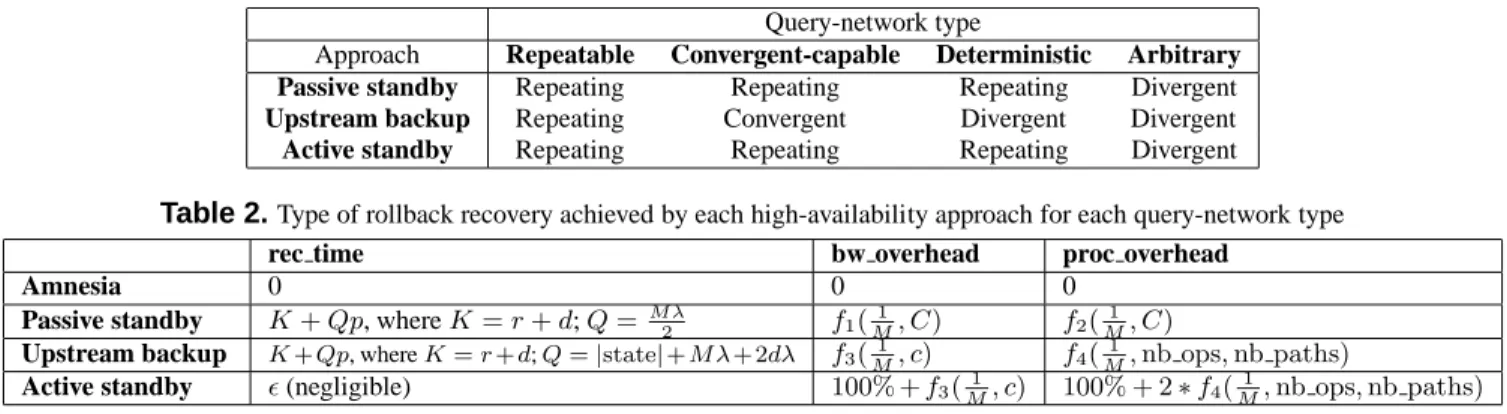
N Nu App tuples Level-0 ACK Level-1 ACK Trim output queues Produce tuples and store in output queues tuples Map output tuples onto input tuples Consume tuples Process tuples, produce new tuples and store in output queues Level-0 ACK Map output tuples to input tuples “Tuples received” “Effect of tup les saved at App ” “Tuples received”
Figure 4.Inter-node communication in upstream backup
the checkpoint interval and proportional to the size of check-point messages. The processing overhead consists of gen-erating and processing checkpoint messages (proportional to the bandwidth overhead). The checkpoint interval (M) de-termines the tradeoff between runtime overhead and recovery time. Table 3 summarizes these results.
5.2
Upstream Backup
In upstream backup, upstream nodes act as backups for their downstream neighbors by logging tuples in their out-put queues until all downstream neighbors completely pro-cess these tuples. For instance, in Figure 1, nodeNuserves as backup for nodeN: ifN fails,N0 restores the lost state
by re-processing the tuples logged atNu. When a failed node rejoins the system, it assumes the role of the recovery node starting from an empty state. The system is then able to tol-erate a new failure without further delay.
The main difficulty of this approach is to determine the maximum set of logged tuples that can safely be discarded given operator non-determinism and the many-to-many rela-tionship between input and output tuples.
Figure 4 shows a typical communication sequence be-tween three nodes Nu, N, andApp. Each node produces and sends tuples downstream while storing them in its out-put queues. Each node also periodically acknowledges re-ception of input tuples by sending level-0 acks to its direct upstream neighbors. When a node (e.g.,N) receives level-0 acks from downstream neighbors (e.g.,App), it notifies its own upstream neighbors (e.g.,Nu) about the earliest logged tuples (one perNu’s output) that contributed to producing the acknowledged tuples and are thus the oldest tuples necessary to re-build the current state (of N). Discarding only earlier tuples allows the system to survive single failures. The noti-fications are thus called level-1 acks (denotedACK(1, S, u), whereS identifies a stream and uidentifies a tuple on that stream). Leaf nodes in the DSPS use level-0 acks to trim their output queues.
Since upstream nodes log all tuples necessary for the sec-ondary to re-build the primary’s state from an empty state (in-put preservation) and the secondary restarts from an empty state (output preservation), upstream backup provides roll-back recovery.
5.2.1 Queue Trimming Protocol
To avoid spurious transmissions, nodes produce both level-0 and level-1 acks everyM seconds. A lower ack frequency
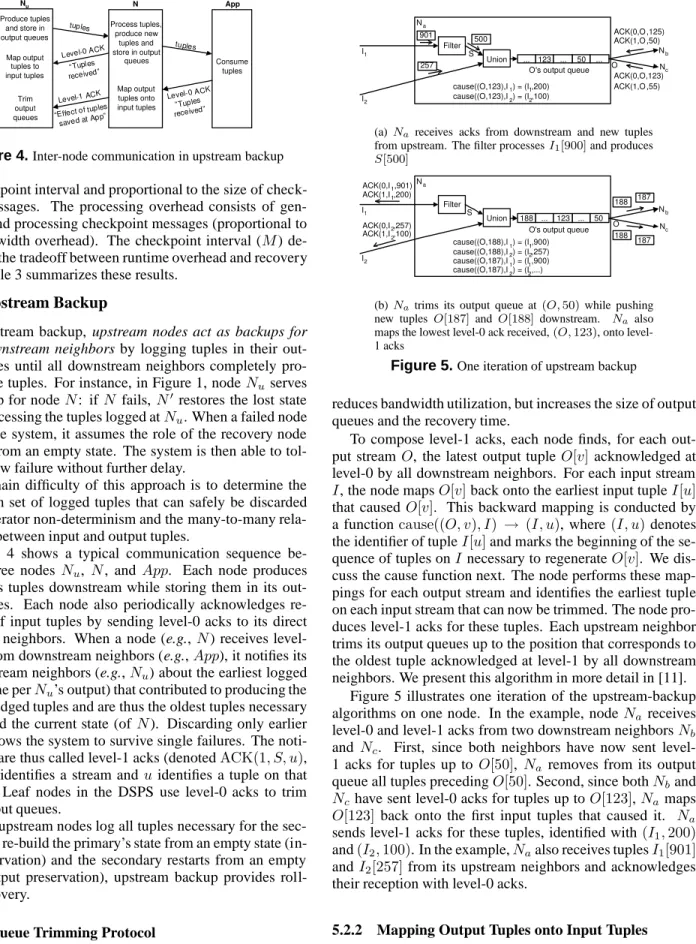
Union ... 123 ... 50 ... 500 Filter 901 257 I1 I2 Na Nb Nc S O O's output queue cause((O,123),I1) = (I1,200) cause((O,123),I2) = (I2,100) ACK(0,O ,125) ACK(1,O ,50) ACK(0,O,123) ACK(1,O ,55)
(a) Na receives acks from downstream and new tuples
from upstream. The filter processesI1[900]and produces
S[500] Union 188 ... 123 ... 50 Filter 187 I1 I2 Na Nb Nc S O O's output queue cause((O,188),I1) = (I1,900) cause((O,188),I2) = (I2,257) ACK(0,I1,901) ACK(1,I1,200) ACK(0,I2,257) ACK(1,I2,100) 188 187 188 cause((O,187),I1) = (I1,900) cause((O,187),I2) = (I2,...)
(b)Natrims its output queue at (O,50)while pushing
new tuples O[187]and O[188] downstream. Na also
maps the lowest level-0 ack received,(O,123), onto level-1 acks
Figure 5.One iteration of upstream backup
reduces bandwidth utilization, but increases the size of output queues and the recovery time.
To compose level-1 acks, each node finds, for each out-put streamO, the latest output tupleO[v]acknowledged at level-0 by all downstream neighbors. For each input stream
I, the node mapsO[v]back onto the earliest input tupleI[u]
that caused O[v]. This backward mapping is conducted by a functioncause((O, v), I) → (I, u), where(I, u)denotes the identifier of tupleI[u]and marks the beginning of the se-quence of tuples onInecessary to regenerateO[v]. We dis-cuss the cause function next. The node performs these map-pings for each output stream and identifies the earliest tuple on each input stream that can now be trimmed. The node pro-duces level-1 acks for these tuples. Each upstream neighbor trims its output queues up to the position that corresponds to the oldest tuple acknowledged at level-1 by all downstream neighbors. We present this algorithm in more detail in [11].
Figure 5 illustrates one iteration of the upstream-backup algorithms on one node. In the example, nodeNa receives level-0 and level-1 acks from two downstream neighborsNb and Nc. First, since both neighbors have now sent level-1 acks for tuples up to O[50],Na removes from its output queue all tuples precedingO[50]. Second, since bothNband
Nc have sent level-0 acks for tuples up toO[123],Namaps
O[123]back onto the first input tuples that caused it. Na sends level-1 acks for these tuples, identified with(I1,200) and(I2,100). In the example,Naalso receives tuplesI1[901] andI2[257]from its upstream neighbors and acknowledges their reception with level-0 acks.
5.2.2 Mapping Output Tuples onto Input Tuples We now discuss how nodes compute the cause function,
output tuple O[v] on streamO onto the earliest input tuple
I[u]on input streamIthat has contributed to the production ofO[v] (i.e. affected the value ofO[v]). To facilitate this mapping, we propose to keep track of the oldest input tuples that affect any computation, by appending input-tuple indica-tors to tuples as they travel through operaindica-tors on a node. For a tupleO[v], these indicators, denoted withindicators(O, v), contain the identifiers of the oldest tuples on input streams necessary to generateO[v]. We also call these indicators low watermarks. On any stream, indicator values are monotoni-cally non-decreasing.
When a tuple enters a node, its indicators are initialized to its identifier: e.g.,indicators(I, u) = {(I, u)}. Each op-erator uses the indicators of its input tuples to compute the indicators for its output tuples. When it is first set up, each operatoroinitializes a watermark variableω for each node-wide input streamIthat contributes to each input streamSof
o: ω[I, S] = 0. As it processes tuples, the operator updates eachω[I, S]to hold the indicator of the oldest tuple currently in the state or, for stateless operators, the indicators of the last tuples processed. When it produces a tuplet, the oper-ator iterates through all ω values and appends (I, ωmin)to
indicators(t), whereωminis the minimum of allω[I,∗]. Some operators, such as union, have many input streams but only a few of them actually contribute to any single out-put tuple. These operators can reduce the number of indica-tors on output tuples by appending only indicaindica-tors for input streams that actually affected the output tuple value. Thus,
cause((O, v), I) refers to the indicator of O[v] that corre-sponds to streamI, or to the indicator of the last preceding tuple affected byI, ifO[v]was not affected byI. Note that indicators are not sent to downstream nodes. More details about the use of indicators can be found in [11].
Figure 5 shows an example of managing input-tuple indi-cators. In Figure 5(a), the filter processes I1[900]and pro-duces S[500]. Hence, indicators(S,500)={(I1,900)}. In Figure 5(b), the union operator processes tuples S[500]and
I2[257]to produceO[187]andO[188]respectively. Hence,
indicators(O,187) = {(I1,900)} andindicators(O,188)
={(I2,257)}. Therefore,cause((O,188), I1) = (I1,900),
cause((O,188), I2) = (I2,257), andcause((O,187), I1) =
(I1,900). cause((O,187), I2)depends on the indicators of the tuples precedingO.
Recovery Type: Upstream backup restarts from an empty state producing a repeating recovery for repeatable query net-works, a convergent recovery for convergent-capable query networks and a divergent recovery for all others. These guar-antees are weaker than those of the standby approaches. Recovery Time: The time,K, to receive the first tuple is the same as for passive standby but the recovery node may re-process significantly more tuples. It must re-re-process (1) all tuples that contributed to the lost state, (2) a complete queue-trimming interval worth of tuples on average (due to the pe-riodic transmission of both level-0 and level-1 acks), and (3) some extra tuples that account for the propagation delays of level-0 acks. The number,∆, of redundant tuples is the prod-uct of the number of tuples to reprocess (Q) and the
query-network selectivity minus the number of tuples that remain as part of the query-network state.
Overhead: Upstream backup has the lowest bandwidth over-head because queue-trimming messages, which contain only the tuple identifiers for streams crossing node boundaries, are significantly smaller than checkpoint messages used by the other approaches. The processing overhead is also small: op-erators keeps track of the oldest tuple (and its indicators) on each of their input streams that contributes to their current states. Furthermore, we can reduce the spatial and compu-tational overhead of managing indicators by processing them and appending them to tuples occasionally. In general, the to-tal overhead, as summarized in Table 3, is proportional to the number of operators and the number of paths, where a path is a data flow connecting an input stream to an output stream.
5.3
Active Standby
Active standby is another variation on the process-pairs model. In contrast to passive standby, with active standby, each secondary node receives tuples from upstream and pro-cesses them in parallel with the primary. The secondary, how-ever, does not send any output tuples downstream. It logs these tuples in its output queues instead.
The challenge of active standby lies in bounding the out-put queues on each secondary, while ensuring outout-put preser-vation. Because the primary and secondary may have non-deterministic operators, they may have different tuples in their output queues. To identify duplicate output tuples, we add a second set of input-tuple indicators to each tuple. For a tuple,O[v], this second set contains for each input streamI, the identifier(I, u)of the most recent tuple that contributed to the production ofO[v]. We call these identifiers high water-marks. A tuple at the secondary is duplicate if it has a lower-valued high watermark than a tuple at the primary. Indeed, this tuple results from processing the same or even older in-put tuples. Each secondary thus trims all logged outin-put tuples that have a high watermark lower than the high watermarks of the tuples already received by downstream nodes. For high watermarks to be correct, we need to distinguish input-tuple indicators that travel on different paths through a node. We discuss these details further in [11].
Watermarks are never sent between upstream and down-stream nodes but they are sent between primary and sec-ondary nodes, as illustrated in the following example. We use Figure 5 to illustrate active standby but we assume in-dicators are high watermarks. When ACK(0, O,125) and
ACK(0, O,123)arrive, nodeNa determines thatO[123]is now acknowledged at level-0 by both downstream neigh-bors. Since tuple O[123] maps onto input tuples iden-tified with (I1,200) and (I2,100), the set of identifiers {(I1,200),(I2,100)} is added to the queue-trimming mes-sage as the entry value for O. When the secondary re-ceives the queue-trimming message, it discards tuples u
(from the output queue corresponding to O) for which
cause((O, u), I1) returns a tuple older than I1[200] and
cause((O, u), I2)returns a tuple older thanI2[100].
If the primary fails, the secondary takes over by sending the logged tuples to all downstream neighbors, and then
con-Passive standby Q. network bw overhead proc overhead rec time Deterministic none negligible none Arbitrary none negligible none
Active standby Q. network bw overhead proc overhead rec time Deterministic none negligible r
Arbitrary determinants determinants r+f5(log. freq.)
Upstream backup Q. network bw overhead proc overhead rec time Repeatable f(k)size(tuple)∗size(tuple id) negligible none Convergent f(k)size(tuple)∗size(tuple id) double negligible Arbitrary determinants determinants negligible Table 4.Added overhead for precise recovery
tinuing its processing. When the failed node rejoins the sys-tem as the new secondary, it starts with an empty state and becomes up-to-date with respect to the new primary only af-ter processing sufficiently many input tuples. Active standby guarantees rollback recovery since each secondary always re-ceives what its primary rere-ceives (input preservation) and each secondary discards logged output tuples only when they be-come duplicate (output preservation).
Recovery Type: Because the secondary processes tuples in parallel with the primary, active standby provides repeating recovery for all deterministic query networks and divergent recovery for others.
Recovery Time: Because the standby continues processing during failure, it only needs to transmit all duplicate tuples in its output queue to reach a state equivalent to that of the primary. Recovery time is therefore negligible. The number,
∆, of redundant tuples is on average M λout
2 + 2dλout for each output stream. M determines the trimming interval for the secondary’s output queues.
Overhead: Because all processing is replicated by the standby node, bothproc overheadandbw overheadare ap-proximately 100%. The overheads are actually somewhat higher due to the processing of input-tuple indicators and transmitting queue-trimming messages. Table 3 summarizes these results.
6
Precise-Recovery Extensions
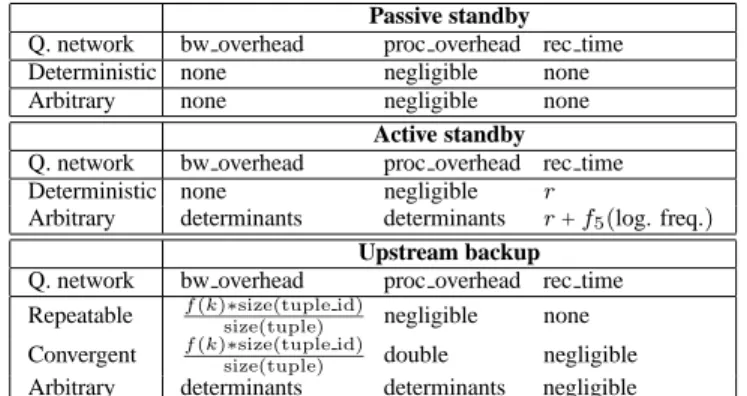
All recovery approaches can achieve precise recovery for convergent-capable query networks, by eliminating duplicate tuples during convergence. It is also possible, though much more costly, to provide precise recovery for arbitrary net-works. Table 4 summarizes the extra runtime overhead and recovery time required for precise recovery.
Passive Standby: Passive standby provides repeating recov-ery for deterministic qurecov-ery networks. To make recovrecov-ery pre-cise, before sending any output tuples, the failover node must ask downstream neighbors for the identifiers of the last tu-ples they received and then discard all tutu-ples preceding the ones identified. These requests can be made while the covery node regenerates the failed state, achieving precise re-covery without additional overhead. For a non-deterministic query network, because the secondary may produce differ-ent duplicate output tuples when it takes over, the primary
can only forward checkpointed tuples downstream. This con-straint causes bursty output while also increasing the end-to-end latency.
Active Standby: For a deterministic query network, active standby also makes recovery precise by asking downstream nodes for the identifiers of the latest tuples they received. The delay imposed by this request cannot be masked and thus ex-tends the recovery time byr. For other query networks, we must ensure that both the primary and secondary follow the same execution. To do so, whenever a non-deterministic op-erator executes, the primary must collect all information nec-essary to replay the execution of the operator. The primary accumulates such information, called determinants [9]1, in a
log message. Determinants affect both bandwidth and pro-cessing overhead. The logging frequency affects (1) the re-covery time, because non-deterministic operators on the sec-ondary cannot execute until they obtain appropriate determi-nants, and (2) the end-to-end delay, because the primary can-not send tuples downstream until the secondary receives all determinants involved in generating these tuples.
Upstream Backup: In repeatable query networks, operators produce output tuples by combining at most one tuple from each input stream. Input-tuple indicators therefore uniquely identify tuples and can serve for duplicate elimination, offer-ing precise recovery with negligible extra processoffer-ing over-head. For a convergent query network, the secondary must be able to remove duplicate output tuples during recovery. It achieves this by using the additional high watermarks as discussed in Section 5.3. This approach thus doubles the processing overhead. For repeatable query networks, nodes forward low watermarks downstream while for convergent-capable query networks, nodes forward high watermarks in-stead. In both cases, the extra bandwidth overhead is approx-imatelyf(k)size(tuple)∗size(tuple id), wheref(k)is a function of the av-erage number of input streams (at a node) that contribute to an output stream. As in active standby, upstream backup can provide precise recovery for more complex query networks by logging determinants from primary to secondary. Unlike active standby, these determinants are processed only when the secondary takes over. The details of the protocol are pre-sented in [11].
7
Evaluation
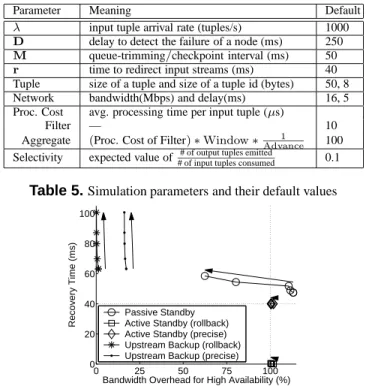
We evaluate and compare the performance of each ap-proach through simulations. Using CSIM [17], we built a detailed simulator of a DSPS. Table 5 summarizes the main simulation parameters. The parameter values were obtained from our prototype implementation, which currently supports all our recovery types for simple repeatable query networks. Each point shown in the figures is the average of 25 simula-tion runs, at least one simulated minute each. Because am-nesia has no overhead and a zero recovery time, but provides
1The representation of a determinant depends on the operator type. For
example, the determinant for a random filter could be represented as a bit vector where each bit shows whether the corresponding tuple passed or was dropped. For a union operator, the determinant must include the exact inter-leaving of tuples.
Parameter Meaning Default
λ input tuple arrival rate (tuples/s) 1000
D delay to detect the failure of a node (ms) 250
M queue-trimming/checkpoint interval (ms) 50
r time to redirect input streams (ms) 40 Tuple size of a tuple and size of a tuple id (bytes) 50, 8 Network bandwidth(Mbps) and delay(ms) 16, 5 Proc. Cost avg. processing time per input tuple (µs)
Filter — 10
Aggregate (Proc. Cost of Filter)∗Window∗ 1
Advance 100
Selectivity expected value of# of input tuples consumed# of output tuples emitted 0.1 Table 5.Simulation parameters and their default values
0 25 50 75 100 0 20 40 60 80 100
Bandwidth Overhead for High Availability (%)
Recovery Time (ms)
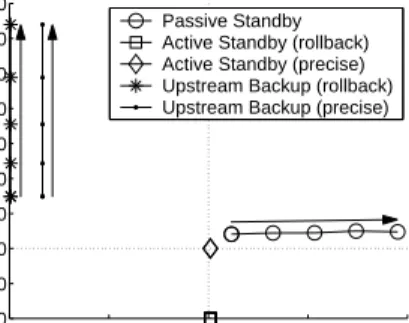
Passive Standby Active Standby (rollback) Active Standby (precise) Upstream Backup (rollback) Upstream Backup (precise)
Figure 6.Recovery time and runtime overhead for rollback and precise recovery as the communication interval varies from 25 ms to 200 ms (indicated by the arrows)
only gap recovery, we focus our evaluation on the other three approaches.
We first examine the overhead and recovery performance of each approach for rollback recovery and a convergent-capable query network (Section 7.1). We then evaluate the added overhead of achieving precise recovery (Section 7.2) and examine the effect of query-network types and other query-network properties on the performance of each ap-proach (Section 7.3). We finally examine how performance changes as a function of query network size (Section 7.4).
For the overhead measurements, we only present band-width overhead because processing overhead poses similar tradeoffs while being more difficult to reproduce and evaluate accurately in simulations. We refer the reader to Sections 4 through 6 for a detailed discussion of processing overheads.
7.1
Runtime Overhead vs Recovery Time
To examine the runtime overhead and recovery time trade-offs for rollback recovery and a convergent-capable query network, we simulate an aggregate with 100 ms window, 10 ms advance (this aggregate consumes 10% of a node’s processing capacity) and default values for other parameters. The only tunable parameter for each approach is the com-munication interval, which is the queue-trimming interval for upstream backup and active standby and the checkpointing interval for passive standby. Figure 6 shows the relation be-tween recovery time and bandwidth overhead as the commu-nication interval varies from 25, to 50, 100, 150, and 200 ms.
Looking at the overhead, upstream backup is the clear winner with an overhead close to zero. Even with a 25 ms communication interval, the node transmits only one 8-byte tuple identifier for every 25 tuples it receives, yielding an overhead of 0.64%. Upstream backup, however, has the slow-est recovery as it must recreate the complete state of the failed query network. Upstream backup’s recovery time is also most sensitive to the duration of the communication interval. Fre-quent trimming reduces recovery time for a negligible added overhead until the size of the query network and the time to redirect the input streams (ris 40 ms in our prototype) even-tually limits the recovery speed. Recovery time is still rela-tively short compared with the 250 ms failure detection delay. Active standby has an overhead of at least 100% because the secondary receives all input tuples in parallel with the primary. Queue-trimming messages used to discard output tuples from the secondary make the overhead slightly exceed 100%. Active standby has a negligible recovery time, though. The secondary only needs to resend half a queue-trimming interval worth of duplicate tuples stored in its output queues. Passive standby’s recovery time is between that of the other approaches because the secondary already has a snap-shot of the last checkpoint but must ask upstream nodes to redirect their output streams and must re-process on average half a checkpoint worth of tuples. Passive standby’s overhead varies significantly with the communication interval as each checkpoint message contains an update of the query-network state. When operators have a selectivity of less than 1.0, increasing the interval between checkpoints also increases the number of tuples processed and dropped without being checkpointed. The knee at 100 ms corresponds to the 100 ms window size. The curve would be smoother for a larger query network.
7.2
Cost of Precise Recovery
Figure 6 also presents the recovery time and runtime overhead of precise recovery. For passive standby and ac-tive standby, precise recovery of convergent-capable query networks adds no runtime overhead compared with roll-back recovery. Precise recovery increases the runtime over-head of upstream backup by a little over 16% (equal to:
k∗size(tuple id)
size(tuple) , withk = 1, and
size(tuple id) size(tuple) =
8
50 = 0.16) because watermarks are now sent downstream. The overhead thus remains much lower than that of the process-pair based approaches.
For upstream backup and passive standby, the precise re-covery time is almost the same as the rollback rere-covery time. Upstream backup must now process additional offset indica-tors but this adds negligible delay. For all approaches, re-covery nodes must now ask downstream neighbors for the latest tuples they received. For upstream backup and passive standby this communication proceeds in parallel with tuple re-processing (or input stream redirection). Active standby cannot mask this delay and recovery extends by the constant valuer(40 ms in our prototype). Overall, all approaches can offer precise recovery for convergent-capable query networks at a negligible incremental cost.
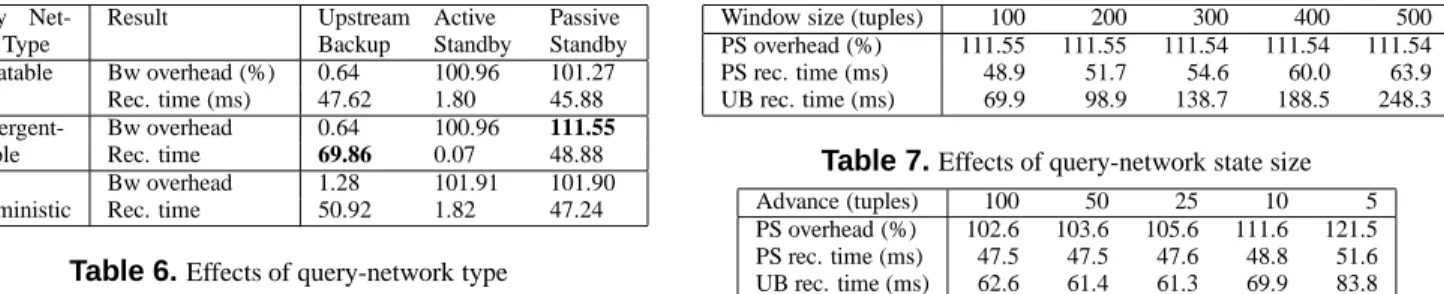
Query Net-work Type Result Upstream Backup Active Standby Passive Standby Repeatable Bw overhead (%) 0.64 100.96 101.27 Rec. time (ms) 47.62 1.80 45.88 Convergent- Bw overhead 0.64 100.96 111.55 capable Rec. time 69.86 0.07 48.88 Non- Bw overhead 1.28 101.91 101.90 deterministic Rec. time 50.92 1.82 47.24
Table 6.Effects of query-network type
7.3
Effects of Query-Network Type
We now examine the effects of query-network types on the basic performance of rollback recovery. Table 6 summarizes the recovery time and bandwidth overhead of each approach when the query network consists of a repeatable filter with selectivity 1.0, our default convergent-capable aggregate, and a non-deterministic union operator that merges two streams (500 tuples/s each) into one. Interestingly, the results show that neither the overheads nor the recovery times of the ap-proaches are affected by the query network type.
Upstream backup and active standby use queue-trimming messages. Their overheads thus depend on the relative rates of these messages and tuples on input streams rather than any other property of the query network. In Table 6, the union has a slightly higher overhead with these approaches because it has two input streams at half the rate each. The overhead of passive standby is proportional to the size of the checkpoint messages, which does not depend on the type of the query network but on the magnitude of changes in query-network state between two checkpoints. Because the aggregate has the greatest differences in state between checkpoints, its over-head is highest with passive standby.
Active standby recovers by retransmitting output tuples. In Table 6, the output rate is ten times lower for the agggate because of the 10 ms advance, resulting in a faster re-covery for that operator. The other two approaches recover by re-processing tuples. Passive standby re-processes half a checkpoint worth of tuples on average. Its recovery perfor-mance is thus independent of the type of the query network but rather depends on processing complexity (during recov-ery tuples are re-processed at the maximum rate). Upstream backup’s recovery also depends on processing complexity. There is, however, a second parameter. The number of tuples that upstream backup must re-process depends on the size of the query-network state. For these reasons, the aggregate has the longest recovery time with these approaches, especially with upstream backup. For passive standby the increase is negligible compared with the stream redirection delay.
Hence, for rollback recovery, the query network type does not affect recovery time or runtime overhead. Rather, the size of the query-network state and the rate and magnitude of the state changes affect recovery time of upstream backup and overhead and somewhat recovery time of passive standby. 7.3.1 Size of Query-Network State
We examine the effects of increasing the size of the query-network state by simulating the failure and recovery of an
Window size (tuples) 100 200 300 400 500 PS overhead (%) 111.55 111.55 111.54 111.54 111.54 PS rec. time (ms) 48.9 51.7 54.6 60.0 63.9 UB rec. time (ms) 69.9 98.9 138.7 188.5 248.3
Table 7.Effects of query-network state size
Advance (tuples) 100 50 25 10 5 PS overhead (%) 102.6 103.6 105.6 111.6 121.5 PS rec. time (ms) 47.5 47.5 47.6 48.8 51.6 UB rec. time (ms) 62.6 61.4 61.3 69.9 83.8 Table 8.Effects of rate of query-network state change
aggregate operator with increasing window size (100 to 500 tuples), but a constant 10-tuple advance. Table 7 shows the resulting passive standby (PS) overhead and both passive standby and upstream backup (UB) recovery times.
Increasing the size of the query-network state does not necessarily increase the rate at which that state changes. In this experiment, the overhead of passive standby remains constant at 112%. The recovery time of passive standby due to reprocessing tuples (the part in excess of 40 ms) increases by about a factor of three when the size of the state quintu-ples. This increase is due to the heavier per-tuple processing cost, due to computing aggregate values over larger numbers of tuples. The increase in recovery time is more pronounced for upstream backup. The time spent reprocessing tuples in-creases roughly linearly with the size of the state. Upstream backup must indeed reprocess a number of tuples directly proportional to the size of the query-network state.
7.3.2 Rate of Query-Network State Change
We examine the impact of increasing the rate at which the state of a query network changes using an aggregate operator with decreasing window advance from 100 ms to 5 ms and thus increasing selectivity from 0.01 to 0.2. Table 8 shows the impact of this increase in query-network state-update rate on the overhead of passive standby and the recovery times of both passive standby and upstream backup.
As expected, the overhead of passive standby increases with the magnitude of changes in query-network state. The advance determines the number of tuples that the operator produces during a checkpoint interval. This number increases from 1 to 20 as the advance decreases from 100 to 5 ms.
The increased per-input-tuple processing cost due to a smaller advance, slightly prolongs recovery for passive standby (visible for an advance of 10 tuples of less). We might expect the same effect to cause a slight increase in the recovery time of upstream backup. We measure a decrease instead. Upstream backup periodically updates the identi-fiers of the oldest tuples on each input stream that contribute to the current query-network state. When the state changes more rapidly, the older tuples are discarded faster and recov-ery restarts from a later point. This in turn results in a faster recovery. For a small enough advance, however, the added processing cost dominates recovery time. As the advance reaches 10 ms, the recovery time starts increasing.
query-0 50 100 150 200 0 20 40 60 80 100 120 140 160 180
Bandwidth Overhead for High Availability (%)
Recovery Time (ms)
Passive Standby Active Standby (rollback) Active Standby (precise) Upstream Backup (rollback) Upstream Backup (precise)
Figure 7. Effects of the number of operators. The arrows indicate the directions of the trends
network state increases upstream backup’s recovery time while the rate and magnitude at which that state changes im-pacts the runtime overhead of passive standby.
7.4
Effect of Network Size
Increasing the size and complexity of the query network translates into increasing the size of the query-network state, the rate at which this state changes, and the processing com-plexity. As an example, Figure 7 shows the performance of each approach for a chain of 1 to 5 aggregate operators (with the parameter values from Table 5). Other configurations yield similar results.
As expected, increasing the number of operators increases the overhead of passive standby because the number of tuples that are produced inside or at the output of the query network increases. Larger query networks also slightly increase re-covery time for passive standby because the processing com-plexity of each tuple increases. The recovery time of up-stream backup increases rapidly as the state of the query net-work increases with each extra aggregate. It reaches 170 ms for 5 operators, which is still relatively short compared with the 250 ms failure detection delay. Interestingly, even with a larger query network, upstream backup still provides precise recovery at a fraction of the cost of the other approaches.
7.5
Discussion
The results show that each approach poses a clear trade-off between recovery time and processing overhead. Active standby, with its high overhead and negligible recovery time, appears particularly well suited for systems where quick re-covery justifies high runtime costs (e.g., financial services, military applications).
Passive standby does not seem well suited to stream-processing systems as its performance is worse than that of active standby for both recovery time and runtime overhead. Passive standby, however, is the only approach that easily provides precise recovery for arbitrary query networks. It is thus best suited for applications, such as patient monitor-ing and other medical applications, that impose a somewhat lower load on the system but necessitate precise recovery.
Additionally, both in our prototype and simulator, we make the first nodes in the system adopt the passive-standby model since other approaches impose extra requirements on stream sources. Active standby requires that each source sends the stream to two different locations and upstream backup re-quires that each source loggs the tuples it produces.
Upstream backup provides precise recovery for most query networks with the lowest runtime overhead but at the cost of a longer recovery. The recovery time of this approach, however, can be significantly reduced by distributing the re-covery load over multiple nodes. In general, upstream backup is appropriate when short recovery delays are tolerable and is thus particularly suitable for sensor-based environment and infrastructure monitoring applications. In contrast to process-pair approaches, recovery nodes can be chosen among live nodes allowing all servers to process data streams at runtime.
8
Related Work
Reliability through redundant processing, checkpoint-ing, and logging has been widely studied in the context of traditional applications [9]. Recently, there has been much work on data-stream processing (e.g., Aurora [1, 5], STREAM [18], TelegraphCQ [6]), including proposals for distributed engines [7, 22]. In this paper, we investigate how to achieve high availability in these new systems.
The process-pairs model is adopted by many existing DBMSs [8, 19, 21, 20]. Oracle10g/DataGuard [19] is one such facility built on top of Oracle Streams [20]. The lat-ter enables cross-database event propagation and trigger-rule-based processing of event streams. DataGuard supports three recovery modes: maximum protection (MPR), availability (MAV), and performance (MPE). MPR synchronously ap-plies the same update to multiple machines as part of the same transaction, providing precise recovery. MPE asyn-chronously transmits redo logs to the standby, providing gap recovery only. MAV switches between MPR and MPE based on the accessibility of the standby. Our approaches provide precise recovery at a lower overhead because checkpoints are asynchronous and they also offer rollback recovery.
Commercial workflow systems [13] also rely on redun-dant components to achieve high availability. A variation of the process-pairs approach is used in the Exotica work-flow system [14]. Instead of backing up process states, Ex-otica logs changes to the workflow components, which store inter-process messages. This approach is similar to upstream backup in that the system state can be recovered by repro-cessing the component backups. Unlike upstream backup, however, this approach does not take advantage of the data-flow nature of processing, and therefore has to explicitly back up the components at remote servers.
The DR scheme [15], which efficiently resumes failed warehouse loads, is also similar to upstream backup. Instead of offset-indicators, DR uses output tuples and properties of operators to compute, during recovery, the trimming bounds on input streams. In contrast to DR, our scheme supports in-finite inputs by trimming output queues at runtime. We also support failure recovery at the granularity of nodes instead of
the whole system. We do not require that input streams have any property such as order on some attribute.
In parallel processing systems, router nodes distribute in-coming messages across a set of parallel servers [12, 22]. If a server fails, the router re-directs incoming messages to other nodes. These approaches address how to select failover nodes and re-route messages to them, whereas we focus on replicating and recovering state. In MQSeries [12], messages that are being processed by a server when the failure happens are trapped until the server recovers. Flux [23] introduces a technique similar to our active-standby method. It tries to accomplish loss-free and duplication-free failure/recovery se-mantics by exploiting sequence numbers assigned to tuples. It currently only considers order-preserving or set-prese rving operators though and thus cannot support convergent-capable and divergent queries discussed in this paper.
9
Conclusion
In this paper, we argue that the distributed and data-flow nature of stream processing applications raises novel chal-lenges and opportunities for high availability. We define three recovery types that provide increasingly stronger guarantees. We also define four classes of operators and query networks based on their impact on the cost of providing various recov-ery guarantees. Within this framework, we introduce three re-covery approaches that provide the proposed guarantees with different combinations of redundant processing, checkpoint-ing, and logging.
Using analysis and simulations, we quantitatively char-acterize the runtime overhead and recovery time tradeoffs among the approaches. We find that each approach cov-ers a complementary portion of the solution space. Process-pair based approaches, especially active standby, provide the fastest recovery but at a high cost. Active standby is thus best suited for environments where fast failure recovery (i.e., minimal disruptions) justifies higher runtime costs. Passive standby is best suited to provide precise recovery for arbitrary query networks. In contrast, upstream backup has a signifi-cantly lower runtime overhead but a longer recovery time that depends mostly on the size of the query-network state. This approach is thus best suited for an environment where failures are infrequent and short recovery delays are tolerable.
We currently have a basic prototype implementation that can provide the proposed recovery types for repeatable query networks. We will extend our prototype to support arbi-trary query networks and perform experiments on real de-ployments. We also plan to investigate how to simultane-ously use different recovery approaches at nodes in a DSPS, and, thus leverage the benefits of all schemes. We also plan to study network partitions, multiple failures, and the interac-tion between high availability and load balancing.
References
[1] D. J. Abadi, D. Carney, U. C¸ etintemel, M. Cherniack, C. Con-vey, S. Lee, M. Stonebraker, N. Tatbul, and S. Zdonik. Aurora: A new model and architecture for data stream management. The VLDB Journal, Sep 2003.
[2] A. Arasu, S. Babu, and J. Widom. The CQL continuous query language: Semantic foundations and query execution. Techni-cal Report 2003-67, Stanford University, 2003.
[3] B. Babcock, S. Babu, M. Datar, R. Motwani, and J. Widom. Models and issues in data stream systems. In Proc. of 2002 ACM PODS, June 2002.
[4] J. Barlett, J. Gray, and B. Horst. Fault tolerance in Tandem computer sytems. Technical Report 86.2, Tandem Computers, Mar. 1986.
[5] D. Carney, U. C¸ etintemel, M. Cherniack, C. Convey, S. Lee, G. Seidman, M. Stonebraker, N. Tatbul, and S. Zdonik. Moni-toring streams: A new class of data management applications. In Proc. of the 28th VLDB, Aug. 2002.
[6] S. Chandrasekaran, A. Deshpande, M. Franklin, and J. Heller-stein. TelegraphCQ: Continuous dataflow processing for an uncertain world. In Proc. of the 1st CIDR, Jan. 2003. [7] M. Cherniack, H. Balakrishnan, M. Balazinska, D. Carney,
U. C¸ etintemel, Y. Xing, and S. Zdonik. Scalable distributed stream processing. In Proc. of the 1st CIDR, 2003.
[8] E. Cialini and J. Macdonald. Creating hot snapshots and
standby databases with IBM DB2 Universal Database(T M)
V7.2 and EMC TimeFinder(T M). DB2 Information
Manage-ment White Papers, Sept. 2001.
[9] E. N. M. Elnozahy, L. Alvisi, Y.-M. Wang, and D. B. Johnson. A survey of rollback-recovery protocols in message-passing systems. ACM Comput. Surv., 34(3):375–408, 2002.
[10] J. Gray. Why do computers stop and what can be done about it? Technical Report 85.7, Tandem Computers, 1985.
[11] J.-H. Hwang, M. Balazinska, A. Rasin, U. C¸ etintemel,
M. Stonebraker, and S. Zdonik. High-availability algorithms for distributed stream processing. Technical Report CS-04-05, Department of Computer Science, Brown University, 2004.
[12] IBM Corporation. Getting the most out of MQSeries.
White paper. http://www.bmc.com/resourcecenter/
partners/mqseries/gettingthemostoutof% mqseries.html, 2003.
[13] IBM Corporation. IBM WebSphere V5.0: Performance, scal-ability, and high availability: WebSphere Handbook Series. IBM Redbook, July 2003.
[14] M. Kamath, G. Alonso, R. Guenthor, and C. Mohan. Providing high availability in very large workflow management systems. In Proc. of 5th Int. Conf. on Extending Database Technology, 1996.
[15] W. Labio, J. L. Wiener, H. Garcia-Molina, and V. Gorelik. Ef-ficient resumption of interrupted warehouse loads. In Proc. of the 2000 ACM SIGMOD, May 2000.
[16] S. Madden and M. J. Franklin. Fjording the stream: An archi-tecture for queries over streaming sensor data. In Proc. of the 18th ICDE, 2002.
[17] Mesquite Software, Inc. CSIM 18 user guide. http://www.
mesquite.com.
[18] R. Motwani, J. Widom, A. Arasu, B. Babcock, S. Babu, M. Datar, G. Manku, C. Olston, J. Rosenstein, and R. Varma. Query processing, approximation, and resource management in a data stream management system. In Proc. of the 1st CIDR, Jan. 2003.
[19] Oracle Inc. Oracle 10g high availability solutions. http://
otn.oracle.com/deploy/availability.
[20] Oracle Inc. Oracle 9i streams - online documentation. http:
//www.oracle.com.
[21] A. Ray. Oracle data guard: Ensuring disaster recovery for the enterprise. An Oracle white paper, Mar. 2002.
[22] M. Shah, J. Hellerstein, S. Chandrasekaran, and M. Franklin. An adaptive partitioning operator for continuous query sys-tems. Technical Report CS-02-1205, UC. Berkeley, 2002.
[23] M. A. Shah, J. M. Hellerstein, and E. Brewer.
Highly-available, fault-tolerant, parallel dataflows. In Proc. of the 2004 ACM SIGMOD, June 2004.

![Figure 5 shows an example of managing input-tuple indi- indi-cators. In Figure 5(a), the filter processes I 1 [900] and pro-duces S[500]](https://thumb-us.123doks.com/thumbv2/123dok_us/10335070.2943811/7.918.84.800.78.1085/figure-shows-example-managing-cators-figure-filter-processes.webp)