683 |
P a g e
ECG SIGNAL ANALYSIS AND PREDICTION OF HEART
ATTACK WITH THE HELP OF OPTIMIZED NEURAL
NETWORK USING GENETIC ALGORITHM
Amit S. Wale
1, Prof. Shilpa S. Sonawani
2, Prof. Shridevi C. Karande
31
PG Student, Department of Computer, Maharashtra Institute of Technology, Pune University, Pune, (India)
2
Professor, Department of Computer, Maharashtra Institute of Technology, Pune University, Pune, (India)
3
Professor, Department of Computer, Maharashtra Institute of Technology, Pune University, Pune, (India)
ABSTRACT
Heart Attacks are the major cause of death in the world today, particularly in India. The need to predict this is a major
necessity for improving the countries healthcare sector. Accurate and precise prediction of the heart disease mainly
depends on Electrocardiogram (ECG) data. Heart disease is a major life threatening disease that cause to death and it
has a serious long term disability. The time taken to recover from heart disease depends on patient’s severity. Heart
disease diagnosis is complex task which requires much experience and knowledge. Nowadays, health care industry
contain huge amount of health care data, which contain hidden information. Advanced data mining techniques along
with computer generated information are used for appropriate results. Neural Network is widely used tool for
predicting heart attack. A Heart Attack Prediction System we are proposing with the help of Neural Network and
Genetic Algorithm. This system calculates the number of hidden nodes for neural network which train the network with
proper selection of neural network architecture and uses the global optimization of genetic algorithm for initialization
of neural network.
Keywords
:
ECG (Electrocardiogram), Neural Network, Genetic Algorithm
.I.
INTRODUCTION
The electrocardiogram (ECG) is the most important bio signal used by cardiologists for diagnostic purposes. The ECG
signal provides key information about the electrical activity of the heart. The heart signals are taken from ECG, which
is known as Electrocardiography. That the heart signals are picked by using electrodes in arms, leg, chest of our body.
By using this signal heart disorder can be find out. Depend on the shape of the ECG waveform, find out the cardiac
health. ECG signal readings and their analysis are carried out from signal processing. Today signal processing plays a
major role in ECG signal analysis and interpretation. The aim of ECG signal processing is diverse and comprises the
Improvement of measurement accuracy and reproducibility (when compared with manual measurements) and by taking
out the information is not readily available from the signal through visual assessment. ECG is composite from 5 waves
- P, Q, R, S and T. This signal could be measured by electrodes from human body in typical engagement [2].
Heart Attacks are the major cause of death in the world today, particularly in India. The need to predict this is a major
684 |
P a g e
depends on Electrocardiogram (ECG) data. Neural Network is widely used tool for predicting heart diseases diagnosis.A Heart Disease Prediction System is developed using Neural Network and Genetic Algorithm. This system calculates
the number of hidden nodes for neural network which train the network with proper selection of neural network
architecture and uses the global optimization of genetic algorithm for initialization of neural network [1].
In today’s world, an optimal and intelligent problem solving approaches are required in every field, regardless of
simple or complex problems. Researches and developers are trying to make machines and software's more efficient,
intelligent and accurate. This is where the Artificial Intelligence plays its role in developing efficient and optimal
solutions. Data mining techniques are used to explore, analyze and extract data using complex algorithms in order to
discover unknown patterns in the process of knowledge discovery. Prediction is done with the help of available
knowledge or previous values so accuracy in prediction is the main challenge. The artificial neural network (ANN) can
use for pattern recognition, classification as well as prediction because it is based on biological neurons, an artificial
neural network (ANN) is a self-adaptive trainable process that is able to learn to resolve complex problems based on
available knowledge Genetic algorithm is one of most pervasive and advanced developed heuristic search technique in
Artificial Intelligence.
II. LITERATURE
SURVE
1.
The literature review related health monitoring
:This section describes the work that has been done in the area of health monitoring systems. Jubadi et al.[13] has
proposed heart rate monitoring alert via SMS. In this an alert system is used to monitor the heart beat rate of a patient.
This heart rate measurement is based on the principle of photoplethysmography (PPG) technique. Then this PPG signal
was processed using PIC16F87 microcontroller to check the heart beat rate per minute. An alert was given to medical
experts or family members via SMS. With the help of this system doctors could monitor & diagnose patient’s condition
continuously & could suggest them precautions if any. Saravanan designed remote patient monitoring system using
computer communication networks through Bluetooth, WiFi, Internet Android Mobile. ECG, EMG, Pulse, BP, arterial
oxygen saturation, blood glucose concentration & temperature signals were monitored. They had designed android
Bluetooth API & constructed a simple peer-to-peer messaging system to work between two paired Bluetooth. The
monitoring section receives data via Bluetooth, Wi-Fi & Internet. This system was mainly designed to send data to the
doctor.
Purnima et al. [14] proposed health monitoring systems based on GSM &Zigbee technology. In this ECG, temperature
& heart beat signals are continuously transmitted & monitored through Zigbee. A Zigbee node was connected to every
patient monitoring system. The data are transmitted to the doctors PC via Zigbee as well as GSM technology is used to
send data to doctor’s mobile.
Singh et al. [15] proposed wireless transmission system which is having a wireless sensor platform along with remote
monitoring capability. They have designed sensor nodes for temperature & heart rate. This sensor data are wirelessly
transmitted to the controller using RF transmitter & receiver module. This data is also wirelessly transmitted to the
remote monitoring station.
Venugopal et al. [16] presented a centralized heart rate monitoring system. The data obtained from sensors of various
685 |
P a g e
Kiran Kumar et al. [17] developed health monitoring system using PSOC mixed signal. They developed dataacquisition system to remotely monitor patient’s parameters like temperature, heart rate, blood oxygen saturation, blood
pH level & ECG. In this system doctor was able to monitor patient on PC using Zigbee wireless communication
technology.
2.
The literature review related to different machine learning technique in ECG for classification
:
Support Vector Machine (SVM):
SVM is a reliable classification technique, which is based on the statistical learning theory. The SVM originated from
the idea of the structural risk minimization Support vector machines are primarily two class classifiers that have been
shown to be attractive and more systematic to learning linear or non-linear class boundaries. K. Polat et al. [18].
According to this author he has got 98 percent accuracy and N. Acr et al. [19]. According to this author he has got 94.3
to 96.4 percent accuracy.
Fuzzy Set Theory:
Fuzzy sets are generalization of crisp sets and have greater flexibility to capture faithfully various aspects of
incompleteness or imperfection in information. For an ordinary set, an element either belongs to it or not; while for
fuzzy sets, an element can partially belong to the multiple sets, with the proviso that the total membership values total
one. Since fuzzy sets characterize imprecise properties, they can be effectively used to model vagueness associated
with real-life systems. Fuzzy logic is based on the theory of fuzzy sets and approximate reasoning. It is much closer in
spirit to human reasoning and natural language than the traditional logical system. W. K. LEI et al.[20]. According to
this author he has got 98.1 percent accuracy and U. R. Acharyaa et al.[21]. According to this author he has got 95 to
100 percent accuracy.
Artificial Neural Network(ANN):
ANN has been applied extensively to a wide range of classification problems within the healthcare domain. There are a
variety of neural network approaches proposed in the literature that vary in terms of topology and operational mode.
Each model can be specified by the following seven major concepts: (1) A set of processing units, (2) An activation
function of each neuron, (3) Pattern of connectivity among neurons, that is, network topology, (4) Propagation method
of activities of neurons through the network, (5) Rules to update the activities of each node, (6) External environment
that feeds information to the network, (7) Learning method to modify the pattern of connectivity. E. Derya et al.[22].
According to this author he used to different models of ANN one was Recurrent Neural Network (RNN) he has got
98.03 percent accuracy and seconnd was Multi Layer Perceptron Neural Network (MPLNN) he has got 90.03 percent
accuracy and I. Gler et al.[23]. According to this author he has got 96.94 percent accuracy and S-N. Yu et al.[24].
According to this author he has got 99.65 percent accuracy.
Rough Set Theory(RST) and Hidden Markov Model(HMM):
Rough set theory is a relatively new data-mining technique used in the discovery of patterns within data. The rough sets
approach has been successfully applied to deal with vague or imprecise concepts, extract knowledge from data, and to
reason about knowledge derived from the data. Hidden Markov model is a statistical model in which the system being
modeled is assumed to be a Markov process with unknown parameters, and the challenge is to determine the hidden
686 |
P a g e
therefore the state transition probabilities are the only parameters. In a hidden Markov model, the state is not directlyvisible, but variables influenced by the state are visible. Each state has a probability distribution over the possible
output tokens. Therefore the sequence of tokens generated by an HMM gives some information about the sequence of
states. The extracted model parameters can then be used to perform further analysis. Matthew C. Wiggins et al.[25].
According to this author he used RST and he has got 87 percent accuracy and L. Clavier et al.[26]. According to this
author he used HMM and he has got 65 percent specificity 70 percent sensitivity.
Hybrid Approach:
Hybrid approaches in the current context employ multiple classifiers which are fused at some level to perform a
classification task. Hybrid Systems are computational systems which are based mainly on the integration of different
soft -Computing techniques (like Fuzzy Logic, Neuro computing, evolutionary Computing, Probabilistic Computing)
but which also allow a traditional symbolic interpretation or interaction with symbolic components (Knowledge Based
Systems / Expert Systems) to classify the ECG signals. There are many different possible combinations among the
Symbolic systems and Soft-Computing techniques, and also different ways to integrate them. As for example, Neural
Networks can be combined with Fuzzy Logic. Y. zbay et al.[27].According to this author Multi Layer Perceptron
(MLP) and Fuzzy Clustering Neural Network( FCNN) he has got 98.9 to 99.9 percent accuracy. And R. U. Acharya et
al[28]. According to this author ANN and Fuzzy Logic he has got 80 to 85 percent accuracy.
3.
The literature review related prediction of heart attack and heart diseases:
This subsection describe about the prediction of heart attack and heart diseases and how much accuracy they have got.
Ravish et al.[1]. According to this author he used ANN technique for heart attack prediction and prevention and he
extracted feature like (1) QRS duration, (2) R-R interval, (3) P-R interval (4).Q-T interval, (5) Isoelectric Line (6)
Rwave Amplitude (7) P-wave Duration and (8) T-wave duration and he has got 97 to 99 percent accuracy.
J. P. Kelwade et al.[2]. According to this author he also used ANN technique for Prediction of Cardiac Arrhythmia and
he extracted feature using R-R interval time series and he has got 97 percent accuracy.
Dimitra Azariadi et al.[5]. According to this author he used SVM technque for ECG Signal Analysis and Arrhythmia
Detection and he extracted feature using Discrete-Wavelet- Transform (DWT) and he has got 98.9 percent accuracy.
Medina Hadjem et al.[6]. According to this author he used Baysien Network technique for Prediction of Cardiac
Anomalies and he extracted the features using Filtering Undecimated Wavelet Transform (UWT) and he has got 96.1
percent accuracy.
Bhuvaneswari Amma et al.[11]. According to this author she used ANN and GA for Prediction of Cardiovascular
Diseases and she extracted the features using normalization and she has got 94.17 percent accuracy.
Nilakshi P. Waghulde et al.[12].According to this author she used ANN and GA for Prediction of Heart Disease and
she has got 94.17 percent accuracy.
According to above survey we can say most of the author used ANN technique for prediction or detection and they
687 |
P a g e
III.
SYSTEM OVERVIEW
From the above literature survey we have concluded that heart activity is very important in health care monitoring
system. And it is done through the ECG signals. Different machine learning algorithms were used for predicting the
heart diseases as well as heart attack. The all research is done using MATLAB tool.
IV. PROPOSED SYSTEM ARCHITECTURE
Raw Data
ECG normal and abnormal signal dataset for male and female taken from MIT-BIH arrhythmia dataset that is raw ECG
data take it for further process.
Data Selection
This includes operations involved the selecting of either normal or abnormal ECG signal data for further process
.
Data Preprocessing
This includes operations applied to the data to prepare it for further analysis. Typical pre-processing operations include
data cleaning to filter out noisy data elements, data interpolation to cope with missing values, data normalization to
cope with heterogeneous sources, temporal alignment, and data formatting.
Feature Extraction
This includes operations for representing the data appropriately and selecting specific features from this representation.
This stage is often called feature extraction and selection.
Figure1: Proposed System Architecture
Optimized Neural Network Model
This stage, also called mining applies knowledge discovery algorithms to identify patterns in the data. Modeling
problems can be classified into six broad categories: anomaly detection to identify statistically deviant data, association
rules to find dependencies and correlations in the data, clustering models to group data elements according to various
notions of similarity, classification models to group data elements into predefined classes, regression models to fit
688 |
P a g e
information. Here, we are applying Optimized neural network using GA for classification and prediction of heartAttack.
Pattern Identification:
In this stage system identify the pattern of normal ECG dataset as well as abnormal ECG dataset for the analysis and
prediction purpose.
Analysis and Prediction:
This stage includes operations for analysis and prediction of the results of the pattern Identification process.
V.
METHODOLOGY
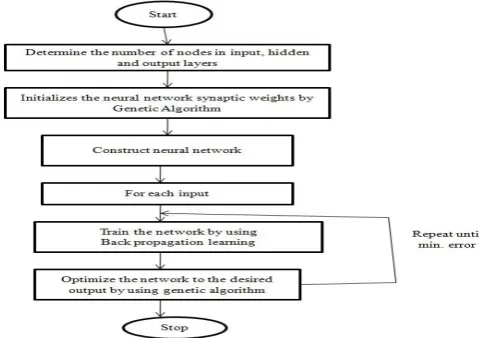
Neural Network Optimized by Genetic Algorithm
In the neural network, the hidden neuron can influence the error on the nodes to which their output is connected. It can
greatly degrade the generalization capability of the neural network which leads to the significant deviation in prediction
result to the problem. To overcome this, an approach is proposed which is able to find minimum number of hidden
nodes. The Neural Network Training Problem consists in determining the synaptic weights of a neural network to get
the desired output for a set of input vectors. As the Genetic Algorithm is able to find global optimize solution to the
problem it can be used for the initialization of neural network weights. Thus, the proposed method with Genetic-Neural
approach can be used to design system for the heart disease prediction.
Figure 2: Flowchart of Neural Network Optimization by Genetic Algorithm
VI.
DATASET
AND
RESULTS
We have taken the ECG signal Datasets from the MIT-BIH arrhythmia dataset site. We have taken the normal and
abnormal ECG signal dataset for male and female.
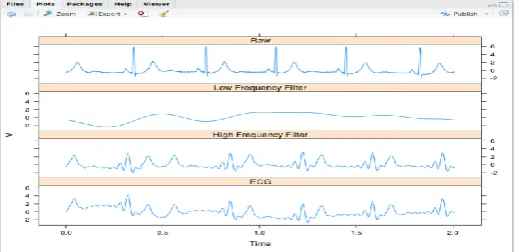
We have done the Preprocessing of normal and abnormal ECG signal datasets. Preprocessing done using R
programming details are given below.
The low-pass filter was first applied to eliminate the high frequency noise, anything greater than 30Hz. we next applied
the filter at a cut-off frequency of 1Hz in order to isolate the slow wave that corresponds to respirations. The images
689 |
P a g e
Figure 2: Normal ECG Signal Data preprocessingFigure 3. Abnormal ECG Signal Data preprocessing
VII.
CONCLUSION
AND
FUTURE
WORK
The ECG is mainly used for diagnosis of heart disease. Genetic Algorithm is used to optimize the initialization of
neural network weights. Genetic Neural Network based prediction of heart disease for patient by improving the
performance using optimize neural network architecture and predicts whether the patient is suffering from heart disease
or not. Also find out possibilities of heart attack based on heart activities. Back propagation is having disadvantage like
slow convergence, long training time and local minima. Genetic algorithm is use to solve this problem and gives
optimal result as well as get accuracy to predict heart attack.
As the healthcare domain is dynamic and this issue is a challenge to the data mining. It is also a forcing motivation to
the data mining applications in healthcare. This dynamism gives way to new horizons and more data mining
applications will be employed to discover new patterns and associations. In the view of the subjects examined in this
study, future data mining studies seem to take place, not limited but in considerable weight, in distributed data mining
applications and text mining algorithms. With the help of data mining algorithms, the classification performance
increases. This can be further enhanced and expanded with more prediction algorithm for major life threatening
diseases. The further enhancement observes on utilizing different method that provides higher accuracy in feature
extraction and classification.
VIII. ACKNOWLEDGEMENT
I would like to take this opportunity to express my thanks to my guide Prof. S. S. Sonawani and co-guide Prof. S. C.
690 |
P a g e
also very grateful for their guidance and comments while designing part of my research paper and learnt many thingsunder their leadership.
REFERENCES
[1] D. K. Ravish, Nayana R Shenoy, Dr.K.J.Shanthi, S.Nisargh, “Heart Function Monitoring, Prediction and Prevention
of Heart Attacks: Using Artificial Neural Networks”, IEEE-2014 International Conference on Contemporary
Computing and Informatics (IC3I).
[2] J. P. Kelwade, S. S. Salankar, “Prediction of Cardiac Arrhythmia using Artificial Neural Network”, International
Journal of Computer Applications (0975 8887) Volume 115 No. 20, April 2015.
[3] Poonam Sao, Rajendra Hegadi, Sanjeev Karmakarl, “ECG Signal Analysis Using Artificial Neural Network”,
International Journal of Science and Research (IJSR)- 2013.
[4] Masanao Nakano, Toshihiro Konishi, Shintaro Izumi, Hiroshi Kawaguchi, Masahiko Yoshimoto, Instantaneous
“Heart Rate Detection Using Short-Time Autocorrelation for Wearable Healthcare Systems”, 34th Annual
International Conference of the IEEE EMBS- 2012.
[5] Dimitra Azariadi, Vasileios Tsoutsouras, Sotirios Xydis, Dimitrios Soudris, “ECG Signal Analysis and Arrhythmia
Detection on IoT wearable medical devices”, IEEE- 2016 5th International Conference on Modern Circuits and
Systems Technologies (MOCAST).
[6] Medina Hadjem, Osman Salem, Farid Nat-Abdesselam, “An ECG Monitoring System For Prediction Of Cardiac
Anomalies Using WBAN”, IEEE-2014 16th International Conference on e-Health Networking, Applications and
Services (Healthcom).
[7] Dayong Gao, Michael Madden, Michael Schukat, Des Chambers, Gerard Lyons, “Arrhythmia Identification from
ECG Signals with a Neural Network Classifier Based on a Bayesian Framework”, 2009.
[8] Neerajkumar Sathawane, Pravin Kshirsagar, “Prediction and analysis of ECG signal behavior using soft
computing”, IMPACT: International Journal of Research in Engineering and Technology (IMPACT: IJRET)-2014.
[9] M.A Chikh, N. Belgacem, F. Bereksi Reguig, “The Use of Artificial Neural Network to Detect the Premature
Ventricular Contraction (PVC) Beats”, 2010.
[10] Tsu-Wang. Shen, Hsiao-Ping Shen,Ching-Heng Lin, “Detection and Prediction of Sudden Cardiac Death (SCD)
For Personal Healthcare” , Proceedings of the 29th Annual International Conference of the IEEE EMBS-2007.
[11] Bhuvaneswari Amma N.G., “Cardiovascular Disease Prediction System using Genetic Algorithm and Neural
Network”, International Conference on Computing, Communication and Applications .IEEE-2012.
[12] Nilakshi P. Waghulde, Nilima P. Patil, “Genetic Neural Approach for Heart Disease Prediction”, International
Journal of Advanced Computer Research Volume-4 Number-3 Issue-16 September-2014.
[13] Warsuzarina Mat Jubadi, Siti Faridatul Aisyah Mohd Sahak, “Heartbeat Monitoring Alert via SMS” 2009 IEEE
Symposium on Industrial Electronics and Applications (ISIEA 2009), October 4-6, 2009, Kuala Lumpur,
Malaysia.
[14] Purnima, Puneet Singh, “Zigbee and GSM Based Patient Health Monitoring System”, Interntional Conference on
Electronics and Communication System (IECS -2014).
[15] Nisha singh, Sr. Asst. Prof. Ravi Mishra, “Microcontroller Based Wireless Temperature and Heart Beat
691 |
P a g e
[16] Kala Venugopal, Amit Kumar, “Centralized Heart Rate Monitoring and Automated Message Alert System usingWBAN”, International Journal of Scientific and Research Publications, Volume 3, Issue 9, September 2013.
[17] D.J.R.Kiran Kumar, Nalini Kotnana, “Design and Implementation of Portable health monitoring system using
PSOC mixed signal Array chip”, International Journal of Recent Technology and Engineering (IJRTE), ISSN:
2277-3878, Volume-1, Issue-3, august 2012.
[18] K. Polat, S. Gunes; “Detection of ECG Arrhythmia using a differential expert system approach based on principal
component analysis and least square support vector machine”; Applied Mathematics and Computation 186 (2007).
[19] N. Acır; “A support vector machine classifier algorithm based on a perturbation method and its application to ECG
beat recognition systems”; Expert Systems with Applications 31 (2006) 150–158.
[20] W. K. Lei1, B. N. Li1, M. C. Dong, and M. I. Vai; “AFC-ECG: An Adaptive Fuzzy ECG Classifier A”.; (Eds.):
Soft Computing in Industrial Applications, ASC 39, (2007), 189–199.
[21] U. R. Acharya, P. S. Bhat, S. S. Iyengar, A. Rao, S. Dua; “Classification of heart rate data using artificial neural
network and fuzzy equivalence relation”; Pattern Recognition 36 (2003) 61 – 68.
[22] S. Mitra, M. Mitra, and B.B. Chaudhuri; “An Approach to a Rough Set Based Disease Inference Engine for ECG
Classification” ; IEEE Transactions on Instrumentation and Measurement; 55, 6, (2006), 2198-2206.
[23] L. Clavier I J.-M. Boucher, R. Lepage, J.-J. Blanc, J.-C. Cornily, “ Automatic P-wave analysis of patients prone to
atrial fibrillation”; Medical & Biological Engineering & Computing 40 (2002), 63-71.
[24] E. Derya Ubyli; “Combining recurrent neural networks with eigenvector methods for classification of ECG beats”;
Digital Signal Processing; 19, 2 (2009), 320-329.
[25] I. Güler and E. Derya beyl˙I; “ECG beat classifier designed by combined neural network model”; Pattern
Recognition, 38, 2,( 2005), 199-208.
[26] S.-N. Yu, Y-H. Chen; “Electrocardiogram beat classification based on wavelet transformation and probabilistic
neural network”; Pattern Recognition Letters 28 (2007) 1142–1150.
[27] Y. zbay, R. Ceylan, B. Karlik; “A fuzzy clustering neural network architecture for classification of ECG
arrhythmias”; Computers in Biology and Medicine 36 (2006) 376–388.
[28] U. R. Acharya, A. I. Kumar P. S. Bhat, C. M. Lim I S. Slyengar, N. Kannathal I S. M. Krishnan; “Classification of