478 | P a g e
AN ENHANCED APPROACH OF ENERGY
EFFICIENT ALGORITHM OF LEACH IN WSN
Manisha K. Goswami
Lecturer, Government Polytechnic, Porbandar, Gujarat
ABSTRACT
Wireless Sensor Network (WSN) is a collection of sensor nodes which nodes have limited battery capacity. It is
very difficult and expensive to replace or recharge the battery in that environment. So main issue is to how to
reduce the energy consumption and increase the network lifetime. Therefore to increase the network lifetime so
many techniques have been developed. For increase the residual energy clustering or hierarchical routing is the
best solution in WSN. In this paper i have proposed a new approach of LEACH which is energy efficient. New
CH selection method will be used based on the residual energy and vicinity factor. This proposed method save
energy and increase the lifetime.
Keywords: Energy Efficient, LEACH (Low Energy Adaptive Clustering Hierarchy), Wireless
Sensor
Network (WSN)
I. INTRODUCTION
Wireless Sensor Network (WSN) is a collection of small sensor nodes which have sensing, communication and
computational capabilities. Sensor nodes monitor the environment and collect data from surrounding
environment and send that collected data to base station. Sensor nodes are battery operated and they have
limited power capacity. When node deplete their energy and then network consider them dead. Hence, reduce
the energy consumption and increase the lifetime it’s a challenge for a WSN. Many techniques for energy
saving are developed, including MAC protocols [6], cross-layer design [7], routing protocols [8], compressive
sensing [9], clustering [10], [11] etc.
A Clustering is the best solution to save energy. A cluster network is divided into various clusters. In each
cluster, one node is elected as a cluster Head (CH) among all sensor nodes and others are cluster members. In
every cluster all the cluster members send their data to CH and CH aggregate that data and compress the data
and send it to Base Station (BS) either directly or via multihop transmission. Cluster head utilizes more energy
than cluster members. So, Cluster head is rotated among the all the cluster members. Energy saving of sensor
nodes is a major design issue. Since sensor nodes are usually battery-operated devices. Sensor network’s
lifetime can be prolonged by minimizing the energy consumption. Hierarchical routing is an efficient routing
technique to reduce energy consumption [1]. LEACH (Low Energy Adaptive Clustering Hierarchy) is the first
479 | P a g e
II. RELATED WORK
LEACH (Low Energy Adaptive Clustering Hierarchy)[1]: LEACH is the most popular energy efficient
hierarchical routing algorithm proposed by W.Heinzelman [1] for WSN to reduce the energy consumption.
LEACH divides the network into several clusters. In every cluster one node is selected as a Cluster Head (CH).
Other non Cluster Head node send their data to CH and all the CH aggregate that data and send compressed data
to Base Station (BS). All CH use the direct communication to forward the data to BS. Since energy dissipation
of the sensor depends on the distance LEACH attempts to transmit data over short distances and reduce total
number of transmission and reception operations [2].
The key features of LEACH are:
1) Randomized Rotation of CH and corresponding clusters.
2) Local aggregation of data to reduce global communication.
3)
Localize co-ordination and cluster set up operation.In LEACH the role of a CH is rotated periodically among all the nodes of clusters to balance the load. CH
rotation takes place rather than selecting one in static manner and give opportunity to all the member of clusters
to become CH to reduce the energy consumptions.
The Operation of LEACH is divided into rounds, each round has mainly two phases.
1) Setup Phase is used to choose a CH, clusters are organized, and CH advertisement and transmission schedule
is created. In this phase CH is selected from all the nodes of cluster based on the threshold criteria (T(n)) with
probability P of CHs, for the current round r, and the set of sensors that have not become CH in the past 1/P
rounds. Nodes which are not selected as the CH in the last 1/P round generate the random number between 0
and 1. If it is less than the threshold T(n) then node becomes a CH for the current round. After selection of CHs
they will broadcast an advertisement to all other nodes of cluster by using CSMA MAC protocol [7]. Now each
node selects a CH based on the received signal strength of the advertisement. Each node sends its join packet to
its selected CH. Then cluster are formed, each CH creates a TDMA schedule according to the number of nodes
in their cluster.
2) Steady State phase for data aggregation, data compression and data transmission to the Base Station. In this
phase after getting TDMA schedule all the nodes send their sensed data to CH during its allocated transmission
time as per the TDMA schedule. The CH receives all the data and aggregates that data and sends these
compressed data to BS. Now after certain time next round will start. Network starts next round again by setup
phase and steady state phase.
In SEEH [12] CH selection is based on node degree. So larger number of cluster member covered by smaller
number of cluster head. Relay nodes will be selected from other cluster members who are nearer to BS. More
480 | P a g e
In Cluster Chain Weight Metrics (CCWM) [13] Select the limited number of CH based on weight metrics tobalance the clusters. Node which has highest metrics value is selected as a CH. Metrics value calculated based
on the node degree, path loss and residual energy.
In LEACH-R [4] CH selection is based on residual energy and from selected CH based on distance to BS and
residual energy one CH selected as a Relay node.
III. PROPOSED WORK
There are lots of researches done on LEACH related to energy consumption. They try to improve the residual
energy using different strategies. I am trying to reduce the energy consumption and increase the lifetime of the
network. There are some research gaps in the previous research that I have noted down. Node with a larger
number of participant node is more appropriate choice for cluster head. The advantage of this method is that
larger number of member node might be covered by smaller number of cluster heads using low power
communication.
Proposed Algorithm
Step 1:For election of Cluster Head, calculates residual energy of all the nodes and if it is less than 50%
of initial energy then calculate new threshold equation based on residual energy. Then each node
generates random value between 0 to 1 and compare with new threshold equation.
If random value < threshold then node is eligible to become cluster head.
Step 2: If residual energy is greater than 50% then we have to check vicinity factor. it means cluster
head select based on the more participant nodes in its vicinity. So, every node has a cluster head in its
vicinity.
Find the Distance between every node through Euclidean distance eq.
Dist(1,2)= SQRT( (x2-x1)2 + (y2- y1)2 )
Through this formula prepare matrix which contains distance between each node.
For Vicinity find out the node which is in its radius.
Radius = SQRT( AREA/no of cluster).
Total no of nodes in vicinity can be find out using
Total Participate node = Dist(1,2)<Radius
Select First Five node based on more participate nodes in vicinity.
Step 3: From selected Cluster Head select MASTER CH based on maximum energy and nearer distance
from the base station. Other cluster heads are become SLAVE-CH.
Step 4: During the communication only MASTER-CH can communicate with the Base-Station. Other
SLAVE-CHs send data to MASTER-CH. During communication participate nodes communicate with
SLAVE-CH using TDMA time slot and SLAVE-CHs communicate with the MASTER-CH. Finally,
481 | P a g e
So, using this HYBRID algorithm I can enhance lifetime of network and residual energy of each node,
and also I can design cluster based on VICINITY.
IV. NETWORK PARAMETER AND SIMULATION RESULTS
In this paper we focused on reduce the energy consumption. For evaluation of LEACH and LEACH-MOD we
are using NS2 Simulator. This is the measurement of protocol through which we can measure the performance
of LEACH.
Energy Consumption: Energy consumption is how much energy is consumed by every node in transmission, receiving and other communication and control functions. This is measured in joule. If
energy consumption is less then network lifetime is increase.
Network Lifetime: Network lifetime is measured in two ways in first method lifetime of network is starting of network operation and up to the first node die (FND) in network. In second method it
measure from staring of network operation and up to the last node die(LND) in network. LND refers to
the time when 90% of the total nodes die.
From our point of view the proposed algorithm is energy efficient as compared to LEACH protocol.
Network Parameter
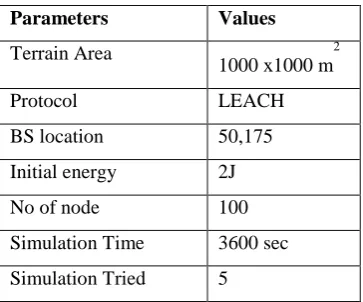
Table 1 Implementation Detail
Simulation Results
Energy Consumption
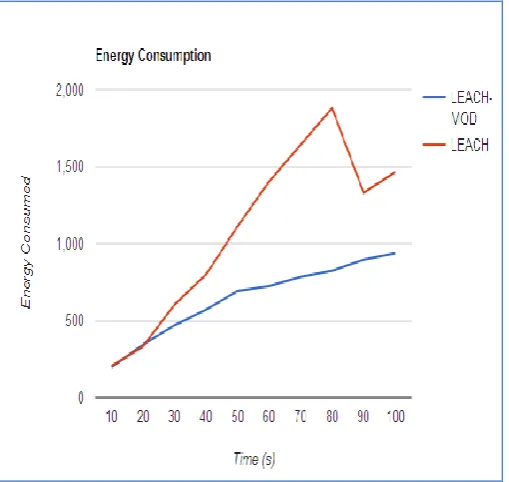
The proposed mechanism is an energy efficient mechanism for the proof. Figure 1 depicts that proposed
LEACH-MOD methodology provides the energy efficiency over the original methodology LEACH method.
This provides a proof of the energy efficiency of the proposed work. The simulation time is taken in X axis
which is having the unit ms and Variance of Energy is taken in Y axis.
Parameters Values
Terrain Area
1000 x1000 m
2
Protocol LEACH
BS location 50,175
Initial energy 2J
No of node 100
Simulation Time 3600 sec
482 | P a g e
Figure 1 Simulation Time v/s Total average Energy Consumed
Sensors lifetime
In the proposed mechanism there is not improvement overall but First node and last node is died earlier in
original LEACH. So overall lifetime will increased.
483 | P a g e
V. CONCLUSION
There are lots of research is going on CH (cluster head) election algorithm, data aggregation, reducing number
of transmission and different power levels. There are many protocols introduced based on LEACH but still have
issue of energy efficiency. Our approach is to improve its performance based on energy consumption rate using
residual energy and vicinity. I have reduced energy consumption and also increase lifetime of network through
this concept.
REFERENCES
[1] W.R. Heinzelman, A. Chandrakasan, and H. Balakrishnan, “Energy efficient Communication Protocol for
Wireless Micro sensor Networks”, in IEEE Computer Society Proceedings of the Thirty Third Hawaii
International Conference on System Sciences (HICSS '00), Washington, DC, USA, Jan. 2000, vol. 8, pp.
8020.
[2] Shio Kumar Singh , M P Singh, D K Singh, “A Survey of Energy-Efficient Hierarchical Cluster-Based
Routing in Wireless Sensor Networks ”, Int. J. of Advanced Networking and Applications Volume: 02,
Issue: 02, 2010, pp. 570-580.
[3] Nikunj pandya, H.J. Kathiriya “Design and simulation of enhanced MODLEACH of wireless sensor
network” Computing, Communication & Automation (ICCCA), 2015 International Conference IEEE 2015
[4] Ningbo WANG and Hao ZHU “An Energy Efficient Algorithm Based on LEACH Protocol” 2012
International Conference on Computer Science and Electronics Engineering IEEE
[5] Hai Lin, Lusheng Wang, Ruoshan Kong “Energy Efficient Clustering Protocol For Large Scale Network.”
IEEE Sensor Journal Vol 15 No 12 December 2015
[6] Y. Wei, J. Heidemann, and D. Estrin, “Medium access control with coordinated adaptive sleeping for wireless sensor networks,” IEEE/ACM Trans. Netw., vol. 12, no. 3, pp. 493–506, Jun. 2004.
[7] M. Al-Jemeli and F. A. Hussin, “An energy efficient cross-layer network operation model for IEEE
802.15.4-based mobile wireless sensor networks,” IEEE Sensors J., vol. 15, no. 2, pp. 684–692, Feb. 2015.
[8] N. A. Pantazis, S. A. Nikolidakis, and D. D. Vergados, “Energy-efficient routing protocols in wireless sensor
networks: A survey,” IEEE Commun.Surv. Tuts., vol. 15, no. 2, pp. 551–591, Second Quarter 2013.
[9] C. Karakus, A. C. Gurbuz, and B. Tavli, “Analysis of energy efficiency of compressive sensing in wireless
sensor networks,” IEEE Sensors J., vol. 13, no. 5, pp. 1999–2008, May 2013.
[10] M. A. Youssef, A. Youssef, and M. F. Younis, “Overlapping multihop clustering for wireless sensor networks,” IEEE Trans. Parallel Distrib. Syst., vol. 20, no. 12, pp. 1844–1856, Dec. 2009.
[11] O. Younis, M. Krunz, and S. Ramasubramanian, “Node clustering in wireless sensor networks: Recent developments and deployment challenges,” IEEE Netw., vol. 20, no. 3, pp. 20–25, May/Jun. 2006.
[12] Mehdi Tarhani, Yousef S. Kavian saman siavoshi “SEECH: Scalable energy efficient clustering hierarchy
protocol in WSNs” IEEE Sensor Journal Vol 14 No 11 Nov-2014
[13] Shilpa mahajan, jyotesh malhotra sandeep sharma “An energy balanced QoS based cluster head selection