Deflection angle of photon from magnetized black hole and effect of nonlinear
electrodynamics
Wajiha Javed,1,∗ Jameela Abbas,1, † and Ali ¨Ovg ¨un2, 3, ‡ 1Department of Mathematics, University of Education,
Township, Lahore-54590, Pakistan.
2Instituto de F´ısica, Pontificia Universidad Cat´olica de Valpara´ıso, Casilla 4950, Valpara´ıso, Chile
3Physics Department, Faculty of Arts and Sciences, Eastern Mediterranean University, Famagusta, North Cyprus, via Mersin 10, Turkey (Dated: March 27, 2019)
In this paper, we proposed a new model of non-linear electrodynamics with parameter. Firstly, we study the weak limit approximation and by using the Gauss Bonnet theorem we obtain the deflection angle of photon from magnetized black hole and effect of non-linear electrodynamics. In doing so, we find the corresponding optical metric after that we calculate the Gaussian curvature which is used in Gauss Bonnet theorem. Then we show the deflection angle in the leading order terms. We also ana-lyzed that our results reduces into Maxwell’s electrodynamics and RN solution with the reduction of parameters. Moreover, we also investigate the graphical behavior of deflection angle w.r.t correction parameter, black hole charge and impact parameter.
PACS numbers: 04.70.Dy; 04.70.Bw; 11.25.-w
Keywords: Relativity and gravitation; Classical black hole; Deflection angle; Gauss-Bonnet; Non-linear electrody-namics.
I. INTRODUCTION
In 1916, Einstein cleverly predicted the existence of gravitational waves and gravitational lensing as part of the theory of general relativity [1]. In 2015, these waves were first detected by LIGO [2]. This shows that the theoretical predictions are well fitted with experimental observations. Hence, this new detection of gravitational waves marks not only a culmination of a decades-long search, but also the beginning of a new way to look at the universe. After detection of gravitational waves by LIGO, there is renewed interest in the topic of gravitational lensing of gravita-tional waves [3]. Gravitagravita-tional lensing first proposed by Soldner in 1801 in context of Newtonian theory [4]. Many useful results for cosmology have come out of using this property of matter and light. Then Using data taken during a solar eclipse in 1919, Eddington measured a value close to that of the GR prediction [5, 6]. Then gravitational lensing has been worked in the literature in various space-times using different methods [7–15].
Moreover, over the years, there have been many studies linking gravitational lensing with the Gauss-Bonnet the-orem (GBT). First, Gibbons and Werner (GW) elegantly showed that the possibile way of calculation to deflection angle using the GBT for asymptotically flat static black holes [16]:
α=− Z Z
S∞Kdσ,
HereKand dσare the Gaussian curvature and surface element of optical metric.
Afterwards, Werner extended this method for stationary black holes [17]. Next, Ishihara et al. [18] showed that it is possible to find deflection angle for the finite-distances (large impact parameter) because the GW only found the deflection angle using the optical Fermat geometry of the black hole’s spacetime in weak field limits and for the observers at asymptotically flat region. Recently, Crisnejo and Gallo have studied the deflection of light in a plasma medium [19]. Since then, there is a continuously growing interest to the weak gravitational lensing via the method of GW and GBT of black holes, wormholes or cosmic strings [20–40].
The main aim of this paper is to investigate the effect of the nonlinear electrodynamical (magnetized) charge on the deflection angle where we use the GBT in which the deflection of light become a global effect [41]. Because we only focus the nonsingular region outside of a photon rays. It is expected that the horizon of a black hole is detected
∗Electronic address: [email protected]; [email protected] †Electronic address: [email protected]
‡Electronic address: [email protected];https://www.aovgun.com
using the Event Horizon Telescope (EHT) in this year so that the properties of the black hole which are encoded in the event horizon might be appears.
Gravitational singularities are mainly considered within general relativity, where density apparently becomes infinite at the center of a black hole, and within astrophysics and cosmology as the earliest state of the universe during the Big Bang. In General Relativity, spacetime singularities raise a number of problems, both mathematical and physical [42–48]. Using the nonlinear electrodynamics it is possible to remove these singularities by constructing a regular black hole solution [49–53]. Recently, Kruglov proposed a new model of nonlinear electrodynamics with two parameters βand γwhere the the specific range of magnetic field, the causality and unitarity principles are satisfied [41]. Moreover, it is shown that there is no singularity of the electric field strength at the origin for the point-like particles and it has a magnetic charge.
This paper is organized as follows. In section 2, we briefly review the solution of magnetized black hole and then we calculate its optical geometry and the optical curvature. In section 3, deflection angle of photon using the GBT is studied in the case of magnetized black hole. In section 4, we analysis the deflection angle in details using the graphical analytsis. And paper concludes in section 4 with a discussion regarding the results obtained from the present work.
II. WEAK GRAVITATIONAL LENSING AND MAGNETIZED BLACK HOLE
In this section, our NLED’s model as [41]
J=
Z d4xp
−g( 1
2k2R+L). (1)
Wherek2=8πG≡ M−2pl ,Mplis for reduced planck mass,Gis Newtonian constant andRis Ricci scalar. From above
equation we derived the Einstein equation as
Rab−
1
2gabR=−k 2T
ab. (2)
Now, we derive the equation of motion for electromagnetic fields by varying(2.1)
∂a(p−g(FabLG+F¯abLG)) =0. (3)
Now, we analyze the static magnetic black hole solution by using the Einstein field equation and equation of motion for electromagnetic field with above equations. In the case of pure magnetic field, Bronnikov shown[49] that when spherical symmetry holds, the invariant isF =q2/(2r2), hereqis a magnetic charge. In this case we find the static and spherical symmetric space-time, the line element is
ds2=−f(r)dt2+ 1
f(r)dr
2+r2(d
θ2+sin2θdϕ2), (4)
By assuming both the source and observer are in the equatorial plane likewise trajectory of the null photon is also on the same plane with(θ= π2), we obtain the optical metric as follows
ds2=−f(r)dt2+ 1
f(r)dr 2+r2d
ϕ2. (5)
For moving photon in the equatorial plane,k2=0 and null geodesics,ds2=0, we get
dt2= 1
f(r)2dr 2+ r2
f(r)dϕ
2. (6)
Subsequently, we make the transformation into new coordinateu, the metric functionζ(u)as
du= dr
f(r),ζ=
r
p
f(r). (7)
Then the optical metric tensor ¯gabas follows
It is to be noted that(a,b)→(r,ϕ)and determinant isdetg¯ab= r
2
f(r)3. Now by usingEq.(2.8), the non-zero Christo-pher symbols areΓrrr = −f
0(r)
f(r),Γrϕϕ =
r(r f0(r)−2f(r))
2 ,Γ
ϕ rϕ =
−r f0(r)+2f(r) 2r f(r) = Γ
ϕ
ϕr. Hence, we can find the Gaussian optical curvatureK[16] as follows
K=−Rrϕrϕ
detg¯rϕ =−1
ζ
d2ζ
du2. (9)
Now, we rewritten Gaussian optical curvature in terms of Schwarzschild radial coordinater[54]. We have
K=−1 ζ dr du d dr( dr du) dζ
dr+ ( dr du)
2d2ζ
dr2
. (10)
By applying the Eq.(2.10) into our metric (2.5) we obtain the Gaussian optical curvature of photon from magnetized black hole, which yields
K=− p
f(r)
r
"
r(f0(r)2−2f(r)f00(r)) 4pf(r)
#
, (11)
where the function f(r)is [41]
f(r) =1−2Gm
r +
Gq2 r2 −
βGq4 5r6 +O(r
−10). (12)
After substituting the value of f(r), we get the value of optical curvature in terms ofras
K = G[−G(−5q
2r4+5mr5+3q4 β)2]
25r14 +
G(−15q2r4+10mr5+21q4β) 25r14
× G(−5r
6+G(−5q2r4+10mr5+q4 β))
25r14 , (13)
which asymptotically behaves as
K ' −2mG
r3 + 3q2G
r4 − 21βq4
5r8 . (14)
III. DEFLECTION ANGLE OF PHOTON AND GAUSS-BONNET THEOREM
Now, we use the Gauss-Bonnet theorem to derive the deflection angle of photon for magnetized black hole. We apply the Gauss-Bonnet theorem to the regionMR, stated as [16]
Z
MR
KdS+
I
∂MR
kdt+
∑
jθj =2πX(MR). (15)
HereKis for Gaussian curvature and the geodesic curvature isk, given ask=g¯(∇α˙α, ¨˙ α)in such a way that ¯g(α, ˙˙ α) = 1, whereθjis the representation for exterior angle at thejthvertex and ¨αis unit acceleration vector. The jump angles becomeπ/2 asR → ∞and we getθO+θS →π. The Euler characteristic isX(MR) = 1, asMRis non singular.
Therefore we get
Z
MR Z
KdS+
I
∂MR
kdt+θj=2πX(MR). (16)
Whereθj = π shows the total jump angle andαg¯ is a geodesic; since the Euler characteristic numberX is 1. As
R →∞the remaining part yield thatk(DR) =| ∇D˙RD˙R |. The radial component of the geodesic curvature is given by
(∇D˙RD˙R)r =D˙Rϕ∂ϕD˙rR+Γrϕϕ(D˙ ϕ
At very largeR,DR:=r(ϕ) =R=const. Therefore, the first term of equation(3.3)vanish and(D˙Rϕ)2= 1ζ. Recalling Γr
ϕϕ =
r(r f0(r)−2f(r))
2 , we get
(∇D˙r R
˙
DrR)r→ −1
R , (18)
and it shows that the geodesic curvature is independent of topological defects,k(DR)→R−1. But from the optical
metric(2.8), we can say thatdt=Rdϕ. Therefore we found that
k(DR)dt= 1
RRdϕ. (19)
Taking into account the above results, we obtain
Z
MR
Z
Kds+
I
kdt=R→∞
Z
S∞
Z
KdS+
Z π+Θ
0 dϕ. (20)
In the weak deflection limit, by assuming that at the zeroth order the light ray is given byr(t) =b/ sinϕ. Thus by using(2.14)and(3.6), the deflection angle becomes [16]
Θ=−
Z π
0 Z ∞
b/ sinϕ Kp
detgdud¯ ϕ, (21)
where,
p
detgdu¯ =rdr(1−6mG
r +
3Gq2 r2 −
3q4Gβ
5r6 ). (22)
After substituting the leading order term of Gaussian curvature(2.14)into equation(3.7), the deflection angle upto second order term as follows:
Θ≈ 4mG
b −
3πGq2
4b2 + 7πβq4
32b6 +
32mβGq2
25b7 . (23)
IV. GRAPHICAL ANALYSIS
This section is devoted to discuss the graphically behavior of deflection angleΘ. We also demonstrate the physical significance of these graphs to analyze the impact of correction parameterβ, BH chargeq, and impact parameterb
on deflection angle by examining the stability and instability of BH.
A. Deflection angle with Impact parameterb
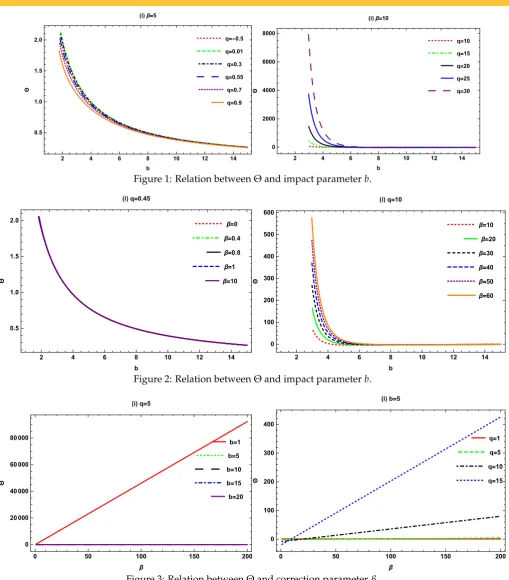
This subsection gives the analysis of deflection angleΘwith impact parameterbfor different values of correction parameterβand BH chargeq, for fixedm=1,G=1 andπ=3.14.
• Figure 1shows the behavior ofΘwithbfor varyingqand for fixed value for correction parameter.
1. In figure (i), we examined that the deflection angle exponentially decreases for small variation ofq. 2. In figure (ii), we analyzed that the deflection angle gradually decreasing and then eventually goes to
infinity for large variation ofqwhich is the unstable state of magnetized BH.
Therefore, we conclude that for small values ofqthe magnetized BH is stable but asqincreases it shows the unstable behavior of magnetized BH.
InFigure 2, indicates the behavior of deflection angle with impact parameter by varying correction parameter β.
q=-0.5
q=0.01
q=0.3
q=0.55
q=0.7
q=0.9
2 4 6 8 10 12 14
0.5 1.0 1.5 2.0
b (i)β=5
q=10
q=15
q=20
q=25
q=30
2 4 6 8 10 12 14
0 2000 4000 6000 8000
b
(i)β=10
Figure 1: Relation betweenΘand impact parameterb.
β0
β 0.4
β 0.8
β1
β 10
2 4 6 8 10 12 14
0.5 1.0 1.5 2.0
b
Θ
(i)q=0.45
β10
β20
β30
β40
β50
β60
2 4 6 8 10 12 14
0 100 200 300 400 500 600
b
Θ
(i)q=10
Figure 2: Relation betweenΘand impact parameterb.
b=1
b=5
b=10
b=15
b=20
0 50 100 150 200
0 20 000 40 000 60 000 80 000
Θ
i)q=5
q=1
q=5
q=10
q=15
0 50 100 150 200
0 100 200 300 400
Θ
i)b=5
β1
β5
β10
β15
β30
0 2 4 6 8 10 12 14
-20 -10 0 10 20 30 40 50
q
Θ
i b=5
b=0.1
b=0.5
b=1
b=5
b=10
0 2 4 6 8 10 12 14
0
5.0×10¹⁰
1.0×10¹¹
1.5×10¹¹
q (i)β=5
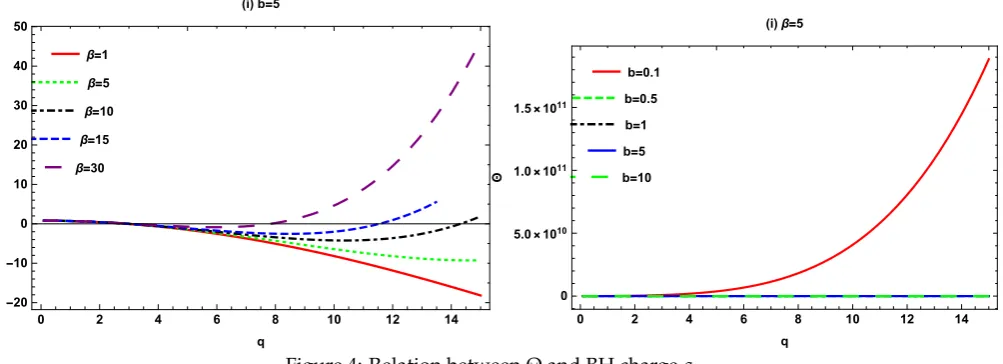
Figure 4: Relation betweenΘand BH chargeq.
• Figure 3shows the behavior ofΘwith correction parameterβ.
1. In figure (i), shows the behavior ofΘwithβ, for varyingband fixedq. This shows that whenb < 0 it gives the uniform negative behavior but forb>0 it behave as a positive slope. We also conclude that for 4≤b<15 the behavior is negative slope but forb≥15 it gives positive slope.
2. In figure (ii), indicate the behavior ofΘwithβ, for the variation ofqand fixedb. We examined that the deflection angle is positively increasing with increase ofqbut for 5≤q≤10 the behavior is negative and then it becomes positive.
InFigure 4, represent the behavior of deflection angle with BH chargeq.
1. In figure (i), represents the behavior ofΘwithq, by varyingβand fixedb. We analyzed that the deflection angle initially decreases but asβincreases the the deflection angle firstly decreases and then increases. We also observe that forβ>20 the behavior is increasing.
2. In figure (ii), shows the behavior ofΘ withq, by varyingband fixed β. We observed that the deflec-tion angle is increasing for smaller values ofbbut asbincreases the deflection angle become negatively decreasing.
V. CONCLUSION
In this paper, we have proposed a new model of NLED with parameter β. Then, we analyzed the magnetized black hole and obtained the regular black hole solution. After that we calculate the optical Gaussian curvature for magnetized black hole. Then by using Gauss-Bonnet theorem, we calculate the weak gravitational lensing. We obtain the following angle of deflection for magnetized black hole
Θ≈ 4mG
b −
3πGq2
4b2 + 7πβq4
32b6 +
32mβGq2
25b7 . (24)
We conclude that for f(r)ifr→∞the space-time becomes flat, ifβ=0 the NLED model converted into Maxwell’s electrodynamics and the solution becomes RN solution. We have analyzed the behavior of deflection angle w.r.t impact parameterb, correction parameterβand BH chargeq.
The results obtained from the analysis of deflection angle given in the paper are summarized as follows: Deflection angle with respect to impact parameter:
• In our analysis we have discussed the behavior of deflection angle, for this we choose different values of BH chargeqand fixed correction parameter. For smaller values the deflection angle gradually decreasing but for large values ofqthe deflection angle gradually decreases and then goes to infinity.
• Thus, for smaller values BH indicates the stability and for large values shows the instability of BH.
Deflection angle with respect to correction parameter:
• The behavior ofΘw.r.tβ, for fixedqand varyingb, positive behavior can be observed only forb > 0 except 4≤b<15.
• The behavior of Θw.r.t β, for fixedb and varyingq, the behavior is positively increasing for q > 0 except 5≤q≤10.
Deflection angle with respect to black hole charge:
• The behavior ofΘw.r.tq, for fixedband varyingβ, the deflection angle initially decreases but with the increase ofβfirstly decreases and then increases. Forβ>20 the deflection angle positively increases.
• The behavior ofΘw.r.tq, for fixedβand choose different values ofb, the deflection angle positively increases for smallband negatively decreases for greaterb.
Acknowledgments
This work was supported by Comisi ´on Nacional de Ciencias y Tecnolog´ıa of Chile through FONDECYT GrantNo
3170035 (A. ¨O.).
[1] A. Einstein, “Lens-Like Action of a Star by the Deviation of Light in the Gravitational Field,” Science84, 506 (1936).
[2] B. P. Abbottet al.[LIGO Scientific and Virgo Collaborations], “Observation of Gravitational Waves from a Binary Black Hole Merger,” Phys. Rev. Lett.116, no. 6, 061102 (2016).
[3] S. S. Li, S. Mao, Y. Zhao and Y. Lu, “Gravitational lensing of gravitational waves: A statistical perspective,” Mon. Not. Roy. Astron. Soc.476, no. 2, 2220 (2018).
[4] J. Soldner, “On the Deflection of a Light Ray from Its Rectilinear Motion, by the Attraction of a Celestial Body at Which It Nearly Passes by,” Berliner Astronomisches Jahrbuch, 161-172. (1801).
[5] F. W. Dyson, A. S. Eddington and C. Davidson, “A Determination of the Deflection of Light by the Sun’s Gravitational Field, from Observations Made at the Total Eclipse of May 29, 1919,” Phil. Trans. Roy. Soc. Lond. A220, 291 (1920).
[6] D. Valls-Gabaud, “The conceptual origins of gravitational lensing,” AIP Conf. Proc.861, no. 1, 1163 (2006) [7] M. Bartelmann and P. Schneider, “Weak gravitational lensing,” Phys. Rept.340, 291 (2001).
[8] M. Bartelmann, “Gravitational Lensing,” Class. Quant. Grav.27, 233001 (2010)
[9] C. R. Keeton, C. S. Kochanek and E. E. Falco, “The Optical properties of gravitational lens galaxies as a probe of galaxy structure and evolution,” Astrophys. J.509, 561 (1998)
[10] E. F. Eiroa, G. E. Romero and D. F. Torres, “Reissner-Nordstrom black hole lensing,” Phys. Rev. D66, 024010 (2002)
[11] S. Mao and B. Paczynski, “Gravitational microlensing by double stars and planetary systems,” Astrophys. J.374, L37 (1991). [12] V. Bozza, “Gravitational lensing in the strong field limit,” Phys. Rev. D66, 103001 (2002)
[13] E. Gallo and O. M. Moreschi, “Gravitational lens optical scalars in terms of energy-momentum distributions,” Phys. Rev. D 83, 083007 (2011)
[14] G. Crisnejo and E. Gallo, “Expressions for optical scalars and deflection angle at second order in terms of curvature scalars,” Phys. Rev. D97, no. 8, 084010 (2018)
[15] M. Sharif and S. Iftikhar, “Strong gravitational lensing in non-commutative wormholes,” Astrophys. Space Sci.357, no. 1, 85 (2015).
[16] G. W. Gibbons and M. C. Werner, “Applications of the Gauss-Bonnet theorem to gravitational lensing,” Class. Quant. Grav. 25, 235009 (2008)
[17] M. C. Werner, “Gravitational lensing in the Kerr-Randers optical geometry,” Gen. Rel. Grav.44, 3047 (2012)
[18] A. Ishihara, Y. Suzuki, T. Ono, T. Kitamura and H. Asada, “Gravitational bending angle of light for finite distance and the Gauss-Bonnet theorem,” Phys. Rev. D94, no. 8, 084015 (2016)
[19] G. Crisnejo and E. Gallo, “Weak lensing in a plasma medium and gravitational deflection of massive particles using the Gauss-Bonnet theorem. A unified treatment,” Phys. Rev. D97, no. 12, 124016 (2018)
[20] K. Jusufi, M. C. Werner, A. Banerjee and A. ¨Ovg ¨un, “Light Deflection by a Rotating Global Monopole Spacetime,” Phys. Rev. D95, no. 10, 104012 (2017).
[21] I. Sakalli and A. Ovgun, “Hawking Radiation and Deflection of Light from Rindler Modified Schwarzschild Black Hole,” EPL118, no. 6, 60006 (2017).
[22] K. Jusufi and A. ¨Ovg ¨un, “Gravitational Lensing by Rotating Wormholes,” Phys. Rev. D97, no. 2, 024042 (2018).
[24] K. Jusufi, A. ¨Ovg ¨un and A. Banerjee, “Light deflection by charged wormholes in Einstein-Maxwell-dilaton theory,” Phys. Rev. D96, no. 8, 084036 (2017) Addendum: [Phys. Rev. D96, no. 8, 089904 (2017)].
[25] A. ¨Ovg ¨un, G. Gyulchev and K. Jusufi, “Weak Gravitational lensing by phantom black holes and phantom wormholes using the Gauss-Bonnet theorem,” arXiv:1806.03719 [gr-qc].
[26] K. Jusufi, I. Sakalli and A. ¨Ovg ¨un, “Effect of Lorentz Symmetry Breaking on the Deflection of Light in a Cosmic String Spacetime,” Phys. Rev. D96, no. 2, 024040 (2017).
[27] H. Arakida, “Light deflection and GaussBonnet theorem: definition of total deflection angle and its applications,” Gen. Rel. Grav.50, no. 5, 48 (2018).
[28] T. Ono, A. Ishihara and H. Asada, “Deflection angle of light for an observer and source at finite distance from a rotating wormhole,” Phys. Rev. D98, no. 4, 044047 (2018).
[29] K. Jusufi and A. ¨Ovg ¨un, “Effect of the cosmological constant on the deflection angle by a rotating cosmic string,” Phys. Rev. D97, no. 6, 064030 (2018).
[30] A. ¨Ovg ¨un, K. Jusufi and I. Sakalli, “Exact traversable wormhole solution in bumblebee gravity,” Phys. Rev. D99, no. 2, 024042 (2019).
[31] K. Jusufi, A. ¨Ovg ¨un, J. Saavedra, Y. Vasquez and P. A. Gonzalez, “Deflection of light by rotating regular black holes using the Gauss-Bonnet theorem,” Phys. Rev. D97, no. 12, 124024 (2018).
[32] A. ¨Ovg ¨un, “Light deflection by Damour-Solodukhin wormholes and Gauss-Bonnet theorem,” Phys. Rev. D98, no. 4, 044033 (2018).
[33] A. ¨Ovg ¨un, K. Jusufi and I. Sakalli, “Gravitational lensing under the effect of Weyl and bumblebee gravities: Applications of GaussBonnet theorem,” Annals Phys.399, 193 (2018).
[34] A. ¨Ovg ¨un, “Deflection angle of photon through dark matter by black holes/wormholes using the Gauss-Bonnet theorem,” arXiv:1806.05549 [physics.gen-ph].
[35] A. ¨Ovg ¨un, I. Sakalli and J. Saavedra, “Weak gravitational lensing by Kerr-MOG Black Hole and Gauss-Bonnet theorem,” arXiv:1806.06453 [gr-qc].
[36] A. ¨Ovg ¨un, I. Sakalli and J. Saavedra, “Shadow cast and Deflection angle of Kerr-Newman-Kasuya spacetime,” JCAP1810, no. 10, 041 (2018).
[37] T. Ono, A. Ishihara and H. Asada, “Deflection angle of light for an observer and source at finite distance from a rotating global monopole,” arXiv:1811.01739 [gr-qc].
[38] A. ¨Ovg ¨un, “Weak gravitational lensing of regular black holes with cosmic strings using the Gauss-Bonnet theorem,” doi:10.13140/RG.2.2.24241.22883 arXiv:1902.04411 [physics.gen-ph].
[39] Wajiha Javed, Rimsha Babar, A. ¨Ovg ¨un, “Weak gravitational lensing of regular black holes with cosmic strings using the Gauss-Bonnet theorem,” doi:10.13140/RG.2.2.29693.82403.
[40] A. ¨Ovg ¨un and I. Sakalli, “Deriving Hawking Radiation via Gauss-Bonnet Theorem: An Alternative Way,” arXiv:1902.04465 [hep-th].
[41] S. I. Kruglov, “Magnetized black holes and nonlinear electrodynamics,” Int. J. Mod. Phys. A32, no. 23n24, 1750147 (2017). [42] S. I. Kruglov, “On a model of magnetically charged black hole with nonlinear electrodynamics,” Universe4, no. 5, 66 (2018). [43] S. I. Kruglov, “Nonlinear Electrodynamics and Magnetic Black Holes,” Annalen Phys.529, no. 8, 1700073 (2017).
[44] S. I. Kruglov, “BornInfeld-type electrodynamics and magnetic black holes,” Annals Phys.383, 550 (2017).
[45] S. I. Kruglov, “Black hole as a magnetic monopole within exponential nonlinear electrodynamics,” Annals Phys.378, 59 (2017).
[46] S. I. Kruglov, “Notes on BornInfeld-type electrodynamics,” Mod. Phys. Lett. A32, no. 36, 1750201 (2017).
[47] S. I. Kruglov, “Asymptotic Reissner-Nordstrm solution within nonlinear electrodynamics,” Phys. Rev. D94, no. 4, 044026 (2016).
[48] S. I. Kruglov, “Nonlinear arcsin-electrodynamics and asymptotic Reissner-Nordstrm black holes,” Annalen Phys.528, 588 (2016).
[49] K. A. Bronnikov, “Regular magnetic black holes and monopoles from nonlinear electrodynamics,” Phys. Rev. D63, 044005 (2001).
[50] E. Ayon-Beato and A. Garcia, “Regular black hole in general relativity coupled to nonlinear electrodynamics,” Phys. Rev. Lett.80, 5056 (1998).
[51] E. Ayon-Beato and A. Garcia, “Nonsingular charged black hole solution for nonlinear source,” Gen. Rel. Grav.31, 629 (1999). [52] M. E. Rodrigues and M. V. d. S. Silva, “Bardeen Regular Black Hole With an Electric Source,” JCAP1806, no. 06, 025 (2018). [53] S. A. Hayward, “Formation and evaporation of regular black holes,” Phys. Rev. Lett.96, 031103 (2006).