STUDY ON FLEXURAL BEHAVIOR OF COLD
FORMED C-SECTION PURLIN WITH DIFFERENT
OPENING SHAPES
Kaluram T. Jadhav
1, Pramod V. Kharmale
2 1PG Student,
2Assistant Professor
1,2Department of Civil Engineering, G.H.Raisoni College of Engineering & Management,
Chas, Ahmednagar, Maharashtra,(India)
ABSTRACT
As increased steel demand in many construction industries, due this phenomenon, the price of steel is also increased. The cost and weight of steel are major consideration during design stage of project. So that to reduce overall cost of the project, web-opening concept for purlin was introduced to reduce its self-weight. If the weight from the top of structure is reduced, it will result in fewer loads transferred to the column and therefore it reduce the size of other structural elements. In this project, we are present study on flexural behavior of cold formed C-section purlin with different opening shapes. Total 13 number of different web opening shapes (C-hexagon, Circular, square and without opening) was provided into the c purlin and it should be tested. In this project finite element analysis is planned for different opening models and there representation with respective various analysis parameters. To investigate that shapes of opening which gives the least reduction in bending moment and to understand the weight to flexural strength for different shapes and to investigate stress-strain variation of C-section purlin using finite element method. The results shows that the CFS C-section purlin of hexagon shape opening gives better strength results and less deflection with respect to the loading, than other shape of opening sections.
Keywords
–Cold formed C-Section, Castellated purlin, F.E.A. by ANSYS-16 Software, Opening sizes,
UTM testing, web Opening shapes.
I. INTRODUCTION
In the steel structures, purlin is an important factor. Purlin is used to sustain the loads from the roof deck and
properly supported by rafters or walls. The use of cold formed steel members in building construction began in
the 1850s. The cold formed steel members offers advantages such as lightness, high strength and stiffness, mass
production, fast and easy installation, economical transportation and handling. In cold formed purlin, C and Z
sections commonly used due to their structural advantages. In this project we are introduce web-opening concept
for cold formed C-section purlin to reduce its weight. We are introducing castellated opening so that the purlin
depth is increase by 50%, it gives more efficient structural performance against bending and improve the aesthetic
II.
LITERATURE REVIEW
Jin Ying Ling et.al [1], they had made a numerical study of buckling behavior of cold formed C-channel purlin
with perforation. Five different shapes of opening investigated. It has seen that c-hexagon shape opening shows
smallest reduction on buckling moment capacity compared to other. They says that web opening is to affects the
buckling moment capacity of the c-channel purlin. As the opening size increases, the buckling moment capacity
decreases.
Ali Awaludin et.al [2], they worked study on development of cold formed steel-timber composite for roof
structure; compression member. This study is done for to improve buckling performance of cold formed steel
members by attaching 15mm thick timber to the web portion of cold formed z, c& double c- section at constant
spacing of 100-mm. compression test was done over five different effective length. They says that the
compressive load carrying capacity increase for short member and decrease as the length of member was
increases.
Jun Ye et.al [3], they had presented study on development of more efficient cold formed steel channel section in
bending. Total ten different types of CFS channel cross section are studied. They says that the edge stiffeners are
much more efficient in increasing the section capacity than intermediate web stiffeners for a CFS beam. The
results shows that optimized folded section bending capacity is 57% more than optimized shapes with the same
amount of material.
Congxiao Zhao et.al [4], they worked on rotational stiffness of cold formed steel roof purlin-sheeting connections.
They represent both analytical method to predict the rotational stiffness for cold formed zed and sigma purlin
sections and it validated by a series of F-tests on both zed and sigma section. It was found that sheet at flange-web
junction line the rotational stiffness was higher than sheet is at the flange-lie junction line.
Adi Susila et.al [5], they had presented study on flexural strength performance and buckling mode prediction of
cold formed steel C-section. The experimental work done in laboratory and numerical done by using finite
element software ABAQUS. The results analyzed by using effective width method and direct strength method. At
the intermediate web stiffeners, the effectiveness between EWM and DSM have shown no significant
improvement of the bending capacity. They says intermediate web stiffener was only provide protection of the
local buckling with in the web.
Xing Zhao Zhang [6], they had presented comparative study of hot formed, hot finished and cold formed
rectangular hollow section. It was found that the tested hollow section chemical composition and geometrical
parameter are similar and mechanical properties are significantly different. While the hot formed and hot finished
sections treated as same in design, their residual stresses distribution and mechanical properties are actually
different.
Mohamed Salah Al-din Soliman [7], they had made numerical study on web crippling and interaction between
bending and web crippling. FEM is used to find out the interaction between bending and web crippling in
C-sections. It was found that, the strength given by design codes are generally inadequate for channel with a
III.
MEANING
OF
COLD
FORMED
C-SECTION
PURLIN
WITH
DIFFERENT
OPENING
SHAPES.
CFS is the product made by pressing or ro000lling steel into semi-finished or finished good at relatively low
temperature. First codified standards is introduced in 1946. Cold formed material was easily workable it could
deform into many shapes. If a small change in geometry created it was affect, strength characteristics of the
section. The purlin is commonly used in cold formed steel section. There are three types of cold formed steel
sections such as, z, c and hollow section purlin. C-section purlin with different opening shapes means the opening
of different shapes such as hexagonal, square, circular are provided in center of web of the section at specific
opening sizes, edge distance, spacing between two openings and number of openings.
IV.
EXPERIMENTAL
WORK
4.1. Material Properties1.Material: CR steel as per IS: 513, galvanized as per: 277.
2.Thickness: 2mm.
3.Length: 1065mm.
4.Yield strength: 345Mpa.
5.Tensile strength: 410Mpa.
6.Purlin in galvanized coated steel in 120Gsm.
4.1. Cutting of Members
The different shapes of web opening to provide in C-section purlin is the main aim in the casting. First to define
all the parameter such as opening shapes, opening sizes, edge distance, spacing between two opening and number
of opening as per criteria given by euro code. Castellated purlin created from a standard wide flange beam by
cutting it longitudinally in a zigzag or semicircular pattern, separating and offsetting the two halves. The cutting
procedure was done by using lesser cutting machine, with no any structural disadvantages.
4.2. Welding of a Member:
Metal arc welding can be used for cold formed steel application with smaller diameter electrodes and low welding
current. The welding process in which an electric arc forms between an electrode and the work piece metal, which
Fig-1: Number of Specimens
Fig-2: Parameters of CFS Sections
4.3. Three Point Bending Flexural Test
The three point bending flexural test had been done to get the values of modulus of elasticity, flexural stress,
flexural strain and the flexural stress- strain response of the material. The bending flexural testing done over the
universal testing machine of 100-ton capacity. The specimen was placed simply supported and load will be act at
the center of top of the section.
V. FINITE ELEMENT ANALYSIS
The finite element method (FEM) is a numerical technique for finding approximate solutions to boundary value
problem for partial differential equation. It is also referred to as finite element analysis (FEA). It subdivided a large
problem into smaller and simple parts that are called finite element. Finite element analysis for cold formed steel
sections, there are different types of software is available such as, ABAQUS software, ANSYS software. ANSYS
is a finite element analysis software used for structural analysis, including nonlinear, linear and dynamic studies. It
provide a complete set of element behavior, material models and equation solves for a wide range of structural
design problem.
5.1. Modelling and Meshing
The CFS C-section purlin with different opening shapes are modelled and analyzed in ANSYS Software by FEA.
The parameters which are defined for experimental work as per euro code, the same parameter are used for finite
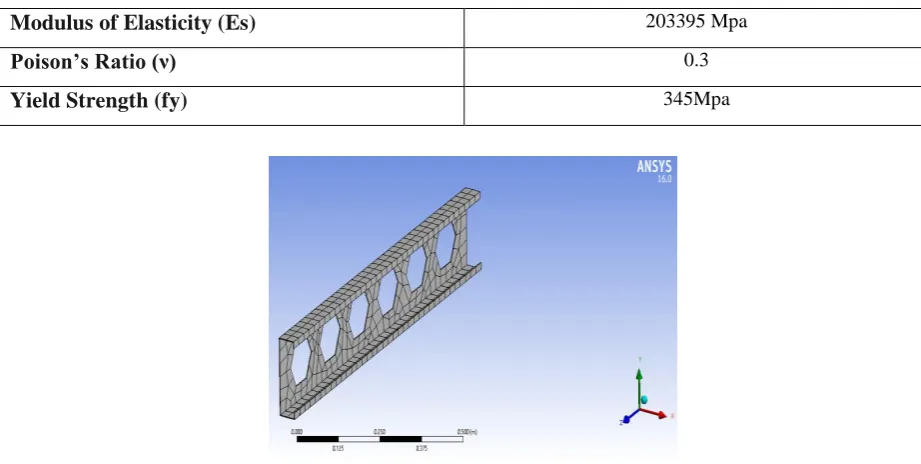
element analysis in ANSYS software. The purlin section is modelled as 3D shell element and the meshing of model
is quadrilateral meshing is used. The material properties given are modulus of elasticity, Poisson’s ratio and yield
strength.
TABLE -1: MATERIAL PROPERTIES OF COLD FORMED STEEL
Modulus of Elasticity (Es)
203395 MpaPoison’s Ratio (ν)
0.3Yield Strength (fy)
345MpaFig-4: Meshing of CFS castellated C-section in ANSYS
5.2. Analysis
The finite element analysis is carried out in ANSYS software to determine the stress variation and deflection of
condition is used. After getting the finite element analysis in ANSYS software the different stress and deflection
values are given which are shown below in results.
VI. RESULTS AND DISCUSSIONS
The results are discussed mainly in three parts such as; experimental results, analytical results and comparison of
experimental and analytical results of cold formed steel C-section purlin of different opening sections.
6.1. Experimental Results
After getting experimental testing of all CFS specimens on universal testing machine, the results of this specimen
are shown below. This results shows the behavior of CFS specimens and their load carrying capacity.
Table -2: Load carrying capacity of different opening shapes
Opening Shapes
Load Carried N
Square 6050
Hexagon 10425
Circular 7425
W/o opening (120mm) 8475
W/o opening (180mm) 12000
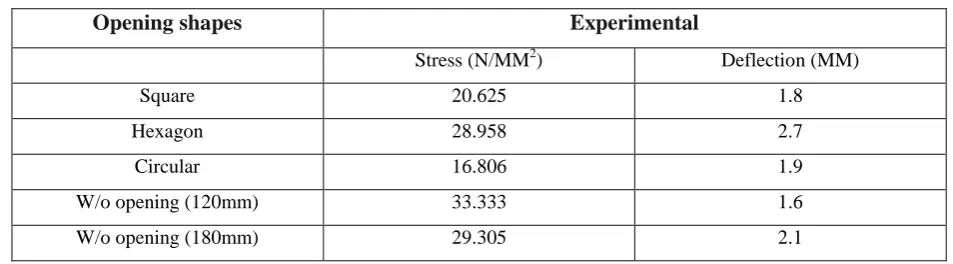
Table-3: Experimental maximum stresses and deflection of different opening shapes
Opening shapes
Experimental
Stress (N/MM2) Deflection (MM)
Square 20.625 1.8
Hexagon 28.958 2.7
Circular 16.806 1.9
W/o opening (120mm) 33.333 1.6
W/o opening (180mm) 29.305 2.1
Chart-1: Load vs. Displacement
Chart-2: Stress vs. Strain
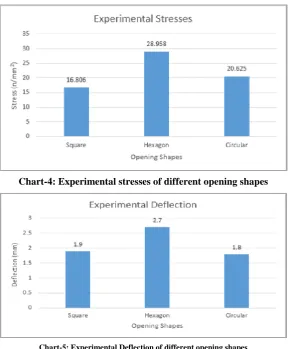
Chart-4: Experimental stresses of different opening shapes
Chart-5: Experimental Deflection of different opening shapes
From experimental results it is observed that the hexagon opening cold formed C-section purlin behaves
satisfactorily in respect of load carrying capacity (10.425KN). It gives more load carrying capacity comparing the
other opening shapes. Hexagon section also taking more load capacity than its parent 120mm depth of without
opening sections and gives maximum stress values than other opening shapes. Which means that hexagon shape
gives maximum strength against loading and less deflection as comparing with loading than other shapes.
6.2. Analytical Results
The Finite element analysis is done by ANSYS 16 Software. The analytical results of maximum stresses and
deflection with respect to the ultimate loading on cold formed steel C-section purlin of different opening shapes
are shown below. This results shows the behavior of CFS specimens and the deflection of the specimens under
ultimate loading conditions.
Table -4: Analytical maximum stresses and deflection of different opening shapes
Opening shapes Analytical
Stress (N/MM2) Deflection (MM)
Square 15.836 1.85
Hexagon 13.653 2.04
Circular 12.105 1.52
W/o opening (120mm) 16.395 2.70
After getting FEA the following results are given for different opening shapes:
Chart-6: Analytical stresses of different opening shapes
Chart-7: Analytical Deflection of different opening shapes
Fig-5: Variation in stresses of Square opening shape by ANSYS
Fig-7: Variation in stresses of Circular opening shape by ANSYS
Fig-8: Deflection of Square opening shape by ANSYS
Fig-9: Deflection of Hexagon opening shape by ANSYS
From the results of above analysis it is observed that the hexagon opening shapes gives more satisfactory results.
It gives less deflection compare with other opening shapes with respect to the loading conditions. Finite elemen t
analysis is good agreement with the experimental results.
6.3. Comparison of Experimental and Analytical Results
The validation of experimental results it can be compare with the FEA results is necessary. The results obtained
from experiment is compared with the results from the finite element analysis in ANSYS. This comparison of
results of CFS C-section purlin with square, hexagonal and circular shaped openings are given in Table-5 below.
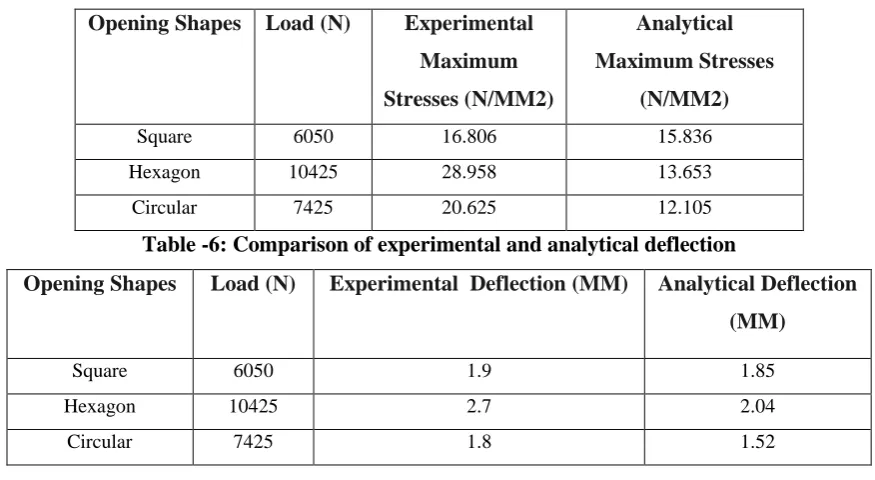
Table -5: Comparison of experimental and analytical stresses
Opening Shapes Load (N)
Experimental
Maximum
Stresses (N/MM2)
Analytical
Maximum Stresses
(N/MM2)
Square 6050 16.806 15.836
Hexagon 10425 28.958 13.653
Circular 7425 20.625 12.105
Table -6: Comparison of experimental and analytical deflection
Opening Shapes
Load (N)
Experimental Deflection (MM)
Analytical Deflection
(MM)
Square 6050 1.9 1.85
Hexagon 10425 2.7 2.04
Circular 7425 1.8 1.52
After getting Experimental testing and FEA the following chart results are given for different opening shapes:
Chart-9: Comparison of experimental and analytical deflection
From the comparison of results it is observed that the experimental results is good agreement with finite element
analysis results of ANSYS software. From both results it is concluded that the CFS C-section purlin with hexagon
opening shape is more reliable in respect of strength requirement. That means it gives more satisfying strength
results than the other square and circular opening shapes.
VII. CONCLUSION
After carrying out the testing on cold formed C-section purlin with different opening in castellated manners
following conclusion can be drawn;
1. After converting the cold formed C- section purlin into the cold formed C- section castellated purlin with
hexagonal opening, the load carrying capacity of section increases.
2. The load carrying capacity of section varies with various shapes of openings.
3. Castellated purlin with hexagonal opening carrying 42% more load than square and 29% more load than
circular opening and it also takes 19% more load than the parent 120mm depth of without opening sections.
4. Hexagon opening C-section purlin of depth 180mm take a load near about, 180mm depth of without opening
sections.
5. Experimental and ANSYS software results prove that hexagon shape opening gives maximum stress and less
deflection values with respect to loading, it means that the CFS C-section purlin with hexagon opening shapes
gives more strength and more satisfactory results than other opening shapes.
6. Results of ANSYS software (FEA) are in good agreement with the results of experimentation.
REFERENCES
[1] Jin Ying Ling, Shin Lin Kong, Fatimah De, Nan, “Numerical study of buckling behavior of cold formed C-
Section steel purlin with perforation” The 5th International Conference of euro Asia civil Engineering Forum.
[Online], (2015, December), pp.1135-1141.
[2] Jun ye, Iman Hajirasouliha, Kypros Pilakoutas, “Development of more efficient cold formed steel channel
section in bending” Thin-Walled Structures. [Online].101, (2015, December), pp. 1-13.
[3] Congxiao Zhao, Jin Yang, Feiliang Wang, Andrew H.C.Chan, “Rotational stiffness of cold-formed steel roof
[4] Adi Susila, Jimmy Tan, “Flexural strength performance and buckling mode prediction of cold formed steel c-
section” The 5th International Conference of euro Asia civil Engineering Forum. [Online], (2015, November),
pp. 979-986.
[5] Ali Awaludin, Kundari Rachmawati, Made Aryati, Anindha Dyah Danastri, “Development of cold formed
steel-timber composite for roof structures: compression members” The 5th International Conference of euro
Asia civil Engineering Forum. [Online], (2015, November). Pp.850-856.
[6] Xing-Zhao Zhang, Su Liu, Sing-Ping Chiew, “Comparative experimental study of hot-formed, hot-finished
and cold formed rectangular hollow sections” Case Studies in Structural Engineering. [Online], (2016,
September), pp.115-129.
[7] Mohamed Saleh Al-Din Soliman, Anwar badawy Badawy Abu-Sena, Mohamed Saeed Refaee Saleh
“Resistance of cold-formed steel sections to combined bending and web crippling” Ain Shams Engineering
Journal. [Online], (2012, December), pp. 435-453.
[8] Indian Standard Code of Practice for use of cold formed light gauge steel structural member’s in general
building construction, IS: 801.
[9] Indian Standard Code of specification for cold formed light gauge structural steel sections IS: 811-1987.
[10]Indian Standard Code of cold reduced low carbon steel sheet and strip, IS-513-2008.