R E S E A R C H
Open Access
Delay constrained throughput
optimization in multi-hop AF relay networks,
using limited quantized CSI
Mehrdad Taki
1*, Tommy Svensson
2and Mohammad Bagher Nezafati
3Abstract
In this paper, we analyze the throughput of multi-hop amplify and forward (AF) relay networks in delay-constrained scenario. Using quantized channel state information (CSI), the transmission rates and powers are discretely adapted with individual average power constraint on each node. A sub-gradient projection-based algorithm is utilized, by which there is no need for probability density functions (PDFs) to solve the optimization problem. Our numerical evaluations show that the sub-gradient projection-based algorithm results in a comparable performance with an analytical approach using PDFs. As shown, a considerably better performance obtained by the designed scheme compared to previous schemes with constant power transmission. More than 70% throughput improvement is achieved by our scheme compared to constant power transmission with just two more feedback bits and a short training time required at the beginning of the transmission.
Keywords: Multi-hop relay, Amplify and forward relaying, Discrete link adaptation, Adaptive modulation and coding, Delay-QoS constraint
1 Introduction
Relaying is a promising tool for expanding the network coverage area and increasing link reliability. Nowadays, there is a great interest in reducing the size of communica-tion tools, thereby reducing power sources and weakening transmitted signals. Thus, when the distance between the transmitter and the receiver is long, multiple relays are deployed in order to have a reliable transmission. Amplify and forward (AF) relaying is less complicated and less costly compared with other relaying schemes, e.g., decode and forward (DF) or compress and forward (CF) relaying [1]. Link adaptation is an efficient tool to overcome multi-path fading effects in wireless channels [2]. In this paper, a new scheme is designed for optimized transmission in a multi-hop AF relay network in which practical constraints for system implementation are considered as follows: (a) Discrete rate adaptation is utilized using adaptive modu-lation and coding, considering instantaneous block error rate (BLER) constraints. (b) To decrease feedback load, transmitter’s power is selected from a limited discrete set
*Correspondence:[email protected]
1Department of Electrical Engineering, University of Qom, Qom, Iran
Full list of author information is available at the end of the article
and just the index of the power level is sent back. Dis-crete rate and power adaptation considerably decrease the sensitivity to imperfect channel state information (CSI). (c) A delay constraint is considered, which makes the proposed scheme suitable for multimedia applications. (d) Independent average power constraint for each relay and the transmitter is considered because in practice nodes have disjoint and independent power supplies. (e) A new version of the proposed scheme is developed which works without any need for the probability density func-tion (PDF) of the signal to interference and noise ratios (SINRs). This satisfies a limitation in practical networks especially mobile systems, where PDFs are not precisely available, e.g., at high speed.
In the following, related principles are illustrated and previous works are reviewed, and then the paper’s contri-butions and structure are presented.
1.1 Literature survey
1.1.1 Link adaptation, limited feedback, and delay constraint
Link adaptation is an enabling tool to overcome the effect of multi-path fading in wireless channels, by which trans-mission rate is adapted based on the link’s SINR. There
are two approaches to link adaptation, i.e., continuous or discrete. In continuous link adaptation, the transmission rate is continuously adapted based on the channel SINR, and capacity-achieving codes with (asymptotically) zero error probability are used [2]. Continuous link adaptation, though insightful for system performance analysis, is not implementable in practical systems.
In discrete link adaptation, a small BLER is accepted and the transmission rate is chosen from a limited set of discrete rates. There are two approaches to discrete link adaptation in a single carrier link1: various trans-mission rates may be obtained by adaptive modulation (AM) [2] or by using adaptive modulation and coding (AMC) [3]. With AM, the instantaneous transmit rate is estimated with a closed-form continuous function; thus, the design of transmission schemes using AM is similar to continuous link adaptation. The performance considerably improves using coding, but the design of transmission schemes with AMC is different and more complicated.
In parallel with rate adaptation, the transmission power may be constant or adapted. For a point to point link, it was shown that continuous power adaptation com-pared to constant power improves the performance [2]. Note that in a multi-link system, a more complicated strategy may be followed to control instantaneous trans-mit power taking intra-cell and inter-cell interference into account, e.g., as in the long-term evolution (LTE) standard [4].
With discrete link adaptation and constant transmit power, just the index of the transmission mode is to be sent back. In networks where continuous power adapta-tion is utilized, channels’ SINRs should be sent to a node at which the optimization problem is solved. Moreover, each node should receive its optimized transmit power. Limited rate control channels are available to exchange the men-tioned real numbers; thus, the quantization method is of great importance. Two approaches may be considered for quantization of feedback SINR in a simple power adaptive transmission without automatic repeat request (ARQ): (1) quantizing transmit power based on rate-distortion theory [5] and (2) using discrete levels for power adap-tation and sending the index of power level as in [6], where capacity-achieving codes are utilized in a point to point link. However, using ARQ, more efficient quantized feedback may be designed [7,8].
When using variable transmission rate, generated data may stand in a buffer until it could be transmitted. This causes queuing delay which is to be limited espe-cially in multimedia communication. To this end, delay-constrained throughput is defined in [9]. Provisioning a statistical queuing delay bound for wireless sys-tems in conjunction with link adaptation is investigated in [10–13].
1.1.2 Relay network and utilizing link adaptation
In a relay node, the received signal may be amplified and forwarded (AF relay), or detected, regenerated and forwarded (DF relay), or detected, compressed and for-warded (CF relay). AF relay is less costly and less com-plicated and has lower forward delay compared to other types. Generally, in an N-hop relay network, the trans-mitter’s signal passes through N − 1 consecutive relays until it is received at the final receiver. If each node only receives the signal of its previous hop, the network is called without diversity, else if it receives signals of different previously placed hops, the network is called
with diversity.
The performance of an AF relay network with contin-uous link adaptation is analyzed in [14–21]. Optimized transmission schemes for an AF relay network using AM are designed in [22–27]. In [14–19] and [22–27], trans-mission powers are constant or adapted in a way that the sum of the instantaneous powers of the relays and of the transmitter is constrained. In [20] and [21], instead, pow-ers are optimized considering a constraint on the sum of the average transmission powers. Transmission schemes for an AF relay network using AMC and constant trans-mission power are designed in [28,29]. In [30,31], spectral efficiency optimization in a single-hop AF relay network is considered. In [30], spectral efficiency in a single-hop network with diversity is optimized. In [31], the consid-ered network structure is a single-hop relay network with several AF relays between a transmitter and a receiver, and at each time, just one relay is selected to forward the transmitter signal to the receiver.
The paper [32] provides a survey on radio resource man-agement solutions, including link adaptation on orthog-onal frequency-division multiple access (OFDMA)-based networks with DF relaying. In [33, 34], optimal power allocation schemes are designed for DF relay network with continues power and rate adaptation. Throughput optimization of DF relay with discrete rate adaptation is addressed in [35–37]. In [38], performance of AF and DF relay networks with continues power and rate adaptation is analyzed.
1.2 Contributions of this work
In this paper, throughput optimized schemes are designed for anN-hop relay network without diversity, to maximize the average spectral efficiency. The list of contributions in this paper is as follows:
• The designed scheme utilizes AMC and power
discrete rate and power adaptation for a multi-hop AF relay network, especially with practical constraints.
• The presented scheme considers the practical
constraints for multimedia communication systems and maximizes delay constrained throughput.
• In general, in a power adaptive transmission scheme,
a high CSI load is required, especially in a multi-hop network, SINRs of all hops are to be known at the power adaptive nodes. Moreover, PDFs of SINRs are required to provide average power constraints. Our scheme is designed in such a way that it works with a quite limited CSI load.
– Each relay adapts its power based on the SINRs of two channels, i.e., the channel towards the next node and that towards the previous node. The mentioned SINRs may be efficiently estimated and monitored at each relay node with good accuracy.
– Discrete power adaptation is utilized for the main transmitter, in other words, a
purpose-driven quantization scheme is designed to adaptively quantize the end-to-end SINR and send the index of appropriate power level. The power levels are agreed upon between the transmitter and the destination at the beginning of the
transmission. IfQ power levels are considered
for each transmission mode,log2(Q)feedback bits are used to specify the power level. – In a modified scheme, the optimization is
done using the sub-gradient projection method [39], in which the parameters are set during the transmission through an iterative process without any need to know the PDFs of the random variables involved.
Based on the authors’ knowledge, this is the first work which utilizes the above-mentioned solutions to decrease the CSI load in a discrete rate and power adaptive transmission scheme.
• From the simulation results, it can be inferred that:
– With continuous power adaptation, considerable better performance is achieved compared to the constant power scheme.
– WithQ=4discrete power levels for each
transmission mode and employing just
log2(Q)=2feedback bits, the performance becomes quite close to that of the continuous power adaptation.
– As shown using the sub-gradient projection-based method, throughput converges to the value which is obtained by
the analytical approach, however, without any need to the SINRs’ PDFs.
1.3 Structure of the paper
The rest of the paper is organized as follows, the net-work structure, channel model, and other preliminaries are explained in Section2. In Section3, a novel scheme is designed to maximize the average spectral efficiency in a multi-hop AF relay network. The designed scheme uti-lizes AMC and continuous power adaptation at all nodes (relays and transmitter), provisioning a detection BLER constraint at the receiver and considering an individual average power constraint for each node. In Section4, the presented scheme in Section 3 is modified considering practical constraints (limited CSI load and with delay con-straint). In Section5, as a baseline to evaluate the effect of continuous power adaptation, a transmission scheme using AMC and constant transmission power is analyzed. Section6 is devoted to the numerical evaluation of the designed schemes and Section7concludes the paper.
1.4 Notation
In this paper, scalar variables are denoted by small italic letters, e.g.,x, and constants by capital roman letters, e.g., X. The statistical average is denoted byE{.}, and [a,b)
represents the set of values either greater than or equal toa, and less thanb, i.e.,a ≤ x < b. The real part ofx
is denoted by Real{x}, and the maximum value between xand zero is shown withx, i.e.,x = max(x, 0). The
convolution operation is represented with∗, the probabil-ity function is represented with Prob{}, the secant ofxis denoted by sec(x)and exp(x)=ex.
2 Preliminaries
2.1 System description and channel model
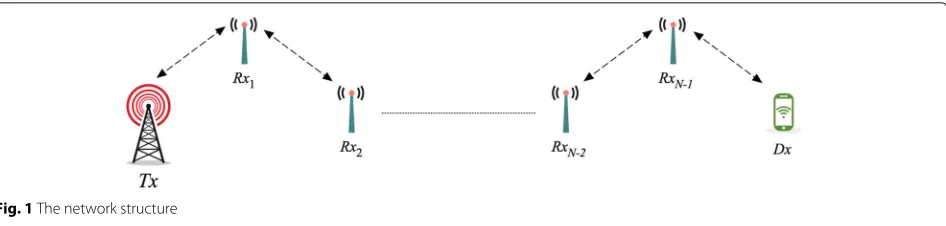
Figure1shows the considered N-hop AF relay network without diversity, i.e., the signal of each node is only received at the next node (next relay or the receiver) and does not reach any farther nodes. Nodes from the trans-mitter to the receiver are labeled with numbers 0 to N, respectively. It is assumed that the transmission power of thei-th node is denoted bypi, and the channel SINR between thei-th and(i+1)-th nodes is represented by si, 0≤ i ≤N−1. Thus, the received SINR at nodeNis given by the following equation [40]:
γeq=p0seq=
N−1
i=0
1+ 1
pisi
−1
−1
≈
N−1
i=0
1
pisi
−1
.
(1)
Fig. 1The network structure
transmission of each data block from the transmitter to the final receiver.
2.2 Link adaptation method
To analyze the system performance, continuous link adap-tation is used by which log2(1+ p0seq) bits/sec/Hz are transmitted where seq is the normalized SINR of the equivalent link andp0is the transmitter’s power.
In practical systems, discrete link adaptation is imple-mentable, where there are M + 1 transmission modes, each implemented by a modulation and a coding scheme that corresponds to a transmission rate Rm, 0 ≤ m ≤
M, which are sorted as 0 = R0 < R1 < R2· · · <
RM. The node throughput is μRm(bits/sec/Hz), where
μ = datalength
blocklength. AMC is utilized in third generation
part-nership project (3GPP) LTE with quadrature phase shift keying/quadrature amplitude modulation (QPSK/QAM) and Turbo coding [42], and BLER is approximated as:
pe(γeq, Rm)=exp
A1,mexp
−
γeq−
A2,m A3,m
2
,
(2)
where A1,m, A2,m, A3,m
are mode dependent constants which are derived and listed in Table1for the selected set of modes. For the BLER to be less thanB0, it is required
that
pe(p0seq,k)≤B0⇒p0≥
gB0(k)
seq
, (3)
Table 1Mode-dependent constants to estimate BLER in LTE standard using (2)
Spec. Mode
1 2 3 4
Modulation QPSK 16-QAM 64-QAM 256-QAM
Coding rate 1/3 1/3 1/3 1/3
Rn 0.67 1.33 2.0 2.67
A1,m −13.10 −13.08 −12.14 −11.49
A2,m 0.9359 1.694 3.221 6.948
A3,m 0.1573 0.3202 0.634 1.633
wherek∈ {R0,· · ·, RM}denotes the instantaneous
trans-mission rate andgB0(k)in LTE is computed as
gB0(k)=A2,m−A3,m
ln
A1,m ln(B0)
. (4)
3 Spectral efficiency optimization using AMC and continuous power adaption
This section aims to design a new transmission scheme for maximizing the average spectral efficiency between the transmitter and the receiver in anN-hop relay network. AMC is used at the transmitter and the powers of the transmitter and the relays are continuously adapted. We consider power-constrained users, and to prolong battery life time of energy-saving devices, average transmission power of thei-th node is limited toP¯i, 0 ≤ i ≤ N −1. It is also required that the instantaneous BLER is lim-ited to B0 at the receiver. The problem of this scheme
which is referred to continues adaptive power (CAP) is formulated as:
max
pi, 0≤i≤N−1μE{k} =
μ
2
kfs0,···,sN−1(s0,· · ·,sN−1)ds0· · ·dsN−1 (5)
subject to:
C(0),· · ·,C(N−1): Epi
≤ ¯Pi, 0≤i≤N−1
C(N): pe
γeq,k≤B0 ,
whereEpi
= 1 2
pifs0,···,sN−1(s0,· · ·,sN−1)ds0· · ·dsN−1 and fs0,···,sN−1(. . .) is the joint PDF of the random vari-ables s0,· · ·,sN−1. The problem above is a constrained
mixed integer optimization problem, whose solution is not straightforward. A similar problem with continuous link adaptation is solved in AppendixA,and following a similar approach, a solution for (5) is presented. In the following, at first, the powers of all nodes are set and the transmitter’s rate is assigned; next, the problem is reformulated and solved.
As computed in AppendixA, we assign the power of the
i-th node, 0≤i≤N−1, as:
pi=qip0; qi 1 αi
s0
si
, (6)
where α0 = q0 = 1 and αi, 1 ≤ i ≤ N − 1 is set
assigned powers, the SINR of the equivalent link between the transmitter and the receiver is derived as:
seq=
N−1
i=0
αi
√
sis0 −1
. (7)
To provide the BLER constraint with respect to (3) and to maximize the utilization of the network resource, the transmitter’s power is set asp0= gBs0eq(k).
To determine the transmission rate, the seq axis is divided into M + 1 non-overlapping adjacent intervals using the thresholds 0 = t0 < t1 < · · · < tM+1 = ∞.
Whenseq ∈[tm,tm+1), the transmission rate is set tok=
Rm, 1≤m≤M.
According to the assigned powers and rate, the aver-age transmission rate,E{k}, and the average transmission powers of the nodesEpi
, 0≤i≤N−1 are respectively computed as:
E{k} = 1
2
M
m=0
Rm tm+1
tm
fseq(seq)dseq, (8)
Epi
=1 2
M
m=0
gB0(Rm)
tm+1
tm
∞
0
qi
seq
fseq,qi(seq,qi)dseqdqi, 0≤i≤N−1,
where fseq,qi(., .) = fseq(.). According to the computed statistical averages, (5) is reformulated as:
max t1,···,tmμ
E{k}s.t. (9)
C(0),· · ·,C(N−1):Epi
≤ ¯Pi; 0≤i≤N−1, where constraint C(N) in (5) is now considered in the transmitter’s power assignment. To solve (9), the Lagrangian is set as [43]:
L=μE{k} −
N−1
i=0
λiEpi
− ¯Pi
. (10)
Based on Karush-Kuhn-Tucker (KKT) condition [44], As ∂∂2tL2
m < 0, the Lagrangian is a convex function of tm and the optimum values of the thresholds are obtained by solving the∇L=0 equation as:
∇L=0⇒tm=Λ
gB0(Rm)−gB0(Rm−1) Rm−Rm−1
, (11)
where Λ = λ0+Ni=−11λi ∞
0 fqi|seq(qi|tm)dqi
/μ. To finalize the solution, the Lagrangian multipliersλi, 0 ≤
i ≤N−1 are to be set. Obviously, all power constraints are active, and thus, the Lagrangian multiplies are to be set such that constraints C(0),· · ·,C(N − 1) in (9) are
satisfied with equality [43]. However, finding λis is not straightforward. Noting (6) andαi=
λi
λ0, there is a direct relation betweenαi andλi; thus,αi is set to satisfyC(i)
with equality, 1≤i≤N−1. Similarly,Λis set to provide
C(0)with equality.
To compute the average powers,fseq,qi(seq,qi), 0≤ i ≤
N−1 are needed, which are computed in AppendixB.
4 Throughput optimization by considering practical issues
In this section, practical constraints in the scheme designed in Section3are explained and proper solutions are presented to consider them. Finally, (5) is revised to design a modified scheme.
4.1 Practical constraints 4.1.1 Delay constraint
Delay constraint is to be provisioned for multimedia com-munication systems, while the use of link adaptation with variable transmit rate leads to possible increase of delay due to variable transmission rate and queuing. The delay constrained throughput of a link is formulated in terms of effective capacity in [9,45,46] as:
EC(θ0)= −
1 2θ0
log
E
e−θ0μk
, (12)
whereθ0is a parameter related to the delay constraint (the
biggerθ0, the stricter constraint). If the rate of data
gener-ation at the source is limited toEC(θ0), the queuing delay
is exponentially bounded as:
ProbDelay>T≤e−θ0T. (13)
For a given delay constraint, the effective capacity is to be maximized or equivalently Ee−θ0μk is to be mini-mized.
4.1.2 Low-rate feedback channel
Noting to (6), each relay needs to have s0 to adapt its
power which requires a high feedback rate, if real values are to be sent. In this section, we propose solutions to decrease the feedback load.
Noting (6), the formula for the relay’s transmit power can be revised as:
pi= αiαi−1
si−1
si
pi−1, 1≤i≤N−1. (14)
Constantsαi−1 andαi are set at the start of the
of information to the destination [47,48]. In time divi-sion duplex (TDD) transmisdivi-sion, thei-th relay can reliably estimatesi−1from the training information of(i−1)-th
relay and si can be acquired through eavesdropping of the training information in channel estimation phase of (i+1)-th relay.
Observing that a discrete set of power levels are assigned to each transmission mode, just index of the power level needs to be sent back to the transmitter. The power levels can be optimized to maximize the overall throughput.
With discrete power adaptation, Q power levels
Pm,1,· · ·,Pm,Q are used in modem, 1 ≤ m ≤ M. The range ofseq is divided into M+1 coarse intervals which are determined by the thresholds 0 = t0,1 < t1,1· · · <
tM,1 < tM+1,1 = ∞. Forseq ∈[tm,1,tm+1,1)the
transmis-sion rate isk = Rm. The interval [tm,1,tm+1,1)is divided
intoQfine consecutive intervals by the thresholdstm,1 <
tm,2· · · <tm,Q+1= tm+1,1. It is assumed that whenseq ∈ [tm,n,tm,n+1), 1≤n≤Q, the transmitter’s power is set as
p0= Pm,n. To satisfy the BLER constraint, the thresholds are set asPm,n = gBt0m(R,nm), 0≤m≤M, 1≤n≤Q. In this scheme,log2(M+1)+log2(Q)feedback bits are required
for discrete rate and power adaptation.
4.1.3 Unavailability of PDFs
To complete the solution in Section 3, Lagrange multi-pliers are found using PDFs. On the other hand, PDFs may not be available in some practical networks, espe-cially in mobile systems. Using sub-gradient projection methods [39], the optimization parameters can be found through an iterative process during transmission without any knowledge of the PDFs. More details are presented in the next subsection.
4.2 Problem reformulation
Given the rate and power assignment strategy developed in the previous section, the effective capacity of the equiv-alent link and the average powers are computed as:
EC(θ0)= −
Thus, the throughput optimization problem of this scheme which is referred to discrete adaptive power (DAP) is formulated as:
min
4.3 Solution to the modified problem
where= 12Ni=−01λi0∞qifseq,qi(tm,1,qi)dqi.
To complete the solution, the Lagrange multipliers are set to satisfy the constraints with equality. They may be computed analytically when the SINR PDFs are available; otherwise, they may be set using sub-gradient projection methods, in which the multipliers are updated using an iterative process as: instantaneous transmission rate, the instantaneous SINR of the equivalent link, and the instantaneous SINR of thei -th hop at -then-th transmission block, andnandαni show the values of the Lagrange multipliers at then-th block.
These multipliers are continuously updated until vergence, i.e., when the difference between the two con-secutive multipliers becomes negligible in (20).
The weighting factor, 0 < β(n) < 1 implements a for-getting factor in the averaging and can be selected to be either asymptotically vanishing or constant. A constant step-size gains robustness to channel non-stationarities, whileβ(n)→0 ensures convergence to the average, when the channel is stationary. To optimize between conver-gence and accuracy for channel non-stationarity, we select β(n) = 10−4. Indeed, β(n) can be vanished as 1n for accommodation to channel stationarity. As a result,β(n)
is selected as min10−4,1n[49].
Steps to compute the thresholds are summarized in the following algorithm.
Pseudo code: Thresholds computation using sub-gradient projection
5 Delay constrained throughput optimization using AMC and constant power
In this section, in order to show the effectiveness of the continuous power adaptation proposed in the previous sections, a baseline scheme is designed for throughput
optimized transmission inN-hop relay network with con-stant powers (CP), where just the index of the transmis-sion rate is sent back to the transmitter and there is no need to know the SINR PDFs. In this scheme, by consider-ing M+1 transmission modes, justlog2(M+1)feedback
bits are required for discrete rate adaptation. According to (3), to guarantee the BLER constraint whenδ = γeq−1 ∈ [ 1/gB0(Rm+1), 1/gB0(Rm)), the transmission rate is chosen ask=Rm. Thus, the effective capacity is computed as:
C(θ0)= − where fδ(.) may be computed using the characteris-tic function (CHF) of δ. When each link is subject to Nakagami-m fading, i.e.,fsi(x) =
approach to compute the spectral efficiency inN-hop AF relay network with AM and constant powers was followed in [27].
6 Results and discussions
This section is devoted to the numerical evaluation of the performance of the designed schemes. AMC modes are selected from the LTE standard where the BLER estimation parameters are derived by fitting the simula-tion curves of BLER versus SINR. The BLER estimasimula-tion parameters according to (2) are listed in Table1. The gen-eral form of the network structure is depicted in Fig.1. Several setups are considered to comprehensively evaluate the performance of the designed schemes.
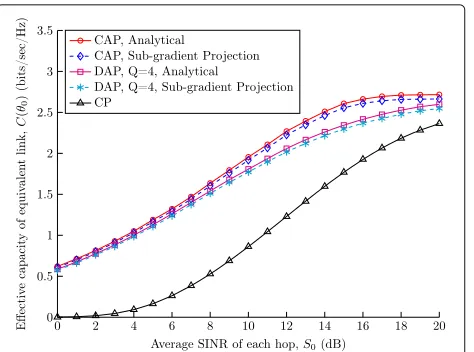
Fig. 2Effective capacity versus average SINR of each hop in different power adaptation schemes, when parameters are obtained analytically or by sub-gradient projection, Rayleigh fading channels
S0=E{si},P¯i=1 W/Hz, 0≤i≤2,B0=10−5,θ0=0.05
hops iss¯i =S0andP¯i=1 Watt/Hertz (W/Hz), 0≤i≤2. The quality-of-service (QoS) constraints are specified by θ0 = 0.05 andB0 = 10−5(BLER). The achievable
effec-tive capacity is depicted for a wide range of average SINRs. A study of these curves leads to the following noticeable observations:
• A considerable performance improvement is seen
when continuous or discrete power adaptation is used, compared to the case of constant power transmission.
• Optimization using the sub-gradient projection
method leads to a performance close to the analytical approach; however, the sub-gradient projection method requires considerably less mathematical computations in the design stage and does not need to know the SINR PDFs.
• With discrete power adaptation usingQ=4power
levels per mode, the performance is quite close to the performance of continuous power adaptation, while requiring justlog2(Q)=2feedback bits.
In Fig. 3, the effect of increasing the number of relays is investigated while the distance between the transmit-ter and the receiver is fixed to D0 andN− 1 relays are
uniformly placed in the signal’s path. A large-scale path loss model is assumed in which E{si} = ¯si = DK0
0
N ζ,
whereK0is a constant andζ = 3 is the path loss
expo-nent. It is assumed that the channels are Nakagami-m fading of order 2. The total sum of the average powers is fixed toPsum = 3 W/Hz, and the average power
con-straint for each node is Pi = PsumN , 0 ≤ i ≤ N − 1. The QoS constraints areθ0 = 0.1 andB0 = 10−5. The
Fig. 3Effective capacity versus number of relays, when path length is constant, path loss exponentζ=3, total average power
consumption is fixed to 3 W/Hz,B0=10−5,θ0=0.1 and Nakagami-m fading channels withmi=2, 0≤i≤N−1
achievable effective capacity is plotted versusN for dif-ferent transmission power schemes. From the results shown in this figure, the following observations can be made:
• As seen, the overall effective capacity is increased by increasing the number of hops.
• Comparison of the throughputs obtained by different
schemes shows that respectively 90% and 80% of the performance gap between the continuous power adaptation and constant power schemes is filled by using justQ=4(2 bits of feedback) andQ=2(1 bit) power levels per mode.
By this simulation, we are examining the effect of increasing hardware complexity while the total transmis-sion power is fixed. This numerical evaluation may be employed for a disaster scenario where the infrastructure is lost, and a user in the disaster zone (source) needs mul-tiple relays to get to the nearest active base station. By this simulation, the required number of relays is found and the tradeoff between the number of relays and the power supply of each relay is shown.
Fig. 4Effect of increasing the number of relays, when the length of line of sight path is fixed and total transmission power is fixed for different path loss exponents,Ni=−01P¯i=3 W/Hz,θ0=0.1
of relays decreases the performance. But whenζ >2, the performance improves by increasing the number of relays. Different behaviors are seen for the path loss exponents lower or more than 2. When ζ > 2, the throughput is increasing by increasing the number of relays, while it is decreasing forζ ≤ 2. To explain this effect, considering (1),γeq is the harmonic mean ofpisi
N−1
i=0 divided byN.
Noting to the bounds of harmonic mean, we have [51]: minpisi
N ≤γeq<
N−1
i=0 pisi
N2 (24)
As the considered network is homogeneous, E{pisi} N is a good estimate forEγeq. For the ease of computation, we here consider the constant power scheme, and by considering the path loss model, we have:
Eγeq≈ PsumK0 Dζ0 N
ζ−2 (25)
Obviously,Eγeqis increasing byNwhenζ >2 and it is decreasing whenζ ≤2 .
In Fig.5, the effect of the delay constraint is investigated in a 3-hop network with heterogeneous hops suffering from Nakagami-m fading. It is assumed thats¯0 = 2 dB,
m0 = 1, P¯0 = 1 W/Hz; s¯1 = 3 dB, m1 = 1, P¯1 =
1.5 W/Hz;s¯2=4 dB,m2=2,P¯2=1 W/Hz. The required
BLER isB0 = 10−5. The achievable effective capacity is
plotted versus different values ofθ0, showing the
trade-off in which a more stringent delay constraint (biggerθ0)
results in lower throughput. The QoS exponent,θ0, may
be interpreted as inverse of average and standard devia-tion of delay. Moreover, the QoS exponent varies between 0.25 and 0.6 in LTE standard [52].
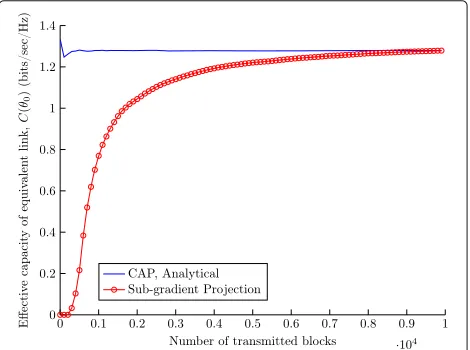
Finally, Fig.6depicts the convergence behavior of the proposed joint scheduling and link adaptation scheme
Fig. 5Effective capacity versus delay constraint,θ0in a heterogeneous 3-hop AF relay network;B0=10−5,s¯0=2 dB,m0=1,P¯0=1 W/Hz;
¯
s1=3 dB,m1=1,P¯1=1.5 W/Hz;s¯2=4 dB,m2=2,P¯2=1 W/Hz
which utilizes the sub-gradient projection method. A 3-hop network is assumed in whichs¯i = 10 dB,mi = 3,
¯
Pi = 1 W/Hz, 0 ≤ i ≤ 2;B0 = 10−5,θ0 = 0.01, and
β =min10−4,1
n
. As seen, a continuous power adaptive scheme using the sub-gradient projection method con-verges after transmitting an acceptable number of data blocks.
7 Conclusion
For an N-hop AF relay network, we have designed a new delay-constrained throughput optimized transmis-sion schemes. Discrete rate adaptation was utilized with adaptive modulation and coding. Discrete power adap-tation was utilized, in which a number of power levels
were assigned to each transmission mode such that the power levels and their number were adaptively set. A limited quantized feedback is required by discrete rate and power adaptation. A sub-gradient projection-based method was utilized, which does not need knowledge of the SINR PDFs to provide average power constraints. Numerical evaluations show a considerable performance gain obtained by the designed scheme, when compared to constant power transmission. An interesting exten-sion to the proposed scheme is to utilize hybrid ARQ (HARQ) and consider the modified version of the pre-sented scheme in [7]. Another fruitful research direction to extend the current work includes devising link adap-tation along with generalized frequency division multi-plexing (GFDM) and spectral efficient frequency division multiplexing (SEFDM) to reach the purposes of fifth gen-eration (5G) mobile communication networks.
8 Methods/experimental
The purpose of this study is to analyze the throughput of multi-hop AF relay network in delay constrained and quantized CSI scenario. The system consists of a transmit-ter node, receiver node, andN−1 AF relay nodes without diversity. The channels between the nodes are assumed to follow Nakagami-m fading. The throughput of the system in terms of effective capacity is optimized using the sub-gradient projection method without any need to know the PDFs of the random variables. Discrete rate and power adaptation are utilized. Discrete rate is utilized with adap-tive modulation and coding. Further, a limited number of power levels are assigned to each transmission mode and the power levels are adaptively set.
Endnote
1Mutual information-based adaptive coding and
mod-ulation algorithm is proposed for a TDMA/OFDMA link [53]. It outperforms the link adaptation framework used in LTE, in a few types of scenarios, e.g., sys-tem with few users having low average SINR and low velocities with channels presenting substantial frequency selectivity [54,55].
Appendix A. To Solve (5) with continuous rate adaptation
In order to obtain insight on how to solve (5), in this appendix, we consider the same problem with continuous rate adaptation as:
The above problem is a constrained optimization prob-lem, which can be solved via a Lagrangian approach using:
L=Esi; 0≤i≤N−1
0, the Lagrangian is a convex function ofpi, and consequently, the optimum value ofpiis computed by solving ∂∂Lp To complete the solution, the Lagrange multipliers (λi, 0≤i≤N−1)are to be determined. As can be seen in (28), if anyλiis set to zero, i.e., the corresponding power constraint C(i) is ignored, Epi
tends to infinity. This means thatC(i)is an active constraint, and thus,λiis to
is considered which may be decomposed as:
req =
In a similar way, in order to compute freq,qi(., .), req is
3GPP: Third generation partnership project; 5G: Fifth generation; AF: Amplify-and-forward; AM: Adaptive modulation; AMC: Adaptive modulation and coding; ARQ: Automatic repeat request; BLER: Block error rate; CAP: Continues adaptive power; CF: Compress-and-forward; CHF: Characteristic function; CP: Constant power; CSI: Channel state information; DAP: Discrete adaptive power; DF: Decode-and-forward; EPA: Extended pedestrian A; GFDM: Generalized frequency division multiplexing; HARQ: Hybrid ARQ; KKT: Karush-Kuhn-Tucker; LMS: Least mean square; LTE: Long-term evolution; OFDMA: Orthogonal frequency-division multiple access; PDF: Probability density function; QoS: Quality-of-service; QPSK/QAM: Quadrature phase shift keying/Quadrature amplitude modulation; SEFDM: Spectral efficient frequency division multiplexing; SINR: Signal to interference and noise ratio; TDD: Time division duplex
Funding
The authors declare that there is no funding for this work.
Availability of data and materials
Data sharing is not applicable to this article as no datasets were generated or analyzed during the current study.
Authors’ contributions
The individual contributions of each authors to the manuscript are the same. All authors read and approved the final manuscript.
Competing interests
The authors declare that they have no competing interests.
Publisher’s Note
Springer Nature remains neutral with regard to jurisdictional claims in published maps and institutional affiliations.
Author details
1Department of Electrical Engineering, University of Qom, Qom, Iran. 2Department of Signals and Systems, Chalmers University of technology,
Gothenburg, Sweden.3Institute for Research in Fundamental Sciences,Tehran, Iran.
Received: 3 October 2018 Accepted: 3 April 2019
References
1. J. N. Laneman, D. N. C. Tse, G. W. Wornell, Cooperative diversity in wireless networks: efficient protocols and outage behavior. IEEE Trans. Inf. Theory. 50(12), 3062–3080 (2004).https://doi.org/10.1109/TIT.2004.838089
2. S. T. Chung, A. J. Goldsmith, Degrees of freedom in adaptive modulation: a unified view. IEEE Trans. Commun.49(9), 1561–1571 (2001).https://doi. org/10.1109/26.950343
3. K. J. Hole, H. Holm, G. E. Oien, Adaptive multidimensional coded modulation over flat fading channels. IEEE J. Sel. Areas Commun.18(7), 1153–1158 (2000).https://doi.org/10.1109/49.857915
4. M. Bilal, M. Abbas, inEvolved Cellular Network Planning and Optimization for UMTS and LTE. Physical uplink shared channel (PUSCH) closed loop power control for 3G LTE (Auerbach Publications, CRC Press, Boca Raton, 2010), pp. 455–486.https://doi.org/10.1201/9781439806500
5. K. N. Lau, inIEEE Wireless Communications and Networking (WCNC), vol. 2. Optimal partial feedback design for SISO block fading channels, (New Orleans, 2003), pp. 936–940.https://doi.org/10.1109/WCNC.2003.1200497
6. A. Gjendemsjø, G. E. Oien, H. Holm, M.-S. Alouini, D. Gesbert, K. J. Hole, P. Orten, Rate and power allocation for discrete-rate link adaptation. EURASIP J. Wirel. Commun. Netw.2008, 16–11611 (2008).https://doi.org/ 10.1155/2008/394124
7. B. Makki, T. Eriksson, On hybrid ARQ and quantized CSI feedback schemes in quasi-static fading channels. IEEE Trans. Commun.60(4), 986–997 (2012).https://doi.org/10.1109/TCOMM.2012.022912.110324
8. B. Makki, T. Eriksson, Feedback subsampling in temporally-correlated slowly-fading channels using quantized CSI. IEEE Trans. Commun.61(6), 2282–2294 (2013).https://doi.org/10.1109/TCOMM.2013.042313.120167
9. D. Wu, R. Negi, Effective capacity: a wireless link model for support of quality of service. IEEE Trans. Wirel. Commun.2(4), 630–643 (2003).
https://doi.org/10.1109/TWC.2003.814353
10. J. Tang, X. Zhang, Quality-of-service driven power and rate adaptation over wireless links. IEEE Trans. Wirel. Commun.6(8), 3058–3068 (2007).
https://doi.org/10.1109/TWC.2007.051075
11. J. S. Harsini, F. Lahouti, Adaptive transmission policy design for delay-sensitive and bursty packet traffic over wireless fading channels. IEEE Trans. Wirel. Commun.8(2), 776–786 (2009).https://doi.org/10.1109/ TWC.2009.071004
12. J. Tang, X. Zhang, Cross-layer-model based adaptive resource allocation for statistical QoS guarantees in mobile wireless networks. IEEE Trans. Wirel. Commun.7(6), 2318–2328 (2008).https://doi.org/10.1109/TWC. 2008.060293
13. J. Xu, X. Shen, J. W. Mark, J. Cai, Adaptive transmission of multi-layered video over wireless fading channels. IEEE Trans. Wirel. Commun.6(6), 2305–2314 (2007).https://doi.org/10.1109/TWC.2007.05838
14. M. O. Hasna, M. S. Alouini, Optimal power allocation for relayed transmissions over Rayleigh-fading channels. IEEE Trans. Wirel. Commun. 3(6), 1999–2004 (2004).https://doi.org/10.1109/TWC.2004.833447
15. Y. Zhao, R. Adve, T. J. Lim, Improving amplify-and-forward relay networks: optimal power allocation versus selection. IEEE Trans. Wirel. Commun. 6(8), 3114–3123 (2007).https://doi.org/10.1109/TWC.2007.06026
16. K. G. Seddik, A. K. Sadek, W. Su, K. J. R. Liu, Outage analysis and optimal power allocation for multinode relay networks. IEEE Signal Process. Lett. 14(6), 377–380 (2007).https://doi.org/10.1109/LSP.2006.888424
17. Z. Jingmei, Z. Qi, S. Chunju, W. Ying, Z. Ping, Z. Zhang, inIEEE 59th Vehicular Technology Conference (VTC), vol. 2. Adaptive optimal transmit power allocation for two-hop non-regenerative wireless relaying system, (Milan, 2004), pp. 1213–1217.https://doi.org/10.1109/VETECS.2004.1389025
18. R. Vaze, R. W. Heath, inIEEE Information Theory Workshop on Networking and Information Theory. Optimal amplify and forward strategy for two-way relay channel with multiple relays, (Volos, 2009), pp. 181–185.
https://doi.org/10.1109/ITWNIT.2009.5158567
19. N. C. Beaulieu, G. Farhadi, Y. Chen, A precise approximation for performance evaluation of amplify-and-forward multihop relaying systems. IEEE Trans. Wirel. Commun.10(12), 3985–3989 (2011).https:// doi.org/10.1109/TWC.2011.101811.101133
20. G. Farhadi, N. C. Beaulieu, Power-optimized amplify-and-forward multi-hop relaying systems. IEEE Trans. Wirel. Commun.8(9), 4634–4643 (2009).https://doi.org/10.1109/TWC.2009.080987
21. G. Farhadi, N. C. Beaulieu, Capacity of amplify-and-forward multi-hop relaying systems under adaptive transmission. IEEE Trans. Commun.58(3), 758–763 (2010).https://doi.org/10.1109/TCOMM.2010.03.080118
channels, (Maui, 2011), pp. 1–6.https://doi.org/10.1109/ICCCN.2011. 6006093
23. A. K. Sadek, W. Su, K. J. R. Liu, Multinode cooperative communications in wireless networks. IEEE Trans. Signal Process.55(1), 341–355 (2007).
https://doi.org/10.1109/TSP.2006.885773
24. C. Qian, Y. Ma, R. Tafazolli, in7th International Wireless Communications and Mobile Computing Conference. Adaptive modulation for cooperative communications with noisy feedback, (Istanbul, 2011), pp. 173–177.
https://doi.org/10.1109/IWCMC.2011.5982413
25. A. Annamalai, B. Modi, R. Palat, inIEEE Consumer Communications and Networking Conference (CCNC). Analysis of amplify-and-forward cooperative relaying with adaptive modulation in Nakagami-m fading channels, (Las Vegas, 2011), pp. 1116–1117.https://doi.org/10.1109/ CCNC.2011.5766344
26. T. Nechiporenko, K. T. Phan, C. Tellambura, H. H. Nguyen, inIEEE International Conference on Communications. Performance analysis of adaptive M-QAM for Rayleigh fading cooperative systems, (Beijing, 2008), pp. 3393–3399.https://doi.org/10.1109/ICC.2008.638
27. N. C. Beaulieu, G. Farhadi, Y. Chen, inIEEE Global Telecommunications Conference (GLOBECOM). Amplify-and-forward multihop relaying with adaptive M-QAM in Nakagami-m fading, (Kathmandu, 2011), pp. 1–6.
https://doi.org/10.1109/GLOCOM.2011.6134065
28. B. Modi, O. Olabiyi, A. Annamalai, D. Vaman, inIEEE Global
Telecommunications Conference (GLOBECOM). Improving the spectral efficiency of adaptive modulation in amplify-and-forward cooperative relay networks with an adaptive ARQ protocol, (Kathmandu, 2011), pp. 1–5.https://doi.org/10.1109/GLOCOM.2011.6134546
29. A. Annamalai, B. Modi, O. Olabiyi, inMilitary Communications Conference (MILCOM). Joint-design of adaptive modulation and coding with adaptive ARQ for cooperative relay networks, (Baltimore, 2011), pp. 67–72.https:// doi.org/10.1109/MILCOM.2011.6127754
30. M. Taki, Spectral efficiency optimisation in amplify and forward relay network with diversity using adaptive rate and adaptive power transmission. IET Commun.7, 1656–16648 (2013).https://doi.org/10. 1049/iet-com.2012.0580
31. M. Taki, M. Sadeghi, Joint relay selection and adaption of modulation, coding and transmit power for spectral efficiency optimisation in amplify-forward relay network. IET Commun.8, 1955–19649 (2014).
https://doi.org/10.1049/iet-com.2013.0948
32. M. Salem, A. Adinoyi, M. Rahman, H. Yanikomeroglu, D. Falconer, Y. D. Kim, E. Kim, Y. C. Cheong, An overview of radio resource management in relay-enhanced OFDMA-based networks. IEEE Commun. Surv. Tutorials. 12(3), 422–438 (2010).https://doi.org/10.1109/SURV.2010.032210.00071
33. X.-X. Nguyen, D.-T. Do, Optimal power allocation and throughput performance of full-duplex DF relaying networks with wireless power transfer-aware channel. EURASIP J. Wirel. Commun. Netw.2017(1), 152 (2017).https://doi.org/10.1186/s13638-017-0936-x
34. R. Katla, A. V. Babu, Outage probability analysis and optimal transmit power allocation for multi-hop full duplex relay network over
Nakagami-m fading channels. EURASIP J. Wirel. Commun. Netw.2018(1), 192 (2018).https://doi.org/10.1186/s13638-018-1207-1
35. N. Yi, Y. Ma, R. Tafazolli, Joint rate adaptation and best-relay selection using limited feedback. IEEE Trans. Wirel. Commun.12(6), 2797–2805 (2013).https://doi.org/10.1109/TWC.2013.050313.120884
36. Y. Ma, R. Tafazolli, Y. Zhang, C. Qian, Adaptive modulation for opportunistic decode-and-forward relaying. IEEE Trans. Wirel. Commun.10(7), 2017–2022 (2011).https://doi.org/10.1109/TWC.2011.051311.091773
37. K. S. Hwang, M. J. Hossain, Y. C. Ko, M. S. Alouini, inIEEE 20th International Symposium on Personal, Indoor and Mobile Radio Communications. Channel allocation and rate adaptation for relayed transmission over correlated fading channels, (Tokyo, 2009), pp. 1477–1481.https://doi.org/ 10.1109/PIMRC.2009.5450001
38. L. Han, B. Shi, W. Zou, Performance analysis and power control for full-duplex relaying with large-scale antenna array at the destination. EURASIP J. Wirel. Commun. Netw.2017(1), 41 (2017).https://doi.org/10. 1186/s13638-017-0828-0
39. D. P. Bertsekas,Nonlinear Programming, 3rd edn. (Athena Scientific, Nashua, 2016)
40. M. O. Hasna, M. S. Alouini, Outage probability of multihop transmission over Nakagami fading channels. IEEE Commun. Lett.7(5), 216–218 (2003).
https://doi.org/10.1109/LCOMM.2003.812178
41. 3GPP TS 36.104, LTE; evolved universal terrestrial radio access (E-UTRA); base station (BS) radio transmission and reception. release 8, version 8.2.0 (2008)
42. 3GPP TS 36.212, LTE; evolved universal terrestrial radio access (E-UTRA); multiplexing and channel coding. release 12, version 12.4.0 (2015) 43. J. Nocedal, S. J. Wright,Numerical Optimization, 2nd edn. (Springer, New
York, 2006)
44. D. G. Luenberger, Y. Ye,Linear and Nonlinear Programming, 3rd edn. (Springer, US, 2008)
45. D. Wu, R. Negi, Effective capacity-based quality of service measures for wireless networks. Mob. Networks Appl.11(1), 91–99 (2006).https://doi. org/10.1007/s11036-005-4463-3
46. J. Jiang, J. Li, R. Hou, X. Liu, Network selection policy based on effective capacity in heterogeneous wireless communication systems. Sci. China Inf. Sci.57(2), 1–7 (2014).https://doi.org/10.1007/s11432-013-4899-1
47. F. Gao, T. Cui, A. Nallanathan, On channel estimation and optimal training design for amplify and forward relay networks. IEEE Trans. Wirel. Commun. 7(5), 1907–1916 (2008).https://doi.org/10.1109/TWC.2008.070118
48. Y. Chen, W. Feng, R. Shi, N. Ge, Pilot-based channel estimation for AF relaying using energy harvesting. IEEE Trans. Veh. Technol.66(8), 6877–6886 (2017).https://doi.org/10.1109/TVT.2017.2654364
49. V. Solo, X. Kong,Adaptive Signal Processing Algorithms: Stability and Performance. (Prentice-Hall, Inc., Upper Saddle River, 1995)
50. T. S. Rappaport,Wireless Communications: Principles And Practice, 2nd edn. (Pearson Education, London, 2010)
51. D.-F. Xia, S.-L. Xu, F. Qi, A proof of the arithmetic mean-geometric mean-harmonic mean inequalities. Technical Report.2(1) (1999). RGMIA Research Report Collection
52. Y. Chen, L. Dong, I. Darwazeh, in9th International Symposium on Communication Systems, Networks Digital Sign (CSNDSP). Effective capacity-based delay performance estimators for LTE radio bearer QoS provision, (Manchester, 2014), pp. 105–110.https://doi.org/10.1109/ CSNDSP.2014.6923807
53. S. Stiglmayr, M. Bossert, E. Costa, inEuropean Wireless. Adaptive coding and modulation in OFDM systems using BICM and rate-compatible punctured codes, (Paris, 2007)
54. Y. Sui, D. Aronsson, T. Svensson, inFuture Network and Mobile Summit. Evaluation of link adaptation methods in multi-user OFDM systems with imperfect channel state information, (Warsaw, 2011)