ISSN 2286-4822 www.euacademic.org
Impact Factor: 3.4546 (UIF) DRJI Value: 5.9 (B+)
Predicting & Explaining Intention to Adopt Green
Concepts among Housing Developers
JASMINE LAU1 Department of Resources Management and Consumer Studies
Faculty of Human Ecology Universiti Putra Malaysia, Serdang, Selangor, Malaysia
AHMAD HARIZA HASHIM Department of Resources Management and Consumer Studies Faculty of Human Ecology Universiti Putra Malaysia, Serdang, Selangor, Malaysia ASNARULKHADI ABU SAMAH Department of Social and Development Sciences Faculty of Human Ecology Universiti Putra Malaysia, Serdang, Selangor, Malaysia
Abstract:
This study aimed to determine the factors that predict the behavioral intentions to adopt green concepts among housing developers using the TPB model. This study adopted quantitative approach with a complementary qualitative data collection procedure. A total of 87 cases were collected from questionnaire survey. Correlation analysis showed that intention to adopt green concept was correlated most strongly with PBC (r = .713, p < .01) and subjective norm (r = .606, p < .01) and less strongly with attitude (r = .584, p < .01). Regression model was statistically significant, F(3, 83) = 57.11, p < .001, and accounted for approximately 67% of the variance of intention to adopt green concepts (R2 = .67). PBC was found to be the best predictor (β = .45, p < .001), followed by subjective norm (β = .34, p < .001) and attitudes (β = .25, p < .01). Conclusion and limitation of this study were also discussed.
Key words: TPB, Green building, Housing, Environmental concern, Sustainability
1. Introduction
implementation. In order to increase the uptake of sustainable construction, identification of the variables most likely to predict intention to adopt green concepts is needed. In specific, this study attempted to determine the predictability of TPB constructs on the intention to adopt green concepts.
According to TPB (Ajzen, 1985, 1991), intention is the immediate antecedent of behaviour. As people formulate their intentions, they tend to take into account three factors namely attiude toward the behaviour, subjective norms and perceived behavoural control (PBC). Attitude refers to the overall favourable or unfavourable appraisal of the expected outcomes of performing the behaviour. Subjective norm represents to the extent of perceived social pressure to perform the behaviour. PBC is defined as the perceived ease or difficulty of performing the behaviour. Behavioural intention refers to an individual‟s motivation and readiness to perform a behaviour. TPB postulates that more favourable attitude and subjective norm as well as the greater the PBC, the stronger an individual‟s intention to perform the behaviour under consideration. The TPB model has widely been used in predicting pro-environmental behaviour (Bamberg, 2003; Chen & Tung, 2014; De Groot & Steg, 2008; Gardner & Abraham, 2010) and received strong empirical support in explaining intention and actual behaviour. Several meta-analyses between years 2003 to 2011 indicated that the TPB explained approximately 40-52% and 19-36% of the variance in intention and behaviour respectively.
2. Methods
quantitative approach. Specifically, this study consists of two phases, beginning with collection and analysis of quantitative data. This is then followed by collection and analysis of qualitative data, which aims to refine and explain those statistical results by exploring participants‟ views in more depth (Tashakkori & Teddlie, 1998). Finally, the quantitative and qualitative portions of this study were integrated during the data interpretation phase.
For quantitative phase, the cross-sectional survey design was used where data was collected via self-administered questionnaires. Samples were drawn from members of Real Estate and Housing Developers‟ Association Malaysia (REDHA) in Klang Valley, Malaysia. The unit of analysis was project managers who worked at the 355 developer organisations. A total of 87 cases were collected, yielding a response rate of 24.5 percent. Low response rate is a norm for questionnaire survey conducted among construction professionals in Malaysia with 5-15 percent deemed as the typical range (Idrus, Hashim & Farah, 2008). Participants ranged in age from 24 to 67 years with most of them in the age bracket of 31-40 (39.1 percent) and 53.5 percent had a Bachelor degree qualification. In terms of tenure status, approximately 41 percent of the participates were attached to their resent organisation between 2 to 5 years and about 53 percent were in current position between 2 to 5 years.
norm was assessed by means of seven items with responses ranging from 1 to 7. Example of items are „Most people who are important ot my organisation think that my organisation should adopt green concepts in future housing projects‟ (1 – strongly disagree, 7 – strongly agree) and „Most organisations like us are going to adopt green concepts in future housing projects‟ (1 – extremely likely, 7 – extremely unlikely). The Cronbach‟s alpha for this construct was 0.76. Perceived behavioural control (PBC) was measured using means of seven items with responses ranging from 1 to 7. Example of items include „My organisation is confident that it could adopt green concepts in future housing projects if it wanted to‟ (1 – strongly disagree, 7 – strongly agree) and „My organisation believes that it has the ability to adopt green concepts in future housing projects‟ (1 – strongly disagree, 7 – strongly agree). This measure had an internal consistency of α = 0.74. Finally, intention to adopt green concepts was captured using four items with internal consistency of α = 0.97. Example of item is „In my opinion, my organisation plans to adopt green concepts in future housing projects‟ (1 – strongly disagree, 7 – strongly agree).
surrounds the research questions as well as the outcome of quantitative analyses. All interviews were conducted under face-to-face conditions and each session generally ranged from thirty to forty minutes.
3. Results
3.1 Survey Findings
Table 1 Correlations Among Variables
1 2 3 4 Mean SD
1. SN - 4.41 .64
2. PBC .412** - 4.91 .87
3. Attitude .321** .494** - 5.27 .95
4. Intention .606** .713** .584** - 5.03 1.23
Notes: SN = Subjective Norm; PBC = Perceived Behavioural Control; SD = Standard Deviation
** p < .01 (2-tailed)
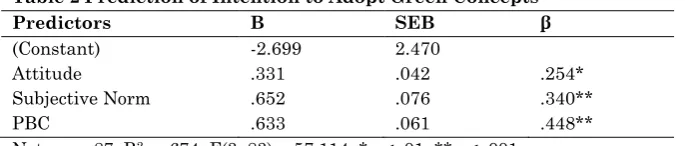
Table 2 Prediction of Intention to Adopt Green Concepts
Predictors B SEB β
(Constant) -2.699 2.470
Attitude .331 .042 .254*
Subjective Norm .652 .076 .340**
PBC .633 .061 .448**
Note: n = 87. R2 = .674; F(3, 83) = 57.114, *p < .01, **p < .001.
Bamberg & Moses (2007) in their meta-analyses and 60 percent limit predicted by Fishbein & Ajzen (2010). Based on the guideline suggested by Nuijs (2004), the regression model strongly fits the data and all three variables contributed significantly to the explanation of intention to adopt green concepts. The beta values suggested that PBC was the best predictor (β = .448, p < .001), followed by subjective norm (β = .340, p < .001) and attitudes (β = .254, p < .01). In other words, higher level of PBC, higher level of subjective norm and more positive attitude toward green concepts tend to increase organisations‟ intention to adopt green concepts in future housing projects. The model can be defined as the equation below:
Intention to adopt green concepts = -2.699 + .331(Attitude) +.652(SN) + .633(PBC)
3.2 Interviews
“Education…..It‟s up to them to maintain it...If they tear down certain things and you know, modify the house that it‟s no longer green then it‟s their--it‟s up to them. It‟s awareness la, you know.” (R3)
“It doesn‟t make sense in the sense that we can only do certain things. For example, I can use paint which give out less toxic, no problem. I can install an energy saving light, no problem. I can also do a solar, a hot water at the top, no problem. But to do recycling of water, there is a certain limit I can do…..You are strata title, so the water tank can be situated at the common property. Just like I need to maintain lift, so for me to maintain the water tank ok.” (R5)
Subjective norms, the second predictor to intentions are the perceived social pressure to perform or not to perform a given behaviour (Fishbein & Ajzen, 2010). Based on the in-depth interviews, three normative referents important to decisions to adopt green concepts had been identified namely the authority (government), competitors and top management. All informants indicated that they did not sense the pressure and urgency of adopting sustainable concepts in their projects. Developers had a relatively conservative attitude when asked regarding the implementation of green in their projects where it was mainly for fulfilling mandatory statutory requirements. Merely a few were willing to go beyond the minimum requirement set. As in the case of rainwater harvesting system, even though it was being made mandatory in all new developments municipal councils were enforcing the rule at a different pace. Thus, informants explained that the pressure was more from complying with the different green regulations from various municipal councils. This is illustrated by the following verbatim responses:
“Not yet, not yet [pressure from government]. If you are in DBKL or you are in PJ, I think you will feel it because they use that [green regulations] to negotiate for higher density or provincial development.” (R2)
“...certain local council has started, say, for new town planning you must follow the green guideline. Otherwise, you won‟t get approval. So, we have no choice. We like it or not we have to follow.” (R5)
In the similar vein, inclination to move towards sustainability was muted by a lack of competitive pressure. According to the informants, they believed that there are very few companies that have started to include some of the sustainability principles in their projects. The uptake of sustainable concept is business driven for top-tier large developers while for small and medium counterparts who are not striving for it, the market remains profitable. For them, including sustainable concept in their projects does not help in differentiating themselves from other competitors. The relevant responses are as follows:
“Yes. Big player need to do this [green concept]...Our mid-range one...Not yet. We don‟t feel the pressure yet.” (R4)
“Say if I‟m MS [big player] and my competitors are doing it. You are MS, you want to be also in their league...For us, no need [green concept to stand out among competitors].” (R5)
Perceived behavioural control (PBC) is the perception regarding the presence or absence of factors that facilitate or impede performance of the behaviour (Ajzen, 2005). Among the three predictors, informants shared a stronger sentiment regarding PBC, which explained its strongest impact on intention in the regression analysis. Incentives and rebates are seen as powerful tools that could be used by the government to motivate developers to take up sustainable projects. Informants agreed that these financial instruments would encourage the practice of sustainability in the housing industry. Current tax incentives are targeted at the owners of green properties and those who construct and own green buildings. Developers who develop but did not own the building were totally left out. Most informants claimed that they were unaware of available incentives or rebates and were looking forward for more attractive measures from the government. Their views are reflected by the following excerpts:
“We don‟t see it [incentive]. Those are for property owners. For developers, we don‟t see it.” (R2)
“No, they have incentive but give it to the tax--save stamp duty. Stamp duty is not me. Developer, I don‟t save anything what. It‟s the purchaser. I don‟t get any tax break....If I‟m the user, I‟ll save money.” (R5)
green may affect their profit margin and prolong the investment payback period. Some of the informants believed that sustainable housing development is more economically viable for high end projects rather than for the medium and low cost ones.
“Let‟s say for the rain water harvesting, there is not much contractor doing that. That‟s why they are controlling the price. We didn‟t get the best price, for us...For one unit, actually let‟s say the price is 100k. Then we need to add another RM6k to RM8k for the rain water harvesting per unit...At least 5 to 6% cost”. (R1)
“If anyone is against it [green concept], it‟s budget. Because the economy is not doing great. Price is very sensitive. We can‟t go very large and spend on all the expensive windows...Affordable housing very hard to implement this because I think our Rakyat is still struggling with cost of living and then you want them to pay for low e-glass that will cost three times more than normal glass”. (R2)
“More expensive...5 to 10%...It depends on the product. So, if I do a link house it costs me 5%. Maybe not worthwhile. I think it‟s more towards high end product.” (R5)
categories of consumers were rather sensitive to the price of properties and this led to low enthusiasm among developers to invest in green technologies.
“It‟s depend on the market. Whether the—our, our—depend on demand, the people...I don‟t think so [the market demand is there].” (R1)
“Yeah. If the customers are willing to pay for it [green housing]. So, if we are doing high-end, we definitely doing it already. In this case, price is quite sensitive. So, we don‟t have that kind of luxury.” (R2)
“They [buyers] don‟t care. It is not an important factor. So, in the double storey link house, four-storey apartment, green or not green is not important to the customer. So, as a developer why should I do green?...So, if I say that double storey link house is RM 400,000. Now, it‟s green it‟s going to cost you 5% more. You‟ll say, forget it man.” (R5)
4. Conclusion
concepts are rarely being incorporated into public project. Apart from this, incentives and rebates were also lacking and developers felt unmotivated to take up sustainable projects.
There were several limitations to this study. The sample for this study was restricted to housing developers in Klang Valley, thus the theoretical measures may be limited to that population. Some cautions are warranted when generalising the results of this study to developers in other states due to differences in statutory requirements and organisational culture. In addition, this study examined developers‟ intention to adopt green concepts instead of their actual behaviour. Reason being, actual behaviour is not always equivalent to intention even though previous studies (e.g. Armitage & Conner, 2001; Boldero, 1995; Taylor & Todd, 1997) indicated that the behavioural intention models are robust in predicting behaviour.
REFERENCES
[1] Abidin, N. Z. “Investigating the awareness and application of sustainable construction concept by Malaysian developers.” Habitat International 34 (2010): 421-426. [2] Ajzen, I. From intentions to actions: A theory of planned
behavior. In J. Kuhl & J. Beckmann (Eds.), Action control: From cognition to behavior (pp. 11-39). Heidelberg: Springer, 1985.
[3] Ajzen, I. “The theory of planned behavior.” Organizational Behavior and Human Decision Processes 50 (1991): 179-211.
[4] Ajzen, I. Attitudes, personality and behaviour (2nd ed.). England: Open University Press, 2005.
[5] Ajzen, I. Constructing a TPB questionnaire: Conceptual and methodological considerations Retrieved 19 May,
http://www.unibielefeld.de/ikg/zick/ajzen%20construction% 20a%20tpb%20questionnaire.pdf
[6] Armitage, C. J., & Conner, M. “Efficacy of the Theory of Planned Behaviour: A meta-analytic review.” British Journal of Social Psychology 40 (2001): 471-499.
[7] Bamberg, S. “How does environmental concern influence specific environmentally related behaviors? A new answer to an old question.” Journal of Environmental Psychology 23 (2003): 21-32.
[8] Bamberg, S., & Moser, G. “Twenty years after Hines, Hungerford, and Tomera: A new meta-analysis of psycho-social determinants of pro-environmental behaviour.” Journal of Environmental Psychology. 27 (2007): 14-25. [9] Boldero, J. “The prediction of household recycling of
newspapers: The role of attitudes, intentions, and situational factors.” Journal of Applied Social Psychology 25 (1995): 440-462.
[10] Chen, M.-F., & Tung, P.-J. “Developing an extended Theory of Planned Behavior model to predict consumers' intention to visit green hotels.” International Journal of Hospitality Management 36 (2004): 221-230.
[11] CIDB, M. Strategic Recommendations for Improving Environmental Practices in Construction Industry. Kuala Lumpur: CIDB Publisher, 2007.
[12] De Groot, J., & Steg, L. “General beliefs and the Theory of Planned Behavior: The role of environmental concerns in the TPB.” Journal of Applied Social Psychology 37 (2007): 1817-1836.
[13] Fishbein, M., & Ajzen, I. Predicting and changing behavior: The reasoned action approach. New York: Psychology Press, 2010.
A manual for health services researches. Retrieved from
http://core.kmi.open.ac.uk/download/pdf/9559500.pdf
[15] Gardner, B., & Abraham, C. “Going Green? Modeling the Impact of Environmental Concerns and Perceptions of Transportation Alternatives on Decisions to Drive.” Journal of Applied Social Psychology 40 (2010): 831-849. [16] Hesse-Biber, S. N., & Leavy, P. The Practice of Qualitative
Research (2nd ed.). USA: Sage Publications, 2011.
[17] Idrus, A., Hashim, K., & Farah, M. “Towards Development of a Database for Civil and Structural Construction Works Production Rates.” Proceedings International Conference on Construction and Building Technology, KL. 16-20 June 2008.
[18] Muijs, D. Doing Quantitative Research in Education with SPSS. London: Sage Publications, 2004.
[19] Tashakkori, A., & Teddlie, C. B. Mixed methodology: Combining qualitative and quantitative approaches. Thousand Oaks, CA: Sage, 1998.
[20] Taylor, S., & Todd, P. “Understanding the determinants of consumer compositing behavior.” Journal of Applied Social Psychology 27 (1997): 602-628.
[21] Wahida, F. Rehda chairman urges developers to adopt green initiatives. Retrieved 4 August, 2014, from