ABSTRACT
HYUN, SANGWON. Secure and Reliable Code Dissemination for Wireless Sensor Networks. (Under the direction of Dr. Peng Ning.)
Wireless sensor networks are considered ideal candidates for a wide range of applications, such as industry monitoring, data acquisition in hazardous environments, and military oper-ations. It is desirable and sometimes necessary to reprogram sensor nodes through wireless links after they are deployed, due to, for example, the need of removing bugs and adding new functionalities. The process of propagating a new code image to the nodes in a wireless sensor network is commonly referred to as code dissemination. Code dissemination requires reliable delivery of code images through lossy wireless channels, typical in wireless sensor networks. In addition, code dissemination must be protected from various malicious attacks to ensure both integrityand availabilityof the remote programming service. This thesis includes three studies for efficient, secure, and reliable code dissemination in wireless sensor networks.
First, we present the design, development, and evaluation of a secure and DoS-resistant code dissemination system named Selugefor wireless sensor networks. Seluge is a secure extension to Deluge, a de facto code dissemination system for wireless sensor networks. It provides security protections for code dissemination, including the integrity protection of code images and resistance to various DoS attacks that exploit code dissemination protocols. Seluge is superior to all previous attempts for secure code dissemination, and is the only solution that seamlessly integrates the security mechanisms and the Deluge efficient propagation strategies. Besides the theoretical analysis that demonstrates the security and performance of Seluge, we also reports the experimental evaluation of Seluge in a network of MicaZ motes, which shows the efficiency of Seluge in practice.
©Copyright 2011 by Sangwon Hyun
Secure and Reliable Code Dissemination for Wireless Sensor Networks
by Sangwon Hyun
A dissertation submitted to the Graduate Faculty of North Carolina State University
in partial fulfillment of the requirements for the Degree of
Doctor of Philosophy
Computer Science
Raleigh, North Carolina 2011
APPROVED BY:
Dr. Huaiyu Dai Dr. Douglas S. Reeves
Dr. Ting Yu Dr. Peng Ning
DEDICATION
I would like to gratefully dedicate this Doctoral Dissertation to my loving wife Dr. Jungsoon Choi, who always gave me heartful encouragement and devoted support by my side during the entire PhD study. Without the invaluable encouragement and support of my wife, it would be
impossible to finish this work. I am also grateful to my grandmother Samhee Lee and my parent Dr. Jongmyung Hyun and Younghee Kim for always supporting me in any mean.
BIOGRAPHY
ACKNOWLEDGEMENTS
First, I am grateful for my advisor Dr. Peng Ning, who has provided me with invaluable guidance and suggestions of my research. I would like to thank him for his generous support and encouragement during my Ph.D. study. I would like to thank my committee members, alphabetically, Dr. Huaiyu Dai, Dr. Douglas S. Reeves, and Dr. Ting Yu for their valuable feedback and comments on my dissertation.
I would like to thank my officemates for their supports during my Ph.D. study: Ahmed Moneeb Azab, Jason Gionta, Dr. Chongkyung Kil, Dr. Mihui Kim, Dr. An Liu, Yao Liu, Arun Natarajan, Young-Hyun Oh, Dr. Younghee Park, Barry Peddycord III, Wenbo Shen, Dr. Kyuyong Shin, Jungki So, Dr. Kun Sun, Ruowen Wang, Dr. Attila Altay Yavuz, Xianqing Yu, and Wu Zhou.
TABLE OF CONTENTS
List of Tables . . . vii
List of Figures . . . .viii
Chapter 1 Introduction . . . 1
1.1 Motivation . . . 1
1.1.1 Integrity Protection of Code Images and Resistance to DoS Attacks Ex-ploiting Dissemination Protocols . . . 2
1.1.2 Jamming-Resistant Code Dissemination . . . 4
1.1.3 Loss-Tolerant and Secure Code Dissemination using Erasure Codes . . . . 5
1.2 Summary of Contributions . . . 6
1.3 Organization of Thesis . . . 6
Chapter 2 Background. . . 8
2.1 Code Dissemination Protocols for Wireless Sensor Networks . . . 8
2.1.1 Approaches based on ARQ . . . 8
2.1.2 Approaches based on the Hybrid of Erasure Codes and ARQ . . . 13
2.2 Anti-jamming Techniques . . . 14
2.2.1 Spread Spectrum Anti-jamming Techniques . . . 14
2.2.2 Channel Hopping-based Anti-jamming Techniques . . . 17
Chapter 3 Seluge: Secure and DoS-Resistant Code Dissemination in Wireless Sensor Networks . . . 19
3.1 Assumptions and Threat Model . . . 20
3.2 Design of Seluge . . . 21
3.2.1 Immediate Authentication of Code Dissemination Packets . . . 21
3.2.2 Authentication of Page Advertisement and SNACK Packets . . . 25
3.2.3 Mitigating DoS Attacks against Signature Packets . . . 25
3.3 Analysis . . . 27
3.3.1 Security Analysis . . . 27
3.3.2 Performance Analysis . . . 28
3.3.3 Comparison with Previous Approaches . . . 30
3.4 Implementation and Experiments . . . 31
3.4.1 Implementation . . . 31
3.4.2 Experimental Evaluation . . . 32
3.5 Summary . . . 37
Chapter 4 Mitigating Wireless Jamming Attacks via Channel Migration . . . 38
4.1 Assumptions and Jamming Model . . . 39
4.2 Mitigating Wireless Jamming Attacks via Channel Migration . . . 40
4.2.1 Overview of Channel Migration . . . 40
4.2.3 Advertisement . . . 42
4.2.4 Switching the Primary Channel . . . 43
4.2.5 Analysis . . . 45
4.2.6 Discussion . . . 46
4.3 Case Study: JR-Seluge . . . 46
4.3.1 Seluge Overview . . . 46
4.3.2 Integrating Channel Migration into Seluge . . . 47
4.3.3 Analysis . . . 49
4.3.4 Experimental Evaluation . . . 51
4.4 Summary . . . 56
Chapter 5 FEC-Seluge: Efficient, Reliable, and Secure Code Dissemination for Wireless Sensor Networks Using Erasure Codes . . . 57
5.1 Assumptions and Threat Model . . . 58
5.2 Preliminaries . . . 59
5.2.1 Erasure Codes . . . 59
5.2.2 LR-Seluge . . . 59
5.3 Limitations of LR-Seluge . . . 60
5.4 Design of FEC-Seluge . . . 61
5.4.1 Encoding and Authenticating a Code Image . . . 62
5.4.2 Proactive Packet Transmission . . . 63
5.4.3 Optimal Redundancy Rate . . . 65
5.4.4 Security Analysis . . . 66
5.5 Experimental Evaluation . . . 67
5.5.1 Optimal Redundancy Rate . . . 69
5.5.2 Defense against Bogus Reports . . . 69
5.5.3 Comparison of FEC-Seluge, LR-Seluge, and Seluge . . . 71
5.6 Summary . . . 73
Chapter 6 Conclusion and Future Work . . . 74
6.1 Contributions . . . 74
6.2 Future Work . . . 76
LIST OF TABLES
Table 3.1 Code size (bytes) on MicaZ. . . 32 Table 4.1 Completion Time and Communication Overhead of JR-Seluge (Seluge is
LIST OF FIGURES
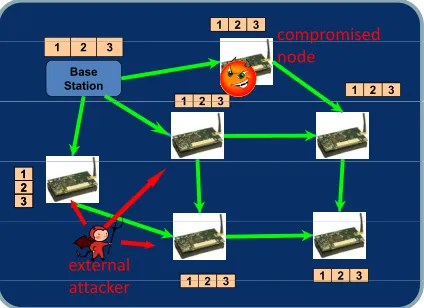
Figure 1.1 Illustration of Code Dissemination; Initiated from the base station, the code image (consisting of three logical units) is distributed over the entire
network through the available wireless links denoted by the arrow lines. . 2
Figure 2.1 Structure of packets and pages in Deluge. . . 9
Figure 2.2 The main concept for authentication in [31, 17] . . . 10
Figure 2.3 An example Merkle hash tree of the approach in [14] . . . 11
Figure 3.1 Authentication of code images. . . 22
Figure 3.2 The Merkle hash tree constructed for page 0 when M = 8 and N = 48. Packet P kt0,i (i = 1, ..., M) consists of V0,i and the values in its authentication path. For example, packetP kt0,1consists ofV0,1,e2,e3−4, and e5−8. . . 23
Figure 3.3 One-way key chain for puzzle keys. . . 26
Figure 3.4 Message specific puzzles. . . 27
Figure 3.5 The testbed (65 MicaZ motes; 152.5 feet× 97 feet). . . 33
Figure 3.6 Propagation delay. (The Berkeley approach does not protect maintenance packets. When this mechanism was disabled in Seluge, the propagation delay was reduced by 30 – 146 seconds.) . . . 34
Figure 3.7 Communication overhead. . . 36
Figure 3.8 Dissemination progress over time on selected nodes. . . 37
Figure 4.1 Illustration of our channel migration scheme . . . 45
Figure 4.2 The sensor network testbed (72 MicaZ motes; 152.5 feet ×97 feet). . . 52
Figure 4.3 Completion time and communication overheads of JR-Seluge and Seluge in scenario 1 . . . 53
Figure 4.4 Completion time and communication overheads of JR-Seluge in scenarios 3 and 4 . . . 55
Figure 5.1 An example sequence of rounds in LR-Seluge . . . 61
Figure 5.2 Encoding and authenticating code images . . . 63
Figure 5.3 An example sequence of rounds in our approach . . . 64
Figure 5.4 The sensor network testbed (72 MicaZ motes; 152.5 feet ×97 feet). . . 68
Figure 5.5 FEC-Seluge performance w.r.t. different redundancy rates . . . 70
Chapter 1
Introduction
A wireless sensor network is expected to consist of a potentially large number of low-cost, low-power, and multi-functional sensor nodes that communicate over short distances through wireless links [6]. Due to their potential to provide fine-grained sensing and actuation at a reasonable cost, wireless sensor networks are considered ideal candidates for a wide range of applications, such as industry monitoring, data acquisition in hazardous environments, and military operations.
It may be necessary to update the code image every sensor node is running after they are deployed, due to, for example, the need of removing bugs and adding new functionalities. The large-scale and embedded nature of wireless sensor networks makes it infeasible to physically access them one-by-one to update their code images. An efficient way is to propagate a new code update using the ad-hoc wireless network formed by the sensor nodes. The process of disseminating a new code image to the network nodes in this way is commonly referred to as code dissemination. Figure 1.1 shows a simple illustration of code dissemination. There exist a few code dissemiantion protocols [13, 24, 57, 30, 50, 29, 52, 44]. In particular, Deluge [24] uses an epidemic protocol [33] for efficient advertisement of code meta data, and divides each code image into multiple pages to allow simultaneous propagation of multiple parts of the image in different regions of the network. Deluge is generally accepted as a de facto code dissemination system for wireless sensor networks as being included in the current TinyOS distributions [5].
1.1
Motivation
Denial-1 2 3 1 2 3
!"#$%"#&'()!
Base Station 1 2 3
11 22 33
11 22 33
$ *")(
11 22 33
3 1 2 3 1 2
11 22 33 11 22 33
(+,(%*-.!
/ 11 22 33 -,,-!/(%
Figure 1.1: Illustration of Code Dissemination; Initiated from the base station, the code image (consisting of three logical units) is distributed over the entire network through the available wireless links denoted by the arrow lines.
of-Service (DoS) attacks and interfere with the code dissemination process. In addition, the adversary may jam the communication channel for code dissemination for disrupting the normal code dissemination process. Moreover, due to the open and unattended nature of wireless sensor networks, all such attacks may be launched in the form of so calledinsider attackswhere the adversary captures legitimate nodes and misuse them and the sensitive information (e.g., authentication keys) on them for her attacks. Therefore, code dissemination must be protected from such various malicious attacks to ensure both integrity and availability of the remote programming service.
Code dissemination essentially requires reliable delivery of code images, which means that every node in a network must receive a complete new code image without any missing parts. However, due to the hardware limitation and various environmental factors, sensor nodes fre-quently suffer from unreliability of the wireless links. In addition, code dissemination leverages the effectiveness of overhearing in wireless communication for efficient dissemination; broadcast-ing a code dissemination packet benefits every node in the communication range who desires the packet. Consequently, a code dissemination protocol must have an efficient way to achieve the reliability requirement in lossy broadcast environments.
1.1.1 Integrity Protection of Code Images and Resistance to DoS Attacks Exploiting Dissemination Protocols
to malicious attacks.
Several recent works have attempted to provide secure code dissemination for wireless sensor networks [17, 14, 31]. All these approaches are extensions to Deluge [24]. Lanigan et al. proposed a protocol named Sluice [31] to integrate signature and cryptographic hash functions to provide efficient authentication for code dissemination. This approach follows Deluge to divide each code image into pages. The hash image of each page is included in the previous page, while the hash image of the first page is signed and included in a signature packet. This approach, however, is vulnerable to Denial of Service (DoS) attacks. This is because in Sluice, a node can only perform authentication when an entire page is received, and thus it cannot authenticate a packet immediately after it is received. To exploit this property, the adversary may send a large number of bogus packets during code dissemination; a sensor node, upon receiving a packet, cannot tell if it is authentic or not, and has to save it if possible. As a result, the adversary can force the sensor nodes to save bogus packets but drop some authentic ones.
A scheme similar to Sluice was independently proposed in [17]. In this approach, the hash image of each code dissemination packet is included in the previous packet, and the hash image of the first packet is signed and included in an advertisement packet. A code dissemination packet can be authenticated only when the packet immediately before it has been received and authenticated. The authors of [17] proposed to optimistically store out-of-order packets. Unfortunately, this decision opens a door to the same DoS attacks, since the adversary can again send a lot of bogus packets to exhaust receivers’ buffers. Not storing out-of-order packets is certainly an option to avoid the DoS attacks. However, this will lead to inefficient code dissemination: Losing one packet at a node will result in the retransmission of all the later packets in the same page.
Deng et al. proposed a scheme to improve the DoS-resilience of secure code dissemination by using Merkle hash tree [14]. Besides having the hash image of each page in the previous one, it also uses a Merkle hash tree to allow each packet to be immediately authenticated upon receipt. However, this approach adds additional overhead due to the transmission of a Merkle hash tree foreverypage [14]. Moreover, it distributes each hash tree in a level-by-level fashion; only after every packet in one level is received and verified can the packets in the next level be requested. This indeed disables the efficient page-by-page propagation in Deluge, leading to higher propagation delays.
adversary may repeatedly request packets from a node to exhaust its battery power. Moreover, the adversary may request packets from a non-existing node; due to the Deluge suppression mechanism, others that overhear this request will not send request for packets (to real nodes). The authors of [14] discussed the authentication of SNACK packets, but overlooked the issue of advertisement packets.
Another critical issue common to these approaches [17, 31, 14] is the vulnerability to DoS attacks against the signatures used to bootstrap secure code dissemination. The approaches in [17, 31] did not consider such threats at all. As a result, the adversary can broadcast packets with bogus signatures, and force all the receivers to perform expensive signature verifications. The approach in [14] proposes to release previously undisclosed values in a one-way hash chain to mitigate such DoS attacks. However, this method is vulnerable to online attackers. Once the adversary overhears a hash value during a legitimate code dissemination, it can reuse the value to send forged signatures to other regions of the network. Due to the multi-hop and low-bandwidth nature of wireless sensor networks, the adversary has sufficient time to launch DoS attacks against many sensor nodes.
In Chapter 3, we present the design, development, and evaluation of a secure and DoS-resistant code dissemination system named Seluge for wireless sensor networks, which is able to address all the limitations existing in the previous approaches [17, 31, 14].
1.1.2 Jamming-Resistant Code Dissemination
Another serious threat to the availability of the code dissemination service is wireless jamming attacks. Wireless sensor networks are vulnerable to jamming attacks due to the use of shared wireless medium. A jammer can simply take advantage of a radio frequency (RF) device to transmit interference signals on wireless channels. As a result, signals of the jammer and the sender collide at the receiver, and the legitimate communication is disrupted. Without proper defense against jamming attacks, it is impossible for wireless sensor networks to perform normal code dissemination operations. More specifically, sensor nodes under jamming cannot download a new code update, and consequently cannot run the operations intended with the new code update. Therefore, jamming resistance is crucial for the success of the remote programming service.
Unfortu-nately, this feature makes all of them vulnerable to insider jammers, who may learn the shared secret through compromised receivers and then jam the wireless communication.
To address this problem, several research groups recently developed DSSS and FHSS-based anti-jamming broadcast communication schemes by eliminating the requirement of shared se-crets in traditional DSSS and FHSS (e.g., [59, 60, 55, 51, 39]). However, these approaches all require changes to the physical radio devices, which are not available on existing wireless sensor platforms.
Lazos et al. proposed a semi-random channel hopping strategy [32] to allow nodes in a cluster to intermittently meet on the same channel to mitigate control-channel jamming attacks. However, this approach can only use a small fraction of the bandwidth due to the need to hide the common channel. In addition, it uses a single cluster header to generate the channel hopping sequences for all cluster members and transmits them to each member individually. Thus, this approach also has a single point of failure and limited scalability.
As discussed above, the existing approaches are either vulnerable to insider jammers, require hardware modification, or degrade the performance. In Chapter 4, we investigate a new anti-jamming solution which does not require any shared secret and hardware modification while allowing better utilization of the available bandwidth.
1.1.3 Loss-Tolerant and Secure Code Dissemination using Erasure Codes Despite the security protections provided by Seluge and other secure code dissemination schemes [17, 14, 31], all of them rely on ARQ (Automatic Repeat reQuest) for reliable dissemination of code images, which is employed by Deluge. However, this ARQ mechanism is inefficient in lossy broadcast environments, which are typical in code dissemination, due to asymmetric packet loss between neighbor nodes.
Erasure codes – a forward error correction (FEC) technique – are a well-known approach for reliable communication. Several researchers demonstrated recently that using erasure codes along with ARQ can provide efficient and reliable code dissemination (e.g., [22, 21, 53]). Based on these techniques, Bohli et al. integrated both integrity protection and erasure coding into code dissemination [7]. However, this approach does not provide immediate authentication of erasure-encoded packets, and consequently is vulnerable to DoS attacks that exploit authenti-cation delays.
prevents flexible application of erasure codes in LR-Seluge.
In Chapter 5, we investigate several new techniques to address the above problems and develop an efficient, reliable, and secure code dissemination scheme called FEC-Seluge.
1.2
Summary of Contributions
The contributions of this thesis are summarized below:
1. Seluge: First, we develop the Seluge suite of techniques for secure and DoS-resistant code dissemination in wireless sensor networks. Our security and performance analysis demonstrates that Seluge is superior to all the previous solutions [17, 31, 14]. Second, we integrate the proposed techniques into the Deluge code base in TinyOS distributions, providing a software packet that is readily available. Third, we perform extensive exper-iments in a network of MicaZ motes to evaluate the performance of Seluge.
2. Channel Migration: The first and most important contribution is the development of the channel migration scheme, which is key to achieving efficient and strong jamming resilience properties. Second, we apply our channel migration scheme to Seluge in a case study and carefully evaluate it through both theoretical analysis and experimental evaluation, which demonstrate the nice properties and real-world performance of our channel migration scheme.
3. FEC-Seluge: First, we develop an efficient, reliable, and secure code dissemination sys-tem named FEC-Seluge which seamlessly integrates erasure codes into the security mecha-nisms of Seluge. At the heart of FEC-Seluge is a novel proactive transmission mechanism, which achieves both efficiency and loss-tolerance through proactively transmitting redun-dant packets to enable receivers to tolerate packet losses. To balance the efficiency and loss-tolerance capabilities, we also developed a technique to estimate the optimal amount of redundancy in proactive transmission for a given network condition. Finally, we imple-ment FEC-Seluge as an extension to Seluge in TinyOS and perform extensive empirical studies in a network of MicaZ motes to see the performance of FEC-Seluge.
1.3
Organization of Thesis
Chapter 2
Background
In this chapter, we give the background information related to our research in this thesis. In Section 2.1, we briefly review the existing code dissemination protocols for wireless sensor networks and point out their limitations. We then discuss the existing techniques to cope with wireless jamming attacks in Section 2.2.
2.1
Code Dissemination Protocols for Wireless Sensor Networks
All the existing code dissemination protocols can be classified into two categories in terms of their mechanisms to achieve reliable dissemination of code images. The first category of protocols (e.g., [13, 24, 57, 30, 52, 44, 14, 17, 31, 26]) is solely based on ARQ (Automatic Repeat Request), in which each node repeatedly requests missing packets until it completely receives the entire code image. We discuss about this category of protocols in Section 2.1.1. The second category of protocols (e.g., [22, 21, 53, 7, 69]) utilizesforward error correctionalong with ARQ to address the inefficiency problem of ARQ in lossy broadcast environments where asymmetric packet loss between neighbors happens. In Section 2.1.2, we review this category of protocols.
2.1.1 Approaches based on ARQ
0
0
1 2 3 4
1 2 3 4 5 N
Page Object
P obj
S
page S
5 Packet
4 3
pkt S
Figure 2.1: Structure of packets and pages in Deluge.
node advertises the availability of the newly received page, and may transmit the corresponding packets upon request. On the other hand, a receiver requests a page only after having received all packets in previous pages.
Deluge uses an epidemic protocol [33] for efficient advertisement of code meta data [24]. Each node periodically advertises the version of its code image and the number of pages it has for that version. For energy efficiency, the advertisement rate is dynamically adjusted: If a node discovers its own advertisement is different from those received from others, it increases its advertisement rate. Otherwise, it decreases the rate. As a result, Deluge can achieve rapid propagation during dissemination of a new code image, but consumes little resource in steady state.
Once a node finds out from an advertisement packet that a neighbor node has the page it needs, it uses Selective Negative Acknowledgment (SNACK) packets to request transmission from this neighbor. Each SNACK packet contains a requested page number and a bit vector indicating the requested packets. Upon receiving several request packets for the same page, a node computes the union of the requested packets, and transmits the packets in a round-robin fashion.
However, Deluge and the other protocols [13, 57, 30, 50, 29, 52, 44] mentioned above never take into account security issues they may face in hostile environments. Consequently, the adversary may simply misuse these protocols to distribute her own malicious code images to the network, and launch DoS attacks for disrupting the normal operations of these protocols.
Secure Extensions to Deluge
Several groups of researchers attempted to provide security protections to Deluge [31, 17, 14, 62]. Lanigan et al. proposed a protocol named Sluice [31] to integrate signature and cryptographic hash functions to provide efficient authentication for code dissemination. In Sluice [31], authen-tication is done in page granularity. Figure 2.2 illustrates how Sluice authenticates a given code image. Initially, the hash image of the last page(P agen) is computed and appended toP agen−1.
Then the hash image of P agen−1 including hn is computed and appended toP agen−2. Sluice
repeats such procedure until gettingh1. Finally,h1is digitally signed and included in the
signa-ture packet along with the digital signasigna-ture. When receiving a code image, the sensor node first requests the signature packet and verifies h1 in it through a signature verification operation. Then it requestsP age1 and verifies it by comparing the hash image computed from the received
P age1 with h1 already verified. In such way, the node can verify all n pages. In Sluice, each
page can be verified only after receiving and verifying the signature packet and all the previous pages. Because of the authentication in a page unit, an individual code dissemination packet cannot be immediately verified upon receipt, and this property makes Sluice vulnerable to DoS attacks exploiting authentication delays.
The approach in [17] is similar to Sluice except that the granularity of the authentication is packet rather than page. The hash image of each code dissemination packet is included in the previous packet as illustrated in Figure 2.2, and the hash image of the first packet is signed. Therefore, in this approach each packet can be verified only after receiving and verifying all the previous packets including the signature packet. However, due to the possibility of out-of-order delivery of the packets in a same page, this approach does not guarantee immediate authentication of each code dissemination packet.
The approach of [14] was proposed to achieve immediate authentication of code dissemi-nation packets by using Merkle hash tree [42]. This approach constructs a single Merkle hash tree for each page. Figure 2.3 shows a Merkle hash tree when each page consists of 9 packets and each packet payload can afford up to 3 hash images. Each node of the tree corresponds to
Pagen(or Pktn) Pagen-1
(or Pktn-1) hn Pagen-2
(or Pktn-2) hn-1 . . . .
Page1 (or Pkt1) h2 h1
Pkt4 Pkt5 Pkt6
Pkt2
Pkt7 Pkt8 Pkt9
Pkt3
Pkt1
Pagei-1
Pagei
Figure 2.3: An example Merkle hash tree of the approach in [14]
a single packet. Each code dissemination packet(P kt4 to P kt9) in a page becomes a leaf node
of the tree. An internal node contains the hash images of all its child nodes, and the number of the children of each internal node depends on the number of hash images the corresponding packet payload can include. The hash image of each root packet(P kt1) is included in the root
packet of the hash tree for the previous page, and the hash image of the root packet of the first page is signed. In order to verify a packet, each node must have received and verified the signature packet and all the packets in the previous pages. In addition, the node must have received and verified all the packets on the path from the root to the parent of the packet in the tree, for instance, P kt1 and P kt2 to verify P kt5. To achieve immediate authentication,
the authors proposed the level-by-level transmission of the packets of each hash tree; only after every packet in one level is received and verified can the packets in the next level be requested. Unfortunately, this indeed disables the efficient page-by-page propagation in Deluge, leading to higher propagation delays.
Tan et al. proposed a secure code dissemination approach [62] solely based on symmetric key cryptographic operations. This approach uses multiple one-way key chains, each of which is used to authenticate code dissemination packets destined to a group of nodes with the same hop distance from the base station. During the initialization phase, the base station generates the one-way key chains for every group of nodes, and then securely distributes each key chain commitment to the corresponding group of nodes. Given a new code image to disseminate, the base station authenticates the ith code dissemination packet of the new code image with the
ith elementki of each key chain, and then broadcasts the authenticated packet along with the
and then verifies the packet with it. However, in this approach, if a compromised node has received a packet with ki while some of the neighbors has missed the packet, it is possible
for the compromised node to provide forged packets to those neighbors before the neighbors receive the legitimate packet with ki. In addition, this approach does not achieve immediate
authentication in case of out-of-order packet delivery. In addition, the management of the key chains requires additional overhead.
Though all the above-mentioned approaches [17, 31, 14, 62] are based on Deluge, none of them provide a satisfactory solution to the authentication of advertisement and Selective Negative Acknowledgment (SNACK) packets. Indeed, the approaches in [17, 31, 62] overlooked the authentication of such packets. As a result, the adversary can forge such packets and exploit the Deluge epidemic and suppression mechanisms to launch DoS attacks. For example, the adversary may repeatedly request packets from a node to exhaust its battery power. Moreover, the adversary may request packets from a non-existing node; due to the Deluge suppression mechanism, others that overhear this request will not send request for packets (to real nodes). The authors of [14] discussed the authentication of SNACK packets, but overlooked the issue of advertisement packets.
Another critical issue common to the approaches in [17, 31, 14] is the vulnerability to DoS attacks against the signatures used to bootstrap secure code dissemination. The approaches in [17, 31] did not consider such threats at all. As a result, the adversary can broadcast packets with bogus signatures, and force all the receivers to perform expensive signature verifications. The approach in [14] proposes to release previously undisclosed values in a one-way hash chain to mitigate such DoS attacks. However, this method is vulnerable to online attackers. Once the adversary overhears a hash value during a legitimate code dissemination, it can reuse the value to send forged signatures to other regions of the network. Due to the multi-hop and low-bandwidth nature of wireless sensor networks, the adversary has sufficient time to launch DoS attacks against many sensor nodes. In Seluge we present in Chapter 3, we address all the above-mentioned limitations existing in [17, 31, 14, 62].
sig-nature scheme which is built on Merkle’s one-time sigsig-nature scheme [43]. Since the introduced stateful-verifierτ-time signature scheme only relies on a secure one-way hash function, it is not only computationally efficient but also requires a small memory footprint. Finally, they applied the proposed signature scheme to an existing secure code dissemination approach, resulting in much smaller memory footprint.
2.1.2 Approaches based on the Hybrid of Erasure Codes and ARQ
In order to improve the efficiency of code dissemination in wireless sensor networks, several re-searchers developed code dissemination protocols which utilize either network coding or erasure coding along with ARQ (e.g., [22, 21, 53]). Hou et al. proposed an approach namedAdapcode which uses adaptive network coding together with ARQ for efficient and reliable dissemination of code images in wireless sensor networks [22]. Given the observation that the best coding scheme which enables the best code dissemination performance varies depending on the num-ber of neighbors, in this approach each sensor node dynamically changes the coding scheme based on its current observation on the number of neighbors. In addition, the authors sug-gested a sender selection mechanism to evenly distribute the number of packet transmissions over different senders.
Hagedorn et al. and Rossi et al. proposed code dissemination protocols based on rateless erasure codes. The approach in [21] employed random linear codes, while the approach in [53] used Fountain codes [40]. The use of erasure codes allows both approaches to significantly re-duce retransmission requests and consequently dissemination latency as well as communication overhead. Moreover, due to the rateless property, in both approaches the sender can generate an arbitrarily number of encoded packets depending on its local neighbors’ requests. That is, it is possible to adaptively change the code rate according to the local link quality. Despite such efficiency with either network coding or rateless erasure coding, none of these approaches took security into consideration.
Secure Extensions
In [7], Bohli et al. proposed a technique which prevents illegitimate code images being propa-gated in the approach of [53]. In this approach, the integrity of each code page is verified after decoding it. However, this approach does not provide immediate authentication of each encoded packet upon receipt, and consequently is vulnerable to DoS attacks that exploit authentication delays. To cope with this problem, the authors suggested a strategy for filtering bogus encoded packets, but did not provide enough discussion on the effectiveness of the strategy.
adopting fixed rate erasure codes and properly organizing the hash images of encoded packets, LR-Seluge not only provides loss-resilience in code dissemination, but also achieves immediate authentication of every encoded packet. In addition, to optimize the way to use encoded packets, LR-Seluge suggests a packet transmission strategy which selects the packet desired by more receivers with higher priority and eventually broadcast the minimum set of packets that can satisfy all the receivers’ needs of additional packets required for decoding. However, this strategy prevents LR-Seluge from taking full advantage of erasure codes due to the lack of proactive transmission, and consequently LR-Seluge does not effectively reduce dissemination delays.
2.2
Anti-jamming Techniques
There are many existing techniques to cope with wireless jamming attacks. Physical layer spread spectrum techniques such as DSSS and FHSS are traditional defense against wireless jamming attacks [54, 64]. Several new anti-jamming schemes based on DSSS and FHSS were recently developed to overcome the limitations in those traditional spread spectrum techniques [59, 60, 55, 51, 39, 35, 36]. In Section 2.2.1, we briefly review the basic ideas of DSSS and FHSS, and then discuss recently developed anti-jamming techniques based on DSSS and FHSS. Several groups of researchers also developed anti-jamming approaches using upper layer channel hopping for platforms without built-in frequency hopping technology [45, 67, 20, 66, 32]. We discuss these approaches in Section 2.2.2.
2.2.1 Spread Spectrum Anti-jamming Techniques DSSS-based Anti-jamming Techniques
Direct Sequence Spread Spectrum (DSSS) is a traditional anti-jamming technique. In DSSS communication, the sender spreads a given message into a bit stream called chips by multiplying each bit of the message with a spreading code, which is a sequence of bits. The sender transforms the spread result into an RF signal and then transmits the signal on the wireless channel. Upon receiving the RF signal, the receiver first recovers the chips from the signal. Then the receiver despreads the recovered chips to get the original message using the same spreading code used by the sender.
spreading code required for them to establish anti-jamming communication. Unfortunately, this feature makes DSSS vulnerable to insider jammers, who may learn the shared secret through compromised receivers and then jam the wireless communication.
P¨opper et al. recently developed Uncoordinated DSSS [51], which enables jamming-resistant broadcast communication by eliminating the requirement of shared secrets in DSSS. In UDSSS, both sender and receivers share the same set of spreading codes. The spreading codes in the set are grouped into code sequences. Given a message to transmit, the sender randomly chooses a code sequence from the set, and spreads each bit of the message using a spreading code in the chosen code sequence. Such random choice makes jammers hard to quickly find out the code sequence used by the sender. However, to despread the message, the receiver also needs to try each code sequence in the set one-by-one until finding the correct code sequence used by the sender. This procedure introduces high computational overhead on the receiver side. In addition, if the jammer has sufficient computational power so that she can find the code sequence used by the sender before the sender finishes transmission, the jammer can jam the remaining part of the transmission. Thus, UDSSS is vulnerable to reactive jammers with sufficient computational power.
To address the vulnerability to reactive jammers in UDSSS, Liu et al. proposed a scheme named RD-DSSS [39] which uses multiple code sequences and permutation to protect each message. However, this approach not only increases burdens on the jammer side, but also requires more efforts on the receiver to find the code sequence randomly chosen by the sender. Thus, the same high computational overhead problem still remains in this approach.
Most recently, Liu et al. proposed DSD-DSSS for efficient anti-jamming broadcast com-munication [36]. In this approach, the sender spreads each message using the code sequence randomly generated based on a random seed only known to the sender. In order to achieve anti-jamming capability, the sender delays the timing when it discloses the random seed after the message transmission has been completed. In this way, when the jammer has the knowledge of the random seed and code sequence which is required for jamming the message transmis-sion, all the receivers have already received the message. A possible jamming strategy against DSD-DSSS is to jam the seed disclosure. To prevent this type of jamming attacks, the authors developed a content-based code subset selection scheme which allows a normal receiver who has received the full message including the random seed to quickly decode the random seed. On the other hand, a jammer without knowing the complete message has more choices to consider.
FHSS-based Anti-jamming Techniques
sequence using the shared secret between them. The sender and receiver communicate with each other, switching their frequencies according to the same hopping sequence in a synchronized way. As long as the jammer has no knowledge of the hopping sequence, the probability that the jammer hits the same channel as the sender and receiver is very low if the number of all available channels is large enough. However, due to the requirement of a pre-shared secret between the sender and its receivers, FHSS is also vulnerable to insider jammers as in DSSS.
Strasser et al. recently proposed UFH (Uncoordinated Frequency Hopping) message transfer protocol [59], whose objective is for a sender and receiver without any pre-shared secret to establish a shared secret in the presence of jammers. After a shared secret is established between them, they can use DSSS or FHSS to protect their subsequent communication from jamming attacks. The basic idea of UFH message transfer protocol is to have the sender quickly hop through random channels and repeat the same transmission, and have a receiver slowly hop through the same set of channels so that it can receive the transmission when the sender hits its channel. To allow very short hop duration for the sender, UFH message transfer protocol fragments the message into short packets, and the receiver reassembles the received fragments to get the original message. To deal with the problems due to fake fragments from attackers, the authors also proposed hash chaining approach to verify each message fragments.
A few variations of UFH were developed to improve the efficiency of UFH. In [60], Strasser et al. proposed several new UFH communication schemes based on erasure codes and packet verification techniques to build verifiable message coding. They showed that BMA (erasure coding combined with a oneway authenticator based on linear maps) reduces the communication latency of UFH up to one-half. In [55], Slater et al. also developed several schemes (i.e., Hashcluster, Merkleleaf, and Witnesscode schemes) using erasure codes to improve the original UFH protocol.
Unfortunately, all these schemes [59, 60, 55] share a common limitation: They have to split each message into multiple short packets due to the constraint of packet size, which is determined by the hop duration and the bit rate. Due to the need to reassemble these packets into meaningful and authenticated messages, each packet has to include additional fields and thus cannot be shorter than a certain length. This feature makes all these schemes vulnerable to responsive jamming attacks, which sense and jam channels with meaningful signals reactively. As a result, it takes a long time (and sometimes impossible) for these schemes to finish transmitting a meaningful message in the presence of jammers.
available for wireless communication, given the assumption that jammers are unable to jam the entire bandwidth at the same time, there is always a chance that only a normal receiver receives the seed and accordingly the message while a jammer does not. To increase this possibility, USD-FH repeats the transmission of a seed and the corresponding message multiple times.
Besides the techniques discussed above, Chiang et al. proposed a scheme that can work with any existing spread spectrum systems so that the systems can detect and isolate insider jammers [10]. The scheme uses a type of binary tree called code tree, in which each node corresponds to a code used for spread spectrum communication. In this scheme, if some of the codes in the tree are captured and being used for jamming, the transmitter can identify those captured codes by cooperating with its receivers, and then remove them from the system.
2.2.2 Channel Hopping-based Anti-jamming Techniques
Several groups of researchers developed channel hopping approaches for platforms without built-in FH technology (e.g., [67, 45, 20, 66, 32]). First, Xu et al. proposed two different channel surfing approaches namedcoordinated channel switchingand spectral multiplexing[67]. In these approaches, every network node is pre-configured with a common channel sequence and equipped with a jamming detection mechanism. In normal condition where there exists no jamming, every network node resides and communicates on a single, fixed channel. In the coordinated channel switching, if jamming is detected, the entire network switches to the next channel in the pre-configured channel sequence. In the spectral multiplexing, only the nodes inside the jammed region switches to the next channel in the channel sequence. The nodes at the boundary of the jammed region act as radio relays, constantly switching between the original and the new channel where the nodes under the jamming currently reside.
Navada et al. proposed a channel hopping approach to protect 802.11 networks from wireless jamming attacks [45]. To establish anti-jamming communication, first of all, the AP generates a seed value to be used to generate a pseudo-random channel hopping sequence and then distributes the seed to its clients via secure communication. For jamming resilience, the AP and clients change their channels according to the same channel hopping sequence generated from the shared seed every period of time called residence time. For synchronous channel hopping, whenever hopping, the AP broadcasts an end-of-slot message to notify the clients on the same channel of its channel switch. Once overhearing the end-of-slot message, clients hops to the next channel in the hopping sequence.
begins scanning all channels to find the AP. While scanning, the client transmits a probe request on its channel. Once hearing the probe request, the AP broadcasts a probe reply, which contains the AP’s current encrypted MD5 value. If the client receives the probe reply, it can generate the same channel hopping sequence as the AP using the received MD5 value, and eventually synchronize with the AP. Then the AP and clients resume their communication while periodically hopping through the common channel hopping sequence.
Wood et al. presented a channel hopping scheme to mitigate jamming attacks in wireless sensor networks [66]. As in FHSS, two communicating parties first agree on the same channel hopping sequence derived from their pre-shared key, and then start hopping. In this approach, theith message is transmitted through theith channel in the hopping sequence.
However, all the above mentioned schemes [45, 67, 20, 66] share a common limitation: They all require that the sender and its receivers share the same channel hopping pattern. Unfortunately, this feature makes all of them vulnerable to insider jammers, who may learn the shared channel hopping sequence through compromised receivers and then jam the wireless communication.
Chapter 3
Seluge: Secure and DoS-Resistant
Code Dissemination in Wireless
Sensor Networks
In this chapter, we present the design, development, and evaluation of a secure and DoS-resistant code dissemination system named Seluge for wireless sensor networks. Seluge is an extension to Deluge [24], an open source code dissemination system included in TinyOS [5]. Seluge inherits the efficiency and robustness properties from Deluge, and at the same time provides security protections for code dissemination, including the integrity protection of code images and resistance to various DoS attacks. Seluge is targeted at the current and future generation of sensor platforms, such as MicaZ [3], TelosB [4], and Imote2 [2].
The key contribution of Seluge is a novel way to organize the packets used to distribute new code images. By carefully arranging code dissemination data items and their hash images in packets, Seluge provides immediate authentication of each packet when it is received, without disrupting the efficient propagation mechanisms used by Deluge. Thus, it can easily defeat the DoS attacks that exploit possible authentication delays.
Seluge uses a signature to bootstrap the authentication of a new code image. However, unlike the previous attempts, Seluge uses a weak authentication along with the signature. This weak authentication mechanism has some nice properties: It can be efficiently verified by a regular sensor node, but it takes a computationally powerful attacker a substantial amount of time to forge. Moreover, it cannot be pre-computed. Thus, this weak authentication mechanism provides an effective filter of forged signatures. As a result, Seluge is not subject to the same DoS attacks against signature verifications as the previous approaches.
is another security property not available in the previous approaches.
Compared with the previous attempts [17, 31, 14], Seluge not only provides integrity pro-tection for disseminated code images, but is also resistant to various DoS attacks exploiting the expensive signature verification operations, possible authentication delays, and the efficient epidemic propagation strategies used by Deluge. Indeed, Seluge is superior to all the pre-vious solutions [17, 31, 14], and is the only solution that seamlessly integrates the security mechanisms and the efficient Deluge propagation strategies.
The organization of this chapter is as follows. The next section clarifies our assumptions and the threats to code dissemination in wireless sensor networks. Section 3.2 presents the techniques used in Seluge for secure and DoS-resistant code dissemination. Section 3.3 provides theoretical analysis of the security and performance of Seluge. Section 3.4 describes the im-plementation and experimental evaluation of Seluge in a network of MicaZ motes. Section 3.5 summarizes this chapter.
3.1
Assumptions and Threat Model
Assumptions: We assume the source of the code images, i.e., the base station, is a powerful node (e.g., a laptop PC) with sufficient energy supply. We assume that sensor nodes are resource constrained. A sensor node may be able to perform a limited number of public key cryptographic operations. For example, a MicaZ mote can perform a 160-bit ECC signature verification operation in about 2.43 seconds using TinyECC [34]. However, a node cannot afford performing many such operations due to the intensive computation and energy consumption. We assume the packet size is large enough to hold a signature and other information required by a signature packet. This can be satisfied on sensor platforms with IEEE 802.15.4 compliant radios [27], where the maximum payload size is 102 bytes. We assume each node has enough memory to store the disseminated code image (e.g., using the measurement flash).
We assume Deluge as the underlying code dissemination protocol. We assume the base station has a private and public key pair, and each sensor node in the network is pre-configured with the base station’s public key. We also assume sensor nodes are able to establish pairwise keys between neighbor nodes, for example, using one of the existing schemes (e.g., [9, 37, 15].
launch DoS attacks by, for example, forging a large number of signature packets or exploiting weaknesses of the code dissemination protocol. The adversary may jam the communication channel; however, we assume that the adversary cannot constantly jam the communication channel without being detected and removed.
The adversary may compromise some nodes to attack the rest of the network. We call such attacks insider attacks, since the compromised nodes are considered a part of the network before they are identified and removed. However, we assume that the majority of the nodes are not compromised. The adversary may exploit the compromised nodes in arbitrary ways to attack the remaining nodes. For example, the adversary may instruct the compromised nodes to intercept sensitive information even if the messages are encrypted, (selectively) drop packets, and launch Sybil attacks [46]. The adversary may also instruct the compromised nodes not to cooperate with others, inject false data, and exploit specific weaknesses of various protocols. However, we assume the base station cannot be compromised.
With those capabilities, the adversary attempts to disseminate illegal code images into the sensor network using the code dissemination mechanism, or launch DoS attacks to consume the limited resources (e.g., battery power, memory) on select sensor nodes.
3.2
Design of Seluge
Seluge relies on Deluge [24] for efficiency (via epidemic propagation and suppression) and robust-ness (via SNACK). To defend against the security threats against code dissemination, Seluge further adds three layers of protection: (1) Immediate authentication of code dissemination packets, (2) authentication of page advertisement and SNACK packets, and (3) anti-DoS pro-tection for signature packets. The key contribution of Seluge is that it provides authentication and DoS-resistant protections by efficiently using cryptographic primitives, and at the same time still allows the efficient code dissemination mechanisms in Deluge.
We use the following notations: H(·) denotes a cryptographic hash function;Sig(M) denotes the signature of M signed by the base station; C kD denotes the concatenation of C and D; and |E|denotes the size ofE in byte.
3.2.1 Immediate Authentication of Code Dissemination Packets
PktP,1
Pkt2,1 Pkt2,2
...
Pkt2,N-1 Pkt2,N Pkt1,1 Pkt1,2...
Pkt1,N-1 Pkt1,NPktP-1,1 PktP-1,2
...
PktP-1,N-1 PktP-1,N.
.
.
.
.
.
PktP,N-1 PktP,2
Hash Tree
...
Signature
.
.
.
.
.
.
...
Page1:
Page2:
Page P
Page P:
Page0:
Signature Packet:
PktP,N
Figure 3.1: Authentication of code images.
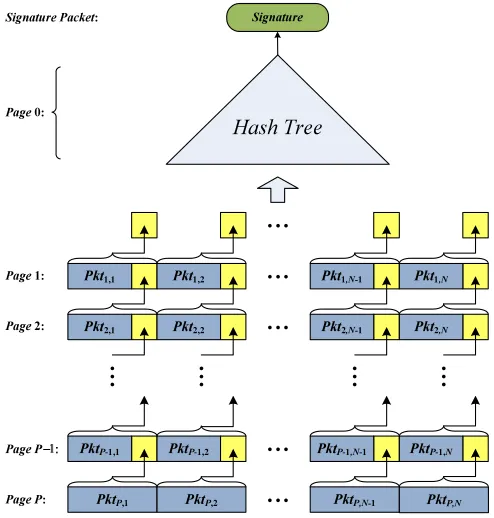
As discussed earlier, due to the Deluge page-by-page dissemination strategy, only after successfully receiving all packets in the current page does a node request the next page from a sender. We exploit this property to enable immediate authentication of each received packet at a node.
Construction of Code Dissemination Packets: Figure 3.1 illustrates our authentica-tion scheme for the code image to be disseminated. We append the hash image of each packet in page P to the corresponding packet in pageP −1. For example, the hash image of packet
P ktP,1, H(P ktP,1), is included in packet P ktP−1,1. We then include the hash image of each
packet in pageP−1 in the corresponding packet in pageP−2. This process continues until we finish hashing all the packets in page 2 and including their hash images in the corresponding packets in page 1.
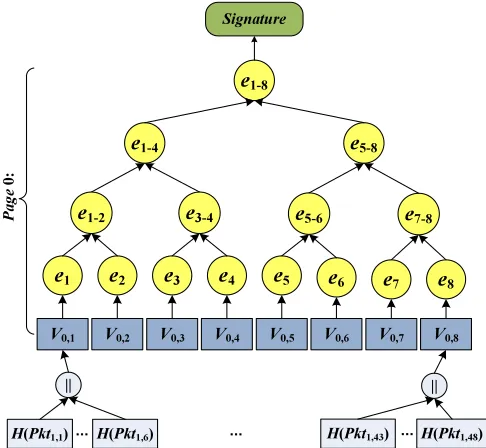
As shown in Figure 3.1, we use Merkle hash tree [42] to facilitate the authentication of the hash images of the packets in page 1. We refer to the packets related to this Merkle hash tree collectively as page 0. Figure 3.2 illustrates the construction of page 0 and its packets. Specifically, we concatenate the hash images of the page 1 packets to form HashV alues =
e1 e2 e3 e4 e5 e6
e5-6 e7-8
e1-4 e5-8
e1-8
Signature
V0,1 V0,2 V0,3 V0,4 V0,5 V0,6 V0,7 V0,8
e7 e8 e3-4
e1-2
H(Pkt1,1)... H(Pkt1,6) ... H(Pkt1,43) ...H(Pkt1,48)
|| ||
Pa
g
e
0
:
Figure 3.2: The Merkle hash tree constructed for page 0 when M = 8 and N = 48. Packet
P kt0,i (i = 1, ..., M) consists of V0,i and the values in its authentication path. For example,
packetP kt0,1 consists ofV0,1,e2,e3−4, ande5−8.
the minimum value that satisfies
N · |H(·)|
2k +k· |H(·)| ≤Maximum payload size. (3.2.1)
(The condition in Equation 3.2.1 is to make sure each leaf node and its authentication path can be transmitted in one packet.) We denote the resulting fragments as V0,1, V0,2, ..., V0,M,
and construct a Merkle hash tree using V0,1, V0,2, ..., and V0,M as leaf nodes [42]. Figure 3.2
shows the construction of the Merkle hash tree when N = 48 and M = 8. Specifically, we compute ei = H(V0,i) (i = 1,2, ..., M), and build a binary tree by computing internal nodes
from adjacent children nodes. Each internal node is the hash image of the two children nodes. For example, in Figure 3.2, e1−2 =H(e1||e2), ande1−4 =H(e1−2||e3−4).
We then construct M packets using this Merkle hash tree. Specifically, we construct one packet P kt0,i for each V0,i, where i = 1,2, ..., M; each packet P kt0,i consists of V0,i and the
values in its authentication path (i.e., the siblings of the nodes in the path from V0,i to the
root) in the Merkle hash tree. For example, packet P kt0,1 consists of V0,1, e2, e3−4, and e5−8
in Figure 3.2.
presentation, we refer to the packets in page 1 through pageP asdata packets, and the packets in page 0 as hash packets. In addition to the payload discussed earlier, each packet also has a header describing auxiliary information about the code image, pages, and packets.
The reader may have noticed that we must choose parameters N and M carefully to en-sure that the hash packets are small enough to be transmitted in wireless sensor networks, as indicated in Equation 3.2.1. This is indeed well accommodated by the current generation of sensor platforms that use IEEE 802.15.4 compliant radios [27], such as MicaZ [3] and TelosB [4] motes. For example, we may set the number of packets per page N = 48, following the default configuration in Deluge. We may use the 64-bit truncation of SHA-1 as H(x), which provides sufficient pre-image resistance and has been used previously (e.g., [17]). Moreover, we may set the number of leaf nodes in the Merkle hash treeM = 8. As a result, each hash packet consists of 6 hash images of page 1 packets (48 bytes) and 3 hash images (24 bytes) in the authentication path in the Merkle hash tree. The total payload size is 72 bytes, smaller than the 102 bytes maximum payload size in the IEEE 802.15.4 standard [27].
Transmission & Authentication of Code Dissemination Packets: We rely on the un-derlying Deluge protocol to distribute packets for a given code image (in apage-by-pagefashion). The additional capability provided by our packet construction is the immediate authentication of packets received by each node. This property is critical to sensor nodes in order to prevent DoS attacks aimed at exhausting receivers’ buffers. Note that the approaches in [17, 31] do not provide this property, and thus are vulnerable to such DoS attacks. Though not vulnerable to such DoS attacks, the approach in [14] is much less efficient than Seluge.
The base station first broadcasts the signature packet, which serves as the advertisement of the new code image. Upon receiving a signature packet, each node verifies the signature to authenticate the root of the Merkle hash tree constructed for page 0. This root allows the node to authenticate each hash packet in page 0 upon receipt, using the values in the authentication path included in the same packet. For example, in Figure 3.2, if e1−8 has been authenticated
in the signature packet, upon receiving a packet consisting of V0,1, e2,e3−4, and e5−8, a node
can immediately verify whether H(H(H(H(V0,1)||e2)||e3−4)||e5−8) = e1−8. If yes, the received
packet is accepted; otherwise, it must be a forged packet and should be discarded right away. Since the hash packets include all the hash images of the page 1 packets, successful receipt of them allows the node to further authenticate page 1 packets immediately upon receiving them. To continue the above example, the receipt of an authenticated V0,1, where V0,1 =
H(P kt1,1)|| · · · ||H(P kt1,6), implies the correct receipt ofH(P kt1,1), ...,H(P kt1,6). Thus, when
this node receives packet P kt1,i (i = 1, ..., N) in page 1, it can immediately verify whether
hashingP kt1,i results inH(P kt1,i) and decide whether the received packet should be accepted
those packets are received.
3.2.2 Authentication of Page Advertisement and SNACK Packets
As discussed in Section 1.1.1, several efficient code propagation mechanisms used by Deluge are vulnerable to exploits. The root cause of these vulnerabilities is the lack of authentication. We have provided immediate authentication of code packets in the previous subsection. However, the adversary can still exploit page advertisement and SNACK packets. Thus, advertisement and request packets must be authenticated as well. Because of the heavy use of overhearing and suppression, such authentication must be (local) broadcast authentication, i.e., a node can authenticate any packet transmitted by its neighbors.
We use cluster keys for local broadcast authentication. (This was first mentioned in [14]; however, the authors of [14] did not give specific details.) Specifically, each node generates a per-node cluster key, which is intended to authenticate all the advertisement and SNACK packets transmitted from itself. When a node is deployed, it notifies its neighbors through periodic hello packets. We assume sensor nodes can establish pairwise keys between neighbor nodes using an existing scheme (e.g., [9, 37, 15]). Upon receiving a hello packet from a new neighbor, after a random delay, each node replies with its cluster key to the sender encrypted using their pairwise key. Moreover, a node that just sends a cluster key to a new neighbor also broadcasts a hello packet so that the new neighbor can reply with its own cluster key.
For each outgoing page advertisement or SNACK packet, the sender includes a unique sequence number (to prevent replay attacks), and authenticates the packet using its cluster key. Each node stores the cluster keys of its neighbors. For each incoming page advertisement or SNACK packet, a node uses the sender’s cluster key to verify its integrity. A node simply discards unauthenticated or duplicate packets. The limitation of this approach is that it cannot uniquely identify senders. As a result, a compromised node can pretend to be its neighbors using their cluster keys.
In an earlier version [25], we discussed a complementary approach that uses µTESLA for local broadcast authentication. TheµTESLA approach providestruebroadcast authentication of page advertisement and SNACK packets. However, due to the use of µTESLA, there has to be either receiver side or sender side delay [48, 49]. The current version of Seluge adopts the cluster key approach due to its simplicity. We will explore theµTESLA approach in our future work.
3.2.3 Mitigating DoS Attacks against Signature Packets
The adversary can inject bogus signature packets into the network, force the nodes that receive such packets to perform expensive signature verifications, and eventually exhaust their limited battery power.
Seluge adapts a recently developed weak authentication mechanism called message specific puzzles [47] to mitigate such DoS attacks [47]. This method has a setup phase before the deployment of sensor networks. During setup, the base station generates a one-way key chain consisting of K0, K1, ..., Kn, where Ki = H(Ki+1) (i = n−1, n−2, ...,0) and H(·) is a
cryptographic hash function. This is done by randomly selectingKnand repeatedly performing
hash function H to Kn, as shown in Figure 3.3. The base station then pre-distributes the key
chain commitmentK0 to all sensor nodes before deployment. The keysK1, K2, ..., Knare called
puzzle keys, and the puzzle keyKi is used for theith version of the disseminated code image.
K
0K
1K
2K
n-1K
nH H H H H
Figure 3.3: One-way key chain for puzzle keys.
We use message specific puzzles to provide another layer of protection for the signature packet of each code image. For each version i, we use the puzzle key Ki to generate a puzzle.
Consider the signature packet of version icode image, denoted as i||Mi||Sig(i||Mi), whereiis
the version number,Mi represents the collection of the other fields in the signature packet, and
Sig(i||Mi) is the signature generated by the base station. The signature packeti||Mi||Sig(i||Mi)
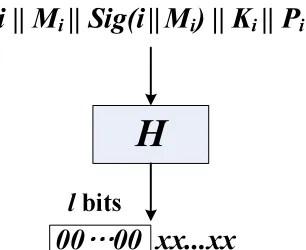
and the puzzle key Ki constitute a message specific puzzle. A valid solution Pi is such a
value that after applying the hash function H to i||Mi||Sig(i||Mi)||Ki||Pi, the first l bits of
the resulting image are all “0”, as illustrated in Figure 3.4. The parameter l determines the strength of the puzzle. Before transmitting the signature packet, the base station first tries to solve the puzzle by finding the puzzle solution Pi. Then the base station broadcasts the final
signature packeti||Mi||Sig(i||Mi)||Ki||Pi.
Upon receiving a signature packet, each node first verifies that the puzzle key is valid using
H andK0(or a previously verified puzzle key) and that the puzzle key has not been used along
with a valid signature before. Only when this verification is successful does the node verify the puzzle solution. If the puzzle solution is invalid, the receiver will simply drop the signature packet. Thus, without first solving some message specific puzzles with a fresh puzzle key, the adversary cannot force a node to verify signatures in forged packets.
H
i || M
i|| Sig(i || M
i) || K
i|| P
i00
00 xx...xx
l
bits
Figure 3.4: Message specific puzzles.
solution can only be found through brute-force search due to the one-way property of the hash function. Moreover, though it takes the same effort for both the base station and the adversary to solve a puzzle formed by a signature packet, the base station has a clear advantage over the adversary due to the prior knowledge of the puzzle keys: The base station has enough time to solve a puzzle off-line before disseminating a new code image. In contrast, the adversary has to solve puzzles after seeing a puzzle key but before the puzzle key becomes invalid when the signature packet reaches the target sensor nodes. Thus, with an appropriate puzzle strength, the message specific puzzle mechanism substantially increases the difficulty of launching DoS attacks against signature packets. Detailed analysis of message specific puzzles can be found in [47].
3.3
Analysis
3.3.1 Security Analysis
wherei= 1,2, ..., P −1. In summary, if the adversary injects a forged or modified code image, each receiving node can detect it easily because of the (immediate) authentication of code dissemination packets.
Resistance to DoS Attacks: As discussed in Section 1.1.1, there are three types of DoS attacks against Deluge based code dissemination: (1) DoS attacks exploiting authentication delays, (2) DoS attacks exploiting the expensive signature verifications, and (3) DoS attacks exploiting the Deluge propagation and suppression mechanisms.
Seluge is resistant to all three types of DoS attacks from external attackers. Due to the page-by-page dissemination strategy, upon receiving a packet, each node should have already received its hash image in the corresponding packet of the previous page (or in a hash packet in page 0). Thus, it can immediately authenticate any packet it receives in the current page, and successfully defeat DoS attacks exploiting authentication delays. Moreover, because of the use of message specific puzzles [47], each node can perform a few efficient hash function operations and comparisons to detect fake signature packets. Thus, Seluge provides resistance to DoS attacks that send fake signature packets. Finally, Seluge uses cluster keys to authenticate every advertisement or SNACK packet. As a result, an external attacker cannot convince regular nodes to misuse the propagation or suppression mechanisms.
Seluge can successfully defeat the first two types of DoS attacks even if there are com-promised nodes. Indeed, without the private key and the unreleased puzzle keys on the base station, even an inside attacker cannot forge any code dissemination packets. However, Sel-uge cannot entirely prevent compromised nodes from launching the third type of DoS attacks that exploit the Deluge propagation and suppression mechanisms. A compromised node may misuse Deluge propagation and suppression mechanisms to mislead its neighbors. Fortunately, such DoS attacks are hard to coordinate and easy to detect, and the impacts are local to the compromised nodes. We will investigate how to detect such misbehaving nodes in the future.
3.3.2 Performance Analysis
Communication Overhead: We denote the code image as CI, and the maximum payload size per packet as|payload|. We first analyze the communication overhead to set up cluster keys between neighbor nodes, and then derive the communication overhead to disseminate a code image. We omit the analysis of overhead due to advertisement and request packets, because it remains the same as in Deluge.
the total number of hello and cluster key packets that each node transmits is limited, though it varies depending on the actual deployment parameters.
The communication cost for propagating a code image includes a signature packet, hash packets, anddata packets.
The total number of data packets depends on P, the number of the pages. Given the parameters N (number of packets per page), |payload| (payload size available for code), and |H(·)| (size of a hash image), P can be determined as follows: Since each packet in all the pages except for the last one should deliver a single hash value, each packet in page 1 to page
P−1 has |payload| − |H(·)| bytes available for code, and each packet in page P has|payload| bytes all available for code. Thus, we can calculate P −1 =⌈N|·CI(|payload|−N·|payload|−|H(·)||)⌉. The number of packets in the last page can be calculated as⌈|CI|−N(P−|1)(payload|payload| |−|H(·)|)⌉, which may be less thanN. Thus, the total number of data packets is (N(P −1) +⌈|CI|−N(P−|1)(payload|payload| |−|H(·)|)⌉), whereP −1 =⌈N|·CI(|payload|−N·|payload|−|H(·)||)⌉.
Now consider the number of hash packets in page 0, which is the number of leaves in the Merkle hash tree. As discussed in Section 3.2.1, the number of hash packets isM = 2k(k≥1),
where k is the minimum value that satisfies the following inequality: N·|2Hk(·)| +k· |H(·)| ≤
|payload|.
Storage Overhead: Now we analyze the maximum buffer size required on each node. In Seluge, each node needs to authenticate advertisement and request packets from its neighbors using the right cluster keys. Thus, each node should store these cluster keys. Suppose each node keeps at most m cluster keys for its neighbors. Moreover, each node needs to store the hash images of the packets in the page to be received; such hash images are distributed in the corresponding packets in the previous page. Note that once a packet is received correctly, its hash image can be discarded, and the buffer entry can be reused for the hash image of the packet in the next page. Thus, each sensor node needs to have buffer for at most N hash images. In total, the maximum buffer size required by Seluge on each sensor node ism× |Kc|+N× |H(·)|,
where|Kc|denotes the size of a cluster key.
Computation Overhead: Now we analyze the computation cost that Seluge requires on regular sensor nodes. Let us first consider attack-free cases. For each cluster key message, a sender adds message integrity code (MIC) for authentication and then encrypts the cluster key. A received cluster key packet is decrypted first and then verified with the MIC in the packet. Therefore, one MIC generation (or verification) and one encryption (or decryption) per trans-mission of a cluster key message are required on the sender (or receiver). Each advertisement or SNACK packet requires a MIC for authentication, and thus a sender (or a receiver) needs to generate (or verify) a MIC.

![Figure 2.2:The main concept for authentication in [31, 17]](https://thumb-us.123doks.com/thumbv2/123dok_us/1689913.1213562/21.612.103.530.627.658/figure-main-concept-authentication.webp)
![Figure 2.3:An example Merkle hash tree of the approach in [14]](https://thumb-us.123doks.com/thumbv2/123dok_us/1689913.1213562/22.612.137.498.75.251/figure-example-merkle-hash-tree-approach.webp)