Copyright 0 1995 by the Genetics Society of America
Genes that Regulate Both Development and Longevity
in
Caenorhabditis elegans
Pamela
L.
Larsen,' Patrice
S.
Albert
and
Donald L. Riddle
Molecular Biology Program and Division of Biological Sciences, University of Missouri, Columbia, Missouri 6521 1
Manuscript received November 11, 1994 Accepted for publication January 11, 1995
ABSTRACT
The nematode Caenorhabditis elegans responds to conditions of overcrowding and limited food by arresting development as a dauer larva. Genetic analysis of mutations that alter dauer larva formation (dufmutations) is presented along with an updated genetic pathway for dauer us. nondauer develop- ment. Mutations in the duf-2 and daf-23 genes double adult life span, whereas mutations in four other dauer-constitutive genes positioned in a separate branch of this pathway (daf-1, daf-4, daf-7 and daf-8)
do not. The increased life spans are suppressed completely by a daf-16 mutation and partially in a daf- 2; daf-18 double mutant. A genetic pathway for determination of adult life span is presented based on the same strains and growth conditions used to characterize Dafphenotypes. Both dauer larva formation and adult life span are affected in daf2; daf-12 double mutants in an allele-specific manner. Mutations in daf-12 do not extend adult life span, but certain combinations of d a f 2 and d a f 1 2 mutant alleles nearly quadruple it. This synergistic effect, which does not equivalently extend the fertile period, is the largest genetic extension of life span yet observed in a metazoan.
P
OSTEMBRYONIC development of Caenorhabditis ekgans proceeds through four larval stages ( L l - L4) to the adult when environmental conditions are favorable for growth and reproduction. A developmen- tally arrested dispersal stage, the dauer larva, may form at the second molt in response to high population den- sity, as measured by a constitutively produced dauer- inducing pheromone, and limited food (GOLDEN and RIDDLE 1984a). The L1 responds to a high phero- mone/
food ratio by molting to a predauer stage called the L2d, which feeds and stores nutrients in intestinal and hypodermal granules. Under continuing dauer-in- ducing conditions, L2d larvae molt to the dauer stage, shrink radially and become resistant to detergent treat- ment. The nonfeeding dauer larva has unique meta- bolic ( WADSWORTH and RIDDLE 1989) and morphologi- cal characteristics (ALBERT and RIDDLE 1983) that are reversed when development resumes in response to a low pheromone/
food ratio.Mutations in genes involved in dauer larva formation are divided into two main classes, dauer-defective muta- tions (dafd) that prevent dauer development, and dauer-constitutive mutations (dafc) that mandate entry into the dauer stage (RIDDLE et al. 1981 )
.
Expression of the Daf-d phenotypes is nonconditional, whereas mu- tations in most dafc genes are temperature sensitive ( SWANSON and RIDDLE 1981 ).
Based on interpretation of epistatic relationships between dafc and dafd muta-Currespondingauthm: Donald L. Riddle, Molecular Biology Program, 311 Tucker Hall, University of Missouri, Columbia, M O 65211. E-mail: [email protected]
em California, Los Angeles, CA 90089.
'
Present address: Andrus Gerontology Center, University of South-tions, the genes have been ordered in various genetic pathways that share the broad representation of sensory reception of environmental cues followed by neural sig- nal transduction and subsequent morphogenetic re- sponse (RIDDLE 1988; VOWELS and THOMAS 1992; THOMAS et al. 1993; GOTTLIEB and RUVKUN 1994). Se- quence analysis of the daf-c genes cloned thus far indi- cates that they play roles in protein growth factor-medi- ated intercellular signal transduction ( GEORGI et al.
1990; ESTEVEZ et al. 1993; LIM 1993).
The proposed genetic pathways differ from each other in gene order and organization into multiple branches. Separate branches of the pathways are par- tially redundant and are thought to act together to con- trol dauer larva formation. Genes positioned early in the pathways involve pheromone production (GOLDEN and RIDDLE 1985) and response to environmental sig- nals by chemosensory neurons. Amphid neurons are implicated in the latter function because the dendritic processes of these neurons are structurally abnormal in some Daf-d mutants (LEWIS and HODGKIN 1977; ALBERT
et al. 1981; PERKINS et al. 1986) and because killing a subset of the amphid neurons in wild-type L1 larvae with a laser microbeam leads to constitutive dauer larva formation ( BARGMANN and HORVITZ 1991 )
.
VOWELS and THOMAS (1992) proposed that the dafc gene daf-11 is directly involved in chemosensory transduction, whereas other dafcgenes act downstream of the chemo- sensory step. THOMAS et al. (1993) then grouped all of the genes known to affect amphid structure or function in a separate branch of their pathway based on gene interactions and phenotypic criteria. GOTTLIEB and RWKUN (1994) have reported genetic interactions be-
1568 P. L. Larsen, P. S. Albert and D. L. Riddle
tween three genes, daf-2, daf-23 and daf-16, which make up a branch of the pathway acting in parallel with or downstream of other branches.
As regulators of dauer larva morphogenesis, dafgenes control functions that enable the efficient life mainte- nance necessary to be an effective dispersal stage. The dauer stage has been termed nonaging because the mean postdauer life span and reproductive capacity are not affected by a prolonged dauer stage of up to 60 days ( KLASS and HIRSH 1976). The apparent resilience of dauer larvae to the passage of time may be in part due to external and intracellular resistance to damage. Increased resistance to oxidative damage-inducing agents and increased levels of superoxide dismutase are correlated with increased life span in the C. elegans age- 1 mutant (LARsEN 1993; VANFLETEREN 1993) and in dauer larvae (ANDERSON 1982; LARSEN 1993). It was known that the effects of some daf mutations are not limited to dauer larva development because there are adult phenotypes affecting egg laying, chemotaxis and body size (RIDDLE 1988). In principle, adult life span might be increased in dafc mutants if these mutations inappropriately induce dauer-related nonaging func- tions in adult animals.
Recently, KENYON et al. (1993) observed that daf2 mutants have doubled adult life spans and that the daf- 2 ( e1370) longevity phenotype is suppressed by a daf- d mutation in daf-16, which was previously shown to suppress the Daf-c phenotype of daf-2 (RIDDLE et al. 1981 )
.
These results suggest that mutations in daf-2 extend life span by allowing inappropriate activation of dafl6function ( KENYON et al. 1993). We are interested in defining the extent of genetic parallels between dauer formation and adult longevity because such par- allels could represent heterochronic expression of dauer-specific life-maintenance functions that promote adult longevity.We have examined daf genes that function late in the genetic pathway. Although we placed daf-12 and daf-2 in separate branches of the dauer pathway (RIDDLE et al. 1981 ) , our recent studies reveal a complex pattern of allele-specific interactions in daf-2; daf-12 double mu- tants. Also, there is a synergistic effect of daf-12 muta- tions on increased adult longevity that was specific to
dafZ( e13701 and not seen with d a f 2 ( d l ) . These in- teractions parallel the allele-specific affects on the Daf phenotype. The daf-c mutations in genes that increase adult life span define a separate branch of the dauer formation pathway from those that do not. Interpreta- tion of epistatic relationships reveals a genetic hierarchy for determination of adult life span.
MATERIALS AND METHODS
Culture methods and mutations used Nematodes were grown on NG agar medium seeded with Escherichia coli strain OP50 ( BKENNER 1974) and maintained at 15" except as indi- cated below. All mutants were derived from the wild-type N2
strain ( BRENNER 1974) . Genetic nomenclature follows guide- lines described by HORVITZ et al. ( 1979). Phenotypes are ab-
breviated as Daf-c (dauer-constitutive) , Dafd (dauer-defec- tive) , Dpy (dumpy, short body), Egl (egg-laying defective), Fer (fertilization defective), Sma (small adult size) , Unc (un- coordinated movement), and ts (temperature sensitive). Mu- tations used are listed by linkage group as follows: LC I: dpy-5( e 6 1 ) , d a f S ( m85ts), unc-29( eIU72), daf16( m26 and
m 2 7 ) , unc-75 (e950) ; LG 11: fer-15( b26ts), age-1 ( hx546), unc-4( e120), daf19( m86ts), daf2?( m?33), rol-1 ( e 9 1 ) , daf
5( e1386), unc-52( e444 and su250ts), mnCl[ dpy-IO( e128) unc-52( e 4 4 4 ) I ; LG 111: daf-7( e1372ts and n696ts), daf 2(e1370ts, m4lts and m 6 5 ) , daf-4(e1364ts and m72ts), unc- ?2( e189), qCl[ dpY-l9( e1259ts) glp-I (q??9) ] ; LG M daf 1 (m40ts), daf18( e1?75), dpy-9( e 1 2 ) , dpY-l?( e 1 8 4 s d ) , daf
14( m77ts), unc-22( s7) ; LC X daf-3( e1?76), dpy-?( e 2 7 ) , unc-27(e155), daf12(m20, m25, m116 and m583), unc- 5 8 ( e665d), eg1-15( n 4 8 4 ) .
Complementation and mapping data: Observations made while testing dafd mutants d a f - l Z ( m20) X and daf-20( m25)
Xfor genetic interactions with Daf-c mutants led us to repeat complementation tests with these two alleles and test two oth- ers, each of which has slightly different genetic or phenotypic
( d a f d or variably long adult) properties. All were subse- quently shown to be allelic, so the daf-20 name is no longer used. For complementation testing, unc-27 daf12( m20) her- maphrodites were mated with males hemizygous for daf- 12( m20, m25, m116, or m58?) or with wild-type males as a control. Several L4 hermaphrodite cross-progeny were placed singly on plates (20"), and the resulting populations were screened visually for the presence of dauer larvae ( o r dauer- like larvae) -5 days after the bacteria were depleted, then were rinsed into 13-mm diameter round-bottom tubes and treated with 1% sodium dodecyl sulfate (SDS) by the method of CASSADA and RUSSELL ( 1975). Similar complementation tests were conducted with males hemizygous for m2U or m58?
mated with dpy-13; daf12( m25) hermaphrodites. Wild-type, homozygous mutant, and m 2 0 / + controls were scored in parallel with experimental populations. Only the wild-type and m20/
+
controls yielded large numbers of SDSresistant animals (dauer larvae). The m25 control population pro- duced some dauer-like larvae that initially were resistant to SDS (30 min) , but during a 2.5-hr period they ceased vigor- ous movement and some died. Dauer-like larvae also were observed in populations started with an animal heterozygous for m25. N o dauer-like animals were observed on any other plates.Based on two-factor data, m25 was previously positioned to the right end of X , left of unc-3 (VOWELS and THOMAS 1992). The m20 allele of daf-12 has been positioned within a twc- map unit interval between unc-27and egl-15 (YEH 1991). Cur- rent work confirms that the m25 allele is in this same interval. Twelve F, progeny of 10 Unc non-Egl and 10 Egl non-Unc recombinants picked from f daf12( m25)
+
/ unc-27 + cgl-15Dauer Development and Adult Longevity 1569
were also tested. Only one of 67 non-Unc animals from
+
daf-12 ( m25) / unc-58
+
produced fully SDSresistant dauer larvae upon starvation, placing daf-12( m25) close to unc-58, consis- tent with its position in the unc-27 egl-15 interval.Close linkage of daf-I to daf-18 thwarted attempts to con- struct a double mutant. A total of 208 Egl ( daf-1) adults segre- gated from daf-1
+
/+
daf-18 heterozygotes were transferredto separate plates at 25.5'. No adults or dauer-like progeny characteristic of daf-18 were observed on any of the plates over a M a y period.
Construction of unlinked &f<; dafd double mutants: The
daf-c; dafd strains used in a previous study (RIDDLE et al. 1981 )
also were homozygous for non-Daf visible markers used to facilitate strain construction. In some instances use of such markers decreased the penetrance of the daf-c mutation. To avoid this, strains constructed for this study contained only daf mutations. The method of strain construction used was determined by whether the duf-d mutation was expected to
suppress the daf-c mutation (RIDDLE et al. 1981 ) and whether the two genes were linked.
In the case of suppressed, unlinked double mutants, dafd males were mated with ts daf-c hermaphrodites at 20", then shifted to restrictive temperature (25.5'). Several L4 progeny were transferred singly to seeded plates and allowed to self at 25.5'. Homozygous F2 Daf-c animals were identified either as dauer larvae, Egl adults (TRENT et al. 1983) , or in the case of daf-4, Sma adults ( ESTEVEZ et al. 1993). The dauer larvae were allowed to resume development at 15", then the progeny of postdauer, Egl or Sma adults were monitored for growth at 25.5'. Stocks of double mutants were established from a population on which all or most of the animals grew to the adult. When the penetrance of suppression was <60%, dauer or dauer-like animals were allowed to mature and their prog- enywere retested at 25.5" to verify the genotype. If the putative double-mutant strain were not homozygous for the daf-dgene, then onequarter of the retested individuals would have been expected to produce all dauer progeny.
For strains in which the daf-c mutation was unlinked to the
daf-d mutation and not suppressed by it, secondary pheno- types were used in some cases to score the double mutants. These include the dauer-like larval arrest exhibited by certain daf2; daf-l2strains and the dauer-like larvae formed by several
duf-e; daf-16 or dafc; daf-18 strains (VOWELS and THOMAS 1992). If there were no secondary phenotypes, a marker was used in trans to the daf-d mutation and subsequently segre- gated away. For example, duf5 ZZ males were mated to unc- 52( e444) ZI; duf-2( 1370) ZZZ hermaphrodites. Heterozygous F1 progeny were allowed to segregate F2 dauer larvae at 25.5", and these animals were shifted to 15" to resume development. Adults were then transferred singly to plates (15") and the Fs generation scored for the absence of unc-52.
Confirmation of dafx; dufd mutant genotypes: In most cases it was necessary to confirm the homozygosity of the duf- cmutation by resegregating constitutively formed dauer larvae from each of 4-6 heterozygotes derived by mating putative double-mutant hermaphrodites with wild-type, dpy-l3/+ or unc-22/
+
males. The paternal markers allowed identification of F1 cross-progeny. For the double-mutant strains in which the daf-c mutation was not suppressed, the homozygosity of the dafd mutation was confirmed by a modified complemen- tation strategy. In the case of unlinked mutations, this in- volved mating Dafd males with individual putative double- mutant hermaphrodites carrying the same daf-d mutation. Three hermaphrodites were tested for each double mutant strain. Several FI progeny from each initial cross were selfed at 25.5" to distinguish cross progeny ( d a f - e / + ; dafd) from the suppressed double mutant based on the percentage ofdauer larvae present. Twenty nondauer F2 animals from a
single F, from each of the three initial crosses were transferred singly to individual plates at 25.5". Five to seven of each set of 20 FS populations lacked constitutively formed dauer larvae in the first generation. These were later scored for starvation- induced dauer larvae, the absence of which from all test plates confirmed that the putative double mutant was homozygous for the daf-d mutation.
Construction of linked dufx dafd double mutants and con-
firmation of genotypes: Several methods were used to con- struct double mutants carrying linked daf-c and dafd muta- tions. Because daf-18 and daf-14 are not closely linked, the double mutant was constructed as described for unlinked dou- ble mutants, except that the 25.5" progeny of a larger number of postdauer adults were examined for the presence of dauer- like animals (homozygous for both mutations) segregated from a recombinant parent. Construction of daf-8 daf-16 was facilitated by selecting non-Unc recombinant dauer larvae segregated at 25.5" from daf8 unc-29
+
/+ +
daf-16 heterozy- gotes. Individual dauer larvae were allowed to resume devel- opment and self at 15". Non-Unc segregants from daf-8+
daf-16/ daf-8 unc-29
+
were transferred singly to fresh plates at 15". The double-mutant stock was started from a wild-type animal that failed to segregate Unc progeny and also formed dauer-like larvae at 25.5'.The daf-23 duf-5/mnCl[ dpy-IO unc-521 strain was con- structed by mating duf5 ( e1386) males with duf-23 ( m333) unc-
52( su25ots) hermaphrodites, the latter having been identi- fied as maternally rescued Egl Unc progeny of a daf-23 unc-
52/
+
unc-52 parent. Individual Egl non-Unc recombinants were picked from duf-23+
unc-52/+
daf5+
hermaphrodites and mated with unc-4/ mnCl males to balance the recombi- nant chromosome. Cross progeny were placed singly on fresh plates and allowed to self. The daf-23 daf55/ mnCl animals, identified based on the segregation of both Egl (daf-23) and Dpy Unc ( m n C I ) adults, were tested for the presence of daf-5 by reisolating the dauer-defective mutant. Unc non-Rol re- combinants from three unc-4
+
rol-1+ / +
daf-23+
daf5 hermaphrodites were picked, and 20 Unc non-Rol segregants from each of several recombinants were tested for the Daf-d phenotype. The absence of starvation-induced dauer larvae in some of the populations indicated the presence of daf5 in the original strain.Construction of daf+ dafd double mutants carrying a non-
conditional dafx allele: The daf-2( m65) ZZZ mutation results in nonconditional dauer larva formation. Consequently, con- struction of the double mutant carrying daf-18( e1375) N u t i - lized qCI [ d p y - l 9 ( e1259t.s) glp-1 ( q339) ] to balance m65. The first step involved construction of daf-2( m65) /qCl ZZZ; dpy-9
N. Construction steps were performed at 20', at which the Dpy-19 and Dpy-9 phenotypes are easily distinguished. Males of genotype daf-2/ qC1 were mated with dpy-9 hermaphrodites and individual F, males of genotype daf-2/+; d p y - 9 / + or qC1/
+;
dpy-9/+
were then backcrossed with daf-2/ qCl her- maphrodites. F2 animals of genotype duf-2/qCI; dpy-9/+
were identified based on F, phenotypes. A Dpy-9 segregant was selected to establish a temporary stock of duf-2/qCl;
The second step involved introducing daf-18 by mating daf- 2/ qC1; dpy-9hermaphrodites with daf18males. F, males ( d a f -
2/
+
; dpy-9 + /+ daf-I8
and qCI /+
; dpy-9+
/+
duf-18) were then backcrossed with daf-2/ qC1; dB-9 hermaphrodites and wild-type L4 progeny were placed individually on fresh plates to identify daf-2,' qC1; dpy-9+
/+
duf-18 animals by observing their progeny. The daf-2/ qCI; duf-I8 stock was started from a hermaphrodite that did not segregate dpy-9 progeny. The presence of daf-18 in the m65 genetic background was con- firmed in that the strain segregates constitutively formed, dauer-like larvae (they exhibit sporadic pharyngeal pump-1570 P. L. Larsen, P. S. Albert and D. L. Riddle
i n g ) , whereas m65 alone results only in the formation of nonfeeding dauer larvae.
The protocol for construction of duf-16( m26) I; duf-2( m65)
IIIwas based on the prediction that daf16would suppress the Daf-c phenotype of m65, as was observed with duf-2( e1370).
Markers used to facilitate construction included unc-32( e189) to balance m65, and dpy-5( e61) to follow segregation of m26.
The first step was construction of daf-16/
+
; daf-2+
/+
unc- 32. Males homozygous for duf-16 were mated with dpy-5; unc- 32 hermaphrodites. The F, males then were mated with duf- 2+
/+ unc-32
hermaphrodites and wild-type L4 progeny were picked individually to fresh plates. Genotypes of these animals were determined based on the phenotypes of their progeny. Suppression by daf-16 was assessed by scoring the progeny ofindividual daf-l6/
+
; daf-2+
/+
unc-32 hermaphrodites. A stock was established from an animal that produced neither Unc adults nor constitutive dauer larvae. The daf-16; daf-2genotype was verified by complementation testing.
Construction of daf16(m26); daf2(e1370); &.12(m20):
Preliminary steps for constructing the triple mutant involved heat-shock induction ( SUISTON and HODCIUN 1988) of duf- 1 6 ( m 2 6 ) I; daf2( eI370) III and daf2(e1370) IZt daf 12( m20) X males. A du.16 I; daf-2 HI; unc-27 egl-15 X strain then was constructed in two phases by mating duf-2/
+
males with unc-27 egl-15 hermaphrodites, putting individual wild- type F1 L4 larvae on fresh plates at 25.5", and selecting F2 Unc dauer larvae, which were transferred to 15" to resume development. One Unc Egl Daf adult was chosen to establish a daf-2; unc-27 egl-15 stock.In the second phase of construction, daf-16; duf-2 males were mated with the daf-2; unc-27 egl-15 hermaphrodites at
20". Several L4 cross progeny, homozygous for duf-2, were put individually on fresh plates at 15" until the adult stage to by- pass dauer formation and increase fertility, then shifted to 25.5" to select for daf-16 segregants based on suppression of
daf2 dauer formation. A daf-16; daf-2; unc-27 egl-15 stock was established from an Unc Egl F2 adult that did not segregate dauer larvae at 25.5", so the presence of daf-2 was confirmed by mating with wild-type males and resegregating constitu- tively formed dauer larvae from five of five heterozygotes.
To construct the desired triple mutant, duf-2; duf-12 males were mated with the daf-16; daf-2; unc-27 egl-15 hermaphro- dites at 15". Individual L4 cross progeny were transferred to fresh plates at 15" and after reaching adulthood, were shifted to 25.5" for selfing. A non-Unc animal that grew to the adult at 25.5" and did not segregate either Unc Egl animals or dauer larvae was used to establish a daf-16; duf-2; duf-12 stock.
The presence of daf-2 and daf-16 mutations was confirmed based on complementation ( daf-2) and the ability of daf-16
to dominantly suppress the Daf-c phenotype of daf-2 in a daf- 12( m20) background ( GOTTLIEB and RUVKUN 1994). Dupli- cate crosses between duf-2( e1370) males and putative triple- mutant hermaphrodites were started at 15" and shifted to
25.5" the next day. The Po's were transferred to fresh plates daily for 2 more days and the progeny from each day's brood scored after 3 days. Both dauer larvae and adult males were observed in the F1 , indicating the presence of both daf-2 and
duf-16 in the triple mutant.
The presence of duf-12was determined by resegregation of the X-linked Daf-d trait. First, males of genotype duf-16/
+;
daf-2/+;
daf-12/0 were mated with unc-27 egl-15 hermaphro- dites. Wild-type L4 progeny were then transferred individuallyto fresh plates at 25.5" to identify those not segregating consti- tutively formed duf2dauer larvae. Progeny of one such animal were put on fresh plates to identify populations in which Unc Egl adults were absent, and therefore presumed to be homozygous for daf-12. Fifteen such populations were scored later for the presence of starvation-induced dauer larvae.
Their absence from all test plates confirmed that the triple mutant was homozygous for duf-12.
Daf phenotypes: The percentage of L4 and adult animals formed by the double mutants and the triple mutant at 25.5" was based on observations of synchronous populations at spe- cific intervals during a 4-5-day period. Approximately 20-24 adult hermaphrodites were allowed to lay eggs on seeded NG plates for -4 hr at 20" and then were removed. The plates were shifted to 25.5" and the populations monitored for dauer and nondauer development starting 48-50 hr after the mid- point of the egg-laying period, and at least daily thereafter. Fourth-stage larvae and adults were removed as necessary to prevent contamination by offspring. The daf-c controls were assayed simultaneously. The only known duf-14 mutation is not 100% penetrant at 25.5'. Consequently, the percentage of nondauer development for nearly all daf-14; dafd double mutants (Table 1 ) was reduced by 1-3% to reflect the back- ground growth by daf-14 alone. The percentage for daf- 16( m26); daf-14 was reduced by 18%, because 18% of the
duf-14 control animals grew to the adult in that experiment. From the time of egg laying a minimum of 60 hr is required for a mutant animal to become a dauer larva and recover to the L4 stage ( B E ~ , Y et aH 1976; SWANSON and RIDDLE 1981; GOLDEN and RIDDLE 198413). Hence, L4 larvae and adults scored 50 hr after the midpoint of the 4 h r egg-laying period resulted from nondauer development rather than recovery from a dauer larva. This focuses the study on entry into the dauer state.
Construction of fm-15; dafc double mutants: Males hetero- zygous for the daf-c mutations were mated with fer-15( b26ts)
raised at 25.5", a temperature at which b26 fails to produce sperm. Single F, hermaphrodites were placed on plates at 25.5" and F2 dauer larvae (homozygous duf-c) were trans- ferred to 15" to resume development. To test for fpf-15, indi- vidual adults were allowed to lay eggs overnight at 15" and then were transferred to fresh plates. The Fs progeny from this egg-laying period were shifted to 25.5" after the tempera- ture-sensitive period for dauer larva formation ( SWANSON and
RIDDLE 1981), and subsequently checked for oocytes laid by the adults. Each fer-15; duf-cstock was started from one animal that had been maintained at 15". The fer-15; duf-4 double mutant was constructed by placing F1 hermaphrodites at 15" and selecting individual small adults (homozygous duf-4),
which were subsequently tested for Fer-15.
Construction of a daf16; age-1 strain: Strains carrying age- 1 also carry the closely linked fer-15 mutation because age- 1 was identified in this genetic background (FRIEDMAN and JOHNSON 1988). Hence, the ts Fer-15 phenotype was used to follow age-1 in strain constructions. Males homozygous for duf- 16 were mated with dpy-5 ( e61 ) unc-75 ( e950) ; fer-15 ( b26) uge- 1 ( hx546), and a ts sterile F2 derivative that did not segregate Dpy Unc progeny was saved as a stock for life-span analysis.
Adult life span: The animals for life-span analysis were raised at 15". For experiments at the restrictive temperature, animals were placed at 25.5" as L4 larvae or young adults. The first day of adulthood is day 1 in the survival curves presented. The adult life span of homozygous duf-23( m333)
Dauer Development and Adult Longevity 1571
C
P
2
P
B
two independent trials were performed for each strain, and the figures show the data from representative trials. Statistical analyses were performed using SAS version 6.04 (SAS Insti- tute, Cary, NC) . Values reported are the mean ? SE, and the last quartile (25% survival).
Reproductive capacity and schedule: Hermaphrodites were raised at 15" until the L4 stage, then shifted to 25.5". Each individual was transferred to a new plate every 24 hr for 10 days. The difference in age of the individual animals could have varied as much as 15 hr (the duration of the L4 stage)
.
The progeny were raised at 15" and counted when they be- came L3 or L4 larvae.RESULTS
Epistasis analysis of dauer-constitutive, dauerdefec- tive double mutants: Based primarily on double-mu- tant phenotypes, daf genes have been ordered in path- ways thought to represent the hierarchy of steps involved in dauer larva formation (RIDDLE et ul. 1981; VOWELS and THOMAS 1992; THOMAS et al. 1993; GOTT-
LIEB and RUVKUN 1994). However, the gene order inter- preted from the mutant analyses differs. We have conducted a new epistasis analysis using tightly synchro- nized populations of duf-c, d a f d mutant strains that do not carry visible marker mutations (see MATERIALS AND METHODS). The phenotype exhibited by a double mu- tant at the restrictive temperature (25.5"), generally either Daf-c or Daf-d, is that of the epistatic gene, which is interpreted to define a later step in the genetic path- way ( RIDDLE et al. 1981 ) . This pathway applies to the formation of dauer larvae and not to long-term mainte- nance of the dauer state, because it is based on observa- tions of synchronous populations 50 hr after the mid- point of a 4 h r egg-laying period.
Some of the epistasis data reported here corroborates that previously published. In addition, we include data pertaining to six new alleles: the d a f d mutations daf-
12( m l 1 6 and m58?), the daf-c mutations daf-8( m85ts), duf-2 ( m4lts and m65) and m???, the original daf-c mu- tation defining daf2?. The duf-8( m85) mutant is more penetrant than the el?W reference allele used in previ- ous work. The duf-2( m4lts) allele has different proper- ties from the e1370ts reference allele, and the daf- 2 ( m65) allele results in a nonconditional Daf-c pheno- type. Homozygous m65 dauer larvae do not exit the dauer stage, so the mutation is maintained either in a balanced heterozygote or in a double mutant with daf-
16. The daf-12 alleles fail to form either dauer or dauer- like larvae, like the reference daf-l2(rn20) allele. The daf-2?( m3??) mutation results in a maternally rescued Daf-c phenotype; homozygous mutant progeny segre- gated from a heterozygous parent become Egl adults. Progeny of maternally rescued homozygous parents un- conditionally arrest development either as dauer or pre- dauer L2d larvae that no longer feed. At 25.5" the per- centage of dauer larvae formed ranges from 15% ( 4
1572 P. L. Larsen, P. S. Albert and D. L. Riddle
by day 20. Hence, the terminal stage of developmental arrest is somewhat ts for daf-23( m333)
.
The intestines of maternally rescued adults and developmentally ar- rested larvae appear darker than the surrounding tissue when viewed through the dissecting microscope, pre- sumably as a result of the accumulation of food storage granules characteristic of dauer and predauer L2d lar- vae (ALBERT and RIDDLE 1988; THOMAS et al. 1993 ).
Suppression of the Daf-c phenotype by an epistatic daf-d mutation in the double mutants divides the daf-c genes into two groups (Table 1 )
.
First, mutations in daf-1, daf-4, daf-7, daf-8, and daf-14were fully suppressed by dafd mutations in daf-3, daf-5, and daf-12( m20 and m 1 1 6 ) , but were not efficiently suppressed by daf-d mu- tations in daf-16 or daf-18. The range of suppression by daf-12( m25) for the same daf-c mutations varied widely, from 96% for daf-14 to only 8% for daf-7( e1372). This incomplete suppression by daf-12( m25),
previously re- ferred to as daf-20 (see MATERIALS AND METHODS),
sug- gested that m25 is a weak allele. Unlike other daf-12 mutants, m25 formed some dauer-like larvae upon star- vation, and the adults were not long. Dauer-like larvae possess some, but not all, of the unique characteristics of dauer larvae. The m25 dauer-like larvae closely resem- bled dauer larvae, but were not fully resistant to SDS treatment due to incomplete suppression of pharyngeal pumping (VOWELS and THOMAS 1992).In contrast to the first group of daf-c mutations, daf- 2 and daf-23 were not suppressed by d a f 3 or daf-5, but were suppressed by daf-16. In addition, daf-16( m26) was capable of suppressing daf-2 ( m65) , a nonconditional Daf-c allele. Fifty hours after the midpoint of egg laying, 91 % of daf-16( m26) ; daf-2 ( m65) progeny developed into L4 larvae or adults ( n = 139) at 25.5" and the other 9% arrested development as L1 or L2 larvae. Al- though this strain was viable at 15", mutant larvae that matured at 25.5" laid eggs that did not hatch. Hence, this strain is a ts embryonic lethal mutant.
Whereas daf-16 was epistatic to both daf-2 and daf-23, daf-18was epistatic to daf-23, but not daf-2( e1370). The daf-18( e1375) mutation was previously reported (VOW- ELS and THOMAS 1992; GOTTLIEB and RUVKUN 1994) not to suppress daf-2( e1370). Our results are consistent with that, and show that 50 hr after egg laying only 3% of the double mutant progeny grew to the adult at 25.5", although 96% grew by day 5. The duf-18 mutation also did not suppress daf-2( m65). The double mutant formed dauer-like larvae simiiar to those formed at low frequency by the daf-18 strain; they were radially shrunken but fed sporadically. The percent suppression exhibited by daf-23; daf-18 mutants depends on the daf- 23 allele. The three known daf-23 alleles, m333, mg44 and mg55, are all nonconditional and maternally res- cued. Data pertaining to m333 are presented in this study, and that for the other alleles is from GO'ITLIEB
and RWUN (1994). Based on the percentage of ani- mals that complete dauer larva morphogenesis, mg55 is
the most severe allele. This is also true with regard to epistasis. Both m333 and mg44 were completely sup- pressed by daf-18( e1375), but only a small percentage of daf-23( mg55) ; daf-18( e1375) animals grew to the adult. However, mg55 was induced by gamma irradia- tion and appears to be a complex rearrangement ( GOTTLIEB and RUVKUN 1994). Therefore, other loci could be affected in addition to daf-23. Also, daf- 18( e1375) might be a weak allele; it is the only known mutation defining the gene. Until further information is obtained, we consider daf-18 to be epistatic to daf-23.
In summary, there are two branches in the genetic pathway (Figure 1, A and B ) because the dafd muta- tions daf-16 and daf-18 are not epistatic to daf-c muta- tions in d a f l , daf-4, daf-7, daf-8, and daf-14, yet are epi- static to duf-23. In addition, the daf-d mutations daf-3 and daf-5 are epistatic to daf-I, daf-4, daf-7, daf-8, and daf-14, but not to daf-23 or daf-2. We refer to these two branches of the pathway as the duf-1 and daf-2 branches, respectively.
Novel phenotypes in double mutants: Certain daf-c; dafd mutants displayed phenotypes unlike those of ei- ther parent. The daf-2( e1370); daf-12 mutants dis- played predauer or dauer-like arrest (Table 1 )
.
This was previously observed for the d a f 2 ( e 1 3 7 0 ) ; daf- 12( m200r m25) and daf-2( e1286) ; daf-12( m20) strains (YEH 1991; VOWELS and THOMAS 1992). We observed that daf-2( e1370) ; duf-12 double mutants constructed with four independent alleles of daf-12 each arrested development with subtly different phenotypes. The daf- 2 ( e1370) ; daf-12( m25) double mutant was most like daf-2( e1370) alone, but formed a small percentage of SDSsensitive animals with incomplete radial body shrinkage. Resistance to 1% SDS is normally acquired -1 hr after radial shrinkage ( SWANSON and R ~ D D L E 1981). The daf-2( e1370) ; daf-12( m20 and m116) ani- mals arrested at about the size and morphology of an L2d with only sporadic pharyngeal pumping. A few ani- mals appeared to initiate, but not complete, radial shrinkage of the body. The daf-2( e1370) ; daf-12( m583) animals fed more and consequently grew larger than the other daf-2( e1370) ; daf-12 double mutants. Some initiated abnormal vulval differentiation. At 22.5", daf- 2 ( e1370) formed dauer and L2d larvae, but the four daf-2( e1370) ; daf-12 double mutants developed slowly into sterile adults, with the exception of an occasional m583 double mutant that was fertile. Hence, the daf-12 mutations tested were not epistatic to daf-2( e1370), but they produced novel, intermediate phenotypes. A rank- ing of daf-12 alleles in order of increasing severity ( m25<
m20 = ml16 < m583) might be inferred from these results, but this order is not maintained with respect to the fecundity or life-span phenotypes.Dauer Development and Adult Longevity 1573
A.
daf-1 daf4 dsf4daf-7 +&f4 daf-8
daf-14 daf-12
dauer
daf-2 daf-23
+
daf-16 adult longevity
B.
daf-12 T I
daf-23
+
daf-18 "-I daf-2 4 d8f-16+
dauerI I
'
' d8f-12
T I
I L
d8f-2
+
d8f-f8+
daf-23+
d8f-16 4 adult IOnQeVltyFIGURE 1.-Genetic pathways for dauer larva formation and adult life span. The pathways are drawn to depict wild-type gene functions that inhibit subsequent steps. The daf-2 and daf-12 genes are represented in a mutually antagonistic rela- tionship. The daf-c genes are daf-1, daf-2, daf-4, daf-7, daf-8, daf-14, and daf-23, mutations in which result in constitutive dauer larva development. The d a f d genes are daf-3, daf-5, daf-
12, daf-16, and daf-18, mutations in which prevent dauer larva development in response to the dauer-inducing pheromone. The daf-1 and daf-2 branches of the pathway are both required for dauer larva development, because mutations in either branch result in a Daf phenotype. Only the daf-2 branch is required to promote adult longevity (because the daf-1 group of dauerconstitutive mutants do not increase adult life span), yet daf-12 mutations modulate the longevity phenotype of daf-
2 mutants. (A) A partial pathway that omits daf-18 and the upstream genes that have pleiotropic effects on amphid sen-
sory functions. Omitting duf-18 reconciles the dauer and life span pathways as shown. A common pathway for both dauer formation and longevity that incorporates daf-18 requires re- interpretation of two sets of epistasis data and is presented in the DISCUSSION. ( B ) The daf-2 branch of the dauer formation pathway with daf-18 included. The pathway represents epi- static interactions observed at 25.5" between d a f d mutations and daf-c mutations as scored in double mutants 50 hr after the midpoint of a 4 h r egg-laying period. Suppression of the Dafc phenotype by an epistatic daf-d mutation is defined as growth of at least twethirds of the experimental animals to adults (Table 1, values >67% )
.
( C ) A pathway for determina- tion of adult life span that includes data for daf-18. The data are presented in Tables 3 and 4 and in Figures 3 and 4.T h e daf-c phenotype of daf-2( m41) was not weaker than that of e1370. All animals of both mutants developed into dauer larvae when raised at 25.5". The phenotypes differed only slightly at 20"; e1370 formed 0.6% 5 0.9 dauer larvae ( n = 1290) and m41 formed 16% 2 3.4 dauer-like larvae ( n = 1377) that had radially shrunken bodies but exhibited small pharyngeal movements. Nei- ther mutant forms dauer larvae at 15". In terms of direct nondauer development at 20", e1370 is more wild type than m41.
T h e daf-12 mutations tested did not suppress daf-
Adult age (days)
FIGURE 2.--Survival curves for daf-c mutants. Populations of animals were raised at 15" and then shifted to 25.5" either as young adults (closed symbols) or as L4 larvae (open sym- bols). Day 1 is the first day of adulthood.
23( m?33). However, the daf-23( m333) ; daf-12( m20) mutant also exhibited a novel phenotype, as was the case with daf-2( e1370) ; daf-12 double mutants. Unlike daf-23 in a daf-12( + ) genetic background, maternally rescued adult double-mutant animals segregated from daf-23/ mnCI; daf-12 did not lay eggs, even though they each possessed a vulva. Their arrested progeny, unlike daf-23 arrested larvae, eventually became less dark bod- ied and underwent some additional gonadal cell divi- sion. This gonadal development, visible in DAPI-stained animals, could not be observed using Nomarski optics due to the presence of intestinal granules responsible for the dark-intestine phenotype. In a double mutant constructed with daf-12( m20) and the weaker daf- 23( mg44) allele, -30% of the animals slowly develop into late larvae or sterile adults lacking the dark intes- tine ( GOTTLIEB and RUVKUN 1994).
In summary, the daf-23( m333) ; daf-12( m20) novel Egl and gonadal phenotypes did not involve entry into dauer formation as defined here because the double mutant progeny were similar in phenotype to daf-23 at 50 hr after the eggs were obtained. The position of daf- 12 is either upstream of daf-23 or in a different branch of the pathway. The data on daf-12 a n d daf-2 do not permit unambiguous ordering of these two genes, be- cause all tested duf-12 alleles are epistatic to m41, but not to e1370, a n d novel phenotypes were produced in the various daf-2( e1370); daf-12 double mutants. We represent these genetic interactions as a mutually antag- onistic relationship between the daf-2 and daf-12 gene products (Figure 1, A and B) similar to that proposed by GOTTLIEB and RUVKUN (1994).
1574 P. L. Larsen, P. S. Albert and D. L. Riddle
TABLE 2
Adult life spans of dauer-constitutive mutant strains at 25.5"
% of N2 Strain Life span (days)" last quartile
N2' 12.3 ? 0.51 (62) 100
daf-I (m40) 10.3 t 0.39 (53) 73
daf7(n696) 10.4 2 0.41 (39) 73
dafg(m85) 10.3 2 0.51 (41) 73
daf-I 9(m86) 10.3 ? 0.47 (63) 87
N2' 12.7 ? 0.37 (66) 100
f k I 5 ( 6 2 6 ) 14.3 2 0.31 (47) 107
fi-I5(626); daf-l(m40) 13.4 ? 0.23 (112) 107
fer15(626); daf-4(m72) 11.7 ? 0.32 (108) 93
fa-I5(626); daf-7(n696) 12.2 t 0.35 (97) 107
fm-15(626); daf8(m85) 11.7 2 0.25 (112) 93
N2* 11.2 ? 0.37 (109) 100
daf2(m41) 20.9 2 1.07 (109) 213
daf2(e1370) 26.7 ? 1.62 (83) 253
daf2(e1370); daf12(m20) 41.4 t 1.87 (114) 387
daf-23(m333) 32.7 2 3.07 (19) 300
"Values are means ? SE with no. of animals in parentheses.
'
The last quartile (25%) of the population remained alive"The last quartile remained alive on day 14. on day 15.
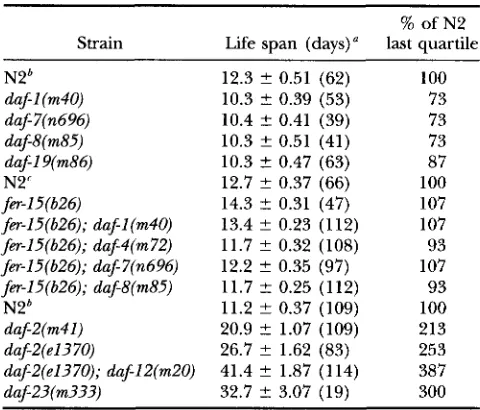
be the most likely to do so. The life spans of adults carrying ts daf-c mutations were determined at a temper- ature at which the Daf phenotype is fully penetrant. The animals were allowed to progress through develop- ment at the permissive temperature (15"), then placed at the restrictive temperature (25.5") to determine adult life span. Some mutations did not increase life span, whereas others doubled it.
Five daf-c mutations, daf-1 ( m40), daf-4( m72), daf- 7 ( n 6 9 6 ) , daf-8( m 8 5 ) , and daf-19( m86) did not in- crease adult life span (Figure 2 and Table 2 )
.
These mutants have a strong Egl phenotype (TRENT et al. 1983), so eggs hatch internally and the developing lar- vae eventually kill the mother. Animals killed in this manner during the experiment presented in Figure 2 were 8, 46, 95, 61, and 56% of the populations for N2, d a f - l ( m 4 0 ) , d a f - 4 ( m 7 2 ) , d a f - 7 ( n 6 9 6 ) , and daf- 8 ( m 8 5 ) , respectively. Animals that died due to internal hatching of eggs were considered to have died from matricide, not senescence. These matricidal deaths be- fore day7
of adulthood were excluded from all the survival curves shown. Inclusion of such deaths would have decreased the means, in some cases to a large extent. To avoid internal hatching of eggs, fer-15ts; daf-c double-mutant strains were constructed and their life spans were determined. The ts fer15 mutation causes sterility, but does not increase life span (FRIEDMAN and JOHNSON 1988)
.
The mean life spans of the sterile fm-15; daf-c double mutants were like that of wild type (Table 2 ) , confirming that exclusion of matricidal deaths prevented the skewing of mean life spans relative to those of control strains.
The daf-c mutations that increased adult life span were daf2?and the two alleles of daf-2( m41 and e1370) that we tested (Figure 2 and Table 2)
.
The daf-2 alleles sa189, sa193 and e1?70 also increase adult life span at 20" ( KENYON et al. 1993). The daf-2( e1370); daf- 12 ( m20) strain was included in the analysis because the daf-12 mutation modifies the Daf-2 phenotype. Double- mutant animals constitutively arrested development as L2d or dauer-like larvae at 25.5". When the animals were raised at 15", then shifted to 25.5", the daf-12( m20) mutation nearly doubled daf-2( e1370) adult longevity (Figure 2 ) . The 41-day mean adult life span for this double mutant is the largest genetic increase observed to date for C. ekgans (Table 2 )
.
One animal lived 85 days at 25.5", more than seven times the mean wild-type life span of 12 days (Figure2 )
.
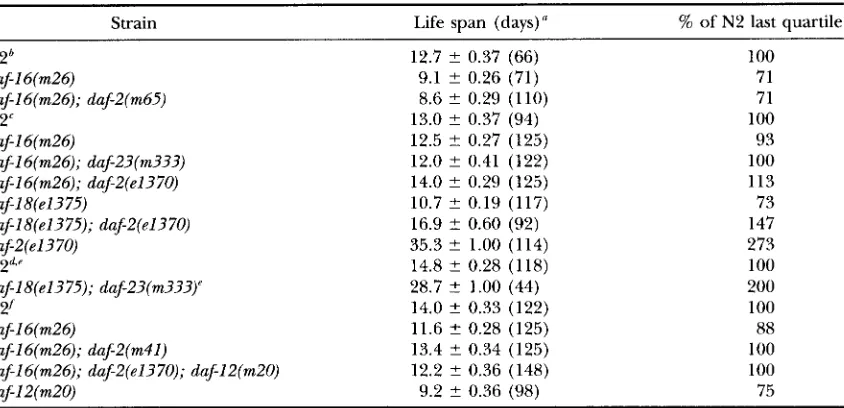
Epistasis analysis of adult life span: We have de- duced a genetic hierarchy for determination of life span from epistatic relationships in appropriate daf-c; daf-d double mutants. The life spans were analyzed for dou- ble mutant strains carrying a long-lived daf-c mutation, daf-23 or daf-2, and a dafd mutation that suppressed the Daf-c phenotype. KENYON et al. (1993) have shown that the daf-16( m26) mutation suppresses the daf- 2( e1370) life span extension phenotype at 20" using the daf-16( m26) ; daf-2( e1370) strain that we had con- structed for analysis of the Daf phenotype. Our experi- ments with this strain were performed at 25.5" because this is the temperature at which the Daf phenotypes were determined for the dauer pathway. As shown in Table 3 and Figure 3, the daf-16( m26) ; daf-2( e1370) life span was similar to that of daf-16( m 2 6 ) . The life spans of daf-d strains daf-16 and daf-18 were reduced in comparison with wild type. Comparisons of the means using the log-rank test yielded a chi-square value of 31.2 for daf-16 ( P
<
0.0001 ) , and a chi-square value of 112 ( P<
0.0001 ) for daf-18 us. wild type. The daf-16 muta- tion also suppressed the extended life spans of the daf- 2? and daf-2( m41) mutants. Furthermore, we observed no extension of life span for the daf-16( m26) ; daf- 2( m65) double mutant, in which the nonconditional daf-2( m65) allele is a putative null allele.The daf-18 mutation partially suppressed the life span extension of daf-2( e1?70), as shown in Figure 3B. The life span of the double mutant is intermediate between those of daf-18 and daf-2( e1?70), but closer to that of daf-18. By contrast, extension of life span by daf- 2?( m???) is not suppressed by daf-18. A caveat of this experiment is that 99% of the daf-18; daf-2? mutant animals die due to internal hatching of eggs, SO we
Dauer Development and Adult Longevity
TABLE 3
Adult life spans of dauer-constitutive, dauerdefective mutant strains at 25.5"
Strain Life span (days) '' % of N2 last quartile
1575
N2 12.7 f 0.37 (66) 100
dafl6(m26) 9.1 f 0.26 (71) 71
daf16(m26); daf2(m65) 8.6 f 0.29 (110) 71
N2' 13.0 f 0.37 (94) 100
dafl6(m26) 12.5 L 0.27 (125) 93
daf16(m26); daf23(m333) 12.0 ? 0.41 (122) 100
daf16(m26); daf2(e1370) 14.0 5 0.29 (125) 113
daflg(e1375) 10.7
+-
0.19 (117) 73daflg(e1375); daf2(e1370) 16.9 2 0.60 (92) 147
daf2(e1370) 35.3 f 1.00 (114) 273
NZd' 14.8 -f 0.28 (118) 100
daf18(el375); daf23(m333)' 28.7 t 1.00 (44) 200
N 2' 14.0 f 0.33 (122) 100
dafl6(m26) 11.6 +- 0.28 (125) 88
dafl6(m26); daf2(m41) 13.4 f 0.34 (125) 100
dafl6(m26); daf2(e1370); dafl2(m20) 12.2 +- 0.36 (148) 100
daf12(m20) 9.2 f 0.36 (98) 75
"Values are means t SE with no. of animals in parentheses. 'The last quartile remained alive on day-14.
'The last quartile remained alive on day-15. The last quartile remained alive on day-17.
"Animals were from eggs isolated by treatment of gravid adults with hypochlorite (SUISTON and HODGKIN
1988). There were initially -8,000 double-mutant adults; only those that did not die due to internal hatching of eggs were included in this analysis.
'The last quartile remained alive on day-16.
from the daf-2 branch of the dauer pathway (Figure l B ) , but the order of these genes differs because of the results with the double mutants carrying daf-18.
Al-
ternate interpretations of daf-18 epistasis are presented in the DISCUSSION.
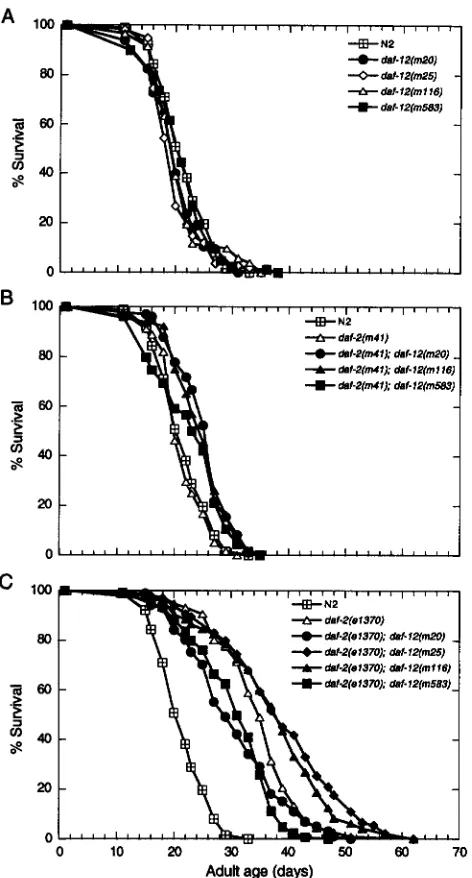
The life spans of seven daf-2; daf-12 double-mutant strains were analyzed to place daf-12 in the life-span pathway and to test for allele-specific effects similar to those observed in dauer larva development. As controls, the life spans of each of four daf-I2 mutants were deter- mined and found to be slightly shorter than that of N2 (Figure
4).
The small reduction in mean life span was less than that observed for daf-18. The maximum life spans of all the daf-2( m41) ; daf-12 animals were approximately double that of wild type and similar to that of m41 alone (Figure 4B).
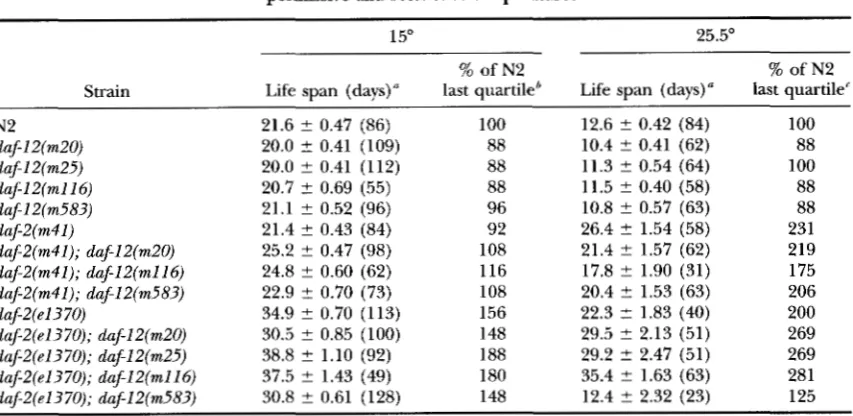
Although the mean life spans of these double mutants appeared to be slightly decreased relative to that of m41 (Table 4 ) , the signifi- cance of these differences was difficult to interpret be- cause the fraction of the m41 population that exhibited extended life varied in independent trials. The maxi- mum life spans also fluctuated because they repre- sented the survival of a single animal. In general, we used the last quartile for comparisons between indepen- dent trials of the daf-2 strains.Mutants homozygous for daf-2( e1370) and one of four independent daf-12 alleles each displayed larval arrest phenotypes if hatched and raised at 25.5", al- though there were subtle qualitative differences in the
terminal phenotypes. The shape of the adult survival curve also differed depending on the daf-12 allele (Fig- ure 4C). The last quartile and maximum life spans of daf-2( e1370) were enhanced in double mutants with daf-12( m20, m25, or m 1 1 6 ) , but in the case of daf- 2( e1370) ; daf-12( m583) , 70% of the population died earlier than wild type, and the remainder lived longer (Table 4 and Figure 4C). Premature death was not seen in any other allelic combination tested, including daf-2 ( m41) ; daf-12 ( m583)
.
These allele-specific mu- tant interactions suggest that in wild-type animals, the daf-2 and daf-12 gene products may interact to deter- mine adult life span.The synergistically enhanced life span of daf-2( e1370) ; daf-12( m20) is completely suppressed by daf-16( m26) in a triple mutant (Figure 3A). These results indicate that daf-16 acts downstream of daf-2 and daf-I2 with respect to life span. The dauer-like arrest phenotype is suppressed in this strain, and in a similar strain reported by GOTTLIEB and RWKUN ( 1994) . The daf-I6gene also acts downstream of age-I. The mean life span of f i - 1 5 ( b26) age-1 ( h x 5 4 6 ) at 25.5" was 28.0 5 0.64 days, consistent with that previously reported by FRIEDMAN and JOHNSON ( 1988) , whereas the mean life span of daf-16( m26) I; f i - 1 5 age-1 IIwas reduced to 15.8 ? 0.35 days. The control daf-16; j&I"15 strain had a mean life span of 12.7 t 0.27 days at 25.5".
1576 P. L. Larsen, P. S. Albert and D. L. Riddle
Adult age (days)
FIGURE J.--Survival curves for daf-c; d a f d mutants in the duf-2 branch of the genetic pathway for dauer formation. Pop- ulations were raised at 15" to the L4 stage, then shifted to 25.5'. ( A ) Strains carrying daf-2 and daf-16. ( B ) Strains car- rying daf-16 or daf-18.
mation ( n o constitutive dauer larvae develop at 15" and 100% form dauer larvae at 25.5")
,
a ts increase in longev- ity would further the parallels between dauer formation and life span. In control experiments, the life spans of each of the four independent daf-12 alleles were nearly like that of wild type at 15" (Figure 5A).
Remarkably, the life span of daf-2( m41) was also like that of wild type (Table 4 and Figure 5B).
The daf-2 ( m41) ; daf-12 mutants were also ts; they had only a very slightly in- creased life span at 15". The daf2( e1370) mutant was somewhat ts for life span (Figure 5C) in that the percent increase over wild type was less at 15" than at 25.5" (Table 4 ) . Interestingly, both the premature death of daf 2( e1370) ; duf-12( m583) and the synergistically ex- tended life spans of the other daf-2( e1370) ; daf-12strains at 25.5" were not apparent at 15".Reproduction in the long-lived Daf strains: We deter- mined the length of the fertile period and the number of progeny produced by the d a f 2 and daf-12 single and double mutants to assess whether these genetically al- tered strains may have "paid" for a greatly increased life span with a reduced reproductive capacity, as might be predicted from the evolutionary theory of aging. In this theory, each species evolved for optimal success of its reproductive strategy instead of affording the maxi- mum possible protection to the soma ( MEDAWAR 1952). Furthermore, cases of antagonistic pleiotropy
Adult age (days)
FIGURE 4.-Survival curves for daf-2, daf-12, and duf-2; daf- 12 adults at 25.5'. The animals were raised at 15", then shifted to 25.5" as young adults. ( A ) Alleles of daf-12. ( B ) Strains bearing daf-2 ( m 4 1 ) , alone and with alleles of daf-12. ( C ) Strains bearing daf-2( e1370), alone and with alleles of
daf-12.
Dauer Development and Adult Longevity
TABLE 4
Adult life span of daf-2 and daf-12 single and double mutant strains at the permissive and restrictive temperatures
15" 25.5"
% of N2 % of N2
Strain Life span (days)" last quartile' Life span (days)" last quartile'
N2 21.6 2 0.47 (86) 100 12.6 ? 0.42 (84) 100
daflZ(m20) 20.0 t 0.41 (109) 88 10.4 ? 0.41 (62) 88
daf-l2(m25) 20.0 ? 0.41 (1 12) 88 11.3 t 0.54 (64) 100
daf12(rn116) 20.7 2 0.69 (55) 88 11.5 ? 0.40 (58) 88
daf-I Z(m583) 21.1 ? 0.52 (96) 96 10.8 ? 0.57 (63) 88
dafZ(m41) 21.4 t 0.43 (84) 92 26.4 t 1.54 (58) 231
dafZ(m41); daf-lZ(m20) 25.2 ? 0.47 (98) 108 21.4 ? 1.57 (62) 219
dafZ(m41); daf-IZ(mll6) 24.8 ? 0.60 (62) 116 17.8 ? 1.90 (31) 175
daf2(m41); daf-lZ(m583) 22.9 ? 0.70 (73) 108 20.4 ? 1.53 (63) 206
dafe(el3 70) 34.9 ? 0.70 (113) 156 22.3 t 1.83 (40) 200
daf-Z(e1370); daf-IZ(m20) 30.5 ? 0.85 (100) 148 29.5 ? 2.13 (51) 269
daf-Z(e1370); dafIZ(m25) 38.8 ? 1.10 (92) 188 29.2 ? 2.47 (51) 269
daf2(e1370); daflZ(m116) 37.5 ? 1.43 (49) 180 35.4 ? 1.63 (63) 281
daf-Z(e1370); daf12(m583) 30.8 ? 0.61 (128) 148 12.4 ? 2.32 (23) 125
"Values are means t SE with no. of animals in parentheses. The last quartile of the N2 population remained alive on day 25. 'The last quartile of the N2 population remained alive on day 14.
1577
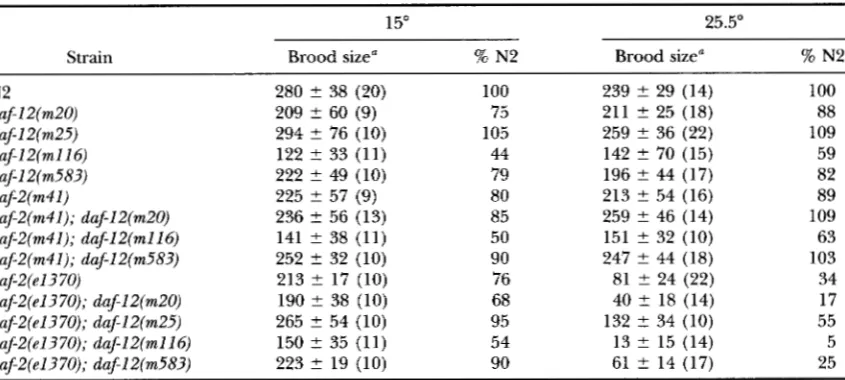
mean brood sizes as low as 59% of wild type, whereas the daf-2( e1370) ; daf-12( m25) strain, which had a similar brood size, nearly tripled life span. We conclude that a reduction in brood size was neither necessary nor predictive for an increased adult life span. Indeed, abla- tion of gonadal cells with a laser microbeam had no effect on wild-type or daf-2 life spans ( KENYON et al.
1993). Of C. elegans mutations that affect fertility, only spe-26 is known to increase life span (JOHNSON 1983; VAN VOORHIES 1992)
.
A remarkable exception to the predominant repro- ductive schedule, noted during the life-span analysis, was that all d a f 2 ( e1370) -bearing strains intermittently produced a small number of progeny late in life. For instance, on day 31 of the experiment shown in Figure 4 there were two Fls from 21 daf-2( e1370) ; daf-12( m25) adults, five Fls from 45 daf-2(e1370); duf-12( m116) adults, and three Fls from nine daf-2( e1370) adults. A few progeny were produced by adults more than 50 days old, and most of these late progeny were viable and fertile. This phenomenon is allele-specific, since no late progeny were observed during the life-span anal- ysis of any daf-2 ( m41) -carrying strains.
Determination of brood sizes and reproductive schedules at 15" showed that fecundity was ts for the daf-2, but not daf-12, mutations, as is the case for dauer larva development and adult life span. The daf- 2 ( e1370) strain produced substantially larger broods at 15" than at 25.5", but a similar effect was not observed for duf-2 ( m41) because the brood size was only slightly less than that of wild type at both temperatures (Table 5 )
.
The small daf-12( m l l 6 ) brood size showed no im- provement at the lower temperature; neither the dauerformation defect nor the reproductive defect is ts for any of the tested alleles of this gene. The timing of onset and cessation of reproduction is similar for all 14 strains tested (Figure
7)
.
In summary, reproduction is neither delayed nor prolonged in mutants with ex- tended adult life spans, except for the very few late progeny produced by daf-2( e1370) -bearing strains at 25.5". In some strains brood sizes were substantially re- duced, but this was not predictive of increased lon- gevity.DISCUSSION
During the life history of C. elegans, daf genes are involved in processes as diverse as larval development, reproduction and adult life span. The partial genetic pathway for dauer larva formation presented here has
two branches. The daf-c mutations that increase adult life span are all positioned in the duf-2 branch, but the gene order may differ depending on the interpretation of interactions with the daf-d gene, daf-18. The daf-2 and daf-12 genes interact in an allele-specific manner to affect both dauer larva formation and adult life span.
1578 P. L. Larsen, P. S. Albert and D. L. Riddle
n
1
0 10 20
30-
40 9"
Adult age (days)
FIGURE 5.-Survival curves for daf-2, daf-12, and daf-2; daf- 1 2 adults at 15". ( A ) Alleles of daf-12. ( B ) Strains bearing
d a f - 2 ( m 4 1 ) , alone and with alleles of daf-12. ( C ) Strains bear- ing daf-2( e1370), alone and with alleles of daf-12.
of the TGF-P superfamily that is a putative ligand for these receptors ( LIM 1993). A phenotypic difference between mutants in the daf-1 and daf-2 branches of the pathway is that nonconditional alleles of daf-2 and daf- 23 exist, whereas all known alleles of the other duf-c genes are
ts.
The null phenotype of at least some genes in the daf-1 branch is ts, based on analysis of nonsense mutants (GOLDEN and RIDDLE 1984b). Synergistic in- teractions between daf-c mutations led THOMAS et al. ( 1993) to propose that daf-11 and daf-21 define a sepa- rate branch of the pathway that is partially redundant with the d a j l branch. Both of these branches are up- stream of daf-12.The daf-12 and daf-2 genes cannot be ordered unam- biguously based on current data. It appears that duf-12
A
I I I I I I I
B
200
150
P
a
0
r
10050
0
C
I I I II I I
"I
150C 0
: I
2 100 a
T
50
0
0 1 2 3 4 5 8
Day of adulthood
FIGURE 6.-Profiles of the fertile periods for daf-2, daf-12,
and daf-2; daf-12 adults at 25.5'. The average number of prog- eny per animal per day is shown for ( A ) Alleles of daf-12.
( B ) Strains bearing d a f - 2 ( m 4 1 ) , alone and with alleles of daf- 12. ( C ) Strains bearing daf-2( e1370), alone and with alleles of daf-12. The average brood was 0-0.1 progeny per animal on day 7, and no progeny were observed on days 8-10 for any strain. Vertical bars represent SD.
Dauer Development and Adult Longevity
TABLE 5
Brood sizes for d@-2 and duj22 single and double mutant strains
15" 25.5"
Strain Brood size" % N2 Brood size" % N2
N2 280 +- 38 (20) 100 239 2 29 (14) 100
daf-l2(m20) 209 2 60 (9) 75 211 +- 25 (18) 88
daf-I Z(m25) 294 ? 76 (10) 105 259 5 36 (22) 109
daf-1 Z ( m l l 6 ) 122 2 33 (11) 44 142 +- 70 (15) 59
daf-I Z(m583) 222 ? 49 (10) 79 196 2 44 (17) 82
daf-2(m41) 225 ? 57 (9) 80 213 5 54 (16) 89
daf2(m41); daflZ(m20) 236 t 56 (13) 85 259 5 46 (14) 109
daf-2(m41); daf-1 Z(mll6) 141 ? 38 (11) 50 151 5 32 (10) 63
daf-Z(m41); daf12(m583) 252 ? 32 (10) 90 247 5 44 (18) 103
daf-2(el3 70) 213 ? 17 (10) 76 81 ? 24 (22) 34
daf-2(e1370); daflZ(m20) 190 ? 38 (10) 68 40 2 18 (14) 17
daf-2(e1370); daf-l2(m25) 265 +- 54 (10) 95 132 2 34 (10) 55
dafZ(e1370); daf12(m116) 150 2 35 (11) 54 13 ? 15 (14) 5
dafZ(el370); daf-lZ(m583) 223 +- 19 (10) 90 61 2 14 (17) 25
"Values are means ? SD with no. of animals in parentheses.
1579
ically. Furthermore, the particular pairings result in unique biological properties that can range from posi- tive to negative regulation (DIAMOND et al. 1990; PICARD
et al. 1990; CARLBERG et al. 1993; YAO et al. 1993)
.
These precedents suggest types of direct interactions that would be consistent with the molecular identity of DAF-12
and the allele-specific phenotypes of the daf-2; daf- 1 2 double mutants.The interactions observed in the daf-2; daf-12 dou- ble mutants may represent a mutually antagonistic relationship between DAF-2 and DAF-12 that inte- grates the two branches of the pathway (GOTTLIEB and RUVKUN 1994; Table 1 )
.
Activation of either branch of the pathway would trigger the activation of the other (both branches are required to promote dauer formation). Furthermore, the decision be- tween dauer us. nondauer development is a dynamic process ( GOLDEN and RIDDLE 1984a) and may involve a regulatory loop. The potential for nondauer devel- opment remains throughout the L1, L2d and dauer stages. Without such a regulatory loop, continual re- assessment of the environment could lead to conflict- ing developmental responses, such that an animalmight not develop according to either morphogene- tic pathway. One hypothesis is that in cases where DAF-12 activity predominates, it remains subject to inhibition by DAF-2, which may be activated by food or reduced pheromone concentration. Once DAF-2 activitypredominates, the daf-I branch of the pathway becomes permanently inactivated to achieve develop- mental commitment to growth.
The alleles used to construct the daf-2; daf-12 dou- ble mutants are almost certainly hypomorphic (par- tial loss of function)
.
The most common class of daf-2 mutation is nonconditional daf-c; that is, all homozygous animals enter the dauer stage irrevers-ibly (RIDDLE 1988). The ts daf-2 mutations used in this work display less severe phenotypes and have sufficient gene function to execute nondauer devel- opment at 20". The d a f - 1 2 alleles result in a noncon- ditional Daf-d phenotype, but alleles differ from one another both in their suppression of mutations in daf-c genes and in their interactions with daf- 2 ( e1370). These data indicate that at least two, if not all, of the tested daf-12 alleles are not null. It is possible that either daf-2 or daf-12, or both, may have essential functions, and that complete loss of activity would result in lethality. A low percentage of lethal- ity (dead eggs and L1 arrest) at the restrictive tem- perature for the ts d a f - 2 ( e1370and e 1 2 8 6 ) mutations has been reported (VOWELS and THOMAS 1992). Al- though the null phenotypes for daf-2 and d a f - I 2 are unknown, this does not prohibit representing them in the pathway. A pathway for vulva induction has been defined, in part, with hypomorphic mutations in genes for which the null phenotype is lethal ( STERNBERG 1993 )