Copyright2000 by the Genetics Society of America
Identification of Autosomal Regions Involved in Drosophila Raf Function
Willis Li,* Elizabeth Noll
†and Norbert Perrimon
†*Department of Genetics,†Howard Hughes Medical Institute, Harvard Medical School, Boston, Massachusetts 02115
Manuscript received March 23, 2000 Accepted for publication June 26, 2000
ABSTRACT
Raf is an essential downstream effector of activated p21Ras(Ras) in transducing proliferation or
differentia-tion signals. Following binding to Ras, Raf is translocated to the plasma membrane, where it is activated by a yet unidentified “Raf activator.” In an attempt to identify the Raf activator or additional molecules involved in the Raf signaling pathway, we conducted a genetic screen to identify genomic regions that are required for the biological function of Drosophila Raf (Draf). We tested a collection of chromosomal deficiencies representing ⵑ70% of the autosomal euchromatic genomic regions for their abilities to enhance the lethality associated with a hypomorphic viable allele ofDraf,DrafSu2. Of the 148 autosomal
deficiencies tested, 23 behaved as dominant enhancers ofDrafSu2, causing lethality inDrafSu2hemizygous
males. Four of these deficiencies identified genes known to be involved in the Drosophila Ras/Raf (Ras1/ Draf ) pathway:Ras1,rolled(rl, encoding a MAPK),14-3-3ε, andbowel(bowl). Two additional deficiencies removed the DrosophilaTecandSrchomologs,Tec29AandSrc64B.We demonstrate thatSrc64Binteracts genetically withDrafand that an activated form of Src64B, when overexpressed in early embryos, causes ectopic expression of the Torso (Tor) receptor tyrosine kinase-target genetailless.In addition, we show that a mutation inTec29Apartially suppresses a gain-of-function mutation in tor.These results suggest that Tec29A and Src64B are involved in Tor signaling, raising the possibility that they function to activate Draf. Finally, we discovered a genetic interaction betweenDrafSu2and Df(3L)vin5that revealed a novel
role ofDrafin limb development. We find that loss ofDrafactivity causes limb defects, including pattern duplications, consistent with a role for Draf in regulation ofengrailed(en) expression in imaginal discs.
T
HE Raf serine/threonine kinase is an essential ef- and is able to substitute for Draf for viability and signal fector, downstream of Ras, in mediating the trans- transduction in Drosophila (Ambrosioet al.1989;Casa-mission of signals that control cellular proliferation, novaet al. 1994; A. Brand, X. Lu andN. Perrimon,
differentiation, and development (reviewed byAvruch unpublished data). Thus, we expect the mechanism of
et al. 1994; Marshall 1994; Moodie and Wolfman activation of Draf to be evolutionarily conserved.
1994). In a simple linear model, Ras, Raf, MEK, and The Ras1/Draf/MEK/MAPK signaling cassette is
com-MAPK are sequentially activated following the activation monly used for signaling by a number of Drosophila
of a cell surface receptor tyrosine kinase (RTK). While RTKs, such as Torso (Tor; reviewed byDuffyand
Perri-the signaling cascade from Raf to MAPK involves direct mon 1994), the epidermal growth factor receptor
phosphorylation, it is not known precisely how Raf is (EGFR or DER;BrandandPerrimon1994), Sevenless
activated following Ras activation (reviewed by Mor- (Sev), and the fibroblast growth factor (FGF) receptor
risonandCutler1997). It has been proposed that the homologs Breathless (Btl;Klambtet al.1992) and Heart-sole function of Ras in Raf activation is to translocate less (Htl;Beimanet al.1996;Gisselbrechtet al.1996).
Raf to the plasma membrane, where Raf activation is These RTKs are involved in various developmental
deci-regulated by an unknown factor (Leevers et al. 1994; sions. The Tor pathway specifies cell fates at the embry-Stokoeet al.1994). However, from our analyses of Draf onic termini. Btl and Htl are required for cell migration
we have proposed that in addition to targeting Raf to and differentiation of the embryonic tracheal system
the plasma membrane, Drosophila Ras (Ras1) has a and mesoderm, respectively. The Sev pathway functions
second function and activates the “Raf activator,” which exclusively in the eye to specify R7 photoreceptor cell in turn activates Raf (Liet al.1998). Such results present fate. In contrast, the EGFR has multiple functions
a more complex picture for Raf activation and predict throughout development and is required during
oogen-the presence of a hypooogen-thetical factor, oogen-the Raf activator, esis and embryogenesis, as well as the development of that is also regulated by Ras. Draf is structurally and wing vein and the eye. All these Drosophila RTKs
acti-functionally homologous to mammalian Raf-1. Human vate the Ras1/Draf/MEK/MAPK cassette to mediate
sig-Raf-1 is 46% identical in amino acid sequence to Draf nal transduction to the nucleus, and perturbation of
Draf activity impedes signaling processes of these RTKs, resulting in visible phenotypes and/or lethality to the Corresponding author:Norbert Perrimon, Department of Genetics,
animal.
Harvard Medical School, 200 Longwood Ave., Boston, MA 02115.
E-mail: [email protected] To genetically isolate the potential Raf activator, as
rescued Drafnull males in whichengrailedexpression could well as new components of the Raf signaling cascade,
be assessed. If provided with daily heat shocks from embryonic we conducted an F1screen for modifiers of Draf
func-stages through late pupal func-stages, this transgene will rescue tion. Here we describe an F1screen to identify genomic Draf11-29males to full viability and fertility.
regions on the second and third chromosomes that To examine the role of Draf in the development of the
imaginal discs, heat shocks were provided daily (2 hr, 37⬚ enhance the lethality of a mutation in Draf (DrafSu2)
waterbath) until the beginning of the second larval instar. that is associated with reduced activity (Luet al.1994).
Then no further heat shocks were provided until 24–36 hr We demonstrate that some of the deficiencies identify
after pupation, when daily heat shocks were again provided genes known to be involved in Draf signaling, thus val- until adults eclosed. Imaginal discs were dissected from wan-idating the specificity of this screen. We also identified dering third instar larvae, fixed briefly in 4% methanol-free formaldehyde, and stained with X-gal according to established regions that were not described in previous screens and
procedures. To examine adult structures, legs and wings were potentially contain new components involved in Draf
mounted in Hoyer’s mountant. signaling. Interestingly, two of these deficiencies remove
Src64B and Tec29A, respectively, raising the possibility that these cytoplasmic tyrosine kinases are directly
in-RESULTS volved in Raf activation. Finally, we describe a novel role
of Draf in limb patterning. We found that reduction in Design of a sensitized screen:To genetically isolate
the potential Raf activator or molecules involved in the Draf function caused limb defects, including notching
of the posterior wing and anterior pattern duplications Raf signaling pathway, we conducted an F1 screen for
modifiers of Draf function. Among a series ofDraf mu-in the posterior compartment. Such defects are similar
to those caused by misregulation ofengrailed(en) in the tant alleles, one particular allele,DrafSu2, which carries
two point mutations inDraf, appeared suitable for such imaginal discs, suggesting a possible role for Draf in
the regulation of en expression during imaginal disc a screen. Unlike most otherDrafalleles,DrafSu2
homozy-gous females or hemizyhomozy-gous males are viable. DrafSu2
development.
was isolated as a suppressor ofDrafC110, a hypomorphic
mutation associated with late zygotic lethality.DrafC110
MATERIALS AND METHODS
carries a point mutation, R217L, that prevents the Draf:Ras1 interaction (Melnicket al. 1993;Hou et al.
Stocks:The deficiency kit stocks for second and third
chro-mosomes were kindly provided by the Bloomington Stock 1995). Arg217 in Draf is equivalent to Arg89 in Raf-1, Center (Bloomington, IN; http://flystocks.bio.indiana.edu/ which is a critical amino acid residue lying in the first df-kit.htm). TheDrafSu2allele is the same as Su(DrafC110)2
de-Ras-binding domain (RBD) of Raf-1 and is essential for scribed inLuet al.(1994). Transgenic flies bearing the
hsp70-its binding to activated Ras (Fabian et al. 1994). In a
Src64B⌬540transgene are as described inKussicket al.(1993).
Genetic screens:Virgin females homozygous forDrafSu2were screen for dominant suppressors of DrafC110, Lu et al.
crossed to males of each mutant or deficiency-bearing stock. (1994) isolated Su2 that restores viability toDrafC110flies.
Multiple broods for each cross were made when necessary to Su2 is an intragenic point mutation [P308L] in the ensure scoring of⬎100 progeny. A mutant was considered as
second RBD of Draf, also known as the cysteine-rich an enhancer ofDrafSu2if far fewerDrafSu2/Y; m/⫹males were
domain (CRD).Su2 increases the biological activity of recovered compared to the number ofDrafSu2/Y;⫹/Balancer
males. Similarly, a deficiency was considered to enhance DrafC110 without restoring the binding of DrafC110 with
DrafSu2if far fewer deficiency-bearing males were recovered,
Ras1 (Li et al.1998). Although flies carrying both the relative to the number of balancer-bearingDrafSu2males.
original DrafC110 mutation, R217L, and the Su2
muta-Examination of embryos: To determine the effect of
tion, P308L, are fully viable as homozygotes (referred
Src64B⌬540overexpression ontllexpression, one copy of the
to as DrafSu2), they are only 18% viable in trans with
hsp70-Src64B⌬540 transgene (Kussick et al. 1993) was
intro-duced from the father by crossing wild-type females with males DrafC110, and are lethal with a null allele of Draf(Luet
homozygous for the hsp70-Src64B⌬540transgene. Embryos (0- al.1994). This suggests that further reduction of Draf to 1-hr old) were collected on agar plates and allowed to activity, such as that resulting from mutation of one copy develop for an additional hour at 25⬚. They were heat shocked
of its activator or downstream signaling components, by floating the plates in a 37⬚water bath for 50 min, cooled
should reduce the viability of DrafSu2 flies. Since the
to 4⬚, then fixed forin situhybridization using atllprobe.
tllmRNA expression in embryos was examined by whole- DrafSu2 protein does not bind to Ras1, it should rely
mount in situhybridization as described inLiet al.(1997). more on the hypothetical Raf activator for its activity Embryos were mounted in Euparal (Carolina Biological Sup- and therefore be more sensitive to changes in the levels ply) followingin situstaining or Hoyer’s mountant for cuticle
of such an activator. preparations.
Validity of the screen:To validate the hypothesis this Generation of partially rescuedDrafnull males:To generate
Drafnull males,Draf11-29females were crossed to males carrying screen was based upon, we tested available mutant
al-an autosomal insertion of a wild-type Draf gene under the leles of genes that are known to be involved in the Ras1/ control of the heat-shock promoter (Diaz-Benjumea and Draf signaling pathway (Table 1). SinceDrafSu2encodes
Hafen 1994) to create a line that was Draf11-29/FM7;
hs-a muths-ant protein thhs-at hhs-as reduced Drhs-af function, we
DrafBT127/hs-DrafBT127. This line could then be used to generate
predicted that it might be most sensitive to changes in partially rescuedDrafmales, or outcrossed to a line carrying
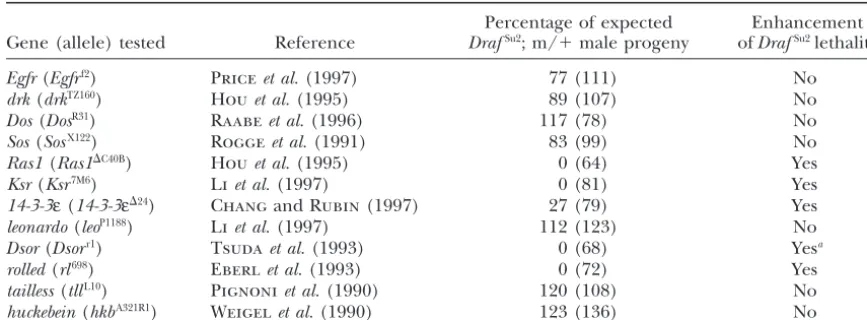
TABLE 1
DrafSu2provides a sensitive genetic background for an F
1enhancer screen
Percentage of expected Enhancement Gene (allele) tested Reference DrafSu2; m/⫹male progeny ofDrafSu2lethality
Egfr(Egfrf2) Priceet al.(1997) 77 (111) No
drk(drkTZ160) Houet al.(1995) 89 (107) No
Dos(DosR31) Raabeet al.(1996) 117 (78) No
Sos(SosX122) Roggeet al.(1991) 83 (99) No
Ras1(Ras1⌬C40B) Houet al.(1995) 0 (64) Yes
Ksr(Ksr7M6) Liet al.(1997) 0 (81) Yes
14-3-3ε(14-3-3ε⌬24) ChangandRubin(1997) 27 (79) Yes leonardo(leoP1188) Liet al.(1997) 112 (123) No
Dsor(Dsorr1) Tsudaet al.(1993) 0 (68) Yesa rolled(rl698) Eberlet al.(1993) 0 (72) Yes
tailless(tllL10) Pignoniet al.(1990) 120 (108) No
huckebein(hkbA321R1) Weigelet al.(1990) 123 (136) No
Mutant alleles (m) of genes known to be involved in Draf signaling were tested for their ability to enhance DrafSu2. Virgin females homozygous forDrafSu2were crossed tom/Balancermales. The percentage of expected
F1progeny is calculated by the number ofDrafSu2/Y; m/⫹males divided by the number ofDrafSu2/Y;⫹/Balancer
males. The total number of male progeny scored in each experiment is indicated in parentheses.
aDsorwas tested by crossing virgins ofDrafC110Dsorr1/BinsctoDrafSu2males. The percentage of expected F 1
progeny is calculated by the number ofDrafC110Dsorr1/DrafSu2females divided by theDrafSu2/Binscfemales.
pathway. In support of this hypothesis, mutant alleles gions allowed us to further identify some of the genes
that interact withDrafSu2.
ofRas1(Simonet al.1991),Ksr(Therrienet al.1995),
Dsor(encoding a MEK or MAPKK;Tsudaet al.1993), 21A1; 21B7–8: This cytogenetic interval is removed
byDf(2L)net-PMF, which enhancesDrafSu2lethality. No
14-3-3ε, androlled(rl, encoding a MAPK;Brunneret al.
1994) enhancedDrafSu2, causing lethalityin transwith obvious candidate gene could be identified in this
re-gion.
DrafSu2hemizygous males (Table 1). These results
indi-cate that DrafSu2 can provide a sensitive background 23A1–2; 23C3–5: Df(2L)C144removes the cytogenetic
interval 23A1–2; 23C3–5 and acts as a moderate en-for isolating additional components required en-for Draf
function and particularly for its activation. hancer ofDrafSu2. This region contains a previously
iden-tified locusSu(Raf)2Athat suppresses a rough eye phe-The autosomal deficiencies that removed the genes
rl, Ras1, and 14-3-3ε enhanced the lethality of DrafSu2 notype generated by expression of an activated form of
Draf (DrafTor) in the eye and therefore is thought to
hemizygous males.In(2R)bwVDe2LCyRcarries a deficiency
of the 41A–B; 42A2–3 interval and removesrl.This defi- act positively in regulation of Draf function (Dickson
et al. 1996). The molecular nature of the Su(Raf )2A
ciency behaved as a strong enhancer ofDrafSu2(Table
2), indicating that the lethality ofDrafSu2 observed in mutation is not known and mutants were not available
for testing in theDrafSu2 background. transwith In(2R)bwVDe2LCyRis due to removal of at least
rl. Df(3R)by10 deletes the 85D8–12; 85E7–F1 interval 35F6–12; 36A8–9: DrafSu2 is enhanced by
Df(2L)cact-255rv64, which removes 35F6–12; 36D, but not by
and removes Ras1. This deficiency strongly enhances
DrafSu2lethality (Figure 1 and Table 2). Therefore, the Df(2L)H20, which deletes 36A8–9; 36E1–2, suggesting
that the cytogenetic region 35F6–12; 36A8–9 contains lethality ofDrafSu2 observedin trans with Df(3R)by10is
due at least in part to haploinsufficiency ofRas1.Finally, an enhancer of DrafSu2. The gene dachshund (dac) is
mapped to 36A1–2 and is disrupted by
Df(2L)cact-Df(3R)DG2, which removes 89E1–F4;91B1–2, behaved
as a strong enhancer ofDrafSu2.Df(3R)C4, removing 89E; 255rv64. dacwas first isolated as a dominant suppressor
of an activatedEGFRmutation,Ellipse(Elp). It also en-90A, did not display any enhancement of the phenotype.
Two genes located in this region have been previously hances a partial loss-of-function mutation inEGFR
dur-ing eye development, and therefore is a positive regula-implicated in Draf signaling: Suppressor of Ras85D 3-6
(SR3-6;Karimet al.1996), which maps to 90D–E, and14- tor of the EGFR signaling pathway (Mardonet al.1994).
Thus, it is possible that the enhancement ofDrafSu2is 3-3ε, which maps to 90F6–7 (ChangandRubin1997). A
14-3-3εnull allele was tested and was found to modestly due to removing half a dose of dac; however, this was
not confirmed by using adacallele (Table 2). enhanceDrafSu2(Tables 1 and 2).
Autosomal regions that enhanceDrafSu2
lethality:In 36E1–2; 37B9–C1:This cytological interval is defined by two overlapping deficiencies: Df(2L)TW137, which this section we describe the deficiencies that enhance
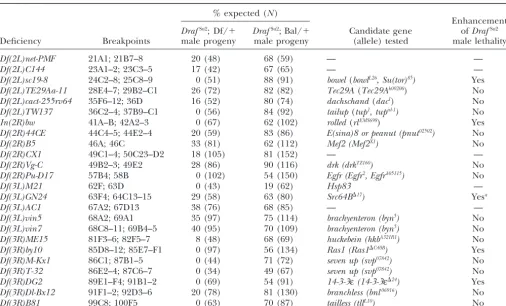
TABLE 2
Deficiencies enhancingDrafSu2and candidate genes
% expected (N)
Enhancement DrafSu2; Df/⫹ DrafSu2; Bal/⫹ Candidate gene ofDrafSu2
Deficiency Breakpoints male progeny male progeny (allele) tested male lethality
Df(2L)net-PMF 21A1; 21B7–8 20 (48) 68 (59) — —
Df(2L)C144 23A1–2; 23C3–5 17 (42) 67 (65) — —
Df(2L)sc19-8 24C2–8; 25C8–9 0 (51) 88 (91) bowel(bowlL26,Su(tor)85) Yes Df(2L)TE29Aa-11 28E4–7; 29B2–C1 26 (72) 82 (82) Tec29A(Tec29Ak00206) No Df(2L)cact-255rv64 35F6–12; 36D 16 (52) 80 (74) dachschand(dac1) No Df(2L)TW137 36C2–4; 37B9–C1 0 (56) 84 (92) tailup(tup1,tupisl-1) No In(2R)bw 41A–B; 42A2–3 0 (67) 62 (102) rolled(rlEMS698) Yes Df(2R)44CE 44C4–5; 44E2–4 20 (59) 83 (86) E(sina)8 or peanut (pnut02502) No
Df(2R)B5 46A; 46C 33 (81) 62 (112) Mef2 (Mef2X1) No
Df(2R)CX1 49C1–4; 50C23–D2 18 (105) 81 (152) — —
Df(2R)Vg-C 49B2–3; 49E2 28 (86) 90 (116) drk (drkTZ160) No Df(2R)Pu-D17 57B4; 58B 0 (102) 54 (150) Egfr (Egfr2, Egfrk05115) No
Df(3L)M21 62F; 63D 0 (43) 19 (62) Hsp83 —
Df(3L)GN24 63F4; 64C13–15 29 (58) 63 (80) Src64B⌬17) Yesa
Df(3L)AC1 67A2; 67D13 38 (76) 68 (85) — —
Df(3L)vin5 68A2; 69A1 35 (97) 75 (114) brachyenteron (byn5) No Df(3L)vin7 68C8–11; 69B4–5 40 (95) 70 (109) brachyenteron (byn5) No Df(3R)ME15 81F3–6; 82F5–7 8 (48) 68 (69) huckebein (hkbA321R1) No Df(3R)by10 85D8–12; 85E7–F1 0 (97) 56 (134) Ras1 (Ras1⌬C40B) Yes Df(3R)M-Kx1 86C1; 87B1–5 0 (44) 71 (72) seven up (svp07842) No Df(3R)T-32 86E2–4; 87C6–7 0 (34) 49 (67) seven up (svp07842) No Df(3R)DG2 89E1–F4; 91B1–2 0 (69) 54 (91) 14-3-3ε(14-3-3ε⌬24) Yes Df(3R)Dl-Bx12 91F1–2; 92D3–6 20 (78) 81 (130) branchless (bnl06916) No Df(3R)B81 99C8; 100F5 0 (63) 70 (87) tailless (tllL10) No
The percentage of expected progeny is calculated as the number of male progeny divided by the number of the female progeny of the same genotype. Female progeny have the genotype ofDrafSu2/⫹;Deficiency/⫹orDrafSu2/⫹;Balancer/⫹.N
indi-cates total number of flies counted. For example, in case ofDf(2L)net-PMF, 48 is the total number ofDrafSu2/y;Df/⫹males and
DrafSu2/⫹;Df/⫹females, and 20 is the number of males divided by the number of females times 100. Candidate genes were
chosen by searching FlyBase for each genomic region that enhancedDrafSu2. Alleles for each candidate gene, if available, were
tested for enhancement ofDrafSu2as heterozygotes. —, not available or not tested.
aEnhanced as homozygotes.
enhancer of DrafSu2, and Df(2L)H20, which removes behaves as a weak enhancer of DrafSu2. No previously
identified components of the Ras/Raf signaling pathway 36A8–9; 36E1–2 and is completely viable astrans
-hetero-zygotes in theDrafSu2background. The genetailup(tup), are located in this region. Df(2R)B5 disrupts, among
other genes,Mef2(Ranganayakuluet al.1995), which
which maps to 37A2–6, is disrupted by Df(2L)TW137.
tup, also known as islet (isl), encodes a LIM domain encodes the Drosophila homolog of the myocyte
en-hancing factor 2 and functions during embryonic
mus-protein (Thor and Thomas1997) that mediates Tor
signaling (Streckeret al.1991). However, atupallele cle development (Bouret al.1995;Tayloret al.1995). A loss-of-function allele ofMef2did not show enhance-tested did not show enhancement ofDrafSu2(Table 2).
44C4–5; 44E2–4:This cytological region is removed ment ofDrafSu2male lethality (Table 2).
49C1–4; 49E2:This cytological interval is defined by
by Df(2R)44CE, which enhanced DrafSu2. A candidate
enhancer in this region is peanut(pnut;Neufeldand two overlapping deficiencies Df(2R)CX1 and Df(2R)
Vg-C, both of which behaved as weak enhancers of
Rubin1994), encoding a Septin homolog required for
cytokenesis.pnutwas first identified asE(sina)8, which DrafSu2. A gene disrupted by these two deficiencies is
E(EGFR)B56, which dominantly enhances mutations in
genetically interacts with seven in absensia (sina;
Car-thew et al. 1994), a gene encoding a nuclear protein EGFR[Priceet al.1997;E(EGFR)B5was not available for
testing].Df(2R)CX1additionally disrupteddrk, a known required for the correct development of R7
photorecep-tor cells in the Drosophila eye. pnuthas been demon- component of the Ras1/Draf signaling pathway (Simon
et al.1993). However, adrkallele did not show
enhance-strated to act positively in the Sev pathway. Loss ofpnut
could therefore enhanceDrafSu2. However, apnutallele ment (Table 2).
57D11–12; 58A1–2:This cytological region is defined
did not show enhancement of DrafSu2(Table 2).
Figure 1.—Autosomal defi-ciencies screened for enhance-ment ofDrafSu2. The four major
autosomal arms are repre-sented as solid lines. Numbers above each line represent the cytological regions. Boxes be-low each autosomal arm repre-sent the approximate genomic regions removed by each defi-ciency tested in this study. Solid and open boxes represent the deficiencies that did and did not enhance DrafSu2,
respec-tively. Shaded boxes indicate that the results were uninter-pretable due to haploinsuffi-ciency of the defihaploinsuffi-ciency tested. The locations of possible candi-date genes are indicated above the respective autosomal arms. However, they may not en-hanceDrafSu2in this study.
Re-gions where no obvious candi-date genes were found are indicated by a question mark.
X58-7, and Df(2R)Pu-D17. Df(2R)AA21 and Df(2R)X58-7 (Mlodziket al.1990). Further, all the components of
the Ras1/Draf pathway are required for the function of remove 56F9–17; 57D11–12 and 58A1–2; 58E4–10,
re-spectively, and did not enhance the lethality ofDrafSu2 svp(Begemannet al.1995). However, asvpallele tested
did not enhanceDrafSu2(Table 2).
males. However,Df(2R)Pu-D17, which deletes the 57B4;
58B region, behaved as a strong enhancer of DrafSu2. 91F5; 92B3: This region is defined by deficiencies
Df(3R)Cha7, removing 90F1–2; 91F5,Df(3R)Dl-BX12,
re-Df(2R)Pu-D17 disrupts the EGFR gene, which maps at
57F1. However, neither of the two mutant alleles of moving 91F1–2; 92D3–6, and Df(3R)H-B79, removing
92B3; 92F13.Df(3R)Dl-BX12behaved as an intermediate
EGFRtested were able to dominantly enhance the
lethal-ity ofDrafSu2 males (Table 2). enhancer ofDrafSu2, while the other two did not, thus
narrowing the genomic region required forDrafSu2
func-62F; 63D:This cytological region is removed byDf(3L)
M21, which behaves as a strong enhancer of DrafSu2. tion to 91F5; 92B3. A candidate gene in the region
isbranchless (bnl), which encodes the Drosophila FGF
This deficiency disruptsHsp83, which has been shown
to be required for Draf signaling (van der Stratenet homolog. bnl is located at 92B2–3 and is deleted by
Df(3R)Dl-BX12(Sutherlandet al.1996). Bnl functions
al.1997; not available for testing).
67A2; 67D13: This cytological region is defined by as a ligand for the Btl RTK to specify the tracheal
branching pattern. However, a hypomorphicP-element
Df(3L)AC1, which behaves as a weak enhancer ofDrafSu2.
There are no obvious candidate genes that might be allele ofbnl(Table 2) did not enhanceDrafSu2.
99C8; 100C:This region is defined by the two
overlap-involved in Draf signaling in this region.
81F3–6; 82F5–7: Df(3R)ME15removes this region and ping deficiencies Df(3R)B81, removing 99C8; 100F5,
Df(3R)awd-KRB, removing 100C; 100D, and
Df(3R)faf-behaved as a strong enhancer ofDrafSu2. A candidate
gene disrupted by this deficiency is huckebein (hkb), a BP, removing 100D; 100F5. Of these three deficiencies,
onlyDf(3R)B81behaved as a strong enhancer ofDrafSu2.
Tor target gene involved in the specification of terminal
cell fates (BronnerandJaeckle1991). However, this The genetllthat maps to 100B1 was a possible candidate; however, a loss-of-functiontllmutation did not enhance was not confirmed by testing ahkbmutation (Table 2).
86E2–4; 87B1–5: This genomic region is defined by DrafSu2.
Su(tor)85is allelic to bowl and is responsible for the the two overlapping deficiencies Df(3R)M-Kx1,
remov-ing 86C1; 87B1–5, andDf(3R)T-32, removing 86E2–4; enhancement ofDrafSu2byDf(2L)sc19-8:24C2–8; 25A5:
This cytological region is defined by the overlapping 87C6–7. Both deficiencies behaved as strong enhancers
of DrafSu2. A candidate gene in the region isseven up deficiencies Df(2L)sc19-8, removing 24C2–8; 25C8–9,
and Df(2L)sc19-4, removing 25A5; 25E5. Df(2L)sc19-8
(svp), which maps to 87B4 and is deleted in both
Df(3R)M-Kx1andDf(3R)T-32. svpencodes a member of behaved as a strong enhancer ofDrafSu2, while Df(2L)
sc19-4did not. The gene bowel(bowl) maps to 24C2–3
the steroid receptor gene superfamily and is required
gene regulated by the Tor target genetlland encodes males, no DrafSu2/Y; Df(3L)GN24/Src64B⌬17 progeny
were recovered, while FM7/Y; Df(3L)GN24/Src64B⌬17
a zinc-finger protein that mediates a subset oftll
func-tions in specifying the hindgut and proventriculus in males survived (N ⫽ 31), as well as females with or
without theDf(3L)GN24chromosome (N⫽112). These
the posterior of the embryo (WangandCoulter1996).
In trans-heterozygotes (see Table 2 and below) abowl results suggest thatSrc64Bis a candidate gene
responsi-ble for the enhancement of DrafSu2 located within
mutation enhancedDrafSu2, indicating that the lethality
of DrafSu2 observed in trans with Df(2L)sc19-8 is likely Df(3L)GN24. There may be another gene deleted by
Df(3L)GN24, which, in conjuction withSrc64B⌬17, is also due to removal ofbowl.
A previous screen for suppressors of a gain-of-function required for Draf function (seediscussion).
To investigate the involvement of Src64B in Draf
sig-tor allele identified a number of loci, referred to as
Su(tor), that may encode signaling components down- naling, we overexpressed an activated form of Src64B,
Src64B⌬540(Kussicket al. 1993), in early embryos
un-stream from the Tor RTK (Doyleand Bishop1993).
We surveyed the existing collection ofSu(tor)alleles for der the control of the heat-shock promoter and exam-ined its effects on the Tor pathway. Src64B⌬540lacks the their abilities to enhanceDrafSu2. We tested eightSu(tor)
alleles that were available (17-29-5, 85, 293-12-3, 307-14, C-terminal negative regulatory domain and acts as a constitutively activated kinase (Kussick et al. 1993). 321-16-5, 337-73, 341, and 404-9-1;Doyle andBishop
1993). Among these, Su(tor)404 and Su(tor)85 enhanced Heat-shock induction of Src64B⌬540 in early embryos
caused dramatic defects in the cuticular structures, most
DrafSu2 [i.e., DrafSu2/Y; Su(tor)404/⫹ and DrafSu2/Y; Su
(tor)85/⫹males died].Su(tor)404is allelic toRas1(Doyle notably deletions of the ventral denticle bands (Figure
2E). Such defects are reminiscent of those associated andBishop1993). BecauseSu(tor)85has been mapped
meiotically to map position 16 on 2L, which corresponds with tor gain-of-function mutations. The embryos
de-rived from females carrying atorgain-of-function muta-to the 24–25 cymuta-tological region, we determined if Su
(tor)85is the mutation in the 24C2–8; 25A5 region re- tion show expansion of thetllexpression domains
(Fig-ure 2D) and disruption of the cuticular struct(Fig-ures in sponsible for the enhancement of DrafSu2. We found
thatSu(tor)85is an allele ofbowlon the basis of its non- the central region of the embryo (Figure 2C). tll is
activated at the embryonic termini (Pignoniet al.1990, complementation with eitherDf(2L)sc19-8or thebowlL26
allele. In addition,Su(tor)85is an embryonic lethal reces- 1992) and the posteriortllexpression domain has been
used as a molecular “readout” for the strength of Tor sive mutation and the embryonic phenotypes associated
with loss ofSu(tor)85are identical to those ofbowlembryos as well as Draf activities (Houet al.1995;Liet al.1997,
1998). To investigate whether the cuticular defects (WangandCoulter1996). These embryos are missing
the denticle bands two, six, and eight. caused by overexpression of Src64B⌬540are due to
expan-sion oftllexpression domains, we examinedtllmRNA Src64B genetically interacts with Draf and
overexpres-sion of an activated form of Src64B causes ectopic ex- levels in embryos following heat-shock induction of Src64B⌬540. Indeed, 16% (N⫽36) of appropriately aged pression of the Tor target gene tll: 63F4; 64C13–15:
Df(3L)GN24removes this region and behaves as a mod- embryos showed marked expansion of tll expression
domains (Figure 2F). No control embryos showed
erate enhancer of DrafSu2. Df(3L)GN24 removes the
Src64Bgene, which maps to 64B12–17, that encodes the expansion oftllexpression under the same heat-shock
treatment. Together, these results suggest that Src64B Drosophila homolog of mammalian c-src (Simonet al.
1985). The existingSrc64Bmutation is homozygous via- activation can positively influence Tor signaling, raising the possibility that it activates Drafin vivo.
ble, suggesting thatSrc64Bmay be functionally
redun-dant, or that it may not be essential for viability.Src64B⌬17 Mutation in Tec29A partially suppressed a gain-of-function mutation of tor: 28E4–7; 29B2–C1: Df(2L)
is associated with a deletion that removes the first two
exons of the Src64B transcript, andSrc64B⌬17 homozy- TE29Aa-11 removes the cytogenetic region 28E4–7;
29B2–C1 and behaves as a weak enhancer of DrafSu2.
gotes produce no Src64B protein. Interestingly,Src64B⌬17
is classified as a weak allele on the basis of the obser- Tec29A, which is located in this interval, encodes the Drosophila homolog of a cytoplasmic tyrosine kinase of vation that animals hemizygous forSrc64B⌬17(Src64B⌬17
in transwith a deficiency of the region) exhibit a more the Tec family. Mammalian Raf-1 can be phosphorylated
and activated by the Src tyrosine kinase in vitro, but severe oogenesis phenotype thanSrc64B⌬17homozygotes
(Dodson et al. 1998). We found no enhancement of there has been no confirmation of thisin vivo(reviewed by BrownandCooper 1996;Morrison andCutler
DrafSu2 by Src64B⌬17 in the heterozygous situation.
However, we found that DrafSu2/Y; Src64B⌬17/Src64B⌬17 1997). Tec proteins share homology with Src in the
kinase domain and are regulated by Src (Guarnieriet
males are semilethal, 51% (38/74) as viable asFM7/Y;
Src64B⌬17/Src64B⌬17 siblings. Further, the DrafSu2/Y; al.1998;Roulieret al.1998). Although a mutant allele
ofTec29Adid not dominantly enhance the lethality of
Src64B⌬17/Src64B⌬17 males that survived had eyes that
were slightly small and rough (data not shown), similar DrafSu2(Table 2), by examining the genetic interactions
betweenTec29Aandtor, we found thatTec29Amutations to the eye phenotypes due to certain mutations in genes
of the Ras/Raf pathway. Finally, when DrafSu2/FM7; partially suppress a gain-of-function allele of tor (see
below).
Figure 2.—Cuticular pheno-types and tll mRNA expression patterns. (A) A wild-type larva, showing eight abdominal denticle bands, the Filzko¨rper materials (arrow) within the posterior spira-cles, and head skeletons. (B) tll expression pattern in a wild-type embryo at the precellularization stage. The posterior domain is ⵑ15% of egg length. (C) An em-bryo laid by a female heterozygous for the gain-of-function mutant torY9. Note that all the ventral
den-ticle bands are missing and the Filzko¨rper is slightly enlarged. (D) Expansion oftllin an embryo de-rived from atorY9/⫹mother. (E)
Embryos carrying one copy of the hsp70-Src64B⌬540 transgene were heat shocked during early em-bryogenesis. Note the severely dis-rupted denticle bands and slightly enlarged Filzko¨rper materials (com-pare with C). (F)tllexpression in embryos carrying one copy of the hsp70-Src64B⌬540transgene follow-ing heat-shock treatment. Note the expansion oftllexpression do-mains similar to the one shown in D. (G) A larva homozygous for Tec29A206. Note the defective mouth
parts (see alsoRoulieret al.1998) and shortened Filzko¨rper (arrow). (H) An unhatched embryo from a torY9/Tec29A206 mother crossed to Tec29A206/⫹ males
presumably homozygous forTec29A206. These embryos were recognized asTec29A206homozygotes because they had defective
mouth parts and shortened Filzko¨rper that are identical toTec29A206homozygous embryos. They exhibited significantly more
ventral denticle bands than those laid bytorY9/⫹females.
A mutation in Tec29A, Tec29A206 is caused by a P-ele- structures. Embryos laid by torY9heterozygous females
lack all denticle bands and have a severely disrupted ment insertion at the 5⬘untranslated region ofTec29A
that greatly reduces Tec29A transcripts such that no head skeleton. Most of them retain intact and often
enlarged posterior spiracles (Figure 2C). We found that
Tec29A mRNA is detectable in Tec29A206 homozygous
embryos (Roulieret al.1998). However, in contrast to zygotic homozygosity for Tec29A206partially suppressed
thetorY9maternal effect phenotype. WhentorY9/Tec29A206
Df(2L)TE29Aa-11, we found thatTec29A206did not cause
lethality to DrafSu2 hemizygous males in the heterozy- females were crossed toTec29A206/⫹males, all embryos
showed a significant increase in the number of ventral gous situation. Embryos homozygous for Tec29A206 do
not hatch, and their cuticles showed defects in the denticle bands, suggesting that reducing the maternal
amount ofTec29A by half suppressedtorY9 (N ⬎ 500).
mouth parts and the posterior spiracles. These terminal
structures are either defective or missing in embryos About one-quarter of the embryos, presumably
zygoti-cally null forTec29A, exhibited mostly theTec29A206
mu-mutant for the Tor pathway genes. As has been
pre-viously demonstrated (Roulieret al.1998), the mouth tant phenotype (Figure 2H). However, they did not
completely restore all the ventral denticle bands (Figure parts ofTec29A206homozygous embryos are missing
sev-eral components (Figure 2G). In addition, the posterior 2H), suggesting that homozygosity ofTec29A does not
completely suppress torY9. We observed similar partial
spiracles ofTec29A206homozygous embryos are shorter
than in wild type (arrow in Figure 2G). These observa- suppressions of thetorY9phenotype when we usedtorY9/
Df(2L)TE29Aa-11females in the above cross. These
re-tions suggest thatTec29Ais required for the
differentia-tion of terminal structures and that it may funcdifferentia-tion sults indicate thatTec29A206is epistatic totorY9, consistent
with a model in which Tec29A functions downstream
in the same genetic pathway as Tor and Draf. Since
mutations inTec29Adisrupt the terminal structures in from, or in parallel, to Tor and is minimally required
for a gain-of-function Tor protein to transduce signal. the embryos, we examined the relationship between
Tec29A and tor. A single copy of the gain-of-function Since Tec29A is regulated by Src64B during oogenesis
(Guarnieriet al.1998;Roulieret al.1998) and overex-alleletorY9causes expansion of the expression domains
Figure 3.—Draf is essential for limb pat-terning. Adult wing defects exhibited by DrafSu2/Y; Df(3L)vin5/⫹males. (A) Wild-type adult wing. (B) A wing from a DrafSu2/Y; Df(3L)vin5/⫹adult male showing notching in the posterior compartment of the wing. (C) A wing from a DrafSu2/Y; Df(3L)vin5/⫹ adult male showing partial duplication of anterior structures in the posterior compartment. (D) A wild-type wing disc showingen-lacZ expres-sion pattern. (E)en-lacZexpression in a wing disc with insufficient levels of Draf during the second and early third larval instars. Note expansion of en-lacZ staining beyond the normal posterior compartment and the mir-ror-image duplication of the anterior compart-ment in the posterior. (F) Mirror image dupli-cation of anterior structures in the posterior compartment due to an insufficient amount of Draf. (G) Leg duplication in a similarly treated partially rescued Draf male.
oftll, we examined whether overexpression ofTec29Ais gotes (Table 2), nor did the DrafSu2/Y; byn/⫹ males
exhibit any wing defects. able to increase Tor signaling. In contrast to Src64B⌬540,
overexpression of Tec29Afrom a heat-shock inducible DrafSu2/Y; Df(3L)vin5/⫹ male escapers exhibit wing
notches that are restricted in the posterior compart-transgene did not cause a significant change in tll
ex-pression in the embryo (data not shown). If the activity ment and anterior pattern duplications at the expense of posterior pattern elements (see above and Figure 3, of Tec29A is regulated by Src64B, overexpression of a
wild-type version of the gene may not have significant B and C). This suggests thatDraf, together with a gene that is removed by Df(3L)vin5, has a function in pat-effects on the animal.
Draf function is required for limb development: terning the imaginal discs.
The wing disc is divided into anterior and posterior
68D6; 69A1: This cytological region is defined by the
overlapping deficiencies Df(3L)vin5, which removes compartments, and the cell identity in the posterior is
maintained by continued expression ofen(reviewed by 68A2; 69A1,Df(3L)vin7, which deletes 68C8–11; 69B4–5,
andDf(3L)vin2, removing 67F2; 68D6. Df(3L)vin5and LawrenceandStruhl1996), but elevated levels of En
in the posterior compartment result in partial
inactiva-Df(3L)vin7 weakly enhanced DrafSu2 male lethality,
whereasDf(3L)vin2showed no interaction withDrafSu2. tion of both en and invected (inv), indicating that En
has a negative autoregulatory mechanism (Guillenet
Interestingly, about half of theDrafSu2/Y;Df(3L)vin5/⫹
escaper males (10/25) exhibited wing defects in the al.1995).hedgehog(hh) is expressed by cells in the poste-rior compartment, which by virtue of their En expres-posterior part of the wing, showing either notches along
the margin (Figure 3B) or pattern duplications inⵑ30% sion are not responsive to Hh. The Hh protein diffuses into the anterior region and, along the anteroposterior of animals (Figure 3C). These defects were also found
inⵑ10% ofDrafSu2/Y; Df(3L)vin7/⫹ males. One gene (A/P) boundary, activates decapentaplegic (dpp), which
encodes a morphogen that organizes the global
pat-deleted by Df(3L)vin5 and Df(3L)vin7, but not by
Df(3L)vin2, is brachyenteron (byn), located at 68E1–4. terning of the wing (Tabata et al. 1992; Baslerand
Struhl1994;Zeccaet al.1995).
bynencodes a homolog of the mouseBrachyurygene, a
T-related homeobox gene regulated by Tor and re- To determine if the cause of the posterior wing
notching and anterior pattern duplications observed in quired for specification of the hindgut and anal pads
during embryogenesis (Singeret al. 1996).byn is acti- the DrafSu2/Y; Df(3L)vin5/⫹ male survivors could be
explained by an additional reduction in Draf activity, vated bytlland repressed byhkb.Therefore it is possible
that byn is responsible for the enhancement of these we examined the role of Draf in patterning of the wing
and leg imaginal discs using partially rescued Draf null two overlapping deficiencies. However, a strongbyn
null alleles cannot be recovered). When Draf is not region that enhancedDrafSu2, we searched FlyBase and
tried to identify a candidate gene that is most likely provided during the second and third larval instars, the
domain ofen-lacZ expression and the overall levels of responsible for the enhancement. For most of these
genes, we obtained mutant alleles and determined if
en-lacZexpression are greatly increased [Figure 3E; this
was also confirmed using antibodies directed against En they were able to enhanceDrafSu2 as heterozygotes. As
shown in Table 2, in four of the candidate genes,bowl, (data not shown)], and an ectopic anterior
compart-ment is induced. When allowed to reach adulthood rl, Ras1, and14-3-3ε, the mutant allele behaved as the
respective deficiency and dominantly enhancedDrafSu2.
these animals exhibited the pattern duplications
pre-dicted on the basis of en expression observed in the The rest of the candidate mutations did not dominantly
enhanceDrafSu2lethality. There are several possible
ex-discs, that is, duplication of anterior pattern elements
in the posterior compartment (Figure 3F). Comparable planations for this. First, the candidate gene selected
may not be responsible for the enhancement ofDrafSu2,
pattern duplications originating from the posterior
compartment were also observed in the legs by withhold- but rather the true enhancer gene was not identified
because the responsible gene has not yet been identi-ing Draf duridenti-ing the second and third larval instars
(Fig-ure 3G). fied, or is not an obvious candidate for an enhancer.
Second, it is possible that some of the alleles tested are Therefore, Draf appears to have a role in negatively
regulating en expression in imaginal discs. The wing not as strong as a deficiency and therefore are unable
to enhanceDrafSu2as the deficiency does. Third,
muta-notching observed exclusively in the posterior
compart-ment is also consistent with Draf negatively regulating tions in a single candidate gene alone may not be suffi-cient to enhance DrafSu2. It is possible that a second en, since increased expression of En in the posterior
compartment serves to partially inactivate en and inv, gene located in the same deficiency region has to be
mutated in order to observe an enhancement of the which is thought to be required for the determination of
posterior cell fates (Guillenet al.1995). These results, lethality. Thus, we cannot rule out a gene as a candidate simply on the basis of the inability of a particular mutant together with the observation that ectopic activation of
Raf or Draf in the discs results in a marked reduction allele to enhance DrafSu2.
Are Src64B and Tec29A activators of Draf? Src64B
in En and Hh expression in the posterior compartment
(E. Noll,unpublished observations), suggest thatDraf andTec29A are removed by two deficiencies that each dominantly enhanced the lethality ofDrafSu2. They were
is essential for limb patterning. On the basis of these
observations, the simplest interpretation of the poste- selected as candidate genes for these two deficiencies because a survey of FlyBase for genes in the regions rior wing notching and duplication in the DrafSu2/Y;
Df(3L)vin5/⫹ males is that the gene removed by removed by the deficiencies did not yield other genes
more likely to be involved in Draf function. We showed
Df(3L)vin5further reduces Draf signaling.
that the Src64B⌬17 allele in homozygotes enhanced
DrafSu2, confirming thatSrc64Bgenetically interacts with
DISCUSSION
DrafSu2. We further showed that overexpression of an
activated form of Src64B in early embryos can cause Previously, genetic screens using EMS-induced lesions
have been conducted for modifiers of activated forms activation of the Tor target genetlland cuticular defects similar to those caused by gain-of-function mutations in of Ras1 or Draf (Dicksonet al.1996;Karimet al.1996)
or for suppressors of aDrafhypomorphic allele (Tsuda tor.These results are consistent with a role of Src64B in Tor signaling and/or Draf activation (Figure 4). We
et al.1993;Luet al.1994). These screens have proven
to be very fruitful in isolating new components in the were unable to demonstrate that Tec29A could enhance
Draf using an available mutant allele of Tec29A. How-Ras/Raf pathway. However, the mechanism of Raf
acti-vation remains unclear. To isolate additional compo- ever, we obtained indirect evidence suggesting a
re-quirement of Tec29A in Tor signaling. First,Tec29A206
nents of the Ras1/Draf pathway, possibly including a
Draf activator, we conducted a screen for enhancers of homozygous mutant embryos exhibit defects in the
ter-minal structures that are specified by the Tor pathway. a viable allele of Draf. We tested 148 autosomal
defi-ciencies in an F1 screen and found that 23 behaved as Specifically, they showed defective mouth parts and
shortened Filzko¨rper, phenotypes consistent with dis-dominant enhancers ofDrafSu2. Some of these
deficien-cies remove genes or loci known to be involved in the ruption of Tor signaling. Further, we found that
reduc-ing the activity ofTec29Asuppresses a gain-of-function Ras1/Draf pathway. Among the deficiencies that
re-move genomic regions not previously known to contain torallele. Most strikingly, embryos zygotically
homozy-gous forTec29A206that are derived from torY9mothers
genes involved in the Ras1/Draf pathway, two
deficien-cies remove genes encoding Tec29A and Src64B, respec- exhibited mouth parts and Filzko¨rper indistinguishable
from those of Tec29A206 embryos. Mutation of Tec29A
tively. In addition, through this screen, we identified a
novel role for Draf in limb development. restored most of the ventral denticle bands that would
have been deleted due totorY9, suggesting that Tec29A Verification of candidate genes for the identified
em-(Rawlingset al.1996). It has been shown in Drosophila that Tec29A is regulated by Src64B and both are re-quired for the growth of ring canals of the egg chamber (Guarnieriet al.1998;Roulieret al.1998). Although it has not been documented that Tec can phosphorylate
Rafin vivo, given the similarities in the kinase domain,
it is not unreasonable to propose that Tec could do so. Finally, consistent with our results, the two genomic regions containing Src64B and Tec29A were also identi-fied as required for the function of Corkscrew (Csw) in a similar screen for modifiers of a partial loss-of-function
cswallele (L. Perkins,personal communication). Function of Draf in limb patterning:The proper ex-pression ofenin the posterior compartment of imaginal discs is essential for maintaining compartmental bound-aries and patterning of Drosophila limbs (Tabataet al.
1995). Despite much insight into the events required
for Hh signaling (Tabata et al. 1992; Basler and
Struhl1994;Zeccaet al.1995; reviewed byLawrence and Struhl 1996), little is known about the mecha-nism(s) by whichenexpression is controlled in the pos-terior compartment.
We have identified two instances where a further re-duction in Draf function, due to the presence of a defi-ciency, results in defects in posterior pattern elements in the limbs. DrafSu2/Y; Df(3L)vin5/⫹ male survivors
Figure4.—Components of Draf signaling in the Tor path- exhibit notching only in the posterior region of the way. Components of the Tor signaling pathway identified in wing, and partial pattern duplications in the posterior this and other studies are listed. The relationship between
compartment. Since no specific role for Draf has been adjacent components is indicated by an arrow (activation);
described in the limbs, we examined what the require-—| (inactivation), or bracket (structural). Molecules that
inter-acted withDrafSu2in this study are boxed. ments for Draf were in the imaginal discs. Since clonal
analysis with null alleles is uninformative, becauseDraf
mutant clones do not develop, we conditionally pro-videdDrafto the developing animals in aDrafnull back-bryos still exhibited minor disruptions in the ventral
denticle bands, a defect reminiscent of weak tor gain- ground.
By withholding Draf during the second and early third of-function mutations. This suggests that homozygosity
forTec29A206cannot completely suppresstorY9. Possibly, larval instars, animals with anterior pattern element
du-plications in the posterior compartment were frequently while Tec29A may be required for Tor signaling,
Tec29A206may not be a null allele and therefore cannot observed (Figure 3F). By examining the imaginal discs
of these animals, we were able to determine that when completely suppresstorY9. This would be consistent with
the inability of this allele to enhance DrafSu2. Alterna- there are insufficient levels of Draf,enexpression is no
longer restricted to the normal posterior compartment, tively, the maternally contributed Tec29A may be able to
partially mediate signaling by the mutantTorY9protein. which suggests that Draf may act to repress/restrict En
expression. Along with ectopic expression of En in the Finally, Tec29A may not be an absolute requirement
for Tor signaling, but rather functions in a separate anterior compartment and increased levels of En in the
posterior compartment, a new mirror image anterior pathway that in conjunction with Tor is required for
the differentiation of terminal structures. compartment devoid of en expression was induced
(Fig-ure 3E). This observation is consistent with the observa-The likelihood that Src64B and Tec29A are involved
in Draf activation is based upon data fromin vitrostudies tions of Guillenet al. (1995), who found that when En was ectopically expressed, ectopic anterior pattern of mammalian c-Src function. Src kinases can
phosphor-ylate and activate Raf-1in vitro, and the tyrosine residues elements were induced. They also found that ectopic expression of En in the anterior compartment induced phosphorylated by Src are important for Raf-1 activation
(reviewed byMorrisonandCutler1997;Thomasand expression of high levels of Hh and Dpp, which were
responsible for overgrowth and the duplication of ante-Brugge1997). Tec kinases are very similar to Src kinases
in the kinase domain, but lack the C-terminal regulatory rior pattern elements. Indeed, when Hh was examined
in the partially rescued Draf null males, it was found to tyrosine and the N-terminal myristylation site that are
specific for Src family members. Tec kinases interact be widely ectopically expressed (E. Noll,unpublished
Avruch, J., X. ZhangandJ. M. Kyriakis, 1994 Raf meets Ras:
observed in DrafSu2/Y; Df(3L)vin5/⫹ male survivors is
completing the framework of a signal transduction pathway.
also consistent with a requirement for Draf in negatively Trends Biochem. Sci.19:279–283.
Basler, K.,andG. Struhl,1994 Compartment boundaries and the
regulatingen, since elevated levels of En expression in
control of Drosophila limb pattern by hedgehog protein. Nature
the posterior compartment partially inactivate bothen
368:208–214.
andinv, which are necessary for the development and Begemann, G., A. M. Michon, L. van der Voorn, R. WepfandM. Mlodzik,1995 The Drosophila orphan nuclear receptor
Seven-terminal differentiation of posterior fates (Guillenet
up requires the Ras pathway for its function in photoreceptor
al. 1995; Tabata et al. 1995). Taken together, these
determination. Development121:225–235.
observations suggest that theDf(3L)vin5deficiency con- Beiman, M., B. Z. ShiloandT. Volk,1996 Heartless, a Drosophila
FGF receptor homolog, is essential for cell migration and
estab-tains a gene that participates with Draf in patterning of
lishment of several mesodermal lineages. Genes Dev.10:2993–
the limbs.
3002.
Specificity of genetic screens using deficiency stocks: Bour, B. A., M. A. O’Brien, W. L. Lockwood, E. S. Goldstein, R. Bodmer et al., 1995 Drosophila MEF2, a transcription factor
One concern regarding screens for enhancement of
that is essential for myogenesis. Genes Dev.9:730–741.
lethality using deficiency stocks is that the resulting flies
Brand, A. H.,andN. Perrimon,1994 Raf acts downstream of the
are in general less healthy as heterozygotes. Therefore, EGF receptor to determine dorsoventral polarity during Drosoph-ilaoogenesis. Genes Dev.8:629–639.
this could produce enhanced lethality in a nonspecific
Bronner, G.,andH. Jaeckle,1991 Control and function of
termi-manner due to the fact that a deficiency usually disrupts
nal gap gene activity in the posterior pole region of the
Drosoph-multiple genes. In our screen we identified 23 deficien- ila embryo. Mech. Dev.35:205–211.
Brown, M. T.,andJ. A. Cooper,1996 Regulation, substrates and
cies that behaved as enhancers ofDrafSu2, and it is
possi-functions of src. Biochim. Biophys. Acta1287:121–149.
ble that some of these are not true enhancers ofDrafSu2.
Brunner, D., N. Oellers, J. Szabad, W. H. Biggs, III, S. L. Zipursky However, we believe that at least some of them are et al., 1994 A gain-of-function mutation in Drosophila MAP
ki-nase activates multiple receptor tyrosine kiki-nase. Cell76:875–888.
specifically required for Draf function. Comparison of
Carthew, R. W., T. P. NeufeldandG. M. Rubin,1994
Identifica-our results with those of similar screens performed by
tion of genes that interact with the sina gene in Drosophila eye
others suggests that screens with deficiency stocks can development. Proc. Natl. Acad. Sci. USA91:11689–11693. Casanova, J., M. Llimargas, S. Greenwood and G. Struhl,
reveal specific interactors. For example, in a similar
1994 An oncogenic form of human raf can specificy terminal
screen using deficiency stocks for enhancers of a weak
body pattern in Drosophila. Mech. Dev.48:59–64.
allele of dpp, W. Gelbart’s laboratory identified three Chang, H. C.,andG. M. Rubin,1997 14-3-3 epsilon positively
regu-lates Ras-mediated signaling in Drosophila. Genes Dev.11:1132–
deficiencies that maternally dominantly enhanced the
1139.
lethality of a weakdppallele (NichollsandGelbart
Diaz-Benjumea, F. J.,andE. Hafen,1994 The sevenless signalling
1998). None of these three deficiencies were found to cassette mediates Drosophila EGF receptor function during
epi-dermal development. Development120:569–578.
enhance the lethality ofDrafSu2.dpphas essential
func-Dickson, B. J., A. van der Straten, M. DominguezandE. Hafen, tions in multiple processes during Drosophila
develop-1996 Mutations modulating Raf signaling in Drosophila eye
ment that are mostly distinct from those that require development. Genetics142:163–171.
Dodson, G. S., D. J. GuarnieriandM. A. Simon,1998 Src64 is
Draffunction, except perhaps in the embryonic
endo-required for ovarian ring canal morphogenesis during
Drosoph-derm induction (Szutset al.1998). Therefore, it is not
ila oogenesis. Development125:2883–2892.
surprising that no deficiencies were found to commonly Doyle, H. J.,andJ. M. Bishop,1993 Torso, a receptor tyrosine enhance bothDraf anddpp mutations. In contrast, L. kinase required for embryonic pattern formation, shares sub-strates with the sevenless and EGF-R pathways in Drosophila.
Perkins’ laboratory performed a screen for modifiers of
Genes Dev.7:633–646.
corkscrew (csw; Perkins et al. 1992), a component of Duffy, J. B.,andN. Perrimon,1994 The Torso pathway in
Drosoph-Drosophila RTK signaling that shares a common path- ila: lessons on receptor protein tyrosine kinase signaling and pattern formation. Dev. Biol.166:380–395.
way, Draf. They were able to identify a total of 27
autoso-Eberl, D. F., B. J. DuyfandA. J. Hilliker,1993 The role of
hetero-mal regions required forcswfunction (L. Perkins,per- chromatin in the expression of a heterochromatic gene, the sonal communication), and 12 of these were also rolled locus of Drosophila melanogaster. Genetics134:277–292.
Fabian, J. R., A. B. Vojtek, J. A. CooperandD. K. Morrison,1994
identified in our study as enhancers of DrafSu2. This
A single amino acid change in Raf-1 inhibits Ras binding and
suggests that many deficiencies do not nonspecifically alters Raf-1 function. Proc. Natl. Acad. Sci. USA91:5982–5986. increase the lethality of flies heterozygous for a mutation FlyBase,1999 The FlyBase: database of the Drosophila Genome Projects and community literature. The FlyBase Consortium.
Nu-in an essential gene, but rather can provide a source
cleic Acids Res.27:85–88.
for identifying specific interacting genes. Gisselbrecht, S., J. B. Skeath, C. Q. DoeandA. M. Michelson,
1996 heartless encodes a fibroblast growth factor receptor We thank E. Hafen, M. Bishop, J. Lengyel, S. K. Beckendorf, and
(DFR1/DFGF-R2) involved in the directional migration of early the Bloomington Stock Center (Bloomington, IN) for reagents or
mesodermal cells in the Drosophila embryo. Genes Dev.10:3003– strains. We thank L. Perkins for communicating results prior to
publi-3017. cation. This work was supported by the Howard Hughes Medical
Guarnieri, D. J., G. S. Dodson andM. A. Simon, 1998 SRC64 Institute from which N.P. is an Investigator. W.L. is supported by a regulates the localization of a Tec-family kinase required for postdoctoral fellowship from the American Cancer Society. Drosophila ring canal growth. Mol. Cell1:831–840.
Guillen, I., J. L. Mullor, J. Capdevila, E. Sanchez-Herrero, G. Morataet al., 1995 The function of engrailed and the specifi-cation of Drosophila wing pattern. Development121:3447–3456.
LITERATURE CITED
Hou, X. S., T.-B. Chou, M. B. MelnickandN. Perrimon,1995 The Torso receptor tyrosine kinase can activate Raf in a
Ras-indepen-Ambrosio, L., A. P. MahowaldandN. Perrimon,1989
Require-dent pathway. Cell81:63–71. ment of theDrosophila rafhomologue fortorsofunction. Nature