Using Language Resources in Humanities research
Marta Villegas, Nuria Bel, Carlos Gonzalo, Amparo Moreno and Nuria Simelio
Universitat Pompeu FabraUniversitat Autònoma de Barcelona
E-mail: [email protected], [email protected], [email protected], [email protected], [email protected]
Abstract
In this paper we present two real cases, in the fields of discourse analysis of newspapers and communication research which demonstrate the impact of Language Resources (LR) and NLP in the humanities. We describe our collaboration with (i) the Feminario
research group from the UAB which has been investigating androcentric practices in Spanish general press since the 80s and whose research suggests that Spanish general press has undergone a dehumanization process that excludes women and men and (ii) the “Municipals’11 online” project which investigates the Spanish local election campaign in the blogosphere. We will see how NLP tools and LRs make possible the so called „e-Humanities research‟ as they provide Humanities with tools to perform intensive and automatic text analyses. Language technologies have evolved a lot and are mature enough to provide useful tools to researchers dealing with large amount of textual data. The language resources that have been developed within the field of NLP have proven to be useful for other disciplines that are unaware of their existence and nevertheless would greatly benefit from them as they provide (i) exhaustiveness -to guarantee that data coverage is wide and representative enough- and (ii) reliable and significant results -to guarantee that the reported results are statistically significant.
The research reported in this paper is part of the activities carried out within the CLARIN (Common Language Resources and Technology Infrastructure).
Keywords: humanities research, NLP web services, massive data
1.
Introduction & aims
CLARIN1 is a large-scale pan-European project which aims at creating a persistent and stable infrastructure addressing the needs of European researchers in the fields of Humanities and Social Sciences. In this framework, one of the main tasks we undertook was the construction of a Spanish national demonstrator that we call CLARIN-es-lab. The eventual demonstrator is a virtual laboratory that collects a set of NLP tools deployed as web services and it is designed for researchers who deal with huge amounts of textual primary data and need to do some kind of text analysis.
One of the goals of our research was to investigate the problems to be addressed when introducing NLP tools and LRs to Humanities and Social Sciences (HSS). Thus, we addressed the Feminario research group from the UAB2 (Women and Mass Culture Feminary, from the Department of Journalism and Communication Sciences) and the “Municipals’11 online” project as we understood they were two good real examples from HSS fields in the sense that, they deal with textual primary data, they
1
CLARIN in Spain has received funds from the 7FP of the EU (FP7-INFRASTRUCTURES-2007-1-212230), the Spanish Misterio de Educación y Ciencia (CAC-2007-23) and Ministerio de Ciencia e Innovación (ICTS-2008-11 and ACI2009-0995) and the Generalitat de Catalunya, this project is committed to the integration of the Catalan language in CLARIN by the development of a demonstrator.
2
Universitat Autònoma de Barcelona (www.uab.es)
perform manual text analysis that could be potentially automated and, though their research was qualitatively brilliant and innovative, the amount of data they could analyze and manage was not big enough.
The rest of the paper is organized as follows. In Section 2, we present the two use cases focusing on the user requirements. In Section 3, we present our collaboration as far as data collection is concerned. In Section 4, we describe our contribution to the analysis of data. Finally, in Section 5, we list the conclusions of our experience and summarize the lessons learnt.
2.
Cases Study
The Feminario research group at the Universitat Autònoma de Barcelona has been investigating androcentric practices in Spanish general press since late 80s. They have developed an innovative methodology to analyze the way mass media represent the social reality. This research provided the basis for various investigations on the representation of women and men in the press since the Spanish transition.
the stage of power, and excludes the remaining women and men as if their contributions were insignificant for social functioning.
During this research, the group undertook two main experiments. In the first one, they analyzed the headlines of 15 issues of Sunday magazines of two general Spanish newspapers from 1974 to 1999. In the second one, they analyzed the headlines of 11 issues of four daily newspapers. They manually collected, loaded and analyzed a total of 776 and 3298 headlines respectively. The compilation process lasted for one year and a half whereas the whole project lasted for three years.
As a follow-up of their initial research, they started a new project called “Guía para Humanizar la Información”. In this case, the group analyzed a selection of the headlines in the front and back pages of four Spanish newspapers. The set of headlines was manually taken from the issues of the first Friday of February in 1984, 1994 and 2004 respectivelly. The whole project lasted for one year.
The “Municipals’11 online” is an e-communication and e-politics project that analyses the elections campaigns in Spain. The main objective of the project is to analyze new tendencies in e-politics and to demonstrate the impact of internet on electoral process. They need to access and analyze texts on the internet daily in order to detect changes and tendencies and to provide a diachronic study.
In both cases the efforts devoted to both the gathering and exploitation of primary data were tremendous. The user requirements can be summarized as follows:
The need to reduce the time invested in data harvesting and analysis processes.
The need for really significant amounts of data that provide their experiments with (i) exhaustiveness -to guarantee that data coverage is wide and representative enough- and/or (ii) reliable & significant results -to guarantee that the reported results are statistically significant.
The need for tools that perform intensive and automatic text analysis processes, even on a daily basis.
3.
Allowing for massive data
One of the problems most researchers in HSS face every day is the location and gathering of primary data. In our case, we benefit from the fact that our institution has a diachronic corpus that collects press data daily since 2002 from El País (www.elpais.com). Basically, the crawling process goes as follows: (i) every day at the same time, the system connects to the web page of El País (www.elpais.com) and accesses the “printed version”
section3 (ii) the system locates the URLs of the list of news collected in that section (iii) downloads the news and (iv) identifies the title and paragraphs and removes the html tags.
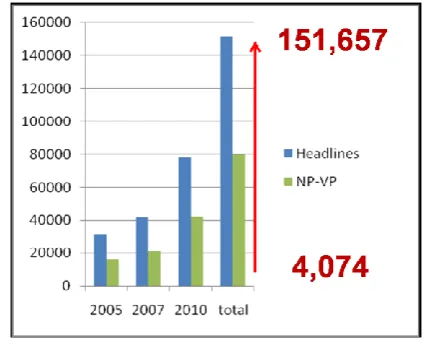
The first column in Figure 1 shows the total amount of gathered headlines for each year. There we can see that the total amount of headlines included in the new experiment is 151,657 and, more important, this represents the whole universe of data, that is: all new headlines published in the “printed version” of El País from 2005, 2007 and 2010.
Taking into account that in previous manual analyses, the total amount of headlines included in the experiment were 4074, the impact of the increase is obvious. In previous experiments, our researchers selected small portions of randomly chosen “representative” data.
Figure 1: Number of headlines gathered for the current experiment. The First column shows the total amount of
headlines. The second column shows the amount of headlines with a NP-VP syntactic pattern
In previous experiments, the lack of digital methods made it impossible to analyze all data and forced our researchers to select small portions of randomly chosen “representative” data. Now we have the whole universe of data.
People from the Muncipals’11 online Project need daily data from the Catalan political blogosphere in order to get a diachronic corpus. In this case the task was harder as we had to implement ad hoc html and boilerplate removal. Crawling data from the web and extract plain data may be a laborious task. However the time invested was necessary and fruitful as the researchers were able to perform automatic texts analysis that could not be done otherwise. We eventually managed to automatically access to 459 blogs from the Catalan political blogosphere. This process allowed us to get more than 8000 posts.
3
4.
NLP and massive computation
The Feminario research group developed a test to evaluate what they call the “informative glance”. Essentially the test addressed four basic questions: (i) who focuses the news –this includes the author and/or source, (ii) what women and men are focused –that is, the protagonists of the news (iii) in which actions are they involved and (iv) in what kind of scenarios. The ultimate goal was to determine who the news were talking about and in what terms.In previous analyses, researchers read the headlines and filled in a form with the questions above. Once all headlines were analyzed they started the statistical analysis. The objective was to help them in the tedious and time consuming task of filling in the forms by providing tools that could automatize the process.
Though the process could not be fully automatized for (ii) and (iii) above CLARIN NLP tools proved really useful. Essentially, the tasks that CLARIN tools addressed were:
the identification of both the protagonists and actions of the headlines
the classification of protagonists (both syntactically and semantically) and
the analysis of associations between protagonists and their corresponding actions in order to find significant associations.
The sequence of tasks performed by CLARIN tools can be summarized as follows:
1. Automated dependency syntactic analysis of the headlines.
2. Selection of the headlines with NP-VP structure. 3. Identification of the subject as the protagonist of the
action
4. Identification of the main verb as the action of the headline
5. Semantic classification of subjects (that is, protagonists). This includes common nouns as well as proper names.
1 to 4 was automatically done in just a few minutes using Freeling service4. The deep-syntactic parser was able to analyse nearly 100% of the headlines.
As we can see in Figure 1 above, around the 50% of the headlines in each year follow the sentence structure NP-VP. The rest of the headlines were essentially noun phrases and adjectival phrases (among other less frequent structures). Notice that our analysis only considered those headlines with NP-VP structure as we were looking
4
Freeling is an open source language analysis tool suite developed by the TALP research center in the Universitat Politèctica de Catalunya (http://nlp.lsi.upc.edu/freeling/). This tool is deployed as a web service in the virtual laboratory at http://clarin-es-lab.org.
for “subjects” (protagonists) and “verbs” (actions). This means that a total amount of 79.611 headlines were eventually included in the experiment.
The semantic classification of proper names was also performed using Freeling tools. In Freeling, Named Entity Classification (NEC) distinguishes between four types: locative, organization, person and miscellaneous. As fully reported in Carreras et al. (2002), the Spanish Freeling NEC system has a precision of 81.38% and a recall of 81.40% overall types. More important in our case, Freeling NEC gets precision of 84.71% and a recall of 93.47% when considering the person type alone.
The semantic classification of subject common nouns was automatically performed via lexicon look up. This lexical look-up process was automated and it took less than two minutes. The process was able to semantically classify more than 91% of the protagonists.
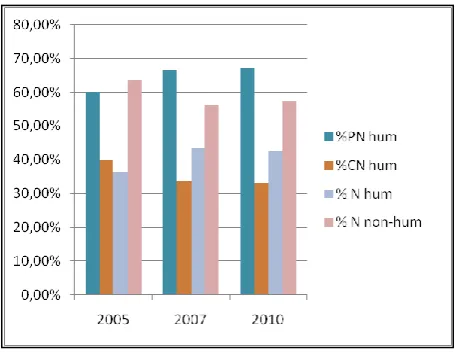
Figure 2 summarizes this classification. The first two columns distinguish between proper nouns vs. common nouns. The second two columns distinguish between human vs. non-human protagonists 5 . The figures demonstrate that as far as protagonists are concerned (i) proper nouns are more frequent than common nouns (60% and 40% respectively) and (ii) non-human protagonists are always more frequent than human protagonists (55% and 45% respectively).
Figure 2: Classification of protagonists
Once we had the protagonists and actions identified and classified, we provided different quantitative analysis tools. These include basic quantitative measures such as different word counts, measures of vocabulary richness, sample representativeness, vocabulary distribution and different measures of association. We were able to identify most statistically significant associations between subject and verbs, compare occurrences between masculine and feminine words and word forms, identify
5
Proceedings of CoNLL Shared Task, pg. 167--170. Taipei, Taiwan.
D. Hull, K. Wolstencroft, R. Stevens, C. Goble, M. Pocock, P. Li, and T. Oinn, “Taverna: a tool for building and running workflows of services.,” Nucleic Acids Research, vol. 34, iss. Web Server issue, pp. 729-732, 2006.
Amparo Moreno. (2007). ¿De quién hablan las noticias? Guía para humanizar la información. Icaria, Colección Akademia. Barcelona. ISBN: 978-84-7426-955-0.
Amparo Moreno. (2007). De qué hablamos cuando hablamos del hombre. Treinta años de crítica y alternativas al pensamiento androcéntrico. Icaria, Colección Akademeia. Barcelona. Páginas: 375. ISBN: 978-84-7426-956-3. Depósito legal: B-49.136-2007
Amparo Moreno. (1998). La Mirada informativa. Barcelona, Bosch Casa Editorial
Lluís Padró and Miquel Collado and Samuel Reese and Marina Lloberes and Irene Castellón. (2010). FreeLing 2.1: Five Years of Open-Source Language Processing Tools Proceedings of 7th Language Resources and Evaluation Conference (LREC 2010),
ELRA. La Valletta, Malta. May,
http://nlp.lsi.upc.edu/freeling.
Senger M., Rice P., Bleasby A., Oinn T., Uludag M.. (2008). "Soaplab2: more reliable Sesame door to bioinformatics programs", In The 9th annual Bioinformatics Open Source Conference.