ABSTRACT
CAYTON, CHARITY SUE-ADAMS. Teachers’ Implementation of Pre-Constructed Dynamic Geometry Tasks in Technology-Intensive Algebra 1 Classrooms. (Under the direction of Dr. Karen F. Hollebrands).
Technology use and a focus on 21st century skills, coupled with recent adoption of Common Core State Standards for Mathematics, marks a new challenge for mathematics teachers. Communication, discourse, and tools for enhancing discourse (NCTM, 1991, 2000) play an integral role in successful implementation of technology and mathematics standards.
Dynamic geometry environments represent a tool that has the potential to enhance the discourse within mathematical discussions. Also, Stein, Engle, Smith and Hughes (2008) described five practices for orchestrating productive mathematical discussions intended to help teachers incorporate student thinking into classroom discussions. The 1:1 laptop
learning environment provides a context that has the potential to examine the intersection of classroom discourse, pedagogical practices, and technology use.
This study examined the nature of mathematical discourse, extent to which teachers used the five practices, examined design and technology features of pre-constructed dynamic geometry tasks and how teachers use them, and explored the combined influence of
discourse, the five practices, and technology use on level of cognitive demand when teachers implement pre-constructed dynamic geometry tasks. The study followed a qualitative, multicase observational research design, where a purposeful sample of three teachers
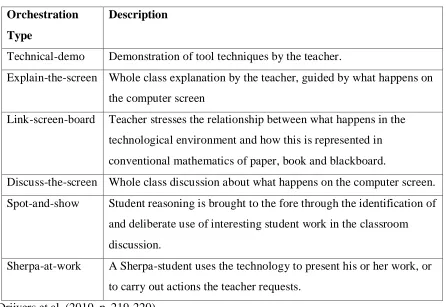
a dynamic model characterizing task implementation and use of the five practices in 1:1 computing classrooms. The Task Analysis Guide (Smith & Stein, 1998), Sinclair’s (2003) design principles for pre-constructed dynamic geometry sketches, and the IQA for Academic Rigor: Mathematical Rubric for Potential of the Task were used to evaluate the potential level of cognitive demand of pre-constructed dynamic geometry tasks. Participants were observed for three teaching sets (Simon, Tzur, Heinz, Kinzel, and Smith, 2000), and excerpts of the video that included use of pre-constructed dynamic geometry tasks served as episodes for analysis. Discourse was analyzed using a modified version of the Oregon Mathematics Leadership Institute Classroom Observation Protocol and Boaler and Brodie’s (2004) question types. Drijvers, Doorman, Reed, & Gravemeijer (2010) teacher technology orchestration types were utilized to describe how teachers used pre-constructed dynamic geometry tasks during implementation. The five practices served as codes for interview, group planning, and classroom observation data to characterize the extent of teachers’ use of the five practices. The triangulation of discourse, technology use, and use of five practices was compared to the IQA for Academic Rigor: Mathematical Rubric for Implementation of the Task to evaluate the implemented level of cognitive demand of the pre-constructed dynamic geometry tasks.
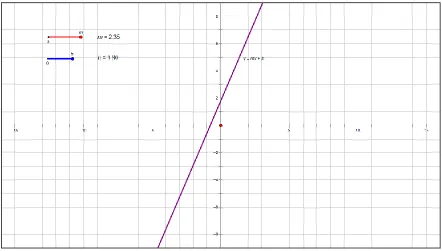
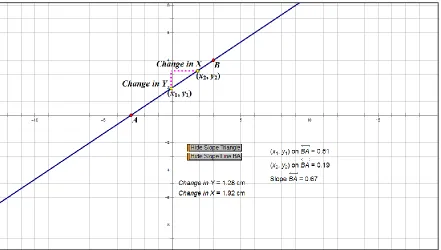
screen. Teachers used sliders and hide/show buttons to focus student attention and facilitate development of mathematical concepts. Given that pre-constructed dynamic geometry tasks adhered to design principles, two themes emerged for level of cognitive demand; 1) when teachers employed higher level questions/statements in conjunction with a discuss the screen technology orchestration type the implemented level of cognitive demand remained high and 2) when teachers employed lower level questions/statements in conjunction with an explain the screen technology orchestration type the implemented level of cognitive demand
Teachers’ Implementation of Pre-Constructed Dynamic Geometry Tasks in Technology-Intensive Algebra 1 Classrooms
by
Charity Sue-Adams Cayton
A dissertation submitted to the Graduate Faculty of North Carolina State University
in partial fulfillment of the requirements for the degree of
Doctor of Philosophy
Mathematics Education
Raleigh, North Carolina 2012
APPROVED BY:
_______________________________ ______________________________
Dr. Karen Hollebrands Dr. Hollylynne Lee
Committee Chair
________________________________ ________________________________
DEDICATION
BIOGRAPHY
Charity Sue-Adams Cayton was born in New Bern, North Carolina on September, 4, 1974. Charity is the daughter of Sue Faught and William Adams. She was raised in Craven County, North Carolina and graduated from West Craven High School in 1992. She received a North Carolina Teaching Fellows Scholarship to attend East Carolina University, where she earned her Bachelor of Science in Mathematics in May, 1996. At graduation, she was
honored with the University Award, given to recognize outstanding graduating seniors. After graduation, Charity accepted a teaching position at D. H. Conley High School in Greenville, North Carolina.
On July 13, 1996, Charity married Darren Jay Cayton, and they welcomed their first child, Zachary Hunter, into the world in the spring of 1997. In the fall of 2001, Mrs. Cayton earned National Board Certification in Adolescent and Young Adult Mathematics, which she renewed in 2011. Mr. and Mrs. Cayton were blessed with their second child, Macayla Daryn, in the spring of 2002. As her teaching career progressed, Charity received the Kathryn Hodgin Award for Teaching Excellence in 2004, and was a state finalist for the Presidential
Award for Excellence in Mathematics and Science Education in 2005. While teaching
full-time, she earned her Master of Arts in Mathematics Education from East Carolina University in May, 2007. Students’ understanding of multiple representations of linear functions served as the focus of her thesis research. Mrs. Cayton left the classroom in the fall of 2008 to pursue a doctorate in mathematics education at North Carolina State University.
Provost Fellowship to help with her first year of doctoral studies. As a graduate teaching assistant, she taught Introduction to Mathematics Education for three semesters, and served as an assistant in Technology in Mathematics Education for one semester. In January, 2010, Mrs. Cayton became a graduate research assistant with Scaling Up STEM Learning with the VCL, under the supervision of Dr. Karen Hollebrands.
Charity accepted a one year research associate position with Scaling Up STEM Learning with the VCL in August, 2012. In the future, she hopes to obtain a faculty position
ACKNOWLEDGMENTS
My mantra throughout my adult life has been, “I can do all things through Christ who strengthens me” (Phillipians 4:13). This belief has never held truer than during the past four years. The path has been long and arduous, but He has been with me every step of the way. For that I am eternally grateful.
While God has been my spiritual rock, my husband, Darren, has been my physical rock. Thank you for your love and support throughout this process. You have often taken a back seat to my school work and the kids, but you have always been understanding and patient with me. You understand me like no one else, and you have believed in me even when I did not believe in myself. I love you and thank God for you every day.
Zach and Macayla, I cannot believe how much each of you have grown over the past four years. When I began this process, Zach was entering middle school, and Macayla had just finished kindergarten. Now, Zach is taller than me, has his driving permit, and his voice is deeper than his daddy’s. You have grown into a fine young man, and I thank you for the clinical interviews and teaching experiments you participated in during my course work. Love you, Wildman. Macayla you amaze me and keep me humble as I see the obstacles you overcome on a daily basis. You have transformed in to a vibrant, young lady with a love of learning and a passion for life. Love you, my little Pinkie Pie.
in me the value of education and set me on this path, long before any of us knew exactly where it would lead. Joe and Barbara, thank you for loving me as if I were your own. I have never felt like a step-daughter, and I hope you have never felt like a step-parent. Also, to my wonderful mother-in-law, Sybil, you have been an angel on earth for my family. You have treated me like your own daughter and loved and cared for Zach and Macayla since they were born. I can only hope to be a portion of the mother-in-law and grandmother that you have been.
To my chair, Karen, you provided academic and emotional support, and welcomed me into your family. I have always been amazed at your patience and how you balance the many facets of your life. I am thankful for all you have done, and I am very excited that I will be able to mentor with you for another year as a research associate. Hollylynne, I remember meeting you and Karen for the first time at PME-NA in Toronto. I could not imagine back then the influence you would have on my life. Thank you for helping me transition from the high school classroom to the doctoral program and always having an open door with a box of tissues. Allison, thank you for sharing your insight and lessons learned with me, not to mention always giving wonderfully therapeutic hugs. Paola, thank you for helping me think deeply about professional development and teacher learning. Roger, I appreciate the fact that you joined my committee at a very critical time and helped me transition from a PhD student to a PhD candidate.
are exemplary mathematics educators and lifelong friends. I am blessed to have each of you in my life. Jenny, I thank you for helping me think and live outside of the box. Don’t worry, John will be finished with his program sooner than you think.
As a high school teacher, I had the opportunity to teach approximately 1500 students. Each one of you contributed in some way to the educator I am today, so I thank each of you. For those that are no longer with us, thank you for helping me remember how precious life is and to cherish every moment with my family and loved ones.
TABLE OF CONTENTS
LIST OF TABLES ... xiii
LIST OF FIGURES ... xiv
CHAPTER 1: INTRODUCTION... 1
Background ... 1
Purpose of the Study ... 4
Significance and Limitations of the Study ... 6
Subjectivity Statement ... 6
CHAPTER 2: LITERATURE REVIEW ... 8
Teaching and Learning in 1:1 Environments... 8
Mathematics Professional Development: Research and Reporting ... 11
Reporting on mathematics professional development ... 11
Adult learning ... 12
Teacher learning ... 15
Role of Discourse in Teaching and Learning Mathematics ... 20
Defining mathematical classroom discourse ... 20
Discourse and mathematical discourse ... 20
Mathematical classroom discourse ... 22
Patterns of mathematical classroom discourse and analysis tools ... 23
Discourse and student learning ... 28
Developing discursive classrooms ... 29
Developing teachers’ mathematical classroom discourse ... 30
Developing students’ mathematical classroom discourse ... 31
Support structures and constructs for mathematical classroom discourse ... 32
Summary... 33
Five Practices for Orchestrating Productive Mathematics Discussions & Level of Cognitive Demand ... 34
Technology Professional Development, Dynamic Geometry Environments, and Tools for Examining Teachers’ Use of Dynamic Geometry Software... 39
Research on teachers and technology professional development ... 39
Dynamic Geometry Environments ... 40
Tools for examining teachers’ use of dynamic geometry environments ... 42
Summary... 45
CHAPTER 3: METHODOLOGY... 46
Scaling Up STEM Learning with the Virtual Computing Lab ... 47
Context... 47
Critical issues ... 48
Strategies ... 48
Summary... 52
Research Design ... 53
Conceptual framework... 54
Participant Selection ... 56
Mrs. Lewis ... 57
Mrs. Patterson... 60
Mr. Phelps... 63
Data Collection Methods ... 65
Teacher interview data ... 65
Group planning session data ... 66
Classroom observation data... 67
Other artifacts ... 68
Data Analysis Methods ... 69
Teacher interview data analysis ... 69
Group planning session data analysis ... 70
Classroom observation data analysis ... 70
Other artifact data analysis ... 73
Within case analysis... 73
Cross case analysis ... 74
CHAPTER 4: CASE ANALYSIS ... 75
Mrs. Lewis ... 75
Teaching Set 1 ... 75
Prior to implementation ... 78
Implementation of tasks... 79
Mathematical discussions ... 80
Five practices ... 85
Technology use ... 85
Implemented level of cognitive demand... 87
Teaching Set 2 ... 88
Prior to implementation ... 90
Implementation of tasks... 94
Mathematical discussions ... 95
Five practices ... 101
Technology use ... 101
Implemented level of cognitive demand... 104
Mathematical discussions ... 110
Five practices... 116
Technology use ... 116
Implemented level of cognitive demand ... 122
Discussion of Mrs. Lewis ... 123
Mrs. Patterson ... 125
Teaching Set 1 ... 125
Prior to implementation ... 125
Mathematical discussions ... 128
Five practices... 132
Technology use ... 133
Implemented level of cognitive demand ... 137
Teaching Set 2 ... 138
Prior to implementation ... 138
Implementation of tasks... 140
Mathematical discussions ... 140
Five practices ... 146
Technology use ... 146
Implemented level of cognitive demand... 151
Teaching Set 3 ... 152
Mathematical discussions ... 152
Five practices... 157
Technology use ... 158
Implemented level of cognitive demand ... 159
Discussion of Mrs. Patterson ... 159
Mr. Phelps ... 161
Teaching Set 1 ... 161
Prior to implementation ... 162
Mathematical discussions ... 163
Five practices... 167
Technology use ... 167
Implemented level of cognitive demand ... 168
Teaching Set 2 ... 168
Prior to implementation ... 169
Implementation of tasks... 169
Mathematical discussions ... 169
Five practices ... 174
Implemented level of cognitive demand... 177
Teaching Set 3 ... 179
Mathematical discussions ... 179
Five practices... 185
Technology use ... 185
Implemented level of cognitive demand ... 187
Discussion of Mr. Phelps ... 187
CHAPTER 5: CROSS CASE ANALYSIS AND FINDINGS ... 193
Findings Related to Research Question 1a ... 194
Teaching set one... 194
Teaching set two ... 194
Teaching set three ... 195
Summary... 195
Findings Related to Research Question 1b ... 196
Findings Related to Research Question 1c ... 198
Findings Related to Research Question 1d ... 200
Discussion ... 205
Summary ... 207
CHAPTER 6: CONCLUSIONS, IMPLICATIONS, AND LIMITATIONS ... 208
Conclusions ... 208
Discourse ... 208
Five practices... 212
Technology use ... 212
Level of cognitive demand ... 213
Implications ... 215
Limitations ... 218
Directions for Future Research ... 219
References ... 220
Appendices ... 233
Appendix A. Research Question and Data Analysis Matrix ... 234
Appendix B. Initial/Summative Teacher Interview Protocol ... 235
Appendix C. Amended OMLI Classroom Observation Protocol ... 237
Appendix D. Focus Group Protocol ... 244
Appendix E. Rubric for Slope Presentation Sketch ... 245
Appendix F. IQA Academic Rigor: Mathematics Rubric for Potential of the Task ... 246
LIST OF TABLES
LIST OF FIGURES
Figure 1. The Task Analysis Guide (Smith & Stein, 1998) ... 36
Figure 2. Mathematical Task Framework (Smith & Stein, 1998) ... 37
Figure 3. Scaling UP Stem Learning Algebra Professional Development Timeline .. 49
Figure 4. Dynamics of the Mathematical Task Framework & 5 Practices in 1-1 Computing Classrooms ... 55
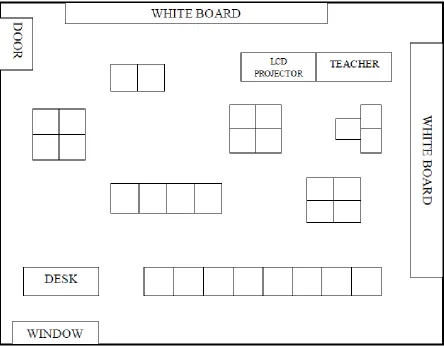
Figure 5. Classroom Configuration for Mrs. Lewis ... 58
Figure 6. Classroom Configuration for Mrs. Patterson ... 61
Figure 7. Classroom Configuration for Mr. Phelps ... 64
Figure 8. Slope-Intercept Task ... 78
Figure 9. Mrs. Lewis’ Slope Presentation Sketch ... 79
Figure 10. Quadratic Coefficient Exploration-Graphing y = ax2 ... 90
Figure 11. Vertical/Horizontal Transformations and Axis of Symmetry-Graphing y = (x – h)2 + k ... 91
Figure 12. Minimum & Maximum Exploration ... 91
Figure 13. Roots/Zeros Exploration ... 92
Figure 14. Quadratic Applications-Projectile Motion ... 92
Figure 15. Quadratic Applications-Minimize Cost ... 93
Figure 16. MP3 Download Task... 107
Figure 17. Pay Raise Task ... 107
Figure 18. Exponential Applications – Interest ... 108
Figure 19. Exponential Applications – Depreciation ... 109
Figure 20. Exponential Applications – Population ... 109
Figure 21. Mrs. Patterson’s Slope Presentation Sketch ... 126
CHAPTER 1: INTRODUCTION Background
The use of technology and a focus on 21st century skills has become an increasingly important facet of education for teachers and students. Evidence of this can be seen in the creation of standards pertaining to technology use by teachers and students, as well as criteria for mathematics teacher educators in the preparation of mathematics teachers. The
International Society for Technology in Education (ISTE) produced the National Educational Technology Standards for Teachers (NETS-T) (2008) and the National Educational
Technology Standards for Students (NETS-S) (2007) to provide guidelines for how teachers and students should be using technology in the classroom. While these standards relate to the use of technology broadly in education, the Association of Mathematics Teacher Educators (AMTE) offers recommendations about the use of technology in the mathematics classroom. AMTE aligns their position with the National Council of Teachers of Mathematics (NCTM) technology principle and directly addresses the preparation of mathematics teachers to teach with technology and outlines the types of experiences that should be included to accomplish this goal. While their suggestions are written in reference to teacher candidates, practicing teachers may or may not have encountered such experiences as components of their
The recent adoption of the Common Core State Standards for Mathematics (CCSSM) (2010) in all but five states (as of August 2012) marks a new challenge for mathematics teachers. The NCTM process standards and the strands of mathematical proficiency from the National Research Council’s report Adding It Up were used to build the Standards for
Mathematical Practice specified in the CCSSM. Communication is one of five process standards from NCTM. This implies that teachers will need to communicate effectively with their students to successfully implement the CCSSM.
The Professional Standards for Teaching (NCTM, 1991) emphasized the role of discourse in the classroom by including the teacher’s role in discourse, the student’s role in discourse, and tools for enhancing discourse as three of six essential teaching standards. NCTM (2000) resonated the importance of discourse with a description of mathematics teaching and learning that engages students, facilitates students’ ability to create and share conjectures, encourages evaluation of ideas presented (by self and others), makes
connections among ideas, and reorganizes understanding.
Research has been conducted that describes specific pedagogical practices that support teachers’ facilitation of mathematical discussions. Stein, Engle, Smith and Hughes (2008) focused on helping teachers incorporate student thinking into classroom discussions, and included five practices for orchestrating productive mathematical discussions. According to Smith and Stein (2011),
The five practices were designed to help teachers to use students’ responses to
to make instructional decisions by shifting some of the decision making to the planning phase of the lesson (p. 7).
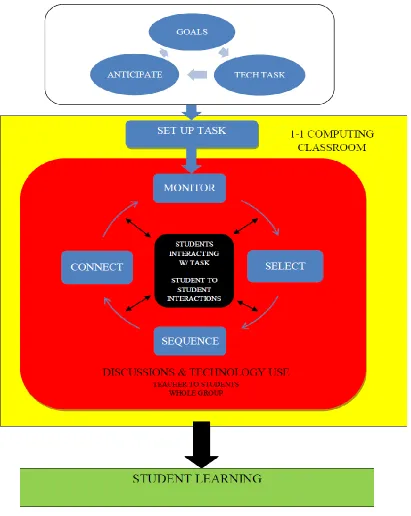
The five practices include anticipating student solution strategies to a task, monitoring students thinking as they work on a task, selecting student strategies to include in classroom discussions, sequencing the selected student strategies in a meaningful way, and connecting the strategies presented. Smith and Stein emphasize the setting of mathematical goal(s) and selecting appropriate mathematical tasks to help achieve said goal(s) as essential aspects of planning that must take place prior to implementing the five practices.
Algebra 1 serves as a gateway for students to reach higher level mathematics. Research focused on Algebra 1 classrooms operating on a 1:1 learning model that includes dynamic geometry technology represent a learning environment that may add to body of knowledge regarding discourse and 1:1 computing.
Teachers face a daunting task to effectively incorporate technological standards (NETS-T and NETS-S) and mathematical standards (CCSSM) in a manner consistent with the vision of mathematics created by NCTM (1991, 2000). AMTE’s (2006) propositions about the important role of technology in preparing future mathematics teachers provides insight into how to build specific types of experiences into mathematics teacher education programs that align with these standards. Yet depending upon where and when practicing teachers received their education, they may not have participated in educational experiences that align with AMTE’s propositions. This is especially true for teachers employed in rural areas with limited access to universities.
Purpose of the Study
The overarching question that guided this study was, “How do teachers implement pre-constructed dynamic tasks in technology intensive Algebra 1 classrooms?” The purpose
of this study is to 1) characterize the nature of mathematical discourse, 2) describe the extent to which teachers use the five practices for orchestrating productive mathematical
pre-constructed dynamic geometry tasks. As such, the following research question will be answered:
When involved in technology-intensive, research-based, professional development on Algebra:
a. What types of mathematical questions and statements are central to the mathematical discussions that occur among students and the teacher when implementing pre-constructed dynamic geometry tasks?
b. To what extent do teachers utilize the five practices for orchestrating productive mathematical discussions to support their implementation of pre-constructed dynamic geometry tasks?
c. What are the design and technological features of pre-constructed dynamic geometry tasks and how do teachers use them during implementation?
d. What is the overall influence of a-c on the implemented level of cognitive demand of the pre-constructed dynamic geometry tasks?
To answer these research questions, a qualitative, observational multicase study was conducted in a small, rural, high needs school system. The school system had been
Significance and Limitations of the Study
The significance of this study may be found in several areas. First, the context of rural, high needs schools represents an understudied demographic of teachers and students. Second, this study focuses on the use of pre-constructed dynamic geometry tasks in a novel environment, Algebra 1. To clarify, the pre-constructed tasks focus on content specific to standards based instruction for Algebra 1, and they were created using dynamic geometry software. Third, this study seeks to integrate three essential aspects of the 1:1 laptop mathematics learning environment (i.e., discourse, pedagogical practices that support mathematical discussions, and technology use) to examine level of cognitive demand when teachers implement pre-constructed dynamic geometry tasks. A limitation of the study is the restricted time frame for the study. It is well documented that changes in teachers’ practices occurs over extended periods of time (Loucks-Horsley, Stiles, Mundry, Love, and Hewson, 2010). Because this study will take place over a single semester, longitudinal data and analysis will not be possible.
Subjectivity Statement
School Mathematics. At the time of the study, I had served one and one-half years as a
graduate research assistant for the grant that provided the professional development for participants in this study. My experiences in the classroom and graduate school provided a wealth of knowledge to draw from throughout this study.
CHAPTER 2: LITERATURE REVIEW
The purpose of this chapter is to outline research related to teachers’ professional development in technology intensive environments. The first two sections of the literature review focus on research pertaining to the context for this study, 1:1 laptop teaching
environments and mathematics professional development. Then literature relevant to the role of discourse in teaching and learning mathematics precedes a discussion of pedagogical practices to promote mathematical discussions and level of cognitive demand. The chapter concludes with research findings related to technology professional development, dynamic geometry environments, and tools for examining teachers’ use of dynamic geometry environments.
Teaching and Learning in 1:1 Environments
The use of technology was cited by NCTM (2000) as one of six core principles of teaching and learning school mathematics. “The existence, versatility, and power of
technology make it possible and necessary to reexamine what mathematics students should learn as well as how they can best learn it” (p. 24). A particular learning environment that personifies the vision of Principles and Standards for School Mathematics (NCTM, 2000), where every student access to technology to facilitate mathematics learning under the instruction of a skilled teacher, is the 1:1 laptop learning environment. Within this
Pennsylvania, and Texas, as well as Henrico County, Virginia. The evaluation studies from these states “found a positive relationship between laptop use and various aspects of the teaching and learning process” (p.11). Evaluators of 1:1 initiatives observed that 1:1 laptop initiatives had the potential to positively influence instructional practice of teachers and student outcomes. For example, a high level of implementation of laptop use was shown to increase student engagement, motivation for learning, and interest in school. Conversely, a low implementation of laptops led to student distraction, as well as indifference and/or negativity with respect to laptop use. With regard to student outcomes, student achievement scores were significantly higher when laptops were used at least once a week. Also,
technology skills of students’ and teachers’ improved along with critical thinking,
communication, collaboration, and self-directed learning skills when high implementation was present. The meta-analysis also documented changes in pedagogy and classroom practices. Teachers increased their use of technology to develop learning materials, higher order questioning increased, and their instructional practices began to shift away from more traditional approaches toward teaching with more reform-oriented approaches (e.g., student-centered instruction, experiential, hands-on learning activities, and project-based learning) (Argueta et al, 2011).
shift their role in the classroom toward becoming facilitators and coaches. The role of high quality professional development was also discussed in relation to successful 1:1
implementation. Within the meta-analysis, schools with an emphasis on professional development had higher implementation, and the structure of the professional development was critical. Built-in teacher training days and teacher accountability for implementing learned practices were characteristics of professional development in higher implementing schools. This contrasted with lower implementing schools that participated in short
professional development sessions during or after school that emphasized proficiency with a particular product. The evaluation report for North Carolina concurred with the need for quality professional development and expressed teachers’ need to collaborate and share successful lessons, specific to the 1:1 learning environment. Supporting professional development, having reasonable expectations for integration, modeling of technology use, providing resources and support, and communication were important recommendations for leadership that were included in the North Carolina evaluation report.
The meta-analysis and North Carolina’s evaluation report was not specific to mathematics classrooms; however the description of teaching and learning in 1:1 environments is consistent with technology standards for teachers and students, the Professional Standards for Teaching Mathematics (NCTM, 1991), the Professional
Standards for School Mathematics (NCTM, 2000), and CCSSM (2010). The next section
Mathematics Professional Development: Research and Reporting
Much has been learned in relation to effective professional development in
mathematics education. Research supports that professional development is more effective when teachers have a vested interest (Elmore, 2002 and Guskey, 2003). Further, effective professional development needs to be on-going and coherent; focused on actively learned content combined with how students learn that content; connected to teaching practice, school, and system-wide goals; and promote collective participation among teachers as a community of learners (Darling-Hammond, Wei, Andree, Richardson & Orphanos, 2009; Desimone, 2009; Elmore, 2002; Garet, Porter, Desimone, Birman & Yoon, 2001; Guskey, 2003; Heck, and Banilower, Weiss & Rosenberg, 2008; & Kennedy, 1998). There also needs to be open communication with all stakeholders in a school system (Elmore, 2002).
Consistent with these findings, Polly and Hannafin (2010) synthesized empirically based studies and recommendations to create a learner-centered professional development (LCPD) framework that could be useful for providing professional development and conducting empirical research on teacher learning. Their framework was characterized by a focus on student learning, teacher-ownership, development of content and pedagogical knowledge, collaboration, ongoing support, and reflection. Various technologies were included in the framework that enhanced teachers’ and researchers’ ability to examine student learning outcomes and teachers’ practice, reconcile differences in beliefs and practices, scaffold in-class implementation of technology, and document the impact of LCPD.
Mathematics Education and organized 21 features into five categories (based on
Loucks-Horsley et al., 1998). These categories included, 1) knowledge and beliefs, 2) context, 3) goals, 4) critical issues, and 5) strategies. The first category pertains to researchers’
knowledge and beliefs about student learning, teacher learning, and adult learning. The next section discusses research pertaining to adult and teacher learning. Various metaphors for adult learning will be described before focusing the discussion of adult learning around teacher learning. The methodology chapter will utilize the remaining four categories
suggested by Sztajn (2011) to discuss the Algebra professional development context for this study.
Adult learning. Before embarking on a study involving teachers, attention must be given to how teachers learn. Since teachers are a subset of the adult learning community, literature related to adult learning will be discussed prior to focusing specifically on teacher learning. Daley (1999) studied novices and experts in the field of nursing to examine how they learn to change their practice as they gain more experience. Building upon Dreyfus and Dreyfus (1980, 1985), five stages were described to characterize career development, 1) novice, 2) advanced beginner, 3) competent, 4) proficient, and 5) expert. Novice
professionals were found to govern their practice with rule-oriented behaviors, whereas advanced beginners begin to differentiate among situations. However, advanced beginners continue to have great difficulty distinguishing what is important and what is not important when making decisions. Between the three to five year mark, professionals transition into the competent stage, characterized by the ability to organize and plan activities, remain
unpredictable situations. Once a professional moves into the proficient stage, they begin to have a holistic sense of the work they are doing. At the highest stage, experts possess an intuitive understanding of a given situation and focus on the main issues without wasting considerable time on extraneous aspects of a situation. Two skills that experts draw upon are similarity recognition across situations and realizing that not all tasks, observations and interventions are equally important. As a professional transitions through the five stages, their working paradigm changes from abstract principles to concrete past experiences. They begin to view situations as part of a connected whole and become an involved performer, rather than viewing situations as discrete and unconnected or being a detached observer, respectively. Daley (1999) noted that the predominant theme within the findings was that nurses learned to how to learn within the context of their practice. Novices relied on more formal means such as review of policy/procedures, attendance at continuing education programs, and reading journals. Experts relied more on informal means situated within their practice for gaining knowledge, such as consulting with peers and other health care
Daley (2001) expanded upon the previous study by including twenty members from each of four professions (social workers, lawyers, adult educators, and nurses) to examine how learning becomes meaningful across various professions. Professionals reported that experiences, continuing professional education, and interactions with colleagues contributed to their growth and refinement of meaningful knowledge. Transfer of learning was not seen as an outcome of educational opportunities, rather transfer was viewed as an integral part of the meaning-making process. For example, new information gained through continued professional education was added to their professional knowledge via thinking about, acting upon, and identifying feelings related to the new information. Before information was to become meaningful, it needed to connect with other concepts and be used in practice. “In other words, incorporating new knowledge is a recursive, transforming process, rather than a simple, straightforward transfer of information from one context to another” (Daley, 2001, p. 50). Similarly, Webster-Wright (2009) argued for a shift in terminology and a move toward more situated, holistic research regarding the learning of professionals. Research from five broad categories of professionals (teaching, health, business, social sciences, and science) was utilized to describe an alternative to professional development, referred to as authentic professional learning. Authentic professional learning was defined as “the lived experience
This is contrary to the assumptions of much professional development and research that maintains that knowledge is gained outside of professional practice, and then incorporated into professional practice and that learning can be mandated through attendance and engagement in professional development programs. Within authentic professional learning knowledge cannot be viewed as a commodity, rather knowledge is situated in practice and cannot be separated from the individuals experiences and social participation. Three
mechanisms for authentic professional learning include learning through experience, learning from reflective action, and learning mediated by context. This view of knowledge and how professionals gain knowledge aligns with the researcher’s view and is consistent with research pertaining specifically to teachers.
Teacher learning. Berliner (1992) utilized the five stages described by Dreyfus and Dreyfus’ (1980, 1985) to describe teachers’ transition along the teaching continuum and noted seven, empirically supported characteristics that expert teachers demonstrated. According to Berliner (1992), expert teachers 1) excel mainly in their own domain and particular contexts, 2) develop automaticity for repetitive operations, 3) are more sensitive to task demands and social situations, 4) are opportunistic in problem solving, 5) view
Borko’s (2000) situative view of cognition serve as two powerful and connected metaphors for teacher learning. Lave (1996) states,
The argument developed by Etienne Wenger and myself (Lave & Wenger, 1991) is that learning is an aspect of changing participation in changing "communities of practice" everywhere. Wherever people engage for substantial periods of time, day by day, in doing things in which their ongoing activities are interdependent, learning is part of their changing participation in changing practices. This characterization fits schools as well as tailor shops. There are not distinguishable "modes" of learning, from this perspective, because however educational enterprises differ, learning is a facet of the communities of practice of which they are composed (p. 150).
Putnam and Borko (2000) echo this view of teacher learning and include specific reference to tools within their situative view of cognition. “Cognition is (a) situated in particular physical and social contexts; (b) social in nature; and (c) distributed across the individual, other persons, and tools” (Putnam and Borko, 2000, p. 4). Similar to the research on adult learning in general, teacher learning is not viewed as a passive process where knowledge is an
imparted commodity, rather it is learned in practice and cannot be separated from
For example, summer workshops appear to be particularly powerful settings for teachers to develop new relationships to subject matter and new insights about individual students' learning. Experiences situated in the teachers' own classrooms may be better suited to facilitating teachers' enactment of specific instructional practices. And, it may be that a combination of approaches, situated in a variety of contexts, holds the best promise for fostering powerful, multidimensional changes in teachers' thinking and practices (p. 7).
(1993). Performance tools “enhance or change how a task is accomplished” and pedagogical tools “focus primarily on changing user’s competencies” (Putnam and Borko, 2000, p. 10). Video cases represent one type of pedagogical tool. Video cases have been shown to
positively impact teacher learning and growth and may serve as a powerful tool for reflection about teaching practice (Sherin & van Es, 2009). One powerful aspect of video cases is that teachers are able to see teaching practice in an environment similar to their own.
Dynamic geometry environments may serve as both a performance and pedagogical tool. Dynamic geometry environments may be used by teachers to create dynamically linked representations. This provides teachers with new ways to present mathematical content. However, teachers must consider how to use the dynamic geometry environment to facilitate student learning, which changes the teacher’s pedagogical competencies. A more detailed discussion of dynamic geometry environments as a tool will be included in the section on dynamic geometry environments and technology use. The next section examines the role of discourse in teaching and learning mathematics.
lived experience for teachers as they learned to incorporate new technology and pedagogical practices.
Role of Discourse in Teaching and Learning Mathematics
The purpose of this portion of the literature review will 1) define mathematical classroom discourse, 2) discuss patterns of mathematical classroom discourse and analysis, 3) share findings related to discourse and student learning, and 4) discuss research on how to develop discursive mathematics classrooms.
Defining mathematical classroom discourse. This section serves three purposes. First, a discussion of Discourse and Mathematical Discourse (with an intentional capital D) will be presented to briefly describe the backdrop for mathematical classroom discourse (with an intentional lowercase d). Second, discourse, as it is defined in various studies, will be synthesized to formulate a definition for mathematical classroom discourse.
Discourse and mathematical discourse. Sfard (2000) reported that some research
utilized Discourse (emphasis on D) to connote a broad view of communication that applies across contexts. Gee (as cited in Moschkovich, 2003) defines Discourse in the following way:
Thus, Discourse in the broader sense describes mechanisms, verbal or otherwise, utilized by individuals to situate themselves as vetted participants within a particular community. Each community is characterized by the discursive practices that members are expected to employ. Further, discursive practices are dynamic rather than static, and these practices often share commonalities with other communities (Sfard, 2000). According to Kieran (2001), Discourse occurs both publically and privately (i.e., among individuals in the community or with
oneself).
Similarly, “Mathematical Discourse (emphasis added) includes not only ways of talking, acting, interacting, thinking, believing, reading, writing but also mathematical values, beliefs, and points of view” (Moschkovich, 2003, p. 326) that cannot be described by a unique set of homogeneous practices. Participation in Mathematical Discourse means an individual speaks and acts consistently with “the ways that mathematically competent people talk and act when talking about mathematics” (p. 326). Sfard (2001) described mediating tools and meta-discursive rules that regulate communication. Mediating tools shape the content, or object-level, aspects of discourse. Meta-discursive rules are the “molders, enablers, and navigators of the communicational activities” (p. 28).These elements control the content of exchange and the flow of the exchange, respectively. Mathematical Discourse may take place among members of a mathematics community or with oneself while doing mathematics. It is important to note that beliefs (Baxter, Woodward, Voorhies & Wong, 2002; Clement, 1997; Forman & Ansell, 2001; Nathan & Knuth, 2003) and
Mathematical classroom discourse. The term discourse varied in meaning throughout the mathematics education literature reviewed for this study. Definitions of discourse included 1) general definitions (including any type of communication), 2) verbal
definitions (talk, utterances, discussion, and dialog), and 3) specific definitions that outlined
Table 1: Definitions of Discourse
Source Definition
Bereiter (1994, p. 9) progressive discourse-understandings are being generated that are new to the local participants and that the participants recognize as superior to their previous understandings.
Clement (1997, p. 3) meaningful mathematical discussion-listening on both sides (teacher and students), all parties (teacher-students or students-students) involved, and
questioning rather than assuming meaning Cobb, Boufi, McClain & Whitenack (1997,
p. 258)
reflective discourse-characterized by repeated shifts such that what the students and teacher do in action subsequently becomes an explicit object of discussion Lo, Wheatley & Smith (1991, p. 1) mathematical discussion-student
interpretation of the mathematical task is the focus of the activity, student-to-student interaction encouraged, teacher’s role is to facilitate student-to-student communication rather than guide or evaluate
Nathan & Knuth (2003, p. 204) productive discourse-forms of social exchange which provide participants with an avenue to construct and build on correct conceptions through their interactions with other class members
Pirie & Schwartzenberger (1988) as reported by Leonard (1999, p. 3)
purposeful talk on a mathematical subject in which there are genuine contributions and interactions
the nature of discourse that must take place. Table 1 presents a summary of six definitions that emerged during this review of literature.
In an effort to synthesize these definitions for the focus of this literature review, I propose the following definition, mathematical classroom discourse refers to verbal
interactions that focus on mathematics and serve to clarify, challenge, expand, investigate, or justify content, solution strategies, or contributions from self and others. This definition resonates with the type of teaching and learning described by NCTM (1991, 2000) and encompasses all members involved in the learning context, consistent with all six views of discourse presented in Table 1. The verbs utilized give further detail to Leonard’s (1999) description of purposeful talk and provide means to build new knowledge that is superior to previous knowledge, similar to Bereiter (1994) and Nathan and Knuth (2003). Further,
successful participation in discursive settings requires listening by all parties (Clement, 1997) to allow for information provided to serve as the object of subsequent discussions (Cobb et al., 1997). Finally, the nature of mathematical classroom discourse described requires that the teacher serve as an arbitrator in the exchange of ideas (Lo et al., 1991), rather than the primary speaker or provider of knowledge.
2008). A slight variation of this pattern, Inquiry-Response-Feedback (IRF) was introduced by Inagaki, Morita, & Hatano (1999) and differs from IRE because the statements offered by the teacher or student after the response are designed to illicit feedback from others to continue the discussion, rather than the evaluative statements that tend to end an IRE unit. Other studies chose to characterize the direction of mathematical classroom discourse between participants. Teacher-to-student and student-to-student interactions were often studied in an effort to document changes in discursive patterns over time in either whole group or small group settings (Baxter et al., 2002; Leikin & Zaslavsky, 1997; Webb, Nemer & Ing, 2006). One study (Leikin & Zaslavsky, 1997) included interactions with not only teacher and student, but also learning materials. Student-to-learning material, student-to-learning material-to-student, and student-to-learning material-to-teacher were three additional directions of interactions. Research by Heibert and colleagues (Hiebert, Gallimore, Garnier, Hollingsworth, Jacobs, Chui, et al., 2003; Hiebert & Stigler, 2000) reported that most classrooms in the United States follow an IRE pattern in reference to teacher and student interactions. Within the IRE discursive pattern, Franke, Kazemi, & Battey (2007) noted that teacher-to-student and student-to-student talk focused on processes and procedures to arrive at solutions, rather than student thinking and strategies when determining a solution. C hazen (2000) noted that mathematical discourse in high school mathematics classrooms was more teacher-centered than other subjects, but maintained that is was one of three themes related to the heart of teaching algebra.
multidimensional discourse delves into students’ mathematical thinking and sharing of their thinking. Boaler and Brodie (2004) examined types of questions posed by teachers (Table 2) to provide a finer grained analysis for what was occurring in secondary mathematics
classrooms. The types of questions teachers pose shape the “nature and flow of classroom discussions and the cognitive opportunities offered to students” (p. 780). They found that
Table 2: Teacher Question Types (Adapted from Boaler and Brodie, 2004)
Question Type Description
1 Gathering information, leading students through a procedure
Requires immediate answer. Rehearses known facts/procedures. Enables students to state facts/procedures. 2 Inserting terminology Once ideas are under discussion, enables
correct mathematical language to be used to talk about them.
3 Exploring mathematical meanings and/or relationships
Points to underlying mathematical relationships and meanings.
Makes links between mathematical ideas and representations.
4 Probing, getting students to explain their thinking
Asks students to articulate, elaborate, or clarify ideas.
5 Generating discussion Solicits contributions from other members of the class.
6 Linking and applying Points to relationships among mathematical ideas and mathematics and other areas of study/life.
7 Extending thinking Extends the situation under discussion to other situation where similar ideas may be used. 8 Orienting and focusing Helps students to focus on key elements or aspects of the situation in order to enable problem solving.
9 Establishing context Talks about issues outside of mathematics in order to enable links to be made with
most teachers employed information gathering questions, but Smith and Stein (2011), suggest that question types 3, 4, and 5 may be helpful to teachers in facilitating classroom discussions. The use of these types of questions aligns well with multidimensional discourse. In multidimensional discourse, processes and procedures may be included in the discussion; however, the goal is to utilize student ideas and questions to drive the mathematical
discourse. This type of discourse requires students to employ a higher level of cognitive demand when participating in mathematical classroom discourse in either whole group or small group settings. Lampert & Cobb (2003) reported that both whole group and small group discussions provided the opportunity for students to make sense of the mathematical ideas being presented when participating in multidimensional discourse.
The Oregon Mathematics Leadership Institute (OMLI) was a five year project funded by the National Science Foundation that focused on K-12 school mathematics. The project involved summer institutes and follow-up activities during the school year. All activities were based on the “belief that understanding and facilitating meaningful mathematics achievement requires a focus on the learner and an emphasis on all levels of student
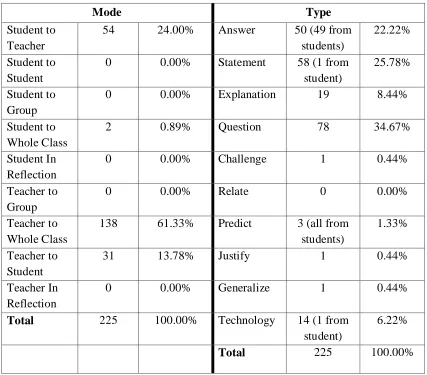
discourse around important concepts in mathematics” (Weaver and Dick, 2006). This project developed an extensive classroom observation protocol specifically designed to examine student discourse in mathematics classrooms. Three levels of student mathematical discourse were included. Modes of mathematics discourse included teacher, student-to-student, student-to-group or class, and individual reflection. Types of mathematics discourse were hierarchical; 1) answering, 2) making a statement or sharing, 3) explaining, 4)
generalizing. The third involved tools for mathematical discourse; 1) verbal, 2)
gesturing/acting, 3) written, 4) graphs, charts, sketches, 5) manipulative, 6) symbolization, 7) notation, 8) computers, calculators, and 9) other. This observation protocol only dealt with student discourse, but the various levels include 1) who is speaking, 2) the nature of the exchange, and 3) tools used. Each of these levels represent mediating tools described by Sfard (2001). Year one results of the project indicated that students in participating teachers’ classrooms participated in classroom discourse slightly more often, and the cognitive demand was slightly higher; however, these results were attributed to selection of participating
According to the OMLI Classroom Observation Protocol, statements and questions occur on the lower end of hierarchical types of discourse; however, a finer grained analysis of statement and question types may provide important insights into the mathematical discourse that occurred (e.g., Boaler and Brodie, 2004). The revised OMLI Observation Protocol, combined with Boaler and Brodie’s question types may be a powerful tool for analyzing multidimensional discourse.
Discourse and student learning. The era of accountability for students and teachers mandates continual growth in student achievement. Hiebert and Wearne (1993) studied six second grade mathematics classrooms (2 experimental, 4 control) during an instructional unit focused on place value, multi-digit addition, and multi-digit subtraction. They linked
improved student achievement to classroom discourse, as measured by amount of
teacher/student talk and types of questions, and reform teaching practices. Although these findings are not broadly generalizable, they do support the notion that teaching and learning environments that encourage classroom discourse and reform practices have the potential to increase student understanding in empirically measureable ways.
Walkowiak (2010) provided examples from research that support the positive impact of multidimensional discourse on student learning (e.g., Cobb, Wood, Yackely, Nicholls, Wheatley, Trigatti, et al., 1991; North Central Regional Educational Laboratory, 2000; Stein & Lane, 1996). According to Walkowiak (2010),
were similar to the IRE pattern. In contrast, the mathematics teachers at the higher performing schools facilitated multidimensional discourse with their students by asking for their mathematical ideas, pushing for the mathematical meaning behind the tasks, and valuing student thinking (p. 25).
Also, the research component of the OMLI project addressed the question: Can student achievement in mathematics be significantly improved by increasing the quantity and quality
of meaningful mathematical discourse in mathematics classrooms? Findings after the third year of professional development were initially inconclusive;
However, once implementation fidelity traits were taken into account, a positive relationship between project participation and student achievement emerged. The degree to which schools implement the practices promoted by the OMLI project is a significant positive predictor of student performance above and beyond what can be explained by the socioeconomic factor as indicated by the percentage of students who qualify for the free and reduced lunch program. This relationship is particularly acute at secondary levels…(Weaver and Dick, 2009, p. 57).
These findings reinforce the importance of mathematics classroom discourse, but the
dilemma of how to create and sustain discursive environments remains. This study examines not only discourse, but also practices to facilitate discourse. Findings may provide further insight into this dilemma.
Developing teachers’ mathematical classroom discourse. The teacher initially decides what is fundamental to the learning environment and, through either direct or indirect means, transfuses these fundamentals into the classroom. Mathematical classroom discourse represents one technique available to teachers that desire to create a teaching and learning environment consistent with the vision of NCTM (1991, 2000). A study conducted by Webb et al. (2006) showed that students’ mathematical classroom discourse mirrored teacher practices when working in small groups. This finding is not surprising since teachers serve as mediators of students’ experiences in the classroom (Baxter et al., 2002; Blanton et al., 2001; Cobb et al., 1997; Weber, Maher, Powell, and Lee, 2008), and teacher’s beliefs greatly impact students’ experiences with discursive practices (Clement, 1997; Nathan & Knuth, 2003).
Leonard (1999) identified four specific teacher variables—pedagogical content knowledge, teacher questioning strategies, use of instructional strategies, and norms—that impacted the amount and quality of mathematical classroom discourse. Consequently, the skill set of a particular teacher has the potential to greatly influence the success of
mathematical classroom discourse. Professional development has been utilized to facilitate
emerged by looking across teachers’ work. First, the literature on classroom discourse had an influence on how the teacher-researchers thought about talk in their classrooms, and what they did in their classrooms. Second, reflection allowed teacher-researchers time and opportunity to think about what they would like to change and helped them make these changes. Third, community was an integral aspect of the professional development project.
Developing students’ mathematical classroom discourse. Students represent a second factor to consider in reference to the development of mathematical classroom discourse. Research compiled for this literature review suggests one of two ways to develop
habits of mathematical classroom discourse in students, direct or indirect transfer. Direct transfer says that expectations for mathematical classroom discourse do not transfer on their own and suggests methods may need to be employed where teachers model, bring attention to, and reinforce expectations for mathematical classroom discourse, treating them as part of the learning goals for the course (Huang, Normandia, & Greer, 2005; Webb et al., 2006). Indirect transfer means that acquiring habits of mathematical classroom discourse occurs as a natural consequence of being a participant in a learning environment patterned around
appropriate verbal means to communicate their ideas effectively. Deficiencies in either area may diminish the students’ ability to actively participate in the learning environment.
Support structures and constructs for mathematical classroom discourse. Research suggests that specific support structures are required to sustain high levels of mathematical classroom discourse. Support structures that overtly impact mathematical classroom
discourse and can be documented through the actual dialog include scaffolding (Baxter et al.,
2002; Jones & Tanner, 2002; Nathan & Knuth, 2003; and Rosales et al., 2008), revoicing (Baxter et al., 2002 and Forman & Ansell, 2001), questioning/probing (Groves & Doig, 2004; Hiebert & Wearne, 1993; Jones & Tanner, 2002; and Piccolo, Harbaugh, Carter, Capraro, & Capraro, 2008), and use of robust learning materials (Groves & Doig, 2004; Heibert & Wearne, 1993; Leonard, 1999; Jones & Tanner, 2002; Webb, 1991; Weber et al., 2008).
true and no observable evidence exists to contradict the assumption the interpretation is considered to be equivalent. If evidence is observed that contradicts this assumption the interpretation would be parallel. In either parallel or equivalent interpretation, when all parties assume their view is shared by others the meaning is said to be taken as shared. During this process members also experience intersubjectivity, which refers to the
assumption that others interpret what we say as we intended, unless evidence is provided to the contrary.
Summary. This portion of the literature review 1) defined mathematical classroom discourse, 2) discussed patterns of mathematical classroom discourse and analysis, 3) shared findings related to discourse and student learning, and 4) discussed research on how to develop discursive mathematics classrooms. It is appropriate to end this section with a quote that encompasses the complex nature, power, and influence of discourse:
Discourse refers to the ways of representing, thinking, talking, agreeing, and disagreeing that teachers and students use to engage. … The discourse embeds fundamental values about knowledge and authority. Its nature is reflected in what makes an answer right and what counts as legitimate mathematical activity, argument, and thinking. Teachers, through the ways they orchestrate discourse, convey
Five Practices for Orchestrating Productive Mathematics Discussions & Level of Cognitive Demand
Sfard (2000) noted two limitations inherent to discourse by emphasizing the extreme difficulty in establishing “appropriate measures of discipline and rigor in school
mathematical discourse” (p. 184), and deciding how to teach elements of mathematical classroom discourse. A combined analysis of mathematical classroom discourse, using the
modified version of the OMLI Classroom Observation Protocoal and Boaler and Brodie’s (2004) question types, may provide a model that characterizes and potentially serve as a measurement tool for the rigor of mathematical discourse. One possible way to address the latter limitation may be found through professional development designed to increase teachers’ awareness of 1) elements of classroom discourse (i.e., revised OMLI codes for modes and types, question types) and 2) the five practices for orchestrating productive mathematical discussions (Smith & Stein, 2011).
Specifically, the five practices include anticipating, monitoring, selecting,
sequencing, and connecting student responses within the context of a mathematics lesson. Anticipating refers to teachers’ proactive consideration of students’ likely responses to
challenging mathematical tasks. However, anticipation involves much more than identifying the correct answer to a task. The teacher must consider 1) how students will mathematically interpret a problem, 2) correct and incorrect approaches to the task, 3) how these
interpretations and strategies “relate to the mathematical concepts, representations,
mathematical thinking and solution strategies during the process of solving the mathematical task. It is of great importance during this time that the teacher utilizes questioning strategies to elucidate and allow for clarification of student thinking, ensure that all students are engaged in solving the task, and ensure students are attending to important details necessary for solving the task. After anticipating and monitoring student responses, the practice of selecting particular students to present their solutions during whole-class becomes the focus
for the teacher. The selection process should be informed by the mathematical goal(s) of the lesson coupled with how the teacher perceives each solution method will help accomplish said goal(s). Once particular students have been selected to share their solutions, the teacher must decide upon the sequencing of the solution methods. This practice provides the teacher with a myriad of options. The teacher may choose to sequence solution strategies from more concrete to more abstract. Another option may be to sequence student strategies by the particular solution strategy that the majority of students utilized to solve the task, then move on to valid but less prevalent solution strategies. Further, sequencing could be based on students’ use of particular representations. Regardless of the how a teacher chooses to sequence presentation of student strategies, the sequencing should be aligned with the mathematical goal(s) for the lesson. The final practice focuses on connecting student strategies. During this practice teachers connect salient features throughout the various solution methods and tie all solution methods in with the mathematical goal(s) for the lesson.
the five practices (Smith and Stein, 2011). Some teachers working with Smith and Stein (2011) referred to the setting of mathematical goals as ‘practice 0’, situating it as the foundation of the remaining five practices. In the Task Analysis Guide (Figure 1),
mathematical tasks are organized by either lower-level or higher-level of cognitive demand, where cognitive demand refers to the amount of reasoning and thinking students will need to employ to solve a particular task. Within these two levels, tasks are further delineated into four categories, 1) memorization, 2) procedures without connections, 3) procedures with connections, and 4) doing mathematics. Teachers may use the Task Analysis Guide to evaluate the level of mathematical tasks during their planning for a lesson; however, the initial categorization of mathematical tasks is not static. Tasks initially appear in
curricular/instructional materials, but they are implemented in classrooms by teachers and students with the eventual outcome of student learning (Figure 2).
Figure 2: Mathematical Task Framework (Smith and Stein, 1998)
materials may be categorized at a lower-level of cognitive demand, but the teacher may alter the task or use questioning strategies during the implementation of the task that increase the level of cognitive demand for students. The reverse scenario is also possible. Similarly, students have the potential to increase or decrease the cognitive demand of a task during classroom implementation.The five practices include anticipating, monitoring, selecting, sequencing, and connecting student solution strategies during whole class discussions. Two essential practices that take place prior to implementing the five practices are setting
mathematical goals and selecting appropriate mathematical tasks that require a high level of cognitive demand on the part of the student. By strategically aligning mathematical tasks with mathematical goals, teachers may be able to embed the discipline and rigor mentioned by Sfard (2000). Also, effective teacher modeling of the five practices would provide students with experiences being a participant in productive mathematical discussions that could possibly teach students how to conduct mathematical classroom discourse during small or large group discussions. A study by Strowbridge (2008) utilized the five practices to study teachers’ use of formative assessment with students as they worked on mathematical problem solving tasks. This research was part of a larger Mathematics Problem Solving Model developed by the Northwest Regional Educational Laboratory that was intended to facilitate teachers’ use of problem solving activities in middle school mathematics
classrooms. However, the practice of sequencing, as it related to formative assessment, received the most attention. In reference to the five practices Strowbridge (2008) states:
studying the five practices helps teachers to craft more mathematically productive sharing episodes in their own classrooms. It is still unknown if teachers actually do feel more in control of classroom discussions when they utilize the five practices (p. 66).
A study that examines the evolution of teachers’ use of all of the five practices to orchestrate productive mathematical discussions would address the lack of research noted by
Strowbridge.
Technology Professional Development, Dynamic Geometry Environments, and Tools for Examining Teachers’ Use of Dynamic Geometry Software
Research on teachers and technology professional development. In a study by Bennison & Goos (2010), teachers identified learning how to incorporate various
technologies in the classroom as their dominant need. Additionally, teacher confidence and positive beliefs regarding student learning with technology was higher for individuals that participated in professional development focused on using technology in teaching
mathematics. Findings from Matzen & Edmunds (2007) showed that teachers increased their use of technology in constructivist ways after participation in technology focused
professional development. Bennison and Goos (2010) utilized chi-square tests on frequency distributions (created from teachers’ survey responses about computers and graphing
professional development focused on using technology in teaching mathematics. However, professional development and access to technology are necessary, but not sufficient
conditions for implementing student-centered teaching practices.
Palak & Walls (2009) investigated links between teachers’ beliefs and technology use in the classroom and how these relate to any shifts toward student-centered teaching
practices. Teachers involved in the study came from technology rich schools in northern West Virginia that demonstrated a commitment to reform, professional development, and technology integration, and they were all current users of technology. The mixed methods analysis revealed three major results. First, teachers most often used technology in non-academic ways (preparation, management, and administrative purposes). Second, teachers using technology in a student-centered manner was rare, even when considering a
technology-rich environment and documented student-centered beliefs. Finally, teachers’ technology use supported existing teacher-centered practices. These findings are of particular importance when considering the potential for mathematical knowledge and practices when digital technologies are present. In their conclusions, Palak and Walls (2009) concluded that technology professional development should not only focus on integrating technology into classroom practice using student-centered pedagogy, but also attend to the context of
teaching practice. Hence, well designed professional development continues to hold promise for facilitating teacher learning.