© 2019, IJCSMC All Rights Reserved 126
Available Online atwww.ijcsmc.com
International Journal of Computer Science and Mobile Computing
A Monthly Journal of Computer Science and Information Technology
ISSN 2320–088X
IMPACT FACTOR: 6.199IJCSMC, Vol. 8, Issue. 9, September 2019, pg.126 – 140
Cloud Computing For Micro, Small &
Medium Scale Enterprises (MSMEs) In
North India Especially in Jammu & Kashmir
Mohd Saleem Bhat
1; Dr. Nissar Ahmad Yatoo
2¹Department of Computer Science, Shri Venkateshwara University, India
²(HOD) Department of Economics, Banking & Finance, International Open University (IOU), Malaysia
1
[email protected], [email protected]
Abstract: Small and medium enterprises (SMEs) face numerous challenges in identification, setting up and making use of information technology (IT) as an enabler for business. Cloud computing could solve this problem by offering ready, low cost of entry IT solutions. The micro, small and medium scale organizations in Jammu and Kashmir are still in nascent state as far as use of IT systems is concerned, though they play a pivotal role in the overall industrial economy of the State. Further analysis of this problem reveals that there are number of barriers which come in the way of MSMEs adopting to new IT systems. Cloud Computing constitutes an alternative for organizations who do not intend to invest in in-house IT resources. They also lack the financial power required to adopt latest information technology and so cannot grow beyond a certain point. The barriers faced by MSMEs in adopting latest IT systems are actually enablers for adoption of cloud computing. One main reason for MSMEs to ignore recent developments in
information technology is lack of awareness. Small and medium sized enterprises (SMEs) assure
economic growth in Jammu & Kashmir. Cloud Computing offers many opportunities and could help companies to improve their business and use technology more efficiently. In this paper a short presentation of Cloud Computing and advantages for SMEs, This paper critically analyzes enablers and barriers in adoption of cloud computing by MSMEs. It also attempts to create awareness, answering many concerns about cloud computing that can be used by MSMEs. It suggests use of cloud computing by MSMEs in Jammu & Kashmir thereby reducing upfront investments, costs and improving efficiency and flexibility.
© 2019, IJCSMC All Rights Reserved 127
I.
Introduction
IT has been deemed as an integral part of modern business, evidenced by how it supports business through communication, information storage, and information retrieval and reporting amongst other key business tasks. Micro, small and medium Scale Enterprises are defined by the reserve bank of India in 2006-2007 are as. For Enterprises engaged in the manufacture or production, processing or preservation of goods - “A micro enterprise is an enterprise where investment in plant and machinery does not exceed Rs 25 lakh; A small enterprise is an enterprise where the investment in plant and machinery is more than Rs. 25 lakh but does not exceed Rs. 5 crore; and A medium enterprise is an enterprise where the investment in plant and machinery is more than Rs.5 crore but does not exceed Rs.10 crore.”
For Enterprises engaged in providing or rendering of services – “A micro enterprise is an enterprise where the investment in equipment does not exceed Rs. 10 lakh; A small enterprise is an enterprise where the investment in equipment is more than Rs.10 lakh but does not exceed Rs. 2 crore; and A medium enterprise is an enterprise where the investment in equipment is more than Rs. 2 crore but does not exceed Rs. 5 crore.”
Cloud computing is computing using shared resources that are delivered as service over internet and charged based on usage. The resources can be infrastructure as a service (IaaS), software as a service (SaaS) or platform as a service (PaaS). Managers and owners of global and local companies are taking steps to ensure their positions in a changing competitive environment. These include efforts to estimate the future development and identifying significant trends. To
watch and
keep up with changes in Information Technology is particularly important because this industry can be considered as the most globally open and inter-connected with fast-moving trends.Future of Cloud Computing In INDIA
The rapid growth of cloud-native services and increasing acceptance of cloud-based environments. With Cloud becoming more prevalent in companies, both large and small, the global requirement for professionals is steadily on the rise and over a million jobs in the sector will be created in the country by 2022, Companies are currently investing 4.5 times the rate of traditional IT spending in cloud infrastructure, and it is expected to grow even faster by 2020, According to a report by ed-tech platform for executives Great Learning. The report is based on conversations with senior cloud experts, recruiting managers as well as subject matter experts and is supplemented by data from high-quality industry research reports. In the coming years, however, nearly all IT expenditure will be on a private, public or hybrid cloud environment, making all IT roles, in some sense, Cloud Computing roles. The Indian cloud computing market, currently at $2.2 billion, is expected to grow to USD 4 billion by 2020 with an annual growth rate of more than 30 per cent, The rapid growth of cloud-native services and increasing acceptance of cloud-based environments as secure coupled with a need to save costs are driving companies away from traditional data centers (DCs) to cloud environments. In India, IT giants are now building solutions on the cloud rather than on physical infrastructure due to increased flexibility, scalability and speed.
"A quick search on popular job boards shows hundreds of open jobs in various roles that require cloud computing expertise. An estimated 1 million new jobs will be created in India by the year 2022 as more companies adopt cloud technology," it added. According to the report there are about 18 million cloud computing jobs worldwide at the moment with a salary of over USD 1,00,000 per annum. More than 1.7 million cloud jobs worldwide remained open as technical recruiters face difficulties in filling out job vacancies in cloud. The report further added that unlike IT skill shortages in the past, solving this skills gap is challenging, as cloud brings a new set of skills, which haven't been needed in the past.
© 2019, IJCSMC All Rights Reserved 128
II.
RESEARCH- ELABORATION
2.1 Statement of the problem and Objectives:
2.1.1
Statement of the problem:
All organizations in today‟s world should adopt the latest in information technology to be competitive for sustainability and growth. While cloud computing arises a great interest in the corporate sector, several researches evidence a lack of professionals able to work in this field. According to the analyst firm IDC3, in 2012 more than 1.7 million cloud computing jobs have remained unoccupied and the trend should lead to more than seven million cloud-related vacancies worldwide in 2015.
However, adoption of the latest in information technology by MSMEs in Jammu and Kashmir is very low. It is affected by a number of enablers and barriers. The barriers are outweighing the enablers resulting in limited penetration of such systems in MSME sector.
Cloud computing offers a solution to this problem as most of the barriers are eliminated but this also gives rise to a new set of barriers.
The enablers and barriers for adoption of the cloud computing by MSMEs in Jammu And Kashmir needs to be critically analyzed. This will help the industry to decide the way forward towards adopting the cloud computing and thereby availing the latest in information technology.
2.1.2
Objectives:
2.1.2.1 Critically analyze the enablers faced by MSMEs in adoption of cloud computing in Jammu And Kashmir.
2.1.2.2 Critically analyze the barriers faced by MSMEs in adoption of cloud computing in Jammu And Kashmir.
2.2
Conceptual Framework
For adoption of IT systems, as per traditional approach, the organizations need to go through huge efforts as explained in the following paragraphs.
The organizations must have their own servers. This requires a specialized server room (also called data center) to commission the servers. The servers need to have a platform for it to work. The platforms are mainly the operating systems- can be MS Windows, UNIX, Linux, Solaris or any other operating system. Apart from this, it requires a software development environment like Java or .Net. This platform and the environment are of no use unless there are applications running on the same. So the organizations need to conduct a requirement analysis and decide applications. The applications can range from a simple e-mailing solution or a financial package to complex ERPs and E-commerce systems. Even after organization deploying all this, the users need to be able to access the applications and so the organizations require IT networking done.
The general objective of the IN-CLOUD project is to foster a partnership between Higher Education and the corporate sector in order to qualify new professionals able to boost the competitiveness and growth of Jammu And Kashmir Companies, Colleges and Universities, thanks to the advantages offered by the cloud computing technology. The objective of the project is reached by pursuing the specific objectives of:
Raising awareness among Jammu And Kashmir Companies, Public Administrations, Colleges, schools and Universities regarding how cloud computing can boost economic growth and innovation,
Creating VET qualifications, based on analysis of the use of cloud computing in companies, for professionals inside Jammu And Kashmir Companies and Public Administrations,
© 2019, IJCSMC All Rights Reserved 129
So conceptually, Cloud-computing dissolves all the barriers in adoption of latest information technology by MSMEs. In fact, those can be considered as enablers for adoption of cloud computing by MSMEs. But then, there are some barriers still existing.
This paper critically analyzes enablers and barriers for adoption of cloud computing by MSMEs in Jammu And Kashmir.
2.3 Literature Review:
One of the most widely cited definition of cloud computing is from the National Institute of Standards and Technology (NIST) which defines cloud computing as
“a model for enabling very convenient, on-demand network access to a shared pool of configurable computing resources such as networks, servers, storage, applications, and services, which can be rapidly provisioned and released with minimal management effort or service provider interaction” (NIST, 2011, p. 2).
According to Miller Michael , if you are using even the web based e-mail applications like Gmail or Hotmail, you are already computing in the cloud. That changes the way you work and collaborate online. Compare this with the desktop based e- mail program (MS-Outlook) to understand the difference.
OECD, United Nations. Economic Commission for Latin America and the Caribbean in the book „Latin American Economic Outlook 2013 SME Policies for Structural Change‟ mention that cloud computing is an opportunity for SMEs, since it significantly reduces the weight of ICTs in their cost structures. Cloud computing gives SMEs the opportunity to access low-cost, standardized, configurable online computer services. These services include computing, storage, software and data management using shared physical and virtual resources (networks, servers and applications).
According to Ed Anderson, a specialist in the predictions of future development in cloud computing at the Gartner Company, the increase in total spending on this technology in the industry is expected to be more than 100% by 2016
.
Global spending should therefore reach 3,914 billion CZK. In contrast, the growth of the whole IT market is assumed to be by 3% [30].Cloud computing represents a new paradigm that enables the utility computing model in which computing resources are offered and consumed as a service on demand, thus reducing the barriers to entry and the challenges for use of IT by businesses (Junior, Biancolino, & Antonio, 2013). Small and Medium Enterprises (SMEs) more so would find cloud computing to be an attractive solution as they may not be having a lot of resources to allocate for IT as compared to larger enterprises (Carcary, Doherty, & Conway, 2014).
Reza Sahandi et. al. in their paper mentioned about the survey of SMEs in UK that they conducted, which shows SMEs interests in exploiting the cloud computing services but there are still some concerns with regard to security and vendor lock-in. This could have affected the speed of cloud computing being adopted. Cloud computing is still a new technological venture for SMEs, but it takes good business sense and appropriate steps to fully reap it‟s benefits. Whenever security, data privacy, interpretability, and portability standards ameliorate, cloud computing adoption will proliferate.
Richard Millham in his paper points out that cloud computing is particularly advantageous to small-to-medium sized enterprises (SME‟s) because they have access to enterprise systems at a fraction of the cost without requiring the resources or expertise to host these systems in-house. The paper further focuses on enabling legacy systems to adapt new technology; in particular demonstrating methods, such as wrapping of these systems, to enable legacy systems to migrate to the cloud paradigm. However this is only one part. Legacy systems in their original or their migrated paradigm must be able to adapt to business changes that their legacy system model as well.
2.4 DEFINITION OF SMALL AND MEDIUM SCALE ENTERPRISES
© 2019, IJCSMC All Rights Reserved 130
purpose of the definition. However, there are standards adopted by who defined small scale industry. In the opinion of Buchele and Robert B. (1977), the various definitions are not legally fixed since some people assumed these standards as being number of employee; assets size; volume of sales; initial capital outlay; ownership structure; management style; profit level; market share; type of industry or a combination of two or more of the above criteria. There are therefore some of the definition of small scale business as written by Agbo G.O. (2000).
According to Johnson, L.K (2005), small scale industry is an industry which is independently owned and operated and not a dominant in its area of operation.
However, The Committee for economic development (CED) of the United State has given a valuable list of characteristic of small business which states that a small business will have at least two of the following characteristics.
1. No separation of ownership from Management 2. Areas of operation are mainly local
3. Owner sources capital 4. Small size within the industry.
From the above, it can be discussed that there are only two major ways of defining a small scale industry, a qualitative and quantitative approach. A quantitative approach laid more emphasizes on the number or size of people employed in the business and the sales volume. While the Quantitative approach recognizes four characteristics which are:
1. Owner supplies capital 2. Managers are also owners 3. It is operated in local area
4. The size is small in consideration with other industries.
Therefore in distinguishing between big business and small business some of the criteria areas are the relative size, type of customers, financial strength and number of employees.
Furthermore, the Reserve Bank Of India(RBI) defines SMEs as an establishment with a total investment of 5 to 10 crore excluding cost of land but including working capital.
In my own view, however, the small scale business enterprise is one that ranges up to ten (10) employees with capital investment of 5 lakh to 10 lakh, 000. The definition is promoted by the fact that almost anything one does in Jammu And Kashmir to earn a living today by way of personal employment can rightly be regarded as small business.
RESEARCH –THEORETICAL- FRAMEWORK
© 2019, IJCSMC All Rights Reserved 131
Technology Organization Environment
Advises
Business Network
Advises
IT Specialist and Consultants
Advises
Friends and Family Members
Pressures
Competitor
Intentions
Top Manager
Size
Size of IT Resources*
SME
Cost-savings
Relative advantages
Compatibility
Accessibility
Lack of Data Security*
Lack of Data Privacy*
Cloud Computing
Actor Properties
* Barriers to CC adoption
Human Actors Non-Human Actors Cloud Computing
Adoption
Fig.1: An initial integrated theoretical framework for adoption of CC by SMEs.
III.
Research Methodology
The study is based on analytical, qualitative, applied, Empirical and one time Field research. It is descriptive and exploratory research based on data collected during May 20118 to March 2019 from MSMEs in Jammu And Kashmir region.
Main methods of data collection are i. Primary Data -
a. Interviews of management of MSMEs b. Discussion with IT industry practitioners ii. Secondary Data -
a. Annual reports of companies
b. Reports published by government agencies
c. Industrial data publications by various industry bodies. d. Journals, research papers, white papers & articles e. Internet and print media
f. Relevant case studies
The Universe size of the data was 912 MSME units in Jammu And Kashmir region. Using Krejcie and Morgan table, the sample size derived was 204. Total data from 301 samples was collected using random sampling. The data collection was done through questionnaire using personal interviews and schedules.
IV.
Research Model
4.1
Hypothesis testing
i. The researcher identified ten factors affecting positively (Enablers) for adoption of cloud computing by MSMEs. Based on this, following hypothesis was constituted.
H1 => Willingness to adopt cloud computing is a function of following enablers: i. Low cost
ii. Low time
Supplier
Service-Level agreement
Competencies
Government
© 2019, IJCSMC All Rights Reserved 132
iii. Improves Company Image iv. Low risk of failure
v. Improves Information availability vi. Improves overall quality of information vii. Low resources requirement
viii. Improves customer satisfaction & sales ix. Keep up with competition
x. Low Complexities
This hypothesis was tested using the descriptive analysis.
Each of the enablers was considered as an independent variable and with willingness to adopt cloud computing as a dependent variable, correlation was found. Further the regression analysis was performed to estimate the relationship among enablers.
i. The researcher identified ten factors affecting negatively (barriers) to the adoption of cloud computing by MSMEs. Based on this, following hypothesis was constituted.
H2 => Willingness to adopt cloud computing is a function of following barriers: i. High Operative Cost
ii. Awareness not available iii. Data Security concerns
iv. Dependency on service providers v. Dependency on internet speed
vi. Compulsory upgrades to latest technology vii. Minimum fixed cost irrespective of usage viii. Legal & compliance issues
ix. Increasing costs every year x. Flexibility issues
This hypothesis was tested using the descriptive analysis. Each of the barriers was considered as an independent variable and with willingness to adopt cloud computing as a dependent variable, correlation was found. Further the regression analysis was performed to estimate the relationship among barriers.
V.
Results, Findings and Discussion
a.
Results of testing hypothesis H1: Correlation between Positive Factors
(Enablers) and willingness to adopt cloud computing:
Based on analysis of the data, the following results are obtained. The findings are discussed below: b.Correlation between willingness to adopt cloud computing and Positive Factor (Enabler): Low cost r = 0.813.
p-value = 0.000
This indicates the strong positive correlation between willingness to adopt cloud computing and „low cost‟ as enabler.
This is the only factor having strong positive correlation with willingness to adopt cloud computing. This finding further stresses that cost is the most important parameter for decision making of SMEs. In other words, the biggest advantage of adoption of cloud computing for SMEs is the low cost.
c. Correlation between willingness to adopt cloud computing and Positive Factor (Enabler): Low time r = 0.502
p-value = 0.000
This indicates the moderately positive correlation between willingness to adopt cloud computing and „low time‟ as enabler.
© 2019, IJCSMC All Rights Reserved 133
d. Correlation between willingness to adopt cloud computing and Positive Factor (Enabler): Improves Company Image
r = 0.590 p-value = 0.000
This indicates the moderately positive correlation between willingness to adopt cloud computing and „improves company image‟ as enabler.
This result is expected as the MSMEs considered for this study are industrial units rather than service oriented organizations. Cloud computing is more beneficial for improving internal processes for industrial MSMEs though they do consider cloud computing as a factor in improving company image.
e. Correlation between willingness to adopt cloud computing and Positive Factor (Enabler): Low risk of failure
r = 0.650 p-value = 0.000
This indicates the moderately positive correlation between willingness to adopt cloud computing and „low risk of failure‟ as enabler.
Most of the MSMEs do not have their own IT systems or have minimum required computerization. In such cases, the risk of failure due to adoption of cloud computing is low. This is as against the case of large organizations who have huge IT systems running their core business functions and adoption of cloud computing may disrupt the normal functioning.
f. Correlation between willingness to adopt cloud computing and Positive Factor (Enabler): Improves Information availability
r = 0.741 p-value = 0.000
This indicates the moderately positive correlation between willingness to adopt cloud computing and „improves information availability‟ as enabler.
MSMEs do agree that adoption of cloud computing will improve information availability. This is due to multiple reasons. The cloud computing can be accessed from almost anywhere and anytime with availability of client and internet. This enables users to access IT systems on the go from their laptops or mobile devices. The systems are available 24x7 improving information availability.
g. Correlation between willingness to adopt cloud computing and Positive Factor (Enabler): Improves overall quality of information
r = 0.670 p-value = 0.000
This indicates the moderately positive correlation between willingness to adopt cloud computing and „improves overall quality of information‟ as enabler.
The cloud services make the information available in different formats due to availability of various software and tools which may be free or paid based on the service provider. This includes data analysis, business intelligence, data warehousing and social media enablement. This improves quality of information available from cloud computing.
h. Correlation between willingness to adopt cloud computing and Positive Factor (Enabler):
Low
resources
requirementr= 0.441 p-value = 0.000
This indicates the moderately positive correlation between willingness to adopt cloud computing and „low resource requirement‟ as enabler
© 2019, IJCSMC All Rights Reserved 134
MSMEs just need to specify their requirement and start accessing the systems. This results in low resource requirement by adoption of cloud computing.
i. Correlation between willingness to adopt cloud computing and Positive Factor (Enabler): Improves customer satisfaction,
r = 0.473 p-value = 0.000
This indicates the moderately positive correlation between willingness to adopt cloud computing and „improves customer satisfaction‟ as enabler.
Customers expect 24x7 system availability with quality information and ease of access. This was till now only possible for large organizations with high IT budgets. With availability of cloud computing, now MSMEs can also make the high availability and feature rich customer facing systems and improve customer satisfaction.
j. Correlation between willingness to adopt cloud computing and Positive Factor (Enabler): Keep up with competition
r = 0.638 p-value = 0.000
This indicates the moderately positive correlation between willingness to adopt cloud computing and „keep up with competition‟ as enabler
Large organizations adopt the latest information technology and maintain their market positions. It is extremely difficult for MSMEs to compete with them. With advent of cloud computing, it is now possible for MSMEs to utilize similar systems at much lower costs. Also some of the MSMEs have already adopted cloud computing and getting benefited from the same. In order to keep up with competition, remaining MSMEs need to adopt cloud computing as soon as possible.
k. Correlation between willingness to adopt cloud computing and Positive Factor (Enabler): Low Complexities
r= 0.457 p-value = 0.000
This indicates the moderately positive correlation between willingness to adopt cloud computing and „low complexities‟ as enabler
Every business is supposed to have core expertise in their business but to avail benefits of modern information technologies; they are forced to spend their efforts on information technology which are complex for them considering that is not their field of expertise. With cloud computing, as the service provider takes care of complexities of information technology, MSMEs can focus on their core business.
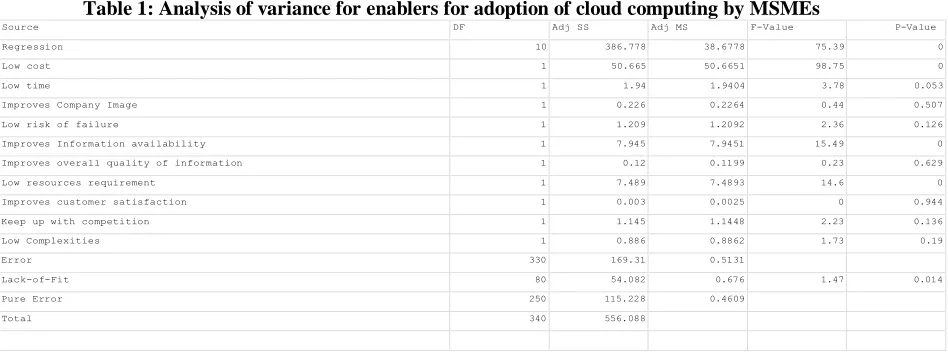
Table 1: Analysis of variance for enablers for adoption of cloud computing by MSMEs
Source DF Adj SS Adj MS F-Value P-Value
Regression 10 386.778 38.6778 75.39 0
Low cost 1 50.665 50.6651 98.75 0
Low time 1 1.94 1.9404 3.78 0.053
Improves Company Image 1 0.226 0.2264 0.44 0.507
Low risk of failure 1 1.209 1.2092 2.36 0.126
Improves Information availability 1 7.945 7.9451 15.49 0
Improves overall quality of information 1 0.12 0.1199 0.23 0.629
Low resources requirement 1 7.489 7.4893 14.6 0
Improves customer satisfaction 1 0.003 0.0025 0 0.944
Keep up with competition 1 1.145 1.1448 2.23 0.136
Low Complexities 1 0.886 0.8862 1.73 0.19
Error 330 169.31 0.5131
Lack-of-Fit 80 54.082 0.676 1.47 0.014
Pure Error 250 115.228 0.4609
© 2019, IJCSMC All Rights Reserved 135
Table 2: Model Summary for enablers for adoption of cloud computing by MSMEs
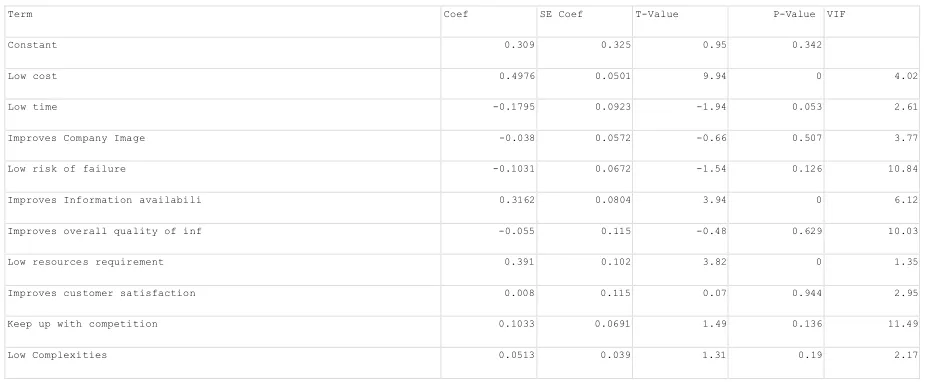
Table 3: Coefficients for enablers for adoption of cloud computing by MSMEs
Term Coef SE Coef T-Value P-Value VIF
Constant 0.309 0.325 0.95 0.342
Low cost 0.4976 0.0501 9.94 0 4.02
Low time -0.1795 0.0923 -1.94 0.053 2.61
Improves Company Image -0.038 0.0572 -0.66 0.507 3.77
Low risk of failure -0.1031 0.0672 -1.54 0.126 10.84
Improves Information availabili 0.3162 0.0804 3.94 0 6.12
Improves overall quality of inf -0.055 0.115 -0.48 0.629 10.03
Low resources requirement 0.391 0.102 3.82 0 1.35
Improves customer satisfaction 0.008 0.115 0.07 0.944 2.95
Keep up with competition 0.1033 0.0691 1.49 0.136 11.49
Low Complexities 0.0513 0.039 1.31 0.19 2.17
Regression Equation
Willingness to adopt cloud computing = + 0.309 + 0.4976 Low cost
-0.1795 Low time
-0.0380 Improves Company Image -0.1031 Low risk of failure
+ 0.3162 Improves Information availability -0.055 Improves overall quality of information + 0.391 Low resources requirement
+ 0.008 Improves customer satisfaction + 0.1033 Keep up with competition
+ 0.0513 Low Complexities
VI.
Effect of Negative Factors (Barriers)
6.1.1
Correlation between Negative Factors (Barriers) and willingness to adopt cloud
computing
6.1.1.1 Correlation between willingness to adopt cloud computing and Negative Factor (Barrier): High Operative Cost
r = -0.669 P-Value = 0.000
This indicates the moderately negative correlation between willingness to adopt cloud computing and „high operative costs‟ as barrier.
Cloud computing saves MSMEs from initial high capital investments but it also results into high operative costs. This high operative costs are relative and change from unit to unit based on usage patterns. But overall, high operative cost is a concern for MSMEs.
6.1.1.2 Correlation between willingness to adopt cloud computing and Negative Factor
(Barrier):
© 2019, IJCSMC All Rights Reserved 136
Awareness not available r = -0.714
P-Value = 0.000
This indicates the moderately negative correlation between willingness to adopt cloud computing and „awareness not available‟ as a barrier.
The researcher has observed that the MSMEs are really interested in adoption of latest information technology. But they do not have sufficient information or guidance about the ways to adopt cloud computing. The consulting firms and IT services firms are mainly interested in large organizations as their clients and MSMEs also cannot afford their charges.
6.1.1.3 Correlation between willingness to adopt cloud computing and Negative Factor (Barrier): Data Security concerns r = -0.828
P-Value = 0.000
This indicates the strong negative correlation between willingness to adopt cloud computing and „data security concerns‟ as barrier.
Data security concerns is the most important factor in decision making for cloud computing. Organizations always feel the data is secured when stored on the computers in their own data centers with all sorts of physical security measures. But they forget that in today‟s networked world, physical security cannot secure the data. In fact, the data in the computers of the cloud service providers is much safer considering the latest security technologies they maintain and the legal agreements supporting data security.
6.1.1.4 Correlation between willingness to adopt cloud computing and Negative Factor (Barrier): Dependency on service providers
r = -0.608 P-Value = 0.000
This indicates the moderately negative correlation between willingness to adopt cloud computing and „dependency on service provider‟ as barrier
The MSMEs perceive that cloud computing is provided by the cloud service provider thereby there will be dependency on the service provider. This is correct but the services provided are
governed by the legal agreement between the service provider and the client organization. There are stringent SLAs on the service provider and client organization can demand adequate compensations in case of any breaches. This makes the organizations safe. Also in case the client organization is still not satisfied with the performance of the service provider, they can switch to another cloud service provider. Considering stiff completion among the cloud service providers, switching is no more a problem.
6.1.5 Correlation between willingness to adopt cloud computing and Negative Factor (Barrier): Dependency on internet speed
r = -0.491 P-Value = 0.000
This indicates the moderately negative correlation between willingness to adopt cloud computing and „dependency on internet speed‟ as barrier
© 2019, IJCSMC All Rights Reserved 137
6.1.6 Correlation between willingness to adopt cloud computing and Negative Factor (Barrier): Compulsory upgrades to latest technology
r = -0.568 P-Value = 0.000
This indicates the moderately negative correlation between willingness to adopt cloud
computing and „compulsory upgrade to latest technology‟ as barrier.
Cloud service providers typically provide latest OS versions and environments with up to
date
service packs and patches installed as recommended by the product vendors. This is in fact a useful feature. But this requires the software version upgrade as the existing software used by organization may not work in the upgraded environment. This results in additional costs and change management.6.1.6.1 Correlation between willingness to adopt cloud computing and Negative Factor (Barrier): Minimum fixed cost irrespective of usage
r = -0.713 P-Value = 0.000
This indicates the moderately negative correlation between willingness to adopt cloud computing and „minimum fixed cost irrespective of usage‟ as barrier
The cloud service providers have different payment models. The basis of payment in most cases is „pay per usage‟. But there are some hidden fixed costs just to maintain the data and accounts with service provider. This is inevitable and the costs are minimal comparing with maintaining own data center.
6.1.6.2 Correlation between willingness to adopt cloud computing and Negative Factor (Barrier): Legal & compliance issues
r = -0.563 P-Value = 0.000
This indicates the moderately negative correlation between willingness to adopt cloud computing and „legal and compliance issues‟ as barrier
MSMEs and for that matter all the business organizations are busy with their core business and need not spend time and efforts of non-core areas. Cloud service providers host company‟s sensitive data and business critical systems and so insists on signing legal agreements. Also the organizations compliance policies may not be accepted by cloud service providers and need to be diluted. For e.g. some of the cloud service providers do not allow site inspection of their server facilities.
6.1.6.3 Correlation between willingness to adopt cloud computing and Negative Factor (Barrier): Increasing costs every year
r = -0.564 P-Value = 0.000
It is very obvious that the costs of services go on increasing every year due to inflation based on monetary indices. But the concern here is that the cloud service providers provide cloud services at highly discounted rates to their clients in the beginning to grab a new client. But from the next year, they start charging higher amounts with huge mark-ups and hidden costs. This practice causes the organizations to think that the operative costs are too high in subsequent years and so this factor becomes a barrier in adoption of cloud computing.
6.1.6.4 Correlation between willingness to adopt cloud computing and Negative Factor (Barrier): Flexibility issues
r = -0.514 P-Value = 0.000
© 2019, IJCSMC All Rights Reserved 138
provider. Also the usage of cloud computing is restricted and the service provider can object for certain activities performe d by client organization.
6.1.7 Regression analysis for negative factors (Barriers)
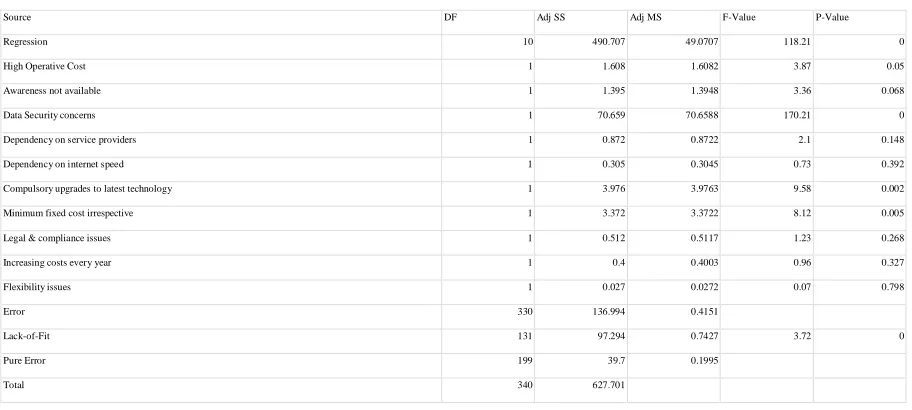
Table 4: Analysis of variance for barriers in adoption of cloud computing by MSMEs
Source DF Adj SS Adj MS F-Value P-Value
Regression 10 490.707 49.0707 118.21 0
High Operative Cost 1 1.608 1.6082 3.87 0.05
Awareness not available 1 1.395 1.3948 3.36 0.068
Data Security concerns 1 70.659 70.6588 170.21 0
Dependency on service providers 1 0.872 0.8722 2.1 0.148
Dependency on internet speed 1 0.305 0.3045 0.73 0.392
Compulsory upgrades to latest technology 1 3.976 3.9763 9.58 0.002
Minimum fixed cost irrespective 1 3.372 3.3722 8.12 0.005
Legal & compliance issues 1 0.512 0.5117 1.23 0.268
Increasing costs every year 1 0.4 0.4003 0.96 0.327
Flexibility issues 1 0.027 0.0272 0.07 0.798
Error 330 136.994 0.4151
Lack-of-Fit 131 97.294 0.7427 3.72 0
Pure Error 199 39.7 0.1995
Total 340 627.701
Table 5: Model Summary for barriers in adoption of cloud computing by MSMEs
S R-sq R-sq(adj) R-sq(pred)
0.644307 0.7818 0.7751 0.7652
Table 6: Coefficients for barriers in adoption of cloud computing by MSMEs
Term Coef SE Coef T-Value P-Value VIF
Constant 6.592 0.12 54.96 0
High Operative Cost -0.0713 0.0362 -1.97 0.05 2.29
Awareness not available -0.0868 0.0474 -1.83 0.068 3.55
Data Security concerns -0.5674 0.0435 -13.05 0 2.34
Dependency on service providers -0.0588 0.0406 -1.45 0.148 2.31
Dependency on internet speed -0.0329 0.0385 -0.86 0.392 1.87
Compulsory upgrades to latest technology -0.1152 0.0372 -3.09 0.002 2.14
Minimum fixed cost irrespective -0.1213 0.0426 -2.85 0.005 2.83
Legal & compliance issues -0.0449 0.0405 -1.11 0.268 2.02
Increasing costs every year -0.0367 0.0374 -0.98 0.327 2.09
Flexibility issues 0.0086 0.0335 0.26 0.798 1.7
Regression Equation:
© 2019, IJCSMC All Rights Reserved 139
6.592 - 0.0713 High Operative Cost -0.0868 Awareness not available -0.5674 Data Security concerns
-0.0588 Dependency on service providers -0.0329 Dependency on internet speed -0.1152 Compulsory upgrades to latest . -0.1213 Minimum fixed cost irrespective -0.0449 Legal & compliance issues -0.0367 Increasing costs every year + 0.0086 Flexibility issues
VII.
Conclusion
The Jammu & Kashmir (J&K) state government is the first to adopt Cloud computing for its e-governance services. The government, using the State Data Centers based out of Madhya Pradesh, is provisioning e-governance services such as issuing death or birth certificates and trade licenses through the Cloud. It is evident that the use of cloud computing services by SMEs in J&K is relatively low due to novelty. It is evident that small and medium sized companies remain vital to the Indian economy but many of them fail in the first five years; so it is important to ensure the survival of these companies and encourage them to grow. In today‟s business world, SMEs are competing with a larger number of companies, many of these are multinationals; they have a greater number of staff and a wider pool of skills. So, it is important for SMEs to acquire the relevant strat egic skills as quickly as possible to remain ahead of the competition by using latest technologies such as Cloud Computing.
The MSMEs should adopt the cloud computing which will enable them to utilize the latest information technology. The willingness to adopt cloud computing in MSME sector is function of multiple enablers and barriers. The main enabler is the low cost followed by information availability. The main barrier is concern about the data security followed by awareness.
Scope for further research
Each of the enablers and barriers considered in this study can be further studied in depth from multiple dimensions.
Managerial implications
The MSME management can consider this study as a viewpoint and can take steps towards adoption of cloud computing in their units. A step by step approach is recommended for MSMEs for venturing into the world of cloud computing rather than a big bang approach.
REFERENCES
[1] Begg, C., & Caira, T. (2011). Data Governance in Practice: The SME Quandary Reflections on the Reality of Data Governance in the Small to Medium Enterprise (SME) Sector. In W. Castelnovo (Ed.), Proceedings of the 5th European.
[2] Conference on Information Management and Innovation (pp. 75-83). Ecime: Academic Conferences Limited.
[3] Chuan, P., Khachidze, V., Lai, I., Liu, Y., Siddiqui, S., & Wang, T. (2014). Innovation in the High-Tech Economy. Springer Science & Business Media.
[4] Kurosu, M. (2014). Human-Computer Interaction Applications and Services. 16th International Conference, HCI International 2014. Heraklion, Crete, Greece: Springer.
[5] Mahmood, Z. (2014). Continued Rise of the Cloud: Advances and Trends in Cloud Computing. Springer. Michael, M. (2011). Cloud Computing. Pearson Education India.
[6] Mohapatra, S., & Lokhande, L. (2014). Cloud Computing and ROI: A New Framework for IT Strategy. Springer.
[7] Singh, N. (2012). A Component- Based Model For E-Business, Integrating Knowledge Management And E-Commerce. Journal of Information and Operations Management, 3(1), pp-25-28..
[8] Stanford-Smith, B., & Kidd, P. (2000). E-business: Key Issues, Applications and Technologies. IOS Press.Timmers, P. (1998, April). Business Models for Electronic Markets. Electronic Markets, pp. 3-8.
[9] Umar, A. (2003). E-Business and Distributed Systems Handbook. nge solutions.
[10] United Nations Publications. (2007). E-business: Development Services for SMEs in Selected ASEAN Countries and Southern China. Thailand: United Nations Publications.
© 2019, IJCSMC All Rights Reserved 140
[12] Myers, M. D. and M. Newman (2007). “The qualitative interview in IS research: Examining the craft”. Information and Organization, 17(1), 2–26.
[13] Carcary, M., Doherty, E., & Conway, G. (2014). The Adoption of Cloud Computing by Irish SMEs – an Exploratory Study. Electronic Journal Information Systems Evaluation, 17(1), 3-14.
[14] Qian, R. and P. Palvia (2013). “Towards An Understanding of Cloud Computing‟s Impact on Organizational IT Strategy”. Journal of Information Technology Case and Application Research, 15(4), 34–54.
[15] Repschlaeger, J., S. Wind, R. Zarnekow and K. Turowski (2013). “Decision Model for Selecting a Cloud Provider: A study of Service Model Decision Priorities”. In: Proceedings of the 19th Americas Conference on Information Systems – AMCIS 2013.
[16] Stankov, I., R. Datsenka and K. Kurbel (2012). “Service Level Agreement as an Instrument to Enhance Trust in Cloud Computing – An Analysis of Infrastructure-as-a-Service Providers”. In: Proceedings of the 18th Americas Conference on Information Systems – AMCIS 2012. [17] Uppala, V., R. Bedeley and W. Wang (2016). “Managing the Implementation of Cloud Based Technologies : Role of Competing Organizational Objectives”.
[18] Erl, T., Mahmood, Z., & Puttini, R. (2013). Cloud Computing Concepts, Technology & Architecture.Massachusetts: Prentice Hall.
[19] Junior, A. M., Biancolino, C. A., & Antonio, E. M. (2013, February). Cloud Computing and Information Technology Strategy. J ournal of technology management & innovation, 178-188. doi:http://dx.doi.org/10.4067/S0718-27242013000300070
[20] Kamra, V., Sonawane, K., & Alappanavar, P. (2012, April). Cloud Computing and it's Pricing Schemes.International Journal on Computer Science and Engineering, 4(4), 577-581.
[21] NIST. (2011, September 10). The NIST Definition of Cloud Computing. Retrieved 03 23, 2016, from https://www.researchgate.net/profile/Gillian_Oliver/publication/273692831_Storage_is_a_Strategic_Issue_Digital_Preservation_in_the_Cloud/li nks/55de804c08ae7983897d1572/Storage-is-a- Strategic-Issue-Digital-Preservation-in-the-Cloud.pdf
[22] Kumar, D. (2017). An Integrated Conceptual Framework of Cloud Computing Adoption in Small and Medium-sized Enterprises in India.
Punjab: Thapar Institute of Engineering and Technology University.
[23] Sullivan, T. (2009). The ways cloud computing will disrupt it Retrieved 23 June, 2012, from http://www.cio.com.au/.
[24] Sultan, N. (2010). Cloud computing for education: A new dawn? International Journal of Information Management, 30 (2), 109 -116. [25] Tatnall, A. (2012, 13 December ). [Some questions regarding ant].
[26] Liu, H., and Orban, D. (2008). Gridbatch: Cloud computing for large-scale data-intensive batch applications. Paper presented at the 8th IEEE International Symposium on Cluster Computing and the Grid, Lyon, France.
[27] Koehler, P., Anandasivam, A., Dan, M., and Weinhardt, C. (2010). Cloud services from a consumer perspective. AMCIS 2010 Proceedings, 329.
[28] Galligan, J. (2011, 27 Sep). The cloud and smes: Fuelling the engines for sustainable growth Retrieved 14 April, 2012, from http://www.asiacloudforum.com/.
[29] Das, R. K., Patnaik, S., and Misro, A. K. (2011). Adoption of cloud computing in e-governance. In N. Meghanathan, B. K. Kaushik & D. Nagamalai (Eds.), (Vol. 133, pp. 161-172): Springer Berlin Heidelberg.
[30] Assuncao, M. D., Costanzo, A., and Buyya, R. (2009). Evaluating the cost-benefit of using cloud computing to extend the capacity of clusters. Paper presented at the 18th ACM International Symposium on High Performance Distributed Computing, Garching, Germany. [31] Caldeira, M. M., and Ward, J. M. (2002). Understanding the successful adoption and use of is/it in smes: An explanation fro m portuguese manufacturing industries. Information Systems Journal, 12 (2), 121-152.
[32] Catteddu, D., and Hogben, G. (2009). Cloud computing: Benefits, risks and recommendations for information security (pp. 1 -25): European Network and Information Security Agency (ENISA).