Recent results from HELIOS
B. B. Backafor the HELIOS CollaborationbPhysics Division, Argonne National Laboratory, Argonne, IL 60439, USA
Abstract. Transfer and inelastic scattering reactions using light-ion beams and stable or long-lived targets have traditionally provided detailed information on the structure of nuclei near the line of beta stability. Such studies can now be extended to nuclei away from the line of β-stability as radioactive beams are becoming available at a number of facilities around the world, including the CARIBU facility at Argonne. These measurements must, however, be carried out in inverse kinematics, resulting in a loss of the effective experimental resolution when conventional detection schemes are employed. The HELIOS spectrometer is based on a new concept, that is especially well suited for such studies by reducing the resolution problem, providing simple particle identification, and giving high detection efficiency with moderate Si detector area. In this talk, the HELIOS concept and results from the first series of experiments will be presented.
1 Introduction
The Nuclear Shell Model by Mayer and Jensen [1] has provided impetus for the study of single-particle or-bits in excited nuclei throughout the nuclear chart. Much experimental work at laboratories and univer-sities throughout the world resulted in detailed in-formation on the single-particle structure, strength, and spin-parity assignments of excited states in both spherical nuclei at or near the closed shells and the deformed nuclei that fall in-between them. A rapid development of experimental facilities and techniques took place over the same period at many research cen-ters. Precision beams of light particles became avail-able from Van de Graaff Tandem accelerators of ever increasing terminal voltage, and the development and implementation of high-resolution magnetic (Bruekner, Enge Split-Pole, Elbek, Multigap, and Q3D) spectrom-eters were the tools needed to carry out experiments with the high energy resolution that is required to measure the excitations in nuclei across the periodic table. In addition, the discovery of direct nuclear reac-tions by Butler [2], its elaboration in terms of the Dis-torted Wave Born Approximation [3, 4], and the
signif-a e-mail:[email protected] b
B.B.Back∗, S.I.Baker∗, J.A.Clark∗, C.M.Deibel∗,%, B.J.DiGiovine∗, S.J.Freeman+, N.J.Goodman#, C.R. Hoffman∗, B.P.Kay∗, H.Y.Lee∗, J.C.Lighthall#,∗, C.J.Lister∗, S.T.Marley#,∗, P.Mueller∗, R.Pardo∗, K.E.Rehm∗
, A.M.Rogers∗
, J.Rohrer∗
, J.P.Schiffer∗ , D.V.Shetty#, J.Snyder#, A.H.Wuosmaa# - ∗Argonne National Laboratory, Argonne, IL 60439, USA -#Western Michigan University, Kalamazoo, MI 49008, USA -+
University of Manchester, Manchester M13 9PL, UK -%Joint Inst. for Nucl. Astroph. Michigan State University,
East Lansing, MI 48824, USA
icance of spectroscopic overlaps by French and Mac-farlane [5] established elegant connections between the theoretical concepts and the experimental observables. The extension of the understanding of single-particle structure to deformed nuclei by S.G. Nilsson [6] gave a more complete picture of all accessible nuclei.
The literature contains information on virtually all nuclei that can be reached with light charged parti-cle reactions on stable or long-lived targets, but the record is not always complete and/or the data anal-ysis method for a series of isotopes in a region may not have been sufficiently uniform to study system-atic trends. However, recent systemsystem-atic measurements of the single-particle strength distribution have been carried out in the Sn region [7] and in N=82 nuclei [8].
2 Using radioactive beams
In recent years, radioactive heavy-ion beams, away from the line ofβ-stability, have become available for studies of nuclear structure. High-energy beams pro-duced by projectile fragmentation can be used in nu-cleon knock-out reactions to obtain information about particle orbits below the Fermi surface. In order to conduct detailed studies of single particle states above the Fermi surface, beams at energies comparable to the Coulomb barrier are needed. Such beams can be provided as secondary beams produced in flight [9] or as re-accelerated radioactive ions. Radioactive-ion production methods include ions extracted from a pri-mary 252Cf fission source at the CARIBU facility at Argonne [10] or from targets bombarded with high-intensity primary beams at HIE-ISOLDE at CERN [11], the HRIBF facility at Oak Ridge National Labora-tory [12], at TRIUMF [13], and several other institu-DOI: 10.1051/epjconf/20111714001
© Owned by the authors, published by EDP Sciences, 2011
tions. In the near future, relatively intense, re-accelerated precision beams of this type will be provided at sev-eral new facilities, namely Spiral-2 at Ganil and FRIB at Michigan State University.
These new beams of radioactive nuclei will in many cases have sufficient intensity to allow studies of their single-particle structure via transfer reactions with light targets. The scientific thrust into these areas is driven by the need to validate the predictive power of present nuclear structure models, search for changes in the single particle structure far away from the line of β -stability where the Fermi levels for protons and neu-trons are severely unbalanced. These studies are also important for Nuclear Astrophysics. The rapid neutron-capturer-process is, for example, strongly affected by the structure of neutron-rich nuclei near the N=82 shell.
0 20 40 60 80
Neutron Number N 0
20 40 60
Proton Number Z
Stable >1012 ions/s
1010-1012 108-1010
106-108 ions/s 104-106 1-104
r-process rp-process
Fig. 1. This figure shows the intensities of re-accelerated beams that can be expected with 400 kW 200 MeV/u pri-mary beams such as those at the planned FRIB facility. The map also indicates the expected location of the astro-physicalrpandr-processes.
Studies based on interactions with nuclei in a thin target, such as Coulomb excitation and transfer reac-tion, require beam intensities around 103to 104ions/s to be feasible. As shown in Fig. 1 the region of the nu-clear chart where beam intensities of sufficient magni-tude are projected for a facility such as FRIB [15], is very substantial. The beam intensity at existing [13, 12, 9] facilities as well as those that will start opera-tion before FRIB [16, 11] will already allow for studies of less exotic nuclei as exemplified in a recent mea-surement of the single-neutron strength outside the doubly magic132Sn by Joneset al. [18].
3 Challenges with inverse kinematics
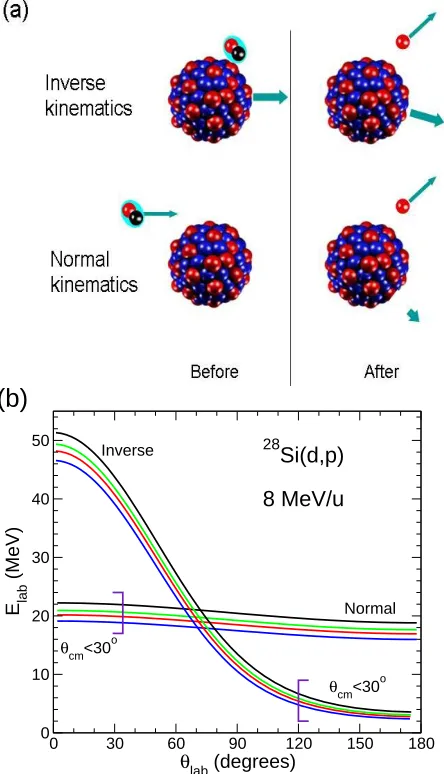
The many new exotic nuclei that are becoming avail-able as re-accelerated beams require, however, that reactions are done in inverse kinematics, i.e. where the radioactive, heavy beam is incident onto a light
0 30 60 90 120 150 180
θlab (degrees)
0 10 20 30 40 50
E lab
(MeV)
θcm<30o
θcm<30o
Normal Inverse
(b)
28
Si(d,p)
8 MeV/u
Fig. 2. Panel a: Illustration of “inverse” and “normal” kinematics reactions involving a simple neutron transfer. Panel b: Kinematic curves are shown for both “normal” and “inverse” kinematics for the28Si(d,p) reaction with a beam energy of 8 MeV/u in both cases.
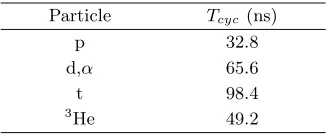
Table 1.Cyclotron periods of light charged particles in a magnetic field of strength B=2 Tesla.
Particle Tcyc (ns)
p 32.8
d,α 65.6
t 98.4
3
He 49.2
standard∆E-E technique of particle identification be-comes very problematic. In addition, the energy inter-val between the various excitations in the29Si nucleus is strongly reduced, by a factor∼2.4 relative to that observed in “normal” kinematics. The inverse kine-matics situation therefore severely limits the number of nuclei that can be studied. It has, however, been demonstrated that systems with widely spaced excited states, including many light systems and nuclei near shell closures, can be explored with normal detector systems [17, 18]. Nevertheless, it is clear that higher Q-value resolution is needed for nuclei in most of the new territory that is being made available with ra-dioactive beam facilities, and that new techniques are required. This has led to the development at Argonne of a new type of spectrometer, the HELIical Orbit Spectrometer (HELIOS), that circumvents the main difficulties with inverse kinematics, as outlined above. In the following section I’ll describe the principle of the HELIOS concept and discuss its implementation.
4 Principle and implementation
The HELIOS spectrometer is based on the fact that charged particles follow helical trajectories in a homo-geneous magnetic field. If the magnetic field is aligned with the beam axis, see Fig. 3, the particles will re-turn to the beam axis, which coincides with the netic axis of the spectrometer, provided that the mag-netic field is strong enough to avoid collisions with the vacuum envelope of the magnet. The flight-time until it returns to the axis is the cyclotron period,
Tcyc= 2πm/qeB, wherem/qis the charge to mass
ra-tio of the particle andBis the magnetic field strength. Note that the flight-time scales withm/q of the par-ticle so one obtains automatic parpar-ticle identification for a range of light charged particles, such as pro-tons, tripro-tons, and 3He, by measuring this quantity. Deuterons and α-particles have the same flight-time, but in many cases their flight-paths will not overlap. Cyclotron periods corresponding to a typical magnetic field strength of 2 Tesla are long enough that particle identification can be achieved rather comfortably with reasonable time resolution, see Table 1.
Particles emitted in the backward hemisphere re-turn to the axis upstream of the target whereas for-ward emitted particles return downstream. Position-sensitive Si detector arrays may be placed at either
lo-Fig. 3. Schematic illustration of the HELIOS concept. Beam enters from the left through a hollow tube that is supporting position sensitive Si detectors on the outside. Particles emitted from the target follow helical trajectories in the co-axial solenoidal magnetic field and return to the beam axis, some of them being intercepted by the Si de-tector array. Recoils may be detected in a dede-tector located at very forward angles.
cation to register the time-of-arrival,t, energy,E, and longitudinal position,z, where the particle strikes the detector. The upstream array must be hollow to allow the beam to reach the target, whereas this requirement does not necessarily apply for a downstream array. However, in many cases it is advantageous to detect, in coincidence, the heavy beam-like recoils in detec-tors positioned at small angles, and in these cases a hollow array is called for.
There is a simple relation between E, z, and the center-of-mass energy of the particle,Ecm, namely
Ec.m.=E+m 2V
2
cm−
VcmqeB
2π z, (1)
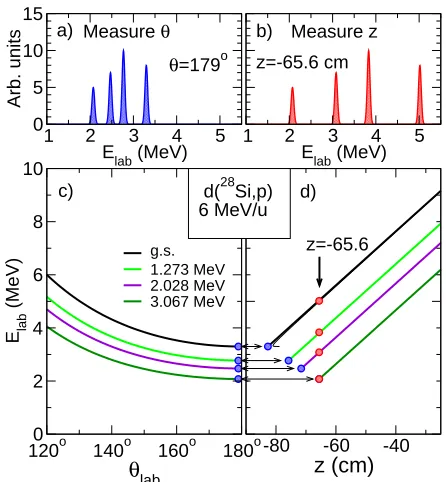
where Vcmis the laboratory velocity of the center-of-mass system, a quantity that is known for the reac-tion, (see Ref.[19]). It is important to note that, un-like the situation in a normal setup, the coefficient in front ofEis unity, which means that the measured level spacing is the same as what would be observed in the center-of-mass system. This feature effectively re-moves the detrimental effects of the inverse kinematics situation. The kinematic loci for different excitations in the nucleus are therefore straight lines for which the particle energy increases withz(positive downstream) with a slope that scales withVcmqB as illustrated for the d(28Si,p) reaction at 6 MeV/u in Fig. 4.
The fact that no kinematic compression occurs when the particles are transported in a magnetic field arises because particles corresponding to different states emitted at the same laboratory angle returns to the beam axis (or the detector array) at different distances
z from the target as shown in Fig. 4.
de-120o 140o 160o 180o
θ
lab0 2 4 6 8 10
E lab
(MeV)
g.s. 1.273 MeV 2.028 MeV 3.067 MeV
-80 -60 -40
z (cm)
1 2 3 4 5
Elab (MeV) 0
5 10 15
Arb. units
1 2 3 4 5
Elab (MeV)
Measure θ Measure z
d(28Si,p) 6 MeV/u
θ=179o z=-65.6 cm
z=-65.6
a) b)
c) d)
Fig. 4. Illustration of the improved Q-value resolution of the HELIOS concept exemplified by the d(28Si,p) reac-tion populating the ground state and the first three ex-cited states in 29Si. The 28Si beam energy is 6 MeV/u, and the assumed combined effects of target thickness and intrinsic energy resolution is ∆E = 75 keV FWHM, for which the upper panels show simulated energy spectra for the emitted protons if measured either at a fixed angle
θ=179◦(panel a) or a fixed z-position, z=-65.6 cm (panel b). Panels c and d, demonstrate that particles correspond-ing to different excitations emitted at a particular angle are intercepted by the Si detector at different z-positions when transported in a 2T, co-axial, homogenous field (blue points). By performing the energy measurement at a spe-cific z-position instead (red points) the level spacing corre-sponding to that in the center-of-mass system is restored. The thin curve in panel d for the g.s. gives the “hook” effect by intercepting the particles at a realistic radial dis-tance of 1.4 cm.
Fig. 5.Computer aided design rendering of the HELIOS spectrometer identifying the beam entrance, the Si detec-tor array that is mounted onto an alignment ring, the tar-get “fan” as well as of the recoil Si detector telescope.
commissioned Magnetic Resonance Imaging scanner. This solenoid is able to generate a homogeneous mag-netic field region over a cylindrical volume of diameter 90 cm and 100 cm in length. The strength of the mag-netic field can be set up to 2.85 Tesla. The solenoid is mounted such that the magnetic field axis is coax-ial with the beam. Fortunately, the end flanges, which were designed to support various RF and field gradient coils used for the MRI scanning, were such that they could be fitted with large vacuum covers that allowed the whole inside bore of the magnet to be evacuated by pumping through the 20 cm diam. beam-pipe. Support structures inside the magnet allow for the mounting of the hollow Si detector array at backward angles and a target “fan”, both of which can slide longitudinally to allow for optimal coverage of the interesting region of particle emission (see Fig. 5). The design also allows for mounting of various detectors to register the coin-cident heavy recoils, shown in Fig. 5 as a Si detector telescope. Another recoil detector system consisting of an x-y position sensitive PPAC backed by a co-axial Bragg curve spectrometer has been built, but this sys-tem has yet to be commissioned.
5 Initial physics experiments
The HELIOS spectrometer was successfully commis-sioned using the28Si(d,p) reaction in August 2008 [20] and subsequently a number of physics experiments have been carried out using both stable and radioac-tive beams produced by the in-flight technique at AT-LAS.
5.112B(d,p)
The first example is a study of the 12B(d,p) reaction populating excited states in13B in an attempt to sepa-rate two positive-parity states at Eexc= 3.48 and 3.68
MeV, which it had not been possible to separate in an earlier attempt with normal detectors [21]. In this ex-periment [22], the radioactive12B beam was produced via a (d,p) reaction of the 81 MeV primary11B beam with an intensity of 50 pnA in a cryogenic deuterium gas cell which resulted in a secondary 12B beam of approximately 105 ions/s at 75 MeV. The 12B ions were focused and separated from the primary beam using various beam-line elements [9] and brought into the HELIOS spectrometer to react with a 73µg/cm2 -thick CD2target. A Si detector telescope covering the forward angular rangeθlab=0.5◦-2.8◦consisting of 80 µm thick∆E and 500µm thick E detectors was used to measure 13B recoils in coincidence with the pro-tons from the (d,p) reaction that were detected in the Si detector array positioned upstream of the target. The primary 11B beam was also used, at a reduced intensity, to measure the 11B(d,p) reaction to excited states in12B at E
exc=2.62 and 3.39 MeV, which
0 15 30 45
10-1
100
101
d
σ
/d
Ω
(mb/sr)
x0.5
x0.2 601
986 1841
a)
2510
2650
1218 x20
l=5
l=6
1303
1534
1590
1751
b)
l=5 l=6
l=6
l=5 g.s.
c)
0 15 30 45
θc.m. (deg.)
x0.2
l=5,6 l=3
0 15 30 45
1930
l=1
Fig. 6. The angular distributions for the11B(d,p)12B re-action to the two states at Eexc= 2.62 and 3.39 MeV popu-lated via L=0 and L=2 transfer are shown in the left panel. The known L=2 transition to the Eexc= 3.39 MeV state was used for normalization of the angular dependence of the detection efficiency. The red points are the HELIOS data for the L=2 transition to the 3.39-MeV state and the blue points are for the L=0, 2.62-MeV state. The solid and dashed curves are DWBA calculations with two dif-ferent sets of parameters. On the right, the data for the 12
B(d,p)13B doublet at 3.48 and 3.68 MeV are shown with the same normalization. The conventions on the symbols and curves are the same as on the left-hand side.
doublet over the entire angular range. This measure-ment provided reference angular distributions used to normalize those measured for the13B doublet and al-lowed us to determine the angular momentum transfer and spectroscopic factor for the two members of the Eexc=3.48 and 3.68 MeV doublet (see Fig. 6).
From these measurements it is clear that the 3.48 MeV member of the13B doublet is populated by L=0 transfer since it is very similar in shape to that of the 2.62 MeV12B state, while the much weaker 3.68 MeV member appears to be reached by L=2 transfer. From these results and an analysis of the relative spectro-scopic factors of the two states it appears that the Eexc= 3.48 MeV and 3.68 MeV states in 13B
corre-spond to the expected 1/2+ and 5/2+ states in this nucleus, respectively. However, with this assignment, the spectroscopic factor for the 5/2+ state is signifi-cantly weaker than predicted by theory.
5.215C(d,p)
Recent results on electromagnetic transition rates be-tween states in 16C have led to the speculation that this nucleus has an exotic structure. A measurement of the B(E2) value for the 2+1 →0+ transition [24] using the Coulomb-nuclear interference method in208Pb+16C
scattering thus obtained a B(E2) of 0.28±0.06 W.U. leading to the suggestion that the 2+1 state is a pure valence neutron excitation. In addition, a direct life-time measurement of the 2+1 → 0+ transition using a recoil-shadow technique [25] obtained a result that corresponds to a B(E2)-value of 0.26 W.U. in agree-ment with the scattering result. In contrast with these results, a more recent measurement of the lifetime of the 2+state using a fusion reaction to populate states in the 16C system obtains a result which corresponds to B(E2)-value of 1.73±0.30 W.U. [26], consistent with theoretical expectations for even-even closed shell sys-tems in this area and which does not require an “ex-otic” interpretation of the structure of the 2+1 state in 16C. With this background, it was felt that it might be advantageous to use a different experimental tech-nique to explore the structure of the16C system.
Using an intense, 100 pnA 14C beam of energy 133 MeV, a secondary 15C beam was generated via the (d,p) reaction in a cryogenic gas cell in the AT-LAS in-flight radioactive beam setup [9]. With this method we obtained a 123 MeV15C-beam with inten-sity of 1-2×10⁶ ions/s. This beam was transported to the HELIOS spectrometer impinging on a 110µg/cm2 CD2 target. The detection of protons and coincident 16C recoils was carried out in a manner similar to the 12B(d,p) experiment described above (see Ref. [23] for details).
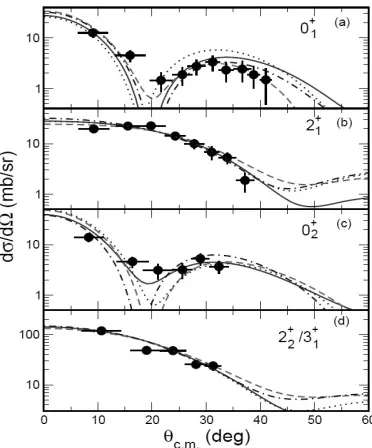
The resulting angular distributions for scattering into the lowest excitations in 16C are displayed in Fig. 7 along with DWBA calculations using four differ-ent Optical Model potdiffer-entials. These comparisons lend strong support to the previously tentative assignment of 0+ to the third excited state at E
exc=3.017 MeV,
since it is seen to be populated via an L=0 transfer, as is the ground state. From the relative spectroscopic factors for the lowest-lying states one finds excellent agreement with shell-model calculations [27], which also correctly account for the latest measurement of the B(E2;2+1 → 0+) transition matrix element [26]. Our 15C(d,p) results thus lend strong support to a standard Shell model description of this nucleus and appears to be at variance with an “exotic” picture of its structure.
6 Summary
Light-ion transfer-reaction studies on nuclei close to the line ofβ-stability, where such studies can be car-ried out with stable or long-lived targets in normal kinematics, have provided much of the existing nu-clear structure information in these systems. However, such studies must be carried out in inverse kinemat-ics to obtain similar information for the wide range of nuclear species that has or will become available at ra-dioactive beam facilities. Using normal detection tech-niques leads to severe limitations in terms of Q-value resolution in this situation. In this talk I have shown that the HELIOS concept, in which light charged par-ticles are transported in a homogenous magnetic field to a hollow Si detector array located on the beam axis, resolves this particular problem and also allows for both high detection efficiency and easy particle identi-fication. The Argonne HELIOS spectrometer was com-missioned in August 2008 and the advantages of this technique were successfully demonstrated in a num-ber of experiments. We have performed several stud-ies of (d,p) reactions in inverse kinematics, includ-ing measurements of the d(28Si,p)29Si commissioning experiment as well as two published studies involv-ing radioactive beams produced in-flight at the AT-LAS facility. In the d(12B,p)13B study, the improved Q-value resolution was crucial for separating two ex-cited positive-parity states and studying their struc-ture. The d(15C,p)16C experiment was the first study of this reaction and it helped validate the theoretical understanding of this nucleus in terms of the modern shell model. Additional experiments have been carried out for which the data analysis is ongoing. Several up-grades are planned for the spectrometer. These include a gas target for He induced reactions, a new, more ef-ficient Si detector array, and a recoil PPAC and Bragg curve detector. With these further improvements we expect that the spectrometer will continue to support a very fruitful scientific program.
Acknowledgments
This work was supported by the U.S. Department of Energy, Office of Nuclear Physics under DE-AC02-06CH11357 and DE-FG02-04ER41320, and NSF Grant No. PHY-08-22648.
References
1. M.G.Mayer, Phys. Rev.74, 235 (1948); O. Haxel, J.H.D. Jensen, and H.E. Suess, Phys. Rev. 75, 1766 (1949).
2. S.T. Butler, Proc. Royal Soc. (London)A208, 559 (1951)
3. W. Tobocman and M.M. Kalos, Phys. Rev. 97, 132 (1955)
4. G.R. Satchler, Ann. Phys.3, 275 (1958)
5. M. H. Macfarlane and J.B. French, Rev. Mod. Phys.34, 41 (1960)
6. S.G.Nilsson, K. Danske Vidensk. Selsk. Mat-fys Medd.,29, 16 (1955)
7. J.P. Schiffer et al., Phys. Rev. Lett. 92, 162501 (2004)
8. B.P. Kayet al., Phys. Lett.B658, 216 (2008) 9. B. Harss et al., Rev. Sci. Instrum.71, 380 (2000) 10. G. Savard et al., Nucl. Instr. Meth. B266, 4086
(2008)
11. http://hie-isolde.web.cern.ch/HIE-ISOLDE/ 12. http://www.phy.ornl.gov/hribf
13. http://www.triumf.ca 14. http://www.frib.msu.edu
15. B.B.Back and C.L.Jiang, ANL internal report No. ANL-06/55 (2006)
16. http://pro.ganil-spiral2.eu/spiral2
17. A.H. Wuosmaa et al., Phys. Rev. C 72, 061301 (2005)
18. K.L.Joneset al., Nature465, 454 (2010)
19. A.H. Wuosmaa et al., Nucl. Instr. Meth. A580, 1290 (2007)
20. J.C. Lighthallet al., Nucl. Instr. Meth.A622, 97 (2010)
21. H. Y. Leeet al., Phys. Rev.C 81, 015802 (2010) 22. B.B.Back et al., Phys. Rev. Lett. 104, 132501
(2010)
23. A.H. Wuosmaa et al., Phys. Rev. Lett. 105, 132501 (2010)
24. Z. Elekeset al., Phys. Lett.B586, 34 (2004) 25. N. Imaiet al., Phys. Rev. Lett.92, 062501 (2004) 26. M. Wiedekinget al., Phys. Rev. Lett.100, 152501
(2008)
27. E.K. Warburton and B.A. Brown, Phys. Rev.