
and Evaluating their Lattice Security
Takanori Yasuda1, Xavier Dahan2, and Kouichi Sakurai1,3
1
Institute of Systems, Information Technologies and Nanotechnologies
{yasuda,sakurai}@isit.or.jp 2
Ochanomizu University
3 Department of Informatics, Kyushu University
Abstract. The encryption scheme NTRU is designed over a quotient ring of a poly-nomial ring. Basically, if the ring is changed to any other ring, NTRU-like cryptosys-tem is constructible.
In this paper, we propose a variant of NTRU using group ring, which is called GR-NTRU. GR-NTRU includes NTRU as a special case. Moreover, we analyze and com-pare the security of GR-NTRU for several concrete groups. It is easy to investigate the algebraic structure of group ring by using group representation theory. We apply this fact to the security analysis of GR-NTRU. We show that the original NTRU and multivariate NTRU are most secure among several GR-NTRUs which we investigated.
Keywords: NTRU, lattice-based cryptography, group ring, group representation theory
1 Introduction
1.1 Background
The NTRU cryptosystem proposed by Hoffstein, Pipher, Silverman [14] is one of the most practical lattice-based schemes. NTRU is suitable for compact and high-speed implementation, and was standardized by IEEE as Standard IEEE 1363.1-200 [29]. Recently, NTRU attracts attention as a candidate for post-quantum cryptography [3]. One weakness of NTRU is that decryption may fail, but parameters may be chosen to minimize or eliminate this drawback.
1.2 Previous Works and Challenging Issue
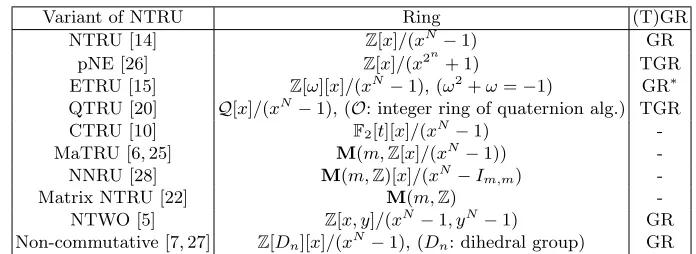
NTRU makes use of analytic and geometric structure of the ringR=Z[x]/(xN−1). On the other hand, many NTRU-like systems have been presented as shows Table 1. These variant schemes basically are constructed by changing the ring R used in NTRU to various rings including non-commutative rings. In the table, (T)GR means whether or not the ring can be expressed as a (twisted) group ring.
The ringZ[x]/(xN −1) has a simple formula for its multiplication:
Variant of NTRU Ring (T)GR
NTRU [14] Z[x]/(xN−1) GR
pNE [26] Z[x]/(x2n+ 1) TGR ETRU [15] Z[ω][x]/(xN−1), (ω2+ω=−1) GR∗ QTRU [20] Q[x]/(xN−1), (O: integer ring of quaternion alg.) TGR CTRU [10] F2[t][x]/(xN−1)
-MaTRU [6, 25] M(m,Z[x]/(xN−1))
-NNRU [28] M(m,Z)[x]/(xN−Im,m)
-Matrix NTRU [22] M(m,Z)
-NTWO [5] Z[x, y]/(xN−1, yN−1) GR
Non-commutative [7, 27] Z[Dn][x]/(xN−1), (Dn: dihedral group) GR
GR∗means that the ring can be expressed as a subring of a group ring. (T)GR means whether or not the ring can be expressed as a (twisted) group ring.
Table 1.Variants of NTRU and relation of them with group rings
multiplication of R and parameters. In case of NTRU, due to the simplicity of (1), the probability of the decryption failure can be easily minimized by turning parameters. An important direction of research about NTRU is the development of variants of NTRU using other rings and their security analysis. Additionally, it is important to choose rings which have a simple multiplication formula like (1) in order to minimize the decryption error.
1.3 Our Contribution
In this paper, we propose a NTRU-like scheme using group ring as a new encryption scheme, and we call GR-NTRU for such scheme. The group ringZ[G] associated to a finite groupGhas also a simple formula for its multiplication like (1). Therefore, we can easily minimize the probability of decryption failure in the proposed scheme similarly as the original NTRU. Since Z[x]/(xN −1) is isomorphic to a group ring
associated to a cyclic group, the original NTRU can be regarded as a special case of GR-NTRU.
Moreover, we propose an attack against GR-NTRU, and analyze the security of GR-NTRU based on the proposed attack. This attack is essentially an extension of the attack proposed by Gentry [11] against NTRU with composite degree.
The underlying idea of the proposed attack is as follows. Using representation theory, Z[G] is embedded in a certain matrix ring Mn(Z). Then, GR-NTRU can
be embedded in a form of NTRU-like scheme using Mn(Z). Therefore, the attacks of NTRU-like schemes using Mn(Z) can be applied to GR-NTRU. The security
of NTRU-like scheme using Mn(Z) was analyzed by Pan and Deng [23]. Simply
speaking, the security of NTRU-like scheme usingMn(Z) is related to the hardness
of some lattice problems of dimension 2n. Therefore, GR-NTRU can be attacked by solving these lattice problems.
to the complexity. However, since the choice of a suitable approximation factor is difficult problem for now, we only discuss the dimension of lattice under the assumption of a fixed approximation factor. As a consequence, we show that the original NTRU and multivariate NTRU are the most secure among them if these schemes have the same key size.
1.4 Comparison with Related Works
There are some variants of NTRU which can be expressed as GR-NTRU. The orig-inal NTRU and multivariate NTRU [5] are regarded as special case of GR-NTRU. The variant of NTRU defined by the polynomial x2n + 1 [26] cannot be seen as a GR-NTRU, but, can be described as a variant of NTRU using a twisted group ring. Similarly, QTRU [20] can also be described as a variant of NTRU using twisted group ring. Twisted group ring is an extension of group ring. The reason why we do not define GR-NTRU using twisted group ring instead of group ring is because the embedding required in our attack cannot be obtained from standard group rep-resentation theory. The scheme proposed by Coppersmith [7, 27], against which an efficient attack has been already found, is a variant of NTRU using the group ring with respect to the dihedral groups. However, its design is different from the design of our scheme.
Other than the previously proposed schemes above, we analyze the security of new schemes described as GR-NTRU with respect to Frobenius group, symmetric group. We summarize these security analysis in the appendix.
2 NTRU
We review a simple description of the NTRU cryptosystem [14]. LetN, p, qbe inte-gers satisfyingp < q, andR=Z[x]/(xN−1). Any elementf inR can be expressed
uniquely as f = ∑Ni=0−1aixi (ai ∈ Z). The subsets Lf,Lg,Lr,Lm are defined as
follows. First, we define the space of messages,
Lm=
{
f =∑aixi∈R
−1
2(p−1)< ai< 1
2(p−1), ∀i }
. (2) For positive integersd1, d2,
L(d1, d2) = f =
∑
aixi ∈R
f hasd1 coefficients equal 1, f hasd2 coefficients equal −1,
the rest are 0.
For three integersdf, dg, d,
Lf =L(df, df −1), Lg =L(dg, dg), Lϕ=L(d, d). (3)
Key Generation
Step 1 Choose f ∈ Lf, g ∈ Lg such that there existsfq, fp ∈R satisfying f∗fq=
1 modq and f∗fp= 1 mod p.
Step 2 Let h=fq∗g mod q. Public Key h, p, q.
Encryption To encrypt a message m ∈ Lm, we first choose randomly a ϕ ∈ Lϕ,
then compute the cipher text:
c≡ph∗ϕ+m mod q.
Decryption First, we compute
a≡f∗c modq.
Next, we choose the coefficients ofain the interval from−q/2 toq/2. Then, we can recover the messagemby computing fp∗amod p.
3 New System using Group Ring
In this section, we propose a new NTRU-based cryptosystem using group ring, as an extension of NTRU.
3.1 Group Ring
LetGbe a finite group.
Definition 1 ([4]). Z[G] is defined as the set
Z[G] =
∑
g∈G ag[g]
ag ∈Z(∀g∈G)
Here, [g]is a formal element associated to g∈G, and {[g]|g∈G} becomes a basis of Z[G]. The addition and multiplication inZ[G] are defined as follows:
(1) The addition is defined by component-wise addition.
(2) For any g, h ∈ G, [g]∗[h] = [gh]. The multiplication of any two elements in Z[G]is defined by Z-linear extension of the above formula.
By these addition and multiplication,Z[G]becomes a ring, which is called the group ring with respect to G.
Example 1 LetCN =⟨σ⟩ be a cyclic group of orderN. ThenZ[CN] is isomorphic toZ[x]/(xN −1). In fact, theZ-linear map below is a ring isomorphism.
Z[CN]−−→∼ Z[x]/(xN −1)
∈ ∈
σi 7→ xi.
(4)
3.2 GR-NTRU
Letp, qbe integers satisfyingp < q,Ga finite group, andR=Z[G]. Any elementfin
Rcan be expressed uniquely asf =∑g∈Gag[g] (ag ∈Z). The subsetsLf,Lg,Lϕ,Lm
ofR are defined as follows. First, we define
Lm =
{
f =∑
g
ag[g]∈R −1
2(p−1)< ai < 1
2(p−1), ∀i }
For positive integersd1, d2,
L(d1, d2) =
f =
∑
g
ag[g]∈R
f hasd1 coefficients equal 1, f hasd2 coefficients equal −1,
the rest are 0.
For three integersdf, dg, d,
Lf =L(df, df −1), Lg =L(dg, dg), Lϕ=L(d, d).
Key Generation
Step 1 Choose f ∈ Lf, g ∈ Lg such that there existsfq, fp ∈R satisfying f∗fq=
1 modq and f∗fp= 1 mod p. Step 2 Let h=fq∗g mod q. Public Key h, p, q.
Private Key f (and fp).
Encryption To encrypt a messagem∈ Lm, we first choose aϕ∈ Lϕ, then compute
the cipher text:
c≡ph∗ϕ+m mod q.
Decryption First, we compute
a≡f∗c modq.
Next, we choose the coefficients ofain the interval from−q/2 toq/2. Then, we can recover the messagemby computing fp∗amod p.
We call this new schemeGR-NTRUin this paper. We remark that in the case of
G= CN (cyclic group), the corresponding GR-NTRU is equivalent to the original
NTRU through the isomorphism (4).
We remark that GR-NTRU has a malleability, which is not discussed in this paper: In fact, writingE(ϕ, m) for the cipher text ph∗ϕ+mmod q, we have
E(ϕ∗a, m∗a) =E(ϕ, m)∗a,
for some elementa∈Z[G].
4 Lattice Attack against GR-NTRU
For NTRU, several attacks have been known, e.g. the brute-force attack, the meet-in-the-middle attack [14]. These attacks can be extended to those against GR-NTRU. The side channel attack against NTRU also has been proposed [17]. However, in this paper, we focus on only the security for lattice attack.
4.1 Lattice
We denote a lattice spanned bynlinear independent vectorsb1,b2, . . . ,bn∈Zn by
L(b1,b2, . . . ,bn) =
{ n ∑
i=1
cibi|ci∈Z
}
The shortest vector problem (SVP) refers to the question of finding the shortest non-zero vectors. It is known to be NP-hard under random reduction. The closest vector problem (CVP) is to find a lattice vector which is closest to a given vector. Denote by ∥v∥ the Euclidean l2-norm of a vector v and by λ1(L) the length of
the shortest non-zero vector in the lattice L. By the Gaussian Heuristic, λ1(L) ≈ √ n
2πedet(L)
1/nin ann-dimensional random latticeL. Similarly, most closest vector
problems forLhave a solution whose size is approximatelyλ1(L)≈√2πen det(L)1/n. If we want to find a short vector v in L, or a vector v such that t−v is the vector in L close to the target vector t, then experience tells us that the smaller
∥v∥/(√2πen det(L)1/n) is, the more easily we will find v in practice.
4.2 Lattice Attack by Coppersmith and Shamir
The lattice attack [9] by Coppersmith and Shamir against NTRU can be extended to GR-NTRU naturally. Here, we give the brief analysis of the attack.
LetN =♯G. Given an ordering for elements in G, let us write
G={g1, g2, . . . , gN}.
Any element inZ[G] is identified with a row vector:
N
∑
i=1
agi[gi]←→(ag1, ag2, . . . , agN).
In what follows, we identify the secret key, public key, plain text, etc. with the corresponding row vectors. For the public keyh = (hg1, hg2, . . . , hgN), consider the 2N-by-2N matrix as follows:
1 0· · ·0 0 h1 hg−1
1 g2 · · ·hg− 1
1 gN−1 hg1−1gN 0 1· · ·0 0 hg−1
2 g1 h1 · · ·hg− 1
2 gN−1 hg2−1gN ..
. ... . .. ... ... ... ... . .. ... ... 0 0· · ·1 0hg−1
N−1g1 hg− 1
N−1g2 · · · h1 hg− 1
N−1gN
0 0· · ·0 1 hg−1
N g1 hg−
1
N g2 · · ·hg−
1
N gN−1 h1
0 0· · ·0 0 q 0 · · · 0 0
0 0· · ·0 0 0 q · · · 0 0
..
. ... . .. ... ... ... ... . .. ... ...
0 0· · ·0 0 0 0 · · · q 0
0 0· · ·0 0 0 0 · · · 0 q
LetLbe the lattice generated by the rows of this matrix. Then, the latticeLcontains the vectorτ = (f, g)∈Z2N becauseh=f−1gmodq. By the Gaussian Heuristic, the expected shorter vector inLhas length approximately √2N/(2πe)·det(L)1/(2N)= √
qN/(πe). The smaller ∥(f, g)∥/√qn/(πe) is, the more easily (f, g) may be found by solving technique for SVP.
4.3 Security Analysis through NTRU-like Scheme Using Matrix Ring
cryptanalysis in this section. We remark that the scheme using matrix ring is not new, in fact, it is regarded as a part of a general NTRU-Like framework proposed by Pan and Deng [23].
NTRU-like System Using Matrix Ring LetR=Mn(Z). A subsetLmof Zn is
defined similarly asLm in (2). For a positive integer d, a subset Lϕof Zn is defined
similarly asLϕ in (3). For positive integersd1, d2, we define
D(d1, d2) =
A= (aij)∈R
Each row of A hasd1 coefficients equal 1,
Each row of A hasd2 coefficients equal −1,
the rest are 0.
For two integersdF, dG, subsets DF,DG ofR are defined by
DF =D(dF, dF −1), DG=D(dG, dG),
Key Generation
Step 1 Choose F ∈ DF, G ∈ DG such that there exists Fq, Fp ∈ R satisfying F∗Fq= 1 mod q and F∗Fp= 1 mod p.
Step 2 Let H=Fq∗Gmod q.
Output H, p, q (public key) andF (secret key).
The encryption and decryption are similar to those of the original NTRU, therefore we omit the explanation. We call this schemeM-NTRU in this paper.
Some Lattice-Based Attacks against M-NTRU Pan and Deng [23] have de-scribed some lattice-based attacks against M-NTRU (by setting it inside in a more general framework). We summarize these attacks.
Since each row ofF and ofGhave small norm, we expect to be able to be recover
F and Gby findingnshort vectors in the lattice spanned by
B = (
1n 0n HT q·1n
)
,
since every column of [F|G]T is in the lattice.
By the Gaussian Heuristic, the size of the solution of the shortest vector problems is approximately √2n/(2πe)·det(L(B))1/(2n) = √qn/(πe). For 1 ≤ i ≤ n, the smallerci =∥[F|G]Ti ∥/√qn/(πe) is, the more easily [F|G]Ti may be found by solving technique for SVP. As it gets closer to 1, finding [F|G]Ti becomes more difficult.
4.4 Proposed Attack against GR-NTRU
Reduction of GR-NTRU to M-NTRU Assume that there is an embedding,
τ :Z[G],→Mn1(Z)⊕Mn2(Z)⊕ · · · ⊕Mnl(Z).
Then, a GR-NTRU scheme SchG over Z[G] corresponds to a set Sτ = {Schi|i =
1, . . . , l} of M-NTRU schemes, where Schi is a M-NTRU scheme overMni(Z). We will describe the secret and public key of Schi for each i. We write τi : Z[G] →
Mni(Z) for the projection of τ into the i-th component. Let f, h ∈ Z[G] be the secret and public key of the GR-NTRU scheme SchG. We define Fi, Hi ∈ Mni(Z) by Fi = τi(f), Hi = τi(h). Then, Fi and Hi are the secret and public key of the schemeSchi, respectively. From the injectivity of τ, we have
Proposition 1. Information of all Fi (resp. Hi) for i= 1, . . . , l recovers F (resp.
H).
Let m, c ∈ Z[G] be a message and cipher text for SchG. For i = 1, . . . , l and j =
1, . . . , n,mij and cij are defined by the j-th column of τi(m) andτi(c) ∈ Mni(Z), respectively. In this way, mi1, . . . ,min are regarded as the message of the scheme
forSchi. From the injectivity ofτ, we also have
Proposition 2. Information of all mij (resp. cij) for i = 1, . . . , l, j = 1, . . . , n
recovers m (resp. c).
Remark 1. In order thatFi∈Mni(Z) defined above becomes the secret of a certain M-NTRU scheme,Fimust have sufficiently small coefficients. Similarly, allmij (j= 1, . . . , n) must have sufficiently small coefficients, too. Such conditions are not always satisfied. However, we checked that these conditions are satisfied in the case where
Gare dihedral groups and Frobenius groups, from the point of view of the Gaussian Heuristic. In what follows, we assume that these conditions are always satisfied.
Lattice Attack Against GR-NTRU From the last subsection, the following attack works well for GR-NTRU. LetSchG be a GR-NTRU scheme over Z[G].
Step 1 Find an injective ring homomorphism,
τ :Z[G],→Mn1(Z)⊕Mn2(Z)⊕ · · ·Mnl(Z).
Step 2 Usingτ, compute the set {Hi}, or {cij} defined as in§4.4 from the public keyH, or a cipher text c forSchG.
Step 3 Apply lattice-based attacks to all Schi (i= 1, . . . , l), and reveal the secret keysFi or messagesmi.
Step 4 Recover f orm using τ.
From§ 4.3, the dimension of the lattice used in the lattice-based attacks against Schi coincides with ni. Therefore, the complexity of the attack is determined
dom-inantly by the maximal number amongn1, . . . , nl.
5 Relation of GR-NTRU and Previous Variants of NTRU
There are several variants of NTRU previously proposed, where the ring can be described by a (twisted) group ring. Our attack can be applied to such schemes. In this section, these schemes are reconsidered from the point of view of GR-NTRU, and we consider the effect of our attack to these schemes.
5.1 NTRU with composite degree
Gentry analyzed the security of NTRU with a composite degree N [11]. He shows that in case of composite N, NTRU can be associated with a lattice problem of a smaller dimension than that of lattice used in the attack by Coppersmith and Shamir. He makes use of a ring homomorphism,
θ:Z[x]/(xN −1)→Z[x]/(xd−1) for a divisordofN (5) From this map, the NTRU system on Z[x]/(xN −1) can be transfered to that of Z[x]/(xd−1). Since the latter ring has smaller dimension than the former, the latter NTRU system is easier to break than the former. If one can gather information about secret keys on NTRU system for all factors, the secret key of the original NTRU can be recovered by the chinese remainder theorem.
Let us explain that the attack above is essentially same as our proposed attack in the case of cyclic group with composite order. As explained in§ 3.1, we have the following isomorphism:
Z[CN]≃Z[x]/(xN −1).
Therefore, the original NTRU is expressed as a GR-NTRU for G = CN. On the
other hand,Z[CN] has following decomposition. Z[CN]≃
⊕
d|N
Z[ζd],
whereζdis a primitive root of 1 inC. This isomorphism induces an injective homo-morphism,
τ :Z[CN],→
⊕
d|N
Mϕ(d)(Z). (6)
Here,ϕ(d) is the Euler’s totient function. Since we obtain an embedding, our attack can be applied to NTRU. The homomorphism (5) can be rewritten by
θ:Z[CN]→
⊕
d′|d
Z[ζd′].
Therefore, consideringθ’s for all factors ofN is essentially equivalent to considering
τ above. From the embedding (6), we have
Proposition 3. The proposed attack against NTRU is reduced to a lattice attack of dimensionϕ(N).
5.2 Multivariate NTRU of Two Variables
NTWO (refered as GB-NTRU in [5]) is a multivariate variant of NTRU using two variables. The used ring is Z[x1, x2]/(xN1 −1, xN2 −1). The degrees of ideal
Z[x1, x2]/(xN11 −1, x N2
2 −1). We have the following isomorphism,
Z[x1, x2]/(xN11 −1, x N2
2 −1)≃Z[CN1 ×CN2].
Similarly as we obtained (6), we have an embedding,
τ :Z[CN1 ×CN2],→
⊕
d1|N1,d2|N2
Mϕ(d1)ϕ(d2)(Z).
Among the matrix size appearing in the direct summands in the right hand side, the largest number isϕ(N1)ϕ(N2). Therefore, we have the following.
Proposition 4. The proposed attack against NTWO is reduced to a lattice attack of dimensionϕ(N1)ϕ(N2).
5.3 NTRU ring defined by x2n + 1
There is a variant of NTRU usingx2n+ 1 instead ofxN−1 [16, 26]. The polynomial
x2n+ 1 is always irreducible andR=Z[x]/(x2n+ 1) is isomorphic to the integer ring of a cyclotomic field for anyn. The security of NTRU usingx2n+ 1 is related to not only SVP, but also Ring-LWE problem [26], which is described over an integer ring of a cyclotomic field.
Unfortunately, the ring R cannot be described as a group ring, but can be de-scribed as a twisted group ring [8]. In short, a twisted group ring has the same set as group ring, but the product generally is defined as
[g]∗[h] =cgh[gh] for some integercgh (∀g, h∈G).
When cgh is always one, the twisted group ring coincides with a group ring. For
the cyclic groupC2n ={1, σ, σ2, . . . , σ2 n−1
}, if a product as a twisted group ring is defined by
[σi]∗[σj] =ci+j[σi+j] (0≤i, j <2n),
where ci+j = −1 if i+j = 2n, and ci+j = 1 otherwise. The twisted group ring is
isomorphic toR.
As explained above, NTRU using x2n+ 1 is not described by a GR-NTRU, but the proposed attack in § 4.4 can be applied to this scheme. The reason why we do not define GR-NTRU using twisted group ring instead of group ring is because the embedding τ with small image required in the algorithm in § 4.4 cannot be obtained using the theory of group representation. However, in the case of NTRU usingx2n+ 1, we have that
τ :Z[x]/(x2n+ 1),→M2n(Z)
is the embedding with the smallest matrix size becauseZ[x]/(x2n+ 1) is an integral domain. Therefore, when we apply the proposed attack to NTRU usingx2n+ 1 , the dimension of a lattice attack is equal to 2n+1.
5.4 Non-commutative NTRU
applied to GR-NTRU with respect to DN. On the other hand, our attack can be
applied to the scheme by Coppersmith. In § A.2 appendix, we analyze our attack against GR-NTRU with respect toDN.
QTRU: Quaternionic Variant of NTRU Let Q be the Hamilton’s quaternion algebra, andOQ its integer ring:
OQ=Z.1⊕Z.i⊕Z.j⊕Z.k, i2 =j2=k2=−1, ij=−ji=k.
OQ can be described as a twisted group ring with respect to G = Z/2Z×Z/2Z.
QTRU is a variant of NTRU using OQ[x]/(xN −1) [20]. OQ[x]/(xN −1) is also
described as a twisted group ring with respect to G = Z/2Z×Z/2Z×CN. The
paper [20] where QTRU is proposed analyzes the lattice attack by Coppersmith and Shamir. Our attack can be applied to QTRU. However, sinceOQ[x]/(xN −1)
cannot be described as a group ring, we cannot find the best choice of embeddingτ
using group representation theory. Therefore, the complexity of our attack cannot be estimated for now.
6 Comparison
For finite groupsG1, G2 of equal order♯G1 =♯G2, GR-NTRU overZ[G1] and that
overZ[G2] have secret key of the same size. For GR-NTRU overZ[G], the dimension of lattice problem associated with the lattice attack by Coppersmith and Shamir is equal to 2·♯G. On the other hand, the dimension of lattice problem associated with our attack is 2nG. In the appendix, for the product of cyclic groups CN1 × · · · × CNk, the dihedral groups DN, the Frobenius groups Fp, we analyze the proposed attack against GR-NTRU. Table 2 shows the dimension of lattice problem associated with the lattice attack by Coppersmith and Shamir (Dimension(C&S)) and that of our attack (Dimension(Our attack)) against GR-NTRU overZ[CN], Z[CN1 × · · · × CNk], Z[Dn], Z[Fp].
For G =CN, CN1 × · · · ×CNk, Dn, Fp, let us compare 2·♯G and the minimum values of 2nG. In any case, nG does not exceed♯G. However, ifN is prime then the ratio ofnCN =ϕ(N) and♯CN =N is almost 1. Similarly, for G=CN1 × · · · ×CNk ifN1, . . . , Nk are all prime, the ratio ofnG=ϕ(N1)· · ·ϕ(Nk) and♯G=N1· · ·Nk is
almost 1. On the other hand, in other cases than cyclic groups and their product, the ratio ofnG by the group order is properly less than 1. If we make the orders of
groups (i.e. the secret key sizes) even, we can compare the security of GR-NTRU by the number 2nG. As a result, we have that the original NTRU and multivariate NTRU are most secure among these GR-NTRUs.
7 Conclusion
Group Order Dimension(C&S) Dimension(Our attack)
CN N 2N 2ϕ(N)
CN1× · · · ×CNk N1· · ·Nk 2N1· · ·Nk ϕ(N1)· · ·ϕ(Nk)
Dn 2n 4n 2n
Fp p(p−1) 2p(p−1) 2p
Table 2.Comparison of Attacks against GR-NTRU overZ[CN], Z[CN1× · · · ×CNk], Z[Dn], Z[Fp]
dihedral groups, Frobenius groups. We show that at the same secret key size, the original NTRU and multivariate NTRU are most secure among these schemes. It is important to understand why (multivariate) NTRU is most secure. From this point of view, we contribute to the safety of NTRU.
GR-NTRU has a possibility to extend to a functional encryption. If it is possible, GR-NTRU’s other than the original NTRU and multivariate NTRU may also be usable. Moreover, GR-NTRU can be extended to a variant of NTRU using twisted group ring, which includes NTRU defined byxN+ 1 and QTRU. It is an important future work to study the security of variant of NTRU in the widely framework.
Acknowledgements
This research is commissioned by Strategic Information and Communications R&D Promotion Programme (SCOPE), no. 0159-0016 , Ministry of Internal Affairs and Communications, JAPAN.
References
1. W.D. Banks and I.E. Shparlinski, “A Variant of NTRU with Non-Invertible Polynomials”, INDOCRYPT’02. Springer LNCS, vol. 2551, pp. 62–70, 2002.
2. K. Bagheri and M.-R. Sadeghi, “A new non-associative cryptosystem based on NTOW public key cryptosystem and octonions algebra”, ACM Communications in Computer Algebra 2015, vol. 49, no. 1, pp. 13-13, 2015.
3. D.J. Bernstein, J. Buchmann, E. Dahmen, “Post-Quantum Cryptography”, Springer-Verlag Berlin Heidelberg, p. 245, 2008.
4. A. A. Bovdi, “Group algebra”, in Hazewinkel, Michiel, Encyclopedia of Mathematics, Springer, 2001.
5. M. Caboara, F. Caruso, C. Traverso, “Gr¨obner bases for public key cryptography ,International Symposium, ISSAC’08.
6. M. Coglianese and B.-M. Goi, “MaTRU: A New NTRU-Based Cryptosystem”, IN-DOCRYPT’05. Springer LNCS, vol. 3797, pp. 232–243, 2005.
7. D. Coppersmith. “Attacking non-commutative NTRU”, IBM Research Report, page 5, April 1997.
8. C. W. Curtis, I. Reiner, “Methods of representation theory I”, Wiley, 1981.
9. D. Coppersmith, A. Shamir, “Lattice Attacks on NTRU”, Eurocrypt’97, Springer LNCS, vol. 1223, pp. 52–61, 1997.
10. P. Gaborit, J. Ohler and P. Sole, “CTRU, a polynomial analogue of NTRU”, INRIA, Rap-port de recherche 4621, INRIA, 2002, ftp://ftp.inria.fr/INRIA/publication/publi-pdf/ RR/RR-4621.pdf
12. J. Hoffstein, N. Howgrave-Graham, J. Pipher, J.H. Silverman, and W. Whyte, “Hybrid Lattice Reduction and Meet in the Middle Resistant Parameter Selection for NTRUEncrypt”,grouper. ieee.org/groups/1363/lattPK/submissions/ChoosingNewParameters.pdf.
13. J. Hoffstein, N. Howgrave-Graham, J. Pipher, W. Whyte, “Practical Lattice-Based Cryptogra-phy: NTRUEncrypt and NTRUSign”. The LLL Algorithm’10, pp. 349–390, 2010.
14. J. Hoffstein, J. Pipher, and J.H. Silverman, “NTRU: a ring based public key cryptosystem”. ANTS-III, Springer LNCS vol. 1423, pp. 267–288, 1998.
15. K. Jarvis, M. Nevins, “ETRU: NTRU over the Eisenstein integers”, Designs, Codes and Cryp-tography, vol. 74, no. 1, pp. 219–242, 2015.
16. K. Xagawa and K. Tanaka “NFALSE: Another Ring-Based Public Key Cryptosystem with Faster Encryption”, The 28th Symposium on Cryptography and Information Security (SCIS’09), 2009.
17. M.-k. Lee , J. E. Song , D. Choi, D.-g. Han, “Countermeasures against Power Analysis At-tacks for the NTRU Public Key Cryptosystem”, IEICE TRANSACTIONS on Fundamentals of Electronics, Communications and Computer Sciences, vol. E93-A, no.1, pp. 153–163. 2010. 18. A. Lopez-Alt, E. Tromer, V. Vaikuntanathan, “On-the-fly multiparty computation on the cloud
via multikey fully homomorphic encryption”, STOC’12, ACM disital library, pp. 1219–1234, 2012.
19. E. Malekian, A. Zakerolhosseini, “Ntru-like Public Key Cryptosystems beyond Dedekind Do-main Up to Alternative Algebra”,http://eprint.iacr.org/2009/446
20. E. Malekian, A. Zakerolhosseini, A. Mashatan, “QTRU: Quaternionic Version of the NTRU Public-Key Cryptosystems”, ISeCure’11, vol. 3, no. 1, pp. 29–42, 2011.
21. M. Nevins , C. KarimianPour, A. Miri, “NTRU over rings beyond Z”, Designs, Codes and Cryptography, vol. 56, no. 1, pp. 65–78, 2010.
22. R. Nayak, C. Sastry, and J. Pradhan, “A matrix formulation for NTRU cryptosystem”, ICON’08, IEEE, pp.1–5, 2008.
23. Y. Pan and Y. Deng, “A General NTRU-Like Framework for Constructing Lattice-Based Public-Key Cryptosystems”, WISE’11, Springer LNCS vol. 7115, pp. 109–120, 2012.
24. J.-P. Serre, “Linear Representations of Finite Groups”, Springer, Graduate Texts in Mathe-matics, vol. 42.
25. J.E. Song, T.Y. Han, M.-L. Lee, “Analysis and Improvement of MaTRU Public Key Cryptosys-tem”, IEICE Transactions on Fundamentals of Electronics Communications and Computer Sciences, E98.A(4), pp. 982–991, 2015
26. D. Stehl, R. Steinfeld, “Making NTRU as Secure as Worst-Case Problems over Ideal Lattices”, EUROCRYPT’11, Springer LNCS vol. 6632, pp. 27–47, 2011.
27. K. R. Truman: Analysis and extension of non-commutative NTRU. (Ph.D Thesis, University of Maryland).
28. N. Vats, “NNRU, a noncommutative analogue of NTRU”,http://arxiv.org/abs/0902.1891 29. “IEEE P1363: Standard Specifications For Public Key Cryptography”, Grouper.ieee.org.
Re-trieved 7 December 2014.
A Security of GR-NTRU for Some Groups
A.1 The Case of Product of Cyclic Group
LetG=CN1×· · ·×CNk, whereCNi is the cyclic group of orderNi(i= 1, . . . , k). For this group, the corresponding GR-NTRU is multivariate NTRU. In fact,R =Z[G] is realized by
R=Z[x1, . . . , xk]/(xN11 −1, . . . , x Nk
k −1).
Therefore, a secret and public keys, plain and cipher texts are described in the form, ∑
0≤i1<N1,...,0≤ik<Nk
ai1,...,ikx
i1 1 · · ·x
ik
Using the result in the case of a cyclic group, we have
τ :R ,→ ⊕ d1|N1,...,dk|Nk
Mϕ(d1)···ϕ(dk)(Z).
As a result,
Proposition 5. The proposed attack against GR-NTRU overZ[CN1× · · · ×CNk]is reduced to a lattice attack of dimension ϕ(N1)× · · ·ϕ(Nk).
A.2 The Case of Dihedral Group
The dihedral groupDn=Cn⋊ Z/2Z is a group of order 2n.Dn is embedded in n
-symmetric groupSn. In fact, a generator ofCN corresponds to a cyclic permutation
(2,3, . . . , n,1), and the non-trivial element ofZ/2Z corresponds to
(
1 2 · · ·n−1n n n−1· · · 2 1 )
.
Using this embedding and the expression of permutation, we have a ring homomor-phism,
Φ1 :Z[Dn]→Mn(Z).
Moreover, a group homomorphismDn=Cn⋊ Z/2Z→ Z/2Zinduces a ring
homo-morphism,
Φ2:Z[Dn]→Z.
Ifnis even, there is a group homomorphism,Dn=Cn⋊Z/2Z→(Cn⋊Z/2Z)/(Cn/2⋊
Z/2Z)≃Z/2Z, and this induces
Φ3:Z[Dn]→Z.
Thus, we have
Lemma 1. 1. If nis odd, Φ1⊕Φ2 :Z[Dn]→Mn(Z)⊕Z is injective. 2. If n is even, Φ1⊕Φ2⊕Φ3 :Z[Dn]→Mn(Z)⊕Z⊕Z is injective. Consequently, the following proposition holds:
Proposition 6. The proposed attack against GR-NTRU over Z[Dn]is reduced to a lattice attack of dimensionn.
A.3 The Case of Frobenius Group
The Frobenius group is defined by Fp = (Z/pZ)⋊(Z/pZ)× (p: prime). From the classification of irreducible representations ofFp, we have an injection,
τ :Z[Fp],→Z[x]/(xp−1−1)⊕Mp(Z) From this map and the result of the case forG=CN, we have
Proposition 7. The proposed attack against GR-NTRU overZ[Fp]is reduced to a
lattice attack of dimensionp.
We remark that the injection τ can be used to realize secret and public keys, and plain and cipher texts. In fact, the image ofZ[Fp] is expressed as follows,
(
p
∑
i=0
A.4 The Case of Symmetric Group
We also analyze the security of our scheme for symmetric groups. However, we cannot estimate the exact order of the complexity with regard to the degree of symmetric group. Therefore, we describe the result of the security analysis in the case of the symmetric groups, separately here.
We denote by Sn n-th symmetric group. To investigate the decomposition of
Z[Sn], we quote general results of group representation theory.
Proposition 8 (Maschke). For a finite group G,Q[G]is semi-simple.
Proposition 9 (Wedderburn-Artin). If A is an algebra over a field K and is semi-simple,Ais uniquely decomposed into a direct sum of matrix ring over a (skew) field:
A≃Mn1(D1)⊕Mn2(D2)⊕ · · · ⊕Mnl(Dl)
Here, Di is a (skew) field over F.
From the above two propositions, Q[G] is decomposed into a direct sum of matrix ring over a (skew) field.
Moreover, in case of C[G], the following is well-known.
Theorem 1.
C[G]≃⊕
σ∈Gˆ
Mnσ(C). (7)
Here, Gˆ is the set of isomorphism classes of irreducible representations of G, and
nσ is the degree of an irreducible representations σ.
In addition, if G = Sn, it is known that Q[G] has the same decomposition as
(7):
Q[G]≃⊕
σ∈Gˆ
Mnσ(Q). (8)
Therefore, it suffices to investigate Sˆn and nσ for an irreducible representation σ. From Proposition 10, it is necessary to know all conjugate classes of Sn. In
case of G = Sn, any conjugate class has one-to-one correspondence to a type of
permutation.
Example 2 The type ofπ= (1,2)(3,4,5)(6,7,8)∈S8 is (2,3,3).
Moreover, any type of permutation has a one-to-one correspondence to a parti-tion ofn.
Example 3 A class of irreducible representation of S8 has one-to-one
correspon-dence to a partition of 8. There are 22 partitions of 8: 8 = [18] = [2,16] =· · ·= [8].
For any irreducible representation of S8, its degree is also known. The pair of the
degree of irreducible representation and its multiplicity is described as follows. [1,2], [7,2], [14,2], [20,2], [21,2], [28,2],
From this,Q[S8] is decomposed as follows.
Q[S8]≃M1(Q)⊕2⊕M7(Q)⊕2⊕ · · · ⊕M90(Q).
This implies that in order to break GR-NTRU associated to S8, one must solve a
lattice-based problem of dimension 90.
Similarly as S8, we can compute the minimum value of nG.
Degreen Dimension (minimum ofnG)
8 90
9 216
10 768
11 2310
12 7700
13 21450
14 69498
15 292864
16 1153152
17 4873050
18 16336320
19 64664600
20 249420600 21 1118939184
Table 3.Dimension of lattice attack against GR-NTRU overZ[Sn]
B How To Find an Embedding τ
In the algorithm in§ 4.4, it is better for adversary to choose an embedding τ with smallerni. Group representation theory tells information of τ which minimizes the
maximum numbernG among n1, . . . , nl.
B.1 Linear Representation of Group
Here, we review fundamental facts about group representation theory. For more details, we refer the reader to the book [24].
Let G be a finite group. A group homomorphism σ : G → GL(n,C) for some positive integern is called a representation ofG(of finite degree). Here,nis called the degree of the representation σ. In this case,G acts on the vector space Cn via
σ:
g.v=σ(g).v (∀g∈G, v∈Cn)
Conversely, if a vector space V = Cn endowed with an action of G is given, V
provides a representation of G. In what follows, we call V a representation of G, simply.
1. For a subspace W of V, if the action of G is stable, we say thatW is a subrep-resentation of V.
2. If V has only {0} and itself as subrepresentations, we say that V is irreducible. 3. For a representation W of G, if there exists an isomorphism ϕ : V → W as
vector spaces such that
ϕ(g.v) =g.(ϕ(v)) (∀g∈G, v ∈V),
we say thatV andW are isomorphic as representation of groups.
As for representations of finite groups, the following fact is well-known.
Proposition 10. The number of isomorphism classes of representations of G is equal to the number of conjugate classes in G. In particular, this number is finite.
Next, we describe a known relation between group representation and group ring.
Lemma 2. A group representation σ : G → GL(n,C) is naturally extended to a homomorphism between group rings,σ˜ :C[G]→M(n,C). Conversely, a
homomor-phism between group rings, σ˜ : C[G] → M(n,C) provides a group representation
σ:G→GL(n,C) by restriction. Consider a ring homomorphism
τ :Z[G]→Mn1(Z)⊕Mn2(Z)⊕ · · · ⊕Mnl(Z) (9) which is not necessary injective. The scalar extension ‘⊗ZC’ onτ, yields the following ring homomorphism,
τC:C[G]→Mn1(C)⊕Mn2(C)⊕ · · · ⊕Mnl(C) (10) The map (10) can be regarded as a representation of degree n1+· · ·+nl. Then, from representation theory, we have
![Table 2. Comparison of Attacks against GR-NTRU over Z[CN], Z[CN1 ×· · ·×CNk], Z[Dn], Z[Fp]](https://thumb-us.123doks.com/thumbv2/123dok_us/7919201.1314949/12.595.156.442.127.186/table-comparison-attacks-gr-ntru-cn-cn-cnk.webp)
![Table 3. Dimension of lattice attack against GR-NTRU over Z[Sn]](https://thumb-us.123doks.com/thumbv2/123dok_us/7919201.1314949/16.595.219.380.224.401/table-dimension-lattice-attack-gr-ntru-z-sn.webp)
