127 |
P a g e
MICROCONTROLLER BASED MULTIVARIABLE
CONTROL SYSTEM
Manoj Suryawanshi
1, Anjali Deshpande
2, Dattatray Bade
3 1PG Student, Department of EXTC,Vidyalankar Institute of Technology, (India)
2
Associate Professor,Department of ETRX,Vidyalankar Institute of Technology, (India)
3
Assitant Professor,Department of EXTC,Vidyalankar Institute of Technology, (India)
ABSTRACT
Industrial control systems are very complex and involve many interacting systems. To explain the behavior of
such systems to the students and understand the controller designing aspects we need a benchmark system
which can be used in laboratory. Multivariable Control for lab-in-a-Box system is an extension to the Single
Board Heater System developed for demonstrating control system concepts. With the help of this system, we will
be able to demonstrate various multivariable control concepts like system identification, multiloop and
multivariable PID controller. In this paper we have given model of a 4×4 heater system and simulate a
multiloop PI controller to control the temperatures.
Keywords:Multiloop Control, Multivariable Control, PI control
I. INTRODUCTION
128 |
P a g e
mounted on a plate. RGA analysis is done to pair the controllers with the sensors and multiloop PI control is implemented. The paper is arranged as follows:This paper is organized as follows: In the next section we describe the schematic diagram of the designed multivariable system. In section III, we describe details of multiloop PI controller and its tuning and Relative Gain Array (RGA) analysis for input output paring for controller design, In section IV, we present mathematical model obtained from the step tests and performance of multiloop PI controller.
II. HARDWARE DESCRIPTION
The multivariable control system comprises of a plate of size 7.5cm x7.5cm, made up of Tin. The objective is to control the temperatures in different regions of this plate. These heater coils are made up of Nichrome wire of 0.7mm diameter wound with 20 equally spaced helical turns into a coil. A computer fan is used to cool the plate from below for equal temperature distribution. A temperature transducer is stuck beneath the tin plate to measure the temperature. Plate is heated using 4 heater coils that are mounted as shown in Fig1.
Fig.1: Schematic of the Process
III. MULTILOOP PI CONTROLLER
A MIMO control scheme is important in systems that have multiple dependencies and multiple interactions between different variables. Each manipulated variable depends on only a single controlled variable. This is called as multiloop control [6]. In this experiment the temperature of four heater coils controlled by four PI controllers. The equation for single PI controller in discrete form is given below
k
n en
I T
s T k e K k u
0 ( ) )
( )
( --- (1)
K
-Proportional controller gainI
T
- Integral time constantS
T
-Sampling time)
(
k
129 |
P a g e
)
(
k
e
- Error signale
(
k
)
is the difference between the reference signal (the set point) and the plant output (themeasured variable).
3.1 PI Controller and Its Tuning
Proportional-integral (PI) controllers are widely used in industrial control systems because of the reduced number of parameters to be tuned. [7]. A proportional integral controller (PI controller) is a control loop feedback mechanism (controller) widely used in industrial control systems. A PI controller takes an error value as the difference between a measured process variable and a desired set point an input. The controller attempts to minimize this error by adjusting the process through use of a manipulated variable. To tune PI controller, AMIGO (Approximate M-constrained integral gain Optimization), algorithm is used [8].In his method, we apply a set of equations to calculate the parameter of the controller in a similar way to the procedure used in Ziegler- Nichols method. The suggested AMIGO Tuning Rule for PI Controller is
L p K
T
T L
LT
p K
K )
2 ) ( 35 . 0 ( 1
--- ( 2)
) 7 12 13 ( 35 .
0 2 2
2
L LT T
LT L
TI
---- (3) K- Proportional controller gain,
I
T
-Integral time constantp
K
-Gain of the processT-Time constant of the process L-Process delay
One of the most important factors, common to all process control applications is the correct pairing of the manipulated and controlled variables. A number of quantitative techniques are available to assist in the selection process. One of the earliest methods proposed was RGA.RGAis an analytical tool used to determine the optimal input-output variable pairings for a multi-input-multi-output (MIMO) system. In other words, the RGA is a normalized form of the gain matrix that describes the impact of each control variable on the output, relative to each control variable's impact on other variables [9].
IV. IMPLEMENTATION RESULTS
4.1 System Modeling
130 |
P a g e
1 228 . 36 023 . 9 090711 . 0 1 30 16 025 . 0 1 929 . 36 30 033102 . 0 1 834 . 46 1 038259 . 0 1 525 , 52 1 055626 . 0 1 563 . 31 157 . 2 1178 . 0 1 42 . 34 958 . 14 066044 . 0 1 305 . 67 1 047669 . 0 1 47 . 50 011 . 14 049982 . 0 1 051 . 56 001 . 1 051343 . 0 1 58 . 55 01 . 5 11944 . 0 1 527 . 47 533 . 5 090032 . 0 1 024 . 46 5 071766 . 0 1 257 . 46 001 . 21 032064 . 0 1 022 . 31 30 03052 . 0 1 839 . 33 825 . 6 06489 . 0 s e s e s e s e s e s e s e s e s e s e s e s e s e s e s e s e GA steady-state gain matrix can be used to determine the RGA.
0.0907
0.0250
0.0331
0.0383
0.0556
0.1178
0.0660
0.0477
0.0500
0.0513
0.1194
0.0900
0.0718
0.0321
0.0305
0.0649
G 17.7035
0.9309
-2.9420
-5.6722
-6.0666
-11.3851
5.2536
-2.5023
11.9283
1.6114
-11.5471
21.8702
-22.1932
-3.8381
-0.4176
30.7358
1 G
17.7035
6.0666
-11.9283
22.1932
-0.9309
-11.3851
1.6114
-3.8381
-2.9420
-5.2536
-11.5471
0.4176
5.6722
-2.5023
21.8702
-30.7358
]
1
[
G
TThe Relative gain matrix is obtained as follows
T
G
G
.
*
[
1
]
---- (4)(.*) represents Schur multiplication. In this multiplication, first element of matrix G will multiply with first
element of
[
G
1]
T, second element of matrix G will multiply with second element of[
G
1]
Tand so on. 6057 . 1 1516 . 0 3948 . 0 8499 . 0 0517 . 0 3411 . 1 1063 . 0 1830 . 0 1471 . 0 2695 . 0 1.37 0.0375 0.4072 -0.0803 0.66 -1.99
Controller design pairing is done between input and output, where the relative gain array is closer to one. Hence we can select input-output pair as follows:
Table 1 Input-Output Pairing
Heater Input Sensor Output
Heater1 Temperature Sensor1
Heater2 Temperature Sensor2
131 |
P a g e
The controller gains used in the simulations and experiments are as follows:
079
.
3
0
0
0
0
312
.
4
0
0
0
0
000
.
4
0
0
0
0
383
.
4
K
496
.
0
0
0
0
0
265
.
0
0
0
0
0
540
.
0
0
0
0
0
739
.
0
I
T
Table 2 Proportional gain and Integral gain
Loop No K TI
1 4.383 0.739
2 4.000 0.540
3 4.312 0.265
4 3.079 0.496
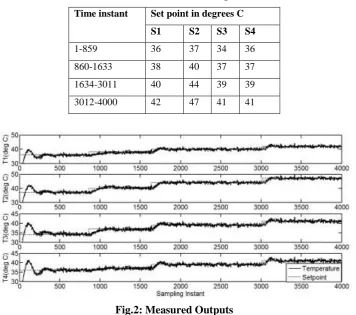
Simulations are carried out for 4000 samples. Set point changes are given as shown in table (3). Results of Simulation are given in Fig 2 and Fig3
Table 3 Set Point Change
Time instant Set point in degrees C
S1 S2 S3 S4
1-859 36 37 34 36
860-1633 38 40 37 37
1634-3011 40 44 39 39
3012-4000 42 47 41 41
132 |
P a g e
Fig.3: Manipulated Inputs
From the fig.2, we can say that all the set points are tracked by the multiloop PI controller and we can observe that when set point changes heater current also change to control the heater input.
V. CONCLUSION
A multivariable system has been designed to carry out multivariable control experiments to teach the concepts of multivariable control. In this paper we have presented simulation and experimental results on a 4x4 heater system. Multiloop PI controller has been developed based on RGA analysis. AMIGO tuning algorithm is used to tune the controller gains. Simulation and experimental results shows that the set points are tracked with an accuracy of 99%.
REFERENCES
[1] Arora, Inderpreet, Kannan M. Moudgalya, and SachitanandMalewar. "A low cost, open source, single board heater system." E-Learning in Industrial Electronics (ICELIE), 2010 4th IEEE International Conference on. IEEE, 2010
[2] Curtis D.Johnson, Process Control Instrumentation Technology (7th edition Pearson Education) [3] D. E. Seborg, T. F. Edgar, D. A. Mellichamp, Process Dynamics and Control (Wiley 2003)
[4] Graham C. Goodwin, Stefan F. Graebe, Mario E. Salgado Prentice, Control System Design (Hall 2000) [5] http://playground.arduino.cc/interfacing/matlab
[6] http://www.cc.ntut.edu.tw/~jcjeng/Multiloop%20and%20Multiloop%20Control.pdf
[7] Basilio, J. C., and S. R. Matos. "Design of PI and PID controllers with transient performance specification." Education, IEEE Transactions on 45.4 (2002): 364-370.