Volume 5, No. 8, Nov-Dec 2014
International Journal of Advanced Research in Computer Science
RESEARCH PAPER
Available Online at www.ijarcs.info
ISSN No. 0976-5697
Robust Algorithm to Design Host, watermark Image using Visual Cryptography on
Color Image
Shivani Sharma
Department of C.S.E N. C. College of EngineeringPanipat,Haryana,India
Anju Gandhi
Assistant Professor ,CSE N. C. College of EngineeringPanipat,Haryana,India
Abstract: Visual Cryptography (VC) is a method of encrypting a secret image into shares such that stacking a sufficient number of shares reveals the secret image. During the past decade, with the development of information digitalization and internet, digital media increasingly predominate over traditional analog media. Watermarking is the technique of embedding a secret image into a cover image without affecting its perceptual quality so that secret image can be revealed by some process. Watermarking is the technique of embedding a secret image into a cover image without affecting its perceptual quality so that secret image can be revealed by some process. Share generation for the visual cryptography can also be done using watermarking technique. We can use these watermarked shares for retrieving the hidden information. This effort can generate the meaningful shares rather than some shares having no information.
Keyword-cryptography, encryption, digital watermarking, host image, spatial domain, predictive coding, patch work, wavelet, discrete cosine transform.
I. INTRODUCTION
Visual cryptography is a cryptographic technique which allows visual information (pictures, text, etc.) to be encrypted in such a way that decryption becomes a mechanical operation that does not require a computer. Such a technique thus would be lucrative for defense and security. Unlike conventional cryptographic methods, VC needs no complicated computation for recovering the secret image. The act of decryption is to simply stack shares and view the secret image that appears on the stacked shares. Visual cryptographic technique is being used by several countries for secretly transfer of images in army, hand written documents, financial documents, text images, internet- voting etc. The digital watermark is then introduced to solve this problem. Covering many subjects such as signal processing, communication theory and Encryption, the research in digital watermark is to provide copyright protection to digital products, and to prevent and track illegal copying and transmission of them. Watermarking is embedding information, which is able to show the ownership or track copyright intrusion, into the digital image, video or audio. Its purpose determines that the watermark should be indivisible and robust to common processing and attack. The proposed scheme adds the advantages of both visual cryptography as well as invisible watermarking technique. Visual cryptography encryption adds the advantage and security of basic scheme. Watermarking is used for embedding shares into cover image without affecting its perceptual quality so that the secret image’s share can be revealed by watermark extraction process.
II. BACKGROUND HISTORY
With the rapid advancement of network topology, multimedia information is transmitted over the Internet conveniently. Various confidential data such as military
maps and commercial identification are transmitted over the Internet. While using secret images, security issues should be taken into consideration because hackers may utilize weak link over communication network to steal information that they want. To deal with security problems of secret images, we should develop some secure appropriate algorithm by which we can secure our data on internet. . Practically, this can be done by printing each share on a separate transparency and then placing all of the transparencies on top of each other. In their technique n-1 shares reveals no information about the original image. We can achieve this by using one of following access structure schemes
Figure shows two of the several approaches for (2, 2) – Threshold VCS. In this particular figure first approach shows that each pixel is broken into two sub pixels. Let B shows black pixel and T shows Transparent (White) pixel. Each share will be taken into different transparencies. When we place both transparencies on top of each other we get following combinations, for black pixel BT+TB=BB or TB+BT=BB and for white pixel BT+BT=BT or TB+TB=TB. Similarly second approach is given where each pixel is broken into four sub pixels. We can achieve 4C2 =6 different cases for this approach
1: Each Pixel is broken into two sub pixels as follows.
First Share Second Share Resultant
2: Each Pixel is broken into four sub pixels as follows.
First Share Second Share Resultant
Black
White
Figure1. Visual Cryptography
III. DESCRIPTION OF SYSTEM DESIGN AND METHODOLOGY
Information hiding can be mainly divided into three processes - cryptography, stenography and watermarks. Cryptography is the process of converting information to an unintelligible form so that only the authorized person with the key can decipher it. Stenography is the process of hiding information over a cover object such that the hidden information cannot be perceived by the user. Watermarking is closely related to stenography, but in watermarking the hidden information is usually related to the cover object. Hence it is mainly used for copyright protection and owner authentication.
A. Principle of Watermarking:
A watermarking system is usually divided into three distinct steps, embedding, attack and detection. In embedding, an algorithm accepts the host and the data to be embedded and produces a watermarked signal. The watermarked signal is then transmitted or stored, usually transmitted to another person. If this person makes a modification, this is called an attack. There are many possible attacks. Detection is an algorithm which is applied to the attacked signal to attempt to extract the watermark from it [1-2]. If the signal was not modified during transmission, then the watermark is still present and it can be extracted. If the signal is copied, then the information is also carried in the copy. The embedding takes place by manipulating the content of the digital data, which means the information is not embedded in the frame around the data, it is carried with the signal itself. Figure 2 shows the basic block diagram of watermarking process.
Figure.2 Watermarking block diagram
B. Classification of Watermarking:
It can be classified in visible and invisible watermarking.
Visible:
The watermark is visible which can be a text or a logo used to identify the owner.
Any text or logo to verify or hide content Fw= (1-α) F+ α*W
Fw = Watermarked Image
α =constant; 0<=α<=1, IF α=0 No watermark, if α=1 watermark present
F =original image W =watermark Invisible
The watermark is embedded into the image in such a way that it cannot be perceived by human eye. It is used to protect the image authentication and prevent it from being copied. Invisible watermark can be further divided into three types. Robust Watermarks, Fragile Watermarks, Public and Private Watermark
C. Techniques of Watermarking:
Digital watermarking is addressed mostly in spatial or frequency domain. Based on application's requirement different watermarking techniques can be selected. Most of the present work in the area of digital watermarking is inspired by the manipulating the frequency domain of the multimedia objects. In frequency domain, researchers have selected different transformation methods for embedding and extracting watermark objects. These includes Discrete Cosine Trans-form (DCT), Discrete Fourier Transform (DFT) and Wavelets.
a. Frequency Domain techniques:
Frequency domain watermarking technique is also called transform domain. Values of certain frequencies are altered from their original. Typically, these frequency alterations are done in the lower frequency levels, since alterations at the higher frequencies are lost during compression. Watermarking in the frequency domain involves embedding in the image’s transform coefficients.
b. Discrete Cosine Transform (DCT) Technique:
which maps an n-dimensional vector to set of n coefficients [3-5]. A linear combination of n known basis vectors weighted with the n coefficients will result in the original vector. The known basis vectors of transforms from this class are “sinusoidal“, which means that they can be represented by sinus shaped waves or, in other words, they are strongly localized in the frequency spectrum. Therefore one speaks about transformation to the frequency domain. The most popular member of this class is the Discrete Fourier Transformation (DFT).The difference between DCT and DFT is that DFT applies to complex numbers, while DCT uses just real numbers. For real input data with even symmetry DCT and DFT are equivalent.
[image:3.595.314.564.56.222.2]The coefficients can be split using the zigzag ordering into low frequency coefficients, mid frequency coefficients and high frequency coefficients as shown in Fig.3
Figure 3 DCT Decomposition
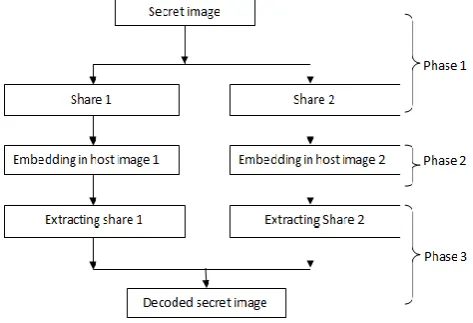
[image:3.595.32.279.244.367.2]Figure 4 shows the structure of the proposed scheme. The proposed scheme generates the VC shares using basic visual cryptography model and then embed them into a cover image using invisible blind watermarking technique, so that the secret shares[6-7] will be more secure, meaningful and shares are protected from the malicious adversaries who may alter the bit sequences to create the fake shares. During the decryption phase, secret shares are extracted from the respective cover images without using any cover image characteristics to provide mutual authentication
Figure 4 Structure of the Proposed Scheme
Any single share is a random choice of two black and two white sub pixels, which looks medium grey. Fig.5 shows share creation using VC (2, 2) Encryption. When two shares are stacked together, the result is either medium grey (which represents white) or completely black (which represents black).
Figure 5 Share creation using VC (2, 2) encryption Scheme
IV. RESULT
[image:3.595.313.566.248.494.2]A. RESULT I: PSNR
[image:3.595.42.279.516.677.2]Figure.6 show PSNR and RMSE of different images
Table 1: PSNR & MSE of Different Image
Sr. No. Types of Images PSNR MSE
1 Original image 16.82 17.95
2 Noisy Image 35.62 15.61
3 Mean Square Error image 36.23 35.91
B. RESULT II Sharpe Images:
[image:3.595.314.550.523.613.2](a)
(b)
(c)
(d)
(e)
[image:4.595.314.565.54.336.2](f)
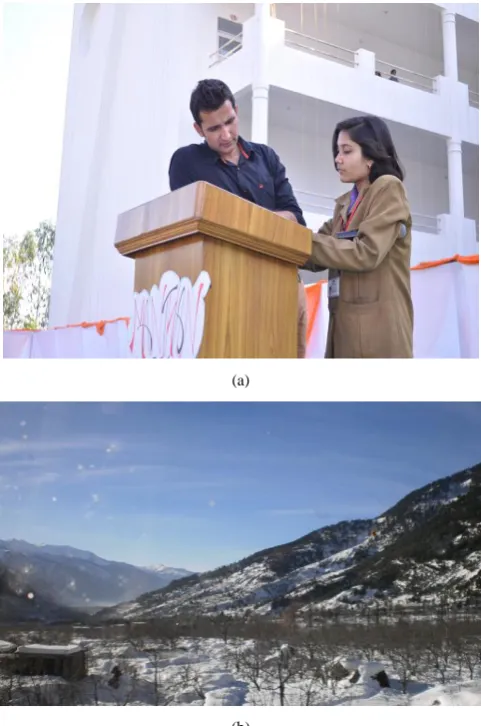
Figure 7 show watermark images (a, b) and then determine extracted secret message(c, d) then shared and finally revealed message (e,f)
Elapsed_time of first image is=0.9828 Elapsed_time of first image is=0.7176
Figure.8 Elapsed time of Fig.7 images
C. RESULT III Blurred Images:
In result III we calculated the blurred images elapsed time from given watermark images. As shown in figure 9 which are watermark images and then determine extracted secret message then shared and finally revealed message.
(a)
[image:4.595.317.558.408.771.2](c)
(d)
(e)
(f)
Figure 9 show watermark images (a, b) and then determine extracted secret message(c, d) then shared and finally revealed message (e,f)
[image:5.595.320.554.56.324.2] Elapsed_time of first image is=1.4508 Elapsed_time of first image is=0.8424
Figure 10 Elapsed time of Fig.9 images
D. Result V: Cryptography
Figure 11 watermark image1
Figure 12 watermark image1
Figure 13 extracted secret message of Fig.11
[image:5.595.320.552.352.603.2]Figure 14 extracted secret message of Fig.12
Figure 15 shared message of Fig.13
Figure16 revealed message of Fig.14
Figure 17 original image of size 144*15
[image:5.595.38.277.386.745.2]Figure.19 show Snapshot of all images obtained by cryptography ie host image1, 2 and watermark image1, 2, secret message, share1, share2,
extracted secret message
Figue 20 white and black pixel processing time of image is listed below
White and Black pixel processing time: a. White pixel processing Time:0.6084 b. Black Pixel processing time:0.5616
IV.V. CONCLUSION
The proposed scheme used visual cryptography for share generation and each share is embedded in a cover image using digital watermarking. Visual cryptography encryption adds the advantage and security of basic scheme. Watermarking provided double security to shares by hiding them in some cover images. Watermarked images are robust against a number of attacks like blurring, sharpening, cropping etc.
V.VI. REFERENCES
[1] B.padhmavati, P.Nirmal Kumar, M.A.Dorai Rangaswamy, 2010. A Novel Scheme for Mutual Authentication and Cheating Prevention in Visual Cryptography Using Image Processing. In Proceedings of International Conference on
Advances in Computer Science 2010 DOI: 02,
ACS.2010.01.264, ACEEE.
[2] D.Jena and S.Jena, 2009. A Novel Visual Cryptography Scheme. In Proceedings of International Conference on Advanced Computer Control, (ICACC’2009), pp.207-211.
[3] Mrs.D.Mathivadhani, Dr.C.Meena, 2010. Digital
Watermarking and Information Hiding using Wavelets, SLSB and Visual Cryptography method. In Proceedings of International Conference on Computational Intelligence and Computing Research (ICCIC’2010), pp. 1-4.
[4] M.Naor and A.Shamir, 1995. Visual cryptography.
Advances in Cryptology EUROCRYPT ’94. Lecture Notes in Computer Science, (950):1–12.
[5] P.S.Revenkar, Anisa Anjum, W.Z.Gandhare, 2010. Survey of Visual Cryptographic Schemes. International Journal of Security and Its Applications, Vol. 4, No. 2, April, 2010.
[6] S.Punitha, S.Thompson, N.Lingam, 2010. Binary
Watermarking Technique based on Visual Cryptography. In
Proceedings of International Conference on
Communication Control and Computing Technologies ( ICCCCT’2010), pp. 232-235.
[7] S.Riaz, M.Javed and M.Anjum, 2008. Invisible
Watermarking Schemes in Spatial and Frequency Domains. In Proceedings of fourth International Conference on Emerging Technologies (ICET’ 2008), pp. 211-216.