Collaborative Filtering Recommendation Algorithm Using
Implicit Similarity in Preference Relationships
Yu Hong ZhouP
[*]
P
, Zhi Jie Duan, Wei Jiang
*Chongqing Key Lab of Mobile Communications Technology, Chongqing University of Posts and Telecommunications, Chongqing 400065, P. R. China
Abstract
In traditional collaborative filtering recommendation algorithm, the similarity is calculated based on the common ratings and the accuracy is not well when the data is sparse. The thesis proposes a novel collaborative filtering by using implicit similarity in preference relationships(CF-ISP). Firstly, it divides the user group based on the user attributes, and secondly, it defines the item preference in the user group and calculates the preference similarity between the items. Finally, it introduces the preference similarity to the Probabilistic Matrix Factorization recommendation algorithm.The thesis conducts the experiment to verify the validity and the accuracy of the algorithm.
Keywords: Recommendation System, Collaborative Filtering, preference similarity,user group
1.
Introduction
With the explosive growth of the personalized recommendation technologies, the users can get higher quality service and better user experience, the items on the website can be displayed in front of the users who are really interested in them. Recommender systems enhances the economic efficiency of the website and the retention rate of the users on the platform[1]. For some time, the collaborative filtering technology is widely used in the industry because of it’s low dependence, good applicability and simple encoding. But it also faces the great challenges such as data sparsity problem. There are at least millions of users and items in the large business recommender systems, but the user only rate some of these items and caused data sparsity problem. Moreover, personalized recommendation also faces cold start problem, extendibility problem and so on.
For the sake of those problems, we first divide the user group based on the user attributes, and then calculates the
preference similarity between the items. Finally, it introduces the preference similarity to the Probabilistic Matrix Factorization recommendation algorithm. It first uses the user’s age attribute, gender attribute and preference attribute to calculate the interest distance between the different users, and utilizes the k-medoids method to divide the user group, and then the formal definition of the item preference is given to calculate preference similarity. Finally, it introduces the preference similarity to the Probabilistic Matrix Factorization recommendation algorithm and redefine the item’s potential feature vector. The local optimum of the potential feature vector can be obtained according to the matrix factorization and SGD method. The experimental result shows that the proposed algorithm utilizes the additional item’s information efficiently, enriches data source and improves the precision of the similarity computation, meets the personalized recommendation demands.
between the users that can spread just like the trust in social network, it constructs new user relationships to alleviate the data sparsity by spreading the similarity in bipartite graphs. Work in [7] proposes the textonly-based, hashtag-based and URL-based approaches to model user profiles and calculated the relevance between users. Work in [8] proposed a matrix factorization method to estimates unknown user-to-user rating based on given trust relation and rating records between social network users. Work in [9] considers that the tag reflects the semantic of the item rather the user’s preference, it recommends according to the different role of the tags to build the user-centric tripartite graph and the item-centric tripartite graph.
2.
User group division
2.1 related definition
Define user set U=
{
u u1, 2,...,um|m=|U|}
, given apositive integer K and division method, if Uis divided
non-empty subset
U
lof size k, and1
K
l l
U
U
=
=
∑
, we sayl
U
is one user group.Define
a u
′
( )
andg u
′
( )
represents the user age attributevalue and gender attribute value, the calculation as follows:
( ) ( ) min( ) max( ) min( )
i
a u a
a u
a a
− ′ =
− (1)
0 ( ) male
( )=
1 ( )=female
g u g u
g u =
′
,, (2)
Define
d u v
( , )
represents the interest distance between the user u and the user v , the calculation as follows:( , )
age( , )
gender( , )
pref( , )
d u v
= ⋅
α
d
u v
+ ⋅
β
d
u v
+ ⋅
γ
d
u v
(3)
Where
d
age( , )
u v
represents the age attribute distance,( , )
gender
d
u v
represents the gender attribute distance,( , )
pref
d
u v
represents the preference attribute distance, parameter α ,β
andγ
is weight factor and1
α β γ
+ + = .d
age( , )
u v
,d
gender( , )
u v
andd
pref( , )
u v
calculates as follows:
( , ) |
( )
( ) |
age
d
u v
=
a u
′
−
a v
′
(4)
( , ) |
( )
( ) |
gender
d
u v
=
g u
′
−
g v
′
(5)
( ( ( ), ( )))
( , )
( )
pref
h
H T p u p v
d
u v
H T
=
(6)
Where T p u( ( ), ( ))p v is a subtree, and the node
p u
( )
andnode
p v
( )
minimum common parent node as the subtreeroot node,
T
h is preference classification tree, H T( ) represents the height of the tree.Define bipartite graph model G < U, E, w >, U is the user
node set, E is the edge set,
e v v
( , )
u i∈
E
represents there is an edge connect the nodev
u andv
i , the weight( , )
u iw v v
represents the interest distance of the user nodeu
v
andv
i. The user interest distance matrix M as follows:[
( , )]
m mM
=
dist i j
×(7)
Where
dist i j
( , )
is the interest distance between the useri
and userj
.2.2 user group division
The pseudocode of the collaborative filtering recommendation algorithm using implicit similarity in preference relationships as follows:
CF-ISP algorithm pseudocode
Algorithm: Collaborative Filtering Recommendation Algorithm Using Implicit Similarity in Preference Relationships
Input: user interest distance matrixMR
, Rthenumber of user group N, user u
Output: N user groups
1: initialize
{
}
1
,
2...
NG
=
g g
g
2: initialize
{
}
1
,
2,...,
c k
C
=
c c
c
3: while||
M
in dist_[
c
kt+1][
c
kt||
22<
ε
do 4: for each user ui∈U do5: for each medoid ci∈Cc do 6:
dis u c
( , )
i i=
M
in dist_[ ][ ]
u
ic
i 7: end for8:
( ,
)
min
{
[ ][ ],...,
[ ][ ]
}
i m i m i k
dis u c
=
M u c
M u c
9:g
m=
c
m
u
i10: end for
11: for each user
u
i∈
g
i& &
u
i≠
c
i do 12: for each useru
j∈
g
i& &
u
j≠
c
i 13:dis
_
sum u
( )
i+ =
M
in dist_[ ][
u
iu
j]
14: end for15:
u
i=
min{
dis
_
sum u
( ),...,
1dis
_
sum u
(
m)}
16: end for17:
c
i=
u
i 18:return3.
Implicit similarity in preference
In the previous section, we divide the user to k user groups. For each user group, we divide the original rating
matrix into R=R1R2 ... Rk , the submatrix
R
i is consist of all users and rating item and rating point ini
-thuser group.
Define user set
U
=
{
u u
1,
2,...,
u
m}
, any itemi,
{
,}
( ) | u i
U i = u∈U R ≠ ∅ represents the user set who has
rated the item
i,
∀ ∈
C
kC
| ( ) |
( ) (0 ( ) 1)
| ( ) |
k
C U i
pref i pref i
U i α
= ≤ ≤
+
(8)
( )
pref i represents the item’s preference in the user group
k. We construct the item-user group preference matrix by the preference value, as table 1 shows:
item-user group preference matrix
1
c
…c
j…
k
c
1
item
P
1,1…
1,j
P
…P
1,k… … … … … …
j
item
P
j,1 …P
j j, …P
j k,… … … … … …
n
item
P
n,1…
,
n j
P
…P
n k, WhereP
n k, represents the preference of the itemitem
n in user groupc
k.Define item set
{
}
1, , ...,2 k
I = i i i
, and
∀ ∈
i
I
, ituses
(
)
,1
,
,2,...,
, i i i kP P
P
=
i
f
represents the preferencefeature vector of the item i, and the implicit similarity in
preference relationships between the item
i
and itemj
can represent as follows:
1
2 2
1 1
( , ) cos( , )
k in jn n
k k
in jn
n n
p p sim i j
p p
=
= =
= =
∑
∑
∑
i j
f f (9)
4.
Recommendation algorithm CF-ISP
Fig 1:CF-ISP model
The thesis redefines the item’s potential feature vector as follows: , j
ˆ
V =
ii j i j N
V S
∈∑
(10)Where
N
iis
the neighbor set of the itemi
,S
i j, is implicit similarity in preference relationships between itemi
and itemj
, and ,( )
1
i j j N i
S
∈
=
∑
. The ConditionalDistributions of the rating matrix Rdefine as follows:
2 2 , 1 1
( |
, ,
)
[ (
| (
),
)]
R ij m n I TR i j i j R
i j
p R U V
σ
N R
g U V
σ
= =
=
∏∏
(11)
Where IijR is the feature function, if the user Ui has rated
the item Vj IijR =1else IijR =0.
Based on the Bayes theorem and likelihood function of Eq.(11) we can obtain the posterior probability of U and
V :
2 2 2 2
2 2 2 2
( , | , , , , , )
( | , , ) ( | ( | ,
R S U V
R U V S
p U V R S
p R U V p U p V S
σ σ σ σ
σ σ σ σ
∝ ) , )
(12)
Where
p V S
( | ,
σ σ
V2,
S2)
∝
p V S
( | ,
σ
S2)
×
p V
( |
σ
V2)
the thesis incorporates the implicit similarity sim i j( , ) intoPMF, so p V S( | ,σS2) can be defined as follows:
2 2 , 1
( | ,
)
(
|
,
)
i NS i j i j S
j N i
p V S
σ
N V
V S
σ
I
∈ =
=
∏
∑
(13)We proposed by minimizing its arithmetic negation
function L R U V SF( , , , ) , the task is transformed to the
following minimization problem:
(
)
, ,
1 ( ) ( )
1 1 2 , , 1 1
( , , , )
2
+ (14)
2
2
T N
S
F i j i j i j i j
i j N i j N i
M N
T T
U V
u u i i
u i
M N
R T
u i u i u i u i
L R U V S
V
V S
V
V S
U U
V V
I
R
U V
λ
λ
λ
= ∈ ∈ = = = ==
−
−
+
+
−
∑
∑
∑
∑
∑
∑∑
Where
λ
U=
σ σ λ
R2 U2,
V=
σ σ λ σ σ
R2 V2,
s=
R2 S2 arethe regularization to avoid model overfitting. To minimize
the objective function L R U V SF( , , , )in Eq.(14), we use
the gradient descent on ∂LF ∂Uu and ∂LF ∂Vi for each
pair Uu and Vi, as follows:
, , 1
(
)
N R T Fu i i u i u i U u i
u
L
I V U V
R
U
U
=λ
∂
=
−
+
∂
∑
(15), , 1 , ( ) , | ( ) ( )
(
)
(
)
(
)
M R T Fu i u u i u i i
i
V i S i j i j j N i
S j x j x
j i N j x N j
L
I U U V
R
V
V
V
V S
V
V S
λ
λ
λ
= ∈ ∈ ∈∂
=
−
+
∂
+
−
−
−
∑
∑
∑
∑
(16)5.
Experiment
5.1 Datasets
In our experiments, we used the MovieLens10M datasets, it contains 71567 users, 10681 movies. We evaluated the completion by RMSE(Root Mean Square Error) 1 j V u U , u i R
..
.
i V 1 , i j S 2 , i j S 2 j V w j V ,w i j S V σ U σ S σ 1, 2,...,i= N
1, 2,...,
u= M
2 R
3.2 experiment result
Fig.2: parameter and RMSE corresponding relation
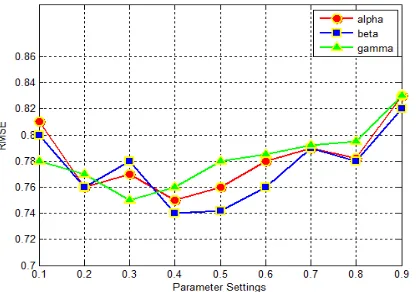
In Figure 2, the experimental results are
presented. When
α
=0.4β =0.4 ~ 0.5γ =0.3,
theRMSE attain optimal value changes with the parameter. When β =0.4 ~ 0.5 , RMSE reaches
minimum 0.74. So we consider the user attribute that the parameter
β
corresponds to has the most influential and importance to the recommender results. It reintroduces the conditionα β γ
+ + =1we can drawa conclusion that when
0.4
β
=,
α
=0.35,
γ
=0.25,
RMSE reaches minimum and achieve best performance of recommendation.
Fig.3: k and RMSE corresponding relation
In Figure 3, the experimental results are presented. The RMSE decreases with increasing of user group k, when
k
=
50
RMSE reaches minimum 0.74. Continue increasing k, RMSE increases and it reduces the recommendation quality.Table 1 :
λ
S and RMSE corresponding relationS
λ
f
=
5
f
=
10
0.001 0.7655 0.7632
0.01 0.7476 0.7459
0.1 0.7459 0.7433
0.5 0.7572 0.7569
1 0.7667 0.7661
5 0.7702 0.7698
10 0.7798
0.7729
In Table 1, it is easy to find that in the same
dimension, changes in parameter
λ
S has the great influential to RMSE. RMSE decreases with increasing ofS
λ
, whenλ
S∈[0.01, 0.1], RMSE descends to its lowest level.Fig.4: feature number and RMSE corresponding relation
In Figure 4, the experimental results are presented. RMSE decreases with increasing of feature number f , when f =10 RMSE descends to its lowest level.
Increasing
f
, the performance of the recommender system starts to slide, But the CF-ISP algorithm still has the lowest RMSE compared to the other three algorithms.6.
Conclusions
In this thesis, we have proposed a new collaborative filtering recommendation algorithm CF-ISP which leverages preference information to improve the recommendation result. The thesis first divide the user group based on the user attributes, and then calculates the
10 20 30 40 50 60 70 80 90 0.72
0.73 0.74 0.75 0.76 0.77 0.78 0.79 0.8
number of user groups(k)
RM
S
E
0.5 0.6 0.7 0.8 0.9 1
RM
S
E
Item-MEAN PMF CTR CF-ISP
preference similarity between the items. Finally, it introduces the preference similarity to the Probabilistic Matrix Factorization recommendation algorithm. The experiment result shows that CF-ISP excels other peer algorithms in terms of recommendation evaluation metrics. As the future work, we plan to parallelize the algorithm, and increase the amount of experimental data.
References
[1] Groh G, Ehmig C. Recommendations in taste related domains: collaborative filtering vs. social filtering[C]//Proceedings of the 2007 international ACM conference on Supporting group work. Sanibel: ACM Press, 2007: 127-136.
[2] Ma H, King I, Lyu M R. Effective missing data prediction for collaborative filtering[C]// SIGIR 2007: Proceedings of the, International ACM SIGIR Conference on Research and Development in Information Retrieval, Amsterdam, the Netherlands, July. DBLP, 2007:39-46. [3] V. Agarwal and K. K. Bharadwaj. A collaborative filtering framework for friends recommendation in social networks based on interaction intensity and adaptive user similarity.Social Network Analysis & Mining, 3(3):359-379, 2013.
[3] Wang S, Xie Y, Fang M. A collaborative filtering recommendation
algorithm based on item and cloud model[J]. Wuhan university journal of
natural sciences, 2011, 16(1): 16-20.
[4] Ahn H J. A new similarity measure for collaborative filtering to alleviate the new user cold-starting problem[J]. Information Sciences, 2008, 178(1):37-51.
[5] Y. Koren. Factor in the neighbors: Scalable and accurate collaborative filtering. ACM Transactions on Knowledge Discovery from Data (TKDD), 4(1):1–24,Jan. 2010.
[6] Satsiou A, Tassiulas L. Propagating Users' Similarity towards Improving Recommender Systems[C]// Web Intelligence. ACM, 2014:221-228.
[7] M. Chechev and P. Georgiev. A multi-view content-based user recommendation scheme for following users in twitter.In Social Informatics, pages 434-447. ACM, 2012.
[8] Jamali, M. and Ester, M. 2010. A matrix factorization technique with trust propagation for recommendation in social networks. In Proceedings of the fourth ACM Conference on Recommender Systems(Sept 26-30, 2010,Barcelona, Spain), RecSys’2010, ACM, 135-142.DOI=http://doi.acm.org/10.1145/1864708.1864736.
[9] Firan C S, Nejdl W, Paiu R. The benefit of using tag-based profiles[C]//Web Conference, 2007. LA-WEB 2007. Latin American. IEEE Press, 2007: 32-41.
YuHong Zhou, was born in Tongling of Anhui province in 1989.
He is now a graduate student in Chongqing University of Posts
and Telecommunications. Hisresearch concerns Mobile communication techniques..
Zhi Jie Duan, was born in Jian of JiangXi province in 1992. He is
now a graduate student in Chongqing University of Posts and Telecommunications. His research concerns Mobile communication techniques.
Wei Jiang was born in ZheJiang province in 1992. He is now a