Audio Watermarking With Emd Technique
Thukaram Gugulothu & Kurumaiah.N
Assistant Professor, Department Of Ece Nalla Narasimhareddy Education Society’s Group Of Institutions,Hyd Assistant Professor Nalla Narasimhareddy Education Society’s Group Of Institutions,Hyd
ABSTRACT:
Another audio watermarking technique, Empirical Mode Decomposition (EMD) is presented in this paper. The audio signal is splitted first into outlines and each edge is then deteriorated by EMD to get its essential intrinsic intermittent components known as Intrinsic Mode Functions (IMFs). These
aggregate blends of watermark and
synchronization code are installed into the last IMF. Last IMFs are most steady frequency segment under different assaults thus ensures nature of the host signal. So this philosophy is connected to any picture and audio signals. Experimentation has given the physical checking and its recognition to secure audio on various assaults.
KEYWORDS:
Empirical mode decomposition, quantization index modulation, frequency modulation Intrinsic Mode Function synchronization code, amplitude modulation, signal to noise ratio.
I.
INTRODUCTION
Computerized audio watermarking has
accomplished a honorable consideration regarding offer effective answers for copyright insurance of advanced media. Fundamental targets of advanced audio watermarking are
vigor and indistinctness. The watermark ought to be indistinct inside host audio with the goal that its quality is safeguarded however it ought to be strong to the assaults or signal alterations given to the host information. Finally, watermark ought to be anything but difficult to separate and to confirm the proprietorship. To accomplish above necessities, seeking after new plans for watermarking is an extremely difficult. Diverse watermarking techniques with various complexities have been given. To secure the dataagainst different assaults, a hearty plan of watermarking is given however it flops in bit rate transmission. To take out piece rate issue, watermarked conspires in the area of wavelet has likewise been proposed. Watermarking in wavelet space has settled premise functions, which don't ensure to coordinate all continuous signals. To defeat
these disadvantages, Empirical Mode
Functions (IMFs). Any signal is extended by EMD as takes after
where C means IMF check and ɼc(t) indicates last leftover . The IMFs are orthogonal to each
other and have zero means. The degree of extrema is decreased when it starting with one then onto the next mode, and the entire plan of decomposition is
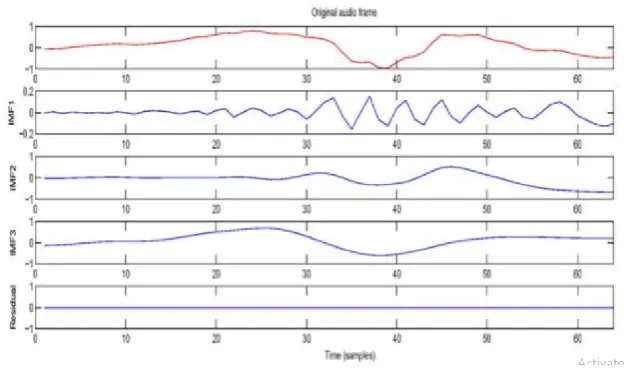
Fig. 1. Decomposition of an audio frame by EMD
deduced in a limited number of modes. The IMFs are totally marked by their nearby extrema thus can be recouped back utilizing it. Low frequency parts that is higher request IMFs are signal controlled subsequently their change can wind up in withdrawal of the signal. Along these lines, these positions are the best to place watermark. In some underlying outcomes, the EMD is joined with Pulse Code Modulation and the watermark is embedded in the last leftover of the sub groups in the change space. This technique gives the mean estimation of PCM audio signal may never again be zero. The technique isn't powerful to different assaults like band-pass
in the perceptually parts of the host signal to have better dissatisfaction against assaults and impalpability. Along these lines in this venture, the watermark are embedded in the extrema of the last IMF. The watermark is connected with a synchronization code to help its area. The favorable position to utilize the time space technique in EMD, is the low spending plan in testing synchronization codes. Audio signal is first fragmented into outlines and every one is
deteriorated into IMFs. Bits are included into the extrema of the last IMF with the end goal that the watermarked signal indistinctness is set up. Exploratory outcomes check that the concealed information are hearty for assaults,
for example, noise augmentations,
compressions, requantization, trimming and so forth. This procedure is simple and powerful as identified with audio watermarking strategies educated as of late.
II.
RELATED WORK
Arnold, et al, has indicated an intangible
watermarking technique in audio
watermarking isn't as grown, yet as identified with the examines which has done in picture and video watermarking. The audio signals are depicted by a couple of tests for each time interim demonstrates that the amount of data bits which can be installed effectively and noiselessly in audio documents is substantially
lesser than the measure of data bits that can be embedded in visual records. Gordy et al, has expressed a calculation free system for likening advanced watermarking calculation as for perceptual quality, piece rate, strength and intricacy to signal preparing. on the premise of four properties perceptual quality, bitrate, multifaceted nature and vigor the calculations for open watermarks were leveled with. Frequency concealing implanting was the expensive operation as of the need to register a mind boggling, time-fluctuating perceptual veiling investigation to be passed out on the host signal. Tom et al, in watermark security has expressed the inability by unapproved clients to approach the watermarked channels. The security of watermarking confides in the mystery of the keys and just the data of both the calculation and the keys can break the calculation. Martins, et
perceive the principal properties and the confinements of watermarking system.Martin, et al, in his paper committed on the plan of a substance inconspicuous audio watermarking plan to permit many after creation developments and on the outline of an invertible watermarking design
helpful with advanced marks for high security. Anastasias, et al, has proclaimed in his outline of watermarking plans in light of disorganized makers and connection sensor. High pass disordered watermarks are superior to low pass watermark which have most noticeably bad execution when no distortion is uncovered on the watermarked signal. Xian youthful, et al, has given the difference of watermarks given by tumultuous functions, strategic guide and Bernoulli maps within the sight of reasonable assaults. He offered the watermark to be subtle and hearty to some regular signal treating operations. Ali, et al, has proposed audio watermarking made on discrete wavelet change. He has given solitary esteem decomposition (SVD) technique. Ke-Xin Yin, et al, has given a blind powerful computerized watermarking plan by methods for turbulent encryption and visual arrangement of human in the DWT space. The watermark is encoded by methods for calculated guide. K.Khaldi, et al, has proposed a near investigation of various decomposition techniques used to de-noise an ECG signal. The challenges of FT technique
can be broken out by Wavelet Transform conspire. As Wavelet Transform is a non-versatile, it isn't appropriate to expel the high frequency noise from signal. The issues of WT technique can be limited by Empirical Mode of Decomposition plot. A top to bottom examination is mandatory to discover the most beneficial decomposition strategy for an ECG signal. A most recent accommodative and versatile audio watermarking technique steady Empirical Mode Decomposition (EMD) was uncovered.
III.
PROPOSED
METHODOLOGY
The possibility of the anticipated
large the measure of extrema per last-IMF of one edge is exceptionally slight contrasted with length of the double grouping to be embedded. This totally relies upon the length of the casing.
Fig.2 Data structure m(i)
Watermark and SCs are not all embedded in extrema of last IMF of one edge. In generally speaking the quantity of extrema per last-IMF is little identified with length of the twofold arrangement to be implanted. This likewise relies upon the length of the edge. On the off chance that we draw byN1andN2 the quantities of bits of SC and watermark individually, the length of double arrangement to be implanted is proportional to 2N1 + N2.Hence, these 2N1 + N2 bits are go out on a few last-IMFs (extrema) of the successive casings. Again this grouping of 2N1 + N2 bits is installed ptimes. In conclusion, reverse transformation(EMD)- 1 is connected to the
enhanced extrema to recuperate the
watermarked audio signal by superposition of the IMFs of each casing trailed by the link of the edges (Fig. 1). For information extraction, the watermarked audio signals aresplitedinto casings and EMD connected to each casing (Fig. 3). Double information game plans are
expelled from each last IMF by testing for SCs (Fig. 4). We characterize the last IMF previously, then after the fact watermarking. This figure demonstrates that there is little alteration as far as amplitudes among the two modes. EMD being completely information versatile, in this way ensure the quantity of IMFs will be unaltered previously, then after the fact implanting the watermark (Figs. 3,5). In the event that the quantities of IMFs are unique, there can be no certification that the last IMF dependably includes the watermark data to be expelled. To come overthis troubles, the filtering of the watermarked signal is upheld to remove an indistinguishable number of IMFs from previously watermarking. The anticipated watermarking framework is visually impaired, that is, the host signal isn't mandatory for watermark extraction. Review of the proposed conspire is itemized as takes after:
A. SYNCHRONIZATION CODE
implanting area of the concealed watermark bits in the host signal a SC which is utilized. This code isn't influenced by trimming and moving assaults.
B. WATERMARK EMBEDDING
Already inserting, SCs are joined with watermark bits to shape a double grouping spoke to by miɛ{0,1}, I – th bit of watermark (Fig.2). Essentials of our watermark inserting are appeared in Fig. 1 and point by point as takes after:
Stage 1: Split unique audio signal to outlines. Stage 2: Decompose each casing into IMFs. Stage 3: Embed P times the parallel course of action {mi} into extrema of the last IMF (IMF)Cby QIM.
Where ei and ei∗ are the outrageous of IMFC of
the host audio signal and the watermarked signal correspondingly . Sine function is equivalent to "+ " ( maxima) and " - " (minima). ˩ demonstrates the floor function , and S signifies the installing quality chose to safeguard the unintelligibility limitation.
Stage 4: Rebuild the edge (EMD)- 1 utilizing enhanced IMFC and connect the watermarked casings to recoup the watermarked signal.
C.WATERMARK EXTRACTION
For extraction of watermark, have signal is splitted into edges and EMD is accomplished on every one as in installing. We at that point chase for SCs in the extricated information. This procedure is dull by moving the chosen section one specimen at any given moment until the point when a SC is found. In the wake of deciding SC, we would then be able to separate the shrouded data bits which trail the
SC. Let y = {mi∗}indicate the parallel
information to be separated Uand indicate the first SC. To follow the inserted watermark,
chase the SCs in the game plan {mi∗}bit by
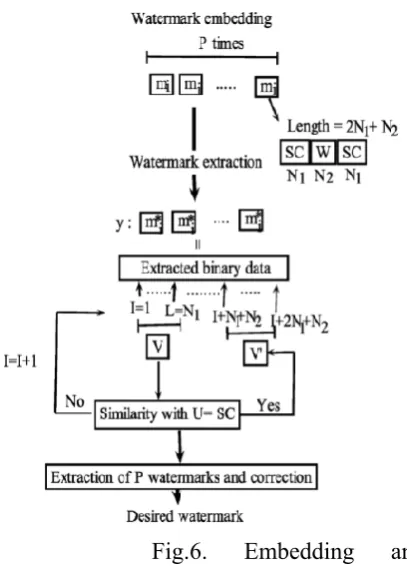
bit. The extraction is performed without utilizing the first audio signal. Basic advances tangled in the watermarking extraction, appeared in Fig. 4, are given as takes after:
Stage 1: Split watermarked signal into singular edges.
Stage 2: Decompose every single edge into IMFs.
Step 4: Extract mi∗ from ei∗ using the following rule:
Stage 5: Set the beginning of index of the separated information y, to I =1 and �L= N1 select specimens (sliding window estimate). Stage 6: Calculate the similitude between the removed section V= y(I: L)and U a tiny bit at a time. On the off chance that the correspondence esteem is ≥ τ, at that point V is taken as the SC and go to Step 8. Or, on the other hand else continue to the following stage.
Stage 7: IncrementI by 1 and slide the window to the nextL = N1samples and rehash Step 6. Stage 8: Calculate the likeness between the second extricated section,
V1 = y(I + N1 + N2: I + 2N1 + N2)andU a little bit at a time.
Stage 9: I ← I + N1 + N2, of the newI esteem is equivalent to grouping length of bits, take after Step 10 or else rehash Step 7.
Stage 10: Extract the P watermarks and make assess a tiny bit at a time among these imprints, for redress, and in conclusion remove
the coveted watermark. Watermarking
Fig.5. Binary Watermark
Fig.6. Embedding and
extraction of watermark actual process
IV. QUALITY ANALYSIS
To assess the execution of proposed technique Bit mistake rate (BER) and Signal to Noise Ratio (SNR), among unique and the watermarked audio signals is taken. A
watermarked audio signal should protect SNR more than 18 dB. To gauge the watermark uncovering precision after assaults ,we utilized the and the characterized as belows:
where⊕ means XOR operator and M × N
signifies the sizes of paired watermark picture. W and W' gives unique and the recouped watermark independently. Is utilized to assess theaccuracy in watermark location after signal handling operations.
V. RESULT AND CONCLUSION
The graphical portrayal of results is given beneath. The primary chart speaks to the information audio signal or unique audio signal. Second chart speaks to the audio signal after decomposition by Empirical mode
decomposition technique. The similar
VI. CONCLUSION
In this paper another watermarking plan in view of the EMD is anticipated. Watermark is presented in low frequency mode and is related with synchronization codes, so guards against different assaults. Information bits of the synchronized watermark are embedded in the extrema of the last IMF of the audio signal so does not blocks the nature of host signal. It works progressively and because of its versatile nature, its upgraded watermarking technique. Altogether audio test signals, the
watermark embedded are indistinct.
Investigations approve that the watermarked audio signals are undefined from their unique ones. This watermarking plan has simple
estimations and does not utilize the first audio signal to recoup.
REFERENCES
[1] I. J. Cox and M. L. Mill operator, "The
initial 50 years of electronic
watermarking,"J.Appl.Signal Process.,vol.2,pp.126– 132,2002.
[2] M. D. Swanson, B. Zhu, and A. H. Tewfik, "Powerful audio watermarking utilizing perceptual concealing," Signal Process., vol. 66, no. 3, pp. 337– 355, 1998.
[3] S. Wu, J. Huang, D. Huang, and Y. Q. Shi,
"Productively self-synchronized audio
watermarking for guaranteed audio
Trans.Broadcasting,vol.51,no.1,pp.69– 76,Mar.2005.
[4] V.Bhat, K.I.Sengupta, and A.Das, "Anadaptive audio watermarking in view of the particular esteem decomposition in the
wavelet space," Digital Signal
Process.,vol.2010,no.20, pp.1547– 1558,2010. [5] D. Kiroveski and S. Malvar, "Powerful spread-range audio watermarking," in Proc. ICASSP, 2001, pp. 1345– 1348.
[6] N. E. Huanget al., "The empirical mode decomposition and Hilbert range fornonlinear andnon-stationary time seriesanalysis,"Proc. R. Soc., vol. 454, no. 1971, pp. 903– 995, 1998. [7] K. Khaldi, A. O. Boudraa, M. Turki, T. Chonavel, and I. Samaali, "Audio encoding in light of the EMD," in Proc. EUSIPCO, 2009, pp. 924– 928.
[8] K. Khaldi and A. O. Boudraa, "On signals pressure by EMD," Electron. Lett., vol. 48, no. 21, pp. 1329– 1331, 2012.
[9] K. Khaldi, M. T.- H. Alouane, and A. O. Boudraa, "Voiced discourse improvement in light of versatile sifting of chose intrinsic mode functions," J.Adv. in Adapt. Information Anal., vol.2,no.1,pp.65– 80,2010.
[10] L. Wang, S. Emmanuel, and M. S. Kankanhalli, "EMD and psychoacoustic model based watermarking for audio," in Proc. IEEE ICME, 2010, pp. 1427– 1432.
[11] A. N. K. Zaman, K. M. I. Khalilullah, Md. W. Islam, and Md. K. I. Molla,"A hearty
advanced audio watermarking calculation utilizing empirical mode decomposition," in Proc. IEEECCECE,2010, pp.1– 4.
[12] I. J. Cox, J. Kilian, T. Leighton, and T. Shamoon, "A protected, strong watermark for interactive media," LNCS,vol.1174,pp.185– 206,1996.
[13] D. Swanson, B. Zhu, A. H. Tewfik,
"Hearty audio watermarking utilizing
perceptual covering" in Signal Process vol. 66, pp. 337-355, 1997.