Construction and Accomplishment of a Multi-Purpose
Wireless Body Area Network
Dr. Kumar Keshamoni Associate Professor, Dept. of
ECE
Vaagdevi Engineering College Warangal, TS, India [email protected]
Abstract: A wireless body area network (WBAN) is a collection of miniaturized and energy efficient wireless sensor nodes which monitor human body functions and its surroundings. It has been observed that WBANs perform single application per network, computation and storage capacities are scarce and there is no or
limited mobility support. Technically complex WBAN
application solutions today, find refuge in processing
computationally complex data external to WBANs, i.e., processing sensor data on a conventional PC which is impractical and clumsy. There is a strong need for WBAN platforms which can perform computationally complex tasks on their own having enough resources in terms of computation and memory but still consuming a slow power as possible in order to prolong net work up time. In this thesis work, an improved WBAN named multipurpose-BodyNet (MPBodyNet) is implemented. It has enough computational and memory resources and compact software solutions to achieve high performance and fidelity. MPBodyNet is a self configuring, multipurpose WBAN which can perform multiple applications and user can switch between applications by a mere push of button. It supports mobility and it acts like an agent network to other networks. MP-BodyNet forms a hierarchy where low-capability networks are supported by higher-capacity networks. Hardware used for MP-BodyNet has been designed by WSN-Team at Centre for Wireless Communications, University of Oulu and this thesis proposes two application scenarios. Senior citizen protection mode (SPM) deals with a very hot health care issue for elderly people and patients. An algorithm is proposed and implemented that can detect falls or if the subject/patient has fainted. In SPM, MP-BodyNet can generate alarms in case of emergency and events can be seen on a central server as well as a special alarm is generated o the user’s phone(android app.) which can in turn establish an emergency call automatically. Algorithmic efficiency achieved is 100%. Silent communication mode (SCM) deals with a military hand signal/gesture recognition application. A quite complex pattern recognition algorithm has been proposed with two novelties in it i.e., a sampling process is introduced in the algorithm and the whole algorithmic processing is supposed to be done on the sensor node itself, no processing is supposed to be happening external to the WBAN. Algorithm for SCM is only presented here conceptually after rigorous research about the subject at disposal. It is not implemented in this thesis due to lack of time and is saved for future development. After a gesture would be recognized, an audio message mapped to the gesture will be heard over a head phone.
Keywords: WBAN, WSN, fall-detection, gesture-recognition.
1. INTRODUCTION
description of WBANs and different tiers of WBANs are discussed along with applications relating to WBANs are identified. In Chapter 3, various wireless communication techniques used in wireless sensor networks were identified and the standards pertaining to those communication techniques were reviewed. Chapter 4 provides an introduction to the MP-BodyNet, the WBAN proposed in this thesis. Chapter 5 discusses in detail all components of MP-BodyNet, its complete architectural design ,and the algorithms developed for different modes of MP-BodyNet are evaluated, Overall performance of the MP-BodyNet is also evaluated. Chapter 6 sheds light on discussion and Chapter 7 provides summary of the thesis.
2. WIRELESSBODYAREANETWORKS
2.1. Overview
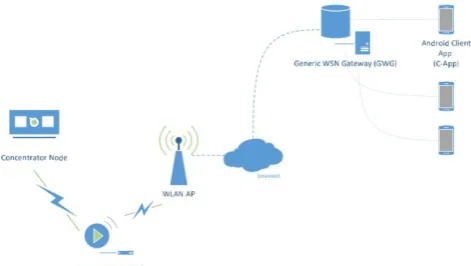
A WBAN is a collection of miniaturized, multi-functional, and energy efficient wireless sensor nodes which monitor human body functions and its surroundings [2]. Figure 1 depicts a WBAN with a few wireless sensor nodes which are monitoring different parameters relating to human body and are reporting to a central node called as a coordinator node or a sink node. Coordinator node itself can be a sensor node or it can simply be an aggregating and relaying device. Coordinator node in turn transmits monitored data for further processing to the backbone network through wireless access point (AP). In some applications coordinator node serves as an AP as well. [4] Wireless sensor nodes can be either wearable or implanted into a human body. Nodes communicate with each other using certain short range wireless technology, e.g., Bluetooth, ZigBee, or ultra wide band (UWB) [4].
A WBAN sensor node consists of fundamentally six components, namely:
• Sensing unit • Processing unit
• Analog-to-digital converter (A/D converter) • Power unit
• Communication unit (radio transceiver) • Memory or storage unit
Sometimes a WBAN sensor node is also equipped with an actuator. Actuator is a device to convert an electrical signal to some action such as a physical phenomenon, e.g., servo motors, insulin pumps, etc. Fundamental task of a sensor node in a WBAN is to sense (monitor) one or more physical, physiological, chemical or biological signal/signals from human body or its surroundings. After sensing, they are responsible for processing the sensed data (signals),i.e., filtration, amplification, digitization, feature extraction etc. This processed data is then stored momentarily and forwarded to the gateway (sink node or coordinator node) through the wireless link. [2,4,5] The gateway or sink is usually a more powerful device with better computational capabilities and is responsible to collect and process the data generated by the
WBAN sensor nodes. Depending on the application, the sink may provide direct feedbacks (visual or vocal) to user based on data collected from sensors, or it may forward data through a wireless backbone network, e.g., wireless local area network (WLAN), global system for mobile communication (GSM), general packet radio service (GPRS), universal mobile telecommunication systems (UMTS), worldwide interoperability for microwave access (Wi-MAX), etc. [5], to a remote server where the data can be processed further and displayed in real-time for user’s inspection and/or stored in a database for post-analysis.
Figure 1. Illustration of a WBAN.
2.2. Generalized system architecture
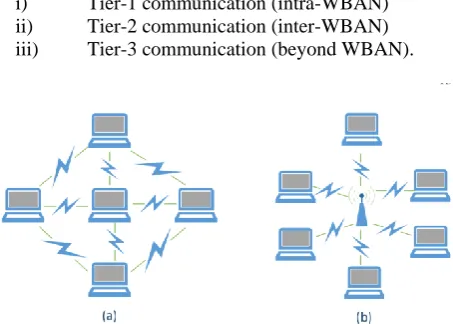
when meeting participants want to exchange documents [6]. Generalized system architecture of a WBAN can be divided in three fundamental levels or tiers of communication as described in [1,2,5]:
i) Tier-1 communication (intra-WBAN) ii) Tier-2 communication (inter-WBAN) iii) Tier-3 communication (beyond WBAN).
Figure 2. (a) Ad-hoc communication (b) Infrastructure based communication.
2.2.1. Tier-1 communication-Intra-WBAN
Tier-1 communication or intra-WBAN communication refers to the radio communication range of about 2 meters around the human body [1]. Intra-WBAN communication can be sub-categorized as follows: (a) Communication among body sensors (b) Communication between body sensors and a personal server (PS) A PS is any machine that can collect data from sensors and do processing on it to generate some meaningful result, e.g., a cell phone or a personal digital assistant (PDA) or a palm top. PS is quite different than a coordinator node or a gateway node because PS is a more complicated multipurpose machine, that is needed to be equipped with some peripheral radio or cable to communicate with the body sensors. PS should also have sensor data manipulating or processing software to generate outputs. Gateway or coordinator nodes are just like sensor nodes, in architecture, from which they collect data. Their task is to forward the data to AP and then AP will route the data on internet to the remote server/database. Design of intra-WBAN tier is far more complicated and challenging than other ones. In existing schemes like MIThrill [8] and SMART [9], the challengesofwirelesslyinterconnectingsensorsandaPSareavoide dbyutilizingcables to directly connect multiple commercially available sensors with a PS. Alternatively, Code Blue [7] stipulates that sensors directly communicate with APs without a PS. However, the typical intra-WBAN designs suggests multiple sensors forwarding body signals to a PS that in turn forwards the processed physiological data to an access point, e.g., in WiMoCa [10]. Well known communication techniques for intra-WBAN communication are ZigBee, Bluetooth and UWB.
2.2.2. Tier-2communication-Inter-WBAN
Inter-WBAN involves communication of PS with the AP, if the network is infrastructure based. In the ad hoc based architecture, multiple APs are deployed to help body sensors
to transmit information. Thus, the service coverage is larger than in the infrastructure based architecture, facilitating users to move around in a building, playground, or in an emergency rescue spot. While the coverage of a WBAN is limited to about two meters, this way of interconnection extends the system to approximately one-hundred meters, which suits both in a short-term setup, and in a long-term setup, e.g., at home. Two categories of nodes exist in this architecture setup, i.e., sensor/actuator nodes in or around a human body, and router nodes around a WBAN, both of which have the same radio hardware to facilitate multi-hop routing. This architecture setup is similar to that of a traditional WSN, and both of them often employ a gateway or a coordinator node to interface with the outside world. In WSNs, however, every node functions as a sensor node and a router node. Tier-2 communication techniques can be WLAN, ZigBee, UWB, GSM or UMTS. [1,5,6]
2.2.3. Tier-3communication-Beyond-WBAN
Tier-3 involves communication between a WBAN and an outside network, e.g., internet or some E-care (electronic care) center. PS and gateway can directly communicate to the outside network and it can also have some base stations involved in between as well. Figure 3 represents a pictorial representation of the tiers of communication for WBANs. A database is an important component of the beyond-WBAN tier. This database maintains, e.g., the user’s profile and medical history. According to user’s service priority and/or doctor’s availability, the doctor may access the user’s information as needed. At the same time, automated notifications can be issued to his/her relatives based on this data via various means of telecommunications. The design of beyond WBAN communication is application-specific, and should adapt to the requirements of user-specific services. For example, if any abnormalities are found based on the up-to-date body signal transmitted to the database, an alarm can notify patient or doctor through email or short message service (SMS).If necessary, doctors or other care-givers can communicate with patients directly by video conference via the Internet. In fact, it might be possible for the doctor to remotely diagnose a problem by relying on both video communications with the patient and the patient’s physiological data information stored in the database or retrieved by a WBAN worn by the patient. Literature, e.g.,[1,2] and [4–6] discuss the above mentioned statements.
2.3. Summary of standards and frequency bands used for WBAN
Figure 3. A pictorial representation of 3-tier communication in a WBAN.
The Institute of Electrical and Electronics Engineers (IEEE) is a non-profit professional institution dedicated to advancing technological innovation and excellence. IEEE is one of the leading standards-making organizations in the world. IEEE performs its standards making and maintaining functions through the IEEE standards association (IEEE-SA). IEEE standards affect a wide range of industries including power and energy, biomedical and healthcare, information technology (IT), telecommunications, transportation, nano-technology, information assurance, and many more. IEEE has many work groups committed to various scientific research areas. [11] IEEE 802.15 is the wireless personal area networks (WPAN) workgroup. WPAN constitute a network class which typically refers to communication of devices located in proximity of an individual. Hence, the typical range of such networks is a few or tens of meters. [12] WBANs fall in the category of WPANs. IEEE has broken down the WPAN working group into 7 task groups, each focused on a different aspect of WPANs. These task groups have issued various standards and exhaustive details about these standards are described in [12]. A brief summary discerned from [12] is as follows:
Task Group 1 - WPAN / Bluetooth: A WPAN standard initially based on the Bluetooth v1.1 specifications, later updated to include changes from Bluetooth v1.2, and published as IEEE802.15.1-2005. The most recent version of Bluetooth is v4.0 which was specified in 2010.
Task Group 2 - Coexistence: A standard that addresses the issue of coexistence of WPANs with other wireless networks and devices operating in unlicensed frequency bands. TG-2 (Task group 2) gave its specifications for
IEEE 802.15.2 in 2003 and now this task group is in hibernation until further notice.
Task Group 3 - High Rate WPAN: A standard for high data rate WPANs. This includes different physical layer definitions. In the original specifications 2.4 GHz physical layer (PHY) was proposed. Then an amendment proposal was considered and it was called as 802.15.3a in which UWB was the candidate PHY to achieve target data rate of 110 Mb. However this proposal was withdrawn later.
Task Group 4 - Low Rate WPAN: A standard that focuses on low data rate and long battery life known as IEEE 802.15.4.
Task Group 5 - Mesh Networking: A standard that defines a recommended practice for mash topologies of WPANs.
Task Group 6 - BAN: This group focuses on technologies for body area networks (BANs). Its goal is the definition of an ultra-low power and short range wireless communication standard.
Task Group 7 - VLC: This group’s goal is the definition of a standard for visible Light communications (VLC).
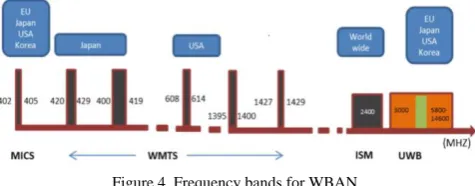
Recently IEEE-SA has published a standard for WBANs which is termed as IEEE 802.15.6 [2]. The standard defines three physical layers (PHY) and a sophisticated medium access control (MAC) protocol. More details about it are given in Chapter 3. The available frequencies for WBANs are regulated by local communication authorities in different countries. Figure 4, which is a discerned version from [13] and [3] show a short summary of some of the frequency bands available for WBAN in different countries. Medical implant communications service (MICS) band is a license db and used for implant communication and has the same frequency range (402-405 MHz) in most of the countries. Wireless medical telemetry services (WMTS) are a licensed band used for medical telemetry system. Neither MICS nor WMTS bandwidths support high data rate applications. The industrial, scientific and medical (ISM) band supports high data rate applications and is available worldwide. However, there are considerable sources of interference as many wireless devices including the ones based on IEEE802.15.1, IEEE 802.15.4 and IEEE 802.11 (WLAN) operate at ISM band.
a lot of work is needed to be done for proper implementation of IEEE 802.15.6. In the past, WBAN application architectures have been finding roots from LR-WPAN (low-rate WPAN) or IEEE 802.15.4 and from IEEE 802.15.1 (Bluetooth). Bluetooth consumes a lot of power and therefore it is replaced by the IEEE 802.15.4. However, recently Bluetooth has evolved as a technology with significantly lower power consumption, e.g., Bluetooth low energy (BLE) [15]. In near future, most probably IEEE 802.15.6 will be implemented for WBAN applications especially in healthcare and tactical military domains. The discussion above summarizes that the 802.15.6 standard will determine the dedicated signal structures for future use in WBANs. The existing standards for WBANs are 802.15.4 and its extension 802.15.4a where physical layer is UWB. In 2011, IEEE merged original 802.15.4 and various other related amendments into a single standard termed as IEEE 802.15.4-2011. [16]
Figure 4. Frequency bands for WBAN.
2.4. State-of-the-art transceiver
The choice of off-the-shelf transceiver or designing a custom transceiver for WBANs is a pivotal network design task. What kind of radio system is to select or design depends on what kind of radio enabling technology one is going to use. In the recent past, an off-the-shelf transceiver for IEEE 802.15.4 radio has been used quite a lot for sensor network applications, including WBANs [17]. It is known as CC2420, made by Texas Instruments powered by ChipCon’s Smart RF technology [18]. A lot of research has been done in this respect and various solutions for different air interfaces have emerged. State-of-the art is pacing quite quickly and a lot of innovations are being added to the IEEE 802.15.4 and 802.15.6 standards [13]. Numerous commercial solutions forIEEE802.15.4 receiver architecture are available e.g., Atmel AT86RF231 [19], Free scale MC13191 [20], Panasonic PAN4561 [21] etc. For characteristic IEEE 802.15.4 radio, both academia and industry have done exhaustive research and still this area is hot and buzzing. Such receiver architectures are discussed in literature, e.g., [14] and [22–27]. Later in 2007, an amendment was done for the IEEE 802.15.4 standard [28] and it was then called as IEEE 802.15.4a, which proposed UWB as an air interface technology (physical layer) and it proposed higher data rate, more mobility and precision ranging. Different types of UWB based receivers for IEEE 802.15.4 a are compared in [29] and [30]. Generally, a state-of-the-art receiver for WBAN applications should be robust and reliable but consume ultra-low power, hence having long battery life. It should be competent against interference; this
becomes significant property when it comes to already crowded ISM band.
Most of the literature suggests direct-conversion receiver architecture with frequency shift keying (FSK) or on-off keying (OOK) modulation schemes and to use a medium access scheme based on a duty cycled wake-up radio capable of detecting node addresses. Such a transceiver which gives an overall power budget of only 1 mW is proposed in [14]. It is realized in a nanometer complementary metal oxide semiconductor (CMOS) as a single chip, thereby reducing the size and cost. Figure 5 depicts a block diagram of a WBAN application which has a ZL70102 radio system built by ZARLINK Semiconductor TM [31]. This transceiver has a built-in wake-up radio which operates at ISM band (2.45 GHz) thus allows to transmit the wake-up at higher power and the main radio operates at MICS band (400 MHz). It is quite self-contained, completer audio system with very few external components required and consumes extremely low power.
Figure 5. A Simple WBAN using ZL.70102 transceiver system
In WBAN applications, low data rate and low transmit power are required because nodes are located on the body and are quite close to each other as compared to other WPANs. However, still significant signal attenuation can take place because different parts of human body have different dielectric constants and absorption of signal happens differently. It even varies from human to human. [32]
3. WBAN APPLICATIONS
WBAN is an emerging enabling technology with a broad range of potential applications and use cases in diverse application domains including medical, fitness and wellness management, military, safety and security, sports, social networking and entertainment. These application domains are described in [33] and are presented here as follows:
• In medical domain, a WBAN of medical sensors can be used in different scenarios, for example, sleep staging, computer-assisted physical rehabilitation, monitoring patients at home, at hospital, or anywhere.
• In fitness and wellness management, a WBAN of physical and physiological sensors can be used by health enthusiasts who wish to track their fitness and improve their well-being.
commanders not just to acquire real-time information about the location and physiological status of their soldiers while in battle fields or during extensive trainings, but also to send instructions/commands to the soldiers in real-time.
• In safety and security domain, a WBAN of wearable biosensors can be used, for instance, for monitoring fire fighters or hazardous material workers (using hazmat sensors),or for detecting chemical and biological attacks, or for automatic identification and authorization, e.g., using RFID (radio frequency identification) tags [34], etc.
• In sports domain, WBAN of physical and physiological sensors worn on the body of athletes can be used, for instance, by coaches/trainers to remotely monitor the physical activities and physiological status of the athletes during trainings/exercises or during real matches. • In social networking and entertainment domain, WBAN
can be used for exchanging digital profile or business cards, match making (hobby, interest, game, and community member), creating groups with same preferences and emotions etc.
IEEE 802.15 TG-6 [35] has proposed many designed cases and application possibilities of WBANs. Mainly those applications are divided in two types.
i) Class B: Non-Medical Applications
ii) Class A: Medical Applications Table 1 and Table 2 list IEEE proposed WBAN application possibilities as presented in [35] and [36].
Table 1. List of IEEE proposed Class B WBAN applications Class B: Non-Medical Applications
Further details about the use-cases and applications listed in Table 1 and Table 2 can be found from [35] whereas examples of non-medical applications are given in [36].
Table 2. List of IEEE proposed Class A WBAN applications
4. NETWORK ARCHITECTURE
Figure 6. MP-BodyNet full configuration.
GN has two front-ends, an IEEE 802.15.4 frontend serving as a bridge for MPBodyNet, and a WLAN front-end serving as gateway. apps are connected to GWG. SNs, CN, GN and C-app are designed and developed at CWC whereas GWG is developed at Tampere University of Technology (TUT) [88]. Hardware for the network entities is mostly developed by the WSN-Team at CWC and partly acquired from industry. Software for SN, CN, GN (gateway) is developed during the course of this thesis except GWG and GN (bridge).
Figure 7. Beyond-WBAN communication in MP-BodyNet.
5. SUMMARY
Wearable health monitoring systems or wearable human body monitoring coupled with wireless communications are the bedrock of an emerging class of sensor networks WBANs. Such networks have myriad applications, including diet monitoring, detection of activity or posture or gesture, and health crisis support etc. Recently, there has been increasing interest from researchers, system designers, and application developers on a new type of network architecture generally known as body sensor networks or WBANs, made feasible by novel advances on lightweight, small-size, ultra-low-power, and intelligent monitoring wearable sensors. In WBANs, sensors continuously monitor human’s physiological activities
and actions, such as health status and motion pattern. Generalized system architecture of a WBAN can be divided in three fundamental levels or tiers of communication namely intra-WBAN, inter-WBAN, and beyond WBAN. Various identified frequency bands available for WBANs include ISM band, MICS band, WMTS band, UWB etc. Two major classes of WBAN applications have been listed by IEEE namely, class A (medical applications) and class B (non-medical applications). Three different short-range wireless communication technologies for intra-WBAN communications can be considered as potential candidates namely IEEE 802.15.1 (Bluetooth), IEEE 802.15.4 (ZigBee) and IEEE 802.15.6. Bluetooth is not suitable in general for WBAN or WSN applications because of excessive power consumption although Bluetooth low energy is a good candidate. IEEE802.15.4 has been used mostly for WSNs and is a strong candidate for WBANs as well. IEEE 802.15.6 is the standard exclusively for WBANs. It offers three different physical layers and huge bandwidth with less power consumption. However, it is not still implemented on industry level. In this thesis, a wireless body area network named MP-BodyNet was partially implemented. The network can perform multiple applications and two modes of applications were devised, i.e., senior citizen protection mode (SPM) and silent communication mode (SCM). IEEE 802.15.4 was chosen as a communication technique for implementation. MP-Body Net has enough computational and memory resources and compact software solutions to achieve high performance and fidelity. MP-BodyNet is a self-configuring, multipurpose WBAN which can perform multiple applications and user can switch between applications by a mere push of button. It supports mobility and it acts like an agent network to other networks. MP-BodyNet forms a hierarchy where low-capability networks are supported by higher-capacity networks. Algorithm for fall detection in SPM was developed and implemented. Due to lack of time, algorithm for SCM could not be implemented. However, the proposed algorithm is presented.
REFERENCES
[1]. Chen M., Gonzalez S., Vasilakos A., Cao H. & Leung V. (2011) Body area networks: A survey. Mobile Networks and Applications 16, pp. 171–193. URL: http://dx.doi.org/10.1007/s11036-010-0260-8. [2]. Ullah S., Higgins H., Braem B., Latre B., Blondia C., Moerman I.,
Saleem S., Rahman Z. & Kwak K. (2012) A comprehensive survey of wireless body area networks. Journal of Medical Systems 36, pp. 1065– 1094. URL: http: //dx.doi.org/10.1007/s10916-010-9571-3.
[3]. Kwak K., Ullah S. & Ullah N. (2010) An overview of ieee 802.15.6 standard. In: 3rd International Symposium on Applied Sciences in Biomedical and Communication Technologies (ISABEL), pp. 1 –6. [4]. Akyildiz I., Su W., Sankarasubramaniam Y. & Cayirci E. (2002)
Wireless sensor networks: a survey. Computer Networks 38, pp. 393 – 422.URL:http://www.sciencedirect.com/science/article/pii/ S1389128 601003024.
[5]. Otto C., Milenkovic A., Sanders C. & Jovanov E. (2006) System architecture of a wireless body area sensor network for ubiquitous health monitoring. Journal of Mobile Multimedia 1, pp. 307–326. [6]. Bilstrup K. (2008) A preliminary study of wban. Technical report
IDE0854, Halmstad University.
[8]. Pentland A. (2004) Healthwear: medical technology becomes wearable. Computer 37, pp. 42 – 49.
[9]. Curtis D., Shih E., Waterman J., Guttag J., Bailey J., Stair T., Greenes R.A. & Ohno-Machado L. (2008) Physiological signal monitoring in the waiting areas of an emergency room. In: Proceedings of the ICST 3rd international conference on Body area networks, BodyNets ’08, ICST (Institute for Computer Sciences,Social Informatics and Telecommunications Engineering), ICST,Brussels, Belgium, Belgium, pp. 5:1–5:8. URL: http://dl.acm.org/citation. cfm?id=1460257. 460264. [10]. Farella E., Pieracci A., Benini L., Rocchi L. & Acquaviva A. (2008) Interfacing human and computer with wireless body area sensor networks: the wimoca solution. Multimedia Tools Appl. 38, pp. 337– 363. URL: http://dx.doi. org/10.1007/s11042-007-0189-5.
[11]. IEEE information page on Wikipedia, (site visited on 7-6-2012) URL: http://en.wikipedia.org/wiki/Institute_of_Electrical_and_Electronics_E ngineers.
[12]. Official home page for 802.15 working group of IEEE, (site visited on 8-6-2012) URL: http://www.ieee802.org/15/.
[13]. Astrin A., Li H. & Kohno R. (2009) Standardization for body area networks. IEICE Transactions on Communications E92.B, pp. 366– 372.
[14]. Sjoland H., Anderson J., Bryant C., Chandra R., Edfors O., Johansson A., Mazloum N., Meraji R., Nilsson P., Radjen D., Rodrigues J., Sherazi S. & Owall V. (2012) A receiver architecture for devices in wireless body area networks. IEEE Journal on Emerging and Selected Topics in Circuits and Systems 2, pp. 82 –95.
[15]. Bluetooth low energy, Bluetooth 4.0 with low energy technology paves the way for Bluetooth Smart devices (site visited on 7-6-2012) http://www.bluetooth.com/Pages/low-energy.aspx.
[16]. IEEE Std. 802.15.4-2011 Part 15.4: Low-Rate Wireless Personal Area Networks (LR-WPANs), 2011.
[17]. Chen G., Wang S. & Li L. (2011) The design of wireless wave height sensor network node based on zigbee technology. In: International Conference on Electric Information and Control Engineering (ICEICE), pp. 3683 –3686.
[18]. Texas Instruments. Data sheet for CC2420, A 2.4 GHz IEEE 802.15.4 / ZigBeeready RF Transceiver. URL: http://www.ti.com/lit/ds /symlink/cc2420.pdf.
[19]. Atmel Corporation. Data sheet for Atmel AT86RF231 Transceiver for IEEE 802.15.4. URL: http://www.atmel.com/Images/doc8111.pdf. [20]. Freescale Semiconductor, Inc. Data sheet for Freescale MC13191
Radio Transceiver System for IEEE 802.15.4 / ZigBEE. URL: http://cache.freescale.com/files/rf_if/doc/data_sheet/MC13191.pdf. [21]. Panasonic Inc. Data sheet for PAN4561 transceiver system for ZigBee.
URL: http://www.panasonic.com/industrial/includes/pdf/PAN4561.pdf. [22]. Scolari N. & Enz C. (2004) Digital receiver architectures for the ieee 802.15.4 standard. In: Circuits and Systems, 2004. ISCAS ’04. Proceedings of the 2004 International Symposium on, vol. 4, vol. 4, pp. IV – 345–8 Vol.4.
[23]. Choi P., Park H.C., Kim S., Park S., Nam I., Kim T.W., Park S., Shin S., Kim M.S., Kang K., Ku Y., Choi H., Park S.M. & Lee K. (2003) An experimental coin-sized radio for extremely low-power wpan (ieee 802.15.4) application at 2.4 ghz. IEEE Journal of Solid-State Circuits 38, pp. 2258 – 2268.
[24]. Kluge W., Poegel F., Roller H., Lange M., Ferchland T., Dathe L. & Eggert D. (2006) A fully integrated 2.4ghz ieee 802.15.4 compliant transceiver for zigbee applications. In: Digest of Technical Papers in IEEE International Solid-State Circuits Conference, ISSCC., pp. 1470 – 1479.
[25]. Camus M., Butaye B., Garcia L., Sie M., Pellat B. & Parra T. (2008) A 5.4 mw/0.07 mm 2.4 ghz front-end receiver in 90 nm cmos for ieee 802.15.4 wpan standard. IEEE Journal of Solid-State Circuits 43, pp. 1372 –1383.
[26]. Mahdavi S. & Abidi A. (2002) Fully integrated 2.2-mw cmos front end for a 900-mhz wireless receiver. IEEE Journal of Solid-State Circuits 37, pp. 662 –669.
[27]. SabaterJ.,GomezJ.&LopezM.(2010)Towardsanieee802.15.4sdrtranscei ver. In: IEEE International Conference on Electronics, Circuits, and Systems (ICECS), pp. 323 –326.
[28]. IEEE Std. 802.15.4a-2007, Amendment to 802.15.4-2006: Wireless Medium Access Control (MAC) and Physical Layer (PHY)
Specifications for Low-Rate Wireless Personal Area Networks (LRWPANs), 2007.
[29]. Niemelä V., Hämäläinen M., Iinatti J. & Kohno R. (2011) Ieee 802.15.4a uwb receivers’ performance in different body area network channels. In: Proceedings of the 4th International Symposium on
Applied Sciences in Biomedical and Communication Technologies, ISABEL ’11, ACM, New York, NY, USA, pp. 116:1– 116:5. URL: http://doi.acm.org/10.1145/ 2093698.2093814.
[30]. Barras D.,EllingerF., Jacke lH. & HirtW.(2006) Arobustfront-endarchitecture for low-power uwb radio transceivers. IEEE Transactions on Microwave Theory and Techniques 54, pp. 1713 – 1723.
[31]. Zarlink Semiconductor. Data sheet for ZL70102, a Medical Implantable RF Transceiver. URL: http://www.zarlink.com/ zarlink/ zl70102-shortformdatasheet.pdf.
[32]. Cotton S. & Scanlon W. (2009) An experimental investigation into the influence of user state and environment on fading characteristics in wireless body area networks at 2.45 ghz. IEEE Transactions on wireless communications 8, pp. 6–12. URL: http://doc. utwente. nl/7 6741/.
[33]. PatelM.&WangJ.(2010)Applications,challenges,andprospectiveinemerg ing body area networking technologies. Wireless Communications, IEEE 17, pp. 80 –88.
[34]. Zhang Y. (2009) RFID and Sensor Networks: Architectures, Protocols, Security and Integrations. Chapter 18, pp. 511.
[35]. Official webpage for WBAN sub-group of IEEE 802.15 group, TG6-BAN. URL: http://www.ieee802.org/15/pub/TG6.html.
[36]. IEEE, use-cases of non-medical body area network applications. URL: https://mentor.ieee.org/802.15/dcn/08/15-08-0017-00-0006-use-cases-of-nonmedical-banapplications.pdf.
[37]. IEEE Std. 802.15.1-2005, Part 15.1: Wireless Medium Access Control (MAC) and Physical Layer (PHY) Specifications for Wireless Personal Area Networks, 2005.
[38]. IEEE Std. 802.15.4-2011 Part 15.4: Low-Rate Wireless Personal Area Networks (LR-WPANs), 2011.
[39]. IEEE Std. 802.15.6-2012, Part 15.6: Wireless body area networks, 2012.
[40]. Bluetooth Special Interest Group (SIG). URL: http://www.bluetooth. org
[41]. Casio Bluetooth low energy watch has two year battery life: Wired magazine. URL: http://www.wired.com/gadgetlab/2011/03/casio-blue too thlowenergy-watch-has-two-year-battery-life/.
[42]. Siekkinen M., Hiienkari M., Nurminen J. & Nieminen J. (2012) How low energy is bluetooth low energy? comparative measurements with zigbee/802.15.4. In: IEEE Wireless Communications and Networking Conference Workshops (WCNCW), pp. 232 –237.
[43]. Bestoon T., (2009) A Wireless Body Area Network System for Monitoring Physical Activities and Health Status via Internet. Master’s Thesis. Uppsala University, Institute of Information Technology, Uppsala.
[44]. Bit A., Orehek M. & Zia W. (2010) Comparative analysis of bluetooth 3.0 with uwb and certified wireless-usb protocols. In: IEEE International Conference on Ultra-Wideband (ICUWB), vol. 2, vol. 2, pp. 1 –4.
[45]. Haartsen J. (2000) The bluetooth radio system. Personal Communications, IEEE 7, pp. 28 –36.
[46]. You L., Ding L., Wu P., Pan Z., Hu H., Song M. & Song J. (2011) Cross-layer optimization of wireless multihop networks with one-hop two-way network coding.Comput.Netw.55,pp.1747–1769.URL: http://dx.doi.org/10. 1016/j.comnet.2011.01.008.
[47]. Zaruba G., Basagni S. & Chlamtac I. (2001) Bluetrees-scatternet formation to enable bluetooth-based ad hoc networks. In: IEEE International Conference on Communications, ICC, vol. 1, vol. 1, pp. 273 –277 vol.1.
[49]. Vainio J., (2000) Bluetooth Security. In: Proceedings of Helsinki University of Technology. URL: http://www.yuuhaw.com/bluesec.pdf. [50]. IEEE Std. 802.15.4-2003, Part 15.4: Wireless Medium Access Control (MAC) and Physical Layer (PHY) Specifications for Low-Rate Wireless Personal Area Networks (LR-WPANs), 2003.
[51]. OfficialhomepageforIEEE802.15.4aworkingbody,(sitevisitedon9-10-2012) URL: www.ieee802.org/15/pub/TG4a.html.
[52]. OfficialhomepageforIEEE802.15.4bworkingbody,(sitevisitedon9-10-2012) URL: www.ieee802.org/15/pub/TG4b.html.
[53]. OfficialhomepageforIEEE802.15.4cworkingbody,(sitevisitedon9-10-2012) URL: www.ieee802.org/15/pub/TG4c.html.
[54]. OfficialhomepageforIEEE802.15.4dworkingbody,(sitevisitedon9-10-2012) URL: www.ieee802.org/15/pub/TG4d.html.
[55]. OfficialhomepageforIEEE802.15.4eworkingbody,(sitevisitedon9-10-2012) URL: www.ieee802.org/15/pub/TG4e.html.
[56]. Official home page for IEEE 802.15.4f working body, (site visited on 9-10-2012) URL: www.ieee802.org/15/pub/TG4f.html.
[57]. OfficialhomepageforIEEE802.15.4gworkingbody,(sitevisitedon9-10-2012) URL: www.ieee802.org/15/pub/TG4g.html.
[58]. Koubaa A., Alves M. & Tovar E. (2006) A comprehensive simulation study of slotted csma/ca for ieee 802.15.4 wireless sensor networks. In: Factory Communication Systems, 2006 IEEE International Workshop on, pp. 183 –192.
[59]. Davis D. & Gronemeyer S. (1980) Performance of slotted aloha random access with delay capture and randomized time of arrival. Communications, IEEE Transactions on 28, pp. 703 – 710.
[60]. Kwak K.S., Ameen M., Kwak D., Lee C. & Lee H. (2009) A study on proposed ieee 802.15 wban mac protocols. In: 9th International Symposium on Communications and Information Technology, ISCIT, pp. 834 –840.
[61]. OfficialhomepageforIEEE802workingbody,(sitevisitedon8-07-2012)URL: http://en.wikipedia.org/wiki/IEEE_802.
[62]. Hernandez M. & Kohno R. (2011) Uwb systems for body area networks in ieee 802.15.6. In: IEEE International Conference on Ultra-Wideband (ICUWB), pp. 235 –239.
[63]. Marco H., Bynam K., et al., Draft Normative Text for the UWB-PHY of TG6, IEEE 15-09-0198-01-0006, (Downloaded on 9-7-2012) URL: https:/mentor.ieee.org/802.15/documents.
[64]. Wolpaw J., Birbaumer N., McFarland D., Pfurtscheller G., Vaughan T. et al. (2002) Brain-computer interfaces for communication and control. Clinical neurophysiology 113, pp. 767–791.
[65]. Kotchetkov I., Hwang B., Appelboom G., Kellner C. & Connolly Jr E. (2010) Brain-computer interfaces: military, neurosurgical, and ethical perspective. Neurosurgical Focus 28, p. 25.
[66]. Wolpaw J. & McFarland D. (2004) Control of a two-dimensional movement signal by a noninvasive brain-computer interface in humans. Proceedings of the National Academy of Sciences of the United States of America 101, pp. 17849–17854.
[67]. Sellers E. & Donchin E. (2006) A p300-based brain–computer interface: initial tests by als patients. Clinical neurophysiology 117, pp. 538–548.
[68]. Pei X., Hill J. & Schalk G. (2012) Silent communication: Toward using brain signals. Pulse, IEEE 3, pp. 43 –46.
[69]. Estellers V. & Thiran J.P. (2012) Multi-pose lipreading and audio-visual speech recognition. EURASIP Journal on Advances in Signal Processing 2012, p. 51. URL: http://asp.eurasipjournals.com/conten t/2012/1/51.
[70]. Reports And Memorandums of the Ministry of Social Affairs and Health: The European Year for Active Ageing and Solidarity between Generations 2012, (Downloaded on 21-1-2012) URL: http://www.stm.fi/c/document_library/get_file?folderId=3320152&nam e=DLFE17207.pdf.
[71]. Sorvala A., Alasaarela E., Sorvoja H. & Myllyla R. (2012) A two-threshold fall detection algorithm for reducing false alarms. In: 6th International Symposium on Medical Information and Communication Technology (ISMICT), pp. 1 –4.
[72]. (2001) Fall-risk screening test: A prospective study on predictors for falls in community-dwelling elderly. Journal of Clinical Epidemiology 54, pp. 837 – 844.
[73]. Kangas M., Konttila A., Lindgren P., Winblad I. & Jamsa T. (2008) Comparison of low-complexity fall detection algorithms for body attached accelerometers. Gait and Posture 28, pp. 285 – 291. URL:
http://www.sciencedirect. com/ science/ article/pii/ S096663 6208 0002 6X.
[74]. Dai J., Bai X., Yang Z., Shen Z. & Xuan D. (2010) Perfalld: A pervasive fall detection system using mobile phones. In: 8th IEEE International Conference on Pervasive Computing and Communications Workshops (PERCOM Workshops), pp. 292 –297. [75]. Bourke A., Van de Ven P., Gamble M., O’Connor R., Murphy K.,
Bogan E., McQuade E., Finucane P., OLaighin G. & Nelson J. (2010) Assessment of waist-worn tri-axial accelerometer based fall-detection algorithms using continuous unsupervised activities. In: Annual International Conference of the IEEE Engineering in Medicine and Biology Society (EMBC), pp. 2782 –2785.
[76]. Liang R. & Ouhyoung M. (1998) A real-time continuous gesture recognition system for signlanguage. In: Third IEEE International Conferenceon Automatic Face and Gesture Recognition, 1998. Proceedings., IEEE, pp. 558–567.
[77]. Smith A., Sutherland A., Lemoine A. & Mcgrath S. (2000), Hand gesture recognition system and method. US Patent 6,128,003. [78]. YoonH., Soh J., Bae Y.& Seung Yang H.(2001) Hand
gesturerecognition using combined features of location, angle and velocity. Pattern Recognition 34, pp. 1491–1501.
[79]. Bretzner L., Laptev I. & Lindeberg T. (2002) Hand gesture recognition using multi-scale colour features, hierarchical models and particle filtering. In: Fifth IEEE International Conference on Automatic Face and Gesture Recognition, 2002. Proceedings., IEEE, pp. 423–428. [80]. Nickel K. & Stiefelhagen R. (2003) Pointing gesture recognition based
on 3dtracking of face, hands and head orientation. In: Proceedings of the 5th international conference on Multimodal interfaces, ACM, pp. 140–146.
[81]. Hollar S., Perng J. & Pister K. (2007) Wireless static hand gesture recognition with accelerometers-the acceleration sensing glove. Berkeley Sensor & Actuator Center, University of California, Berkeley .
[82]. Sama M., Pacella V., Farella E., Benini L. & Riccó B. (2006) 3did: a low-power, low-cost hand motion capture device. In: Proceedings of the conference on Design, automation and test in Europe: Designers’ forum, European Design and Automation Association, pp. 136–141. [83]. MäntyjärviJ.,KelaJ.,KorpipääP.&KallioS.(2004)Enablingfastandeffortl
ess customisation in accelerometer based gesture interaction. In: Proceedings of the 3rd international conference on Mobile and ubiquitous multimedia, ACM, pp. 25–31.
[84]. Kela J., Korpipää P., Mäntyjärvi J., Kallio S., Savino G., Jozzo L. & Marca D. (2006) Accelerometer-based gesture control for a design environment. Personal Ubiquitous Comput. 10, pp. 285–299. [85]. Barbieri R., Farella E., Benini L., Riccó B. & Acquaviva A. (2004) A
low-power motion capture system with integrated accelerometers [gesture recognition applications].In: First IEEE Consumer Communications and Networking Conference, CCNC, IEEE, pp. 418– 423.
[86]. LaViola J. (1999) A survey of hand posture and gesture recognition techniques and technology. Brown University, Providence, RI . [87]. Schlömer T., Poppinga B., Henze N. & Boll S. (2008) Gesture
recognition with a wii controller. In: Proceedings of the 2nd international conference on Tangible and embedded interaction, TEI’08,ACM,NewYork,NY,USA, pp.11–14.URL: http://doi.acm.org /10.1145/1347390.1347395.
[88]. WSN OpenAPI Gateway, (site visited on 23-5-2013) URL: http://www.tkt.cs.tut.fi/research/gwg/index.html.
[89]. Weicker R.P. (1984) Dhrystone: a synthetic systems programming benchmark. Commun. ACM 27, pp. 1013–1030. URL: http://doi.acm. org/ 10.1145/358274.358283.
[90]. ST Micro-electronics. Data sheet for STM32F217, Microcontroller Unit. URL: http://www.st.com/.
[91]. Analog Devices. Data sheet for ADXL435 3-axis accelerometer. URL:
http://www.analog.com/static/imported-files/data_sheets/ADXL345.pdf.
[92]. MyOnTec: Wearable sensory solutions, (site visited on 23-5-2013) URL: http://www.myontec.com/.
[93]. Friendly Arm. Data sheet for Mini6410 Single board computer (SBC). URL: http://www.friendlyarm.net/dl.php?file=mini6410_manual.zip. [94]. Serial line internet protocol, (site visited on 23-5-2013) URL:
[95]. Dunkels A., Gronvall B. & Voigt T. (2004) Contiki - a lightweight and flexible operating system for tiny networked sensors. In: 29th Annual IEEE International Conference on Local Computer Networks, pp. 455– 462.
[96]. Chen Y., Chanet J.P. & Hou K.M. (2012) RPL Routing Protocol a case study: Precision agriculture. In: First China-France Workshop on Future Computing Technology (CF-WoFUCT 2012), Harbin, Chine. URL: http://hal. archives-ouvertes.fr/hal-00681319.
[97]. Suhonen J., Kivelä O., Laukkarinen T. & Hännikäinen M. (2012) Unified service access for wireless sensor networks. In: Third International Workshop on Software Engineering for Sensor Network Applications (SESENA), pp. 49–55.
[98]. Tampere University of Technology Wireless Sensor Network, (site visited on 23-5-2013) URL: http://www.tkt.cs.tut.fi /research/daci /wia_open/TUTWSN.
[99]. Wirepas Networks Official Webpage, (site visited on 23-5-2013) URL: www.wirepas.com.
[100]. IPv6 Router Advertisement Options for DNS Configuration, (site visited on 23-5-2013) URL: http://tools.ietf.org/html/rfc6106. [101]. Analog Devices. Application Note, Using an accelerometer for
inclination sensing. URL: http://www.analog.com/static/imported-files/application_notes/AN1057.pdf.
[102]. Rabiner L. & Juang B.H. (1986) An introduction to hidden markov models. ASSP Magazine, IEEE 3, pp. 4–16.
[103]. Rabiner L. (1989) A tutorial on hidden markov models and selected applications in speech recognition. Proceedings of the IEEE 77, pp. 257–286.
[104]. Kanungo T., Mount D.M., Netanyahu N.S., Piatko C., Silverman R. & Wu A.Y. (2000)The analysis of as implek-means clustering algorithm .In: Proceedings of the sixteenth annual symposium on Computational geometry,ACM,pp.100–109.


![Figure 14 represents a pictorial manifestation of MP-BodyNet. IEEE 802.15.4 [38] has been chosen as the communication technology](https://thumb-us.123doks.com/thumbv2/123dok_us/7730674.1265589/6.595.339.523.86.368/figure-represents-pictorial-manifestation-bodynet-chosen-communication-technology.webp)