Available online: https://edupediapublications.org/journals/index.php/IJR/ P a g e | 4477
DESIGN AND SIMULATION OF FLEXIBLE MEMS INTERDIGITAL
CAPACITOR FOR ENERGY STORAGE SYSTEMS
S Sathya1, S Muruganand2 and M Pavithra1
1 Research Scholar, Department of Electronics and Instrumentation, Bharathiar University,
Coimbatore, Tamil Nadu, India.
2 Assistant Professor, Department of Electronics and Instrumentation, Bharathiar University,
Coimbatore, Tamil Nadu, India.
E-mail: [email protected], [email protected]
Abstract:
In this research work an actuation mechanism based on the micro electromechanical systems interdigital capacitor (IDC) for flexible substrate. This IDC model is one of the basic model which uses the principle of electrostatic and force can be generated for the capacitive sensors. This study carryout by overlapping movable and fixed comb fingers which produces an energy. The ZnO and Polyimide material based on the planar electrodes are analysed for different number of combs and gap between the fixed and movable combs using Finite Element Methods (FEM) techniques. Results are shown in the structural domain performance of an electrostatic actuation verses number of combs and displacement is related to change in the capacitance due to the comb fingers and calculated the capacitance in overlapping combs. Here Finite element method (FEM) is used to simulate the physics scenario and it is designed as three dimensional structure using COMSOL multiphysics domain. The prototype of MEMS interdigital capacitor suitable for micro energy storage devices.
Keywords: MEMS, Interdigital Capacitor, Electrostatic actuation, FEM and Energy storage system
1. Introduction:
Available online: https://edupediapublications.org/journals/index.php/IJR/ P a g e | 4478 electrostatic force generated by overlapping combs between the movable and fixed comb fingers. The merits of energy storage device is small size, light weight, good performance, high reliability and lower cost. The three dimensional comb fingers are used to develop the MEMS interdigital capacitor based device or systems, which can bring significant benefits from sensing to energy harvester applications.
2. Methods and Materials:
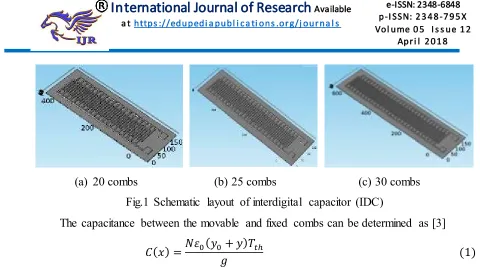
The three dimensional structure of interdigital capacitor is consists of rectangular shaped comb fingers, which one fixed combs and another one movable combs and anchor pad. The voltages are applied to the prototype structure between the overlapping combs, which displacement of movable combs towards the fixed combs, generates an electrostatic force in the direction opposites to the direction along the length of the combs. Electrostatic force is generated along the overlapping comb fingers and it produces a capacitance, therefore the total capacitance is sum of capacitance contributed by neighbouring comb
fingers [7]. The opposite walls of comb fingers in the overlapping region from a parallel plate
capacitor contributes a capacitance C. Let C1, C2 be the capacitances between the fixed comb
fingers and the movable comb fingers C1 and C2 Capacitance can be analysis of edge of the
comb fingers like as fringe capacitance. This C2 analytical estimation of fringe capacitance
Available online: https://edupediapublications.org/journals/index.php/IJR/ P a g e | 4479
(a) 20 combs (b) 25 combs (c) 30 combs Fig.1 Schematic layout of interdigital capacitor (IDC)
The capacitance between the movable and fixed combs can be determined as [3]
𝐶(𝑥) =𝑁𝜀0(𝑦0+ 𝑦)𝑇𝑡ℎ
𝑔 (1)
where, N is total number of movable comb fingers, ɛ0 is the permittivity of the free
space 8.85×10⁻¹² F/m, 𝑦
0 is overlap comb finger, y is displacement in y direction, 𝑇𝑡ℎ is
thickness of the structure layout and g is gap between the fixed and movable comb fingers on the one side.
The capacitance C is generated between overlapping comb fingers can be store the energy U is obtained as following as [3]
𝑈 =1 2𝐶𝑉
2 (2)
Table 1.Important dimension of the MEMS interdigital capacitor
S.No Part description Designed Value
1 Structure thickness Tth 5µm
2 Different number of movable combs 20, 25, 30
3 Gap (g) 5µm
4 Comb finger width (Wcomb) 5 µm
5 Comb finger length (Lcomb) 100 µm
6 Overlapping combs (y0) 70 µm
7 Anchor size width × length 35 µm ×35 µm
Available online: https://edupediapublications.org/journals/index.php/IJR/ P a g e | 4480
Fig.2 Triangle mesh with fine
This simulations of electrostatic actuation were performed for various mesh densities for the quadratic and linear elements [7 -10]. However, the density selection of the typical values are available in COMSOL Multiphysics and it is varied from the extremely coarse to extremely fine densities. Here, Fig. 2 shows the triangle mesh with fine densities.
3. Numerical Simulation:
The pre-processor can create the geometries on 3D structures are designed for 20, 25
and 30 comb fingers for using the important dimension show in table 1. ZnO material can
applied to 3D model, polyimide material for substrate and surrounded by an air medium. In order to study the characteristics of the MEMS IDC the electric potential have been varying 0V to 5V voltage.
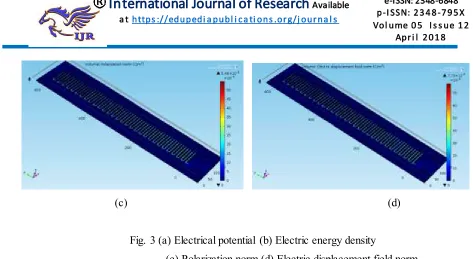
This research focuses the comb finger acts as an interdigital capacitor due to electrostatic actuation. Some energy stored in the comb fingers due to capacitive sensing. Here, the mentioned 3D view model of MEMS IDC based capacitive sensing shows in Fig. 3 (a) electric potential 5V, (b) electric energy density of the devices, (c) polarization norms on the combs and (d) overlapping combs displacement of the electric displacement field in interdigital capacitor.
Available online: https://edupediapublications.org/journals/index.php/IJR/ P a g e | 4481
(c) (d)
Fig. 3 (a) Electrical potential (b) Electric energy density
(c) Polarization norm (d) Electric displacement field norm
Fig.4 No.of Combs vs capacitance
However, the capacitance analysis of the equation 1 calculated the capacitance values, that values are gradually increase in various number of comb fingers shown in fig 4.
(a) 30 combs (b) 25 combs (c) 20 combs Fig.5 Applied voltages vs Total electric energy
Available online: https://edupediapublications.org/journals/index.php/IJR/ P a g e | 4482 capacitor is energy storage micro level devices. The study of electrostatic actuation based capacitance, electrical distribution of the comb fingers and total energy are analysed. This three dimensional IDC structure is produce the high capacitance values 30 movable combs and electric energy. The role of research work on FEM model offers accurate analysis using multiphysics domain and linear displacement. Therefore the MEMS interdigital capacitors are energy storage mechanism using COMSOL multiphysics.
Acknowledgments
Financial support from DST Inspire Fellowship (IF150425) is gratefully acknowledged. We are fruitful to our department for providing necessary facilities for the comments through discussions to carryout our research work and also we are grateful Dr.T.Shanmuganantham by Department of Electronics Engineering, Pondicherry University, Puducherry, India.
References:
[1] Tang. C.W, Nguyen.H.T, and HoweT.R, Laterally Driven Polysilicon Resonant
Microstructures, Sensors and Actuators, vol. 20, pp. 25-32, 11/15. 1989.
[2] Sathya.S, Pavithra.M and Muruganand.S, Simulation of Electrostatic Actuation in
Interdigitated Comb Drive MEMS Resonator for Energy Harvester Applications, IOP Conf. Series: Materials Science and Engineering 149, 012050, 2016.
[3] Pavithra.M, Sathya.S and Muruganand S., Design and modeling of nonlinear coupled
MEMS resonator using electrostatic actuation for L-Band mobile satellite communication, Int.J. ChemTech Res, 7.2, 678 – 684, 2015.
[4] Liu C., Foundations of MEMS, 2nd edition Pearson Education Limited, 2011.
[5] Chyuan,W-S., Computational simulation for MEMS comb drive levitation using
FEM, J. Electrostatics 66, 361–365, 2008.
[6] Guo C and Fedde G.K., A quadratic-shaped-finger comb parametric resonator
Available online: https://edupediapublications.org/journals/index.php/IJR/ P a g e | 4483
[7] Sathya.S, Pavithra.M and Muruganand.S, Simulation of nonlinear coupled
interdigitated flexible MEMS resonators in different vibrating modes, Int.J. ChemTech Res, Vol.10 No.5, pp. 948-956, 2017.
[8] Vinotha.K, Muruganand.S, Sathya.S, SenthilKumar.V, A Novel Design of
Electrostatic Actuation Based on Comb Drive MEMS Resonator using Vibrating Energy Storage Application, International Journal of Advanced Research in Computer and Communication Engineering , Vol. 5, Issue 3, Pp.1058-1062, 2016.
[9] Timpe S.J, Hook D.A, Dugger M.T and Komvopoulos K., Levitation compensation
method for dynamic electrostatic comb-drive actuators, Sensors and Actuators A, 143, 383-389, 2008.
[10] W.M.Zhang, H.Yan, Z.K.Peng, G.Meng, “Electrostatic pull-in instability