Joint DOD and DOA Estimation for Bistatic MIMO Radar without
Eigenvalue Decomposition
Hao Chen1, 2, *, Lu Gan1, Zhaohui Wu1, Xiaoming Liu1, and Jinji Ma3
Abstract—A low computational complexity direction of departure (DOD) and direction of arrival (DOA) estimation method is derived for bistatic multiple-input multiple-output (MIMO) radar. In this method, we propose a novel bistatic MIMO radar geometry with one transmit array and two subarrays at the receive array, based on which the cross-correlation matrix is constructed. The DODs and DOAs can be estimated without eigendecomposition, thereby significantly reduce computational burden. Moreover, the DODs and DOAs can be paired automatically. Simulation results verify that the proposed method holds better performance than the unitary estimation of signal parameters via rotational invariance technique and joint diagonalization direction matrix method.
1. INTRODUCTION
Multiple-input multiple-output (MIMO) radar [1–3], which simultaneously transmits orthogonal waveforms and receives reflected signals with multiple antennas, has drawn lots of attention in recent years. Due to the more degrees of freedom, MIMO radar holds better performances in detection and identification of targets. In general, MIMO radar can be classified into two types. Statistic MIMO radar [4–6], whose transmit and receive antennas are placed widely, can achieve the spatial diversity gain. The other is collocated MIMO radar [7–10], in which transmit and receive antennas are placed closely. In this paper, we focus on the bistatic MIMO radar where the antennas are placed closely.
With the development of bistatic MIMO radar technique, many algorithms for direction of departure (DOD) and direction of arrival (DOA) estimation have been proposed [11–17]. In [11], an angle estimation method based on Capon is proposed, which needs to search in two-dimensional (2-D). To reduce the computational complexity, RD-MUSIC and RD-Capon algorithms are derived in [12, 13]. On the other hand, estimation of signal parameters via rotational invariance technique (ESPRIT) is applied to direction estimation with MIMO radar in [14]. However, this method exploits the invariance property of transmit array and receive array separately, therefore requires an additional pairing of DODs and DOAs. In [15], an ESPRIT method in which the DODs and DOAs can be paired automatically is presented. By decomposing the 2-D angle estimation into 1-D estimation, a joint DOD-DOA estimation method is proposed in [16]. This method uses the ESPRIT and Root-MUSIC for DOD and DOA estimation respectively, therefore improving the estimate efficiency.
In practical viewpoint, computational accuracy and efficiency are two important topics of direction finding in a radar system. Additional pairing of DODs and DOAs increases computational burden. Recently, pairing automatically estimation methods such as Unitary ESPRIT (U-ESPRIT) [17],
Received 1 October 2018, Accepted 12 November 2018, Scheduled 1 December 2018 * Corresponding author: Hao Chen ([email protected]).
1 College of Physics and Electronic Information, Anhui Normal University, Wuhu 241002, China. 2 Department of Neuroscience,
beamspace Unitary ESPRIT (B-USPRIT) [18] and joint diagonalization direction matrix (JDDM) [19] are proposed, while complicated eigendecomposition is needed.
It is worth pointing out that most of the traditional subspace-based methods need to perform eigendecompostion. Considering other radar geometries, a computationally efficient cross-correlation based 2-D DOA estimation (CODE) method without eigendecomposition is presented for the L-shaped array in [20]. By constructing a cross-correlation matrix (CCM) between the receiver data of two uniform linear arrays (ULAs), the azimuth and elevation angles are estimated independently. However, this method does not fit for bistatic MIMO radar.
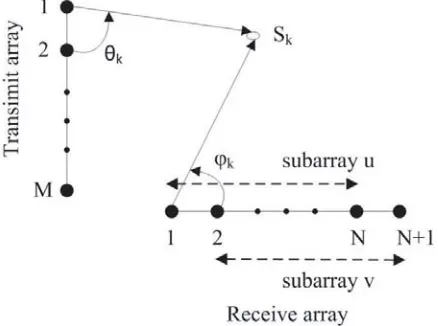
In this paper, we present a pairing automatically DODs and DOAs estimation method for bistatic MIMO radar without eigenvalue decomposition. A novel bistatic MIMO radar geometry is proposed to construct CCM from the received signal vectors of the two receive subarrays. The influence of additive noise is mitigated, and then the DODs are estimated by finding the minima of a cost function. Substituting the estimated DODs into the received signal vectors, a matrix containing the information of steering vector about DOAs is deduced. Finally, by exploiting the rotational invariance property of receive array, the DOAs are estimated. The eigendecomposition is not needed in the proposed algorithm, which can reduce the computational complexity. Additionally, the estimated DODs and DOAs can be paired automatically. Simulation results show that the proposed method holds better estimation performance than the U-ESPRIT and JDDM.
The remainder of this paper is organized as follows: the data model of the bistatic MIMO radar is introduced in Section 2. In Section 3, a novel joint DOD and DOA estimate method for MIMO radar system is proposed. The proposed method is free of eigendecomposition, and the DODs and DOAs can be paired automatically. Simulation results and performance analysis are shown in Section 3.3. Finally, Section 5 concludes the paper.
Notations: The superscripts (·)−1, (·)∗, (·)H, and (·)† represent inverse, conjugate, conjugate transpose, and pseudo-inverse, respectively. E[·],⊗,, and angle(·) denote the statistical expectation, Kronecker product, Khatri-Rao product, and phase angle operator for complex number. In addition, Ip,1p, and 0p denotep×pidentity matrix, one matrix, and zero matrix.
2. SIGNAL MODEL OF BISTATIC MIMO RADAR
Consider a bistatic MIMO narrowband radar system with K uncorrelated sources in the far field, as shown in Fig. 1. The transmit array hasM elements. The receive array has two subarraysuandv, and both have N elements. All of the arrays are ULAs, and the spacing between the adjacent elements is half-wavelength. Assume that the system simultaneously transmits M orthogonal waveforms, and the DOD and DOA of thekth target are θk andϕk(k= 1,2,· · · , K).
The output vectors after matched filters at the subarraysuandvwithlth snapshot can be expressed
as
x(l) = [u(ϕ1)⊗a(θ1),· · · ,u(ϕK)⊗a(θK)]s(l) +zx(l) (1)
y(l) = [v(ϕ1)⊗a(θ1),· · ·,v(ϕK)⊗a(θK)]s(l) +zy(l) (2)
whereu(ϕk) =1, ejπcosϕk,· · · , ej(N−1)πcosϕkT andv(ϕk) =ejπcosϕk,· · · , ejNπcosϕkT are the receive steering vectors of subarrays u and v, and a(θk) = 1, ejπcosθk,· · · , ej(M−1)πcosθkT is the transmit steering vector. The s(l) = [s1(l),s2(l),· · · ,sK(l)]T, and sk(l) = ρkej2πfkl with ρk being the reflected
coefficient andfkDoppler frequency of the target. zx(l) andzy(l) are zero mean additive white Gaussian noises with variance σ2.
Define U = [u(ϕ1),u(ϕ2),· · ·,u(ϕK)] ∈ CN×K, V = [v(ϕ1),v(ϕ2),· · ·,v(ϕK)] ∈ CN×K, and
A= [a(θ1),a(θ2),· · · ,a(θK)]∈CM×K. ForL snapshots, Eqs. (1) and (2) can be rewritten as
X = (UA)S+ZX (3)
Y = (VA)S+ZY (4)
where
X= [x(1),x(2),· · · ,x(L)]∈CNM×L Y= [y(1),y(2),· · · ,y(L)]∈CNM×L
S= [s(1),s(2),· · · ,s(L)]∈CK×L ZX = [zx(1),zx(2),· · ·,zx(L)]∈CNM×L ZY = [zy(1),zy(2),· · · ,zy(L)]∈CNM×L.
(5)
According to the geometry of MIMO radar as illustrated in Fig. 1, we can obtain
V=UΦr (6)
whereΦr= diagejπcosϕ1, ejπcosϕ2,· · · , ejπcosϕK.
3. PROPOSED ALGORITHM FOR JOINT DOD AND DOA ESTIMATION 3.1. Estimation of DODs
To construct the CCM from the received signals, we rewrite Eqs. (1) and (2) as
x(l) = [x1,x2,· · ·,xN]T (7)
y(l) = [y1,y2,· · ·,yN]T (8)
where xn ∈ C1×M and yn ∈ C1×M, n = 1,2,· · · , N. Then, the CCM about xn and yn can be constructed by
R(1)n =ExnynH=un(ϕ)ARS(vn(ϕ)A)H (9) whereRS = (1/L)SSH and vn=ejnπcosϕ. Define vector ¯y in backward way withy as
¯
y(l) = [¯y1,y¯2,· · ·,y¯N]T = [yN,· · ·y2,y1]H =JMNy(l)∗ (10)
where y¯n =
y∗(N−n)M+1,y∗(N−n)M+2,· · · ,y∗(N−n+1)M
T
and JMN ∈ CMN×MN is a counter-identity matrix. In the same way, we can get another CCM from matricesxn and ¯yn as
R(2)n =Exn¯yHn=un(ϕ)AD−ϕ(N−1)RS∗(vn(ϕ)A)H (11) where Dϕ = diagejπcosϕ1, ejπcosϕ2,· · · , ejπcosϕK . By combining the above two CCMs, we form an
extended matrix Rxy as Eq. (12). Rxy =
R(1)1 ,R(2)1 ,R(1)2 ,R(2)2 ,· · · ,R(1)N ,R(2)N
= a(θ)
u1(ϕ)RS(v1(ϕ)a(θ))H, u1(ϕ)D−ϕ(N−1)R∗S(v1(ϕ)a(θ))H,
· · ·, uN(ϕ)RS(vN(ϕ)a(θ))H, uN(ϕ)D−ϕ(N−1)RS∗(vN(ϕ)a(θ))H
AssumingK < M, we partition the transmit matrix Ainto two submatrices as A=
a1(θ)
a2(θ)
}K
}M−K (13)
wherea1(θ)∈CK×K anda2(θ)∈(M−K)×K select the firstK and lastM−K rows ofA. It was shown
in [21] that there is a linear operator PHc between a1(θ) and a2(θ)
a2(θ) =PHc a1(θ). (14)
Similarly, the CCMRxy can also be partitioned into two submatrices as
Rxy =
Rxy1
Rxy2
}K
}M−K (15)
whereRxy1 andRxy2 represent the firstK and lastM−K rows ofRxy. Therefore, the linear operator
Pc in Eq. (14) can be obtained by [22]
Pc =aH1 (θ) −1aH2 (θ) =Rxy1RHxy1 −1
Rxy1RHxy2. (16)
DefineQc= [Pc,−IM−K]T and Γc=Qc(QHc Qc)−1QHc , the DODs can be estimated by minimizing the cost function
f(θk) =aH(θk)Γca(θk). (17)
3.2. Estimation of DOAs
In order to extract the information matrix about receive steering vectors from X in Eq. (3), we define a selection matrix
J0 =IN ⊗
a(θk)
∗
. (18)
Then, the receive steering vectors can be further extracted by
bk =J0X−σ2J01MN×L=u(ϕk)sk (19)
where sk = [sk(1),sk(2),· · · ,sk(L)], and the noise covariance σ2 can be obtained from the receiver
when there is no input signal. By doing so, the influences from additive noise and transmit array are eliminated. In Eq. (19), there are only information about the receive steering vectors and transmitting signals. Furthermore, we denotes the covariance matrix ofbk as
Rk=EbkbHk=u(ϕk)RksuH(ϕk) (20) whereRks = (1/L)sksHk.
Here, the block matrix is used for estimating the DOAs. Assume that uH(ϕk) is partitioned into three parts as uH(ϕk) = uH1 (ϕk)uH2 (ϕk)uH3 (ϕk), where uH1 (ϕk) ∈ CK×K, uH2 (ϕk) ∈ CK×K, and uH3 (ϕk)∈C(N−1−2K)×K. Then, we partitionRk as
Rk=
⎡ ⎢ ⎣
∗ R12k ∗ R21
k ∗ ∗
R31k R32k ∗
⎤ ⎥
⎦ (21)
where R21k and R12k ∈ CK×K, R31k and Rk32 ∈ C(N−1−2K)×K, and [∗] is other part of Rk. According to [23], we have
Ψ1 = R32k
R21k −H =u3(ϕk)u−11(ϕk) (22)
Ψ2 = R31k R12k −H =u3(ϕk)u−21(ϕk). (23)
Define matrices O and Pas
O =
Ψ1(1 :N −2−2K, K)
Ψ2(1 :N −2−2K, K)
(24)
P =
Ψ1(2 :N −1−2K, K)
Ψ2(2 :N −1−2K, K)
where the notationG(a:b,:) is a Matlab expression which denotes a submatrix consisting of theath to thebth row of matrix G. According to the relationship between O and P, the matrixDϕ in Eq. (11) can be obtained by calculating the eigenvalue matrix of O†P. Then the DOAs can be obtained by
ϕk= arc cos
angle (Φk)
π
. (26)
where Φk denotes the kth eigenvalue of O†P.
Additional pairing match is not needed in the proposed method because the DOAs are deduced from DODs. A simple summary of the proposed method is as below.
(1) Construct two CCMs with Eqs. (9) and (11). The matrixRxy can be obtained from Eq. (12). (2) Partition the matrixRxy to estimate Γc.
(3) Estimate the DODsθk by minimizing the cost function in Eq. (17).
(4) Extract the receive steering vectors by Eq. (19) to construct the CCM with Eq. (20). (5) Partition matrixRk with Eq. (21).
(6) Obtain the estimation of DOAs with Eq. (26).
Remark: As mentioned above, the DODs and DOAs are estimated by different methods to ensure the superior accuracy and efficiency. Therefore, the estimation performances are not identical, and the DOD estimation performance is better than DOA. However, if the geometry of bistatic MIMO radar has two transmit subarrays and one receive array, the estimation performance will be reversed. This is suitable for some specific applications.
3.3. Performance Analysis
In the proposed method, the eigendecomposition and additional pairing match are not needed. The main computation complexity is estimating the CCM in Eqs. (9), (11) and (20), and calculates the orthogonal projector in Eq. (16). Assuming M, N K, the main computation flops is about 2LM2N +KLN2+ 16M3. On the other hand, in U-ESPRIT [17] and JDDM method [19], the main computational complexity is about 4LM2N2+ (MN)3 and LM2N2 + (MN)3. Therefore, compared
with the U-ESPRIT method and JDDM method, which need to implement eigendecomposition, the proposed method has a lower computational burden.
The advantages of the proposed method are summarized as follows.
(1) The estimation algorithm holds superior accuracy, because the influence of additive noise is mitigated by the two CCMs.
(2) The proposed algorithm is free of eigendecompsition. The main computational load lies in the constructing of the three CCMs, therefore has a low complexity.
(3) The estimate DODs and DOAs can be paired automatically in the algorithm.
4. SIMULATION RESULTS
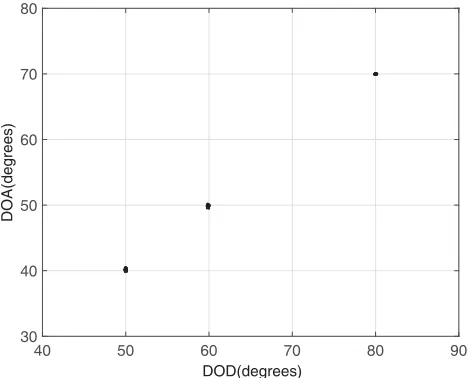
This section describes the simulation results of the proposed method in comparison with the U-ESPRIT, JDDM, and the Cramer-Rao low bound (CRLB) [24]. The CRLB is a low bound for parameter estimation error, which is usually used to measure the performance of estimation method. In the simulations, suppose that the transmit array and receive array are both have 8 elements and that three noncoherent targets are located at angles (θ1, ϕ1) = (80◦,70◦), (θ2, ϕ2) = (60◦,50◦), and
(θ3, ϕ3) = (50◦,40◦), respectively. The angle estimate performance is measured by root mean square
error (RMSE) as
RMSE =
1
KT T
t=1 K
k=1
θkt−θk 2
+ϕkt−ϕk 2
(27)
In the first test, the performance of pairing automatically between DODs and DOAs is investigated. Fig. 2 provides the estimation result of the three targets for 500 Monte Carlo trials. The SNR is 10 dB, and number of snapshots is 256. It is shown that the DODs and DOAs can be observed clearly and paired automatically.
40 50 60 70 80 90
DOD(degrees)
30 40 50 60 70 80
DOA(degrees)
Figure 2. Scatter plots of proposed method.
In the second test, the performances of U-ESPRIT, JDDM, and proposed methods are further compared. Fig. 3 illustrates the estimation performance versus the SNR with L = 50. It is indicated that the estimation performance of the proposed method is observed to outperform the U-ESPRIT and JDDM methods, and the performances of the above two methods are close at high SNR.
0 5 10 15 20 25 30
SNR(dB)
10-3 10-2 10-1 100
RMSE(degree)
Proposed U-ESPRIT [17] JDDM [19] CRLB
Figure 3. RMSE versus SNR withL= 50.
50 100 150 200 250 300 350
Snapshots
10-2 10-1 100
RMSE(degree)
Proposed U-ESPRIT [17] JDDM [19] CRLB
Figure 4. RMSE versus snapshots.
To see more clearly about the proposed algorithm, the estimation performance versus the snapshots is depicted in Fig. 4 with SNR = 5 dB. The number of snapshots vary from 50 to 350. We can observe that the estimation performances are better with the increase of snapshots, and the proposed method is superior to other two methods.
Number of array elements M=N
10-3 10-2 10-1 100
RMSE(degree)
Proposed U-ESPRIT [17] JDDM [19] CRLB
8 10 12 14 16 18 20
Figure 5. RMSE versus the elements number.
Number of array elements M=N 10-3
10-2 10-1
Run time(s)
Proposed U-ESPRIT [17] JDDM [19]
8 10 12 14 16 18 20
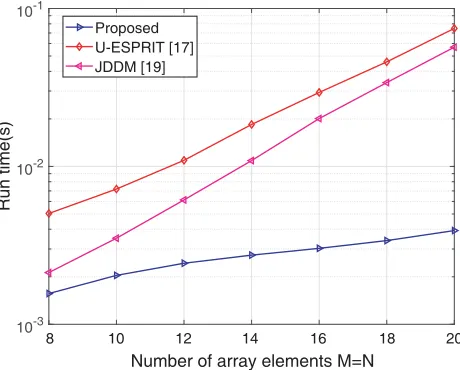
Figure 6. Run time versus the elements number.
from 8 to 20 with M =N. As shown in Fig. 5, we can obtain that the performance of the proposed method is improving with increasing of the number of array elements.
At last, we verify the efficiency of the proposed method by comparing the simulation times with the U-ESPRIT and JDDM. The SNR is fixed at 10 dB, and the number of snapshots is L = 50. The simulation times versus the number of sensor are depicted in Fig. 6. We use a PC with Intel(R) Core(TM) i5-4440 CPU @ 3.10 GHz and 8G RAM. The test is implemented in MATLAB, and the results are averaged over 500 runs. In contrast to the other two methods, the proposed method is computational efficient because it is free of eigendecomposition.
5. CONCLUSION
A low computational burden DOD and DOA estimation method for bistatic MIMO radar has been presented in this paper. In order to construct the CCM from the received data vectors, we propose a novel bistatic MIMO radar geometry, in which two subarrays are placed at the receive array. The proposed method is free of eigendecomposition and additional pairing match, which can reduce the computational load. Simulation results demonstrate that the proposed method has better performance than the U-ESPRIT and JDDM method, and the estimate angles can be paired automatically.
ACKNOWLEDGMENT
This work was supported in part by China Scholarship Council, the National Natural Science Foundation of China (Nos. 41671352 and 61871003), the Natural Science Foundation of Anhui province, China (No. 1708085QF133), and the Natural Science Program of Universities in Anhui Province (No. KJ2017A329).
REFERENCES
1. Bliss, D. W. and K. W. Forsythe, “Multiple-input multiple-output (MIMO) radar and imaging: Degrees of freedom and resolution,” Proceedings of the 37th Asilomar Conference on Signals, Systems and Computers, 54–59, 2003.
2. Fishler, E., A. Haimovich, R. Blum, D. Chizhik, L. Cimini, and R. Valenzuela, “MIMO radar: An idea whose time has come,” Proceedings of IEEE Radar Conference, 71–78, 2004.
4. Fishler, E., A. Haimovich, R. S. Blum, L. J. Cimini, D. Chizhik, and R. A. Valenzuela, “Spatial diversity in radars-models and detection performance,” IEEE Transactions on Signal Processing, Vol. 54, 823–838, 2006.
5. Haimovich, A. M., R. S. Blum, and L. J. Cimini, “MIMO radar with widely separated antennas,”
IEEE Signal Processing Magazine, Vol. 25, 116–129, 2008.
6. Chen, S. W., C. L. Meng, and A. C. Chang, “DOA and DOD estimation based on double 1-D Root-MVDR estimators for bistatic MIMO radars,”Wireless Personal Communications, Vol. 2016, No. 86, 1321–1332, 2016.
7. Chen, H., X. Zhang, Y. Bai, and J. Ma, “Direction finding for bistatic MIMO radar with non-circular sources,”Progress In Electromagnetics Research M, Vol. 66, 173–182, 2018.
8. Li, J. and P. Stoica, “MIMO radar with widely separated antennas,” IEEE Signal Processing Magazine, Vol. 24, 106–114, 2007.
9. Gorji, A. A., R. Tharmarasa, and T. Kirubarajan, “Optimal antenna allocation in MIMO radars with collocated antennas,”IEEE Transactions on Aerospace and Electronic Systems, Vol. 50, 542– 558, 2014.
10. Hassanien, A. and S. A. Vorobyov, “Transmit energy focusing for DOA estimation in MIMO radar with colocated antennas,” IEEE Transactions on Signal Processing, Vol. 59, 2669–2682, 2011. 11. Yan, H. D., J. Li, and G. S. Liao, “Multitarget identification and localization using bistatic MIMO
radar systems,”EURASIP Journal on Advances in Signal Processing, Vol. .2008, 283483, 2007. 12. Zhang, X. F., L. Y. Xu, L. Xu, and D. Z. Xu, “Direction of departure (DOD) and direction of
arrival (DOA) estimation in MIMO radar with reduced-dimension MUSIC,”IEEE Communications Letters, Vol. 14, 1161–1163, 2010.
13. Zhang, X., Y. Huang, C. Chen, J. Li, and D. Xu, “Reduced-complexity Capon for direction of arrival estimation in a monostatic multiple-input multiple-output radar,” IET Radar Sonar and Navigation, Vol. 6, 796–801, 2012.
14. Chen, D. F., B. X. Chen, and G. D. Qin, “Angle estimation using ESPRIT in MIMO radar,”
Electronics Letters, Vol. 44, 770–770, 2008.
15. Chen, J. L., H. Gu, and W. M. Su, “Angle estimation using ESPRIT without pairing in MIMO radar,”Electronics Letters, Vol. 44, 1422–1423, 2008.
16. Bencheikh, M. L. and Y. Wang, “Joint DOD-DOA estimation using combined ESPRIT-MUSIC approach in MIMO radar,”Electronics Letters, Vol. 46, 1081–1083, 2010.
17. Zheng, G. M., B. X. Chen, and M. L. Yang, “Unitary ESPRIT algorithm for bistatic MIMO radar,”
Electronics Letters, Vol. 48, 179–181, 2012.
18. Dang, X. F., B. X. Chen, M. L. Yang, and G. M. Zheng, “Beamspace unitary ESPRIT algorithm for angle estimation in bistatic MIMO radar,”International Journal of Antennas and Propagation, Vol. 621358, 1–9, 2015.
19. Xia, T. Q., “Joint diagonalization based DOD and DOA estimation for bistatic MIMO radar,”
Signal Processing, Vol. 108, 159–166, 2015.
20. Wang, G. M., J. M. Xin, N. N. Zheng, and A. Sano, “Computationally efficient subspace-based method for two-dimensional direction estimation with L-shaped array,” IEEE Transactions on Signal Processing, Vol. 59, 3197–3212, 2011.
21. Marcos, S., A. Marsal, and M. Benidir, “The propagator method for source bearing estimation,”
Signal Processing, Vol. 42, 121–138, 1995.
22. Xin, J. M. and A. Sano, “Computationally efficient subspace-based method for direction-of-arrival estimation without eigendecomposition,” IEEE Transactions on Signal Processing, Vol. 52, 876– 893, 2004.
23. Tayem, J., K. Majeed, and A. A. Hussain, “Two-dimensional DOA estimation using cross-correlation matrix with L-shaped array,”IEEE Antennas and Wireless Propagation Letters, Vol. 15, 1077–1080, 2016.