
The PADME experiment at LNF
M. Raggi1,a, V. Kozhuharov2and P. Valente3
1INFN Laboratori Nazionali di Frascati via E. Fermi 40 Frascati, Italy
2University of Sofia "St. Kl. Ohridski", Sofia, Bulgaria
3INFN Sezione di RomaI, I-00185 Roma,Italy
Abstract. Massive photon-like particles are predicted in many extensions of the Standard Model. They have interactions similar to the photon, are vector bosons, and can be produced together with photons. The PADME experiment proposes a search for the dark photon (A) in thee+e− → γA process in a positron-on-target experiment, exploiting the positron beam of the DAΦNE linac at the Laboratori Nazionali di Frascati, INFN. In one year of running a sensitivity in the relative interaction strength down to 10−6is achievable, in the mass region from 2.5 MeV<MA<22.5 MeV. The proposed experimental setup and the analysis technique is discussed.
1 Introduction
For MeV-GeV scale dark matter the direct detection tech-niques are notoriously difficult. Nevertheless some of the most appealing dark matter scenarios predict the possibil-ity of observing new particles in such a small mass range. This is the case of models in which the new states are hidden not because of their high mass but due to a very small coupling to the Standard Model. Despite attaining the highest energy ever reached at accelerators, LHC has not yet been able to provide evidence for WIMP like par-ticles, strongly constraining this class of dark matter mod-els. This largely open field of GeV-scale dark matter has recently revived models postulating the existence of a hid-den sector[1] interacting through a messenger with the vis-ible one and offers a well-motivated opportunity for exper-imental exploration. Dark sector models have been used to explain different anomalies recently observed in particles and astroparticle physics: the excess of positrons in cos-mic rays observed by PAMELA in 2008[2] and confirmed by AMS[3] and the present three sigma discrepancy be-tween experiment and theory in the muon anomalous mag-netic momentaμ=(gμ−2)/2[4].
The simplest hidden sector model just introduces one extra U(1) gauge symmetry and a corresponding gauge bo-son: the “dark photon” (DP). As in QED, this will gener-ate interactions of the types
L ∼ gq
fψ¯fγμψfUμ, (1)
wheregis the universal coupling constant of the new in-teraction andqf are the corresponding charges of the
inter-acting fermions. Not all the Standard Model particles need to be charged under this new U(1) symmetry thus leading in general to a different (and sometimes vanishing) inter-action strength for quarks and leptons. In the case of zero
aCorresponding author e-mail: [email protected]
U(1) charge of the quarks [5], the new gauge boson can be directly produced in hadron collisions or meson decays. The coupling constant and the charges can in alternative be generated effectively through the so called kinetic mix-ing mechanism between the QED and the new U(1) gauge bosons [1]. In the latter case the chargesqf in equation(1)
will be just proportional to the electric charge and the as-sociated mixing term in the QED Lagrangian will be
Lmix=−
2F
QED
μν Fdarkμν . (2)
The associated mixing coupling constant, , can be so small (< 10−3) as to preclude the discovery of the dark photon in most of the experiments carried out so far. An-other possibility is mass mixing with the Z, in which case the particle could also have Z-like properties. If the dark photon mass is smaller than twice the muon mass and no dark sector particle lighter than the DP exist, it can only decay toe+e−pairs and it is expected to be a very narrow resonance whose total decay width is given by:
ΓA= ΓA→e+e−=13α2MA
1−4me
2
M2 A
⎛ ⎜⎜⎜⎜⎝1+2me
2
M2 A
⎞ ⎟⎟⎟⎟⎠ (3)
which leads to a lifetimeτAproportional to 1/(2MA).
In this scenario many experimental constraints are avail-able and the preferred by g-2 region has been recently ruled out by NA48/2[6], in the hypothesis that the dark photon couples to quarks. In Figure 1 exclusion forA→ e+e−are shown. In the most general scenario the dark sec-tor may contain particles lighter than the dark photon it-self, thus allowing the so called "invisible" decays. The decay productχin this case are non standard model par-ticles which escape detection and all the decays to stan-dard model particles are suppressed by2and therefore the presents exclusions are weakened. There are few studies
DOI: 10.1051/ C
Owned by the authors, published by EDP Sciences, 2015 /201
epjconf 5960102
This is an Open Access article distributed under the terms of the Creative Commons Attribution License 4.0, which permits unrestricted use, distribution, and reproduction in any medium, provided the original work is properly cited.
Figure 1.Current exclusion limits and prospects forA→e+e−. Filled areas are excluded at 90% C.L. Lines represent regions accessible to future experiments. Adapted from [7].
aΜ3Σ
aΜexplained
90CL
ae3
Σ
ae2 Σ
ae95
5 10 50 100 500 1000
1107
5107
1106
5106
1105
5105
1104
mdark photon MeV
2
Figure 2.Model independent bounds forA→χχ[8].
on the searches of aAnot decaying into Standard model particles. The exclusions however are in general model dependent or introduce additional parameters, namely the dark matter mass and coupling Mχ and αD[9].
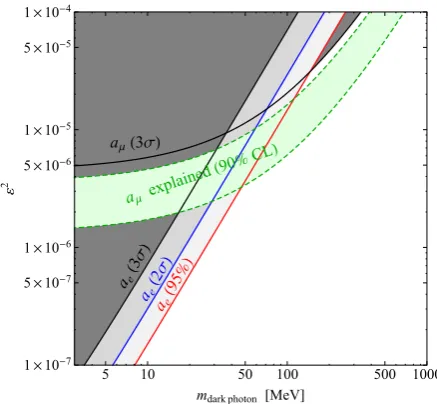
With-out making further assumptions abWith-out dark sector particle masses or coupling-constants, this parameter space is only constrained by (g−2)e, and (g−2)μ[10] as shown in Figure
2 [8].
2 The PADME experiment
All the dark photon searches performed so far were based on the hypothesis that the dark sector does not contain any particle of mass lower than that of the dark photon. After the recent improvement on the limits in the visible decay sector a new interest for invisible decays has grown in both theoretical [10] experimental side [11].
The Positron Annihilation into Dark Matter Experi-ment (PADME) aims to search for the production of a dark photon in the process
e+e−→Aγ, (4)
where the positrons are the beam particles ande−are the electrons in the target. The PADME experiment uses the 550 MeV positron beam provided by the DAΦNE linac impinging on a thin target.
2.1 TheDAΦNEBeam Test Facility
The DAΦNE beam-test facility (BTF)[12], is a beam transfer-line from the DAΦNE linac capable of provid-ing up to 50 bunches per second of electrons or positrons with 800/550 MeV maximum energy with a variable bunch width from 1.5-40 ns. Each bunch consists of mi-crobunches with total length of 350 ps with 140 ps flat top. The typical emittance of the electron/positron beam is of 1(1.5)mm*mrad. The BTF can operate from single particle up to 109 particle per bunch. An energy upgrade
of the linac is foreseen within the next three years, bring-ing the maximum energy for electrons/positrons to about 1050/800 MeV together with a bunch width enlarged to 100ns. The sensitivity estimate for the PADME experi-ment assume that theDAΦNElinac will be able to provide 50 bunches/s of 40 ns duration with 104−105positrons in
each. The present maximum positron energy of 550 MeV is assumed. In these conditions a sample of 1013 −1014 positrons on target can be obtained in one year of data tak-ing.
2.2 The PADME detector
The PADME detector is a small scale detector composed of the following parts:
• Diamond Active target (50μm), to measure the average position, with mm resolution, and the intensity of the beam in each single bunch
• Spectrometer, to measure the charged particle mo-menta in the range 50-400 MeV
• Dipole magnet, to deflect the primary positron beam out of the spectrometer and calorimeter and to allow mo-mentum analysis.
• Vacuum chamber, to minimize the unwanted interac-tions of primary and secondary particles.
"!! %%
"% #!
"&%
$!
γ
PADME
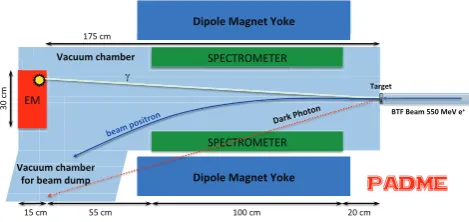
Figure 3.Schematic of the Positron Annihilation into Dark Mat-ter Experiment (PADME).
A schematic view of the experimental apparatus is shown in Figure 3. Details can be found in [13]. The primary
beam crosses the 50 μm diamond target and if a beam
particle does not interact it is bent by the magnet in be-tween the end of the spectrometer and the calorimeter, thus leaving the experiment undetected. If any kind of interac-tion causes the positron to lose more than 50 MeV of en-ergy the magnet bends it into the spectrometer acceptance, providing the veto capability against bremsstrahlung back-ground. In case of annihilation the accompanying SM pho-ton is detected by the electromagnetic calorimeter
regard-less of theAdecay products. A single kinematic variable
characterizing the process, the missing mass, is computed using the formula:
Mmiss2 =(Pe−+Pbeam−Pγ)2. (5)
Its distribution should peak atM2
A for Adecays, at zero
for the concurrent e+e− → γγ process, and should be
smooth for the remaining background. The PADME ex-periment is equipped with a calorimeter and a magnetic spectrometer and it is sensitive to both visible and
invisi-ble dark photon decays. In fact if theAdecays intoe+e−,
the tracks are deflected into the spectrometer and their in-variant mass can be computed.
The possibleAproduction mechanisms accessible in
e+-on-target collisions are e+e− → Aγ and e+N →
e+NA, the so called annihilation andA-strahlung
produc-tion. Both process are similar to the ones for ordinary
pho-tons, and their cross section scales with2. The PADME
experiment can access four different type of dark photon
searches by combining production processes and decay fi-nal states:
• Annihilation produced dark photons decaying into
in-visible particles
• Annihilation produced dark photons decaying intoe+e−
pairs.
• Bremsstrahlung produced dark photons decaying into
invisible particles
• Bremsstrahlung produced dark photons decaying into
e+e−pairs.
The present linac maximum positron energy of 550 MeV allows the production of dark photons through annihilation
up to a mass of 23.7 MeV, while masses up to 600 MeV
can be reached by DP produced byA-strahlung using the
800 MeV electron beams. At present detailed study have been performed only for annihilation production to asses the sensitivity to invisible decays. Studies on the other fi-nal states are ongoing. In case of annihilation production
theAcoupling constantcan be determined by
normaliz-ing the number of observed dark photon candidates to the
Standard Model processe+e−→γγusing the formula:
σ(e+e−→Aγ)
σ(e+e−→γγ) =
N(Aγ) N(γγ) ∗
Acc(γγ) Acc(Aγ) =
2∗δ, (6)
whereN(Aγ)=N(Aγ)obs−N(Aγ)bkgis the number
of the signal candidates after the background subtraction,
N(γγ) is the number of observed annihilation events,δis
the (e+e− → Aγ)/(e+e− → γγ) cross section
enhance-ment factor, andAcc(γγ) andAcc(Aγ) are the
correspond-ing Montecarlo acceptances for the signal and normaliza-tion channels.
2.3 Montecarlo simulation
To study the sensitivity of the PADME experiment to the dark photon, a GEANT4 simulation has been developed. The simulation describes in detail the segmentation of the calorimeter and simulates showers to produces energy de-posits for each single crystal. A cluster reconstruction al-gorithm providing energy and position was implemented, starting from the energy deposits in each of the calorime-ter crystals. The magnetic field is considered to be uniform and transverse to the beam direction. The spectrometer is modeled as an active volume from which the energy of the crossing particles is retrieved without any reconstruction. The simulation does not include any passive material and does not simulate the dumping of the primary beam. To describe the bunch structure, a simultaneous multi positron gun was implemented, taking into account beam spot size and energy spread in each single burst. The simulation includes backgrounds simulated by GEANT4 low-energy electromagnetic libraries, two photon annihilation, ioniza-tion processes, Bhabha and Moller scattering, and
produc-tion of δ-rays. A custom generator to simulate the
pro-duction of the dark photon and its decays intoe+e−or
in-visible, and the three photon annihilation was developed. A simple and preliminary selection aiming to address the possibility of performing a model independent search for
aAhas been developed. The selection of DP candidates
is based on the missing mass squared variable, calculated according to formula (5). The signal region is defined as ±1.5σM2
miss around the reconstructed value ofM
2
A, with a
proper resolution depending on the considered mass. It is applied both the events with visible and invisible dark photon decays. Since the background estimation does not
depend on theAdecay channel the only difference is the
acceptance for the two cases. With this selection, an
(MeV) 2 miss M -300 -200 -100 0 100 200 300 400 500 600
2
Events/5 MeV
1 10 2 10
3 10
4
10 2 no cuts
miss
M
cuts
2 miss
M no cuts
2 miss
M
cuts
2 miss
M
Figure 4.M2
missfor background events. In red with no selection
cuts in blue after all cuts applied.
A' Mass [MeV]
2 4 6 8 10 12 14 16 18 20
Number of background events
0 50 100 150 200 250 300
350 Total
γ γ γ →
-e
+
e
Figure 5. Number of background events for differentAmass hypothesis. In rede+e−→γγin blue total background after all cuts applied.
2.4 Background estimates
The PADME sensitivity to the invisible decay of the DP is limited by the single-photon background originating
from three main contributions: bremsstrahlung, 2γ
an-nihilation, and 3γ annihilation. Other background
pro-cesses like Bhabha scattering and pile-up of annihilation events are included in the background estimation through the GEANT4 simulation of the interactions of the primary positron beam. Double annihilation events contain extra
clusters and due to energy/angle relation are additionally
suppressed with respect to single ones. Figure 4 shows the M2
missdistribution of the simulated background events
be-fore (red) and after (blue) the DP selection. The
annihila-tion background peaks atM2
miss=0 the bremsstrahlung is
located in the region of highM2
missvalues while the
three-photon background populates the entire region.
2.5 Sensitivity estimate
With the described experimental setup and simulation
technique 1011 positrons on target were generated (107
events each with 104 positron and 108 events each with
103positron) in order to study the effect of pile up events.
(MeV) A' M
2 4 6 8 10 12 14 16 18 20
68% CL
2
∈
-8 10
-7 10
-6 10
-5 10
-4 10
-e + e
→
U
invisible
→
U
Figure 6.Expected exclusion limits in the−MAplane in case
of no signal[13].
Figure 7. Expected exclusions in the invisible channel com-pared with the band of values preferred by current gμ − 2
discrepancies[13].
In addition, samples of 1000 events were generated forA
masses 2.5, 5, 7.5, 10, 12.5, 15, 17.5, 20 MeV, with a
sin-gle A. The background was further scaled by a constant
factor of 400 to account for one year of running of the
ex-periment with 60% efficiency, 4·104positrons per bunch,
corresponding to a total of 4·1013 positrons on target.
The total number of annihilation events (N(γγ)/Acc(γγ)),
which are used for normalization, can be determined in two independent ways. The first is to exploit the active target for the measurement of the beam flux and use the
known value ofσe+e−→γγ. Alternatively, direct
reconstruc-tion of the e+e− → γγ annihilation events can be
per-formed. Under the assumption of no signal, an upper limit
on the coupling can be set, using the statistical
uncer-tainty on the background as N(Aγ) in equation 6. The
selec-tion inclusive of both cases. PADME sensitivity to visible DP decays generated byAstrahlung is under investigation together the the possibility of a dedicated beam dump ex-periment with 1020EOT[14]. In this case the spectrometer
is employed to reconstruct invariant mass of the detected
e+e−pairs coming from DP decays. Mass up toMA ∼100
MeV can be explored with this alternative technique.
2.6 Conclusion
The PADME experiment aims to search for MeV scale dark matter by its decay into electrons or by detecting missing mass in low energye+on target collision. In par-ticular PADME will be sensitive to any new small mass particle produced ine+e− collisions regardless of its de-cay mode and life time. Dark photons, low mass dark Higgs[15] or leptonic gauge bosons[16] models can be ex-plored. In addition the new-physics interpretation of any positive signal would be greatly simplified by the kinemat-ical informations provided by the PADME detector. Mass of the new particle and its coupling to electrons can be immediately measured. Early studies applied to dark pho-ton invisible decay modes demonstrated that PADME can reach a sensitivity down to the level of2 ∼ 1·10−6 in
the mass range 2.5<MA<22.5 MeV. Being limited in the
explorable mass region by the BTF positron beam energy, the PADME experiment will strongly profit by an energy upgrade of the existing DAΦNE linac as proposed in[17].
References
[1] B. Holdom, Phys. Lett. B166, 196 (1986)
P. Galison and A. Manohar, Phys. Lett. B 136, 279 (1984).
[2] O. Adrianiet al.[PAMELA Collaboration], Nature
458, 607 (2009).
[3] M. Aguilaret al.[AMS Collaboration], Phys. Rev. Lett.110, 141102 (2013).
[4] J. Beringeret al.[Particle Data Group], Phys. Rev. D86, 010001 (2012).
[5] P. Fayet, Phys. Lett. B675, 267 (2009).
[6] E. Goudzovki on behalf of the NA48/2 collabora-tion, "Search for the dark photon in π0 decays by
the NA48/2 experiment at CERN" Contribution to the same conference proceedings to be published in EPJ
[7] D. Curtin, R. Essig, S. Gori and J. Shelton, arXiv:1412.0018 [hep-ph].
[8] H. Davoudiasl, H. S. Lee and W. J. Marciano, Phys. Rev. D 89, 095006 (2014) [arXiv:1402.3620 [hep-ph]].
[9] B. Batell, R. Essig and Z. Surujon, Phys. Rev. Lett.
113, no. 17, 171802 (2014) [arXiv:1406.2698 [hep-ph]].
[10] E. Izaguirre, G. Krnjaic, P. Schuster and N. Toro, arXiv:1411.1404 [hep-ph].
[11] M. Battaglieri et al. [BDX Collaboration], arXiv:1406.3028
[12] A. Ghigo, G. Mazzitelli, F. Sannibale, P. Valente and G. Vignola, Nucl. Instrum. Meth. A515, 524 (2003). [13] M. Raggi and V. Kozhuharov, Adv. High Energy
Phys.2014, 959802 (2014)
[14] M. Raggi, PADME dump, What Next LNF, Frascati 10-11 November 2014.
[15] B. Batell, M. Pospelov and A. Ritz, Phys. Rev. D79, 115008 (2009)
[16] H. S. Lee, Phys. Rev. D90, 091702 (2014)
![Figure 6. Expected exclusion limits in the ϵ − MA′ plane in caseof no signal[13].](https://thumb-us.123doks.com/thumbv2/123dok_us/8172845.1364744/4.595.310.534.264.484/figure-expected-exclusion-limits-ma-plane-caseof-signal.webp)
