Evaluating Contextual Dependency of Paraphrases
using a Latent Variable Model
Kiyonroi OHTAKE
Spoken Language Communication Research Laboratories Advanced Telecommunications Research Institute International
Kyoto 619-0288 Japan
kiyonori.ohtake + @atr.jp
Abstract
This paper presents an evaluation method employing a latent variable model for paraphrases with their con-texts. We assume that the context of a sentence is indicated by a latent vari-able of the model as a topic and that the likelihood of each variable can be inferred. A paraphrase is evaluated for whether its sentences are used in the same context. Experimental re-sults showed that the proposed method achieves almost 60% accuracy and that there is not a large performance differ-ence between the two models. The re-sults also revealed an upper bound of accuracy of 77% with the method when using only topic information.
1 Introduction
This paper proposes a method to evaluate whether a paraphrasing pair is contextually independent. Evaluating a paraphrasing pair is important when we extract paraphrases from a corpus or apply a paraphrase to a sentence, since we must guarantee that the paraphrase carries almost the same mean-ing. However, the meaning carried by a sentence is affected by its context. Thus, we focus on the contextual dependency of paraphrases.
A thing can be expressed by various expres-sions, and a single idea can be paraphrased in many ways to enrich its expression or to increase understanding. Paraphrasing plays a very impor-tant role in natural language expressions.
How-ever, it is very hard for machines to handle differ-ent expressions that carry the same meaning.
The importance of paraphrasing has been widely acknowledged, and many paraphrasing studies have been carried out. Using only sur-face similarity is insufficient for evaluating para-phrases because there are not only surface dif-ferences but many other kinds of difdif-ferences be-tween paraphrased sentences. Thus, it is not easy to evaluate whether two sentences carry almost the same meaning.
Some studies have constructed and evaluated hand-made rules (Takahashi et al., 2001; Ohtake and Yamamoto, 2001). Others have tried to extract paraphrases from corpora (Barzilay and McKeown, 2001; Lin and Pantel, 2001), which are very useful because they enable us to struct paraphrasing rules. In addition, we can con-struct an example-based or a Statistical Machine Translation (SMT)-like paraphrasing system that utilizes paraphrasing examples. Thus, collect-ing paraphrased examples must be continued to achieve high-performance paraphrasing systems.
Several methods of acquiring paraphrases have been proposed (Barzilay and McKeown, 2001; Shimohata and Sumita, 2002; Yamamoto, 2002). Some use parallel corpora as resources to obtain paraphrases, which seems a promising way to ex-tract high-quality paraphrases.
con-textually dependent paraphrases is a serious prob-lem, and thus there is a specific paraphrase direc-tion for each pair. In addidirec-tion, it is also important to evaluate a paraphrasing pair not only when ex-tracting but also when applying a paraphrase.
Consider this example, automatically extracted from a corpus: Can I pay by traveler’s check? /Do you take traveler’s checks? This example seems contextually independent. On the other hand, here is another example: I want to buy a pair of sandals. /I’m looking for sandals. This example seems to be contextually dependent, be-cause we don’t know whether the speaker is only looking for a single pair of sandals. In some con-texts, the latter sentence means that the speaker is seeking or searching for sandals. In other words, the former sentence carries specific meaning, but the latter carries generic meaning. Thus, the para-phrasing sentences are contextually dependent, and although the paraphrasing direction from spe-cific to generic might be acceptable, the opposite direction may not be.
We can solve part of this problem by inferring the contexts of the paraphrasing sentences. A text model with latent variables can be used to infer the topic of a text, since latent variables corre-spond to the topics indicated by texts. We as-sume that a topic indicated by a latent variable of a text model can be used as an approximation of context. Needless to say, however, such an ap-proximation is very rough, and a more complex model or more powerful approach must be devel-oped to achieve performances that match human judgement in evaluating paraphrases.
The final goal of this study is the evaluation of paraphrasing pairs based on the following two factors: contextual dependency and paraphras-ing direction. In this paper, however, as a first step to evaluate paraphrasing pairs, we focus on the evaluation of contextual dependency by us-ing probabilistic Latent Semantic Indexus-ing (pLSI) (Hofmann, 1999) and Latent Dirichlet Allocation (LDA) (Blei et al., 2003) as text models with la-tent variables.
2 Latent Variable Models and Topic Inference
In this section, we introduce two latent variable models, pLSI and LDA, and also explain how to
infer a topic with the models.
In addition to pLSI and LDA, there are other la-tent variable models such as mixture of unigrams. We used pLSI and LDA because Blei et al. have already demonstrated that LDA outperforms mix-ture of unigrams and pLSI (Blei et al., 2003), and a toolkit has been developed for each model.
From a practical viewpoint, we want to deter-mine how much performance difference exists be-tween pLSI and LDA through evaluations of con-textual paraphrase dependency. The time com-plexity required to infer a topic by LDA is larger than that by pLSI, and thus it is valuable to know the performance difference.
2.1 Probabilistic LSI
PLSI is a latent variable model for general co-occurrence data that associates an unobserved topic variablez ∈ Z = {z1,· · ·, zK} with each
observation, i.e., with each occurrence of word w ∈ W ={w1,· · ·, wM}in documentd∈ D = {d1,· · ·dN}.
PLSI gives joint probability for a word and a document as follows:
However, to infer a topic indicated by a docu-ment, we have to obtainP(z|d). From (Hofmann, 1999), we can derive the following formulas:
P(z|d, w) ∝P(z)P(d|z)P(w|z) (3)
and
P(d|z)∝X w
n(d, w)P(z|d, w), (4)
where n(d, w) denotes term frequency, which is the number of times w occurs in d. Assuming thatP(d|z) =Q
by given documentd =w1,· · ·, wM(d)with For-mula 5. A topicz that maximizes Formula 5 is inferred as the topic of documentd.
2.2 Latent Dirichlet Allocation
Latent Dirichlet Allocation (LDA) is a generative probabilistic model of a corpus. The basic idea is that documents are represented as random mix-tures over latent topics, where each topic is char-acterized by a distribution over words.
LDA gives us the marginal distribution of a document (p(d|α, β), d = (w1, w2,· · ·wN)) by
where α parameterizes Dirichlet random vari-able θ and β parameterizes the word probabili-ties, andznindicates a topic variablezn ∈ Z = {z1, z2,· · ·, zN}. To obtain the probability of a
corpus, we take the product of the marginal prob-abilities of single documents.
Here, we omit the details of parameter estima-tion and the inference of LDA due to space lim-itations. However, the important point is that the Dirichlet parameters used to infer the probability of a document can be seen as providing a repre-sentation of the document in the topic simplex. In other words, these parameters indicate a point in the topic simplex. Thus, in this paper, we use the largest elements of the parameters to infer the topic (as an approximation of context) to which a given text belongs.
3 Evaluating Paraphrases with Latent Variable Models
To evaluate a paraphrasing pair of sentences, we must prepare a learning corpus for constructing latent variable models. It must be organized so that it consist of documents, and each document must be implicated in a specific context.
Both latent variable models pLSI and LDA re-quire vector format data for their learning. In this paper, we follow the bag-of-words approach and prepare vector data that consist of words and their frequency for each document in the learning cor-pus.
After constructing the pLSI and LDA models, we can infer a topic by using the models with vec-tor data that correspond to a target sentence.The vector data for the target sentence are constructed by using the target sentence and the sentences that surround it. From these sentences, the vector data that correspond to the target sentence are con-structed. We call the number of sentences used to construct vector data “window size.”
Evaluating a paraphrasing pair (P1:P2) is simple. Construct vector data (vec(P1) and vec(P2)) and infer contexts (T(P1)andT(P2)) by using a latent variable model. Using pLSI, the topic that indicates the highest probability is used as the inferred result, and using LDA, the largest parameter that corresponds to the topic is used as the inferred result. If topics T(P1) and T(P2)
are different, the sentences might be used in dif-ferent contexts, and the paraphrasing pair would be contextually dependent; otherwise, the para-phrasing pair would be contextually independent.
4 Experiments
We carried out several experiments that automati-cally evaluated extracted paraphrases with pLSI and LDA. To carry out these experiments, we used plsi-0.031 by Kudo for pLSI and lda-c2 toolkit by Blei (Blei et al., 2003) for LDA.
4.1 Data set
We used a bilingual corpus of travel conversation containing Japanese sentences and correspond-ing English translations (Takezawa et al., 2002). Since the translations were made sentence by sen-tence, this corpus was sentence-aligned from its origin and consisted of 162,000 sentence pairs.
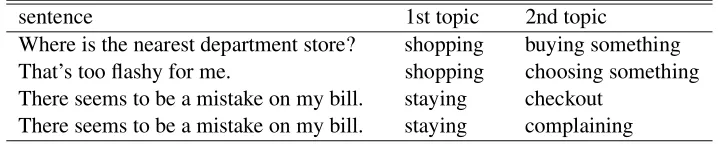
The corpus was manually and roughly anno-tated with topics. Each topic had a two-level hierarchical structure whose first level consisted of 19 topics. Each first-level topic had several subtopics. The second level consisted of 218 top-ics, after expanding all subtopics of each topic in the first level. A rough annotation example is shown in Table 1; the hierarchical structure of this topic seems unorganized. For example, in the first-level topic, there are topics labeledbasicand communication, which seem to overlap.
Table 1: Examples of manually annotated topics
sentence 1st topic 2nd topic
Where is the nearest department store? shopping buying something That’s too flashy for me. shopping choosing something There seems to be a mistake on my bill. staying checkout
There seems to be a mistake on my bill. staying complaining
In the corpus, however, there is an obvious textual cohesion such that sentences of the same topic are locally gathered. Each series of sen-tences can be used as a document for a text model. Under the assumption that each series of tences is a document, the average number of sen-tences included in a document is 18.7, and the av-erage number of words included in a document is 44.9.
4.2 Extracting paraphrases
A large collection of parallel texts contains many sentences in one language that correspond to the same expression in the other language for translation. For example, if Japanese sentences Ji1, ..., Jim correspond to English sentence Ei,
then these Japanese sentences would be para-phrases.
We utilized a very simple method to extract Japanese paraphrases from the corpus. First, we extracted duplicate English sentences by exact matching. From the learning set, 18,505 sen-tences were extracted. Second, we collected Japanese sentences that correspond to each ex-tracted English sentence. Next, we obtained sets of Japanese sentences collected by using English sentences as pivots. In the corpus, one English sentence averaged almost 4.5 Japanese sentences, but this number included duplicate sentences. If duplicate sentences are excluded, the average number of Japanese sentences corresponding to an English sentence becomes 2.4. Finally, we obtained 944,547 Japanese paraphrasing pairs by combining sentences in each group of Japanese sentences.
4.3 Comparing human judgement and inference by latent variable models
In this section, we determine the difference be-tween manually annotated topics and inference
results using pLSI and LDA. We originally con-sidered evaluating each paraphrase as a binary classification problem that determines whether both sentences of the paraphrase are used in the same context. We evaluated the inferred results by comparison with the manually annotated top-ics, and thus accuracy could be calculated when the manually annotated topics were correct. How-ever, accuracy is inappropriate for evaluating re-sults inferred by a latent variable model, since the topics were roughly annotated by humans as men-tioned in Section 4.1. Accordingly, we employed Kappa statistics as a rough guide for the correct-ness of the inferred results by latent variable mod-els.
Tables 2 and 3 show the comparison results, where the window size is 11 (the target sentence + the previous five and the following five sen-tences). When constructing pLSI models, the pa-rameter for tempered EM (TEM) is set to 0.9 (we use this value in all of the experiments in this pa-per), because it showed the best performance in preliminary experiments. We performed the ex-periments on several topics.
Table 2: Comparing results of first-level topic (19)
# of topics κby pLSI κby LDA
10 0.4812 0.4798
20 0.5085 0.5185
30 0.5087 0.5094
40 0.5392 0.5245
50 0.5185 0.4897
window size = 11
con-Table 3: Comparing results of second-level topic (218)
# of topicss κby pLSI κby LDA
30 0.3523 0.3883
40 0.3663 0.4093
50 0.4122 0.4111
60 0.4184 0.4186
70 0.4196 0.4133
80 0.3665 0.3702
90 0.3437 0.3596
100 0.3076 0.3526
window size = 11
ducted comparison experiments for the first- and second-level topics, as shown in Tables 4 and 5. The threshold values used to judge whether topics are the same are indicated in the parentheses.
Table 4: Comparing results of first-level topic (19) with cosine metric
# of topics κby pLSI κby LDA 10 0.4873(0.5) 0.5042(0.5) 20 0.5230(10−6) 0.5841(0.5) 30 0.5502(10−6) 0.5672(0.5) 40 0.5808(10−6) 0.5871(0.5) 50 0.5611(10−6
) 0.5573(0.5) window size = 11
Table 5: Comparing results of second-level topic (218) with cosine metric
# of topics κby pLSI κby LDA 30 0.3536(0.5) 0.3726(0.5) 40 0.3679(0.5) 0.4006(0.5) 50 0.4127(0.5) 0.4085(0.5) 60 0.4186(0.5) 0.4218(0.5) 70 0.4202(0.5) 0.4202(0.5) 80 0.3733(0.5) 5.2∗10−7(0.5)
window size = 11
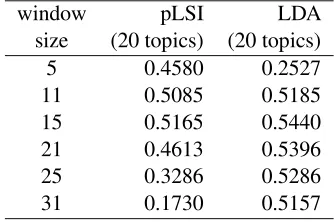
We also performed an experiment to confirm the relationship between Kappa statistics and window-size context. Experiments were done un-der the following conditions: the number of topics was 20 for both pLSI and LDA, Kappa statistics were calculated for the first-level topic, and win-dow sizes were 5, 11, 15, 21, 25, and 31. Table 6
Table 6: Window size and Kappa statistics for first-level annotation
window pLSI LDA
size (20 topics) (20 topics)
5 0.4580 0.2527
11 0.5085 0.5185
15 0.5165 0.5440
21 0.4613 0.5396
25 0.3286 0.5286
31 0.1730 0.5157
shows the experimental results.
The actual computing time needed to evaluate 944,547 paraphrases with a Pentium M 1.4-GHz, 1-GB memory computer is shown in Table 7. It is important to note that the inference program for pLSI was written in Perl, but for LDA it was writ-ten in C.
Table 7: Computing time to evaluate paraphrases
# of topics pLSI LDA
20 665 sec. 996 sec.
60 1411 sec. 2223 sec. window size = 15
4.4 Experiments from paraphrasing perspectives
To investigate the upper bound of our method, we carried out several experiments. So far in this pa-per, we have discussed topic information as an approximation of contextual information by com-paring topics annotated by humans and automati-cally inferred by pLSI and LDA. However, since our goal is to evaluate paraphrases, we need to determine whether latent variable models detect a difference of topics for sentences of paraphrases.
First, we randomly selected 1% of the English seed sentences. Each sentence corresponds to several Japanese sentences, so we could produce Japanese paraphrasing pairs. The number of se-lected English sentences was 185.
places in the corpus. From a paraphrasing per-spective, such pairs are useless. Thus we removed them and randomly selected one pair from one English seed sentence.
Finally, we sampled 117 paraphrasing pairs and evaluated them based on a paraphrasing per-spective: whether a paraphrase is contextually independent. There were 71 contextually inde-pendent paraphrases and 37 contextually depen-dent paraphrases. Nine paraphrases had prob-lems, all of which were caused by translation er-rors. The phrase “contextually independent para-phrases” means that the paraphrases can be used in any context and can be applied as two-way paraphrases. On the other hand, “contextually de-pendent paraphrases” means that the paraphrases are one-way, and so we have to give consideration to the direction of each paraphrase.
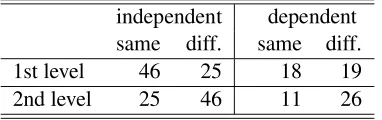
Table 8: Evaluation with manually annotated la-bels
independent dependent same diff. same diff.
1st level 46 25 18 19
2nd level 25 46 11 26
We removed the nine problematic paraphras-ing pairs and evaluated the remainparaphras-ing samples with manually annotated topic labels, as shown in Table 8. According to the basic idea of this method, a contextually independent paraphras-ing pair should be judged as havparaphras-ing the same topic, and a contextually dependent pair should be judged as having a different topic. Thus, we introduced a criterion to evaluate labeling results in terms of an error rate, defined as follows:
Error rate= |Dindep|+|Sdep|
#of judged pairs, (7)
whereDindepdenotes a set that consists of
para-phrasing pairs that are judged as having differ-ent topics but are contextually independdiffer-ent. On the other hand,Sdepdenotes a set that consists of
paraphrasing pairs that are judged as having the same topic, but are contextually dependent.
For example, from the results in Table 8, the error rate of the results for the first-level topic is 0.398 ((25 + 18)/108), and that for the second-level topic is 0.528 ((46 + 11)/108).
To estimate the upper bound of this method, we also investigated potentially unavoidable errors. Several paraphrasing pairs are used for the exact same topic, but they seem contextually dependent because several words are different. On the other hand, some paraphrasing pairs seem to be used in obviously different topics but are contextually independent. Table 9 shows the investigation re-sults; at least ten paraphrasing pairs seem contex-tually independent but are accontex-tually used in differ-ent topics. In addition, there are at least 15 para-phrasing pairs whose topic is obviously the same, but several differences of words make them con-textually dependent. Moreover, in this case, the error rate is 0.231 ((15+10)/108), meaning that it is difficult to judge all of the paraphrasing pairs correctly by using only topic (contextual) infor-mation. Thus, this method’s upper bound of ac-curacy when using only topic information is esti-mated to be around 77%.
Table 9: Potential upper bound of this method human judgement human judgement from paraphrasing based on topic perspective same different
independent 61 10
dependent 15 22
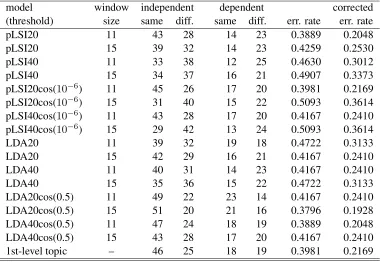
We prepared several latent variable models to investigate the performance of the proposed method and applied it to the sampled paraphras-ing sentences mentioned above. Table 10 shows the evaluation results.
5 Discussion
Table 10: Evaluating contextual dependency of paraphrases by latent variable models
model window independent dependent corrected
(threshold) size same diff. same diff. err. rate err. rate
pLSI20 11 43 28 14 23 0.3889 0.2048
pLSI20 15 39 32 14 23 0.4259 0.2530
pLSI40 11 33 38 12 25 0.4630 0.3012
pLSI40 15 34 37 16 21 0.4907 0.3373
pLSI20cos(10−6) 11 45 26 17 20 0.3981 0.2169
pLSI20cos(10−6) 15 31 40 15 22 0.5093 0.3614
pLSI40cos(10−6
) 11 43 28 17 20 0.4167 0.2410
pLSI40cos(10−6) 15 29 42 13 24 0.5093 0.3614
LDA20 11 39 32 19 18 0.4722 0.3133
LDA20 15 42 29 16 21 0.4167 0.2410
LDA40 11 40 31 14 23 0.4167 0.2410
LDA40 15 35 36 15 22 0.4722 0.3133
LDA20cos(0.5) 11 49 22 23 14 0.4167 0.2410
LDA20cos(0.5) 15 51 20 21 16 0.3796 0.1928
LDA40cos(0.5) 11 47 24 18 19 0.3889 0.2048
LDA40cos(0.5) 15 43 28 17 20 0.4167 0.2410
1st-level topic – 46 25 18 19 0.3981 0.2169
judge a pair of paraphrasing sentences.
From Table 6, LDA seems robust against the inclusion of noisy sentences with a large window, but it is easily affected by a small window. On the other hand, pLSI seems robust against infor-mation shortages due to a small window, but it is not effective with a large window. The best per-formances were shown at window size 15 for both pLSI and LDA, since the average number of sen-tences in a document (segment) is 18.7, as shown in Section 4.1.
Table 7 shows that in spite of the difference in programing language, pLSI is faster than LDA in practice. In addition, Table 8 reveals that judging the contextual dependency of paraphrasing pairs does not require fine-grained topics.
From the results shown in Table 10, we can conclude that topic inference by latent variable models resembles context judgement by humans as recorded in error rate. However, we note that the error rate was not weighted for contextually independent or dependent results. Error rate is simply a relative index. For example, if there is a result in which all of the inferences reflect the same topic, then the error rate becomes 0.3426. Thus it is important to detect a contextually
de-pendent paraphrase. Considering these points, pLSI20 with window size 11 shows very good re-sults in Table 10.
In Section 4.4, we showed the potential upper bound of this method. The smallest error rate is 0.231, and we can estimate a corrected error by the following formula:
|Dindep|+|Sdep| −C
#of judged pairs−C, (8)
where C denotes the correction value that cor-responds to the number of paraphrasing pairs judged incorrectly with only contextual informa-tion. In our experiments, from the results shown in Table 9,Cis set to 25. From the results shown in Table 10, we can conclude that the performance of our method is almost the same as that by the manually annotated topics, and the accuracy of our method is almost 80% for paraphrasing pairs that can be judged by contextual information.
we would be able to dynamically detect a pre-cise window using some other reliable text mod-els specialized to text segmentation.
So far, we have mainly discussed the contex-tual dependency of paraphrasing pairs. However, when a paraphrasing pair is contextually depen-dent, it is also important to infer its specific para-phrasing direction. Unfortunately, we conclude that inferring the paraphrasing direction with con-textual information is difficult. In the experimen-tal results, however, there were several examples whose direction could be inferred from their con-textual information. Thus, concon-textual information may benefit the inference of paraphrasing direc-tion. Actually, in the experiments, 11 of 37 con-textual dependent pairs had obvious paraphrasing directions. In most of the paraphrasing pairs, dif-ferent words were used or inserted, or some words were deleted. Thus, to infer a paraphrasing direc-tion, we need more specific information for words or sentences; for example what words carry spe-cific or generic meaning and so on.
One might consider a supervised learning method, such as Support Vector Machine, to in-fer topics (e.g., (Lane et al., 2004)). However, we cannot know the best number of topics for an ap-plication in advance. Thus, a supervised learning method is promising only if we already know the best number of topics for which we can prepare an appropriate learning set.
6 Conclusion
We proposed an evaluation method for the contex-tual dependency of paraphrasing pairs using two latent variable models, pLSI and LDA. To eval-uate a paraphrasing pair, we used sentences sur-rounding the given sentence as contextual infor-mation and approximated context by topics that correspond to a latent variable of a text model. The experimental results with paraphrases auto-matically extracted from a corpus showed that the proposed method achieved almost 60% accuracy. In addition, there is no major performance differ-ence between pLSI and LDA. However, they have slightly different characteristics: LDA is robust against noisy sentences with long context, while pLSI is robust against information shortage due to short context. The results also revealed that any method’s upper bound of accuracy using only
contextual information is almost 77%. Acknowledgements
This research was supported in part by the Min-istry of Public Management, Home Affairs, Posts and Telecommunications.
References
Regina Barzilay and Kathleen R. McKeown. 2001. Extracting paraphrases from a parallel corpus. In Proceedings of the 39th Annual Meeting of the ACL, pages 50–57.
David M. Blei, Andrew Y. Ng, and Michael I. Jordan.
2003. Latent Dirichlet allocation. Journal of
Ma-chine Learning Research, 3:993–1022, January.
Thomas Hofmann. 1999. Probabilistic Latent
Seman-tic Indexing. InProceedings of the 22nd Annual
ACM Conference on Research and Development in Information Retrieval, pages 50–57.
Ian R. Lane, Tatsuya Kawahara, Tomoko Matsui, and Satoshi Nakamura. 2004. Topic classification and verification modeling for out-of-domain utterance
detection. InProceedings of ICSLP, pages 2197–
2200.
Dekang Lin and Patrick Pantel. 2001. Discovery
of inference rule for question-answering. Natural
Language Engineering, 7(4):343–360.
Kiyonori Ohtake and Kazuhide Yamamoto. 2001.
Paraphrasing honorifics. InWorkshop Proceedings
of Automatic Paraphrasing: Theories and Appli-cations (NLPRS2001 Post-Conference Workshop), pages 13–20.
Mitsuo Shimohata and Eiichiro Sumita. 2002. Auto-matic paraphrasing based on parallel corpus for
nor-malization. InProceedings of LREC 2002, pages
453–457.
Tetsuro Takahashi, Tomoya Iwakura, Ryu Iida,
At-sushi Fujita, and Kentaro Inui. 2001. KURA:
A transfer-based lexico-structural paraphrasing
en-gine. In Proceedings of Automatic
Paraphras-ing: Theories and Applications (NLPRS2001 Work-shop), pages 37–46.
Toshiyuki Takezawa, Eiichiro Sumita, Fumiaki Sug-aya, Hirofumi Yamamoto, and Seiichi Yamamoto. 2002. Toward a broad-coverage bilingual corpus for speech translation of travel conversations in the
real world. InProceedings of LREC 2002, pages
147–152.
Kazuhide Yamamoto. 2002. Acquisition of lexical
paraphrases from texts. InProceedings of the 2nd