Classification of Inconsistent Sentiment Words
Using Syntactic Constructions
W il t rud K ESS LER Hinrich SCH
U T Z E
¨
Institute for Natural Language ProcessingUniversity of Stuttgart
A
BSTRACTAn important problem in sentiment analysis areinconsistentwords. We define an inconsistent word as a sentiment word whose dictionary polarity is reversed by the sentence context in which it occurs. We present a supervised machine learning approach to the problem ofinconsistency classification, the problem of automatically distinguishing inconsistent from consistent sentiment words in context. Our first contribution to inconsistency classification is that we take into account sentence structure and use syntactic constructions as features – in contrast to previous work that has only used word-level features. Our second contribution is a method for learning polarity reversing constructions from sentences annotated with polarity. We show that when we integrate inconsistency classification results into sentence-level polarity classification, performance is significantly increased.
1 Introduction
Sentiment analysis or opinion mining is the computational study of opinions and sentiments expressed in text (Liu, 2010). Sentiment analysis is typically performed based on sentiment words – words that indicate the sentiment polarity of a document or sentence. A challenge for this approach is that the dictionary polarity of a sentiment word may be reversed by sentence context (Polanyi and Zaenen, 2004). We call such wordsinconsistentwords1.
A classical example of an inconsistent word is the sentiment word“worth”in the sentence“this player is notworthposany price”where the negation“not”reverses the polarity of“worth”, so
that the final sentiment expressed in the sentence is not positive, but negative. Such polarity reversing expressions are diverse, e.g.,“lack ofqualitypos”or“easyposto hit accidentally”.
In this work we present a supervised machine learning approach to the problem of inconsistency classification, the problem of automatically distinguishing inconsistent from consistent sentiment words in context. Training examples for inconsistency classification are extracted automatically from sentences annotated with polarity. We make two contributions to the state of the art. First, while previous work has used only features at the word level, we take into account sentence structure and use syntactic constructions as features. Second, we present first steps towards automatically extracting polarity reversing constructions (PRCs) from sentences annotated with polarity. PRCs can be used as features for inconsistency classification as well as for directly identifying inconsistent words. We show that our treatment of inconsistent words improves polarity classification performance on sentence-level compared to a baseline.
This paper is structured as follows. The next section discusses related work. Section 3 describes inconsistency classification, the format of syntactic constructions and the extraction of training examples. We then present experimental results for polarity classification (Section 4). The second part of this paper describes our method for automatically extracting PRCs (Section 5), and evaluates their usefulness (Section 6). Finally, we conclude and outline future work.
2 Related Work
Negations, or, more generally,polarity reversers, create inconsistent words which are a major source of errors for polarity classification. Polarity reversers are diverse and do not include only negation function words (Choi and Cardie, 2008). Thus, some treatment of inconsistent words in polarity classification is common; for a survey see Wiegand et al. (2010).
Most approaches for polarity classification work on word-level and simply consider a wordw
as inconsistent if it is preceded by a word out of a fixed list of polarity reversers, this includes rule-based (Polanyi and Zaenen, 2004; Hu and Liu, 2004) as well as statistical approaches (Pang et al., 2002). Unlike these approaches, we use syntactic information.
Some approaches go beyond word-level, e.g., Wilson et al. (2005) use special features to model the existence of polarity modifiers in the syntactic context of a sentiment word, Choi and Cardie (2008) use syntactic patterns to treat content negators, and Nakagawa et al. (2010) integrate polarity reversing words into a dependency tree based method. While these works include some syntactic information, they still use a manually defined list of polarity reversing words. In contrast, we use machine learning to identify polarity reversing constructions (PRCs).
1Note that our terminology differs from that used by (Dragut et al., 2012) who use the term “inconsistent” to refer
An important challenge that most approaches ignore is the detection of the scope of negation. Councill et al. (2010) use dependency parses to predict the scope of polarity reversing words. Our approach goes the opposite way: given a sentiment word, we determine if it is in the scope of any PRC. Our definition of syntactic constructions explicitly includes scope.
The work most closely related to our approach is (Ikeda et al., 2008) who also address the task of inconsistency classification. Their inconsistency classifier uses the local context of three words to the left and right of the target sentiment word as features. Li et al. (2010) extend that method to document level by stacking two classifiers trained on reversed and nonreversed sentences. Both works use only word-level information in their classifiers. We go beyond word-level and use syntactic constructions. We also attempt to explicitly identify and extract the syntactic constructions that are responsible for making a sentiment word inconsistent.
3 Approach
The main component of our approach is the inconsistency classifier, that assigns a score
sincons(w)to each sentiment word tokenwin context, and classifieswas beinginconsistent
(sincons(w)>0) orconsistent(sincons(w)≤0) with its dictionary polarity.
The final task we want to improve is sentence-level polarity classification. To determine the polarity of a sentence, we calculate a positivity scorespos(S)for the sentenceSusing a dictionary of positive and negative sentiment words (pandn). The sentence is labeledpositiveiff
spos(S)≥0, elsenegative. We integrate inconsistency classification by counting a word with its scoresincons(w). Thus, we definespos(S)as follows (cf. (Ikeda et al., 2008)):
spos(S) =X w∈p−
sincons(w) +X w∈n
sincons(w) (1)
for allw∈S. In our proposedconsistency votingwe use a statistical classifier to determine
sincons(w)and use its classification confidence as score. Our first contribution is to include syntactic constructions as defined below as features for inconsistency classification.
We use two baselines with simpler ways of determiningsincons(w):Standard votingassumes every word to be consistent, so we setsincons(w) =−1 for all words and Equation 1 is simplified tospos(S) =|{w∈p}| − |{w∈n}|. A common way of treating inconsistent words isnegation voting, which setssincons(w) =1 (inconsistent) iff an odd number of negation cues occurs in the context ofw, elsesincons(w) =−1 (consistent).
3.1 Syntactic constructions
have
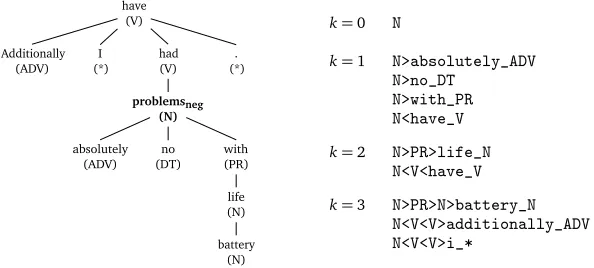
Figure 1: Formalization of syntactic constructions. Left: The basis for extracting constructions is a dependency parse, in this case for the sentence“Additionally I have had absolutely no problems with battery life.”Right: Extracted constructions for the sentiment word“problems”.
included, as we are interested in constructions that are independent of specific sentiment words. The path contains the direction in the parse tree (up<or down>), the nodes that are traversed on the way – represented by POS category (Vfor“had”and“have”) – and lemma/POS of the
final word on the path (“additionally”,ADV).
All syntactic constructions extracted from the context of a sentiment wordwup to a certain parse tree distancek(defined in number of nodes on the path) are used as features for training the bag-of-constructions inconsistency classifier.
3.2 Finding consistent and inconsistent training examples
For training our inconsistency classifier we need a set of training examples annotated for (in)consistency. We assume that we have a corpus of polarity annotated sentences and a dictionary of positive and negative sentiment words at our disposal.
We follow Ikeda et al. (2008) and extract training examples automatically from the corpus. Given a sentiment wordwwith dictionary polaritypwthat appears in a sentenceswith polarity psin the corpus, we labelwconsistentiffpw=ps, andinconsistentotherwise. We
ignore words and sentences with any label other thanpositiveandnegativeas well as sentiment words occurring with a POS not in the dictionary.
E.g., from the sentence2“The phone isn’thard
negto use so itsgreatpos”(labeledpositive),
we extract“hard”(resp.“great”) as aninconsistent(resp.consistent) training example.
4 Experiments
4.1 Data
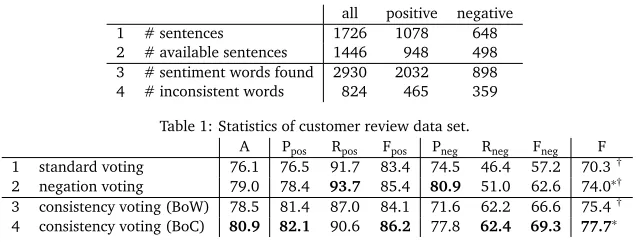
We evaluate on the customer review data set3(Hu and Liu, 2004). Statistics about the data set
can be found in Table 1. The original data set is annotated at aspect level. To create sentence 2All example sentences are from user reviews including all errors in spelling and grammar.
all positive negative
1 # sentences 1726 1078 648
2 # available sentences 1446 948 498
3 # sentiment words found 2930 2032 898
4 # inconsistent words 824 465 359
Table 1: Statistics of customer review data set.
A Ppos Rpos Fpos Pneg Rneg Fneg F
1 standard voting 76.1 76.5 91.7 83.4 74.5 46.4 57.2 70.3†
2 negation voting 79.0 78.4 93.7 85.4 80.9 51.0 62.6 74.0∗†
3 consistency voting (BoW) 78.5 81.4 87.0 84.1 71.6 62.2 66.6 75.4†
4 consistency voting (BoC) 80.9 82.1 90.6 86.2 77.8 62.4 69.3 77.7∗
Table 2: Results of sentence-level polarity classification on customer review data set:Accuracy, Precision,Recall,F-measure (positive and negative sentences), macroF-measure.
polarity annotations, we take the aspect label as sentence label if there is only one aspect or all aspect labels have the same polarity. If a“but”separates two aspects of conflicting polarity, the two parts of the sentence are split and separately annotated. If no splitting is possible or there is no annotated aspect, the sentence is ignored.
From the total number of polarity annotated sentences (line 1) we can only compute a useful polarity score for sentences that contain at least one sentiment word (line 2), all other sentences are ignored for the evaluation.
As a dictionary of sentiment words we use the MPQA subjectivity clues4(Wilson et al., 2005)
containing 2304 positive and 4152 negative words. A word may have several possible POS tags. Sentences have been parsed with the Bohnet dependency parser (Bohnet, 2010). Sentiment words are extracted as (in)consistent (lines 3 and 4) with the method presented in Section 3.2.
4.2 Results of sentence-level polarity classification
We use two different inconsistency classifiers with consistency voting: The bag-of-words classifier BoWdeterminessincons(w)with the three context words to the left and right of the sentiment word as features. This is a reimplementation of Ikeda et al.’s (2008) “word-wise” learning. The bag-of-constructions classifierBoCuses the syntactic constructions described in Section 3.1 up to parse-tree distancek=3 as features for inconsistency classification. In both cases, we use the Stanford MaxEnt classifier (Manning and Klein, 2003) with default settings and train it in a 5-fold cross-validation setting.
As baselines, we includestandard votingandnegation voting. For negation voting we define context as the three words to the left and right of the sentiment word and use nine negation cue words from (Ikeda et al., 2008):no,not,yet,never,none,nobody,nowhere,nothing,neither. Ikeda et al. (2008) report an accuracy of 71.6% for the standard voting baseline on the same data set when using sentiment words from General Inquirer (Stone et al., 1996). Our standard voting baseline with MPQA subjectivity clues yields a much higher accuracy of 76.1%. Accuracy is a less suitable performance measure for this task as the data set is skewed (65.6%
positive sentences). This is why we have reimplemented their approach and restrict our further discussion to our reimplementation and macro F-measure only.
Table 2 shows the result of our experiments. Bold numbers denote the best result in each column. We mark a macro F-measure result with * if it is significantly higher than the previous line and with † if it is significantly worse than consistency voting with the BoC classifier.5
Determining inconsistency with the BoC classifier significantly outperforms all other methods.
5 Polarity reversing constructions (PRCs)
We define apolarity reversing construction(PRC) as a syntactic construction (see Section 3.1) that reverses the polarity of the sentiment word in its scope. Recall that the sentiment word is the first node of the path represented by the construction.
Our goal is the automatic extraction of PRCs. We work on the assumption that in the syntactic context of inconsistent words there is always a PRC present. Syntactic constructions that appear often in the context of inconsistent words are likely to be PRCs. We use the extracted training examples for consistent and inconsistent words (see Section 3.2). All training examples are parsed with a dependency parser and syntactic constructions are extracted from the context (see Section 3.1). All extracted constructions are candidates for PRCs.
The candidates are scored with Mutual Information (MI).MImeasures how much infor-mation the presence or absence of a candidate x contributes to making the correct clas-sification decision for a sentiment word. M I(x,C)between candidatex and the classes
C={consistent,inconsistent}is defined as
M I(x,C) =X
whereP(x)is the probability thatxoccurred, andP(¯x)the probability thatxdidn’t occur. The ncandidates with the highest scores are taken as PRCs.
MIextracts candidates that serve as a good indicator forone ofthe classes, but not necessarily for the classinconsistent. For theMI+score, we remove candidates with negative association from the final set of PRCs (Dunning, 1993).
6 Experiments with PRCs
6.1 Results of PRC extraction
For the robust extraction of PRCs we need more annotated sentences than the customer review corpus contains. As there is no such corpus in the domain and to avoid manual annotation effort, we use semistructured reviews in which users provide pros (product aspects the user evaluates as positive) and cons (product aspects the user evaluates as negative) in addition to the written text of the review. We automatically create a corpus annotated with polarity at the sentence level as follows: All pros (resp. cons) longer than 3 tokens are extracted as a sentence with labelpositive(resp.negative). Shorter pros (resp. cons) are stripped of sentiment words (using the subjectivity clues dictionary) and if the resulting string is found in the review text, the containing sentence is extracted aspositive(resp.negative). This is a somewhat simplistic method, but we still get enough annotated sentences for our purposes.
all positive negative
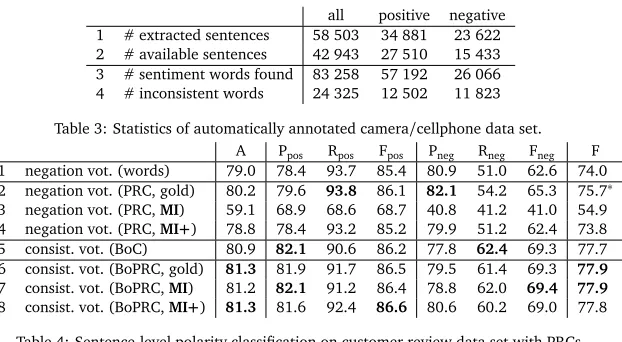
1 # extracted sentences 58 503 34 881 23 622
2 # available sentences 42 943 27 510 15 433
3 # sentiment words found 83 258 57 192 26 066
4 # inconsistent words 24 325 12 502 11 823
Table 3: Statistics of automatically annotated camera/cellphone data set.
A Ppos Rpos Fpos Pneg Rneg Fneg F
1 negation vot. (words) 79.0 78.4 93.7 85.4 80.9 51.0 62.6 74.0
2 negation vot. (PRC, gold) 80.2 79.6 93.8 86.1 82.1 54.2 65.3 75.7∗
3 negation vot. (PRC,MI) 59.1 68.9 68.6 68.7 40.8 41.2 41.0 54.9
4 negation vot. (PRC,MI+) 78.8 78.4 93.2 85.2 79.9 51.2 62.4 73.8
5 consist. vot. (BoC) 80.9 82.1 90.6 86.2 77.8 62.4 69.3 77.7
6 consist. vot. (BoPRC, gold) 81.3 81.9 91.7 86.5 79.5 61.4 69.3 77.9
7 consist. vot. (BoPRC,MI) 81.2 82.1 91.2 86.4 78.8 62.0 69.4 77.9
8 consist. vot. (BoPRC,MI+) 81.3 81.6 92.4 86.6 80.6 60.2 69.0 77.8
Table 4: Sentence-level polarity classification on customer review data set with PRCs.
We perform the annotation on an existing corpus of 17 442 semistructured camera and cellphone reviews6(Branavan et al., 2008) fromepinions.com. Table 3 contains statistics about the
data. We use this corpus only for the automatic extraction of PRCs, not to evaluate polarity classification. To judge the quality of the automatic annotation, we hired a graduate student of computational linguistics to manually annotate a random subset of 1271 sentences. The agreement of the automatic and manual annotation is 0.79; Cohen’sκis 0.61.
To directly evaluate the extracted PRCs, the graduate student also annotated some syntactic constructions as PRCs/non-PRCs. This results in a set of 70 gold PRCs.7
Comparing the automatically extracted constructions to our set of gold PRCs, we find that few actual PRCs are found when scoring withMI(as we expected). Of the top 70 constructions extracted as PRCs withMI, only 15 are correct (21%). Results forMI+are better, but still noisy: 20 out of 70 are correct (29%). These results do not look very promising, but as we will see, we can still use noisy PRCs successfully in polarity classification.
6.2 Results of sentence-level polarity classification
We use PRCs in two ways: Innegation voting with PRCs, we define context as the syntactic context of a sentiment word and use PRCs as negation cues. We also use consistency voting with a bag-of-PRC (BoPRC) inconsistency classifier that uses only PRCs as features instead of using all constructions (i.e., a feature-selection on BoC). Our intuition is that as only polarity reversal is marked, PRCs should be all that is needed to identify inconsistent words.
Both methods are tested with PRCs extracted usingMIandMI+. We extract these PRCs from the camera/cellphone data described in Section 6.1. We extract the top 70 constructions to match the number of constructions in our manually annotated PRC set. Additionally, we use the manually annotated PRCs (gold) as an upper bound of automatic PRC-based performance.
To enable comparison with our previous results, we use the evaluation setup described in Section 4.2. Table 4 shows the results. For easier comparison, we have repeated lines 2 (word-level negation voting) and 4 (consistency voting with BoC) from Table 2 as lines 1 resp. 5 in Table 4. Bold numbers denote the best result in each column.
We compare negation voting with PRCs to the word-level negation voting. The improvement in macro F-measure of negation voting with gold PRCs is significant (marked with∗).8
Un-surprisingly, the PRCs extracted withMIhurt performance instead of improving it. The noisy PRCs extracted withMI+achieve a similar performance than word-level negation voting (the difference is not significant). For such a noisy set (only 29% of the PRCs are correct), this is a promising result.
In consistency voting, telling the BoC inconsistency classifier which features are important by some sort of feature selection either manually or automatically improves performance for all variants of BoPRC. Although no improvement is statistically significant, this is still an interesting result, as it shows that even noisy information about the important features can improve performance of inconsistency classification.
Conclusion and perspectives
We have presented a supervised machine learning approach to detect if a sentiment word is consistent or inconsistent with its dictionary polarity in a specific sentence context. We have evaluated our approach on sentence-level polarity classification by integrating the score of such an inconsistency classifier into a majority voting approach. As our first contribution, we have shown that the use of syntactic constructions as features for the inconsistency classifier can improve performance. As a second contribution, we have presented first steps towards automat-ically extracting polarity reversing constructions from sentences annotated with polarity and demonstrated two possible uses of such constructions in sentence-level polarity classification. To get sufficient training data for the extraction of polarity reversing constructions, we have automatically annotated sentences from semistructured reviews with polarity. For future work, we plan to improve the quality and coverage of this automatic annotation as a means to get sentence-labeled data from semistructured reviews, which are available in large quantities. A major problem in sentiment analysis are sentiment words that do not express sentiment in a given context (subjectivity analysis cf. (Wilson et al., 2005)). In a preliminary study, we found that about 50% of words extracted as inconsistent training examples did in fact not express sentiment in the sentence context, e.g., the word“slow”in the positive sentence“easy to hold steady when using slower shutter speeds”. Identifying and discarding non-subjective phrases like“slower shutter speeds”would improve the classification results as well as the quality of the extracted polarity reversing constructions.
Acknowledgments
This research was funded by Deutsche Forschungsgemeinschaft (DFG, SFB 732, D7). We thank Olga Podushko for the annotation. We also thank Andrea Glaser, Charles Jochim, Khalid Al Khatib and Christian Scheible for their suggestions about this work.
References
Bohnet, B. (2010). Very high accuracy and fast dependency parsing is not a contradiction. In
Proceedings of COLING ’10, pages 89–97.
Branavan, S. R. K., Chen, H., Eisenstein, J., and Barzilay, R. (2008). Learning document-level semantic properties from free-text annotations. InProceedings of ACL ’08, pages 263–271. Choi, Y. and Cardie, C. (2008). Learning with compositional semantics as structural inference for subsentential sentiment analysis. InProceedings of EMNLP ’08, pages 793–801.
Councill, I. G., McDonald, R., and Velikovich, L. (2010). What’s great and what’s not: learning to classify the scope of negation for improved sentiment analysis. InProceedings of NeSp-NLP ’10, pages 51–59.
Dragut, E., Wang, H., Yu, C., Sistla, P., and Meng, W. (2012). Polarity consistency checking for sentiment dictionaries. InProceedings of ACL ’12, pages 997–1005.
Dunning, T. (1993). Accurate methods for the statistics of surprise and coincidence. Computa-tional Linguistics, 19(1):61–74.
Hu, M. and Liu, B. (2004). Mining and summarizing customer reviews. InProceedings of KDD ’04, pages 168–177.
Ikeda, D., Takamura, H., Ratinov, L.-A., and Okumura, M. (2008). Learning to shift the polarity of words for sentiment classification. InProceedings of IJCNLP ’08, pages 50–57.
Li, S., Lee, S. Y. M., Chen, Y., Huang, C.-R., and Zhou, G. (2010). Sentiment classification and polarity shifting. InProceedings of COLING ’10, pages 635–643.
Liu, B. (2010). Sentiment analysis and subjectivity. In Indurkhya, N. and Damerau, F. J., editors,Handbook of Natural Language Processing, Second Edition, pages 627–666. Chapman & Hall/CRC.
Manning, C. and Klein, D. (2003). Optimization, maxent models, and conditional estimation without magic. InProceedings of NAACL-Tutorials ’03.
Nakagawa, T., Inui, K., and Kurohashi, S. (2010). Dependency tree-based sentiment classifica-tion using CRFs with hidden variables. InProceedings of HLT ’10, pages 786–794.
Noreen, E. W. (1989). Computer-intensive methods for testing hypotheses – an introduction. Wiley & Sons.
Pang, B., Lee, L., and Vaithyanathan, S. (2002). Thumbs up? Sentiment classification using machine learning techniques. InProceedings of EMNLP ’02, pages 79–86.
Polanyi, L. and Zaenen, A. (2004). Contextual valence shifters. InProceedings of AAAI Spring Symposium on Exploring Attitude and Affect in Text, pages 106–111.
Stone, P. J., Dunphy, D. C., Smith, M. S., and Ogilvie, D. M. (1996). General Inquirer: A Computer Approach to Content Analysis. The MIT Press.