Syntax Based Reordering with Automatically Derived Rules for
Improved Statistical Machine Translation
Karthik Visweswariah IBM Research
Jiri Navratil IBM Research
Jeffrey Sorensen Google, Inc.
Vijil Chenthamarakshan IBM Research
Nanda Kambhatla IBM Research
Abstract
Syntax based reordering has been shown to be an effective way of handling word order differences between source and target languages in Statistical Machine Translation (SMT) systems. We present a simple, automatic method to learn rules that reorder source sentences to more closely match the target language word or-der using only a source side parse tree and automatically generated alignments. The resulting rules are applied to source lan-guage inputs as a pre-processing step and demonstrate significant improvements in SMT systems across a variety of lan-guages pairs including English to Hindi, English to Spanish and English to French as measured on a variety of internal test sets as well as a public test set.
1 Introduction
Different languages arrange words in different or-ders, whether due to grammatical constraints or other conventions. Dealing with these word order permutations is one of the fundamental challenges of machine translation. Given an exceptionally large training corpus, a phrase-based system can learn these reordering on a case by case basis. But, if our systems are to generalize to phrases not seen in the training data, they must explicitly cap-ture and model these reorderings. However, per-mutations are difficult to model and impractical to search.
Presently, approaches that handle reorderings
typically model word and phrase movements via a distortion model and rely on the target language model to produce words in the right order. Early distortion models simply penalized longer jumps more than shorter jumps (Koehn et al., 2003) independent of the source or target phrases in question. Other models (Tillman, 2004), (Al-Onaizan and Papineni, 2006) generalize this to include lexical dependencies on the source.
Another approach is to incorporate features, based on the target syntax, during modeling and decoding, and this is shown to be effective for var-ious language pairs (Yamada and Knight, 2001), (Zollmann and Venugopal, 2006). Hierarchical phrase-based decoding (Chiang, 2005) also al-lows for long range reordering without explic-itly modeling syntax. While these approaches have been shown to improve machine translation performance (Zollmann et al., 2008) they usually combine chart parsing with the decoding process, and are significantly more computationally inten-sive than phrase-based systems.
Chinese, (Wang et al., 2007) and Hindi to English (Ramanathan et al., 2008).
In this paper, we propose a simple model for re-ordering conditioned on the source side parse tree. The model is learned using a parallel corpus of source-target sentence pairs, machine generated word alignments, and source side parses. We ap-ply the reordering model to both training and test data, for four different language pairs: English
→Spanish, English→French, English→Hindi, and English→German. We show improvements in machine translation performance for all of the language pairs we consider except for English→ German. We use this negative result to propose extensions to our reordering model. We note that the syntax based reordering we propose can be combined with other approaches to handling re-ordering and does not have to be followed by an assumption of monotonicity. In fact, our phrase-based model, trained upon reordered data, retains its reordering models and search, but we expect that these facilities are employed much more spar-ingly with reordered inputs.
2 Related work
There is a significant quantity of work in syntax based reordering employed to improve machine translation systems. We summarize our contribu-tions to be:
• Learning the reordering rules based on train-ing data (without relytrain-ing on ltrain-inguistic knowl-edge of the language pair)
• Requiring only source side parse trees
• Experimental results showing the efficacy for multiple language pairs
• Using a lexicalized distortion model for our baseline decoder
There have been several studies that have demonstrated improvements with syntax based reordering based upon hand-written rules. There have also been studies inves-tigating the sources of these improvements (Zwarts and Dras, 2007). Hand-written rules depend upon expert knowledge of the linguis-tic properties of the parlinguis-ticular language pair. Initial efforts (Niessen and Ney, 2001) were made at improving German-English translation
by handling two phenomena: question inver-sion and detachable verb prefixes in German. In (Collins et al., 2005), (Wang et al., 2007), (Ramanathan et al., 2008), (Badr et al., 2009) rules are developed for translation from Ger-man to English, Chinese to English, English to Hindi, and English to Arabic respectively. (Xu et al., 2009) develop reordering rules based upon a linguistic analysis of English and Korean sentences and then apply those rules to trans-lation from English into Korean and four other languages: Japanese, Hindi, Urdu and Turkish. Unlike this body of work, we automatically learn the rules from the training data and show efficacy on multiple language pairs.
There have been some studies that try to learn rules from the data. (Habash, 2007) learns re-ordering rules based on a dependency parse and they report a negative result for Arabic to En-glish translation. (Zhang et al., 2007) learn re-ordering rules on chunks and part of speech tags, but the rules they learn are not hierarchi-cal and would require large amounts of training data to learn rules for long sentences. Addition-ally, we only keep a single best reordering (in-stead of a lattice with possible reorderings) which makes the decoding significantly more efficient. (Xia and McCord, 2004) uses source and target side parse trees to automatically learn rules to re-order French sentences to match English re-order. The requirement to have both source and target side parse trees makes this method inapplicable to any language that does not have adequate tree bank resources. In addition, this work reports re-sults using monotone decoding, since their exper-iments using non-monotone decoding without a distortion model were actually worse.
3 Reordering issues in specific languages
In this section we discuss the reordering issues typical of translating between English and Hindi, French, Spanish and German which are the four language pairs we experiment on in this paper.
3.1 Spanish and French
con-trast to English, French and Spanish adjectives and adjunct nouns follow the main noun, i.e. we typically observe a reversal of word order in noun phrases, e.g., “A beautiful red car” translates into French as “Une voiture rouge beau”, and as
“Un coche rojo bonito” into Spanish.
Phrase-based MT systems are capable of capturing these patterns provided they occur with sufficient fre-quency for each example in the training data. For rare noun phrases, however, the MT may pro-duce erroneous word order that can lead to seri-ous distortions in the meaning. Particularly dif-ficult are nominal phrases from specialized do-mains that involve challenging terminology, for example: “group reference attribute” and
“valida-tion checking code”. In both instances, the
base-line MT system generated translations with an in-correct word order and, consequently, possibly a different meaning. We will return to these two ex-amples in Section 5.1 to compare the output of a MT system with and without reordering.
3.2 German
Unlike French and Spanish, German poses a con-siderably different challenge with respect to word ordering. The most frequent reordering in German relates to verbs, particularly verb groups consist-ing of auxiliary and main verbs, as well as verbs in relative clauses. Moreover, reordering patterns between German and English tend to span large portions of the sentence. We included German in our investigations to determine whether our auto-mated rule extraction procedure can capture such long distance patterns.
3.3 Hindi
Hindi word order is significantly different than English word order; the typical order followed is Subject Object Verb (although Object Subject Verb order can be used if nouns are followed by appropriate case markers). This is in contrast to English which has a Subject Verb Object order. This can result in words that are close in English moving arbitrarily far apart in Hindi depending on the length of the noun phrase representing the ob-ject and the length of the verb phrase. These long range reorderings are generally hard for a phrase based system to capture. Another way Hindi and
English differ is that prepositions in English be-come postpositions in Hindi and appear after the noun phrase. Again, this reordering can lead to long distance movements of words. We include Hindi in our investigation since it has significantly different structure as compared to English.
4 Learning reordering rules
In this section we describe how we learn rules that transform source parse trees so the leaf word order is more like the target language. We restrict our-selves to reorderings that can be obtained by per-muting child nodes at various interior nodes in a parse tree. With many reordering phenomena dis-cussed in Section 3 this is a fairly strong assump-tion about pairs of languages, and there are exam-ples in English→Hindi where such an assumption will not allow us to generate the right reordering. As an example consider the English sentence “I
do not want to play”. The sentence has a parse:
S
NP PRP
I
VP
VBP do
RB not
VP
VB want
S VP TO
to VP VB play The correct word order of the translation in Hindi is “I to play not want” In this case, the word not breaks up the verb phrase want to play and hence the right Hindi word order cannot be obtained by the reordering allowed by our model. We found such examples to be rare in English→Hindi, and we impose this restriction for the simplicity of the model. Experimental results on several languages show benefits of reordering in spite of this simpli-fying assumption.
Consider a source sentence s and its corre-sponding constituency parse tree S1. We set up the problem in a probabilistic framework, i.e. we would like to build a probabilistic modelP(T|S)
that assigns probabilities to trees such that the
1
word order in treesT which are assigned higher probability match the order of words in the target language. A parse tree,S is a set of nodes. Inte-rior nodes have an ordered list of children. Leaf nodes in the tree are the words in the sentence
s, and interior nodes are labeled by the linguis-tic constituent that they represent. Each word has a parent node (with only one child) labeled by the part-of-speech tag of the word.
Our model assigns non-zero probabilities to trees that can be obtained by permuting the child nodes at various interior nodes of the treeS. We assume that children of a node are ordered inde-pendently of all other nodes in the tree. Thus
P(T|S) =
n∈I(S)
P(π(cn)|S, n, cn),
whereI(S)is the set of interior nodes in the tree
S,cn is the list of children of node nand π is a permutation. We further assume that the reorder-ing at a particular node is dependent only on the labels of its children:
P(T|S) =
n∈I(S)
P(π(cn)|cn).
We parameterize our model using a log-linear model:
P(π(cn)|cn) =
1
Z(cn)
exp(λTf(π, cn)). (1)
We choose the simplest possible set of feature functions: for each observed sequence of non-terminals we have one boolean feature per per-mutation of the sequence of non-terminals, with the feature firing iff that particular sequence is ob-served. Assuming, we have a training corpusCof
(T, S) tree pairs, we could optimize the parame-ters of our model to maximize : S∈CP(T|S).
With the simple choice of feature functions de-scribed above, this amounts to:
P(π(cn)|cn) =
count(π(cn))
count(cn)
,
where count(cn) is the number of times the se-quences of nodes cn is observed in the training data and count(π(cn)) is the number of times
that cn in S is permuted to π(cn) in T. In Sec-tion 6, we show considering more general fea-ture functions and relaxing some of the indepen-dence might yield improvements on certain lan-guage pairs.
For each source sentenceswith parseSwe find the treeT that makes the given alignment for that sentence pair most monotone. For each nodenin the source treeS letDnbe the set of words that are descendants ofn. Let us denote bytpos(n)the average position of words in the target sentence that are aligned to words inDn. Then
tpos(n) = 1 |Dn|
w∈Dn
a(w),
wherea(w)is the index of the word on the target side that w is aligned with. If a word w is not aligned to any target word, we leave it out from the mean position calculation above. If a wordw
is aligned to many words we leta(w)be the mean position of the words thatwis aligned to. For each nodenin the tree we transform the tree by sorting the list of children of n according to tpos. The pairs of parse trees that we obtain (S, T) in this manner form our training corpus to estimate our parameters.
In using our model, we once again go for the simplest choice, we simply reorder the source side sentences by choosingarg maxT P(T|S)both in training and in testing; this amounts to reordering each interior node based on the most frequent re-ordering of the constituents seen in training. To reduce the effect of noise in training alignments we apply the reordering, only if we have seen the constituent sequence often enough in our training data (a count threshold parameter) and if the most frequent reordering is sufficiently more frequent than the next most frequent reordering (a
signifi-cance threshold).
5 Experiments
5.1 Results for French, Spanish, and German
and a maximum entropy parser for English (Ratnaparkhi, 1999). With a significance thresh-old of 1.2, we obtain about 1000 rules in the eventual reordering process.
Phrase-based systems were trained for each lan-guage pair using 11M sentence pairs spanning a variety of publicly available (e.g. Europarl, UN speeches) and internal corpora (IT technical and news domains). The system phrase blocks were extracted based on a union of HMM and max-ent alignmmax-ents with corpus-selective count prun-ing. The lexicalized distortion model was used as described in (Al-Onaizan and Papineni, 2006) with a window width of up to 5 and a maximum number of skipped (not covered) words during de-coding of 2. The distortion model assigns a prob-ability to a particular word to be observed with a specific jump. The decoder uses a 5-gram in-terpolated language model spanning the various domains mentioned above. The baseline system without reordering and a system with reordering was trained and evaluated in contrastive experi-ments. The evaluation was performed utilizing the following (single-reference) test sets:
• News: 541 sentences from the news domain.
• TechA: 600 sentences from a
computer-related technical domain, this has been used as a dev set.
• TechB: 1038 sentences from a similar
do-main as TechA used as a blind test.
• Dev09: 1026 sentences defined as the
news-dev2009b development set of the Workshop
on Statistical Machine Translation 2009 2. This set provides a reference measurement using a public data set. Previously published results on this set can be found, for example, in (Popovic et al., 2009).
In order to assess changes in word ordering pat-terns prior to and after an application of the re-ordering, we created histograms of word jumps in the alignments obtained in the baseline as well as in the reordered system. Given a source word
si at index iand the target word tj it is aligned to at index j, a jump of 1 would correspond to
si+1aligning to target wordtj+1, while an
align-ment totj−1 corresponds to a jump of -1, etc. A
2
http://statmt.org/wmt09/
−8 −6 −4 −2 0 2 4 6 8 10
−1 −0.5 0 0.5 1 1.5 2
x 105
Cnt2 − Cnt1
Difference of histograms after and before reordering (EN−ES)
−8 −6 −4 −2 0 2 4 6 8 10
−5000 0 5000 10000 15000 20000
Distance to next position
Cnt2 − Cnt1
Difference of histograms after and before reordering (EN−FR)
Figure 1: Difference-histogram of word order distortions for English→Spanish (upper), and English→French (lower).
histogram over the jump values gives us a sum-mary of word order distortion. If all of the jumps were one, then there is no reordering between the two languages. To gain insight into changes in-troduced by our reordering we look at differences of the two histograms i.e., counts after reordering minus counts before reordering. We would hope that after reordering most of the jumps are small and concentrated around one. Figure 1 shows such difference-histograms for the language pairs English→Spanish and English→French, respec-tively, on a sample of about 15k sentence pairs held out of the system training data. Here, a pos-itive difference value indicates an increased num-ber after reordering. In both cases a consistent trend toward monotonicity is observed, i.e more jumps of size one and two, and fewer large jumps. This confirms the intended reordering effect and indicates that the reordering rules extracted gen-eralize well.
Table 1 shows the resulting uncased BLEU scores for English-Spanish and English-French.
[image:5.595.301.523.73.298.2]System News TechA TechB Dev09
Baseline 0.3849 0.3371 0.3483 0.2244
Sp
an
is
h
Reordered 0.4031 0.3582 0.3605 0.2320
Baseline 0.5140 0.2971 0.3035 0.2014
F
rench
Reordered 0.5242 0.3152 0.3154 0.2092
Baseline 0.2580 0.1582 0.1697 0.1281
German Reordered 0.2544 0.1606 0.1682 0.1271
Baseline 20.0
H
indi
[image:6.595.74.286.69.235.2]Reordered 21.7
Table 1: Uncased BLEU scores for phrase-based machine translation.
were not common in the training data were fixed by use of the reordering rules.
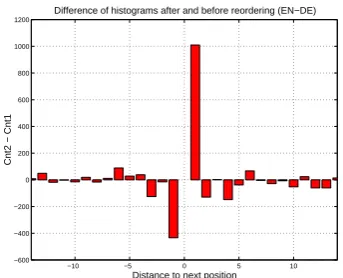
Table 1 shows the BLEU scores for the English→German language pair, for which a mixed result is observed. The difference-histogram for English→German, shown in Figure 2, differs from those of the other languages with several increases in jumps of large magnitude, in-dicating failure of the extracted rules to general-ize.
The failure of our simple method to gain con-sistent improvements comparable to Spanish and French, along with our preliminary finding that a relatively few manually crafted reordering rules (we describe these in Section 6.4) tend to outper-form our method, leads us to believe that a more refined approach is needed in this case and will be subject of further discussion below.
5.2 Results for Hindi
Our Hindi-English experiments were run with an internal parallel corpus of roughly 250k sen-tence pairs (5.5M words) consisting of various domains (including news). To learn reordering rules we used HMM alignments and a maxent parser (Ratnaparkhi, 1999), with a count thresh-old of 100, and a significance threshthresh-old of 1.7 (these settings gave us roughly 200 rules). We also experimented with other values of these thresh-olds and found that the performance of our sys-tems were not very sensitive to these thresholds. We trained Direct Translation Model 2 (DTM)
−10 −5 0 5 10
−600 −400 −200 0 200 400 600 800 1000 1200
Distance to next position
Cnt2 − Cnt1
[image:6.595.326.498.71.210.2]Difference of histograms after and before reordering (EN−DE)
Figure 2: Difference-histogram of word order dis-tortions for English→German.
systems (Ittycheriah and Roukos, 2007) with and without source reordering and evaluated on a test set of 357 sentences from the News domain. We note that the DTM baseline includes features (functions of target words and jump size) that al-low it to model lexicalized reordering phenomena. The reordering window size was set to +/- 8 words for the baseline and system with reordered in-puts. Table 1 shows the uncased BLEU scores for English-Hindi, showing a gain from using the re-ordering rules. For the reordered case, the HMM alignments are rederived, but the accuracy of these were no better than those of the unreordered in-put and experiments showed that the gains in per-formance were not due to the effect on the align-ments.
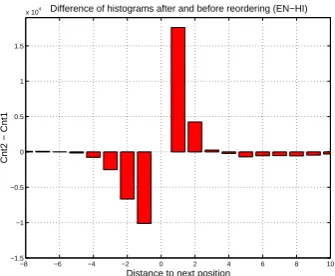
Figure 3 shows difference-histograms for the language pair English→Hindi, on a sample of about 10k sentence pairs held out of the system training data. The histogram indicates that our reordering rules generalize and that the reordered English is far more monotonic with respect to the Hindi.
6 Analysis of errors and future directions
−8 −6 −4 −2 0 2 4 6 8 10 −1.5
−1 −0.5 0 0.5 1 1.5
x 104
Distance to next position
Cnt2 − Cnt1
[image:7.595.97.265.72.210.2]Difference of histograms after and before reordering (EN−HI)
Figure 3: Difference-histogram of word order dis-tortions for English→Hindi.
6.1 Model weakness
In our initial experiments, we noticed that for the most frequent reordering rules in English→Hindi (e.g that IN NP or NP PP flips in Hindi) the prob-ability of a reordering was roughly 65%. This was concerning since it meant that on 35% of the data we would be making wrong reordering deci-sions by choosing the most likely reordering. To get a better feel for whether we needed a stronger model (e.g by lexicalization or by looking at larger context in the tree rather than just the children), we analyzed some of the cases in our training data where (IN,NP), (NP, PP) pairs were left unaltered in Hindi. In doing that analysis, we noticed exam-ples involving negatives that our model does not currently handle. The first issue was mentioned in Section 4, where the assumption that we can achieve the right word order by reordering con-stituent phrases, is incorrect. The second issue is illustrated by the following sentences: I have
some/no books, which have similar parse
struc-tures, the only difference being the determiner
some vs the determiner no. In Hindi, the order
of the fragments some books and the fragment
no books are different (in the first case the words
stay in order, in the second the flip). Handling this example would need our model to be lexical-ized. These issue of negatives requiring special handling also came up in our analysis of German (Section 6.4). Other than the negatives (which re-quire a lexicalized model), the major reason for the lack of sharpness of the reordering rule proba-bility was alignment errors and parser issues. We
Aligner
Number of
Sentences fMeasure BLEU score
HMM 250k 62.4 21.7
MaxEnt 250k 76.6 21.4
[image:7.595.313.510.72.125.2]Manual 5k - 21.3
Table 2: Using different alignments
look at these topics next.
6.2 Alignment accuracy
Since we rely on automatically generated align-ments to learn the rules, low accuracy of the alignments could impact the quality of the rules learned. This is especially a con-cern for English→Hindi since the quality of HMM alignments are fairly low. To quan-tify this effect, we learn reordering rules us-ing three sets of alignments: HMM alignments, alignments from a supervised MaxEnt aligner (Ittycheriah and Roukos, 2005), and hand align-ments. Table 2 summarizes our results using aligners with differing alignment qualities for our English→Hindi task and shows that quality of alignments in learning the rules is not the driving factor in affecting rule quality.
6.3 Parser accuracy
Accuracy of the parser in the source language is a key requirement for our reordering method, be-cause we choose the single best reordering based on the most likely parse of the source sentence. This would especially be an issue in translat-ing from languages other than English, where the parser would not be of quality comparable to the English parser.
In examining some of the errors in reordering we did observe a fair fraction attributable to issues in parsing, as seen in the example sentence:
The rich of this country , corner almost 90% of the wealth .
The second half of the sentence is parsed by the Berkeley parser (Petrov et al., 2006) as:
FRAG
NP-SBJ NN corner
ADVP RB almost
NP-SBJ
NP CD 90%
PP
IN of
NP DT the
and by IBM’s maximum entropy parser parser (Ratnaparkhi, 1999) as:
VP
VB corner
NP
NP QP RB almost
CD 90%
PP
IN of
NP DT the
NN wealth With the first parse, we get the right Hindi order for the second part of the sentence which is: the
wealth of almost 90% corner . To investigate the
effect of choice of parser we compared using the Berkeley parser and the IBM parser for reorder-ing, and we found the BLEU score essentially unchanged: 21.6 for the Berkeley parser and 21.7 for the IBM parser. A potential source of improvements might be to use alternative parses (via different parsers or n-best parses) to generate
n-best reorderings both in training and at test.
6.4 Remarks on German reordering
Despite a common heritage, German word order is distinct from English, particularly regarding verb placement. This difference can be dramatic, if an auxiliary (e.g. modal) verb is used in conjunction with a full verb, or the sentence contains a subor-dinate clause. In addition to our experiments with automatically learned rules, a small set of hand-crafted reordering rules was created and evalu-ated. Our preliminary results indicate that the lat-ter rules tend to outperform the automatically de-rived ones by 0.5-1.0 BLEU points on average. These rules are summarized as follows:
1. In a VP immediately following an NP, move the negation particle to main verb.
2. Move a verb group away from a modal verb; to the end the of a VP. Negation also moves along with verb.
3. Move verb group to end of an embed-ded/relative clause.
4. In a VP following a subject, move negation to the end of VP (handling residual cases)
The above hand written rules show several weak-nesses of our automatically learned rules for re-ordering. Since our model is not lexicalized, nega-tions are not handled properly as they are tagged
RB (along with other adverbs). Another limitation apparent from the first rule above (the movement of verbs in a verb phrase depends on the previous phrase being a noun phrase) is that the automatic reordering rule for a node’s children depends only on the children of that node and not a larger con-text. For instance, a full verb following a modal verb is typically parsed as a VP child node of the modal VP node, hence the automatic rule, as cur-rently considered, will not take the modal verb (being a sibling of the full-verb VP node) into ac-count. We are currently investigating extensions of the automatic rule extraction alorithm to ad-dress these shortcomings.
6.5 Future directions
Based on our analysis of the errors and on the hand designed German rules we would like to ex-tend our model with more general feature func-tions in Equation 1 by allowing features: that are dependent on the constituent words (or head-words), that examine a large context than just a nodes children (see the first German rule above) and that fire for all permutations when the con-stituent X is moved to the end (or start). This would allow us to generalize more easily to learn rules of the type “move X to the end of the phrase”. Another direction that we feel should be explored, is the use of multiple parses to obtain multiple reorderings and combine these at a later stage.
7 Conclusions
References
[Al-Onaizan and Papineni2006] Al-Onaizan, Yaser and Kishore Papineni. 2006. Distortion models for sta-tistical machine translation. In Proceedings of ACL.
[Badr et al.2009] Badr, Ibrahim, Rabih Zbib, and James Glass. 2009. Syntactic phrase reordering for english-to-arabic statistical machine translation. In
Proceedings of EACL.
[Chiang2005] Chiang, David. 2005. A hierarchical
phrase-based model for statistical machine transla-tion. In Proceedings of ACL.
[Collins et al.2005] Collins, Michael, Philipp Koehn, and Ivona Kucerova. 2005. Clause restructuring for statistical machine translation. In Proceedings
of ACL.
[Habash2007] Habash, Nizar. 2007. Syntactic prepro-cessing for statistical machine translation. In MT
Summit.
[Ittycheriah and Roukos2005] Ittycheriah, Abraham
and Salim Roukos. 2005. A maximum entropy
word aligner for arabic-english machine translation. In Proceedings of HLT/EMNLP.
[Ittycheriah and Roukos2007] Ittycheriah, Abraham
and Salim Roukos. 2007. Direct translation model 2. In Proceedings of HLT-NAACL, pages 57–64.
[Koehn et al.2003] Koehn, Philipp, Franz Och, and Daniel Marcu. 2003. Statistical phrase-based trans-lation. In Proceedings of HLT-NAACL.
[Niessen and Ney2001] Niessen, Sonja and Hermann Ney. 2001. Morpho-syntactic analysis for reorder-ing in statistical machine translation. In Proc. MT
Summit VIII.
[Petrov et al.2006] Petrov, Slav, Leon Barrett, Romain Thibaux, and Dan Klein. 2006. Learning accu-rate, compact, and interpretable tree annotation. In
COLING-ACL.
[Popovic et al.2009] Popovic, Maja, David Vilar,
Daniel Stein, Evgeny Matusov, and Hermann Ney. 2009. The RWTH machine translation system for WMT 2009. In Proceedings of WMT 2009.
[Ramanathan et al.2008] Ramanathan, A., P. Bhat-tacharyya, J. Hegde, R. M. Shah, and M. Sasikumar. 2008. Simple syntactic and morphological process-ing can help english-hindi statistical machine trans-lation. In Proceedings of International Joint
Con-ference on Natural Language Processing.
[Ratnaparkhi1999] Ratnaparkhi, Adwait. 1999. Learn-ing to parse natural language with maximum en-tropy models. Machine Learning, 34(1-3).
[Tillman2004] Tillman, Christoph. 2004. A unigram orientation model for statistical machine translation. In Proceedings of HLT-NAACL.
[Wang et al.2007] Wang, Chao, Michael Collins, and Philipp Koehn. 2007. Chinese syntactic reordering for statistical machine translation. In Proceedings
of EMNLP-CoNLL.
[Xia and McCord2004] Xia, Fei and Michael McCord. 2004. Improving a statistical mt system with auto-matically learned rewrite patterns. In Proceedings
of Coling.
[Xu et al.2009] Xu, Peng, Jaeho Kang, Michael Ring-gaard, and Franz Och. 2009. Using a dependency parser to improve SMT for Subject-Object-Verb lan-guages. In Proceedings of NAACL-HLT.
[Yamada and Knight2001] Yamada, Kenji and Kevin Knight. 2001. A syntax-based statistical translation model. In Proceedings of ACL.
[Zhang et al.2007] Zhang, Yuqi, Richard Zens, and
Hermann Ney. 2007. Chunk-level reordering
of source language sentences with automatically learned rules for statistical machine translation. In
NAACL-HLT AMTA Workshop on Syntax and Struc-ture in Statistical Translation.
[Zollmann and Venugopal2006] Zollmann, Andreas
and Ashish Venugopal. 2006. Syntax augmented
machine translation via chart parsing. In
Pro-ceedings on the Workshop on Statistical Machine Translation.
[Zollmann et al.2008] Zollmann, Andreas, Ashish
Venugopal, Franz Och, and Jay Ponte. 2008. A systematic comparison of phrase-based,
hierar-chical and syntax-augmented statistical MT. In
Proceedings of COLING.
[Zwarts and Dras2007] Zwarts, Simon and Mark Dras.
2007. Syntax-based word reordering in