Improving Pivot-Based Statistical Machine Translation
Using Random Walk
Xiaoning Zhu
1*Conghui Zhu
1, and Tiejun Zhao
1, Zhongjun He
2, Hua Wu
2, Haifeng Wang
2,
Harbin Institute of Technology, Harbin, China1 Baidu Inc., Beijing, China2
{xnzhu, chzhu, tjzhao}@mtlab.hit.edu.cn {hezhongjun,wu_hua,wanghaifeng}@baidu.com
*
This work was done when the first author was visiting Baidu.
Abstract
This paper proposes a novel approach that uti-lizes a machine learning method to improve pivot-based statistical machine translation (SMT). For language pairs with few bilingual data, a possible solution in pivot-based SMT using another language as a "bridge" to gen-erate source-target translation. However, one of the weaknesses is that some useful source-target translations cannot be generated if the corresponding source phrase and target phrase connect to different pivot phrases. To allevi-ate the problem, we utilize Markov random walks to connect possible translation phrases between source and target language. Experi-mental results on European Parliament data, spoken language data and web data show that our method leads to significant improvements on all the tasks over the baseline system.
1
Introduction
Statistical machine translation (SMT) uses bilin-gual corpora to build translation models. The amount and the quality of the bilingual data strongly affect the performance of SMT systems. For resource-rich language pairs, such as Chinese-English, it is easy to collect large amounts of bi-lingual corpus. However, for resource-poor lan-guage pairs, such as Chinese-Spanish, it is difficult
to build a high-performance SMT system with the small scale bilingual data available.
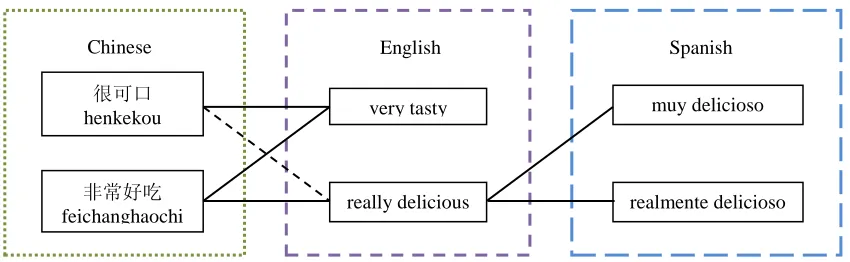
The pivot language approach, which performs translation through a third language, provides a possible solution to the problem. The triangulation method (Wu and Wang, 2007; Cohn and Lapata, 2007) is a representative work for pivot-based ma-chine translation. With a triangulation pivot ap-proach, a source-target phrase table can be obtained by combining the source-pivot phrase table and the pivot-target phrase table. However, one of the weaknesses is that some corresponding source and target phrase pairs cannot be generated, because they are connected to different pivot phrases (Cui et al., 2013). As illustrated in Figure 1, since there is no direct translation between “很
可口henkekou” and “really delicious”, the trian-gulation method is unable to establish a relation between “很可口henkekou” and the two Spanish phrases.
To solve this problem, we apply a Markov ran-dom walk method to pivot-based SMT system. Random walk has been widely used. For example, Brin and Page (1998) used random walk to dis-cover potential relations between queries and doc-uments for link analysis in information retrieval. Analogous to link analysis, the aim of pivot-based translation is to discover potential translations be-tween source and target language via the pivot language.
The goal of this paper is to extend the previous triangulation approach by exploring implicit trans-lation retrans-lations using random walk method. We evaluated our approach in several translation tasks, including translations between European lan-guages; Chinese-Spanish spoken language transla-tion and Chinese-Japanese translatransla-tion with English as the pivot language. Experimental results show that our approach achieves significant improve-ments over the conventional pivot-based method, triangulation method.
The remainder of this paper is organized as fol-lows. In section 2, we describe the related work. We review the triangulation method for pivot-based machine translation in section 3. Section 4 describes the random walk models. In section 5 and section 6, we describe the experiments and analyze the performance, respectively. Section 7 gives a conclusion of the paper.
2
Related Work
Several methods have been proposed for pivot-based translation. Typically, they can be classified into 3 kinds of methods:
Transfer Method: Within the transfer frame-work (Utiyama and Isahara, 2007; Wang et al., 2008; Costa-jussà et al., 2011), a source sentence is first translated to n pivot sentences via a source-pivot translation system, and then each source-pivot sen-tence is translated to m target sentences via a piv-ot-target translation system. At each step (source to pivot and pivot to target), multiple translation outputs will be generated, thus a minimum Bayes-risk system combination method is often used to select the optimal sentence (González-Rubio et al., 2011; Duh et al., 2011). A problem with the trans-fer method is that it needs to decode twice. On one
hand, the time cost is doubled; on the other hand, the translation error of the source-pivot translation system will be transferred to the pivot-target trans-lation.
Synthetic Method: A synthetic method creates a synthetic source-target corpus using source-pivot translation model or pivot-target translation model (Utiyama et al., 2008; Wu and Wang, 2009). For example, we can translate each pivot sentence in the pivot-target corpus to source language with a pivot-source model, and then combine the translat-ed source sentence with the target sentence to ob-tain a synthetic source-target corpus, and vice versa. However, it is difficult to build a high quali-ty translation system with a corpus created by a machine translation system.
Triangulation Method: The triangulation method obtains source-target model by combining source-pivot and pivot-target translation models (Wu and Wang, 2007; Cohn and Lapata 2007), which has been shown to work better than the oth-er pivot approaches (Utiyama and Isahara, 2007). As we mentioned earlier, the weakness of triangu-lation is that the corresponding source and target phrase pairs cannot be connected in the case that they connect to different pivot phrases.
3
The Triangulation Method
In this section, we review the triangulation method for pivot-based translation.
[image:2.612.95.520.68.199.2]With the two additional bilingual corpora, the source-pivot and pivot-target translation models can be trained. Thus, a pivot model can be ob-tained by merging these two models. In the trans-lation model, the phrase transtrans-lation probability and the lexical weight are language dependent, which will be introduced in the next two sub-sections.
Figure 1: An example of random walk on phrase table. The dashed line indicates an implicit relation in the phrase table.
非常好吃
feichanghaochi really delicious
very tasty
很可口
henkekou
realmente delicioso
Chinese English Spanish
3.1 Phrase Translation Probability
The triangulation method assumes that there exist translations between phrases
s
and phrasep
in source and pivot languages, and between phrasep
and phrase t in pivot and target languages. The phrase translation probability φ between source and target languages is determined by the following model:( | ) ( | , ) ( | )
( | ) ( | ) p
p
s t s p t p t
s p p t
φ
φ
φ
φ
φ
=
=
∑
∑
(1)3.2 Lexical Weight
Given a phrase pair ( , )s t and a word alignment
a
between the source word positions i=1,,nand the target word positions
j
=
0,1,
,
m
, the lexical weight of phrase pair ( , )s t can be calcu-lated with the following formula (Koehn et al. 2003) :( , ) 1
1
( | , ) ( | )
{ | ( , ) } n
i j i j a
i
p s t a s t
j i j a
ξ
ω
∀ ∈
=
=
∈
∑
∏
(2)In formula 2, the lexical translation probability distribution
ω
( | )s t between source words
and target wordt
can be estimated with formula 3.'
'
( , )
( | )
( , )
scount s t
s t
count s t
ω
=
∑
(3) Thus the alignmenta
between the source phrase s and target phrase t via pivot phrasep
is needed for computing the lexical weight. The alignment
a
can be obtained as follows:1 2
{( , ) |
: ( , )
& ( , )
}
a
=
s t
∃
p
s p
∈
a
p t
∈
a
(4) wherea
1 anda
2 indicate the word alignmentbe-tween the phrase pair ( , )s p and ( , )p t , respec-tively.
The triangulation method requires that both the source and target phrases connect to the same piv-ot phrase. Otherwise, the source-target phrase pair cannot be discovered. As a result, some useful translation relations will be lost. In order to allevi-ate this problem, we propose a random walk model, to discover the implicit relations among the source, pivot and target phrases.
4
Random Walks on Translation Graph
For phrase-based SMT, all source-target phrase pairs are stored in a phrase table. In our random walk approach, we first build a translation graph according to the phrase table. A translation graph contains two types of nodes: source phrase and target phrase. A source phrase s and a target phrase t are connected if exists a phrase pair
( , )s t in the phrase table. The edge can be weighted according to translation probabilities or alignments in the phrase table. For the pivot-based translation, the translation graph can be derived from the source-pivot phrase table and pivot-target phrase table.
Our random walk model is inspired by two works (Szummer and Jaakkola, 2002; Craswell and Szummer,2007). The general process of ran-dom walk can be described as follows:
Let G=( , )V E be a directed graph with
n
ver-tices andm
edges. For a vertex v V∈ ,Γ
( )
v
de-notes the set of neighbors ofv
in G. A random walk on G follows the following process: start at a vertexv
0 , chose and walk along a randomneighbor
v
1, withv
1∈Γ
( )
v
0 . At the second step, start fromv
1 and chose a random neighborv
2, and so on.Let S be the set of source phrases, and P be the set of pivot phrases. Then the nodes V are the un-ion of S and P. The edges E correspond to the rela-tions between phrase pairs.
Let R represent the binary relations between source phrases and pivot phrases. Then the 1-step translation
R
ikfrom node i to node k can be direct-ly obtained in the phrase table.Define operator ⊗ to denote the calculation of relation R. Then 2-step translation Rij from node i
to node j can be obtained with the following for-mula.
ij ik kj
R =R ⊗R (4)
We use Rt|0( | )k i to denote a t-step translation
|0
( | )
[
]
tt ik
P k i
=
A
(5) where A is a matrix whose i,k-th element isR
ik.4.1 Framework of Random Walk Approach
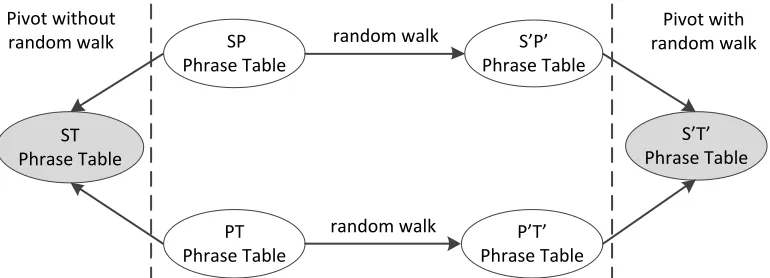
The overall framework of random walk for pivot-based machine translation is shown in Figure 2. Before using random walk model, we have two phrase tables: source-pivot phrase table (SP phrase table) and pivot-target phrase table (PT phrase ta-ble). After applying the random walk approach, we can achieve two extended phrase table: extended source-pivot phrase table (S’P’ phrase table) and extended pivot-target phrase table (P’T’ phrase table). The goal of pivot-based SMT is to get a source-target phrase table (ST phrase table) via SP phrase table and PT phrase table.
Our random walk was applied on SP phrase ta-ble or PT phrase tata-ble separately. In next 2 sub-sections, we will explain how the phrase
transla-tion probabilities and lexical weight are obtained with random walk model on the phrase table.
Figure 3 shows some possible decoding pro-cesses of random walk based pivot approach. In figure 3-a, the possible source-target phrase pair can be obtained directly via a pivot phrase, so it does not need a random walk model. In figure 3-b and figure 3-c, one candidate source-target phrase pair can be obtained by random walks on source-pivot side or source-pivot-target side. Figure 3-d shows that the possible source-target can only by ob-tained by random walks on source-pivot side and pivot-target side.
4.2 Phrase Translation Probabilities
For the translation probabilities, the binary relation
R is the translation probabilities in the phrase table. The operator ⊗ is multiplication. According to formula 5, the random walk sums up the probabili-ties of all paths of length t between the node i and
[image:4.612.108.493.75.214.2]k.
Figure 2: Framework of random walk based pivot translation. The ST phrase table was generated by combin-ing SP and PT phrase table through triangulation method. The phrase table with superscript “’” means that it
was enlarged by random walk.
S’P’ Phrase Table
P’T’ Phrase Table SP
Phrase Table
PT Phrase Table ST
Phrase Table
S’T’ Phrase Table Pivot without
random walk
Pivot with random walk random walk
[image:4.612.101.488.276.387.2]random walk
Figure 3: Some possible decoding processes of random walk based pivot approach. The □ stands for the source phrase (S); the ○ represents the pivot phrase (P) and the ◇ stands for the target phrase (T).
(a) Pivot without random walk
S P T
(d) Random walk on both sides
S P T
(b) Random walk on source-pivot side
S P T
(c) Random walk on pivot-target side
Take source-to-pivot phrase graph as an exam-ple; denote matrix A contains s+p nodes (s source phrases and p pivot phrases) to represent the trans-lation graph.
( ) ( ) ij s p s p
A g
+ × +
= (6) where gij is the i,j-th elements of matrix A.
We can split the matrix A into 4 sub-matrixes: 0
0 s s sp
ps p p
A A
A
×
×
=
(7)
where the sub-matrix Asp =[pik s p]× represents the translation probabilities from source to pivot lan-guage, and
A
ps represents the similar meaning.Take 3 steps walks as an example: Step1:
0 0
s s sp
ps p p
A A
A
×
×
=
Step2:
2 0
0
sp ps s p
p s ps sp
A A
A
A A
×
×
×
= ×
Step3:
3 0
0 s s sp ps sp
ps sp ps p p
A A A
A
A A A
×
×
× ×
= × ×
For the 3 steps example, each step performs a translation process in the form of matrix’s self-multiplication.
1. The first step means the translation from source language to pivot language. The matrix
A is derived from the phrase table directly and each element in the graph indicates a transla-tion rule in the phrase table.
2. The second step demonstrates a procedure: S-P-S’. With 2 steps random walks, we can find the synonymous phrases, and this procedure is
analogous to paraphrasing (Bannard and Callison-Burch, 2005). For the example shown in figure 1 as an example, the hidden relation between “很可口 henkekou” and “非常好吃
feichanghaochi” can be found through Step 2.
3. The third step describes the following proce-dure: S-P-S’-P’. An extended source-pivot phrase table is generated by 3-step random walks. Compared with the initial phrase table in Step1, although the number of phrases is not increased, the relations between phrase pairs are increased and more translation rules can be obtained. Still for the example in Fig-ure 1 , the hidden relation between “很可口
henkekou” and “really delicious” can be gen-erated in Step 3.
4.3 Lexical Weights
To build a translation graph, the two sets of phrase translation probabilities are represented in the phrase tables. However, the two lexical weights are not presented in the graph directly. To deal with this, we should conduct a word alignment random walk model to obtain a new alignment a
after t steps. For the computation of lexical weights, the relation R can be expressed as the word alignment in the phrase table. The operator
⊗ can be induced with the following formula.
[image:5.612.96.519.80.201.2]1 2
{( , ) | : ( , ) & ( , ) }
a= x y ∃p x z ∈a z y ∈a (8) where a1 and a2 represent the word alignment
information inside the phrase pairs ( , )x y and
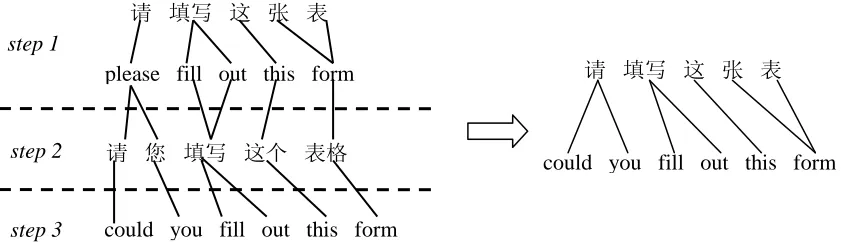
( , )y z respectively. An example of word alignment inducing is shown in Figure 4. With a new word alignment, the two lexical weights can be calculated by formula 2 and formula 3.
Figure 4: An example of word alignment induction with 3 steps random walks
请 填写 这 张 表
could you fill out this form
请 您 填写 这个 表格 please fill out this form
请 填写 这 张 表
could you fill out this form
step 1
step 2
5
Experiments
5.1 Translation System and Evaluation Met-ric
In our experiments, the word alignment was ob-tained by GIZA++ (Och and Ney, 2000) and the heuristics “grow-diag-final” refinement rule. (Koehn et al., 2003). Our translation system is an in-house phrase-based system using a log-linear framework including a phrase translation model, a language model, a lexicalized reordering model, a word penalty model and a phrase penalty model, which is analogous to Moses (Koehn et al., 2007). The baseline system is the triangulation method based pivot approach (Wu and Wang, 2007).
To evaluate the translation quality, we used BLEU (Papineni et al., 2002) as our evaluation metric. The statistical significance using 95% con-fidence intervals were measured with paired boot-strap resampling (Koehn, 2004).
5.2 Experiments on Europarl
5.2.1. Data sets
We mainly test our approach on Europarl1
We perform our experiments on different trans-lation directions and via different pivot languages. As a most widely used language in the world (Mydans, 2011), English was used as the pivot language for granted when carrying out experi-ments on different translation directions. For trans-lating Portuguese to Swedish, we also tried to perform our experiments via different pivot
corpus, which is a multi-lingual corpus including 21 Euro-pean languages. Due to the size of the data, we only select 11 languages which were added to Europarl from 04/1996 or 01/1997, including Dan-ish (da), German (de), Greek (el), EnglDan-ish (en), Spanish (es), Finnish (fi), French (fr), Italian (it) Dutch (nl) Portuguese (pt) and Swedish (sv). In order to avoid a trilingual scenario, we split the training corpus into 2 parts by the year of the data: the data released in odd years were used for train-ing source-pivot model and the data released in even years were used for training pivot-target model.
1
http://www.statmt.org/europarl/
guages. Table 1 and Table 2 summarized the train-ing data.
Language Pairs (src-pvt)
Sentence Pairs #
Language Pairs (pvt-tgt)
Sentence Pairs #
da-en 974,189 en-da 953,002 de-en 983,411 en-de 905,167 el-en 609,315 en-el 596,331 es-en 968,527 en-es 961,782 fi-en 998,429 en-fi 903,689 fr-en 989,652 en-fr 974,637 it-en 934,448 en-it 938,573 nl-en 982,696 en-nl 971,379 pt-en 967,816 en-pt 960,214 sv-en 960,631 en-sv 869,254
Table1. Training data for experiments using English as the pivot language. For source-pivot (src-pvt; xx-en) model training, the data of odd years were used. Instead
the data of even years were used for pivot-target (pvt-src; en-xx) model training.
Language Pairs (src-pvt)
Sentence Pairs #
Language Pairs (pvt-tgt)
Sentence Pairs #
pt-da 941,876 da-sv 865,020 pt-de 939,932 de-sv 814,678 pt-el 591,429 el-sv 558,765 pt-es 934,783 es-sv 827,964 pt-fi 950,588 fi-sv 872,182 pt-fr 954,637 fr-sv 860,272 pt-it 900,185 it-sv 813,000 pt-nl 945,997 nl-sv 864,675
Table2. Training data for experiments via different piv-ot languages. For source-pivpiv-ot (src-pvt; pt-xx) model
training, the data of odd years were used. Instead the data of even years were used for pivot-target (pvt-src;
xx-sv) model training.
Test Set Sentence # Reference #
WMT06 2,000 1
WMT07 2,000 1
WMT08 2,000 1
Several test sets have been released for the Europarl corpus. In our experiments, we used WMT20062, WMT20073 and WMT20084 as our test data. The original test data includes 4 lan-guages and extended versions with 11 lanlan-guages of these test sets are available by the EuroMatrix5
5.2.2. Experiments on Different Translation Directions
project. Table 3 shows the test sets.
We build 180 pivot translation systems6
The baseline system was built following the tra-ditional triangulation pivot approach. Table 4 lists the results on Europarl training data. Limited by
(including 90 baseline systems and 90 random walk based systems) using 10 source/target languages and 1 pivot language (English).
2 http://www.statmt.org/wmt06/shared-task/ 3 http://www.statmt.org/wmt07/shared-task.html 4 http://www.statmt.org/wmt08/shared-task.html 5 http://matrix.statmt.org/test_sets/list 6
Given N languages, a total of N*(N-1) SMT systems should be build to cover the translation between each language.
the length of the paper, we only show the results on WMT08, the tendency of the results on WMT06 and WMT07 is similar to WMT08.
Several observations can be made from the table. 1. In all 90 language pairs, our method achieves general improvements over the baseline system.
2. Among 90 language pairs, random walk based approach is significantly better than the baseline system in 75 language pairs.
3. The improvements of our approach are not equal in different translation directions. The im-provement ranges from 0.06 (it-es) to 1.21 (pt-da). One possible reason is that the performance is re-lated with the source and target language. For ex-ample, when using Finnish as the target language, the improvement is significant over the baseline. This may be caused by the great divergence be-tween Uralic language (Finnish) and Indo-European language (the other Indo-European language in Table4). From the table we can find that the translation between languages in different lan-guage family is worse than that in some lanlan-guage family. But our random walk approach can im-TGT
SRC da de el es fi fr it nl pt sv
Baseline
RW da -
19.83 20.15* 20.46 21.02* 27.59 28.29* 14.76 15.63* 24.11 24.71* 20.49 20.82* 22.26 22.57* 24.38 24.88* 28.33 28.87* Baseline RW de
23.35 23.69* -
19.83 20.05 26.21 26.70* 12.72 13.57* 22.43 22.78* 18.82 19.32* 23.74 24.11* 23.05 23.35* 21.17 21.27 Baseline
RW el
23.24 23.82* 18.12 18.49* - 32.28 32.48 13.31 14.08* 27.35 27.67* 23.19 23.63* 20.80 21.26* 27.62 27.86 22.70 23.15* Baseline RW es
25.34 26.07*
19.67 20.17*
27.24 27.52 -
13.93 14.61* 32.91 33.16 27.67 27.92 22.37 22.85* 34.73 34.93 24.83 25.50* Baseline RW fi
18.29 18.63* 13.20 13.40 14.72 15.00* 20.17 20.48* - 17.52 17.84* 14.76 15.01 15.50 16.04* 17.30 17.68* 16.63 16.79 Baseline
RW fr
25.67 26.51* 20.02 20.45* 26.58 26.75 37.50 37.80* 13.90 14.75* - 28.51 28.71 22.65 23.33* 33.81 33.93 24.64 25.59* Baseline RW it
22.63 23.27* 17.81 18.40* 24.24 24.66* 34.36 35.42* 13.20 14.11* 30.16 30.48* - 21.37 21.81* 30.84 30.92* 22.12 22.64* Baseline RW nl
22.49 22.76 19.86 20.45* 18.56 19.10* 24.69 25.19* 11.96 12.63* 21.48 22.05* 18.36 18.67* - 21.71 22.13* 19.83 22.17* Baseline RW pt
24.08 25.29* 19.11 19.83* 25.30 26.20* 36.59 37.13* 13.33 14.21* 32.47 32.78* 28.08 28.44* 21.52 22.46* - 22.90 23.90* Baseline
RW sv
31.24 31.75* 20.26 20.74* 22.06 22.59* 29.21 29.87* 15.39 16.13* 25.63 26.18* 21.25 21.81* 22.30 22.62* 25.60 26.09* -
prove the performance of translations between dif-ferent language families.
5.2.3. Experiments via Different Pivot Lan-guages
In addition to using English as the pivot language, we also try some other languages as the pivot language. In this sub-section, experiments were carried out from translating Portuguese to Swedish via different pivot languages.
Table 5 summarizes the BLEU% scores of dif-ferent pivot language when translating from Por-tuguese to Swedish. Similar to Table 4, our approach still achieves general improvements over the baseline system even if the pivot language has been changed. From the table we can see that for most of the pivot language, the random walk based approach gains more than 1 BLEU score over the baseline. But when using Finnish as the pivot lan-guage, the improvement is only 0.02 BLEU scores on WMT08. This phenomenon shows that the piv-ot language can also influence the performance of random walk approach. One possible reason for the poor performance of using Finnish as the pivot language is that Finnish belongs to Uralic lan-guage family, and the other lanlan-guages belong to Indo-European family. The divergence between different language families led to a poor perfor-mance. Thus how to select a best pivot language is our future work.
The problem with random walk is that it will lead to a larger phrase table with noises. In this sub-section, a pre-pruning (before random walk) and a post-pruning (after random walk) method were introduced to deal with this problem.
We used a naive pruning method which selects the top N phrase pairs in the phrase table. In our experiments, we set N to 20. For pre-pruning, we prune the SP phrase table and PT phrase table be-fore applying random walks. Post-pruning means that we prune the ST phrase table after random walks. For the baseline system, we also apply a pruning method before combine the SP and PT phrase table. We test our pruning method on pt-en-sv translation task. Table 6 shows the results.
With a pre- and post-pruning method, the ran-dom walk approach is able to achieve further im-provements. Our approach achieved BLEU scores of 25.11, 24.69 and 24.34 on WMT06, WMT07 and WMT08 respectively, which is much better
than the baseline and the random walk approach with pruning. Moreover, the size of the phrase table is about half of the no-pruning method. When adopting a post-pruning method, the per-formance of translation did not improved signifi-cantly over the pre-pruning, but the scale of the phrase table dropped to 69M, which is only about 2 times larger than the triangulation method.
Phrase table pruning is a key work to improve the performance of random walk. We plan to ex-plore more approaches for phrase table pruning. E.g. using significance test (Johnson et al., 2007) or monolingual key phrases (He et al., 2009) to filter the phrase table.
Table5. Experimental results on translating from Portu-guese to Swedish via different pivot language. RW=Random Walk. * indicates the results are
signifi-cantly better than the baseline (p<0.05).
Table6. Results of Phrase Table Filtering
trans language WMT 06 WMT 07 WMT 08 Baseline
RW pt-da-sv
23.40 24.47* 22.80 24.21* 22.49 23.75* Baseline
RW pt-de-sv
22.72 23.12* 22.21 23.26* 21.76 22.35* Baseline
RW pt-el-sv
22.53 23.75* 22.19 23.22* 21.37 22.40* Baseline
RW pt-en-sv
23.54 24.66* 23.24 24.22* 22.90 23.90* Baseline
RW pt-es-sv
23.58 24.65* 23.37 24.10* 22.80 23.77* Baseline
RW pt-fi-sv
21.06 21.17 20.06 20.42* 20.26 20.28 Baseline
RW pt-fr-sv
23.55 24.75* 23.09 24.15* 22.89 23.96* Baseline
RW pt-it-sv
23.65 24.74* 22.96 24.18* 22.79 24.02* Baseline
RW pt-nl-sv
5.3 Experiments on Spoken Language
The European languages show various degrees of similarity to one another. In this sub-section, we consider translation from Chinese to Spanish with English as the pivot language. Chinese belongs to Sino-Tibetan Languages and English/Spanish longs to Indo-European Languages, the gap be-tween two languages is wide.
A pivot task was included in IWSLT 2008 in which the participants need to translate Chinese to Spanish via English. A Chinese-English and an English-Spanish data were supplied to carry out the experiments. The entire training corpus was tokenized and lowercased. Table 7 and Table 8 summarize the training data and test data.
Table 9 shows the similar tendency with Table 4. The random walk models achieved BLEU% scores 32.09, which achieved an absolute improvement of 2.08 percentages points on BLEU over the base-line.
Corpus Sentence pair #
Source word #
Target word # CE 20,000 135,518 182,793 ES 19,972 153,178 147,560
Table 7: Training Data of IWSLT2008
Test Set Sentence # Reference #
IWSLT08 507 16
Table8. Test Data of IWSLT2008
System BLEU% phrase pairs # Baseline 30.01 143,790 +pruning 30.25 108,407 RW 31.57 2,760,439
+pre-pruning 31.99 1,845,648
+post-pruning 32.09* 1,514,694
Table9. Results on IWSLT2008
5.4 Experiments on Web Data
The setting with Europarl data is quite artificial as the training data for directly translating between source and target actually exists in the original data sets. The IWSLT data set is too small to rep-resent the real scenario. Thus we try our experi-ment on a more realistic scenario: translating from
Chinese to Japanese via English with web crawled data.
All the training data were crawled on the web. The scale of Chinese-English and English-Japanese is 10 million respectively. The test set was built in house with 1,000 sentences and 4 ref-erences.
System BLEU% phrase pairs # Baseline 28.76 4.5G +pruning 28.90 273M
RW 29.13 46G
+pre-pruning 29.44 11G
+post-pruning 29.51* 3.4G
Table10. Results on Web Data
Table 10 lists the results on web data. From the table we can find that the random walk model can achieve an absolute improvement of 0.75 percent-ages points on BLEU over the baseline.
In this subsection, the training data contains parallel sentences with different domains. And the two training corpora (Chinese-English and Eng-lish-Japanese) are typically very different. It means that our random walk approach is robust in the realistic scenario.
6
Discussions
The random walk approach mainly improves the performance of pivot translation in two aspects: reduces the OOVs and provides more hypothesis phrases for decoding.
6.1 OOV
Out-of-vocabulary (OOV7
We count the OOVs when decoding with trian-gulation model and random walk model on IWSLT2008 data. The statistics shows that when using triangulation model, there are 11% OOVs when using triangulation model, compared with 9.6% when using random walk model. Less OOV often lead to a better result.
) terms cause serious problems for machine translation systems (Zhang et al., 2005). The random walk model can reduce the OOVs. As illustrated in Figure 1, the Chinese phrase “很可口henkekou” cannot be connected to any Spanish phrase, thus it is a OOV term.
7
6.2 Hypothesis Phrases
To illustrate how the random walk method helps improve the performance of machine translation, we illustrate an example as follows:
- Source: 我想要枕头
wo xiang yao zhentou - Baseline trans: Quiero almohada
- Random Walk trans: Quiero una almohada
For translating a Chinese sentence “我想要枕头
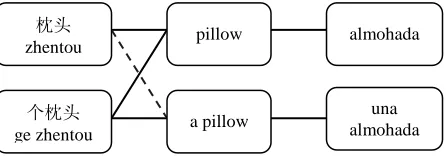
wo xiang yao zhentou” to Spanish, we can get two candidate translations. In this case, the random walk translation is better than the baseline system. The key phrase in this sentence is “枕头 zhentou”, figure 5 shows the extension process. In this case, the article “a” is hidden in the source-pivot phrase table. The same situation often occurs in articles and prepositions. Random walk is able to discover the hidden relations (hypothesis phrases) among source, pivot and target phrases.
7
Conclusion and Future Work
In this paper, we proposed a random walk method to improve pivot-based statistical machine transla-tion. The random walk method can find implicit relations between phrases in the source and target languages. Therefore, more source-target phrase pairs can be obtained than conventional pivot-based method. Experimental results show that our method achieves significant improvements over the baseline on Europarl corpus, spoken language data and the web data.
A critical problem in the approach is the noise that may bring in. In this paper, we used a simple filtering to reduce the noise. Although the filtering method is effective, other method may work better. In the future, we plan to explore more approaches for phrase table pruning.
Acknowledgments
We would like to thank Jianyun Nie, Muyun Yang and Lemao Liu for insightful discussions, and three anonymous reviewers for many invaluable comments and suggestions to improve our paper. This work is supported by National Natural Sci-ence Foundation of China (61100093), and the Key Project of the National High Technology Re-search and Development Program of China (2011AA01A207).
References
Colin Bannard and Chris Callison-Burch. 2005. Para-phrasing with Bilingual Parallel Corpora. In Pro-ceedings of the 43rd Annual Meeting of the Association for Computational Linguistics, pages 597-604
Sergey Brin and Lawrence Page. 1998. The Anatomy of a Large-Scale Hypertextual Web Search Engine. In Proceedings of the Seventh International World Wide Web Conference
Trevor Cohn and Mirella Lapata. 2007. Machine Trans-lation by TrianguTrans-lation: Make Effective Use of Mul-ti-Parallel Corpora. In Proceedings of 45th Annual Meeting of the Association for Computational Lin-guistics, pages 828-735.
Marta R. Costa-jussà, Carlos Henríquez, and Rafael E. Banchs. 2011. Enhancing Scarce-Resource Language Translation through Pivot Combinations. In Proceed-ings of the 5th International Joint Conference on Natural Language Processing, pages 1361-1365
Nick Craswell and Martin Szummer. 2007. Random Walks on the Click Graph. In Proceedings of the 30th annual international ACM SIGIR conference on Research and development in information retrieval, pages 239-246
Yiming Cui, Conghui Zhu, Xiaoning Zhu, Tiejun Zhao and Dequan Zheng. 2013. Phrase Table Combination Deficiency Analyses in Pivot-based SMT. In Pro-ceedings of 18th International Conference on Appli-cation of Natural Language to Information Systems, pages 355-358.
Kevin Duh, Katsuhito Sudoh, Xianchao Wu, Hajime Tsukada and Masaaki Nagata. 2011. Generalized Minimum Bayes Risk System Combination. In Pro-ceedings of the 5th International Joint Conference on Natural Language Processing, pages 1356–1360
[image:10.612.75.298.348.426.2]Jesús González-Rubio, Alfons Juan and Francisco Casacuberta. 2011. Minimum Bayes-risk System Figure 5: Phrase extension process. The dotted line
indicates an implicit relation in the phrase table. 个枕头
ge zhentou
枕头
zhentou pillow
a pillow
almohada
Combination. In Proceedings of the 49th Annual Meeting of the Association for Computational Lin-guistics, pages 1268–1277
Zhongjun He, Yao Meng, Yajuan Lü, Hao Yu and Qun Liu. 2009. Reducing SMT Rule Table with Mono-lingual Key Phrase. In Proceedings of the ACL-IJCNLP 2009 Conference Short Papers, pages 121-124
Howard Johnson, Joel Martin, George Foster, and Ro-land Kuhn. 2007. Improving translation quality by discarding most of the phrase table. In Proceedings of the 2007 Joint Conference on Empirical Methods in Natural Language Processing and Computational Natural Language Learning, pages 967–975.
Philipp Koehn, Franz J. Och, and Daniel Marcu. 2003. Statistical Phrase-Based Translation. In HLT-NAACL: Human Language Technology Conference of the North American Chapter of the Association for Computational Linguistics, pages 127-133
Philipp Koehn. 2004. Statistical significance tests for machine translation evaluation. In Proceedings of the 2004 Conference on Empirical Methods in Natural Language Processing (EMNLP), pages 388–395.
Philipp Koehn. 2005. Europarl: A Parallel Corpus for Statistical Machine Translation. In Proceedings of MT Summit X, pages 79-86.
Philipp Koehn, Hieu Hoang, Alexanda Birch, Chris Callison-Burch, Marcello Federico, Nicola Bertoldi, Brooke Cowan, Wade Shen, Christine Moran, Rich-ard Zens, Chris Dyer, Ondrej Bojar, Alexandra Constantin, and Evan Herbst. 2007. Moses: Open Source Toolkit for Statistical Machine Translation. In Proceedings of the 45th Annual Meeting of the Association for Computational Linguistics, demon-stration session, pages 177–180.
Franz Josef Och and Hermann Ney. 2000. A compari-son of alignment models for statistical machine translation. In Proceedings of the 18th International Conference on Computational Linguistics, pages 1086–1090
Kishore Papineni, Salim Roukos, Todd Ward and Wei-Jing Zhu. 2002. BLEU: a Method for Automatic Evaluation of Machine Translation. In Proceedings of the 40th Annual Meeting of the Association for Computation Linguistics, pages 311-319
Karl Pearson. 1905. The Problem of the Random Walk. Nature, 27(1865):294
Mydans, Seth. 2011. Across cultures, English is the word. New York Times.
Martin Szummer and Tommi Jaakkola. 2002. Partially Labeled Classification with Markov Random Walks. In Advances in Neural Information Processing Sys-tems, pages 945-952
Kristina Toutanova, Christopher D. Manning and An-drew Y. Ng. 2004. Learning Random Walk Models for Inducting Word Dependency Distributions. In Proceedings of the 21st International Conference on Machine Learning.
Masao Utiyama and Hitoshi Isahara. 2007. A Compari-son of Pivot Methods for Phrase-Based Statistical Machine Translation. In Proceedings of Human Language Technology: the Conference of the North American Chapter of the Association for Computa-tional Linguistics, pages 484-491
Masao Utiyama, Andrew Finch, Hideo Okuma, Michael Paul, Hailong Cao, Hirofumi Yamamoto, Keiji Ya-suda, and Eiichiro Sumita. 2008. The NICT/ATR speech Translation System for IWSLT 2008. In Pro-ceedings of the International Workshop on Spoken Language Translation, pages 77-84
Haifeng Wang, Hua Wu, Xiaoguang Hu, Zhanyi Liu, Jianfeng Li, Dengjun Ren, and Zhengyu Niu. 2008. The TCH Machine Translation System for IWSLT 2008. In Proceedings of the International Workshop on Spoken Language Translation, pages 124-131
Hua Wu and Haifeng Wang. 2007. Pivot Language Ap-proach for Phrase-Based Statistical Machine Transla-tion. In Proceedings of 45th Annual Meeting of the Association for Computational Linguistics, pages 856-863.
Hua Wu and Haifeng Wang. 2009. Revisiting Pivot Language Approach for Machine Translation. In Proceedings of the 47th Annual Meeting of the Asso-ciation for Computational Linguistics and the 4th IJCNLP of the AFNLP, pages 154-162