R E S E A R C H
Open Access
Improved coverage in WSNs by exploiting spatial
correlation: the two sensor case
Michalis Michaelides
*and Christos G Panayiotou
Abstract
One of the main applications of Wireless Sensor Networks (WSNs) is area monitoring. In such problems, it is desirable to maximize the area coverage. The main objective of this work is to investigate collaborative detection schemes at the local sensor level for increasing the area coverage of each sensor and thus increasing the coverage of the entire network. In this article, we focus on pairs of nodes that are closely spaced and can exchange
information to decide their collective alarm status in a decentralized manner. By exploiting their spatial correlation, we show that the pair can achieve a larger area coverage than the two individual sensors acting alone. Moreover, we analyze the performance of different collaborative detection schemes for a pair of sensor nodes and show that the area coverage achieved by each scheme depends on the distance between the two sensors.
Keywords:Wireless Sensor Networks, area monitoring, coverage, distributed detection, spatial correlation
Introduction
This article investigates a Wireless Sensor Network (WSN) for monitoring a large area for the presence of an event source that releases a certain signal or sub-stance in the environment which is then propagated over a large area. This sensor network can deal with a number of environmental monitoring and tracking applications including acoustic source localization, toxic source identification and early detection of fires [1-3]. In this context, a large number of sensor nodes is deployed in the field and the objective is to maximize the area coveragea. In order to maximize the area coverage one can optimally place the sensor nodes and/or increase the detection range of the sensors while maintaining a fixed false alarm probability. This article considers the latter by investigating different collaboration schemes between neighboring nodes. For the environmental monitoring applications, sensor observations are expected to be highly correlated in the space domain [4]. In other words, sensors that are located close to each other are very likely to record “similar” measure-ments. The objective of this work is to take advantage of the correlation in order to increase the collective
coverage range of a pair of sensors while maintaining a fixed false alarm probability.
In a typical scenario, the event source emits a signal and its energy attenuates uniformly in all directions and can be measured only by the sensor nodes located in the vicinity of the source. On the other hand, sensor nodes that are located far away from the source do not receive any signal information so their measurements are based on noise alone. Furthermore, the sensor mea-surements are spatially correlated based on the distance from the source and the distance from each other. At this point, we should emphasize that the fact that only a small subset of the sensor nodes receives signal energy information of variable strength based on their location relative to the source makes the detection problem in WSNs significantly different than any related work for radar/sonar applications (see [5,6] and references therein). In such applications, the system requirements will specify a system (overall) false alarm rate (PF).
Given the expected noise level and the fusion rule at the fusion center (sink) one can determine the maximum acceptable false alarm probability of each individual or pair of sensors (Pf) which will then determine their
cov-erage range. Traditionally, the sensing covcov-erage of a sen-sor node has been represented by a disc around the sensor node location inside which the energy measured from the event exceeded a threshold [7-12]. In this * Correspondence: [email protected]
KIOS Research Center for Intelligent Systems and Networks and Department of Electrical and Computer Engineering, University of Cyprus, Nicosia, Cyprus
context each sensor node would employ an energy detector (ED) to decide whether to become alarmed and then at the fusion center the decisions from all alarmed sensor nodes would be combined using a counting rule to decide the overall detection of the event [13].
In this article, we consider various collaboration schemes that can be employed by a pair of nodes. A straightforward solution would be for each sensor node to use the ED so that each individual node would determine its alarm status and then the pair would determine its collective decision using an ANDor an OR rule. Another possibility is for the pair to exchange all of their measurements and decide its alarmed status based on the sample covariance. This is referred to as the covariance detector (CD). In this article, we also consider a hybrid detection scheme (the enhanced cov-ariance detector (ECD)) that combines the strengths of the ED and the CD for closely spaced sensor nodes. By utilizing two different thresholds, one for each detector used, the ECD can improve the overall coverage while attaining the same probability of false alarms as any individual detector. An important outcome of this work is that it shows that the area coverage achieved by each collaborative detection scheme depends on the distance between the two sensors. When the two sen-sors are located relatively close to each other, ECD achieves better coverage whereas when the two sensors are spaced further apart, the ED with an OR fusion rule can achieve better results. Therefore, for monitor-ing applications one can organize the sensors of the field into pairs (e.g., closest neighbors) and each pair will decide its alarm status using the best detection algorithm given their relative distance. The corner-stone of this approach is that closely spaced sensors can take advantage of the possible correlation in their measurements to reduce the false alarm probability and extend their coverage.
In summary, the contribution of this work is that it investigates collaborative detection schemes between pairs of closely spaced sensor nodes and shows that the choice of which scheme to use should depend on the distance between the nodes. Furthermore, for the different detection schemes considered in this article, we provide an in-depth analysis of their performance both in terms of detection and false alarm probabil-ities as well as coverage. A shorter version of this work introducing the different collaborative detection schemes has appeared in [14]. Our results indicate that the proposed hybrid detection scheme (the ECD) combines the strengths of the ED and the CD and achieves the best coverage for closely spaced sensor nodes.
The article is organized as follows. In Sect. II, we pre-sent the model we have adopted and the underlying
assumptions. Then, in Sect. III, we present the details of the optimal detector (OD), the ED, the CD and the ECD as they apply to a pair of sensor nodes. Section IV analyzes the area coverage for each of the detectors. Section V presents several simulation results. In Section VI, we review related work in distributed detection, cov-erage and spatial correlation in sensor networks. We conclude with Section VII, where we also present plans for future work.
Signal propagation model
For the remaining of this article we make the following assumptions:
(1) A set ofNsensor nodes (N) is uniformly spread over a rectangular field of area A. The nodes are assumed stationary. The position of each node is denoted by (xi,yi),i= 1, ...,N.
(2) The network is connected in the sense that each node has at least one path to the fusion center (sink).
(3) If present, the source of the event is located at a position (xs,ys) insideA. The signal generated at the
source location is normally distributed N(0, σ2 S). The signal energy attenuates uniformly in all direc-tions from the source and is modeled by a Gaussian space-time-varying processs(x, y,t). Since only spa-tial correlation is considered, we assume that the samples received at each sensor node location are temporally independent.
All assumptions are quite common and reasonable for sensor networks. Assumption 3 defines a signal energy model that is appropriate for a variety of pro-blems where we use a WSN to monitor the environ-ment, since sensor observations are expected to be highly correlated in the space domain [4]. Each observed sample Zi, t, of sensor node i at time t is
represented as:
Zi,t=Si,t+Wi,t (1)
i = 1, ..., N, t = 1, ..., M, where M is the number of measurements taken by a sensor.Si, tis the realization
of a space-time-varying process s(x, y,t), i.e., it is the sample at sensorilocated at a position (xi,yi) at timet.
Furthermore,Wi,tis a sequence of i.i.d. Gaussian
ran-dom variables with zero mean and variance σW2 (white noise).
The random variables Si, t model the signal that is
received by the sensors due to the source. Clearly, if no source is present thenSi,t≡0 for alli,tthus the sensor
nodes measure only noise (Wi, t). On the other hand, if
sensoriwill depend on the distance of the sensor from the source. Specifically, we assume that
E[Si,t] = 0 (2)
E[S2i,t] =σS2C2(λv, ri) (3)
E[Si,tSj,t] =σS2C(λv, ri)C(λv, rj)C(λc, dij) (4) wheredijis the Euclidean distance between the sensor
nodesi and jand ri is the distance of nodei from the
source, i.e.,ri=
(xi−xs)2+ (yi−ys)2. Furthermore, |C (l, r)| is a decreasing function of the distance r such that limr®∞ C(l, r) = 0. For the purposes of this article
we assume that
C(λ, r) =e− r
λ (5)
l> 0, however, we point out that other functions are also possible, e.g., see [4]. The constantslvandlcin (3),
(4) can be chosen according to the physical event propa-gation model. The first, reflects the rate at which the sig-nal energy (variance) attenuates as a function of the radial distance from the sourcer. The second, reflects the expected correlation between the signals received (excluding noise) by two sensor nodesiandjbased on the separation distance between themdij. For a variety of
problems where WSNs are used to monitor the environ-ment, sensor observations are expected to be highly cor-related in the space domain [4]. In other words, sensors that are located close to each other are very likely to record“similar”measurements. The signal propagation model used in this article is chosen to reflect this“ simi-larity”. Measurements of sensors that are close to each other and close to the source are correlated. On the other hand, sensor nodes that are located far away from the source do not receive any signal information; so even if they happen to fall next to each other their measure-ments are based on uncorrelated noise alone.
Collaborative pairwise detection schemes
For the remaining of this article, we concentrate on a single pair of sensor nodes that w.l.o.g. are assumed to be located on the horizontal axis in the middle of the fieldA and are placed at a distance d apart (at points
(−d
2, 0)and d
2, 0
.). Under the modeling assumptions
used in this article, the detection problem can be mathe-matically described as,
H0:z=w
H1:z=s+w
wheres∼N(0,Cs,w∼N(0,σW2I), andsandware inde-pendent. The signal covariance matrixCs can be calcu-lated using (2)-(5) as,
Cs=σS2e
−r1+r2 λv
⎛ ⎜ ⎜ ⎜ ⎝
e− r1−r2
λv e− d
λc
e− d
λc e
−r2−r1 λv
⎞ ⎟ ⎟ ⎟
⎠. (6)
For detecting the presence of an event in the field using the pair of sensors, we investigate two different categories of collaborative detection schemes. In the first category, we have classical detection schemes that employ asingletest statistic: the OD, the ED with either theANDor the ORfusion rules and the CD. In the sec-ond category we introduce a hybrid detection scheme that appropriately fuses the results from two different test statistics: the ECD. For each detector, one of the two sensors (referred to as the leader) collects the required information and computes the test statistic.
Definition 1:A sensor is“alarmed” if the value of the test statisticT (depending on the detection algorithm) exceeds a pre-determined threshold.
Next, we present the specifics of each detector below and derive analytical expressions that approximate their performance (in terms of probability of false alarm and detection).
Optimal detector
Assuming the two nodes are synchronized and all signal measurements are available at the leader, the modeling assumptions of this article lead to the general Gaussian detection problem. The test statistic for the OD for this problem is given in [15] as:
TOD=
1
M M
t=1
z[t]TCs(Cs+σW2I)−1z[t]γo (7)
where z[t]T = [Z1,t, Z2,t] are the sensor
measure-ments andgo is the threshold calculated in a
Neyman-Pearson formulation to achieve a pre-specified prob-ability of false alarms constrain. The detection perfor-mance of the OD (also known in the literature as estimator-correlator or Wiener filter) is in general dif-ficult to obtain analytically [15]. However, for a large number of samples M, using the Central Limit Theo-rem (CLT), the test statistic in (7) has a Gaussian dis-tribution that depends on the underlying hypothesis. Under the H0 hypothesis, the probability of false
alarms is given by
Pf|OD=Pr{TODγo|H0}=Q
γ
o−μ0|OD
σ0|OD
where
μ0|OD=σW2(b11+b22) (9)
σ2 0|OD=
2
Mσ 4 W
b211+b222+1
2(b12+b21)
2
(10)
are the mean and the variance of the OD test statistic under H0 and [bij] for i, j= 1, 2 are the entries of the
B=Cs(Cs+σ2
WI)−1matrix in (7). Using the above equa-tions, the threshold go can be calculated such that the
pair’s probability of false alarms constrainPf|OD=afor
a specific source location and distribution as,
γo=σ0|ODQ−1(α) +μ0|OD (11)
The probability of detection can then be obtained numerically using this threshold.
The drawback of the OD is that it requires complete knowledge of the signal distribution (through the matrix Cs) and it is thus impractical for the problem under investigation. Even if we use a grid based exhaustive search method to detect a source at all possible source locations on the grid, we still have to assume knowledge of the signal variance σ2
S and calculate a different threshold for each possible source location.
The OD performance is optimal using a Neyman-Pearson formulation [15]. In other words, given a fixed probability of false alarms, the OD can achieve the highest detection probability than any other detector that uses any other test statistic and any other thresh-old. However, this result only applies to detection schemes that use a singletest statistic. In fact, ECD, the hybrid detection scheme proposed in this article, under certain conditions can outperform the OD by fusing together information from two different test statistics (see Sect. V).
Energy detector
For the ED each sensor independently decides first its alarm status based on its own measurements. Then, the 1-bit decisions are gathered at the leader where the detection decision of the pair is decided using anAND or an OR fusion strategy. Using theAND fusion rule, the pair decides that it has detected the event if both sensors are alarmed, while using theOR strategy detec-tion is decided if at least one of the sensor nodes becomes alarmed.
The test statistic used by each sensor is the sample variancebof the measurements compared to a constant thresholdge,
TED=
1
M M
t=1
Z2i,t γe (12)
At this point we should clarify that a different thresholdgeapplies for each fusion rule. Strictly
speak-ing, the test statistic is c-distributed, however, for large enough M, the CLT applies and so the distribution of the test statistic is approximated by a normal distribu-tion which can simplify the computadistribu-tion of the appro-priate threshold ge such that the false alarm
requirement is satisfied. Using the CLT, the probabil-ities of false alarm pf|ED and detectionpd|ED of the ED
for asinglenode are given by
pf|ED=Q
γe−Mσ02|ED √
2Mσ02|ED
(13)
pd|ED=Q
γe−M(σ02|ED+σ12|ED) √
2M(σ2
0|ED+σ12|ED)
(14)
where
σ2 0|ED=
σ2 W
M (15)
σ2 1|ED=
σ2 Se
−2r λv M
(16)
and Q(x) = √1 2π
∞
x exp(− y2
2)dy is the right-tail
probability of a Gaussian random variable N (0, 1) [15]. 1) Fusion rules for the ED:Next, we consider the case where the decisions of the two sensor nodes are com-bined. UnderH0 the decisions of the two sensor nodes
are independent and the pair’s probability of false alarm for the two fusion rules AND(∧) andOR(∧) are:
Pf∧|ED=p2
f|ED (17)
Pf∨|ED= 1−(1−pf|ED)2 (18)
Using a Neyman-Pearson formulation we setP(.)f|ED=α
and using (13) we can derive the threshold that each node in the pair should use depending on the fusion rule.
γ∧
e =
2σ4
W
M Q
−1(√α) +σ2
W (19)
γ∨
e =
2σ4
W
M Q
−11−√1−α+σ2
W (20)
probability of false alarma, we need to haveγe∧< γe∨. In other words, the ANDrule requires a smaller thresh-old than theOR rule. This observation will become sig-nificant when we study the coverage of the detectors in Sect. IV.
UnderH1, the test statistics of the two sensor nodes 1
and 2 for large M become 2 correlated Gaussian ran-dom variables TED|1andTED|2. To derive the system probability of detection for the ED for the two fusion rules we first make the following observation. TheOR
fusion rule can be thought of as max
{TED|1, TED|2}γe∨while the AND fusion rule is min {TED|1, TED|2}γe∧. The exact distribution of the Max and Min of two correlated Gaussian random variables is given in [16] which can be used to obtain the probability of detection for the pair of nodes under the different fusion rules.
Covariance detector
For the CD, we assume that the two sensor nodes can synchronize their measurements over the next time interval. For the synchronization we are assuming a lightweight scheme like the one proposed in [17] where a pair-wise synchronization is achieved with only three messages. Then, the leader node receives the measure-ments of the other sensor and computes the following test statistic:
TCV=
1
M M
t=1
(Z1,t−Z1)×(Z2,t−Z2)
γc (21)
where Zi=
1
M
M
t=1Zi,t. The test statistic used is the
sample covariance of the measurements between the two sensor nodes compared to a constant threshold gc.
Note that (21) exploits the correlation between the mea-surements of two sensors that are located close to each other.
For large M, again using the CLT, the test statistic in (21) has a Gaussian distribution that depends on the underlying hypothesis:
TCV∼
N (0, σ2
0|CD), underH0
N(μ1|CD, σ12|CD), underH1
For the model under investigation,
σ2 0|CD=
σ4 W
M (22)
μ1|CD=σS2e
−(r1+r2
λv +d
λc
) (23)
whileσ12|CDis obtained numerically.
Under the H0 hypothesis, the probability of false
alarms for the pair of sensor nodes 1 and 2, is given by
Pf|CD= Pr{TCVγc|H0}=Q
γ
c
σ0|CD
(24)
where s0|CDis given by (22). Using the above
equa-tion, the thresholdgc can be calculated to attain a
prob-ability of false alarms constrainPf|CD=a,
γc=
σ4
W
MQ
−1√α (25)
It is worth pointing out that the threshold obtained by the CD may be much lower (depending on the noise variance σ2
W) than the one obtained for the ED in the previous section to attain the same Pf–compare the
above equation with (19) and (20). Under H1, again
using the CLT, the probability of detection for the pair of sensor nodes is given as a function of the threshold gcby
Pd|CD=Pr{TCVγc|H1} ≈Q
γ
c−μ1|CD
σ1|CD
(26)
where μ1|CD is given by (23) and s1|CD is obtained
numerically.
Enhanced covariance detector
The proposed ECD uses two test statistics; the ED test statistic (12) and the CD test statistic (21) using the fol-lowing fusion rule.
{TCDγc2} ∧ {(TED|1γ
∨
e2)∨(TED|2γ
∨
e2)}. (27)
In other words, a pair of sensors will become alarmed only if the sample covariance measured by the pair exceeds a thresholdγc2(different than the threshold
used by the CD alone) and if either of the sensors becomes alarmed using the ED (i.e., if the recorded sam-ple variance exceedsγe∨2, different from the
correspond-ing ED threshold). The test statistic is computed by any one of the two sensor nodes. The two thresholds, γc2
andγe∨2are computed using P
∨
f|ED= √
α and Pf|CD=√α for the individual detectors ED and CD, respectively, using (20) and (25). This ensures that the pair’s
prob-ability of false alarms for the ECD will be
Coverage area analysis
In this section we formally define the coverage area of the pair of sensors in terms of the Pf and the Pd. We
show that the coverage area shape and size depends on the underlying fusion rule.
Definition 2: Given the acceptable false alarm prob-ability for each pair isPf=a,“Coverage Area“denotes
the area around the sensor locations where if a source is present it will be detected by the pair with probability Pd 12.
This area is a function of the detection algorithm and the threshold used. When the test statistic has a Gaus-sian distribution∼N(μ1, σ12)under theH1hypothesis,
the coverage area can also be represented by
Pd=Q
μ
1−γ
σ1
1
2 ⇒μ1γ (28)
wheregis the appropriate detection threshold. Note that defining the coverage area asPd 12, is just a con-vention used to facilitate the graphical analysis. In this way, for symmetric distributions (e.g., Gaussian), the cov-erage area shape becomes simply a function of the mean. Next we investigate the coverage area for each detector.
Energy detector
From (28) and using (14), we can calculate the coverage area of a single sensor using the ED which becomes a disc around the sensor node location with radius Re
given by
pd|ED= 1 2⇒σ
2
Se −2Re
λv +σ2
W=γe⇒Re=λ v
2ln
σ2
S
γe−σW2
. (29)
Note that Reis a function of the detection threshold
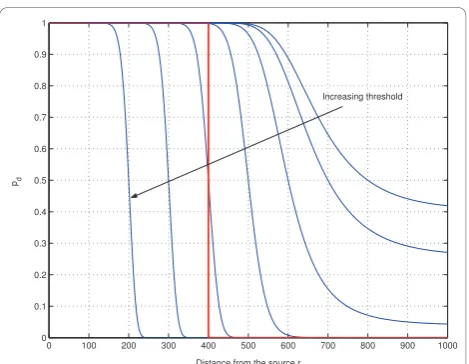
ge. Figure 1 displays pd|EDversus the distance from the
sourcer for different values of the threshold ge. From
the figure, it becomes evident that as the thresholdgeis
increased, the pd|ED curve can be approximated by a
step function;pd|EDis close to one when the source falls
inside the sensor coverage disc while it sharply falls if the source is outside. In order to achieve a fairly small false alarm probability, which is desirable in the context of monitoring applications, it is desirable to select a threshold such that the probability of detection falls to zero when the source is at a distance from the sensor; the larger the threshold the sooner the cutoff appears and the lower the false alarm probability. Assuming that pd|EDtakes the form of the step function (see Figure 1),
then the coverage area of the pair depends on the fusion rule used. The coverage area is given by the union and intersection between two circles for theAND(∧) andOR (∧) fusion rules, respectively, (see Figure 2c). Note from the figure that the discs for the AND(∧) have a larger
radius than the ones for theOR(∧) fusion rule. The rea-son comes from (19) and (20) where we clearly see that givenPf=awe getγe∧< γe∨.
Next we argue that the fusion rule to be used by a pair depends on the distancedbetween the two sensors. Let Ae=πR2e denote the coverage area of a single sensor node whereReis given by (29). Also, letA∧e denote the combined coverage area of two sensor nodes using the ANDfusion rule and A∨e the coverage area of two sensor nodes using the OR fusion rule. As argued above, A∧e >A∨e. When the distance between the two sensors is zero, both the union and intersection of the circles are the circles themselves, thus the coverage area of the AND rule (A∧e)is larger. On the other hand, as the
0 100 200 300 400 500 600 700 800 900 1000
0 0.1 0.2 0.3 0.4 0.5 0.6 0.7 0.8 0.9 1
Distance from the source r pd
Increasing threshold
Figure 1Probability of detection vs. distance from the sourcer
for a single sensor using the ED for different values of the thresholdge.
$H25
$H$1'
G
Figure 2Graphical representation (not drawn to scale) of the coverage area of two sensor nodes separated by a distanced
distance is increased, there is a distance where the two circles become disjoint and coverage area of the pair becomes zero, while the coverage area of the pair that uses theOR rule achieves its maximum equal to2A∨e. In fact, there exists a distanced¯where the two fusion rules have identical performance. For d<d¯ the AND rule achieves better coverage whereasd>d¯ for the ORrule becomes superior.
Covariance detector
According to (28) and (23) and given the threshold gc,
the perimeter of the coverage area by the two sensors is given by
σ2 Se
−( r
λv +d
λc )
=γc.
where r = r1 + r2. Note that it is necessary that
σ2
S > γcsince e−
( r
λv +d
λc )
1for anyr, d≥ 0,lv, lc> 0.
Taking logarithms on both sides and rearranging terms,
r=λv(lnσ 2 S
γc − d
λc
) = 2a (30)
Equation 30 is an ellipse with general equation
x2 a2 +
y2 a2−d2
4
= 1. (31)
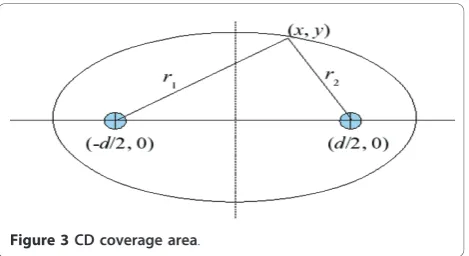
and therefore the area covered by a sensor that uses the CD is given by
Ac=πa
a2− d 2
4.
(32)
Note that for (32) it is necessary thatd <2a. Ifd= 0, i.e., the two sensors are located at the same point, then the coverage area is a circle with radius a. Also note that the maximum coverage area is achieved when d= 0. In other words, two sensors that use the CD can achieve their maximum coverage when they are located at exactly the same point.
Enhanced covariance detector
The ECD essentially takes the intersection of the cover-age areas of two detectors: the CD (ellipse shown in Figure 3) and the ED using theORfusion rule (union of two circles shown in Figure 2). This intersection opera-tion allows the threshold of each detector to decrease and the individual coverage area to increase without affecting the system probability of false alarms. Since the coverage areas of the two detectors have similar shape for closely spaced sensor nodes, taking the inter-section of the increased individual coverage areas of the
two detectors can improve the coverage area when using the ECD.
Simulation results
For all subsequent experiments, we use a square field of 500 × 500 with two sensors placed in the middle of the field separated by a horizontal distance d. We assume that the sensor measurements are given by the propaga-tion model in Sect. II, withλv=λc= 200, σW2 =σS2= 10 and M= 100. The thresholds for all detectors are calcu-lated using the equations derived in Sect. III, to obtain a probability of false alarmsPf=a in a Neyman-Pearson
formulation. To obtain the experimental probability of detection (Pd), we take the average over a grid of
possi-ble source locations that cover the entire field. For each source location we use 500 Monte-Carlo simulations. For all experiments we use Matlab.
Figure 4 shows the performance of the different detec-tors for Pf = 0.01 as we vary the horizontal separation
distancedbetween the two sensor nodes. From the plot it is evident that for all detectors, the analytical approxi-mations for the probability of detection–derived in Sect.
Figure 3CD coverage area.
0 50 100 150 200
0 0.05 0.1 0.15 0.2 0.25 0.3 0.35 0.4
Separation distance d between the 2 sensor nodes Pdet
ED (OR) Analytical ED (AND) Analytical ECD Analytical CD Analytical ED (OR) Experimental ED (AND) Experimental ECD Experimental CD Experimental OD Experimental
Figure 4Probability of detection vs. separation distanced
III–are very close to the experimental results obtained. The ECD outperforms the other distributed schemes for d <120 while for greater separation distancesd the ED with the ORfusion rule becomes the best option. The OD is also shown on the same plot for comparison pur-poses. To calculate the performance of the OD, we first used (8-10) to calculate the threshold for each different source location. Then, the probability of detection was obtained numerically using these thresholds. It is inter-esting to note that the hybrid detection scheme ECD proposed in this article outperforms the OD ford <40. Remember that the OD refers to a single test statistic compared to a single threshold but assumes full knowl-edge of the event location and distribution while ECD uses two test statistics with two different thresholds.
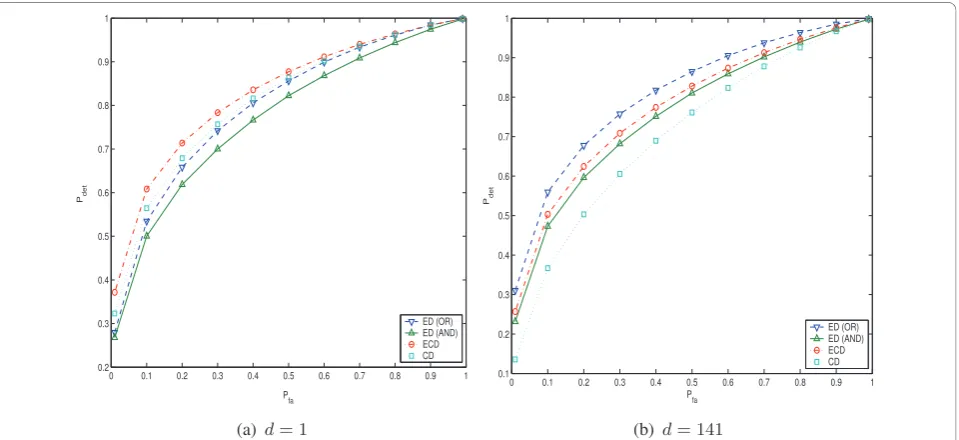
Next, Figure 5 displays the ROC curves for the differ-ent pair detectors for two differdiffer-ent separation distances dbetween the two sensor nodes. For small d, the ECD achieves the better results while for largedthe ED with theORfusion rule is the best option.
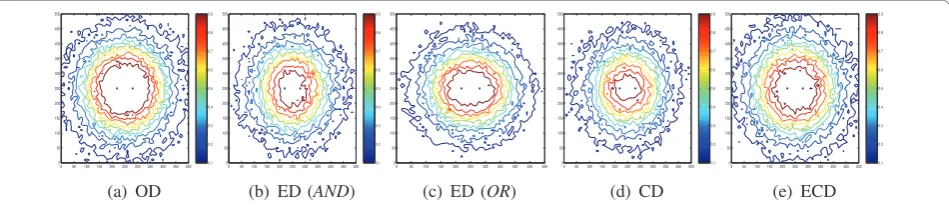
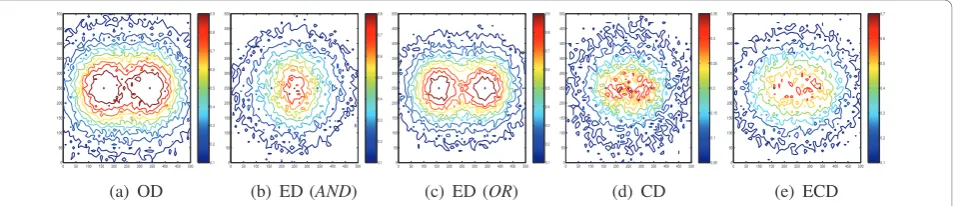
Finally, Figures 6, 7, 8, and 9 show snapshots of the coverage of the different detectors for the specified values ofd for the test scenario displayed in Figure 4. There are several things to notice from these plots that are consistent with the analysis in Sect. IV: 1. When the sensor nodes are very close to each other (see Figure 6), the coverage area for all detectors is a circle around the location of the sensor nodes. For this case the hybrid detector ECD has the best coverage followed by CD that essentially achieves the optimal performance (OD). It is also interesting to note that for this case, ED(AND)
achieves slightly better coverage than ED(OR). 2. As the separation distance between the two sensor nodes is increased (see Figures 7, 8), the coverage area of the CD becomes an ellipse around the sensor nodes’ locations and looks very similar to the one of ED(OR)–this explains the motivation behind using the ECD. Please note that while the coverage area of the OD and the ED (OR) increases, the coverage area of all other detectors decreases since they depend on either covariance infor-mation–CD, ECD–or simultaneous detection by the two sensor nodes–ED(AND). 3. When the sensor nodes are sufficiently apart (see Figure 9) the optimal coverage area becomes two circles around the individual sensor nodes’positions. This is closely resembled by ED(OR) which achieves the best coverage out of the distributed detectors. The other detectors do not perform well for this case–this is expected because their performance is based on closely spaced sensor nodes.
Preliminary simulation results with 100 randomly deployed sensors
In this section we present some preliminary results for the case where we have 100 randomly deployed sensor nodes to cover a 1000 × 1000 area. Other than that we use the simulation parameters of the previous section. Furthermore, we assume that the fusion center uses a counting rule, thus it decides detection if at leastK sen-sors/pairs become alarmed. Figure 10 displays the ROC curves for the different detectors.s1 - ED refers to the case where each sensor node uses the ED and reports its alarm status to the fusion center which decides
0 0.1 0.2 0.3 0.4 0.5 0.6 0.7 0.8 0.9 1 0.2
0.3 0.4 0.5 0.6 0.7 0.8 0.9 1
Pdet
P fa
ED (OR) ED (AND) ECD CD
(a) d= 1
0 0.1 0.2 0.3 0.4 0.5 0.6 0.7 0.8 0.9 1 0.1
0.2 0.3 0.4 0.5 0.6 0.7 0.8 0.9 1
P
fa Pdet
ED (OR) ED (AND) ECD CD
(b)d= 141
detection if at leastK= 1 nodes become alarmed. s2 -ED is similar to s1 - ED but the fusion center decide detection if at leastK= 2 nodes are alarmed. For p1 -CD andp1 - ECD, each sensor node utilizes information from itsclosest neighborfor computing the test statistics (TCDandTECD, respectively) and the fusion center deci-des detection if at least K= 1 pairs become alarmed. From the plot it becomes evident, that utilizing colla-borative local detection schemes (ECD) can significantly improve the coverage of the WSN especially for small system probabilities of false alarmPFby exploiting
sen-sor nodes that happen to fall close to each other. Redu-cing the false alarm rate can preserve valuable energy and extend the lifetime of our WSN while achieving the required coverage performance. We plan to investigate this further as part of our future work.
Related work
In this section we review related work from the areas of distributed detection, area coverage in the context of WSN.
A. Distributed detection
Distributed detection using multiple sensors and optimal fusion rules has been extensively investigated for radar and sonar applications (see [5,6] and references therein). The objective in most studies is to develop computa-tionally efficient algorithms at the sensors and at the fusion center. Optimality is usually studied under the Neyman-Pearson and Bayesian detection criteria [15,18]. Both of these formulations, however, require complete
or partial knowledge of the joint densities (pdf) of the observations at the sensor nodes given the hypothesis. For conditionally independent observations, optimum fusion rules have been derived in [19,20]. In large-scale WSNs, however, the signal generated by the event to be detected has unknown strength and varies spatially mak-ing sensor observations location-dependent and not identically distributed. Without the conditional indepen-dence assumption there is no guarantee that optimal decision rules can be derived in terms of thresholds for the likelihood ratio because the optimal solution is mathematically intractable (NP-hard) [21]. Fusion rules for correlated observations have been studied in [22-24]. They derive the optimum strategy at the fusion center when the local sensor performances in terms of the probability of detection, the probability of false alarm and the correlation between their local decisions are given. For the WSN under investigation, however, both, the local sensor performance and the correlation between their measurements are unknown and can change dynamically with the location of the event, mak-ing it infeasible in most cases to obtain this information at the fusion center. Consequently, one needs to resort to suboptimal schemes and heuristics to achieve the desired objectives and the optimal decision rule for detection should be determined at the sensor node level sometimes even before deployment [25].
B. Coverage in WSN
Coverage has been extensively studied for sensor net-works in the last few years using mostly computational
0 50100 150 200250 300350 400450 500 0 50 100 150 200 250 300 350 400 450 500 0.1 0.2 0.3 0.4 0.5 0.6 0.7 0.8 0.9 (a) OD
0 50 100 150200 250 300350 400450 500 0 50 100 150 200 250 300 350 400 450 500 0.1 0.2 0.3 0.4 0.5 0.6 0.7 0.8 0.9
(b) ED (AND)
0 50 100 150200 250300 350400 450 500 0 50 100 150 200 250 300 350 400 450 500 0.1 0.2 0.3 0.4 0.5 0.6 0.7 0.8 0.9
(c) ED (OR)
0 50 100150 200 250300 350400 450500 0 50 100 150 200 250 300 350 400 450 500 0.1 0.2 0.3 0.4 0.5 0.6 0.7 0.8 0.9 (d) CD
0 50 100150 200250 300 350400 450500 0 50 100 150 200 250 300 350 400 450 500 0.1 0.2 0.3 0.4 0.5 0.6 0.7 0.8 0.9 (e) ECD
Figure 6Detection snapshots between two sensor nodes separated byd= 1 m.
0 50100 150 200250 300350 400450 500 0 50 100 150 200 250 300 350 400 450 500 0.1 0.2 0.3 0.4 0.5 0.6 0.7 0.8 0.9 (a) OD
0 50 100 150200 250 300350 400450 500 0 50 100 150 200 250 300 350 400 450 500 0.1 0.2 0.3 0.4 0.5 0.6 0.7 0.8 0.9
(b) ED (AND)
0 50 100 150 200 250 300 350 400 450 500 0 50 100 150 200 250 300 350 400 450 500
(c) ED (OR)
0 50 100 150200 250300 350400 450500 0 50 100 150 200 250 300 350 400 450 500 0.1 0.2 0.3 0.4 0.5 0.6 0.7 0.8 0.9 (d) CD
0 50 100150 200250 300 350400 450500 0 50 100 150 200 250 300 350 400 450 500 0.1 0.2 0.3 0.4 0.5 0.6 0.7 0.8 0.9 (e) ECD
geometry techniques for developing algorithms for worst-best case coverage [7], exposure [8], or to deter-mine whether an area is sufficientlyk-covered [9]. Sche-duling schemes have also been investigated in the literature for turning off some nodes while still preser-ving a complete coverage of the monitored area [26]. Most of the aforementioned work, however, assumes that the sensing coverage of a sensor node can be repre-sented by a uniform disc inside which an event is always detected. There have also been a few attempts in the lit-erature to deal with coverage in a probabilistic way by adding noise to the sensor measurements and consider-ing the tradeoff involvconsider-ing the probability of false alarms [10-12]. They all assume i.i.d. observations between the sensor nodes, however, and do not consider the effects of spatial correlation.
Spatial correlation in WSN
In [4] the authors develop a theoretical framework to model the spatial and temporal correlations in a WSN and use it for designing efficient communication proto-cols but they do not address the problem of detection. The authors of [27] develop a decision fusion Bayesian framework for detecting and correcting sensor measure-ment faults in event region detection by exploiting the fact that measurement errors are uncorrelated while environmental conditions are spatially correlated. Spatial correlation in their work is only reflected by the fact that sensor nodes lie inside the event region they aim to detect. We additionally model the spatial correlation in the actual measurements that the sensor nodes get
based on the distance from the event source and the distance from each other.
Conclusions and future work
In this article we investigate distributed detection strate-gies for improving the coverage (detection performance) of two sensor nodes as we vary the separation distance between them. For closely spaced sensor nodes the pro-posed ECD can significantly improve the coverage while attaining the same probability of false alarms as any other single distributed detection scheme. For sensor nodes that are further apart using the ED (with anORfusion rule between the two sensor nodes) achieves the best coverage out of the distributed detector schemes tested.
For our future work we plan to extend these results to a randomly deployed WSN for detecting the presence of an event source. We plan to use a hybrid detection scheme where each sensor node independently decides which detector to employ based on the distance from its closest neighbor. Based on our current results we believe that this can improve significantly the overall coverage of the WSN, since it is often the case in random deploy-ments that sensor nodes fall very close to each other.
Endnotes
a
For the purposes of this article, coverage is the prob-ability of detecting the event averaged over the entire field under observation subject to a fixed probability of false alarms in a Neyman-Pearson formulation. In other words, coverage can be thought of as the spatial prob-ability of detection, or the percentage of the area under
0 50100 150 200250 300350 400450 500 0 50 100 150 200 250 300 350 400 450 500 0.1 0.2 0.3 0.4 0.5 0.6 0.7 0.8 0.9 (a) OD
0 50 100 150200 250 300350 400450 500 0 50 100 150 200 250 300 350 400 450 500 0.1 0.2 0.3 0.4 0.5 0.6 0.7 0.8 0.9
(b) ED (AND)
0 50 100 150200 250300 350400 450 500 0 50 100 150 200 250 300 350 400 450 500 0.1 0.2 0.3 0.4 0.5 0.6 0.7 0.8 0.9
(c) ED (OR)
0 50 100150 200 250300 350400 450500 0 50 100 150 200 250 300 350 400 450 500 0.1 0.2 0.3 0.4 0.5 0.6 0.7 (d) CD
0 50 100150 200250 300 350400 450500 0 50 100 150 200 250 300 350 400 450 500 0.1 0.2 0.3 0.4 0.5 0.6 0.7 0.8 0.9 (e) ECD
Figure 8Detection snapshots between two sensor nodes separated byd= 121 m.
0 50100 150 200250 300350 400450 500 0 50 100 150 200 250 300 350 400 450 500 0.1 0.2 0.3 0.4 0.5 0.6 0.7 0.8 0.9 (a) OD
0 50 100 150200 250 300350 400450 500 0 50 100 150 200 250 300 350 400 450 500 0.1 0.2 0.3 0.4 0.5 0.6 0.7 0.8
(b) ED (AND)
0 50 100 150200 250300 350400 450 500 0 50 100 150 200 250 300 350 400 450 500 0.1 0.2 0.3 0.4 0.5 0.6 0.7 0.8 0.9
(c) ED (OR)
0 50 100150200 250300 350400 450500 0 50 100 150 200 250 300 350 400 450 500 0.05 0.1 0.15 0.2 0.25 0.3 0.35 (d) CD
0 50 100150 200250 300 350400 450500 0 50 100 150 200 250 300 350 400 450 500 0.1 0.2 0.3 0.4 0.5 0.6 0.7 (e) ECD
observation where detection will happen with high enough probability.
b
Note that the unbiased estimator of the variance is
given by 1 M−1
M
t=1Z2i,tbut for large M the difference
between the two becomes insignificant.
c
Note that due to the difference of the actual pd|ED
from the step function during the transition from one to zero (see Figure 1) the coverage area approximation in Figure 2 is less accurate near the areas where the two discs intersect. For those situations, the result obtained from the intersection of the two circles (AND) overesti-mates the true coverage while the result obtained from the union (OR) underestimates the actual coverage area. Nevertheless, for the calculation of the total coverage area this graphical representation method provides a reasonably accurate approximation.
Abbreviations
CLT: Central Limit Theorem; CD: covariance detector; ED: energy detector; ECD: enhanced covariance detector; OD: optimal detector; WSN: Wireless Sensor Network.
Acknowledgements
This work is partly supported by the Cyprus Research Promotion Foundation, the European Regional Development Fund and the Government of Cyprus.
Competing interests
The authors declare that they have no competing interests.
Received: 7 December 2010 Accepted: 10 June 2011 Published: 10 June 2011
References
1. I Akyildiz, W Su, Y Sankarasubramaniam, E Cayirci, A survey on sensor networks. IEEE Communications Magazine,40(8), 102–114, Aug. 2002 2. F Zhao, L Guibas,Wireless Sensor Networks: An Information Processing
Approach. (San Francisco, CA: Morgan Kaufmann, 2004)
3. C Chong, S Kumar, Sensor networks: Evolution, opportunities, and challenges. Proceedings of the IEEE.91(8), 1247–1256, Aug. 2003 4. M Vuran, O Akan, I Akyildiz, Spatio-temporal correlation: theory and
applications for wireless sensor networks. Computer Networks,45, 245–259, March 2004
5. R Viswanathan, P Varshney, Distributed detection with multiple sensors: Part I-fundamentals. Proceedings of the IEEE,85(1), 54–63, Jan. 1997
6. R Blum, S Kassam, V Poor, Distributed detection with multiple sensors: Part II-advanced topics. Proceedings of the IEEE,85(1), 64–79, Jan. 1997 7. S Meguerdichian, F Koushanfar, M Potkonjak, M Srivastava, Coverage
problems in wireless ad-hoc sensor networks, inINFOCOM, 1380–1387 (2001)
8. S Meguerdichian, G Koushanfar, G Qu, M Potkonjak, Exposure in wireless ad-hoc sensor networks, inMOBICOM, 139–150 (2001)
9. C Huang, Y Tseng, The coverage problem in a wireless sensor network. MONET,10(4), 519–528 (2005)
10. V Phipatanasuphorn, P Ramanathan, Vulnerability of sensor networks to unauthorized traversal and monitoring, IEEE Transactions on Computers,
53(3), 364–369, March 2004
11. N Ahmed, S Kanhere, S Jha, Probabilistic coverage in wireless sensor networks, inIEEE Local Computer Networks, 672–679 (2005)
12. S Adlakha, M Srivastava, Critical density thresholds for coverage in wireless sensor networks. inIEEE Wireless Communications and Networking Conference (WCNC‘03), March 2003
13. R Niu, P Varshney, M Moore, D Klamer, Decision fusion in a wireless sensor network with a large number of sensors. in7th IEEE International Conference on Information Fusion (ICIF’04), Stockholm, Sweden, June 2004
14. MP Michaelides, CG Panayiotou, Collaborative pairwise detection schemes for improving coverage in WSNs, inIEEE GLOBECOM 2009, Nov. 2009 15. SM Kay,Fundamentals of Statistical Signal Processing: Detection Theory(New
Jersey: Prentice Hall PTR, 1993)
16. S Nadarajah, S Kotz, Exact distribution of the max/min of two gaussian random variables. IEEE Transactions on VLSI Systems,16(2), 210–212, Feb. 2008
17. J Greunen, J Rabaey, Lightweight time synchronization for sensor networks. in2nd ACM international conference on Wireless sensor networks and applications (WSNA’03), Sep. 2003
18. H Van Trees,Detection, Estimation and Modulation Theory(New York: John Wiley and Sons Inc., 2001)
19. PK Varshney,Distributed Detection and Data Fusion(New York: Springer, 1997)
20. Z Chair, P Varshney, Optimal data fusion in multiple sensor detection systems. IEEE Transactions on Aerospace and Electronic Systems,22(1), 98–101, Jan. 1986
21. J Tsitsiklis, M Athans, On the complexity of decentralized decision making and detection problems. IEEE Transactions on Automatic Control,30(5), 440–446, May 1985
22. P Willett, P Swaszek, R Blum, The good, bad, and ugly: distributed detection of a known signal in dependent gaussian noise. IEEE Transactions on Signal Processing,48, 3266–3279, Dec. 2000
23. E Drakopoulos, C Lee, Optimal multisensor fusion of correlated local decisions. IEEE Transactions on Aerospace and Electronic Systems,27(4), 593–606, July 1991
24. M Kam, Q Zhu, S Gray, Optimal data fusion of correlated local decisions in multiple sensor detection systems. IEEE Transactions on Aerospace and Electronic Systems,28(3), 916–920, July 1992
25. Y Sung, L Tong, A Swami, Asymptotic locally optimal detector for large-scale sensor networks under the poisson regime. IEEE Transactions on Signal Processing,53(6), 2005–2017, March 2005
26. D Tian, N Georganas, A coverage-preserving node scheduling scheme for large wireless sensor networks, inFirst ACM Workshop on Wireless Sensor Networks and Applications, (2002)
27. B Krishnamachari, S Iyengar, Distributed bayesian algorithms for fault-tolerant event region detection in wireless sensor networks. IEEE Transactions on Computers,53(3), 241–250, March 2004
doi:10.1186/1687-6180-2011-11
Cite this article as:Michaelides and Panayiotou:Improved coverage in WSNs by exploiting spatial correlation: the two sensor case.EURASIP Journal on Advances in Signal Processing20112011:11.
0 0.1 0.2 0.3 0.4 0.5 0.6 0.7 0.8 0.9 1
0.65 0.7 0.75 0.8 0.85 0.9 0.95 1
PF PD
s1−ED s2−ED p1−CD p1−ECD